Mixed formulation and structure-preserving discretization of Cosserat rod dynamics in a port-Hamiltonian framework
Pith reviewed 2026-05-16 20:33 UTC · model grok-4.3
The pith
Mixed port-Hamiltonian formulation for Cosserat rods enables structure-preserving discretization and energy-momentum consistent integration.
A machine-rendered reading of the paper's core claim, the machinery that carries it, and where it could break.
Core claim
The authors establish a mixed formulation of Cosserat rod dynamics as an infinite-dimensional nonlinear port-Hamiltonian system with quadratic energy functional, governed by partial differential-algebraic equations. The formulation incorporates a director representation of finite rotations and uses time-differentiated stress-strain compliance to enforce constraints. Upon structure-preserving finite element discretization, the system retains its port-Hamiltonian structure in finite dimensions, which supports the construction of energy-momentum consistent time integrators. Dissipative effects and actuation mechanisms integrate directly into this framework.
What carries the argument
The mixed formulation with independent displacement, velocity, and stress fields in a port-Hamiltonian setting, combined with director-based rotation representation and time-differentiated compliance for constraints.
If this is right
- Supports design of energy-momentum consistent integration schemes for the rod dynamics.
- Accommodates dissipative material models such as the generalized-Maxwell model without additional modifications.
- Enables non-standard actuation like pneumatic chambers or tendons within the same energy-based structure.
- Maintains objectivity and avoids locking in simulations of large rotations and displacements.
Where Pith is reading between the lines
- Similar port-Hamiltonian discretizations could apply to other flexible body models in computational mechanics.
- The constant mass matrix from the director formulation may simplify the analysis of constrained mechanical systems.
- Energy consistency could improve long-term stability in simulations of robotic or biological rod-like structures.
Load-bearing premise
The time-differentiated form of the stress-strain compliance relations preserves the overall port-Hamiltonian structure even when imposing kinematic constraints.
What would settle it
A simulation exhibiting drift in total energy or momentum for an inextensible Cosserat rod under the proposed discretization scheme would indicate failure to preserve the port-Hamiltonian structure.
Figures


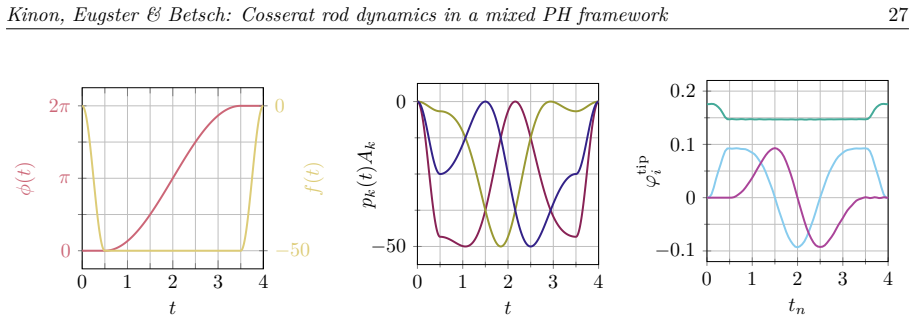

read the original abstract
An energy-based modeling framework for the nonlinear dynamics of spatial Cosserat rods undergoing large displacements and rotations is proposed. The mixed formulation features independent displacement, velocity and stress variables and is further objective and locking-free. Finite rotations are represented using a director formulation that avoids singularities and yields a constant mass matrix. This results in an infinite-dimensional nonlinear port-Hamiltonian (PH) system governed by partial differential-algebraic equations with a quadratic energy functional. Using a time-differentiated compliance form of the stress-strain relations allows for the imposition of kinematic constraints, such as inextensibility or shear-rigidity. A structure-preserving finite element discretization leads to a finite-dimensional system with PH structure, thus facilitating the design of an energy-momentum consistent integration scheme. Dissipative material behavior (via the generalized-Maxwell model) and non-standard actuation approaches (via pneumatic chambers or tendons) integrate naturally into the framework. As illustrated by selected numerical examples, the present framework establishes a new approach to energy-momentum consistent formulations in computational mechanics involving finite rotations.
Editorial analysis
A structured set of objections, weighed in public.
Referee Report
Summary. The manuscript develops a mixed port-Hamiltonian formulation for the nonlinear dynamics of spatial Cosserat rods with large displacements and rotations. Independent fields are introduced for displacement, velocity and stress; finite rotations are handled via a director formulation yielding a constant mass matrix and an objective, locking-free model. The infinite-dimensional system is expressed as nonlinear PDAEs with quadratic Hamiltonian. Time-differentiated compliance relations replace algebraic constitutive laws to enforce kinematic constraints such as inextensibility without Lagrange multipliers. A structure-preserving finite-element discretization is shown to produce a finite-dimensional port-Hamiltonian system, enabling energy-momentum consistent time integration. Dissipative (generalized Maxwell) and non-standard actuation terms integrate naturally; numerical examples are provided to illustrate the framework.
Significance. If the exact preservation of the port-Hamiltonian structure after differentiation and discretization is rigorously established, the work would supply a valuable systematic route to energy-consistent integrators for geometrically exact rod models. The natural accommodation of dissipation, actuation and constraints within the same structure is particularly useful for flexible multibody and soft-robotics applications.
major comments (2)
- [§3.2] §3.2: The time-differentiated compliance form is introduced to enforce inextensibility and shear-rigidity. This step replaces an algebraic constitutive relation with a differential one and thereby modifies the underlying Dirac structure; an explicit verification that the resulting infinite-dimensional system remains port-Hamiltonian (i.e., that the interconnection operator stays skew-symmetric) is required before the discretization step can be claimed to inherit the structure exactly.
- [§4] §4: The finite-element discretization is asserted to yield a finite-dimensional PH system whose interconnection matrix remains skew-symmetric and whose Hamiltonian remains quadratic. No explicit algebraic check or numerical test is supplied confirming that the projected differentiated compliance terms preserve skew-symmetry once the nonlinear director-frame kinematics are taken into account.
minor comments (2)
- Notation for the director triad and its time derivatives could be introduced more explicitly at the beginning of §2 to aid readability.
- The abstract states that numerical examples illustrate the framework; a short quantitative statement (e.g., observed convergence rates or energy drift) would strengthen the abstract.
Simulated Author's Rebuttal
We thank the referee for the constructive comments, which help clarify the need for explicit structure-preservation proofs. We address each major point below and will revise the manuscript to incorporate the requested verifications.
read point-by-point responses
-
Referee: [§3.2] §3.2: The time-differentiated compliance form is introduced to enforce inextensibility and shear-rigidity. This step replaces an algebraic constitutive relation with a differential one and thereby modifies the underlying Dirac structure; an explicit verification that the resulting infinite-dimensional system remains port-Hamiltonian (i.e., that the interconnection operator stays skew-symmetric) is required before the discretization step can be claimed to inherit the structure exactly.
Authors: We agree that an explicit verification of skew-symmetry after time differentiation is necessary. In the revised manuscript we will add a dedicated derivation in §3.2 that computes the modified interconnection operator explicitly and proves its skew-symmetry with respect to the natural duality pairing, confirming that the infinite-dimensional system retains port-Hamiltonian structure. revision: yes
-
Referee: [§4] §4: The finite-element discretization is asserted to yield a finite-dimensional PH system whose interconnection matrix remains skew-symmetric and whose Hamiltonian remains quadratic. No explicit algebraic check or numerical test is supplied confirming that the projected differentiated compliance terms preserve skew-symmetry once the nonlinear director-frame kinematics are taken into account.
Authors: We acknowledge the value of an explicit algebraic check. The revision will include in §4 the projected discrete interconnection matrix and a direct algebraic demonstration that skew-symmetry is preserved under the nonlinear director-frame kinematics. We will also augment one numerical example with a quantitative energy-momentum conservation test to corroborate the discrete structure. revision: yes
Circularity Check
No significant circularity in derivation chain
full rationale
The paper presents a mixed formulation derived from standard port-Hamiltonian modeling principles applied to Cosserat rod kinematics, followed by a time-differentiated compliance relation to handle constraints and a finite-element discretization explicitly constructed to retain the PH structure. No step reduces the central claim (preservation of finite-dimensional PH structure) to a fitted parameter, self-referential definition, or unverified self-citation chain; the discretization is shown to produce a skew-symmetric interconnection matrix and quadratic Hamiltonian by direct construction from the weak form, with the time-differentiation justified as a modeling choice rather than an assumption that presupposes the result. External benchmarks such as energy-momentum consistency in numerical examples are independent of the derivation itself. This is the expected self-contained mathematical development with no load-bearing circularity.
Axiom & Free-Parameter Ledger
axioms (2)
- domain assumption Port-Hamiltonian structure for systems governed by partial differential-algebraic equations
- domain assumption Director formulation for finite rotations yields constant mass matrix and avoids singularities
Lean theorems connected to this paper
-
IndisputableMonolith/Cost/FunctionalEquation.leanwashburn_uniqueness_aczel unclear?
unclearRelation between the paper passage and the cited Recognition theorem.
mixed formulation... time-differentiated compliance form... structure-preserving finite element discretization leads to a finite-dimensional system with PH structure... quadratic energy functional (Eq. 25, 38)
-
IndisputableMonolith/Foundation/RealityFromDistinction.leanreality_from_one_distinction unclear?
unclearRelation between the paper passage and the cited Recognition theorem.
formal skew-adjointness of J... (z,Jz)Ω yields only boundary terms... power balance (28)
What do these tags mean?
- matches
- The paper's claim is directly supported by a theorem in the formal canon.
- supports
- The theorem supports part of the paper's argument, but the paper may add assumptions or extra steps.
- extends
- The paper goes beyond the formal theorem; the theorem is a base layer rather than the whole result.
- uses
- The paper appears to rely on the theorem as machinery.
- contradicts
- The paper's claim conflicts with a theorem or certificate in the canon.
- unclear
- Pith found a possible connection, but the passage is too broad, indirect, or ambiguous to say the theorem truly supports the claim.
Reference graph
Works this paper leans on
-
[1]
O. A. Bauchau.Flexible Multibody Dynamics. Vol. 176. Solid Mechanics and Its Applications. Dordrecht: Springer Nether- lands, 2011.doi:10.1007/978-94-007-0335-3
-
[2]
A. Albu-Schaffer, O. Eiberger, M. Grebenstein, S. Haddadin, C. Ott, T. Wimbock, S. Wolf, and G. Hirzinger. “Soft robotics”. In:IEEE Robotics & Automation Magazine15.3 (2008), pp. 20–30.doi:10.1109/MRA.2008.927979
-
[3]
V. Dörlich, J. Linn, and S. Diebels. “Flexible Beam-Like Structures - Experimental Investigation and Modeling of Cables”. In:Advances in Mechanics of Materials and Structural Analysis. Ed. by H. Altenbach, F. Jablonski, W. H. Müller, K. Naumenko, and P. Schneider. Vol. 80. Cham: Springer International Publishing, 2018, pp. 27–46.doi:10.1007/978- 3- 319- 70563-7_2
-
[4]
E. Hairer, C. Lubich, and G. Wanner.Geometric numerical integration. Berlin: Springer, 2006.doi:10.1007/3-540-30666-8
-
[5]
S. S. Antman.Nonlinear problems of elasticity. 2nd ed. Applied mathematical sciences v. 107. New York: Springer, 2005
work page 2005
-
[6]
V. Duindam, A. Macchelli, S. Stramigioli, and H. Bruyninckx.Modeling and Control of Complex Physical Systems: The Port-Hamiltonian Approach. Springer Berlin Heidelberg, 2009.doi:10.1007/978-3-642-03196-0
-
[7]
The three-dimensional dynamic problem
J. Simo. “A finite strain beam formulation. The three-dimensional dynamic problem. Part I”. In:Computer Methods in Applied Mechanics and Engineering49.1 (1985), pp. 55–70.doi:10.1016/0045-7825(85)90050-7
-
[8]
Zeitschrift für angewandte Mathematik und Physik (ZAMP) (1972) https://doi.org/10.1007/BF01602645
E. Reissner. “On one-dimensional finite-strain beam theory: The plane problem”. In:Journal of Applied Mathematics and Physics (ZAMP)23.5 (1972), pp. 795–804.doi:10.1007/BF01602645
-
[9]
Constrained dynamics of geometrically exact beams
P. Betsch and P. Steinmann. “Constrained dynamics of geometrically exact beams”. In:Computational Mechanics31.1-2 (2003), pp. 49–59.doi:10.1007/s00466-002-0392-1
-
[10]
I. Romero and F. Armero. “An objective finite element approximation of the kinematics of geometrically exact rods and its use in the formulation of an energy–momentum conserving scheme in dynamics”. In:International Journal for Numerical Methods in Engineering54.12 (2002), pp. 1683–1716.doi:10.1002/nme.486
-
[11]
M. A. Crisfield and G. Jelenić. “Objectivity of strain measures in the geometrically exact three-dimensional beam theory and its finite-element implementation”. In:Proceedings of the Royal Society of London. Series A: Mathematical, Physical and Engineering Sciences455.1983 (1999), pp. 1125–1147
work page 1983
-
[12]
Numerical aspects in the dynamic simulation of geometrically exact rods
H. Lang and M. Arnold. “Numerical aspects in the dynamic simulation of geometrically exact rods”. In:Applied Numerical Mathematics62.10 (2012), pp. 1411–1427
work page 2012
-
[13]
S. Eugster, C. Hesch, P. Betsch, and C. Glocker. “Director-based beam finite elements relying on the geometrically exact beam theory formulated in skew coordinates”. In:International Journal for Numerical Methods in Engineering97.2 (2014), pp. 111–129.doi:10.1002/nme.4586
-
[14]
S. Leyendecker, P. Betsch, and P. Steinmann. “Objective energy–momentum conserving integration for the constrained dynamics of geometrically exact beams”. In:Computer Methods in Applied Mechanics and Engineering195.19-22 (2006), pp. 2313–2333.doi:10.1016/j.cma.2005.05.002
-
[15]
Nonunit quaternion parametrization of a Petrov–Galerkin Cosserat rod finite element
J. Harsch and S. R. Eugster. “Nonunit quaternion parametrization of a Petrov–Galerkin Cosserat rod finite element”. In: PAMM23.4 (2023), e202300172.doi:10.1002/pamm.202300172
-
[16]
Geometrically exact beam finite element formulated on the special Euclidean group SE (3)
V. Sonneville, A. Cardona, and O. Brüls. “Geometrically exact beam finite element formulated on the special Euclidean group SE (3)”. In:Computer Methods in Applied Mechanics and Engineering268 (2014), pp. 451–474
work page 2014
-
[17]
M. Herrmann and P. Kotyczka. “Relative-kinematic formulation of geometrically exact beam dynamics based on Lie group variational integrators”. In:Computer Methods in Applied Mechanics and Engineering432 (2024), p. 117367.doi:10.1016/ j.cma.2024.117367
-
[18]
P. Wasmer and P. Betsch. “A projection-based quaternion discretization of the geometrically exact beam model”. In:Inter- national Journal for Numerical Methods in Engineering125.20 (2024), e7538.doi:10.1002/nme.7538
-
[19]
M. Herrmann, D. Castello, J. Breuling, I. C. Garcia, L. Greco, and S. R. Eugster.A mixed Petrov–Galerkin Cosserat rod finite element formulation. 2025.doi:10.48550/ARXIV.2507.01552
-
[20]
M. Debeurre, A. Grolet, and O. Thomas. “Quaternion-based finite-element computation of nonlinear modes and frequency responses of geometrically exact beam structures in three dimensions”. In:Multibody System Dynamics63.4 (2025), pp. 557– 594.doi:10.1007/s11044-024-09999-9
-
[21]
Statics and Dynamics of Continuum Robots With General Tendon Routing and External Loading
D. C. Rucker and R. J. Webster III. “Statics and Dynamics of Continuum Robots With General Tendon Routing and External Loading”. In:IEEE Transactions on Robotics27.6 (2011), pp. 1033–1044.doi:10.1109/TRO.2011.2160469
-
[22]
Real-time dynamics of soft and continuum robots based on Cosserat rod models
J. Till, V. Aloi, and C. Rucker. “Real-time dynamics of soft and continuum robots based on Cosserat rod models”. In:The International Journal of Robotics Research38.6 (2019), pp. 723–746.doi:10.1177/0278364919842269. Kinon, Eugster & Betsch: Cosserat rod dynamics in a mixed PH framework30
-
[23]
Soft Pneumatic Actuator Model Based on a Pressure-Dependent Spatial Nonlinear Rod Theory
S. R. Eugster, J. Harsch, M. Bartholdt, M. Herrmann, M. Wiese, and G. Capobianco. “Soft Pneumatic Actuator Model Based on a Pressure-Dependent Spatial Nonlinear Rod Theory”. In:IEEE Robotics and Automation Letters7.2 (2022), pp. 2471–2478.doi:10.1109/LRA.2022.3144788
-
[24]
C. Alessi, C. Agabiti, D. Caradonna, C. Laschi, F. Renda, and E. Falotico.Rod models in continuum and soft robot control: a review. 2024.doi:10.48550/ARXIV.2407.05886
-
[25]
Frame-indifferent beam finite elements based upon the geometrically exact beam theory
P. Betsch and P. Steinmann. “Frame-indifferent beam finite elements based upon the geometrically exact beam theory”. In: International Journal for Numerical Methods in Engineering54.12 (2002), pp. 1775–1788.doi:10.1002/nme.487
-
[26]
A DAE Approach to Flexible Multibody Dynamics
P. Betsch and P. Steinmann. “A DAE Approach to Flexible Multibody Dynamics”. In:Multibody System Dynamics8.3 (2002), pp. 365–389.doi:10.1023/A:1020934000786
-
[27]
Theory and numerics of three-dimensional beams with elastoplastic material behaviour
F. Gruttmann, R. Sauer, and W. Wagner. “Theory and numerics of three-dimensional beams with elastoplastic material behaviour”. In:International Journal for Numerical Methods in Engineering48.12 (2000), pp. 1675–1702.doi:10.1002/ 1097-0207(20000830)48:12<1675::AID-NME957>3.0.CO;2-6
work page 2000
-
[28]
S. Leyendecker, P. Betsch, and P. Steinmann. “The discrete null space method for the energy-consistent integration of constrained mechanical systems. Part III: Flexible multibody dynamics”. In:Multibody System Dynamics19.1-2 (2008), pp. 45–72.doi:10.1007/s11044-007-9056-4
-
[29]
An electromechanically coupled beam model for dielectric elastomer actuators
D. Huang and S. Leyendecker. “An electromechanically coupled beam model for dielectric elastomer actuators”. In:Com- putational Mechanics69.3 (2022), pp. 805–824
work page 2022
-
[30]
A family of total Lagrangian Petrov–Galerkin Cosserat rod finite element formulations
S. R. Eugster and J. Harsch. “A family of total Lagrangian Petrov–Galerkin Cosserat rod finite element formulations”. In: GAMM-Mitteilungen46.2 (2023), e202300008.doi:10.1002/gamm.202300008
-
[31]
On the choice of finite rotation parameters
A. Ibrahimbegovic. “On the choice of finite rotation parameters”. In:Computer Methods in Applied Mechanics and Engi- neering149.1-4 (1997), pp. 49–71.doi:10.1016/S0045-7825(97)00059-5
-
[32]
On the parametrization of finite rotations in computational mechanics
P. Betsch, A. Menzel, and E. Stein. “On the parametrization of finite rotations in computational mechanics”. In:Computer Methods in Applied Mechanics and Engineering155.3-4 (1998), pp. 273–305.doi:10.1016/S0045-7825(97)00158-8
-
[33]
Interpolation of rotation and motion
O. A. Bauchau and S. Han. “Interpolation of rotation and motion”. In:Multibody System Dynamics31.3 (2014), pp. 339– 370.doi:10.1007/s11044-013-9365-8
-
[34]
I. Romero. “The interpolation of rotations and its application to finite element models of geometrically exact rods”. In: Computational Mechanics34.2 (2004).doi:10.1007/s00466-004-0559-z
-
[35]
Port-Controlled Hamiltonian Systems: Modelling Origins and Systemtheoretic Prop- erties
B. Maschke and A. J. van der Schaft. “Port-Controlled Hamiltonian Systems: Modelling Origins and Systemtheoretic Prop- erties”. In:IFAC Proceedings Volumes25.13 (1992), pp. 359–365.doi:10.1016/S1474-6670(17)52308-3
-
[36]
Hamiltonian formulation of distributed-parameter systems with boundary energy flow
A. J. van der Schaft and B. M. Maschke. “Hamiltonian formulation of distributed-parameter systems with boundary energy flow”. In:Journal of Geometry and Physics42.1-2 (2002), pp. 166–194.doi:10.1016/S0393-0440(01)00083-3
-
[37]
Twenty years of distributed port-Hamiltonian systems: A literature review
R. Rashad, F. Califano, A. J. van der Schaft, and S. Stramigioli. “Twenty years of distributed port-Hamiltonian systems: A literature review”. In:IMA J. Math. Control. Inf.37.4 (2020), pp. 1400–1422
work page 2020
-
[38]
Port-Hamiltonian FE models for filaments
T. Thoma and P. Kotyczka. “Port-Hamiltonian FE models for filaments”. In:IFAC-PapersOnLine55.30 (2022), pp. 353– 358
work page 2022
-
[39]
Port-Hamiltonian formulation and structure-preserving discretization of hyperelastic strings
P. L. Kinon, T. Thoma, P. Betsch, and P. Kotyczka. “Port-Hamiltonian formulation and structure-preserving discretization of hyperelastic strings”. In:Proceedings of the 11th ECCOMAS Thematic Conference on Multibody Dynamics. Lisbon, Portugal, 2023, pp. 1–10.doi:10.48550/arXiv.2304.10957
-
[40]
P.L.Kinon,T.Thoma,P.Betsch,andP.Kotyczka.“GeneralizedMaxwellviscoelasticityforgeometricallyexactstrings:Non- linear port-Hamiltonian formulation and structure-preserving discretization”. In:IFAC-PapersOnLine58.6 (2024), pp. 101– 106.doi:10.1016/j.ifacol.2024.08.264
-
[41]
A. Brugnoli, D. Alazard, V. Pommier-Budinger, and D. Matignon. “Port-Hamiltonian formulation and symplectic discretiza- tion of plate models Part I: Mindlin model for thick plates”. In:Applied Mathematical Modelling75 (2019), pp. 940–960. doi:10.1016/j.apm.2019.04.035
-
[42]
A. Brugnoli, D. Alazard, V. Pommier-Budinger, and D. Matignon. “Port-Hamiltonian formulation and symplectic discretiza- tion of plate models Part II: Kirchhoff model for thin plates”. In:Applied Mathematical Modelling75 (2019), pp. 961–981. doi:10.1016/j.apm.2019.04.036
-
[43]
A port-Hamiltonian approach to modeling the structural dynamics of complex systems
A. Warsewa, M. Böhm, O. Sawodny, and C. Tarín. “A port-Hamiltonian approach to modeling the structural dynamics of complex systems”. In:Applied Mathematical Modelling89 (2021), pp. 1528–1546.doi:10.1016/j.apm.2020.07.038
-
[44]
ModelingandcontroloftheTimoshenkobeam.ThedistributedportHamiltonianapproach
A.MacchelliandC.Melchiorri.“ModelingandcontroloftheTimoshenkobeam.ThedistributedportHamiltonianapproach”. In:SIAM journal on control and optimization43.2 (2004), pp. 743–767
work page 2004
-
[45]
Mixed finite elements for port-Hamiltonian models of von Kármán beams
A. Brugnoli, R. Rashad, F. Califano, S. Stramigioli, and D. Matignon. “Mixed finite elements for port-Hamiltonian models of von Kármán beams”. In:IFAC-PapersOnLine54.19 (2021), pp. 186–191
work page 2021
-
[46]
Port-Hamiltonian modeling of a geometrically nonlinear hyperelastic beam
C. Ponce, Y. Wu, Y. Le Gorrec, and H. Ramirez. “Port-Hamiltonian modeling of a geometrically nonlinear hyperelastic beam”. In:IFAC-PapersOnLine58.6 (2024), pp. 309–314.doi:10.1016/j.ifacol.2024.08.299
-
[47]
Constrained port-Hamiltonian modeling and structure-preserving dis- cretization of the Rayleigh beam
C. Ponce, H. Ramirez, Y. Le Gorrec, and Y. Wu. “Constrained port-Hamiltonian modeling and structure-preserving dis- cretization of the Rayleigh beam”. In:IFAC-PapersOnLine59.8 (2025), pp. 108–113.doi:10.1016/j.ifacol.2025.08.075
-
[48]
Port-based modeling of a flexible link
A. Macchelli, C. Melchiorri, and S. Stramigioli. “Port-based modeling of a flexible link”. In:IEEE Transactions on Robotics 23.4 (2007), pp. 650–660.doi:10.1109/TRO.2007.898990
-
[49]
Stabilisation of a Nonlinear Flexible Beam in Port-Hamiltonian Form
A. Macchelli. “Stabilisation of a Nonlinear Flexible Beam in Port-Hamiltonian Form”. In:IFAC Proceedings Volumes46.23 (2013), pp. 412–417.doi:10.3182/20130904-3-FR-2041.00115
-
[50]
Energy-BasedModelingandControlofaPiezotubeActuatedOptical Fiber
E.P.Ayala,Y.Wu,K.Rabenorosoa,andY.LeGorrec.“Energy-BasedModelingandControlofaPiezotubeActuatedOptical Fiber”. In:IEEE/ASME Transactions on Mechatronics28.1 (2023), pp. 385–395.doi:10.1109/TMECH.2022.3199566
-
[51]
A mixed variational formulation based on exact intrinsic equations for dynamics of moving beams
D. H. Hodges. “A mixed variational formulation based on exact intrinsic equations for dynamics of moving beams”. In: International journal of solids and structures26.11 (1990), pp. 1253–1273
work page 1990
-
[52]
Control and stabilization of geometrically exact beams
C. M. Rodriguez. “Control and stabilization of geometrically exact beams”. PhD thesis. Nürnberg, Friedrich-Alexander- Universität Erlangen-Nürnberg, 2022
work page 2022
-
[53]
Modal-Based Nonlinear Model Predictive Control for 3-D Very Flexible Structures
M. Artola, A. Wynn, and R. Palacios. “Modal-Based Nonlinear Model Predictive Control for 3-D Very Flexible Structures”. In:IEEE Transactions on Automatic Control67.5 (2022), pp. 2145–2160.doi:10.1109/TAC.2021.3071326
-
[54]
Interconnection and damping assignment passivity-based controlofport-controlledHamiltoniansystems
R. Ortega, A. J. van der Schaft, B. Maschke, and G. Escobar. “Interconnection and damping assignment passivity-based controlofport-controlledHamiltoniansystems”.In:Automatica38.4(2002),pp.585–596.doi:10.1016/S0005-1098(01)00278- 3. Kinon, Eugster & Betsch: Cosserat rod dynamics in a mixed PH framework31
-
[55]
Energy-Shaping Controllers for Soft Robot Manipulators Through Port- Hamiltonian Cosserat Models
B. Caasenbrood, A. Pogromsky, and H. Nijmeijer. “Energy-Shaping Controllers for Soft Robot Manipulators Through Port- Hamiltonian Cosserat Models”. In:SN Computer Science3.6 (2022), p. 494.doi:10.1007/s42979-022-01373-w
-
[56]
Non-linear dynamics of three-dimensional rods: Exact energy and momentum conserving algorithms
J. C. Simo, N. Tarnow, and M. Doblare. “Non-linear dynamics of three-dimensional rods: Exact energy and momentum conserving algorithms”. In:International Journal for Numerical Methods in Engineering38.9 (1995), pp. 1431–1473.doi: 10.1002/nme.1620380903
-
[57]
F. L. Cardoso-Ribeiro, D. Matignon, and L. Lefèvre. “A partitioned finite element method for power-preserving discretization of open systems of conservation laws”. In:IMA J. Math. Control. Inf.38.2 (2021), pp. 493–533
work page 2021
-
[58]
Port-Hamiltonian flexible multibody dynamics
A. Brugnoli, D. Alazard, V. Pommier-Budinger, and D. Matignon. “Port-Hamiltonian flexible multibody dynamics”. In: Multibody System Dynamics51.3 (2021), pp. 343–375.doi:10.1007/s11044-020-09758-6
-
[59]
P. L. Kinon, P. Betsch, and S. R. Eugster. “Energy-momentum-consistent simulation of planar geometrically exact beams in a port-Hamiltonian framework”. In:Multibody System Dynamics(2025).doi:10.1007/s11044-025-10087-9
-
[60]
Discrete nonlinear elastodynamics in a port-Hamiltonian framework
P. L. Kinon, T. Thoma, P. Betsch, and P. Kotyczka. “Discrete nonlinear elastodynamics in a port-Hamiltonian framework”. In:PAMM23.3 (2023), e202300144.doi:10.1002/pamm.202300144
-
[61]
Gradient Based Discrete-Time Modeling and Control of Hamiltonian Systems
L. Gören-Sümer and Y. Yalçιn. “Gradient Based Discrete-Time Modeling and Control of Hamiltonian Systems”. In:IFAC Proceedings Volumes41.2 (2008), pp. 212–217.doi:10.3182/20080706-5-kr-1001.00036
-
[62]
Discrete gradient methods for port-Hamiltonian differential-algebraic equations
P. L. Kinon, R. Morandin, and P. Schulze. “Discrete gradient methods for port-Hamiltonian differential-algebraic equations”. In:Applied Numerical Mathematics223 (2026), pp. 45–75.doi:10.1016/j.apnum.2025.12.006
-
[63]
Energy-consistent Petrov–Galerkin time discretization of port-Hamiltonian systems
J. Giesselmann, A. Karsai, and T. Tscherpel. “Energy-consistent Petrov–Galerkin time discretization of port-Hamiltonian systems”. In:arXiv preprint arXiv:2404.12480(2024).doi:10.48550/arXiv.2404.12480. arXiv:2404.12480
-
[64]
D. Zupan and M. Saje. “Finite-element formulation of geometrically exact three-dimensional beam theories based on interpo- lation of strain measures”. In:Computer Methods in Applied Mechanics and Engineering192.49-50 (2003), pp. 5209–5248. doi:10.1016/j.cma.2003.07.008
-
[65]
Kinematically exact curved and twisted strain-based beam
P. Češarek, M. Saje, and D. Zupan. “Kinematically exact curved and twisted strain-based beam”. In:International Journal of Solids and Structures49.13 (2012), pp. 1802–1817.doi:10.1016/j.ijsolstr.2012.03.033
-
[66]
A new higher-order hybrid-mixed curved beam element
J. G. Kim and Y. Y. Kim. “A new higher-order hybrid-mixed curved beam element”. In:International Journal for Numerical Methods in Engineering43.5 (1998), pp. 925–940.doi:10.1002/(SICI)1097-0207(19981115)43:5<925::AID-NME457>3.0.CO;2- M
-
[67]
A mixed hybrid finite beam element with an interface to arbitrary three-dimensional material models
J. Wackerfuß and F. Gruttmann. “A mixed hybrid finite beam element with an interface to arbitrary three-dimensional material models”. In:Computer Methods in Applied Mechanics and Engineering198.27-29 (2009), pp. 2053–2066.doi: 10.1016/j.cma.2009.01.020
-
[68]
AnobjectiveandaccurateG 1 -conformingmixedBézierFE-formulationforKirchhoff– Love rods
L.Greco,D.Castello,andM.Cuomo.“AnobjectiveandaccurateG 1 -conformingmixedBézierFE-formulationforKirchhoff– Love rods”. In:Mathematics and Mechanics of Solids29.4 (2024), pp. 645–685.doi:10.1177/10812865231204972
-
[70]
E. Marino. “Locking-free isogeometric collocation formulation for three-dimensional geometrically exact shear-deformable beams with arbitrary initial curvature”. In:Computer Methods in Applied Mechanics and Engineering324 (2017), pp. 546– 572.doi:10.1016/j.cma.2017.06.031
-
[71]
A. Brugnoli. “A port-Hamiltonian formulation of flexible structures. Modelling and structure-preserving finite element dis- cretization”. PhD thesis. France: Université de Toulouse, ISAE-SUPAERO, 2020
work page 2020
-
[72]
T. Thoma, P. Kotyczka, and H. Egger. “On the velocity-stress formulation for geometrically nonlinear elastodynamics and its structure-preserving discretization”. In:Mathematical and Computer Modelling of Dynamical Systems30.1 (2024), pp. 701–720.doi:10.1080/13873954.2024.2397486
-
[73]
G. Ferri, D. Ignesti, and E. Marino. “An efficient displacement-based isogeometric formulation for geometrically exact viscoelastic beams”. In:Computer Methods in Applied Mechanics and Engineering417 (2023), p. 116413.doi:10.1016/j. cma.2023.116413
work page doi:10.1016/j 2023
-
[74]
O. Weeger, D. Schillinger, and R. Müller. “Mixed isogeometric collocation for geometrically exact 3D beams with elasto- visco-plastic material behavior and softening effects”. In:Computer Methods in Applied Mechanics and Engineering399 (2022), p. 115456.doi:10.1016/j.cma.2022.115456
-
[75]
A discrete, geometrically exact method for simulating nonlinear, elastic and inelastic beams
C. Lestringant, B. Audoly, and D. M. Kochmann. “A discrete, geometrically exact method for simulating nonlinear, elastic and inelastic beams”. In:Computer Methods in Applied Mechanics and Engineering361 (2020), p. 112741.doi:10.1016/ j.cma.2019.112741
-
[76]
Parallelizing LQR computation through endpoint-explicit riccati recursion,
V. Mehrmann and R. Morandin. “Structure-preserving discretization for port-Hamiltonian descriptor systems”. In:2019 IEEE 58th Conference on Decision and Control (CDC). IEEE, 2019, pp. 6863–6868.doi:10.1109/CDC40024.2019.9030180
-
[77]
Linear port-Hamiltonian descriptor systems
C. Beattie, V. Mehrmann, H. Xu, and H. Zwart. “Linear port-Hamiltonian descriptor systems”. In:Mathematics of Control, Signals, and Systems30 (2018), pp. 1–27
work page 2018
-
[78]
Control of port-Hamiltonian differential-algebraic systems and applications
V. Mehrmann and B. Unger. “Control of port-Hamiltonian differential-algebraic systems and applications”. In:Acta Nu- merica32 (2023), pp. 395–515.doi:10.1017/S0962492922000083
-
[79]
Partitioned finite element method for structured discretiza- tion with mixed boundary conditions
A. Brugnoli, F. L. Cardoso-Ribeiro, G. Haine, and P. Kotyczka. “Partitioned finite element method for structured discretiza- tion with mixed boundary conditions”. In:IFAC-PapersOnLine53.2 (2020), pp. 7557–7562.doi:10.1016/j.ifacol.2020. 12.1351
-
[80]
T. Thoma and P. Kotyczka. “Explicit Port-Hamiltonian FEM-Models for Linear Mechanical Systems with Non-Uniform Boundary Conditions”. In:IFAC-PapersOnLine55.20 (2022), pp. 499–504.doi:10.1016/j.ifacol.2022.09.144
-
[81]
Explicit structure-preserving discretization of port-Hamiltonian systems with mixed boundary control
A. Brugnoli, G. Haine, and D. Matignon. “Explicit structure-preserving discretization of port-Hamiltonian systems with mixed boundary control”. In:IFAC-PapersOnLine55.30 (2022), pp. 418–423.doi:10.1016/j.ifacol.2022.11.089
discussion (0)
Sign in with ORCID, Apple, or X to comment. Anyone can read and Pith papers without signing in.