Solving strategies for data-driven one-dimensional elasticity exhibiting nonlinear strains
Pith reviewed 2026-05-16 19:57 UTC · model grok-4.3
The pith
Combining greedy optimization with the alternating direction method improves global solutions for data-driven nonlinear elasticity problems.
A machine-rendered reading of the paper's core claim, the machinery that carries it, and where it could break.
Core claim
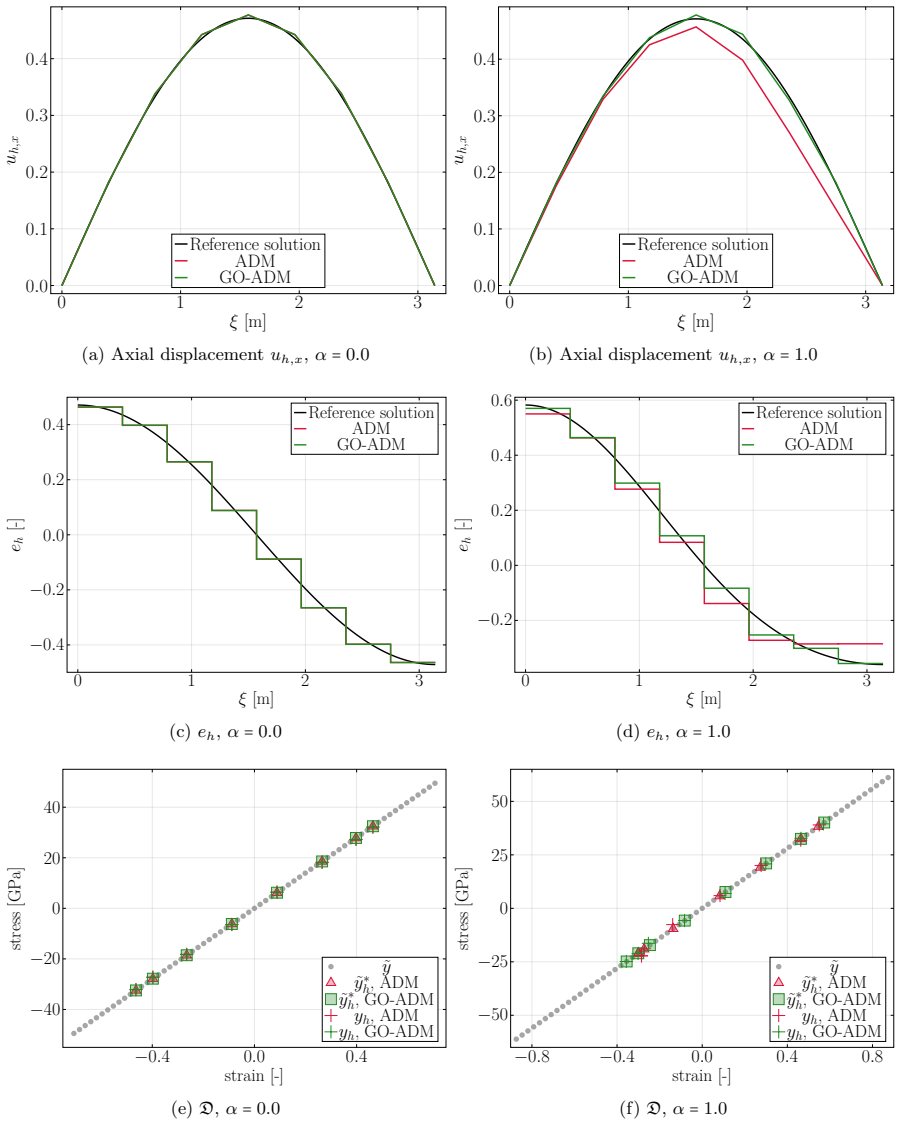
The central claim is that the combination of greedy optimization and the alternating direction method for data-driven solvers achieves a better approximation of the globally optimal solution in nonlinear elasticity problems. This is illustrated through examples with one- and two-dimensional bar and truss structures using various nonlinear strain measures and constitutive datasets. The method is further applied to reproduce cyclic testing data for a nylon rope and demonstrates improved accuracy and robustness for unsymmetrical and noisy data.
What carries the argument
The greedy optimization algorithm integrated with the alternating direction method solver, which enables multiple searches to identify superior global solutions in the data-driven computation of nonlinear elastic responses.
If this is right
- Improved approximation to global optima for structures under nonlinear strains
- Higher computational cost that scales with the number of greedy searches performed
- Successful reproduction of experimental cyclic loading cycles for materials like nylon ropes
- Enhanced performance on unsymmetrical or noisy constitutive data sets
Where Pith is reading between the lines
- Future work might explore adaptive selection of the number of greedy searches to balance accuracy and efficiency.
- Similar strategies could apply to three-dimensional or dynamic problems in elasticity.
Load-bearing premise
The assumption that combining greedy searches with the ADM solver will reliably find better global solutions without creating new instabilities or biases across different nonlinear strain measures and data sets.
What would settle it
A test case with a specific nonlinear strain measure and dataset where increasing the number of greedy searches produces solutions farther from the global optimum or introduces oscillations in the results.
Figures



read the original abstract
In this work, we extend and generalize our solving strategy, first introduced in [1], based on a greedy optimization algorithm and the alternating direction method (ADM) for nonlinear systems computed with multiple load steps. In particular, we combine the greedy optimization algorithm with the direct data-driven solver based on ADM which is firstly introduced in [2] and combined with the Newton-Raphson method for nonlinear elasticity in [3]. We numerically illustrate via one- and two-dimensional bar and truss structures exhibiting nonlinear strain measures and different constitutive datasets that our solving strategy generally achieves a better approximation of the globally optimal solution. This, however, comes at the expense of higher computational cost which is scaled by the number of "greedy" searches. Using this solving strategy, we reproduce the first cycle of the cyclic testing for a nylon rope that was performed at industrial testing facilities for mooring lines manufacturers. We also numerically illustrate for a truss structure that our solving strategy generally improves the accuracy and robustness in cases of an unsymmetrical data distribution and noisy data.
Editorial analysis
A structured set of objections, weighed in public.
Referee Report
Summary. The manuscript extends a prior solving strategy by combining a greedy optimization algorithm with the alternating direction method (ADM) for data-driven one-dimensional elasticity problems involving nonlinear strain measures. It claims that this greedy+ADM approach generally yields a better approximation to the globally optimal solution than standard ADM combined with Newton-Raphson, demonstrated on bar and truss structures with various constitutive datasets as well as reproduction of nylon rope cyclic test data, at the expense of computational cost that scales with the number of greedy searches. The method is also reported to improve accuracy and robustness for unsymmetrical or noisy data distributions.
Significance. If substantiated, the strategy would provide a useful practical tool for improving global solution quality in combinatorial data-driven problems in nonlinear elasticity without exhaustive enumeration. The reproduction of real industrial nylon rope data and the handling of noisy/unsymmetrical datasets are positive aspects that could enhance applicability in engineering contexts. However, the lack of absolute optimality verification limits the assessed significance.
major comments (2)
- [Numerical illustrations and abstract] The central claim that the greedy+ADM strategy 'generally achieves a better approximation of the globally optimal solution' (abstract) is load-bearing but unsupported by any brute-force enumeration or absolute residual-to-global-minimum comparisons on small instances where exhaustive search is feasible. Numerical illustrations appear to compare only against local ADM/Newton baselines, so reported improvements could reflect different convergence behavior rather than verified proximity to the true global optimum.
- [Numerical sections (as referenced in abstract)] No quantitative error metrics, convergence data, or full comparison tables (e.g., objective values, iteration counts, or residual norms) are provided to support the 'better approximation' claim or to quantify the computational cost scaling with the number of greedy searches.
minor comments (2)
- [Title and abstract] The title specifies 'one-dimensional elasticity' while the abstract refers to 'one- and two-dimensional bar and truss structures'; clarify the dimensionality scope and any extension beyond 1D.
- [Introduction] References [1], [2], and [3] are cited but not fully detailed in the provided text; ensure complete bibliographic information for the prior works on greedy optimization and ADM.
Simulated Author's Rebuttal
We thank the referee for the constructive comments on our manuscript. We address each major comment below, agreeing that additional verification strengthens the presentation, and outline the revisions we will implement.
read point-by-point responses
-
Referee: [Numerical illustrations and abstract] The central claim that the greedy+ADM strategy 'generally achieves a better approximation of the globally optimal solution' (abstract) is load-bearing but unsupported by any brute-force enumeration or absolute residual-to-global-minimum comparisons on small instances where exhaustive search is feasible. Numerical illustrations appear to compare only against local ADM/Newton baselines, so reported improvements could reflect different convergence behavior rather than verified proximity to the true global optimum.
Authors: We acknowledge that direct verification against the global optimum via brute-force enumeration on small instances would provide stronger support for the claim. Our current comparisons demonstrate improved results relative to the standard ADM/Newton-Raphson baseline on the considered bar and truss examples, but we agree these could arise from better local convergence rather than guaranteed proximity to the global minimum. In the revised manuscript, we will add exhaustive-search comparisons for selected small-scale 1D bar problems (where enumeration remains computationally feasible) and report the residuals to the true global optimum to substantiate the approximation quality. revision: yes
-
Referee: [Numerical sections (as referenced in abstract)] No quantitative error metrics, convergence data, or full comparison tables (e.g., objective values, iteration counts, or residual norms) are provided to support the 'better approximation' claim or to quantify the computational cost scaling with the number of greedy searches.
Authors: We agree that quantitative metrics and tables are needed to rigorously support the claims and to document the computational trade-off. In the revised manuscript, we will include detailed tables and supplementary figures reporting objective function values, iteration counts, residual norms, and wall-clock times for different numbers of greedy searches across all numerical examples, along with direct comparisons to the baseline solver. revision: yes
Circularity Check
Minor self-citations for base method; central numerical claims independent
full rationale
The paper extends its own prior solving strategy from [1] and ADM solver from [2,3] but presents new numerical results on bar/truss structures and experimental nylon rope data. No derivation chain reduces a prediction or optimality claim to fitted inputs or self-citations by construction; improvements are shown via direct simulation comparisons without combinatorial exhaustive verification. This qualifies as low-burden self-citation that is not load-bearing for the reported outcomes.
Axiom & Free-Parameter Ledger
Lean theorems connected to this paper
-
IndisputableMonolith/Cost/FunctionalEquation.leanwashburn_uniqueness_aczel unclear?
unclearRelation between the paper passage and the cited Recognition theorem.
We combine the greedy optimization algorithm with the direct data-driven solver based on ADM... minimizing the global objective function distG(y,ỹ)
-
IndisputableMonolith/Foundation/ArithmeticFromLogic.leanLogicNat ≃ Nat recovery unclear?
unclearRelation between the paper passage and the cited Recognition theorem.
reformulate the optimization problem (5) as a mixed-integer quadratic programming (MIQP) problem
What do these tags mean?
- matches
- The paper's claim is directly supported by a theorem in the formal canon.
- supports
- The theorem supports part of the paper's argument, but the paper may add assumptions or extra steps.
- extends
- The paper goes beyond the formal theorem; the theorem is a base layer rather than the whole result.
- uses
- The paper appears to rely on the theorem as machinery.
- contradicts
- The paper's claim conflicts with a theorem or certificate in the canon.
- unclear
- Pith found a possible connection, but the passage is too broad, indirect, or ambiguous to say the theorem truly supports the claim.
Reference graph
Works this paper leans on
-
[1]
V. H. Gjerde, A data-driven model for the analysis of geometrically nonlinear one-dimensional structures, Master’s thesis, University of Bergen (2025)
work page 2025
-
[2]
T. Kirchdoerfer, M. Ortiz, Data-driven computational mechanics, Comput. Methods Appl. Mech. Eng. 304 (2016) 81–101
work page 2016
-
[3]
L. T. K. Nguyen, M.-A. Keip, A data-driven approach to nonlinear elasticity, Comput. Struct. 194 (2018) 97–115
work page 2018
-
[4]
T. Kirchdoerfer, M. Ortiz, Data driven computing with noisy material data sets, Comput. Methods Appl. Mech. Eng. 326 (2017) 622–641
work page 2017
-
[5]
T. Kirchdoerfer, M. Ortiz, Data-driven computing in dynamics, Int. J. Numer. Methods Eng. 113 (11) (2018) 1697–1710
work page 2018
-
[6]
J. Douglas, Jr, H. H. Rachford, Jr, On the numerical solution of heat conduction problems in two and three space variables, Trans. Am. Math. Soc. 82 (2) (1956) 421–439. 36
work page 1956
- [7]
- [8]
- [9]
- [10]
-
[11]
C. G. Gebhardt, D. Schillinger, M. C. Steinbach, R. Rolfes, A framework for Data-Driven Structural Analysis in general elasticity based on nonlinear optimization: The static case, Comput. Methods Appl. Mech. Eng. 365 (2020) 112993
work page 2020
-
[12]
C. G. Gebhardt, M. C. Steinbach, D. Schillinger, R. Rolfes, A framework for data-driven structural analysis in general elasticity based on nonlinear optimization: The dynamic case, Int. J. Numer. Methods Eng. 121 (24) (2020) 5447–5468
work page 2020
-
[13]
Y. Kanno, Alternating minimization for data-driven computational elasticity from experimen- tal data: kernel method for learning constitutive manifold, Theor. Appl. Mech. Lett. 11 (5) (2021) 100289
work page 2021
-
[14]
C. G. Gebhardt, S. Lange, M. C. Steinbach, Formulating and heuristic solving of contact problems in hybrid data-driven computational mechanics, Commun. Nonlinear Sci. Numer. Simul. 134 (2024) 108031
work page 2024
- [15]
- [16]
-
[17]
A. Platzer, A. Leygue, L. Stainier, M. Ortiz, Finite element solver for data-driven finite strain elasticity, Comput. Methods Appl. Mech. Eng. 379 (113756) (2021) 113756
work page 2021
-
[18]
R. Eggersmann, T. Kirchdoerfer, S. Reese, L. Stainier, M. Ortiz, Model-free data-driven in- elasticity, Comput. Methods Appl. Mech. Eng. 350 (2019) 81–99
work page 2019
-
[19]
P. Carrara, L. De Lorenzis, L. Stainier, M. Ortiz, Data-driven fracture mechanics, Comput. Methods Appl. Mech. Eng. 372 (113390) (2020) 113390
work page 2020
-
[20]
S. Zschocke, F. Leichsenring, W. Graf, M. Kaliske, A concept for data-driven computational mechanics in the presence of polymorphic uncertain properties, Eng. Struct. 267 (114672) (2022) 114672. 37
work page 2022
- [21]
-
[22]
T. F. Korzeniowski, K. Weinberg, A multi-level method for data-driven finite element compu- tations, Comput. Methods Appl. Mech. Eng. 379 (113740) (2021) 113740
work page 2021
-
[23]
A. Gorgogianni, K. Karapiperis, L. Stainier, M. Ortiz, J. E. Andrade, Adaptive goal-oriented data sampling in Data-Driven computational mechanics, Comput. Methods Appl. Mech. Eng. 409 (115949) (2023) 115949
work page 2023
- [24]
-
[25]
K. Weinberg, L. Stainier, S. Conti, M. Ortiz, Data-Driven games in computational mechanics, Comput. Methods Appl. Mech. Eng. 417 (116399) (2023) 116399
work page 2023
- [26]
-
[27]
M. Dalémat, M. Coret, A. Leygue, E. Verron, Measuring stress field without constitutive equation, Mech. Mater. 136 (103087) (2019) 103087
work page 2019
-
[28]
L. Stainier, A. Leygue, M. Ortiz, Model-free data-driven methods in mechanics: material data identification and solvers, Comput. Mech. 64 (2) (2019) 381–393
work page 2019
-
[29]
M. Flaschel, S. Kumar, L. De Lorenzis, Discovering plasticity models without stress data, Npj Comput. Mater. 8 (1) (2022)
work page 2022
-
[30]
H. De Gersem, A. Galetzka, I. G. Ion, D. Loukrezis, U. Römer, Magnetic field simulation with data-driven material modeling, IEEE Transactions on Magnetics 56 (8) (2020) 1–6
work page 2020
-
[31]
E. Marenić, G. Seychal, J.-C. Passieux, Data driven approach in multiphysics framework: Application to coupled electro-mechanical problems, Comput. Methods Appl. Mech. Eng. 395 (114959) (2022) 114959
work page 2022
-
[32]
C. G. Gebhardt, B. A. Roccia, J. M. Bossio, G. R. Bossio, A framework for data-driven simulation of electrical circuits based on discrete-continuous optimization, IEEE Access 13 (2025) 168743–168760
work page 2025
-
[33]
Y. Kanno, Mixed-integer programming formulation of a data-driven solver in computational elasticity, Optim. Lett. 13 (2019) 1505–1514
work page 2019
-
[34]
A. Galetzka, D. Loukrezis, H. De Gersem, Data-driven solvers for strongly nonlinear material response, Int. J. Numer. Methods Eng. 122 (6) (2021) 1538–1562
work page 2021
-
[35]
L. T. K. Nguyen, R. C. Aydin, C. J. Cyron, Accelerating the distance-minimizing method for data-driven elasticity with adaptive hyperparameters, Comput. Mech. 70 (3) (2022) 621–638
work page 2022
-
[36]
C. G. Gebhardt, S. Lange, M. C. Steinbach, On the mathematical structure and numerical solution of discrete–continuous optimization problems in ddcm, Z. Angew. Math. Phys. 76 (5) (2025). 38
work page 2025
-
[37]
R. Eggersmann, L. Stainier, M. Ortiz, S. Reese, Model-free data-driven computational me- chanics enhanced by tensor voting, Comput. Methods Appl. Mech. Eng. 373 (113499) (2021) 113499
work page 2021
- [38]
-
[39]
V. N. Temlyakov, Greedy approximation, Acta Numer. 17 (2008) 235–409
work page 2008
-
[40]
V. N. Temlyakov, Sparse approximation and recovery by greedy algorithms in banach spaces, Forum of Mathematics, Sigma 2 (2014) e12
work page 2014
-
[41]
R. Eggersmann, L. Stainier, M. Ortiz, S. Reese, Efficient data structures for model-free data- driven computational mechanics, Comput. Methods Appl. Mech. Eng. 382 (113855) (2021) 113855
work page 2021
- [42]
-
[43]
C. G. Gebhardt, M. C. Steinbach, On the mathematical structure and solvability of certain hilbert space optimization problems in data-driven elasticity, Appl. Math. Lett. 172 (2026) 109739
work page 2026
-
[44]
R. Glowinski, On alternating direction methods of multipliers: A historical perspective, in: Computational Methods in Applied Sciences, Computational methods in applied sciences (Springer), Springer Netherlands, Dordrecht, 2014, pp. 59–82
work page 2014
- [45]
-
[46]
S. Boyd, N. Parikh, E. Chu, B. Peleato, J. Eckstein, Distributed optimization and statistical learning via the alternating direction method of multipliers, Found. Trends Mach. Learn. 3 (1) (2011) 1–122
work page 2011
-
[47]
E. Lappano, F. Naets, W. Desmet, D. Mundo, E. Nijman, A greedy sampling approach for the reduced order basis construction in parametric model order reduction for structural dynamics models, 2016, pp. 3563–3572
work page 2016
- [48]
-
[49]
P. R. Babbepalli, J. J. C. Remmers, O. van der Sluis, An efficient physics-based model order reduction for geometrically nonlinear solid mechanics, Finite Elem. Anal. Des. 248 (104351) (2025) 104351
work page 2025
-
[50]
J. D. Blanchard, J. Tanner, Performance comparisons of greedy algorithms in compressed sensing, Numer. Linear Algebra Appl. 22 (2) (2015) 254–282. 39
work page 2015
-
[51]
García, Greedy algorithms: a review and open problems, J
A. García, Greedy algorithms: a review and open problems, J. Inequal. Appl. 11 (2025)
work page 2025
-
[52]
L. Montaut, Q. Le Lidec, V. Petrik, J. Sivic, J. Carpentier, Collision detection accelerated: An optimization perspective, in: Robotics: Science and Systems, 2022
work page 2022
-
[53]
L. Montaut, Q. Le Lidec, V. Petrik, J. Sivic, J. Carpentier, Gjk++: Leveraging acceleration methods for faster collision detection, IEEE Transactions on Robotics 40 (2024) 2564–2581
work page 2024
-
[54]
A. Rakotomamonjy, S. Koço, L. Ralaivola, Greedy methods, randomization approaches, and multiarm bandit algorithms for efficient sparsity-constrained optimization, IEEE Transactions on Neural Networks and Learning Systems 28 (11) (2017) 2789–2802. 40
work page 2017
discussion (0)
Sign in with ORCID, Apple, or X to comment. Anyone can read and Pith papers without signing in.