REVIEW 3 major objections 5 minor 2 references
Evidence for Clean d-wave Superconductivity in Samarium Nickelates
T0 review · 3 major / 5 minor · reviewed 2026-08-03 · deepseek-v4-flash
Pith's one-line read Samarium nickelate superconducting films show clean-limit d-wave pairing, with a weak-coupling gap of 2.5 meV.
desk verdict Careful ultrafast THz study of a Sm nickelate film, but the clean-limit d-wave claim hangs on an unvalidated mapping between transient and equilibrium superfluid density. read the letter →
The pith
A machine-rendered reading of the paper's core claim, the machinery that carries it, and where it could break.
The reading
What carries the argument
The load-bearing object is the photo-destroyed superfluid density Δρs(T), extracted by fitting transient terahertz conductivity with a two-fluid model. The argument turns on the previously established proportionality Δρs ∝ ρs, so the measured linear temperature dependence of Δρs is read as the clean-limit d-wave form of the equilibrium superfluid density, whose slope is set by the gap. Supporting machinery includes the extended two-fluid model that separates superfluid response from thermal-quasiparticle heating near Tc, and bimolecular recombination kinetics that connect the transient signal to Cooper-pair breaking and re-pairing.
What would settle it
Measure the equilibrium London penetration depth of the same 10 nm film by a non-optical technique such as mutual inductance or a microwave resonator, and check whether the equilibrium superfluid density ρs(T) is linear in temperature between 5 and 18 K with a slope corresponding to Δ(0) = 2.5 meV; a quadratic temperature dependence would indicate the dirty limit and refute the clean d-wave claim.
Extended reading notes
Core claim
The central claim is that the temperature dependence of the photo-destroyed superfluid density in a Sm0.75Ca0.05Eu0.2NiO2 film is linear between 5 and 18 K, which the authors take as the fingerprint of clean-limit d-wave pairing. Because the photo-destroyed density is assumed proportional to the equilibrium superfluid density, the linear slope yields a zero-temperature gap of 2.5 meV, a gap-to-Tc ratio of about 3, and a mean-free-path to coherence-length ratio of about 1.5 from the measured equilibrium quasiparticle scattering rate. The transient complex conductivity is described by an extended two-fluid model in which optical excitation breaks Cooper pairs and the recovery is governed by bi
Load-bearing premise
The load-bearing premise is that the fraction of Cooper pairs broken by each laser pulse is always in the same proportion to the total superfluid density; if instead the pump breaks a fixed number of pairs set by the pulse energy, then the linear temperature dependence in the data would not reflect the equilibrium superfluid density.
Editorial extensions
If this is right
- Samarium nickelate joins cuprates as a clean-limit d-wave superconductor, meaning the pairing gap has nodes and is not dominated by impurity scattering.
- A gap-to-Tc ratio near 3 indicates weak-coupling pairing strength comparable to conventional BCS-like descriptions despite the high-Tc family resemblance.
- The clean-limit value l/ξ ≈ 1.5 shows that current film quality is sufficient to observe intrinsic nodal behavior, making further disorder studies a natural next step.
- Transient terahertz spectroscopy can extract superfluid density even in low-superfluid-density nickelate films, providing a bulk probe that avoids surface sensitivity issues.
- Dirty-limit quadratic behavior in other nickelate films and clean-limit linear behavior here suggest that sample quality, not just composition, shapes the observed pairing symmetry.
Reading between the lines
- If the clean-limit d-wave picture holds, the nickelate family may share the same pairing mechanism as cuprates, with the rare-earth site and doping mostly controlling disorder rather than the pairing symmetry.
- The proportionality Δρs ∝ ρs could be tested by measuring Δρs(T) at several pump fluences; if the extracted gap changes with fluence, the pump would not be probing the equilibrium condensate.
- Because l/ξ ≈ 1.5 sits near the clean-to-dirty boundary, a slightly more disordered samarium nickelate film should show a crossover to quadratic superfluid-density behavior, a testable prediction of this interpretation.
- The same ultrafast protocol could be applied to other low-superfluid-density superconductors where equilibrium terahertz response is dominated by normal-fluid conductivity, extending the technique beyond nickelates.
Editorial analysis
A structured set of objections, weighed in public.
Referee Report
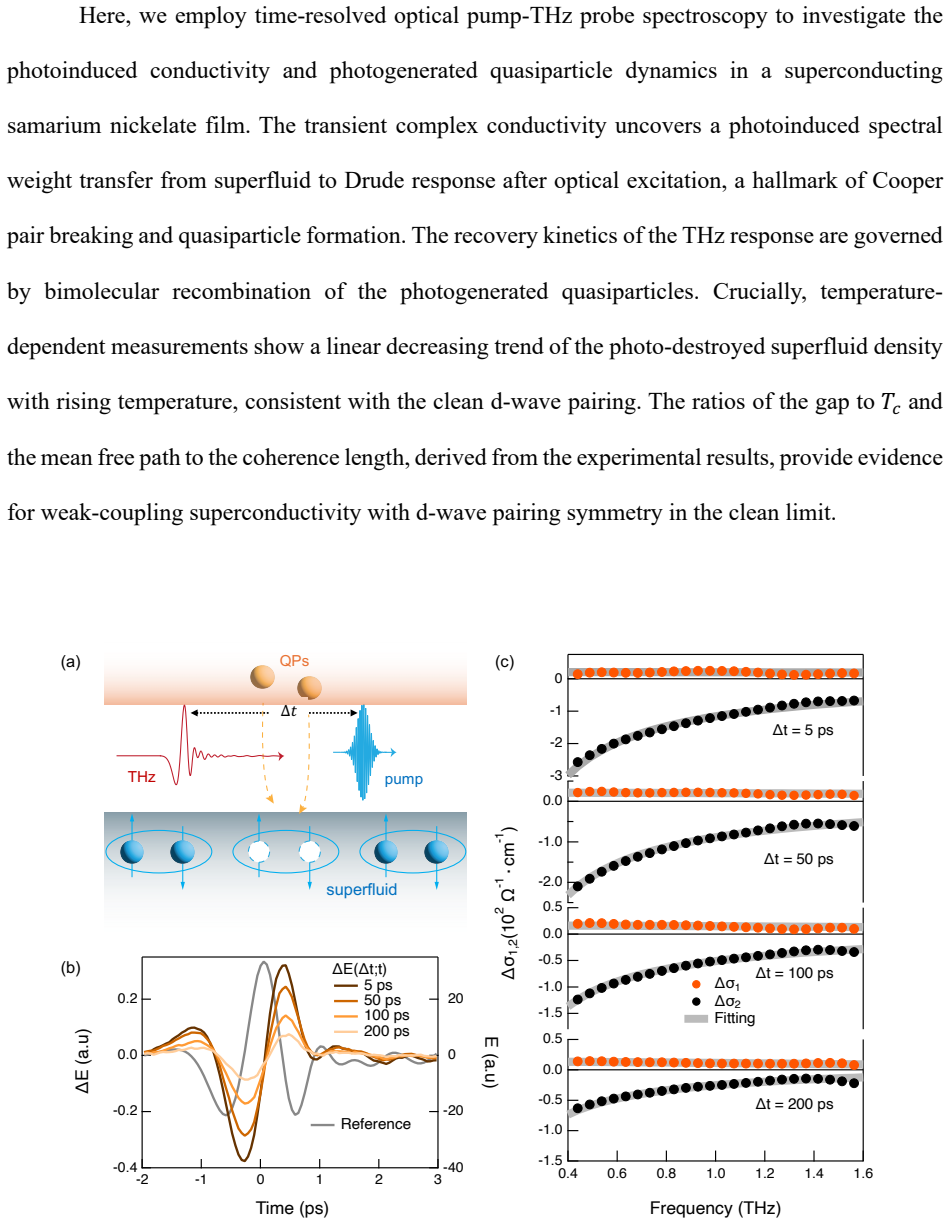
Summary. The paper reports optical pump–THz probe measurements on a superconducting Sm0.75Ca0.05Eu0.2NiO2 film with Tc = 20 K. The transient THz conductivity shows the standard signature assigned to photoinduced Cooper-pair breaking: a Drude-like positive Δσ1 and a negative Δσ2 with a 1/ω component. The recovery kinetics are bimolecular. The central claim is based on the temperature dependence of the extracted photo-destroyed superfluid density Δρ_s(T): after normalizing to Δρ_s(0), the data are said to decrease linearly with T, and a fit to the clean-limit d-wave expression yields Δ(0) = 2.5 ± 0.1 meV, 2Δ/k_B T_c ≈ 3, and l/ξ ≈ 1.5. The authors conclude that the film is a clean-limit d-wave superconductor, paralleling cuprates.
Significance. If the central claim holds, this is a significant data point for the nickelate field: it would show clean-limit d-wave pairing in a samarium nickelate film, placing it in the same regime as high-quality cuprates. The experiment itself is nontrivial, and the spectral-weight transfer and bimolecular recombination analysis are consistent with the proposed pair-breaking picture. However, the conclusion rests on an unvalidated proportionality between the photo-destroyed superfluid density and the equilibrium superfluid density, and the derived l/ξ and 2Δ/k_B T_c are arithmetic consequences of the same fit rather than independent measurements. These load-bearing points need to be addressed before the paper's title claims can be accepted.
major comments (3)
- [§4, Fig. 4, Eq. (2)] The identification Δρ_s(T)/Δρ_s(0) = ρ_s(T)/ρ_s(0) is the foundation of the paper, but the proportionality Δρ_s ∝ ρ_s is only asserted, with citations [18,23] to cuprate pump-probe studies. No validation is provided for this samarium nickelate film. In the low-fluence linear regime (Fig. S2), the number of broken pairs is set by the pump fluence and pair-breaking efficiency, not necessarily by the equilibrium condensate density; if that efficiency is only weakly T-dependent, Δρ_s(T) could be roughly T-independent even when ρ_s(T) is not. The observed linear decrease of Δρ_s would then not be evidence for clean-limit d-wave ρ_s(T), and all subsequent conclusions collapse. A direct check, e.g., Δρ_s versus pump fluence at several temperatures, or a comparison with an equilibrium penetration-depth measurement on the same film, is essential.
- [§4, paragraph after Eq. (2)] Eq. (2) is itself the clean-limit d-wave prediction. Fitting Δρ_s(T)/Δρ_s(0) to this expression and obtaining Δ(0) is a consistency check, not independent confirmation of d-wave pairing. The subsequent l/ξ ≈ 1.5 is computed from this fitted Δ(0) and from τ_scatt extracted from the same extended two-fluid model; it is therefore not an independent validation of the clean-limit condition. The statement that l/ξ 'confirms' the clean-limit is circular unless l/ξ is measured by an independent route (e.g., from a separate transport or penetration-depth determination of l and ξ).
- [Fig. 4] The linearity evidence is weaker than the text implies. The plotted data have no error bars, and the linear fit is restricted to T ≈ 5–18 K, excluding the low-temperature points that 'deviate from the linear trend' and the near-T_c points where the extended two-fluid model is needed. No residuals are shown, and the number of independent points in the linear range is small. With this scatter, a quadratic or other smooth T-dependence could also describe the data over the same window. The slope is the sole source of Δ(0), so the uncertainty in the slope directly controls the claimed 2Δ/k_B T_c. Please show the complete dataset, include error bars, and provide a residuals plot or reduced χ² for the linear fit.
minor comments (5)
- [Eq. (2)] The formula is garbled in the typeset: it should read ρ_s(T)/ρ_s(0) = 1 − (2 ln 2 / Δ(0)) k_B T (or equivalent). Please correct the typesetting.
- [Fig. 4 caption] The caption does not identify which fitted line corresponds to Δt = 5 ps and which to Δt = 50 ps, nor how Δρ_s(0) is defined (measured at the lowest T or extrapolated).
- [References] Reference [12] is an incomplete arXiv citation; it should be completed or updated, and the year is missing.
- [Notation] The notation Δρ_s versus Δρ( in Eq. (1) is inconsistent, and the subscript formatting is degraded throughout. Please unify the symbols and define all quantities at first use.
- [§4, l/ξ] The text says 'τ_scatt is the scattering rate for the equilibrium quasiparticles', but the fitting is performed on the transient photoinduced response; the relationship between this τ and the equilibrium transport scattering rate should be clarified.
Circularity Check
No construction-level circularity: the linear T-dependence is an observed transient signal, and the extracted gap and l/ξ are explicit parameter combinations, not forced predictions.
full rationale
The paper's central empirical result is the measured linear temperature dependence of the normalized photo-destroyed superfluid density Δρ_s(T)/Δρ_s(0) (Fig. 4). This linearity is an observed trend in the data, not an output of the model being verified. The clean-limit d-wave formula (Eq. 2) is then used to extract the single parameter Δ(0); this is a fit, not a prediction. The subsequent quantities 2Δ(0)/k_BT_c and l/ξ = πΔ(0)/(ℏτ_scatt) are arithmetic combinations of that fitted gap and of a separately fitted scattering rate τ_scatt; they are internal consistency checks rather than independent confirmations, and the paper's word 'confirming' for l/ξ is somewhat overstated. However, l/ξ is not forced by construction: τ_scatt is an independent input and the value could in principle have been <1. The load-bearing mapping Δρ_s ∝ ρ_s is imported from external literature (refs [18,23]), not from a self-citation or from the definition of the target result; its failure would be a scientific validity issue, not a circularity. No self-citation chain, uniqueness theorem, or ansatz-smuggling is used to make the central claim. The observed linear dependence and the extracted parameters are therefore not equivalent to the inputs by construction, and the paper does not present a fitted parameter as an independent prediction.
Assumptions & free parameters
free parameters (2)
- Δ(0) =
2.5 ± 0.1 meV
- τ_scatt =
8.3 THz
assumptions (5)
- domain assumption Photo-destroyed superfluid density Δρ_s is proportional to equilibrium superfluid density ρ_s(T), so their temperature dependencies coincide.
- domain assumption Clean-limit d-wave BCS formula for superfluid density, Eq. (2): ρ_s(T)/ρ_s(0)=1−(2 ln 2 / Δ(0)) k_B T, holds from ~5 K to ~18 K.
- domain assumption The phenomenological two-fluid model and its extended version with 'hot' thermal quasiparticles describe the transient THz conductivity.
- ad hoc to paper The THz quasiparticle scattering rate τ_scatt can be used in l/ξ = π Δ(0) τ / ℏ to determine the clean/dirty regime.
- domain assumption Spectral weight conservation: Δρ_qp = −Δρ_s.
Cite this review
Pith. "Pith review of Evidence for Clean d-wave Superconductivity in Samarium Nickelates." pith.science (2026). https://pith.science/paper/F3YYQBLJ
@misc{pith2026251220928,
  author       = {Pith},
  title        = {Pith review of: Evidence for Clean d-wave Superconductivity in Samarium Nickelates},
  year         = {2026},
  howpublished = {\url{https://pith.science/paper/F3YYQBLJ}},
  note         = {Machine review of arXiv:2512.20928}
}
read the original abstract
The discovery of superconducting nickelates provides a unique opportunity to explore the pairing mechanism of high-temperature superconductivity. Here, we use ultrafast terahertz spectroscopy to probe the temperature-dependent superfluid density in an infinite-layer samarium nickelate film with a Tc of 20 K. The superfluid density decreases linearly with rising temperature, consistent with clean limit d-wave pairing. From this linear relation, we extract a superconducting gap of 2.5 meV and a gap-to-Tc ratio of 3, suggesting that this sample lies in the weak-coupling limit. Furthermore, the ratio of the mean free path to the coherence length, is determined to be 1.5, confirming the clean-limit behavior. These findings establish strong parallels between the pairing mechanisms in nickelate and cuprate superconductors.
Figures

Reference graph
Works this paper leans on
-
[9]
Z. Li and S. G. Louie, Two-Gap SuperconducMvity and the Decisive Role of Rare-Earth d Electrons in Infinite-Layer Nickelates, Phys. Rev. Le\. 133, 126401 (2024). [10] Q. Gu, Y . Li, S. Wan, H. Li, W. Guo, H. Yang, Q. Li, X. Zhu, X. Pan, Y . Nie, and H.-H. Wen, Single parMcle tunneling spectrum of superconducMng Nd1-xSrxNiO2 thin films, Nat. Commun. 11, 6027...
arXiv 2024
-
[25]
Demsar, R
J. Demsar, R. D. Averi\, A. J. Taylor, V. V. Kabanov, W. N. Kang, H. J. Kim, E. M. Choi, and S. I. Lee, Pair-Breaking and SuperconducMng State Recovery Dynamics in MgB2, Phys. Rev. Le\. 91, 267002 (2003). [26] N. Gedik, P . Blake, R. C. Spitzer, J. Orenstein, R. Liang, D. A. Bonn, and W. N. Hardy, Single-quasiparMcle stability and quasiparMcle-pair decay ...
2003
Reviewed August 3, 2026 · model on record in the stance chip above.
Discussion (0). Sign in to comment.