Random dilation superchannel
Pith reviewed 2026-05-21 16:55 UTC · model grok-4.3
The pith
A quantum circuit turns parallel queries to an unknown channel into queries to a random dilation isometry of that channel.
A machine-rendered reading of the paper's core claim, the machinery that carries it, and where it could break.
Core claim
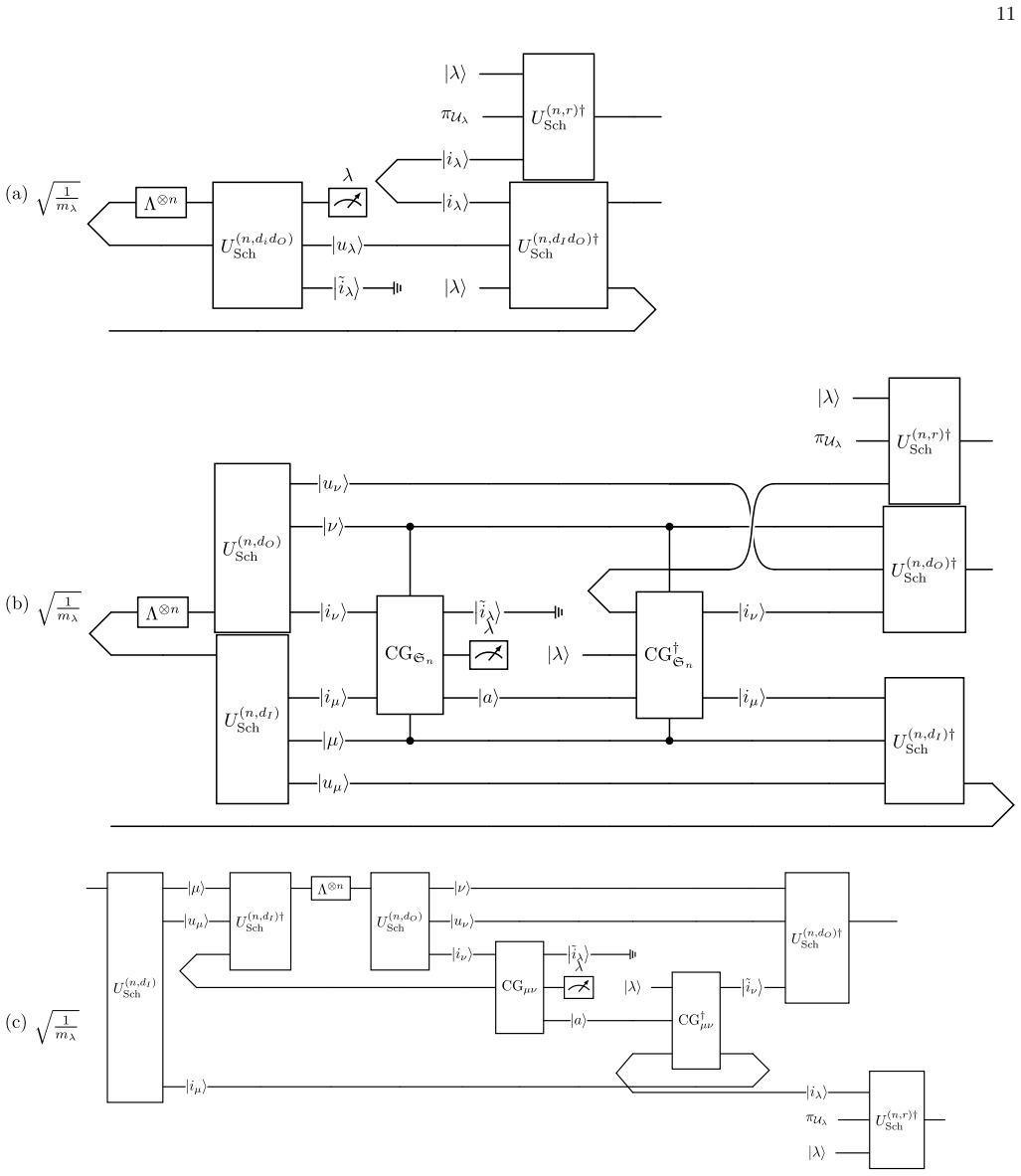
We present a quantum circuit that implements the random dilation superchannel, transforming parallel queries of an unknown quantum channel into the same number of parallel queries of a randomly chosen dilation isometry of the input channel. This is a natural generalization of the random purification channel. The circuit complexity is O(poly(n, log d_I, log d_O)). This random dilation superchannel is extended to the sequential queries approximately, by transforming the parallel random dilation isometry into sequential random dilation unitaries with O(poly(d_I)) overhead in the number of queries. We also show that our results can be further extended to the case of quantum superchannels. On the
What carries the argument
The random dilation superchannel, implemented by a circuit that selects and applies a random Stinespring dilation isometry without knowledge of the unknown channel.
If this is right
- Enables storage-and-retrieval of an unknown quantum channel with program cost that improves exponentially in the retrieval error ε.
- For minimal Kraus rank r = d_I/d_O, transforms n parallel queries approximately into Θ(n^α) parallel queries for any α < 2.
- Implements the Petz recovery map for the maximally mixed reference state both probabilistically and exactly.
- Extends the random dilation construction to quantum superchannels.
Where Pith is reading between the lines
- The separation between parallel and sequential cases indicates that access model strongly affects what manipulations of channels are efficient.
- The technique may let protocols that rely on random purifications of states be adapted to channels.
- Approximate sequential versions could still support useful quantum information tasks even if exact ones are ruled out.
Load-bearing premise
A suitably distributed random dilation isometry can be chosen and realized by a circuit whose structure does not depend on the unknown channel.
What would settle it
Running the circuit on a known test channel such as the identity channel and checking whether the output statistics match the expected distribution over random dilations would confirm or refute the construction.
Figures


read the original abstract
We present a quantum circuit that implements the random dilation superchannel, transforming parallel queries of an unknown quantum channel into the same number of parallel queries of a randomly chosen dilation isometry of the input channel. This is a natural generalization of the random purification channel, that transforms copies of an unknown mixed state to copies of a randomly chosen purification state. The circuit complexity of our construction is $O(\mathrm{poly}(n, \log d_I, \log d_O))$, where $n$ is the number of queries and $d_I$ and $d_O$ are the input and output dimensions of the input channel, respectively. This random dilation superchannel is extended to the sequential queries approximately, by transforming the parallel random dilation isometry into sequential random dilation unitaries with $O(\mathrm{poly}(d_I))$ overhead in the number of queries. We also show that our results can be further extended to the case of quantum superchannels. On the other hand, we show a no-go theorem on the exact random dilation of sequential queries with $o(\mathrm{poly}(\min\{d_I, d_O\}))$ query overhead, showcasing a fundamental difference between the parallel and sequential cases. As an application, we show an efficient storage-and-retrieval of an unknown quantum channel, which improves the program cost exponentially in the retrieval error $\varepsilon$. For the case where the Kraus rank $r$ is the least possible (i.e., $r = d_I/d_O$), we show quantum circuits that transform $n$ parallel queries of an unknown quantum channel $\Lambda$ to $\Theta(n^\alpha)$ parallel queries of $\Lambda$ for any $\alpha<2$ approximately, and implement its Petz recovery map for the maximally mixed reference state probabilistically and exactly.
Editorial analysis
A structured set of objections, weighed in public.
Referee Report
Summary. The paper claims to construct a quantum circuit that implements the random dilation superchannel for parallel queries to an unknown quantum channel, converting them to queries of a random dilation isometry. The circuit has complexity O(poly(n, log d_I, log d_O)). It provides an approximate extension to sequential queries with O(poly(d_I)) overhead, a no-go theorem for exact sequential random dilation, and applications to efficient storage-retrieval of channels and approximate Petz recovery for minimal Kraus rank cases.
Significance. If the central claims hold, the work is significant because it generalizes the random purification channel to the setting of quantum channels and superchannels. The efficient parallel-query construction, the clear separation between parallel and sequential cases via the no-go result, and the exponential improvement in the storage-retrieval application represent useful advances. The paper provides explicit constructions relying on standard techniques for approximating Haar-random unitaries, which aids reproducibility.
major comments (2)
- [Sequential queries extension] The approximate extension to sequential queries is claimed with O(poly(d_I)) overhead. However, the manuscript does not specify how the approximation error in the parallel-to-sequential transformation scales with the number of queries n; this could affect the overall utility for large n.
- [No-go theorem] The no-go theorem states that exact random dilation for sequential queries requires Ω(poly(min{d_I, d_O})) query overhead. The proof sketch should clarify whether it applies to all possible distributions over dilations or only uniform ones, as this impacts the strength of the fundamental difference claimed between parallel and sequential cases.
minor comments (3)
- The notation d_I and d_O for input and output dimensions is introduced in the abstract but should be defined explicitly at the beginning of the main text for readers.
- [Application to storage-and-retrieval] The claim of exponential improvement in program cost with respect to the retrieval error ε would benefit from a direct comparison to the best known previous results in the literature.
- Some equations in the complexity analysis could include explicit constants or big-O notation clarifications to avoid ambiguity.
Simulated Author's Rebuttal
We thank the referee for their careful reading of our manuscript and for the constructive comments. We address each major comment point by point below. Where clarifications are needed, we will revise the manuscript accordingly.
read point-by-point responses
-
Referee: [Sequential queries extension] The approximate extension to sequential queries is claimed with O(poly(d_I)) overhead. However, the manuscript does not specify how the approximation error in the parallel-to-sequential transformation scales with the number of queries n; this could affect the overall utility for large n.
Authors: We thank the referee for highlighting this omission. The parallel-to-sequential transformation applies an approximate unitary dilation independently to each query. Consequently, the per-query approximation error accumulates linearly with n. To keep the total error below a fixed constant, the per-query error tolerance can be set to scale as 1/n; this adds only a logarithmic factor in n to the overhead while preserving the polynomial dependence on d_I. We will revise the relevant section to state this scaling explicitly and confirm that the overall query complexity remains polynomial in d_I (with an additional log n factor when error control is required). revision: yes
-
Referee: [No-go theorem] The no-go theorem states that exact random dilation for sequential queries requires Ω(poly(min{d_I, d_O})) query overhead. The proof sketch should clarify whether it applies to all possible distributions over dilations or only uniform ones, as this impacts the strength of the fundamental difference claimed between parallel and sequential cases.
Authors: We appreciate the referee’s suggestion for greater precision. The no-go result is proven for the uniform distribution over dilations, which is the direct generalization of the random purification channel used in the parallel-query construction. The argument relies on the invariance of the uniform measure on the appropriate Stiefel manifold together with a counting argument on the number of distinct sequential behaviors. We will revise the proof sketch to state explicitly that the theorem applies to the uniform distribution, thereby preserving the claimed separation between the parallel and sequential regimes under this canonical choice. revision: yes
Circularity Check
No significant circularity in the derivation chain
full rationale
The paper constructs an explicit quantum circuit for the random dilation superchannel by composing fixed random unitaries on ancilla registers with black-box channel queries, independent of the unknown channel. Circuit complexity follows from standard efficient approximations to Haar-random unitaries on the environment space. The approximate sequential extension and no-go theorem for exact sequential dilation are derived separately without reducing the central parallel result to fitted inputs or self-referential definitions. No load-bearing steps rely on self-citations that themselves presuppose the target construction, and the application to storage-and-retrieval uses the circuit as an independent primitive.
Axiom & Free-Parameter Ledger
axioms (1)
- standard math Every quantum channel admits a Stinespring dilation to an isometry on a larger space
Lean theorems connected to this paper
-
IndisputableMonolith/Foundation/AbsoluteFloorClosure.leanreality_from_one_distinction unclear?
unclearRelation between the paper passage and the cited Recognition theorem.
We present a quantum circuit that implements the random dilation superchannel, transforming parallel queries of an unknown quantum channel into the same number of parallel queries of a randomly chosen dilation isometry of the input channel. ... based on the quantum Schur transform and the quantum Fourier transform over the symmetric group.
-
IndisputableMonolith/Cost/FunctionalEquation.leanwashburn_uniqueness_aczel unclear?
unclearRelation between the paper passage and the cited Recognition theorem.
The quantum circuit shown in Fig. 2 (a) implements the random dilation superchannel Ξ that transforms n parallel queries of an unknown quantum channel Λ ...
What do these tags mean?
- matches
- The paper's claim is directly supported by a theorem in the formal canon.
- supports
- The theorem supports part of the paper's argument, but the paper may add assumptions or extra steps.
- extends
- The paper goes beyond the formal theorem; the theorem is a base layer rather than the whole result.
- uses
- The paper appears to rely on the theorem as machinery.
- contradicts
- The paper's claim conflicts with a theorem or certificate in the canon.
- unclear
- Pith found a possible connection, but the passage is too broad, indirect, or ambiguous to say the theorem truly supports the claim.
Forward citations
Cited by 5 Pith papers
-
Quantum channel tomography: optimal bounds and a Heisenberg-to-classical phase transition
Quantum channel tomography query complexity transitions from Heisenberg scaling Θ(r d1 d2 / ε) at dilation rate τ=1 to classical scaling Θ(r d1 d2 / ε²) for τ ≥ 1+Ω(1).
-
Optimal Quantum State Testing Even with Limited Entanglement
Algorithms achieve near-optimal quantum state certification with limited entanglement (t=d^2 copies), plus similar results for mixedness testing and purity estimation, supported by lower bounds.
-
Probabilistic and approximate universal quantum purification machines
A machine that purifies two quantum inputs of different rank with positive probability cannot be a linear positive map, ruling out universal probabilistic purification from finite copies; approximate strategies exhibi...
-
Quantum metrology of mixed states via purification
New purification-based reformulations of QCRB and HCRB connect mixed-state metrology bounds to those of purified states, enabling asymptotic attainment of HCRB or 2×QCRB via random channels and individual measurements.
-
Advances in quantum learning theory with bosonic systems
A concise review of sample complexities and methods for tomography and learning in continuous-variable quantum systems, with emphasis on Gaussian versus non-Gaussian states.
Reference graph
Works this paper leans on
-
[1]
Store the action of Λ into the Choi stateJ Λ
-
[2]
Apply the random purification channel onJ ⊗n Λ to obtain the Choi state ofE V∼Dil(Λ) [V ⊗n]
-
[3]
The above strategy can be described as Fig
Retrieve the action of the quantum channel EV∼Dil(Λ) [V ⊗n] from its Choi state by using the P-CTC. The above strategy can be described as Fig. 2 (b). The controlled permutation channel ctrl−πsandwiched by the unnormalized maximally entangled state|1⟩ ⟩and the P-CTC can be rewritten as ctrl−π T := X σ∈Sn |σ⟩ ⟨σ| ⊗π(σ)T,(15) as shown in Fig. 2 (a). The abo...
- [4]
-
[5]
E. Tang, J. Wright, and M. Zhandry, Conjugate queries can help, arXiv:2510.07622 (2025)
work page internal anchor Pith review Pith/arXiv arXiv 2025
-
[6]
F. Girardi, F. A. Mele, and L. Lami, Random purification channel made simple, arXiv:2511.23451 (2025)
-
[7]
A. Pelecanos, J. Spilecki, E. Tang, and J. Wright, Mixed state tomography reduces to pure state tomography, arXiv:2511.15806 (2025)
- [8]
-
[9]
M. Walter and F. Witteveen, A random purification channel for arbitrary symmetries with applications to fermions and bosons, arXiv:2512.15690 (2025)
- [10]
-
[11]
Quartic quantum theory: an extension of the standard quantum mechanics
K. ˙Zyczkowski, Quartic quantum theory: an extension of the standard quantum mechanics, Journal of Physics A: Mathematical and Theoretical41, 355302 (2008), arXiv:0804.1247
work page internal anchor Pith review Pith/arXiv arXiv 2008
-
[12]
Transforming quantum operations: quantum supermaps
G. Chiribella, G. M. D’Ariano, and P. Perinotti, Trans- forming quantum operations: Quantum supermaps, Eu- rophysics Letters83, 30004 (2008), arXiv:0804.0180
work page internal anchor Pith review Pith/arXiv arXiv 2008
-
[13]
G. Chiribella, G. M. D’Ariano, and P. Perinotti, Quan- tum Circuit Architecture, Phys. Rev. Lett.101, 060401 (2008), arXiv:0712.1325
work page internal anchor Pith review Pith/arXiv arXiv 2008
-
[14]
Quantum correlations with no causal order
O. Oreshkov, F. Costa, and ˇC. Brukner, Quantum corre- lations with no causal order, Nature communications3, 1092 (2012), arXiv:1105.4464
work page internal anchor Pith review Pith/arXiv arXiv 2012
- [15]
-
[16]
R. Beals, Quantum computation of Fourier transforms over symmetric groups, inProceedings of the twenty-ninth annual ACM symposium on Theory of computing(1997) pp. 48–53
work page 1997
-
[17]
Y. Kawano and H. Sekigawa, Quantum Fourier trans- form over symmetric groups—improved result, Journal of Symbolic Computation75, 219 (2016)
work page 2016
-
[18]
The Quantum Schur Transform: I. Efficient Qudit Circuits
D. Bacon, I. L. Chuang, and A. W. Harrow, The quan- tum Schur transform: I. efficient qudit circuits (2005), arXiv:quant-ph/0601001
work page internal anchor Pith review Pith/arXiv arXiv 2005
- [19]
-
[20]
A. Burchardt, J. Fei, D. Grinko, M. Larocca, M. Ozols, S. Timmerman, and V. Visnevskyi, High-dimensional quantum Schur transforms, arXiv:2509.22640 (2025)
-
[21]
Universal super-replication of unitary gates
G. Chiribella, Y. Yang, and C. Huang, Universal Su- perreplication of Unitary Gates, Phys. Rev. Lett.114, 120504 (2015), arXiv:1412.1349
work page internal anchor Pith review Pith/arXiv arXiv 2015
- [22]
- [23]
-
[24]
R. Goodman and N. R. Wallach,Symmetry, Representa- tions, and Invariants, Vol. 255 (Springer, 2009)
work page 2009
-
[25]
G. D. James,The Representation Theory of the Symmet- ric Groups, Vol. 682 (Springer, 2006)
work page 2006
-
[26]
A. W. Harrow,Applications of coherent classical com- munication and the Schur transform to quantum infor- mation theory, Ph.D. thesis, Massachusetts Institute of Technology (2005), arXiv:quant-ph/0512255
work page internal anchor Pith review Pith/arXiv arXiv 2005
-
[27]
The quantum mechanics of time travel through post-selected teleportation
S. Lloyd, L. Maccone, R. Garcia-Patron, V. Giovan- netti, and Y. Shikano, Quantum mechanics of time travel through post-selected teleportation, Phys. Rev. D84, 025007 (2011), arXiv:1007.2615
work page internal anchor Pith review Pith/arXiv arXiv 2011
-
[28]
M. A. Nielsen and I. L. Chuang, Programmable Quan- tum Gate Arrays, Phys. Rev. Lett.79, 321 (1997), arXiv:quant-ph/9703032
work page internal anchor Pith review Pith/arXiv arXiv 1997
-
[29]
Optimal quantum learning of a unitary transformation
A. Bisio, G. Chiribella, G. M. D’Ariano, S. Facchini, and P. Perinotti, Optimal quantum learning of a uni- tary transformation, Phys. Rev. A81, 032324 (2010), arXiv:0903.0543
work page internal anchor Pith review Pith/arXiv arXiv 2010
-
[30]
Optimal probabilistic storage and retrieval of unitary channels
M. Sedl´ ak, A. Bisio, and M. Ziman, Optimal Probabilistic Storage and Retrieval of Unitary Channels, Phys. Rev. Lett.122, 170502 (2019), arXiv:1809.04552
work page internal anchor Pith review Pith/arXiv arXiv 2019
-
[31]
M. Sedl´ ak and M. Ziman, Probabilistic storage and re- trieval of qubit phase gates, Phys. Rev. A102, 032618 (2020), arXiv:2008.09555
- [32]
-
[33]
M. Sedl´ ak, R. St´ arek, N. Horov´ a, M. Miˇ cuda, J. Fiur´ aˇ sek, and A. Bisio, Storage and retrieval of two unknown uni- tary channels, arXiv:2410.23376 (2024)
-
[34]
Quantum Advantage in Storage and Retrieval of Isometry Channels
S. Yoshida, J. Miyazaki, and M. Murao, Quantum ad- vantage in storage and retrieval of isometry channels, 7 arXiv:2507.10784 (2025)
work page internal anchor Pith review Pith/arXiv arXiv 2025
-
[35]
Structure of states which satisfy strong subadditivity of quantum entropy with equality
P. Hayden, R. Jozsa, D. Petz, and A. Winter, Structure of States Which Satisfy Strong Subadditivity of Quantum Entropy with Equality, Communications in mathemati- cal physics246, 359 (2004), arXiv:quant-ph/0304007
work page internal anchor Pith review Pith/arXiv arXiv 2004
-
[36]
A. Gily´ en, S. Lloyd, I. Marvian, Y. Quek, and M. M. Wilde, Quantum Algorithm for Petz Recovery Channels and Pretty Good Measurements, Phys. Rev. Lett.128, 220502 (2022)
work page 2022
-
[37]
A. Gily´ en, Y. Su, G. H. Low, and N. Wiebe, Quantum singular value transformation and beyond: exponential improvements for quantum matrix arithmetics, inPro- ceedings of the 51st Annual ACM SIGACT Symposium on Theory of Computing, STOC 2019 (Association for Computing Machinery, New York, NY, USA, 2019) pp. 193–204, arXiv:1806.01838
- [38]
- [39]
-
[40]
S. Yoshida, A. Soeda, and M. Murao, Universal adjointa- tion of isometry operations using conversion of quantum supermaps, Quantum9, 1750 (2025), arXiv:2401.10137
-
[41]
S. Yoshida, A. Soeda, and M. Murao, Reversing Unknown Qubit-Unitary Operation, Deterministically and Exactly, Phys. Rev. Lett.131, 120602 (2023), arXiv:2209.02907
- [42]
-
[43]
F. Girardi, F. A. Mele, H. Zhao, M. Fanizza, and L. Lami, Random Stinespring superchannel: converting channel queries into dilation isometry queries, arXiv:2512.20599 (2025)
-
[44]
C. A. Fuchs and J. Van De Graaf, Cryptographic Distin- guishability Measures for Quantum Mechanical States, IEEE Transactions on Information Theory45, 1216 (2002), arXiv:quant-ph/9712042
work page internal anchor Pith review Pith/arXiv arXiv 2002
-
[45]
J. Miyazaki, A. Soeda, and M. Murao, Complex conjuga- tion supermap of unitary quantum maps and its univer- sal implementation protocol, Phys. Rev. Res.1, 013007 (2019), arXiv:1706.03481
-
[46]
Asymptotic teleportation scheme as a universal programmable quantum processor
S. Ishizaka and T. Hiroshima, Asymptotic Telepor- tation Scheme as a Universal Programmable Quan- tum Processor, Phys. Rev. Lett.101, 240501 (2008), arXiv:0807.4568
work page internal anchor Pith review Pith/arXiv arXiv 2008
-
[47]
Quantum teleportation scheme by selecting one of multiple output ports
S. Ishizaka and T. Hiroshima, Quantum teleportation scheme by selecting one of multiple output ports, Phys. Rev. A79, 042306 (2009), arXiv:0901.2975
work page internal anchor Pith review Pith/arXiv arXiv 2009
-
[48]
Port-based teleportation in arbitrary dimension
M. Studzi´ nski, S. Strelchuk, M. Mozrzymas, and M. Horodecki, Port-based teleportation in arbi- trary dimension, Scientific reports7, 10871 (2017), arXiv:1612.09260
work page internal anchor Pith review Pith/arXiv arXiv 2017
- [49]
- [50]
- [51]
- [52]
-
[53]
A. Klimyk and N. Y. Vilenkin,Representation of Lie Groups and Special Functions: Recent Advances (Springer, 1995). End Matter Proof of Thm. 1.As shown in Lem. 2.16 of Ref. [2], the random purification is given by E|ψ⟩∼Pur(ρ) h |ψ⟩ ⟨ψ|⊗n i = X λ⊢n mλX i,i′=1 U(n,r)† Sch (|λ⟩ ⟨λ| ⊗πUλ ⊗ |i⟩ ⟨i′|)U(n,r) Sch ⊗U (n,d)† Sch [|λ⟩ ⟨λ| ⊗fλ(ρ)⊗ |i⟩ ⟨i′|]U (n,d) Sch...
work page 1995
discussion (0)
Sign in with ORCID, Apple, or X to comment. Anyone can read and Pith papers without signing in.