REVIEW 5 major objections 5 minor 44 references
This paper claims that interleaving model offloading into pipeline parallelism lets a small cluster of memory-constrained edge devices serve lossless 70B-parameter LLM inference at substantially lower latency than prior collaborative infere
Reviewed by Pith at T0; open to challenge. T0 means a machine referee read the full paper against a public rubric. the ladder, T0–T4 →
T0 review · deepseek-v4-flash
2026-08-03 13:59 UTC pith:QB7QCI7J
load-bearing objection The abstract's LOIP and the body's LIME disagree on system, scale, and speedups; the cost model's perfect-overlap assumption is plausible but unvalidated. the 5 major comments →
Collaborative Lossless LLM Inference Serving with Offloading-based Pipeline Parallelism on Edge Devices
The pith
A machine-rendered reading of the paper's core claim, the machinery that carries it, and where it could break.
Core claim
The paper's central claim is that offloading-based interleaved pipeline parallelism can hide most SSD loading latency behind computation and communication, making lossless inference of 70B-scale LLMs practical on a handful of Jetson-class edge devices. The system, called LIME, assigns each device multiple small pipeline stages so that, within a segment, the layers that must be offloaded for the next segment load while the current segment is still computing and while data moves between devices. A dynamic-programming offline scheduler solves a cost model that explicitly accounts for offloading overhead, and an online memory adaptation strategy responds to KV-cache growth and network bandwidth
What carries the argument
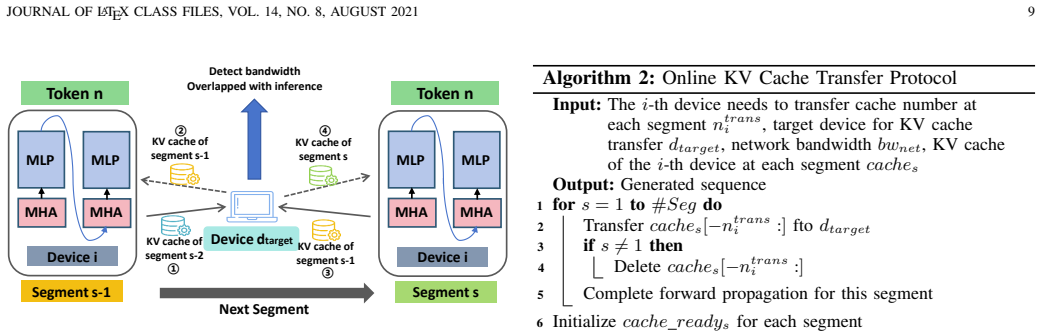
The central mechanism is the interleaved pipeline combined with the offload-aware cost model of Equation 1. In the interleaved pipeline, model layers are partitioned into segments; each device runs one stage per segment and asynchronously loads the next segment's offloaded layers while computing the current segment. The cost model expresses per-token latency as computation time plus segment communication plus 'uncovered' loading time—the portion of load(L̃_i) that cannot be hidden behind computation and communication on other devices. The offline scheduler (Algorithm 1) uses dynamic programming to minimize this total, choosing layer assignments and the number of segments, then fine-grained M
Load-bearing premise
The speedup rests on the assumption that offloading a model segment from SSD to GPU can be overlapped almost perfectly with computation and communication, so that only the uncovered remainder adds latency, and the paper does not experimentally validate this overlap.
What would settle it
Instrument the described Jetson testbed to measure per-step latency while recording SSD read/write time, PCIe utilization, and GPU compute time; if the measured latency exceeds the cost model's predicted uncovered loading time by a significant margin—indicating that loads contend with compute or KV-cache transfers—the central overlap premise is false.
If this is right
- If the overlap assumption holds, lossless 70B-class inference becomes feasible on small homogeneous or heterogeneous edge clusters, enabling privacy-preserving deployment without cloud uploads.
- The cost model and DP scheduler are generalizable to any transformer with offloadable layer blocks, not just LLaMA, and to other memory-constrained accelerators.
- The interleaved pipeline principle could be combined with quantization or sparsity techniques to push the latency envelope further while retaining some accuracy margin.
- The online KV-cache transfer protocol offers a template for adaptive cache migration in other distributed or pipelined inference systems.
Where Pith is reading between the lines
- The abstract's speedup claims (8.8x–20.3x) versus the body's measured speedups (1.7x–3.7x) are not reconciled; if the realistic figure is the lower one, the practical advantage over baselines is more modest but still positive.
- The entire result depends on loading being contention-free with compute and network transfer; if SSD/DRAM contention is significant in practice, the scheduler's allocations could be suboptimal and the speedups would shrink.
- The paper implicitly assumes that offloading model shards is always cheaper than offloading KV cache; a test that varies the KV-cache-to-model-size ratio could expose where that crossover lies and whether the protocol's cache transfer decision is optimal.
- The online memory adaptation strategy could be extended to handle multi-request batching at the edge, since the current evaluation uses micro-batch size 1 for sporadic patterns.
Editorial analysis
A structured set of objections, weighed in public.
Referee Report
Summary. The full text (titled LIME) proposes a collaborative inference system for lossless LLM serving on memory-constrained edge devices. LIME combines an interleaved pipeline with model offloading so that loading the next segment's layers can overlap with computation and communication. It introduces a heterogeneous cost model (Eq. 1), a dynamic-programming offline scheduler (Alg. 1), and an online memory adaptation strategy consisting of an MHA/MLP block offloading plan and a bandwidth-sensitive KV-cache transfer protocol. The evaluation deploys the system on NVIDIA Jetson testbeds with Llama2-13B, Qwen3-32B, and Llama3.3-70B models, comparing against six baselines under two request patterns and several bandwidth settings. However, the submission is internally inconsistent: the abstract describes a different system (LOIP) with different speedups and platform counts, and the body contains conflicting statements about the model used in Sec. V.C.
Significance. The motivating problem is real: memory-constrained edge devices cannot hold 70B models or their KV caches, and existing offloading pipelines create bubbles. If the claimed results held, the interleaved-pipeline-plus-offloading design would be a useful contribution for edge LLM serving, and the paper shows commendable implementation breadth: real Jetson testbeds, three model scales, six baselines, and an ablation study. The offline scheduler has polynomial complexity O(|L_Lef t|^2 |D|), which is appealing. Unfortunately, the central quantitative claim is not currently well-defined because of the abstract/body mismatch, and the cost model that drives the scheduler is both unvalidated and internally inconsistent with the DP recurrence. Those issues make the speedup claims unsubstantiated as submitted.
major comments (5)
- [Abstract vs. full text] The submission is not self-consistent. The abstract describes system 'LOIP' with 8.8x–20.3x speedups, five Jetson devices, 2500+ lines of Python, and 500+ lines of C++/CUDA; the full text describes 'LIME' with 1.7x and 3.7x speedups, four devices, and 1000+ lines of Python. Section V.C states the extremely low-memory experiments use Llama3.3-70B-Instruct, but Figs. 15–17 are captioned 'Qwen3-32B' and the Setting-1 description uses five devices. The paper's headline result is therefore not well-defined; there is no single coherent central claim to evaluate.
- [§IV-B, Eq. (1)] The T_uncover term assumes loading of \tilde L_i can be fully overlapped with comp(L_i - \tilde L_i) + Σ_{i'≠i} comp(L_i') + |D| h_size/bw_net, with only the positive residual exposed. This is a contention-free premise: SSD/DRAM/PCIe traffic for parameter loading is assumed not to interfere with forward-pass compute, KV-cache transfers, or inter-device communication. No per-phase timing breakdown, no comparison of Eq. (1) predictions with measured per-step latencies, and no contention study on the Jetson memory systems is reported. If loading contends with compute or communication, the DP scheduler optimizes an incorrect objective and the reported speedups (Figs. 12–18) are unsupported.
- [§IV-C, Alg. 1 lines 6–7 vs. Eq. (1)] The recurrence subtracts the same T_idle_i at every device transition, although Eq. (2)'s T_idle_i includes the same segment-wide overlap window (Σ_i comp + |D|h/bw) for each i. Hence the same idle interval can be counted once per device. Example: three devices with load times 100, 300, 100 and idle time 200 give T_uncover=100 by Eq. (1), but the recurrence produces 0 (max(0, max(0, max(0,100−200)+300−200)+100−200)=0). No proof is given that the recurrence computes the max in Eq. (1); without it, the scheduler's optimality and the speedup figures rest on an unverified internal model.
- [§V-A] The paper states: 'As this is lossless inference, no accuracy results were recorded.' The abstract and conclusion claim 'without compromising model accuracy' and 'incurring no accuracy loss.' This missing evaluation is explicitly acknowledged in the text and is load-bearing for the lossless claim. The authors should at least compare generated outputs or task accuracy against a reference HuggingFace FP16 run; currently the lossless claim is unvalidated.
- [§V-B–§V-D] All latency figures are single scalar values per condition (e.g., Figs. 12–18), with no error bars, repetitions, or statistical analysis. Given the unvalidated overlap assumption in the cost model and the low-memory OOM/OOT thresholds, it is impossible to determine whether the reported speedups are within run-to-run noise. Quantitative claims of speedup require repeated measurements and a statement of variance.
minor comments (5)
- [§V-A] The sentence 'we set the micro-batch size for inference to 1 and the number of devices, respectively' is garbled; please clarify the batch sizes used for the sporadic and bursty request patterns.
- [§IV-D, Eq. (5)] In Eq. (5), T^{S1}_i = M_em_i / mem(token[1:n−n_i^trans]) is dimensionally unclear: if mem(...) denotes the total memory footprint of the listed tokens, the quotient does not yield a token-length threshold. Please define the units of mem and clarify the intended formula.
- [§IV-C, Alg. 1 lines 14–23] The code uses h_size × p_M and h_size × p_A as memory amounts, but Table I defines h_size as the intermediate output size of a decoder layer. If h_size is a byte count for activations, it is not the memory footprint of an MLP or MHA block; please use consistent notation for weight-memory sizes.
- [§III, Fig. 2b] The caption says 'comparison between model offloading and KV cache offloading,' while the body explains a comparison of per-step loading latency when offloading one MHA block versus offloading the KV cache. Please align the wording and specify the exact quantities plotted.
- [§V.C] The text refers to 'extremely low-memory scenarios ... on Llama3.3-70B-Instruct,' while the captions of Figs. 15–17 label the same results as Qwen3-32B. The model identity should be corrected in one of the two places.
Circularity Check
No circular derivation: the cost model and scheduler are inputs, while speedups come from measured latency; remaining issues are validation and reporting gaps, not circularity.
full rationale
The claimed derivation chain is: build a cost model (Eq. 1), use dynamic programming (Alg. 1) to choose a layer partition minimizing that model, run an online memory/KV-cache adaptation loop (Sec. IV-D), and then report wall-clock latency against six baselines. Nothing in this chain predicts the measured latency from the model alone after fitting to it. The offline scheduler optimizes Eq. 1, but the evaluation measures real execution on Jetson devices; an incorrect model would yield poor allocations and contradict the speedup claim, so the model is falsifiable rather than tautological. The fixed empirical n and profiled computation/loading times are configuration inputs, not fitted values that by construction equal the measured outcome. The online planner (Eqs. 5-8, Alg. 2) is a feedback controller that sizes KV-cache transfers to available slack and reacts to measured bandwidth; the reported latency is measured after adaptation, not computed directly from the control law. Self-citations in the reference list ([19], [21], [24], [25]) are related-work citations on compression, pruning, and federated learning and are not load-bearing; no uniqueness theorem is imported from the authors' prior work. The abstract/body speedup discrepancy (8.8x-20.3x vs 1.7x and 3.7x) and the statement 'no accuracy results were recorded' are serious correctness and verifiability concerns, but they are not instances of a claim reducing by definition to its inputs. Score 2 reflects only minor self-citations and lightly self-confirming configuration choices; there is no fatal circularity.
Axiom & Free-Parameter Ledger
free parameters (3)
- empirical inference sequence length n =
constant, exact value not stated
- fluctuation threshold n_ts =
not specified
- profiled comp(L_i), load(~L_i) estimates =
obtained from device profiling, values not reported
axioms (5)
- domain assumption A single uniform pairwise network bandwidth bw_net between all devices, unaffected by transfer patterns.
- domain assumption Offloading/loading can overlap perfectly with computation and communication of other devices; only the max(0, load - overlap) is uncovered.
- domain assumption At least one segment's layers are fully resident in GPU memory and layer positions are identical across segments (interleaved pipeline regularity).
- ad hoc to paper DP state transition Fallo(l,i) correctly accumulates uncovered loading delays with independence across devices.
- domain assumption KV-cache memory grows linearly with token count and can be transferred as discrete blocks without correctness impact.
invented entities (2)
-
Unified Memory Architecture (UMA)-aware loading optimization with customized CUDA operators
no independent evidence
-
High-threshold device (d_target) for KV-cache receiving
no independent evidence
read the original abstract
Providing lossless inference services of LLMs on edge devices remains challenging, especially given the extremely tight memory budgets. The existing offloading techniques inevitably introduce numerous loading bubbles, which further inflate the end-to-end latency of the entire inference pipeline. Meanwhile, dynamically fluctuating network bandwidth and diverse user request patterns pose additional obstacles to efficient lossless inference on edge devices. To address this, we propose LOIP, a collaborative lossless LLM inference system that employs an offloading-based interleaved pipeline parallelism to better overlap model offloading with computing and communicating. Specifically, LOIP first constructs an offloading-aware cost model to characterize inference latency and memory overhead under heterogeneous device capabilities and limited bandwidth. Based on this cost model, LOIP develops a fine-grained allocation scheduler that determines latency-efficient layer partitions across devices while explicitly accounting for offloading overhead, along with a unified memory architecture (UMA)-aware loading optimization using customized CUDA operators to reduce runtime loading overhead. LOIP further designs an online memory adaptation strategy to handle the increasing KV cache pressure and dynamic bandwidth fluctuations during inference. We implement LOIP with 2500+ lines of Python and 500+ lines of C++/CUDA code, and deploy it on five heterogeneous NVIDIA Jetson edge devices for lossless collaborative inference of LLaMA3.3-70B-Instruct. Extensive experiments demonstrate that LOIP achieves 8.8$\times$$\sim$20.3$\times$ speedups over the SOTA baselines under different bandwidth conditions and request patterns without compromising model accuracy.
Figures




Reference graph
Works this paper leans on
-
[1]
A. Liu, B. Feng, B. Xue, B. Wang, B. Wu, C. Lu, C. Zhao, C. Deng, C. Zhang, C. Ruanet al., “Deepseek-v3 technical report,”arXiv preprint arXiv:2412.19437, 2024
Pith/arXiv arXiv 2024
-
[2]
Improving language understanding by generative pre-training,
A. Radford, K. Narasimhan, T. Salimans, I. Sutskeveret al., “Improving language understanding by generative pre-training,” 2018. JOURNAL OF LATEX CLASS FILES, VOL. 14, NO. 8, AUGUST 2021 14
2018
-
[3]
Sasha: creative goal-oriented reasoning in smart homes with large language models,
E. King, H. Yu, S. Lee, and C. Julien, “Sasha: creative goal-oriented reasoning in smart homes with large language models,”Proceedings of the ACM on Interactive, Mobile, Wearable and Ubiquitous Technologies, vol. 8, no. 1, pp. 1–38, 2024
2024
-
[4]
Gemini robotics: Bringing ai into the physical world,
G. R. Team, S. Abeyruwan, J. Ainslie, J.-B. Alayrac, M. G. Arenas, T. Armstrong, A. Balakrishna, R. Baruch, M. Bauza, M. Blokzijlet al., “Gemini robotics: Bringing ai into the physical world,”arXiv preprint arXiv:2503.20020, 2025
Pith/arXiv arXiv 2025
-
[5]
Privacy inference attacks and defenses in cloud-based deep neural network: A survey,
X. Zhang, C. Chen, Y . Xie, X. Chen, J. Zhang, and Y . Xiang, “Privacy inference attacks and defenses in cloud-based deep neural network: A survey,”arXiv preprint arXiv:2105.06300, 2021
Pith/arXiv arXiv 2021
-
[6]
Privacy-preserving federated learning for transportation mode prediction based on personal mobility data,
F. Yu, Z. Xu, Z. Qin, and X. Chen, “Privacy-preserving federated learning for transportation mode prediction based on personal mobility data,”High-Confidence Computing, vol. 2, no. 4, p. 100082, 2022
2022
-
[7]
Re- search on medical data storage and sharing model based on blockchain,
J. Zhao, W. Qiang, Z. Zhao, T. An, Z. Kuang, D. Xu, and L. Shi, “Re- search on medical data storage and sharing model based on blockchain,” High-Confidence Computing, vol. 3, no. 3, p. 100133, 2023
2023
-
[8]
{ServerlessLLM}:{Low-Latency}serverless inference for large language models,
Y . Fu, L. Xue, Y . Huang, A.-O. Brabete, D. Ustiugov, Y . Patel, and L. Mai, “{ServerlessLLM}:{Low-Latency}serverless inference for large language models,” in18th USENIX Symposium on Operating Systems Design and Implementation (OSDI 24), 2024, pp. 135–153
2024
-
[9]
The llama 3 herd of models,
A. Dubey, A. Jauhri, A. Pandey, A. Kadian, A. Al-Dahle, A. Letman, A. Mathur, A. Schelten, A. Yang, A. Fanet al., “The llama 3 herd of models,”arXiv e-prints, pp. arXiv–2407, 2024
2024
-
[10]
Nvidia jetson xavier,
“Nvidia jetson xavier,” https://www.nvidia.cn/autonomous-machines/ embedded-systems/jetson-xavier-series/, 2019
2019
-
[11]
Kvquant: Towards 10 million context length llm inference with kv cache quantization,
C. Hooper, S. Kim, H. Mohammadzadeh, M. W. Mahoney, Y . S. Shao, K. Keutzer, and A. Gholami, “Kvquant: Towards 10 million context length llm inference with kv cache quantization,”Advances in Neural Information Processing Systems, vol. 37, pp. 1270–1303, 2024
2024
-
[12]
Spqr: A sparse- quantized representation for near-lossless llm weight compression,
T. Dettmers, R. Svirschevski, V . Egiazarian, D. Kuznedelev, E. Frantar, S. Ashkboos, A. Borzunov, T. Hoefler, and D. Alistarh, “Spqr: A sparse- quantized representation for near-lossless llm weight compression,” arXiv preprint arXiv:2306.03078, 2023
Pith/arXiv arXiv 2023
-
[13]
Qlora: Efficient finetuning of quantized llms,
T. Dettmers, A. Pagnoni, A. Holtzman, and L. Zettlemoyer, “Qlora: Efficient finetuning of quantized llms,”Advances in neural information processing systems, vol. 36, pp. 10 088–10 115, 2023
2023
-
[14]
Gptq: Accurate post-training quantization for generative pre-trained transformers,
E. Frantar, S. Ashkboos, T. Hoefler, and D. Alistarh, “Gptq: Accurate post-training quantization for generative pre-trained transformers,”arXiv preprint arXiv:2210.17323, 2022
Pith/arXiv arXiv 2022
-
[15]
Awq: Activation-aware weight quanti- zation for on-device llm compression and acceleration,
J. Lin, J. Tang, H. Tang, S. Yang, W.-M. Chen, W.-C. Wang, G. Xiao, X. Dang, C. Gan, and S. Han, “Awq: Activation-aware weight quanti- zation for on-device llm compression and acceleration,”Proceedings of machine learning and systems, vol. 6, pp. 87–100, 2024
2024
-
[16]
Minillm: Knowledge distillation of large language models,
Y . Gu, L. Dong, F. Wei, and M. Huang, “Minillm: Knowledge distillation of large language models,”arXiv preprint arXiv:2306.08543, 2023
Pith/arXiv arXiv 2023
-
[17]
Less is more: Task-aware layer-wise distillation for language model compression,
C. Liang, S. Zuo, Q. Zhang, P. He, W. Chen, and T. Zhao, “Less is more: Task-aware layer-wise distillation for language model compression,” in International Conference on Machine Learning. PMLR, 2023, pp. 20 852–20 867
2023
-
[18]
Distilling step-by-step! outperforming larger language models with less training data and smaller model sizes,
C.-Y . Hsieh, C.-L. Li, C.-K. Yeh, H. Nakhost, Y . Fujii, A. Ratner, R. Kr- ishna, C.-Y . Lee, and T. Pfister, “Distilling step-by-step! outperforming larger language models with less training data and smaller model sizes,” inFindings of the Association for Computational Linguistics: ACL 2023, 2023, pp. 8003–8017
2023
-
[19]
Resource-aware federated self-supervised learn- ing with global class representations,
M. Li, X. Zhang, Q. Wang, T. Liu, R. Wu, W. Wang, F. Zhuang, H. Xiong, and D. Yu, “Resource-aware federated self-supervised learn- ing with global class representations,”Advances in Neural Information Processing Systems, vol. 37, pp. 10 008–10 035, 2024
2024
-
[20]
Sparsegpt: Massive language models can be accurately pruned in one-shot,
E. Frantar and D. Alistarh, “Sparsegpt: Massive language models can be accurately pruned in one-shot,” inInternational conference on machine learning. PMLR, 2023, pp. 10 323–10 337
2023
-
[21]
Unity is power: Semi-asynchronous collaborative training of large-scale models with structured pruning in resource-limited clients,
Y . Li, X. Zhang, M. Li, G. Xu, F. Chen, Y . Yuan, Y . Zou, M. Zhao, J. Lu, and D. Yu, “Unity is power: Semi-asynchronous collaborative training of large-scale models with structured pruning in resource-limited clients,” IEEE Transactions on Mobile Computing, 2025
2025
-
[22]
Slicegpt: Compress large language models by deleting rows and columns,
S. Ashkboos, M. L. Croci, M. G. d. Nascimento, T. Hoefler, and J. Hensman, “Slicegpt: Compress large language models by deleting rows and columns,”arXiv preprint arXiv:2401.15024, 2024
Pith/arXiv arXiv 2024
-
[23]
Llm-pruner: On the structural pruning of large language models,
X. Ma, G. Fang, and X. Wang, “Llm-pruner: On the structural pruning of large language models,”Advances in neural information processing systems, vol. 36, pp. 21 702–21 720, 2023
2023
-
[24]
Generalization-aware distributed minimax optimization for large-scale models on resource-limited devices,
M. Li, X. Zhang, Y . Yuan, Y . Zou, S. Guo, X. Cheng, and D. Yu, “Generalization-aware distributed minimax optimization for large-scale models on resource-limited devices,” inThe 21st International Confer- ence on Mobility, Sensing and Networking, 2025
2025
-
[25]
Theoretical convergence guaranteed resource-adaptive federated learning with mixed heterogeneity,
Y . Wang, X. Zhang, M. Li, T. Lan, H. Chen, H. Xiong, X. Cheng, and D. Yu, “Theoretical convergence guaranteed resource-adaptive federated learning with mixed heterogeneity,” inProceedings of the 29th ACM SIGKDD Conference on Knowledge Discovery and Data Mining, 2023, pp. 2444–2455
2023
-
[26]
Credit risk analysis using machine and deep learning models,
P. M. Addo, D. Guegan, and B. Hassani, “Credit risk analysis using machine and deep learning models,”Risks, vol. 6, no. 2, p. 38, 2018
2018
-
[27]
Medical image analysis using deep learning algorithms,
M. Li, Y . Jiang, Y . Zhang, and H. Zhu, “Medical image analysis using deep learning algorithms,”Frontiers in public health, vol. 11, p. 1273253, 2023
2023
-
[28]
Pipeedge: Pipeline parallelism for large-scale model inference on heterogeneous edge devices,
Y . Hu, C. Imes, X. Zhao, S. Kundu, P. A. Beerel, S. P. Crago, and J. P. Walters, “Pipeedge: Pipeline parallelism for large-scale model inference on heterogeneous edge devices,” in2022 25th Euromicro Conference on Digital System Design (DSD). IEEE, 2022, pp. 298–307
2022
-
[29]
Edgeshard: Efficient llm inference via collaborative edge computing,
M. Zhang, X. Shen, J. Cao, Z. Cui, and S. Jiang, “Edgeshard: Efficient llm inference via collaborative edge computing,”IEEE Internet of Things Journal, 2024
2024
-
[30]
Galaxy: A resource-efficient collaborative edge ai system for in-situ transformer inference,
S. Ye, J. Du, L. Zeng, W. Ou, X. Chu, Y . Lu, and X. Chen, “Galaxy: A resource-efficient collaborative edge ai system for in-situ transformer inference,” inIEEE INFOCOM 2024-IEEE Conference on Computer Communications. IEEE, 2024, pp. 1001–1010
2024
-
[31]
Tpi-llm: Serving 70b-scale llms efficiently on low-resource mobile devices,
Z. Li, W. Feng, M. Guizani, and H. Yu, “Tpi-llm: Serving 70b-scale llms efficiently on low-resource mobile devices,”IEEE Transactions on Services Computing, 2025
2025
-
[32]
Band: coordinated multi-dnn inference on heterogeneous mobile processors,
J. S. Jeong, J. Lee, D. Kim, C. Jeon, C. Jeong, Y . Lee, and B.-G. Chun, “Band: coordinated multi-dnn inference on heterogeneous mobile processors,” inProceedings of the 20th Annual International Conference on Mobile Systems, Applications and Services, 2022, pp. 235–247
2022
-
[33]
Coedge: Cooperative dnn inference with adaptive workload partitioning over heterogeneous edge devices,
L. Zeng, X. Chen, Z. Zhou, L. Yang, and J. Zhang, “Coedge: Cooperative dnn inference with adaptive workload partitioning over heterogeneous edge devices,”IEEE/ACM Transactions on Networking, vol. 29, no. 2, pp. 595–608, 2020
2020
-
[34]
Model parallelism optimization for distributed inference via decoupled cnn structure,
J. Du, X. Zhu, M. Shen, Y . Du, Y . Lu, N. Xiao, and X. Liao, “Model parallelism optimization for distributed inference via decoupled cnn structure,”IEEE Transactions on Parallel and Distributed Systems, vol. 32, no. 7, pp. 1665–1676, 2020
2020
-
[35]
When the edge meets transformers: Distributed inference with transformer models,
C. Hu and B. Li, “When the edge meets transformers: Distributed inference with transformer models,” in2024 IEEE 44th International Conference on Distributed Computing Systems (ICDCS). IEEE, 2024, pp. 82–92
2024
-
[36]
Jupiter: Fast and resource-efficient collaborative inference of generative llms on edge devices,
S. Ye, B. Ouyang, L. Zeng, T. Qian, X. Chu, J. Tang, and X. Chen, “Jupiter: Fast and resource-efficient collaborative inference of generative llms on edge devices,” inIEEE INFOCOM 2025-IEEE Conference on Computer Communications. IEEE, 2025, pp. 1–10
2025
-
[37]
Sequence parallelism: Long sequence training from system perspective,
S. Li, F. Xue, C. Baranwal, Y . Li, and Y . You, “Sequence parallelism: Long sequence training from system perspective,” inProceedings of the 61st Annual Meeting of the Association for Computational Linguistics (Volume 1: Long Papers), 2023, pp. 2391–2404
2023
-
[38]
Megatron-lm: Training multi-billion parameter language models using model parallelism,
M. Shoeybi, M. Patwary, R. Puri, P. LeGresley, J. Casper, and B. Catan- zaro, “Megatron-lm: Training multi-billion parameter language models using model parallelism,”arXiv preprint arXiv:1909.08053, 2019
Pith/arXiv arXiv 1909
-
[39]
Pipedream: Generalized pipeline parallelism for dnn training,
D. Narayanan, A. Harlap, A. Phanishayee, V . Seshadri, N. R. Devanur, G. R. Ganger, P. B. Gibbons, and M. Zaharia, “Pipedream: Generalized pipeline parallelism for dnn training,” inProceedings of the 27th ACM symposium on operating systems principles, 2019, pp. 1–15
2019
-
[40]
Gpipe: Efficient training of giant neu- ral networks using pipeline parallelism,
Y . Huang, Y . Cheng, A. Bapna, O. Firat, D. Chen, M. Chen, H. Lee, J. Ngiam, Q. V . Le, Y . Wuet al., “Gpipe: Efficient training of giant neu- ral networks using pipeline parallelism,”Advances in neural information processing systems, vol. 32, 2019
2019
-
[41]
Deepspeed-inference: enabling efficient inference of transformer models at unprecedented scale,
R. Y . Aminabadi, S. Rajbhandari, A. A. Awan, C. Li, D. Li, E. Zheng, O. Ruwase, S. Smith, M. Zhang, J. Rasleyet al., “Deepspeed-inference: enabling efficient inference of transformer models at unprecedented scale,” inSC22: International Conference for High Performance Com- puting, Networking, Storage and Analysis. IEEE, 2022, pp. 1–15
2022
-
[42]
Flexgen: High-throughput generative inference of large language models with a single gpu,
Y . Sheng, L. Zheng, B. Yuan, Z. Li, M. Ryabinin, B. Chen, P. Liang, C. R ´e, I. Stoica, and C. Zhang, “Flexgen: High-throughput generative inference of large language models with a single gpu,” inInternational Conference on Machine Learning. PMLR, 2023, pp. 31 094–31 116
2023
-
[43]
Linux advanced routing & traffic control howto,
B. Hubertet al., “Linux advanced routing & traffic control howto,” Netherlabs BV, vol. 1, pp. 99–107, 2002
2002
-
[44]
A. Yang, A. Li, B. Yang, B. Zhang, B. Hui, B. Zheng, B. Yu, C. Gao, C. Huang, C. Lvet al., “Qwen3 technical report,”arXiv preprint arXiv:2505.09388, 2025. JOURNAL OF LATEX CLASS FILES, VOL. 14, NO. 8, AUGUST 2021 15 Mingyu Sunis currently pursuing the M.S. degree with the School of Computer Science and Tech- nology, Shandong University. He received his B....
Pith/arXiv arXiv 2025
discussion (0)
Sign in with ORCID, Apple, or X to comment. Anyone can read and Pith papers without signing in.