REVIEW 4 major objections 4 minor 31 references
Constituency Structure over Eojeol in Korean Treebanks
T0 review · 4 major / 4 minor · reviewed 2026-08-03 · deepseek-v4-flash
Pith's one-line read Korean constituency trees should take eojeol as terminals and keep morphology in a separate layer.
desk verdict A clear, honest design proposal for eojeol-based Korean constituency; the conditional equivalence claim is asserted rather than demonstrated, so treat it as a proposal, not a result. read the letter →
The pith
A machine-rendered reading of the paper's core claim, the machinery that carries it, and where it could break.
The reading
What carries the argument
The eojeol — the orthographic spacing unit in Korean, typically a lexical stem plus functional morphemes — is the central object. The argument makes it the sole constituency terminal and treats it as the minimal unit that participates in syntactic relations. Working as the common backbone, it allows the three treebanks to be normalized into one representational space, and it anchors the six-column format in which constituency bracketing and morphological analysis are aligned but non-interacting.
What would settle it
Take any sentence annotated in both the strictly-binary treebank and the null-element treebank, apply the paper's normalizations, and compare the derived eojeol-bracketed trees; if the two derived trees differ in constituent boundaries or labels for the same eojeol yield, the equivalence fails. A single such case, for example a null subject whose deletion changes where a complement attaches, would refute the claim.
Extended reading notes
Core claim
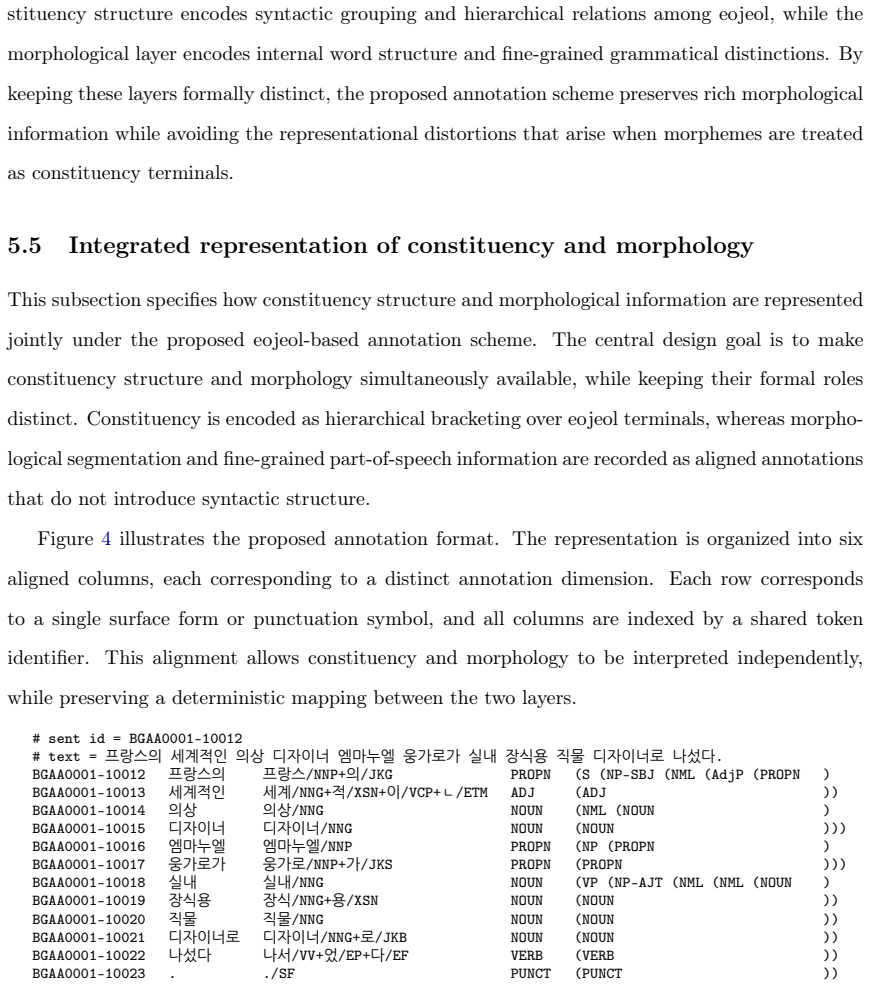
The paper's load-bearing claim is representational equivalence under normalization: debinarizing the strictly binary treebank, deleting null elements from the treebank that annotates empty categories, and standardizing eojeol tokenization do not change the set of terminals, their order, or the syntactic relations among them. Under those assumptions the two major eojeol-based Korean constituency treebanks can be treated as encoding the same eojeol-level constituency structure; the third treebank, which segments functional morphemes as independent terminals, is converted to the same backbone by reattaching those morphemes to their host eojeol. The paper then proposes a six-column annotation fo
Load-bearing premise
The load-bearing premise is that the three normalization steps—debinarization, deletion of null elements, and tokenization alignment—are syntactically inert, altering neither the eojeol sequence nor the dominance relations among terminals; if any step changes attachment or hierarchy, the claimed equivalence collapses.
Editorial extensions
If this is right
- The three existing Korean constituency treebanks can be compared and merged on a single eojeol backbone, so cross-treebank evaluation no longer requires reconstructing word boundaries.
- Constituency–dependency conversion in Korean becomes a direct mapping because both representations share eojeol as their terminal unit.
- Future treebanks can be built in layers: modifying the morphological segmentation does not change the syntactic tree, and vice versa.
- Constituency parsing can be framed as bracketing over surface eojeol plus universal POS preterminals, independent of morphological analysis.
- A practical path to open resources is converting public eojeol-based dependency corpora into the proposed constituency format, because the existing treebanks are license-restricted.
Reading between the lines
- A testable extension: if the equivalence is right, a constituency parser trained on one normalized treebank should transfer to another with little loss; unexpected performance gaps would reveal where the normalization did change structure.
- The paper leaves open which of the three compatible nominal-modifier analyses to adopt; a systematic annotation-consistency experiment would settle it and would determine whether the proposed modifier layer's attachment decisions are reproducible.
- The separation of morphology from syntax implies that morphological error does not propagate into syntactic evaluation, which would change how Korean parsing errors are diagnosed; this is an implication the paper does not develop.
- If the equivalence holds across all three treebanks, then many previously reported cross-treebank syntactic differences may be representational artifacts (binarization, nulls, segmentation); re-analyzing published Korean parsing results on the normalized backbone would test how much of the variance survives.
Signed reviews
Editorial analysis
A structured set of objections, weighed in public.
Referee Report
Summary. The paper argues that Korean constituency treebanks should use eojeol (orthographic spacing units) as the terminal layer, with morphological segmentation and fine-grained POS information stored in a separate, explicitly non-constituent annotation layer. It reviews the Sejong, Penn Korean, and KAIST treebanks, proposes a set of normalization steps (debinarizing Sejong, removing Penn nulls, aligning eojeol tokenization, and applying the SPMRL 2013 conversion to KAIST) under which these resources are claimed to become representationally equivalent over a shared eojeol-based constituency backbone. On this basis, it outlines a six-column annotation format and discusses implications for cross-treebank comparison, constituency–dependency conversion, and future Korean resource development.
Significance. If the central equivalence claim held, the paper would provide a useful common structural baseline for comparing and converting Korean constituency treebanks, and its separation of constituency structure from morphological annotation is a clear and potentially valuable design principle. The paper is commendably transparent about the conditional, methodological nature of the equivalence, and the proposed six-column format is concrete and actionable. However, the load-bearing assertion that the normalizations are syntactically inert is never demonstrated, and the paper's own footnote concedes that key structural choices cannot be resolved on structural grounds. The significance is therefore contingent on additional validation, either through formal proof or corpus-scale empirical checks, which are currently absent.
major comments (4)
- [§5.1] The assertion that the three normalization steps 'do not alter the set of eojeol terminals or their linear order, nor do they introduce new syntactic relations' is load-bearing but unsupported. Debinarizing recursive NP→NP NP chains can collapse distinct modifier-attachment sites into a single flat NP; two different binary trees can map to the same flat tree, thus erasing syntactic distinctions rather than merely removing notation. Similarly, removing Penn's null elements deletes argument positions and may leave an S-COMP dominating a subjectless VP, changing the structural analysis of clausal complements. The paper should provide a formal definition of 'syntactic relations' and a proof of inertness, or support the claim with corpus-wide comparisons of original vs. normalized trees (e.g., checking that debinarization preserves head-modifier relations and that null removal does not alter
- [§5.3 and Footnote 4] The introduction of the NML layer and the re-attachment of modifiers in Figure 5 constitutes a further analysis choice, not merely a normalization. Footnote 4 explicitly states that at least three alternative analyses are 'compatible with the surface word order' and 'cannot be resolved on structural grounds alone.' This means the claimed 'shared backbone' is not uniquely determined by the source treebanks; the choice of Figure 5 is an annotation decision layered on top of the normalization. The paper should either demonstrate that the NML analysis is derivable from the original Sejong/Penn structures, or clearly separate this reanalysis from the equivalence claim and relegate it to an optional enrichment.
- [Abstract and §6.1] The abstract states that a 'comparative analysis shows' representational equivalence, but the paper presents only a single worked example (Figures 1–5). No corpus-scale evaluation, statistics, or agreement measurements are reported across the Sejong, Penn Korean, or SPMRL-converted KAIST treebanks. If the equivalence claim is intended as an empirical result, it requires a corpus-level normalization study; if it is only a methodological conditional, the abstract and discussion should be rephrased to avoid claiming an empirical comparative result that the paper does not contain.
- [§5.1 (KAIST)] The treatment of KAIST relies on a cited SPMRL 2013 conversion procedure, but no example of a converted KAIST tree is shown, no description is given of how eojeol boundaries are inferred from the original morpheme-level terminals, and there is no verification that the converted trees satisfy the proposed eojeol-terminal condition. Without such evidence, including KAIST in the equivalence claim is unsupported and should either be substantiated with examples and checks or explicitly deferred to future work.
minor comments (4)
- [§5.3] Typo: 'Earlier resourceEarlier resources' should read 'Earlier resources'.
- [Throughout] Inconsistent capitalization of 'KAIST' vs. 'Kaist' across §3.3 and elsewhere; pick one consistent spelling.
- [§5.5] The statement that 'surface forms are the sole terminals' is potentially confusing because UPOS nodes are described as preterminals. Please clarify that the terminal level consists of eojeol, with UPOS labels as an intermediate preterminal layer, so the bracketing notation remains unambiguous.
- [Figure 4] The six-column format is described in the text but the example is rendered with inconsistent whitespace, making it hard to see the column boundaries. Consider presenting the example with explicit tab separators or a clear table layout.
Circularity Check
No circularity: the §5.1 equivalence claim is an explicit conditional normalization proposal with an unproven invariance premise, not a derivation that reduces to its own inputs.
full rationale
The paper's central claim is not a fitted prediction or a theorem derived from itself. The Sejong/Penn equivalence in §5.1 is introduced as an explicitly conditional and methodological assumption: "This equivalence is explicitly conditional and methodological." The normalization steps (debinarizing Sejong, removing Penn nulls, aligning eojeol tokenization) are asserted to be inert, but they are not shown to force the two treebanks into the same structure; the assertion "these normalization steps do not alter the set of eojeol terminals or their linear order, nor do they introduce new syntactic relations" is an unverified invariance claim. If false, the equivalence fails, but that is a correctness/evidence problem, not circularity. There are no equations in which the conclusion is identical to an input by construction, and no parameter is fitted and then renamed as a prediction. The Kaist mapping relies on the external SPMRL 2013 conversion description (Seddah et al., 2013), not on a self-cited uniqueness result. Footnote 4 explicitly concedes that the NML modifier-attachment choice "cannot be resolved on structural grounds alone," which weakens the claim that the proposed backbone is uniquely determined, but the paper presents Figure 5 as an adopted analysis rather than as a derived consequence. The numerous self-citations (Park 2018; Park and Kim 2023, 2024; Park and Tyers 2019; Kim and Park 2022) support terminology and prior positions, but no load-bearing step reduces to an unverified assertion by the same authors. The main gap is that no corpus-scale comparison is reported, so the abstract's "comparative analysis shows" overstates the evidence; that is an empirical shortfall, not circularity.
Assumptions & free parameters
assumptions (5)
- domain assumption Eojeol is the minimal unit that participates systematically in syntactic relations; functional morphemes are grammatically integrated within a single syntactic unit, not independent syntactic words.
- domain assumption The purpose of constituency is to represent only syntactic grouping, excluding sublexical morphology.
- domain assumption Debinarizing Sejong's binary trees and deleting Penn's null elements preserve the syntactic relations encoded by the original trees.
- domain assumption Kaist trees can be converted to an eojeol-based form by reattaching functional morphemes to their host lexical items as described in SPMRL 2013.
- domain assumption UPOS categories reflect syntactic behavior rather than morphological realization and can serve as preterminals for eojeol.
invented entities (1)
-
NML (nominal modifier) layer
Cite this review
Pith. "Pith review of Constituency Structure over Eojeol in Korean Treebanks." pith.science (2026). https://pith.science/paper/57QBHAIQ
@misc{pith2026251222487,
  author       = {Pith},
  title        = {Pith review of: Constituency Structure over Eojeol in Korean Treebanks},
  year         = {2026},
  howpublished = {\url{https://pith.science/paper/57QBHAIQ}},
  note         = {Machine review of arXiv:2512.22487}
}
read the original abstract
The design of Korean constituency treebanks raises a central representational question concerning the choice of terminal units. Although Korean words are morphologically complex, treating morphemes as constituency terminals can obscure the distinction between word-internal morphology and phrase-level syntactic structure, and can create mismatches with eojeol-based dependency resources. This paper argues for an eojeol-based constituency representation, with morphological segmentation and fine-grained POS information encoded in a separate, non-constituent layer. A comparative analysis shows that, under explicit normalization assumptions, the Sejong, Penn Korean, and KAIST treebanks can be compared over a shared eojeol-based constituency backbone. Building on this result, we outline an eojeol-based annotation scheme that preserves interpretable constituency, supports cross-treebank comparison and constituency-dependency alignment, and provides a surface-form terminal layer for future end-to-end Korean constituency parsing.
Figures


Figures from the paper (2 more)

Reference graph
Works this paper leans on
-
[1]
Building a Treebank for French
Anne Abeill \' e , Lionel Cl \' e ment, and François Toussenel. Building a Treebank for French . In Anne Abeill \' e , editor, Treebanks: Building and Using Parsed Corpora, pages 165--188. Kluwer, 2003
2003
-
[2]
Daniel M. Bikel. Intricacies of Collins' Parsing Model . Computational Linguistics, 30 0 (4): 0 479--511, 2004. doi:10.1162/0891201042544929. URL https://doi.org/10.1162/0891201042544929
-
[3]
Tyers, and Jungyeul Park
Yige Chen, Eunkyul Leah Jo, Yundong Yao, KyungTae Lim, Miikka Silfverberg, Francis M. Tyers, and Jungyeul Park. Yet Another Format of Universal Dependencies for Korean . In Nicoletta Calzolari, Chu-Ren Huang, Hansaem Kim, James Pustejovsky, Leo Wanner, Key-Sun Choi, Pum-Mo Ryu, Hsin-Hsi Chen, Lucia Donatelli, Heng Ji, Sadao Kurohashi, Patrizia Paggio, Nia...
2022
-
[4]
Towards Standardized Annotation and Parsing for Korean FrameNet
Yige Chen, Jae Ihn, KyungTae Lim, and Jungyeul Park. Towards Standardized Annotation and Parsing for Korean FrameNet . In Nicoletta Calzolari, Min-Yen Kan, Veronique Hoste, Alessandro Lenci, Sakriani Sakti, and Nianwen Xue, editors, Proceedings of the 2024 Joint International Conference on Computational Linguistics, Language Resources and Evaluation (LREC...
2024
-
[5]
Korean named entity recognition based on language-specific features
Yige Chen, KyungTae Lim, and Jungyeul Park. Korean named entity recognition based on language-specific features . Natural Language Engineering, 30 0 (3): 0 625–649, 2024 b . doi:10.1017/S1351324923000311
-
[6]
Korean Treebank Transformation for Parser Training
DongHyun Choi, Jungyeul Park, and Key-Sun Choi. Korean Treebank Transformation for Parser Training . In Proceedings of the ACL 2012 Joint Workshop on Statistical Parsing and Semantic Processing of Morphologically Rich Languages, pages 78--88, Jeju, Republic of Korea, 2012. Association for Computational Linguistics. URL http://www.aclweb.org/anthology/W12-3411
2012
-
[7]
Han, Young G
Key-Sun Choi, Young S. Han, Young G. Han, and Oh W. Kwon. KAIST Tree Bank Project for Korean: Present and Future Development . In Proceedings of the International Workshop on Sharable Natural Language Resources, pages 7--14, Nara Institute of Science and Technology, 1994. Nara Institute of Science and Technology
1994
-
[8]
Factors Affecting the Accuracy of Korean Parsing
Tagyoung Chung, Matt Post, and Daniel Gildea. Factors Affecting the Accuracy of Korean Parsing . In Proceedings of the NAACL HLT 2010 First Workshop on Statistical Parsing of Morphologically-Rich Languages, pages 49--57, Los Angeles, CA, USA, 2010. Association for Computational Linguistics. URL http://www.aclweb.org/anthology/W10-1406
2010
Show all 31 references
-
[9]
Programming Languages and Their Compilers: Preliminary Notes
John Cocke. Programming Languages and Their Compilers: Preliminary Notes . New York University, USA, 1969. ISBN B0007F4UOA
1969
-
[11]
Penn Korean Treebank: Development and Evaluation
Chung-Hye Han, Na-Rae Han, Eon-Suk Ko, Martha Palmer, and Heejong Yi. Penn Korean Treebank: Development and Evaluation . In Proceedings of the 16th Pacific Asia Conference on Language, Information and Computation, pages 69--78, Jeju, Korea, 2002. Pacific Asia Conference on Lan...
2002
-
[12]
Null Objects in Korean: Experimental Evidence for the Argument Ellipsis Analysis
Chung-hye Han, Kyeong-min Kim, Keir Moulton, and Jeffrey Lidz. Null Objects in Korean: Experimental Evidence for the Argument Ellipsis Analysis . Linguistic Inquiry, 51 0 (2): 0 319--340, 2020 a . ISSN 0024-3892. 10.1162/ling \_ a \_ 00342 . URL https://doi.org/10.1162/ling
2020 doi
-
[13]
Annotation Issues in Universal Dependencies for Korean and Japanese
Ji Yoon Han, Tae Hwan Oh, Lee Jin, and Hansaem Kim. Annotation Issues in Universal Dependencies for Korean and Japanese . In Marie-Catherine de Marneffe, Miryam de Lhoneux, Joakim Nivre, and Sebastian Schuster, editors, Proceedings of the Fourth Workshop on Universal Dependenc...
2020
-
[14]
An Efficient Recognition and Syntax-Analysis Algorithm for Context-Free Languages
Tadao Kasami. An Efficient Recognition and Syntax-Analysis Algorithm for Context-Free Languages . Technical report, University of Illinois at Urbana-Champaign, 3 1966. URL http://hdl.handle.net/2142/74304
1966
-
[15]
K-UD: Revising Korean Universal Dependencies Guidelines
Kyuwon Kim, Yige Chen, Eunkyul Leah Jo, KyungTae Lim, Jungyeul Park, and Chulwoo Park. K-UD: Revising Korean Universal Dependencies Guidelines . arXiv, pages 1--6, 2024. URL https://arxiv.org/abs/2412.00856
2024 arXiv
-
[16]
A note on constituent parsing for Korean
Mija Kim and Jungyeul Park. A note on constituent parsing for Korean . Natural Language Engineering, 28 0 (2): 0 199--222, 2022. doi:10.1017/S1351324920000479
2022 doi
-
[17]
Marcus, Mary Ann Marcinkiewicz, and Beatrice Santorini
Mitchell P. Marcus, Mary Ann Marcinkiewicz, and Beatrice Santorini. Building a Large Annotated Corpus of English: The Penn Treebank . Computational linguistics, 19 0 (2): 0 313--330, 1993. URL https://aclanthology.org/J93-2004
1993
-
[18]
a ckstr \
Ryan McDonald, Joakim Nivre, Yvonne Quirmbach-Brundage, Yoav Goldberg, Dipanjan Das, Kuzman Ganchev, Keith Hall, Slav Petrov, Hao Zhang, Oscar T \" a ckstr \" o m, Claudia Bedini, Núria Bertomeu Castell \' o , and Jungmee Lee. Universal Dependency Annotation for Multilingual P...
2013
-
[19]
Enhancing Universal Dependencies for Korean
Youngbin Noh, Jiyoon Han, Tae Hwan Oh, and Hansaem Kim. Enhancing Universal Dependencies for Korean . In Proceedings of the Second Workshop on Universal Dependencies (UDW 2018), pages 108--116, Brussels, Belgium, 11 2018. Association for Computational Linguistics. doi:10.18653...
2018 doi
-
[20]
For Developing the Synthetic Perspective about the Concept of Word in Korean
Chulwoo Park. For Developing the Synthetic Perspective about the Concept of Word in Korean . HANGEUL, 79 0 (2): 0 327--368, 2018. ISSN 1225-0449. doi:https://doi.org/10.22557/HG.2018.06.79.2.327. URL https://www.kci.go.kr/kciportal/ci/sereArticleSearch/ciSereArtiView.kci?sereA...
2018 doi
-
[21]
A role of functional morphemes in Korean categorial grammars
Jungyeul Park and Mija Kim. A role of functional morphemes in Korean categorial grammars . Korean Linguistics, 19 0 (1): 0 1--30, 2023. doi:10.1075/kl.22003.par. URL https://doi.org/10.1075/kl.22003.par
2023 doi
-
[22]
Word segmentation granularity in Korean
Jungyeul Park and Mija Kim. Word segmentation granularity in Korean . Korean Linguistics, 20 0 (1): 0 83--113, 2024. URL https://benjamins.com/catalog/kl.00008.par
2024
-
[23]
A New Annotation Scheme for the Sejong Part-of-speech Tagged Corpus
Jungyeul Park and Francis Tyers. A New Annotation Scheme for the Sejong Part-of-speech Tagged Corpus . In Proceedings of the 13th Linguistic Annotation Workshop, pages 195--202, Florence, Italy, 8 2019. Association for Computational Linguistics. URL https://www.aclweb.org/anth...
2019
-
[24]
Korean Language Resources for Everyone
Jungyeul Park, Jeen-Pyo Hong, and Jeong-Won Cha. Korean Language Resources for Everyone . In Proceedings of the 30th Pacific Asia Conference on Language, Information and Computation: Oral Papers (PACLIC 30), pages 49--58, Seoul, Korea, 2016. Pacific Asia Conference on Language...
2016
-
[25]
KLUE: Korean Language Understanding Evaluation
Sungjoon Park, Jihyung Moon, Sungdong Kim, Won Ik Cho, Ji Yoon Han, Jangwon Park, Chisung Song, Junseong Kim, Youngsook Song, Taehwan Oh, Joohong Lee, Juhyun Oh, Sungwon Lyu, Younghoon Jeong, Inkwon Lee, Sangwoo Seo, Dongjun Lee, Hyunwoo Kim, Myeonghwa Lee, Seongbo Jang, Seung...
2021
-
[26]
A Universal Part-of-Speech Tagset
Slav Petrov, Dipanjan Das, and Ryan McDonald. A Universal Part-of-Speech Tagset . In Proceedings of the Eighth International Conference on Language Resources and Evaluation (LREC-2012), pages 2089--2096, Istanbul, Turkey, 2012. European Language Resources Association (ELRA). I...
2012
-
[27]
Djamé Seddah, Reut Tsarfaty, Sandra K \" u bler, Marie Candito, Jinho D. Choi, Richárd Farkas, Jennifer Foster, Iakes Goenaga, Koldo Gojenola Galletebeitia, Yoav Goldberg, Spence Green, Nizar Habash, Marco Kuhlmann, Wolfgang Maier, Joakim Nivre, Adam Przepi \' o rkowski, Ryan ...
2013
-
[28]
A Proposal on Universal Dependencies (v.2) Annotation for Korean
Saetbyol Seo, Myeong-ju Kim, YeonSook Sung, and Seong Hee Yoo. A Proposal on Universal Dependencies (v.2) Annotation for Korean . Language and Information, 23 0 (1): 0 91--122, 2019. URL https://doi.org/10.29403/LI.23.1.5
2019 doi
-
[29]
Parsing Noun Phrases in the Penn Treebank
David Vadas and James R Curran. Parsing Noun Phrases in the Penn Treebank . Computational Linguistics, 37 0 (4): 0 753--809, 12 2011. 10.1162/COLI \_ a \_ 00076 . URL https://aclanthology.org/J11-4006/
2011 doi
-
[30]
Converting Dependency Structures to Phrase Structures
Fei Xia and Martha Palmer. Converting Dependency Structures to Phrase Structures . In Proceedings of the First International Conference on Human Language Technology Research, San Diego, CA, 2001. Association for Computational Linguistics. URL http://www.aclweb.org/anthology/H01-1014
2001
-
[31]
The Penn Chinese TreeBank: Phrase Structure Annotation of a Large Corpus
Nianwen Xue, Fei Xia, Fu-dong Chiou, and Marta Palmer. The Penn Chinese TreeBank: Phrase Structure Annotation of a Large Corpus . Natural Language Engineering, 11 0 (2): 0 207--238, 6 2005. ISSN 1351-3249. doi:10.1017/S135132490400364X. URL https://doi.org/10.1017/S135132490400364X
2005 doi
-
[32]
Daniel H. Younger. Recognition and parsing of context-free languages in time n3 . Information and Control, 10 0 (2): 0 189--208, 1967. ISSN 0019-9958. doi:https://doi.org/10.1016/S0019-9958(67)80007-X. URL http://www.sciencedirect.com/science/article/pii/S001999586780007X
1967 doi
Reviewed August 3, 2026 · model on record in the stance chip above.
Discussion (0). Continue with ORCID to comment.