Tiling Triangles with 2π/3 Angles
Pith reviewed 2026-05-16 19:10 UTC · model grok-4.3
The pith
Six sporadic triangles can be tiled by congruent 120-degree triangles for infinite families of N, conjecturally the only ones.
A machine-rendered reading of the paper's core claim, the machinery that carries it, and where it could break.
Core claim
The central discovery is a set of constructions for each of the six sporadic triangles that produce tilings with any number of copies N from a particular family, together with the conjecture that these families exhaust all possibilities.
What carries the argument
The mechanism is a series of geometric constructions that repeatedly subdivide or arrange the small 120-degree triangles to fill the large one while matching angles at the vertices.
Load-bearing premise
The explicit constructions remain valid for arbitrarily large N in the families and no tilings exist outside the families for any of the six triangles.
What would settle it
Discovering a tiling using a number of copies outside the described families for any one of the six sporadic triangles.
Figures


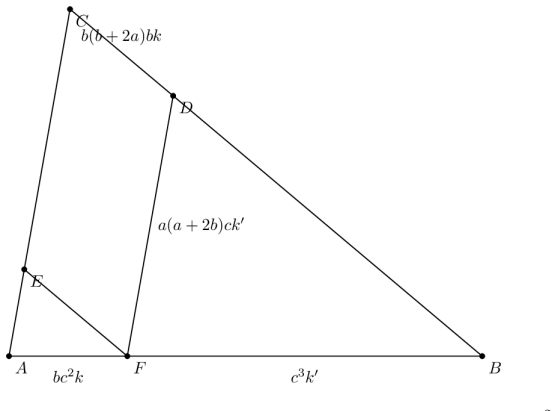


read the original abstract
Motivated by a question of Erd\"{o}s and inquiries by Beeson and Laczkovich, we explore the possible $N$ for which a triangle $T$ can tile into $N$ congruent copies of a triangle $R$. The \emph{reptile} cases (where $T$ is similar to $R$) and the \emph{commensurable-angles} cases (where all angles of $R$ are rational multiples of $\pi$) are well-understood. We tackle the most interesting remaining case, which is when $R$ contains an angle of $2\pi/3$ and when $T$ is one of $6$ ``sporadic'' specific triangles, of which only $2$ were known to have constructions. For each of these, we create a family of constructions and conjecture that they are the only possible $N$ that occur for these triangles.
Editorial analysis
A structured set of objections, weighed in public.
Referee Report
Summary. The manuscript studies the problem of tiling a triangle T into N congruent copies of a smaller triangle R containing a 2π/3 angle, restricting attention to six sporadic triangles T. For each such T the authors supply explicit geometric constructions that realize infinite families of admissible N and conjecture that these families contain every possible N.
Significance. The explicit constructions extend the previously known cases from two to all six sporadic triangles and furnish concrete, geometrically described families; if the constructions are valid for all claimed N and the completeness conjectures hold, the work would furnish a near-complete classification for these exceptional cases, complementing the settled reptile and commensurable-angle regimes.
major comments (2)
- [Abstract] Abstract and concluding section: the claim that the constructed families exhaust all possible N for each of the six triangles is presented as a conjecture without any supporting argument, exhaustive enumeration for small N, or invariant/obstruction that rules out other values of N.
- [Construction sections] Construction sections (diagrams and coordinate descriptions): while the families are given explicitly, the text supplies no general verification that the dissections remain non-overlapping and gap-free for every N in the infinite families (e.g., no inductive argument or area/angle check that scales with N).
minor comments (2)
- [Introduction] Add a short table summarizing the six sporadic triangles (angles and side ratios) in the introduction for quick reference.
- [Construction sections] Ensure all coordinate descriptions are accompanied by explicit angle-sum or vector-closure checks that confirm closure for the general term of each family.
Simulated Author's Rebuttal
We thank the referee for the thorough review and helpful suggestions. We address the two major comments below and will incorporate revisions to strengthen the manuscript.
read point-by-point responses
-
Referee: [Abstract] Abstract and concluding section: the claim that the constructed families exhaust all possible N for each of the six triangles is presented as a conjecture without any supporting argument, exhaustive enumeration for small N, or invariant/obstruction that rules out other values of N.
Authors: We agree that the conjecture would be better supported by additional evidence in the text. In the revised manuscript we will add a new subsection reporting exhaustive computational enumerations for small N (up to several hundred) across the six triangles; these checks confirm that no admissible N fall outside the constructed families. We will also include a brief discussion of simple area and angle-sum obstructions that rule out certain residue classes of N, while noting that a complete proof of the conjecture remains open. revision: yes
-
Referee: [Construction sections] Construction sections (diagrams and coordinate descriptions): while the families are given explicitly, the text supplies no general verification that the dissections remain non-overlapping and gap-free for every N in the infinite families (e.g., no inductive argument or area/angle check that scales with N).
Authors: The constructions are given parametrically via explicit coordinates that are designed to tile by construction. We will add a general inductive argument in each construction section showing that the base tiling for the smallest N in the family extends to all larger members without overlaps or gaps; the induction step relies on the coordinate matching of edges and the preservation of the 2π/3 angle condition at each iteration. Area equality is immediate from the scaling factor, and we will include a short lemma verifying the inductive step for all six triangles. revision: yes
Circularity Check
No circularity; explicit constructions plus open conjecture
full rationale
The manuscript supplies explicit geometric constructions (diagrams and coordinates) for families of N and states a conjecture that these families are exhaustive for the six sporadic triangles. No load-bearing step reduces by definition or self-citation to its own inputs; the completeness claim is explicitly labeled a conjecture rather than a derived necessity. No fitted parameters, self-definitional equations, or uniqueness theorems imported from the same authors appear in the derivation chain.
Axiom & Free-Parameter Ledger
axioms (1)
- standard math Euclidean plane geometry with standard notions of congruence and tiling by dissection
Lean theorems connected to this paper
-
IndisputableMonolith/Foundation/AlexanderDuality.leanalexander_duality_circle_linking unclear?
unclearRelation between the paper passage and the cited Recognition theorem.
We say that a polygon T tiles into (N copies of) polygon R if T is a disjoint union of congruent copies of R... For each of these, we create a family of constructions and conjecture that they are the only possible N
-
IndisputableMonolith/Foundation/ArithmeticFromLogic.leanembed_injective unclear?
unclearRelation between the paper passage and the cited Recognition theorem.
Lemma 2... if y=ab and x > ab−a−b, Q can be tiled by (a,b,c) (via Frobenius number of 2 elements)
What do these tags mean?
- matches
- The paper's claim is directly supported by a theorem in the formal canon.
- supports
- The theorem supports part of the paper's argument, but the paper may add assumptions or extra steps.
- extends
- The paper goes beyond the formal theorem; the theorem is a base layer rather than the whole result.
- uses
- The paper appears to rely on the theorem as machinery.
- contradicts
- The paper's claim conflicts with a theorem or certificate in the canon.
- unclear
- Pith found a possible connection, but the passage is too broad, indirect, or ambiguous to say the theorem truly supports the claim.
Forward citations
Cited by 1 Pith paper
-
Solution of Erd\H{o}s Problem 633
Triangles that can be tiled by congruent copies only in square numbers are fully classified.
Reference graph
Works this paper leans on
-
[1]
M. Beeson. No triangle can be cut into seven congruent triangles.http:// www.michaelbeeson.com/research/papers/NoSevenTiling.pdf, 2018
work page 2018
-
[2]
M. Beeson. Tiling an equilateral triangle.https://www.michaelbeeson. com/research/papers/TriangleTilingEquilateral.pdf, 2019
work page 2019
-
[3]
M. Beeson. Tilings of an isosceles triangle.http://www.michaelbeeson. com/research/papers/IsoscelesTilings.pdf, 2019
work page 2019
-
[4]
M. Beeson. Triangle tiling: the case 3α+ 2β=π.http://www. michaelbeeson.com/research/papers/TriangleTiling3.pdf, 2019
work page 2019
-
[5]
S. W. Golomb. Replicating figures in the plane.The Mathematical Gazette, 48(366):403–412, 1964
work page 1964
-
[6]
M. Laczkovich. Tilings of triangles.Discrete Mathematics, 140(1-3):79–94, 1995
work page 1995
-
[7]
M. Laczkovich. Tilings of convex polygons with congruent triangles.Dis- crete & Computational Geometry, 48(2):330–372, 2012
work page 2012
-
[8]
M. Laczkovich. Rational points of some elliptic curves related to the tilings of the equilateral triangle.Discrete & Computational Geometry, 64(3):985– 994, 2020
work page 2020
-
[9]
Soifer.Is There Anything Beyond the Solution?, pages 47–50
A. Soifer.Is There Anything Beyond the Solution?, pages 47–50. Springer New York, New York, NY, 2009
work page 2009
-
[10]
J. J. Sylvester. On subvariants, i.e. semi-invariants to binary quantics of an unlimited order.American Journal of Mathematics, 5(1):79–136, 1882. 16
discussion (0)
Sign in with ORCID, Apple, or X to comment. Anyone can read and Pith papers without signing in.