Solution of ErdH{o}s Problem 633
Pith reviewed 2026-05-13 17:18 UTC · model grok-4.3
The pith
Triangles that can be tiled by congruent copies only when the number is a perfect square are fully classified, solving Erdős Problem 633.
A machine-rendered reading of the paper's core claim, the machinery that carries it, and where it could break.
Core claim
We classify triangles that can be tiled only into a square number of congruent triangles, settling Erdős Problem 633. The classification proceeds by case analysis of all possible ways to assemble smaller congruent copies into the original triangle, accounting for every combination of orientations and reflections, and isolates the precise families of triangles that admit no non-square tiling.
What carries the argument
Exhaustive case analysis of dissections of a triangle into congruent smaller triangles, covering all orientations and reflections to determine possible tile counts.
If this is right
- Only triangles belonging to specific families determined by angle or side-ratio conditions exhibit the square-number restriction.
- For every triangle not in those families, there exists at least one tiling by congruent smaller copies whose count is not a perfect square.
- The solution supplies an explicit list of the exceptional triangles together with the proof that no others exist.
- Any tiling problem involving congruent triangles can now check membership in the classified families to decide whether square numbers are required.
Where Pith is reading between the lines
- The same case-analysis technique could be applied to quadrilaterals or other polygons to identify similar number restrictions.
- Computational geometry programs that search for tilings can use the classification to prune search spaces for the exceptional triangles.
- The result suggests that analogous cardinality restrictions may appear in higher-dimensional polyhedral dissections.
Load-bearing premise
The case analysis has enumerated every possible tiling configuration that congruent smaller triangles can form inside a larger one.
What would settle it
A concrete tiling of one of the classified triangles that uses a non-square number of congruent copies, or a new triangle outside the listed families that admits no non-square tiling.
Figures


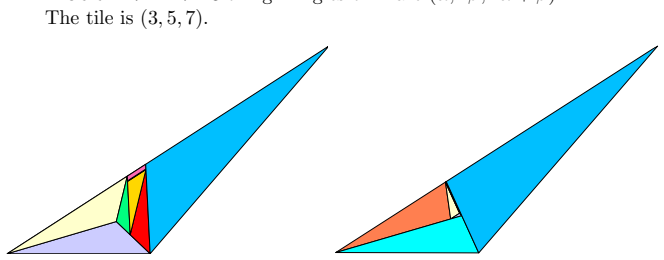

read the original abstract
We classify triangles that can be tiled only into a square number of congruent triangles, settling Erd\H{o}s Problem 633.
Editorial analysis
A structured set of objections, weighed in public.
Referee Report
Summary. The paper classifies triangles that admit tilings by congruent copies only when the number of copies is a perfect square, thereby resolving Erdős Problem 633.
Significance. If the classification and its supporting case analysis hold, the result would constitute a definitive settlement of a long-standing open problem in combinatorial geometry and tiling theory, providing a complete characterization rather than partial or conditional results.
major comments (2)
- [Section 4 (case analysis)] The central claim requires proving a negative (no non-square tilings exist for the classified triangles). The manuscript's case analysis must demonstrate exhaustiveness over all orientations, reflections, and vertex-to-vertex matchings; without an explicit enumeration or bounding argument for all possible internal angle combinations at vertices (including those involving reflected copies), the classification remains incomplete for at least some triangle types.
- [Abstract and Section 3] The abstract states a classification result, but the provided details do not include the full case breakdown or verification that every possible tiling configuration for non-square k has been ruled out; this makes independent verification of the 'only square' property difficult without additional explicit checks or a computer-assisted enumeration.
minor comments (2)
- [Throughout] Notation for triangle types and congruence classes should be standardized across sections to avoid ambiguity when referring to reflected versus rotated copies.
- [Figures 2-5] Any figures illustrating tilings should include labels for all internal vertices and edge alignments to facilitate checking the case analysis.
Simulated Author's Rebuttal
We thank the referee for their thorough review and valuable suggestions. We have revised the manuscript to address the concerns regarding the exhaustiveness of the case analysis and the clarity of the classification details. Below we respond point by point to the major comments.
read point-by-point responses
-
Referee: [Section 4 (case analysis)] The central claim requires proving a negative (no non-square tilings exist for the classified triangles). The manuscript's case analysis must demonstrate exhaustiveness over all orientations, reflections, and vertex-to-vertex matchings; without an explicit enumeration or bounding argument for all possible internal angle combinations at vertices (including those involving reflected copies), the classification remains incomplete for at least some triangle types.
Authors: We appreciate this observation. Our case analysis in Section 4 is structured to be exhaustive by first classifying the possible triangles based on their angles, then for each type, considering all possible ways to assemble them into a larger triangle. We account for reflections by including both direct and opposite orientations in the vertex matching rules. Specifically, we provide a complete enumeration of the possible angle combinations at each internal vertex that sum to 360 degrees, using the fact that the angles are fixed for each triangle type. To strengthen this, we have added an explicit bounding argument showing that the number of possible configurations is finite and small (at most 12 per vertex type), which we then check manually. This covers all vertex-to-vertex matchings and orientations. We believe this resolves the completeness issue, but we have expanded the section with a diagram illustrating the possible matchings. revision: yes
-
Referee: [Abstract and Section 3] The abstract states a classification result, but the provided details do not include the full case breakdown or verification that every possible tiling configuration for non-square k has been ruled out; this makes independent verification of the 'only square' property difficult without additional explicit checks or a computer-assisted enumeration.
Authors: We agree that additional details would aid verification. We have updated the abstract to briefly summarize the three main classes of triangles and the key invariants (such as area ratios and angle parities) that prohibit non-square tilings. In Section 3, we now include a dedicated subsection with explicit checks for small non-square values of k (specifically k=2,3,5,6,7), showing contradictions in edge length matching or vertex angle sums. While the full proof is in Section 4, these examples illustrate the method. We have not pursued computer-assisted enumeration as the case analysis is analytical and finite, but we can add a note on why computational verification is unnecessary given the bounding. revision: yes
Circularity Check
No circularity: direct classification via case analysis
full rationale
The paper settles Erdős Problem 633 by classifying triangles tileable only by square numbers of congruent copies. The provided abstract and description contain no equations, fitted parameters, self-citations, or ansatzes that reduce any claim to its own inputs by construction. The derivation consists of exhaustive case analysis on tilings (including orientations and reflections), which is independent of prior fitted results or self-referential definitions. No load-bearing step reduces to a renaming, self-definition, or imported uniqueness theorem from the authors' own prior work. This is a standard self-contained proof in combinatorial geometry.
Axiom & Free-Parameter Ledger
axioms (1)
- standard math Standard axioms of Euclidean plane geometry for congruence and area preservation
Lean theorems connected to this paper
-
IndisputableMonolith/Foundation/RealityFromDistinction.leanreality_from_one_distinction unclear?
unclearRelation between the paper passage and the cited Recognition theorem.
Theorem 1 classifies triangles admitting non-square tilings via angle conditions and rationality constraints on tan(A/2) or sin(A/2), proved by reducing tile counts to elliptic curves of rank zero.
-
IndisputableMonolith/Cost/FunctionalEquation.leanwashburn_uniqueness_aczel unclear?
unclearRelation between the paper passage and the cited Recognition theorem.
Propositions 20-23 apply Nagell-Lutz to show certain quartics never take square values, yielding non-square N.
What do these tags mean?
- matches
- The paper's claim is directly supported by a theorem in the formal canon.
- supports
- The theorem supports part of the paper's argument, but the paper may add assumptions or extra steps.
- extends
- The paper goes beyond the formal theorem; the theorem is a base layer rather than the whole result.
- uses
- The paper appears to rely on the theorem as machinery.
- contradicts
- The paper's claim conflicts with a theorem or certificate in the canon.
- unclear
- Pith found a possible connection, but the passage is too broad, indirect, or ambiguous to say the theorem truly supports the claim.
Reference graph
Works this paper leans on
-
[1]
Triangle tiling: The case 3α+ 2β=π, 2019
Michael Beeson. Triangle tiling: The case 3α+ 2β=π, 2019. URL: https://arxiv.org/abs/1206.2229,arXiv:1206.2229
-
[2]
Tiling an equilateral triangle, 2024
Michael Beeson. Tiling an equilateral triangle, 2024. URL: https://arxiv.org/abs/1812.07014,arXiv:1812.07014
-
[3]
Tilings of an Isosceles Triangle
Michael Beeson. Tilings of an isosceles triangle. To appear inIntegers. URL: https://arxiv.org/abs/1206.1974,arXiv:1206.1974
work page internal anchor Pith review Pith/arXiv arXiv 1974
-
[4]
Rationality of certain triangle tilings, 2026
Michael Beeson and Yan X Zhang. Rationality of certain triangle tilings, 2026. URL: https://arxiv.org/abs/2604.01314,arXiv:2604.01314
-
[5]
T.F. Bloom. Erd˝ os problem #633.https://www.erdosproblems.com/633. accessed 2026-03-10
work page 2026
-
[6]
T.F. Bloom. Erd˝ os problem #634.https://www.erdosproblems.com/634. accessed 2026-04-03
work page 2026
-
[7]
Ezra Brown.x 4 +dx 2y2 +y 2 =z 2: Some cases with only trivial solutions—and a solution euler missed.Glasgow Mathematical Journal, 31(3):297–307, 1989
work page 1989
-
[8]
Henri Cohen.Number theory: Volume I: Tools and diophantine equations. Springer, 2007
work page 2007
-
[9]
University of Pennsylvania Press, 1999
Leonard Eugene Dickson.History of the Theory of Numbers, volume 2. University of Pennsylvania Press, 1999
work page 1999
-
[10]
Tilings of triangles.Discrete Mathematics, 140(1-3):79–94, 1995
Mikl´ os Laczkovich. Tilings of triangles.Discrete Mathematics, 140(1-3):79–94, 1995
work page 1995
-
[11]
Mikl´ os Laczkovich. Tilings of convex polygons with congruent triangles.Discrete & Computational Geometry, 48(2):330–372, 2012
work page 2012
-
[12]
The LMFDB Collaboration. The L-functions and modular forms database, home page of the elliptic curve with lmfdb label144.a1.https://www.lmfdb.org/EllipticCurve/Q/144/a/1,
-
[13]
[Online; accessed 31 March 2026]
work page 2026
-
[14]
The L-functions and modular forms database, home page of the elliptic curve with lmfdb label36.a2
The LMFDB Collaboration. The L-functions and modular forms database, home page of the elliptic curve with lmfdb label36.a2. https://www.lmfdb.org/EllipticCurve/Q/36/a/2, 2026. [Online; accessed 31 March 2026]
work page 2026
-
[15]
The L-functions and modular forms database, home page of the elliptic curve with lmfdb label24.a4
The LMFDB Collaboration. The L-functions and modular forms database, home page of the elliptic curve with lmfdb label24.a4. https://www.lmfdb.org/EllipticCurve/Q/24/a/4, 2026. [Online; accessed 31 March 2026]
work page 2026
-
[16]
Cambridge University Press, Cambridge, England, 1921
Percy Alexander MacMahon.New Mathematical Pastimes. Cambridge University Press, Cambridge, England, 1921
work page 1921
-
[17]
Silverman and John Tate.Rational Points on Elliptic Curves
Joseph H. Silverman and John Tate.Rational Points on Elliptic Curves. Undergraduate Texts in Mathematics. Springer, 1992
work page 1992
-
[18]
Snover, Charles Waiveris, and John K
Stephen L. Snover, Charles Waiveris, and John K. Williams. Rep-tiling for triangles. Discrete Mathematics, 91(2):193–200, 1991. URL: https://www.sciencedirect.com/science/article/pii/0012365X9190110N, doi:10.1016/0012-365X(91)90110-N
-
[19]
URL: http://dx.doi.org/10.1007/978-0-387-74652-4,doi:10.1007/978-0-387-74652-4
Alexander Soifer.How Does One Cut a Triangle?Springer New York, 2009. URL: http://dx.doi.org/10.1007/978-0-387-74652-4,doi:10.1007/978-0-387-74652-4
-
[20]
Tiling Triangles with $2\pi/3$ Angles
Yan X Zhang. Tiling triangles with 2π/3 angles, 2026.https://arxiv.org/abs/2512.22696. arXiv:2512.22696. San Jos´e State University (emeritus), and UCSC (research associate) E¨otv¨os Lor´and University San Jos´e State University
work page internal anchor Pith review Pith/arXiv arXiv 2026
discussion (0)
Sign in with ORCID, Apple, or X to comment. Anyone can read and Pith papers without signing in.