From AdS₅ to AdS₃: TsT deformations, Magnetic fields and Holographic RG Flows
Pith reviewed 2026-05-16 19:07 UTC · model grok-4.3
The pith
A special TsT deformation value restores perpendicular meson fluctuations in a magnetic background and produces an asymptotically AdS3 x S5 geometry with D1-brane interpretation.
A machine-rendered reading of the paper's core claim, the machinery that carries it, and where it could break.
Core claim
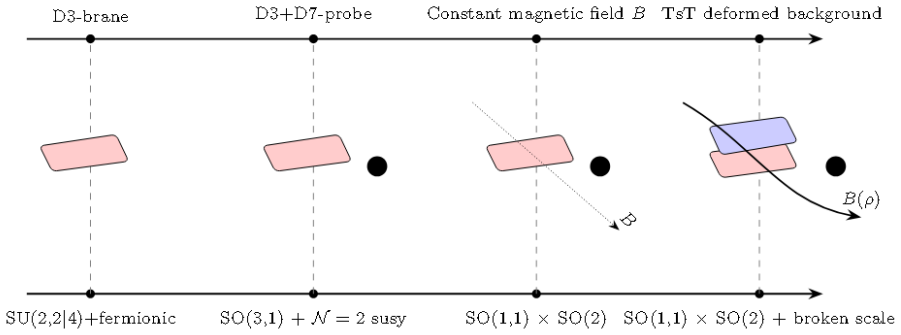
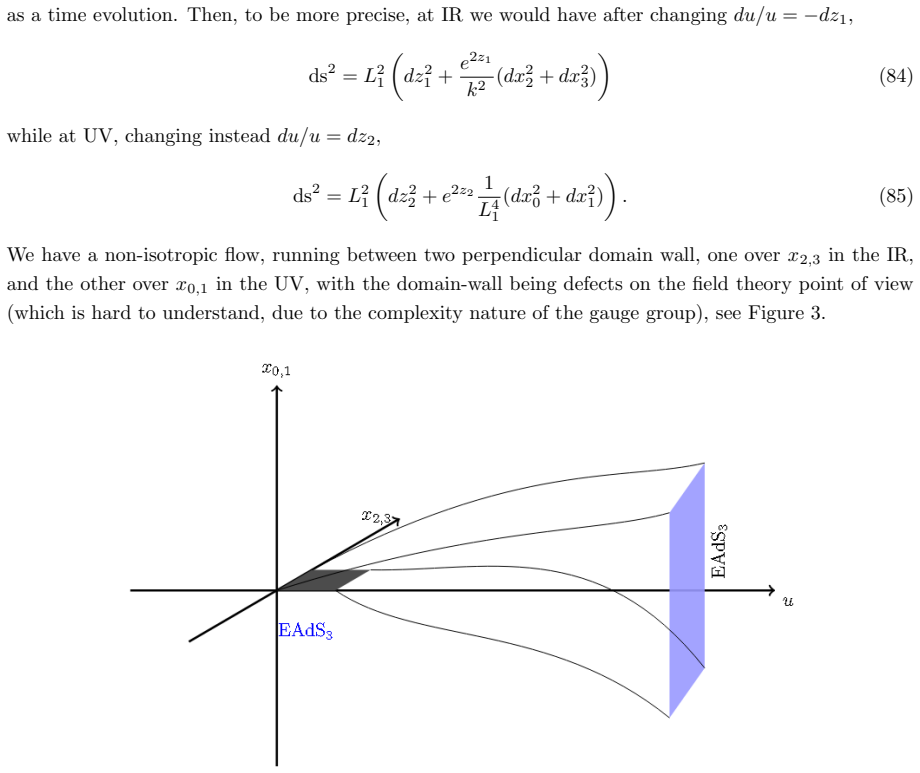
In this deformed setup the Kalb-Ramond field acquires radial dependence except when the TsT parameter satisfies k equals minus one over H. At that point the field becomes constant, perpendicular meson fluctuations no longer diverge near the horizon, and the spacetime admits an asymptotically AdS3 times S5 geometry with a degenerate horizon that supports a D1-brane description. The dual field theory interpretation connects to D1 and D5 systems, renormalization group flows, defect field theories, and domain wall holography.
What carries the argument
The TsT deformation parameter k combined with the constant magnetic field H, which at the special value k equals minus one over H renders the Kalb-Ramond field constant and drives the dimensional reduction from AdS5 to AdS3.
If this is right
- Chiral symmetry breaking persists in the TsT deformed magnetic background.
- Perpendicular meson fluctuations are restored only at the special value k equals minus one over H.
- The resulting background at this special value admits a D1-brane interpretation and asymptotically AdS3 times S5 geometry.
- The magnetic field effects on the spectrum are shifted to order H squared.
- The setup provides a holographic description of RG flows linking different brane systems and defect theories.
Where Pith is reading between the lines
- This may model holographic RG flows between four-dimensional and two-dimensional field theories or defect CFTs.
- The degenerate horizon and boundary could correspond to specific solutions in lower-dimensional supergravity.
- Investigating the finite-temperature version might reveal new phase transitions in the deformed brane system.
- Connections to domain wall holography suggest possible applications to interface or boundary CFTs.
Load-bearing premise
The probe D7-brane approximation remains valid throughout the geometry to the horizon, without back-reaction or higher-order corrections altering the divergence structure or the special value restoration.
What would settle it
Solve the perpendicular fluctuation equations at the special value k equals minus one over H and verify that the near-horizon behavior is regular and admits normalizable solutions instead of divergences.
Figures
read the original abstract
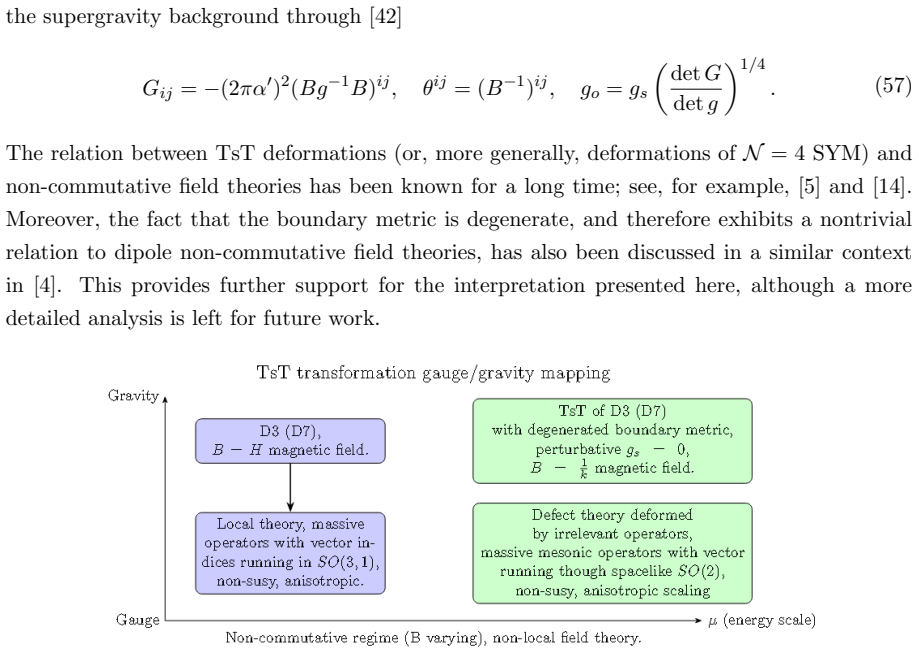
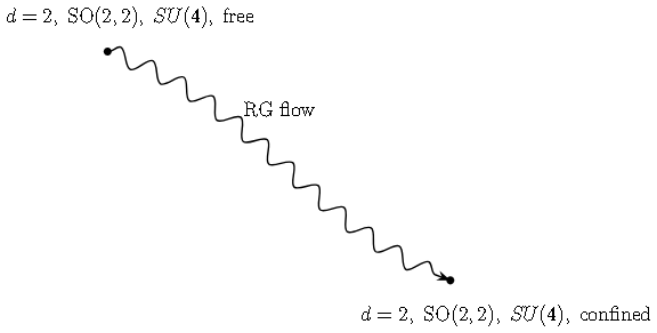
It was previously shown that a D7 brane probe in a D3 brane background with a pure gauge constant magnetic field $\mathrm{B} = \mathrm{H}$ exhibits chiral symmetry breaking and a discrete meson spectrum with Zeeman splitting. In this work, we investigate how these features are modified by a TsT deformation of the background, which renders the Kalb Ramond field physical and radially dependent, thereby obscuring its interpretation as a constant magnetic field. We show that chiral symmetry breaking persists in the deformed model. The meson spectrum, however, depends on the fluctuation sector. Fluctuations perpendicular to the magnetic field are sensitive to the deformation and, for generic values of the TsT parameter $\mathrm{k}$, do not admit a consistent spectrum due to divergent behavior near the horizon, whereas fluctuations parallel to the magnetic field remain unaffected. Remarkably, the combined effect of the magnetic field and the TsT deformation singles out the special value $\mathrm{k} = -\frac{1}{\mathrm{H}}$. At this point, the perpendicular modes are restored. Moreover, the Kalb Ramond field becomes constant again, recovering its interpretation as a magnetic field. The resulting effects on the spectrum appear only at order $O(H^2)$, and therefore the Zeeman splitting, if present at all, is shifted to this higher order. Furthermore, the resulting background with $\mathrm{k} = - \frac{1}{\mathrm{H}}$ is interesting in its own right, even without embedding any brane. The spacetime admits an interpretation in terms of D1 branes and exhibits a degenerate boundary geometry, asymptotically $\mathrm{AdS}_3 \times S^5$, with a degenerate horizon. We present a first discussion of the dual field theory interpretation, making connections to D1 and D5 systems, renormalization group flow, defect field theories, and domain wall holography.
Editorial analysis
A structured set of objections, weighed in public.
Referee Report
Summary. The paper studies TsT deformations of a D3-brane background with constant magnetic field B=H, probed by D7 branes. Chiral symmetry breaking persists, but perpendicular meson fluctuations diverge near the horizon for generic TsT parameter k; they are restored at the special value k=-1/H, where the Kalb-Ramond field becomes constant again, spectrum effects appear only at O(H^2), and the geometry asymptotes to AdS3 x S5 with a D1-brane interpretation, RG flows, and connections to defect field theories.
Significance. If the central claims hold, the work provides a concrete mechanism linking AdS5 to AdS3 geometries through combined TsT and magnetic deformations, with potential implications for holographic models of magnetic catalysis, Zeeman splitting at higher order, and defect RG flows. The identification of a parameter value that restores a constant B-field interpretation while yielding a degenerate horizon is a notable feature that could connect to D1-D5 systems.
major comments (3)
- [Abstract] Abstract: the statement that perpendicular fluctuations diverge for generic k and are restored at k=-1/H is presented without the explicit linearized fluctuation equations, boundary conditions, or radial dependence of the deformed Kalb-Ramond field that would demonstrate the divergence and its cancellation.
- [Abstract] Abstract: the claim that spectrum effects appear only at O(H^2) is asserted without an explicit perturbative expansion of the background metric or the resulting meson mass corrections in powers of H.
- [Abstract] Abstract: the probe-brane approximation and validity of the TsT solution are assumed to hold down to the degenerate horizon at k=-1/H, but no check is provided against back-reaction from the D7 brane or α' corrections that could reintroduce divergences or spoil B-field constancy.
minor comments (1)
- Notation for the TsT parameter k and magnetic field strength H should be introduced with explicit definitions and kept consistent when discussing the special value k=-1/H.
Simulated Author's Rebuttal
We thank the referee for their careful reading and constructive comments on our manuscript. We address each major comment point by point below, providing the strongest honest defense based on the calculations presented in the paper.
read point-by-point responses
-
Referee: [Abstract] Abstract: the statement that perpendicular fluctuations diverge for generic k and are restored at k=-1/H is presented without the explicit linearized fluctuation equations, boundary conditions, or radial dependence of the deformed Kalb-Ramond field that would demonstrate the divergence and its cancellation.
Authors: The abstract provides a high-level summary of our results. The explicit linearized fluctuation equations for the perpendicular modes are derived in Section 3.2 of the manuscript, where the radial wave equation is obtained from the DBI action and the effective potential is analyzed to demonstrate the divergence near the horizon for generic k. The boundary conditions are the standard ones: normalizable modes at the AdS boundary and regularity at the horizon. The radial dependence of the Kalb-Ramond field is given explicitly in Equation (2.3), showing its non-constant form for generic k. At the special value k = -1/H the field becomes constant, canceling the divergence and restoring regular modes. We can add a brief reference to Section 3 in the abstract if the editor prefers. revision: partial
-
Referee: [Abstract] Abstract: the claim that spectrum effects appear only at O(H^2) is asserted without an explicit perturbative expansion of the background metric or the resulting meson mass corrections in powers of H.
Authors: The abstract summarizes the outcome of our calculation. The explicit perturbative expansion is performed in Section 4, where the TsT-deformed metric and D7 embedding are expanded to second order in H. The meson mass corrections are then obtained by perturbing the fluctuation equations, with the explicit result that the linear term in H vanishes identically due to the structure of the deformation, leaving the leading corrections at O(H^2). We can add a short clarifying phrase to the abstract referencing this perturbative analysis. revision: partial
-
Referee: [Abstract] Abstract: the probe-brane approximation and validity of the TsT solution are assumed to hold down to the degenerate horizon at k=-1/H, but no check is provided against back-reaction from the D7 brane or α' corrections that could reintroduce divergences or spoil B-field constancy.
Authors: We acknowledge this is a fair point on the regime of validity. The manuscript works throughout in the probe-brane limit (N_f ≪ N_c), where backreaction is parametrically suppressed; this is standard for such holographic setups. At k = -1/H the geometry remains a valid supergravity solution with a regular degenerate horizon. We do not perform an explicit backreaction computation, as it would require solving the coupled supergravity equations with D7 sources. α' corrections are likewise suppressed in the large 't Hooft coupling limit. We will add a dedicated paragraph in the conclusions discussing these approximations and their expected robustness. revision: yes
Circularity Check
No significant circularity; special value emerges from explicit cancellation
full rationale
The paper derives the TsT-deformed background explicitly, shows that the Kalb-Ramond field acquires radial dependence for generic k, and identifies k = -1/H by direct substitution that cancels the radial term and restores constancy. This is a straightforward algebraic choice within the given supergravity solution, not a fit to external data or a redefinition of the input. Fluctuation equations are stated to diverge for generic k and to become regular at this value; the regularity follows from the same cancellation rather than from any self-referential loop. Prior work on the undeformed D3-D7 system is cited only for context and is not required to justify the new deformed equations. The probe-brane and TsT validity assumptions are stated as approximations but do not enter the derivation as fitted parameters that are later renamed as predictions. The AdS3 x S5 limit at k = -1/H is likewise obtained by direct substitution into the metric, yielding a self-contained geometric statement.
Axiom & Free-Parameter Ledger
free parameters (1)
- TsT parameter k
axioms (2)
- domain assumption Probe-brane approximation remains valid near the horizon
- domain assumption TsT deformation can be applied to the magnetic D3-D7 background without spoiling supersymmetry or consistency
Lean theorems connected to this paper
-
IndisputableMonolith/Foundation/AlexanderDuality.leanalexander_duality_circle_linking unclear?
unclearRelation between the paper passage and the cited Recognition theorem.
the combined effect of the magnetic field and the TsT deformation singles out the special value k=-1/H. At this point, the perpendicular modes are restored. Moreover, the Kalb-Ramond field becomes constant again... the spacetime admits an interpretation in terms of D1 branes and exhibits a degenerate boundary geometry, asymptotically AdS3×S5
-
IndisputableMonolith/Foundation/AlphaCoordinateFixation.leanalpha_pin_under_high_calibration unclear?
unclearRelation between the paper passage and the cited Recognition theorem.
the TsT deformation... produces a non-constant Kalb-Ramond field... for generic values of the TsT parameter k, do not admit a consistent spectrum due to divergent behavior near the horizon
What do these tags mean?
- matches
- The paper's claim is directly supported by a theorem in the formal canon.
- supports
- The theorem supports part of the paper's argument, but the paper may add assumptions or extra steps.
- extends
- The paper goes beyond the formal theorem; the theorem is a base layer rather than the whole result.
- uses
- The paper appears to rely on the theorem as machinery.
- contradicts
- The paper's claim conflicts with a theorem or certificate in the canon.
- unclear
- Pith found a possible connection, but the passage is too broad, indirect, or ambiguous to say the theorem truly supports the claim.
Reference graph
Works this paper leans on
-
[1]
Daniel Arean, Angel Paredes, and Alfonso V. Ramallo. Adding flavor to the gravity dual of non- commutative gauge theories.JHEP, 08:017, 2005
work page 2005
-
[2]
J. Babington, J. Erdmenger, N. Evans, Z. Guralnik, and I. Kirsch. Chiral symmetry breaking and pions in nonsupersymmetric gauge/gravity duals.Physical Review D, 69(6), 2004
work page 2004
-
[3]
Dongsu Bak, Michael Gutperle, and Shinji Hirano. A dilatonic deformation ofads5and its field theory dual.Journal of High Energy Physics, 2003(05):072–072, May 2003
work page 2003
-
[4]
Aaron Bergman, Keshav Dasgupta, Ori J. Ganor, Joanna L. Karczmarek, and Govindan Rajesh. Nonlocal field theories and their gravity duals.Phys. Rev. D, 65:066005, 2002
work page 2002
-
[5]
Aaron Bergman and Ori J. Ganor. Dipoles, twists and noncommutative gauge theory.JHEP, 10:018, 2000
work page 2000
-
[6]
Vladimir M. Braun, Sergey E. Derkachov, and A. N. Manashov. Integrability of three particle evolution equations in QCD.Phys. Rev. Lett., 81:2020–2023, 1998. 39
work page 2020
-
[7]
J. David Brown and M. Henneaux. Central Charges in the Canonical Realization of Asymptotic Symmetries: An Example from Three-Dimensional Gravity.Commun. Math. Phys., 104:207–226, 1986
work page 1986
-
[8]
T. H. Buscher. A Symmetry of the String Background Field Equations.Phys. Lett. B, 194:59–62, 1987
work page 1987
-
[9]
Matlalcuatzi-Zamora, Uriel Noriega, and Juan M
Roberto Cartas-Fuentevilla, Alfredo Herrera-Aguilar, V. Matlalcuatzi-Zamora, Uriel Noriega, and Juan M. Romero. Anisotropic Lifshitz holography in Einstein–Proca theory with stable negative mass spectrum.Eur. Phys. J. Plus, 135(2):155, 2020
work page 2020
-
[10]
Lunin-Maldacena deformations with three parameters.JHEP, 02:026, 2006
Aybike Catal-Ozer. Lunin-Maldacena deformations with three parameters.JHEP, 02:026, 2006
work page 2006
-
[11]
Alain Connes, Michael R Douglas, and Albert Schwarz. Noncommutative geometry and matrix theory.Journal of High Energy Physics, 1998(02):003–003, February 1998
work page 1998
-
[12]
Neil R. Constable and Robert C. Myers. Exotic scalar states in the AdS / CFT correspondence. JHEP, 11:020, 1999
work page 1999
-
[13]
Glueball mass spectrum from supergravity
Csaba Cs´ aki, Hirosi Ooguri, Yaron Oz, and John Terning. Glueball mass spectrum from supergravity. JHEP, 1999(01):017–017, 1999
work page 1999
-
[14]
Keshav Dasgupta, Ori J. Ganor, and Govindan Rajesh. Vector deformations of N=4 superYang-Mills theory, pinned branes, and arched strings.JHEP, 04:034, 2001
work page 2001
-
[15]
Magnetic Brane Solutions in AdS.JHEP, 10:088, 2009
Eric D’Hoker and Per Kraus. Magnetic Brane Solutions in AdS.JHEP, 10:088, 2009
work page 2009
-
[16]
Joshua Erlich, Emanuel Katz, Dam T. Son, and Mikhail A. Stephanov. QCD and a holographic model of hadrons.Phys. Rev. Lett., 95:261602, 2005
work page 2005
-
[17]
Nick J. Evans and Jonathan P. Shock. Chiral dynamics from AdS space.Phys. Rev. D, 70:046002, 2004
work page 2004
-
[18]
L. D. Faddeev and G. P. Korchemsky. High-energy QCD as a completely integrable model.Phys. Lett. B, 342:311–322, 1995
work page 1995
-
[19]
Charles Fefferman and C. Robin Graham. The ambient metric.Ann. Math. Stud., 178:1–128, 2011
work page 2011
-
[20]
Veselin G. Filev, Clifford V. Johnson, R. C. Rashkov, and K. S. Viswanathan. Flavoured large N gauge theory in an external magnetic field.JHEP, 10:019, 2007
work page 2007
-
[21]
Lax pair for strings in Lunin-Maldacena background.JHEP, 2005(05):069–069, 2005
Sergey Frolov. Lax pair for strings in Lunin-Maldacena background.JHEP, 2005(05):069–069, 2005
work page 2005
-
[22]
L. Girardello, M. Petrini, M. Porrati, and A. Zaffaroni. Novel local CFT and exact results on perturbations of N=4 super Yang Mills from AdS dynamics.JHEP, 12:022, 1998
work page 1998
-
[23]
L. Girardello, M. Petrini, M. Porrati, and A. Zaffaroni. The Supergravity dual of N=1 superYang- Mills theory.Nucl. Phys. B, 569:451–469, 2000
work page 2000
-
[24]
Amit Giveon, Nissan Itzhaki, and David Kutasov.T ¯Tand LST, 2020
work page 2020
-
[25]
Sean A. Hartnoll and Pavel Kovtun. Hall conductivity from dyonic black holes.Phys. Rev. D, 76:066001, 2007
work page 2007
-
[26]
On deformed gauge theories and their string/M-theory duals.JHEP, 2008(10):026–026, 2008
Emiliano Imeroni. On deformed gauge theories and their string/M-theory duals.JHEP, 2008(10):026–026, 2008
work page 2008
-
[27]
Gravity duals of Lifshitz-like fixed points.Phys
Shamit Kachru, Xiao Liu, and Michael Mulligan. Gravity duals of Lifshitz-like fixed points.Phys. Rev. D, 78:106005, 2008
work page 2008
-
[28]
Adding flavor to AdS/CFT.JHEP, 2002(06):043–043, 2002
Andreas Karch and Emanuel Katz. Adding flavor to AdS/CFT.JHEP, 2002(06):043–043, 2002
work page 2002
-
[29]
Andreas Karch, Emanuel Katz, Dam T. Son, and Mikhail A. Stephanov. Linear confinement and AdS/QCD.Phys. Rev. D, 74:015005, 2006. 40
work page 2006
-
[30]
P. Kovtun, Dan T. Son, and Andrei O. Starinets. Viscosity in strongly interacting quantum field theories from black hole physics.Phys. Rev. Lett., 94:111601, 2005
work page 2005
-
[31]
Martin Kruczenski, David Mateos, Robert C. Myers, and David J. Winters. Towards a holographic dual of large N(c) QCD.JHEP, 05:041, 2004
work page 2004
-
[32]
L. N. Lipatov. High energy asymptotics of multi–colour qcd and exactly solvable lattice models, 1993
work page 1993
-
[33]
Oleg Lunin and Juan Maldacena. Deforming field theories with U(1)×U(1) global symmetry and their gravity duals.JHEP, 2005(05):033–033, 2005
work page 2005
-
[34]
The LargeNlimit of superconformal field theories and supergravity.Adv
Juan Martin Maldacena. The LargeNlimit of superconformal field theories and supergravity.Adv. Theor. Math. Phys., 2:231–252, 1998
work page 1998
-
[35]
The holographic universe.Journal of Physics: Conference Series, 222:012007, April 2010
P L McFadden and K Skenderis. The holographic universe.Journal of Physics: Conference Series, 222:012007, April 2010
work page 2010
-
[36]
Holography for cosmology.Physical Review D, 81(2), January 2010
Paul McFadden and Kostas Skenderis. Holography for cosmology.Physical Review D, 81(2), January 2010
work page 2010
-
[37]
Moving the CFT into the bulk withT T
Lauren McGough, M´ ark Mezei, and Herman Verlinde. Moving the CFT into the bulk withT T. JHEP, 04:010, 2018
work page 2018
-
[38]
An Sl(2,Z) multiplet of nine-dimensional type II supergravity theories.Nucl
Patrick Meessen and Tomas Ortin. An Sl(2,Z) multiplet of nine-dimensional type II supergravity theories.Nucl. Phys. B, 541:195–245, 1999
work page 1999
-
[39]
Robert C. Myers. Dielectric branes.JHEP, 12:022, 1999
work page 1999
-
[40]
Low energy hadron physics in holographic QCD.Prog
Tadakatsu Sakai and Shigeki Sugimoto. Low energy hadron physics in holographic QCD.Prog. Theor. Phys., 113:843–882, 2005
work page 2005
-
[41]
More on a holographic dual of QCD.Prog
Tadakatsu Sakai and Shigeki Sugimoto. More on a holographic dual of QCD.Prog. Theor. Phys., 114:1083–1118, 2005
work page 2005
-
[42]
String theory and noncommutative geometry.JHEP, 1999(09):032–032, 1999
Nathan Seiberg and Edward Witten. String theory and noncommutative geometry.JHEP, 1999(09):032–032, 1999
work page 1999
-
[43]
J. Sonnenschein and A. Loewy. On the supergravity evaluation of Wilson loop correlators in confining theories.JHEP, 01:042, 2000. 41
work page 2000
discussion (0)
Sign in with ORCID, Apple, or X to comment. Anyone can read and Pith papers without signing in.