REVIEW 2 major objections 2 minor 36 references
Mixing, segregation, and collapse transitions of interacting copolymer rings
T0 review · 2 major / 2 minor · reviewed 2026-05-16 · grok-4.3
Pith's one-line read Two interacting ring polymers exhibit three equilibrium phases: segregated-expanded, segregated-collapsed, and mixed.
desk verdict Lattice model of two interacting rings yields three phases with linked mixed state and knotted collapsed state, using standard Monte Carlo plus topology counts. read the letter →
The pith
A machine-rendered reading of the paper's core claim, the machinery that carries it, and where it could break.
The reading
What carries the argument
Lattice model of two ring polymers with self-avoiding walks and tunable energies for self and mutual contacts, sampled by Monte Carlo to map phase boundaries and measure linking and knotting probabilities.
What would settle it
An experiment measuring the center-of-mass separation, radius of gyration, linking probability, and knotting probability of two real ring polymers in solution while varying temperature or solvent quality to check whether three distinct regimes appear.
Extended reading notes
Core claim
Using Monte Carlo simulations and combinatorial arguments on a lattice model, the authors determine three equilibrium phases for two self and mutual interacting ring polymers: segregated-expanded, segregated-collapsed, and mixed interpenetrating. Phase boundaries are located numerically and their critical character is discussed. The rings are likely to be linked in the mixed phase and knotted in the segregated-collapsed phase.
Load-bearing premise
The chosen lattice model with its self and mutual interaction parameters sufficiently approximates the equilibrium behavior of real three-dimensional copolymer rings.
Editorial extensions
If this is right
- The mixed phase features interpenetrating rings with elevated linking probability.
- The segregated-collapsed phase features compact rings with elevated knotting probability.
- Phase boundaries separate the three regimes and can be located by varying interaction strengths.
- Topological measures serve as order parameters that distinguish the phases.
Reading between the lines
- The observed coupling between spatial segregation and knotting suggests topology may stabilize compact polymer states in experiments.
- Similar transitions could appear in systems of multiple rings or in biological contexts such as DNA minicircles under crowding.
- Numerical location of the boundaries provides concrete targets for future off-lattice simulations or direct imaging studies.
Editorial analysis
A structured set of objections, weighed in public.
Referee Report
Summary. The manuscript studies two self- and mutually-interacting ring polymers on a lattice model using Monte Carlo sampling supplemented by combinatorial arguments. It reports three equilibrium phases (segregated-expanded, segregated-collapsed, and mixed), locates the phase boundaries numerically, discusses their critical character, and examines topological invariants to conclude that the rings are typically linked in the mixed phase and knotted in the segregated-collapsed phase.
Significance. If the lattice results hold under refinement, the work clarifies the interplay among spatial mixing, collapse, and topology for constrained polymers, a topic with direct relevance to soft-matter and biophysical systems such as chromatin rings. The combination of explicit sampling with combinatorial counting is a methodological strength.
major comments (2)
- [Results on phase boundaries] The numerical location of phase boundaries and the assertion of their critical nature (abstract and results section) lack reported error bars, finite-size scaling collapses, or explicit checks for post-hoc parameter tuning; without these the central phase diagram remains only moderately supported.
- [Topological properties analysis] The topological claims that the rings are 'likely to be linked' in the mixed phase and 'knotted' in the segregated-collapsed phase rest on lattice projections and invariants; no quantitative comparison to off-lattice bead-spring or worm-like-chain realizations is provided, leaving open the possibility of lattice-specific artifacts near the collapse transition.
minor comments (2)
- [Abstract] The abstract states that 'combinatorial arguments' are used but does not identify which counting arguments or invariants are invoked; a one-sentence clarification would improve readability.
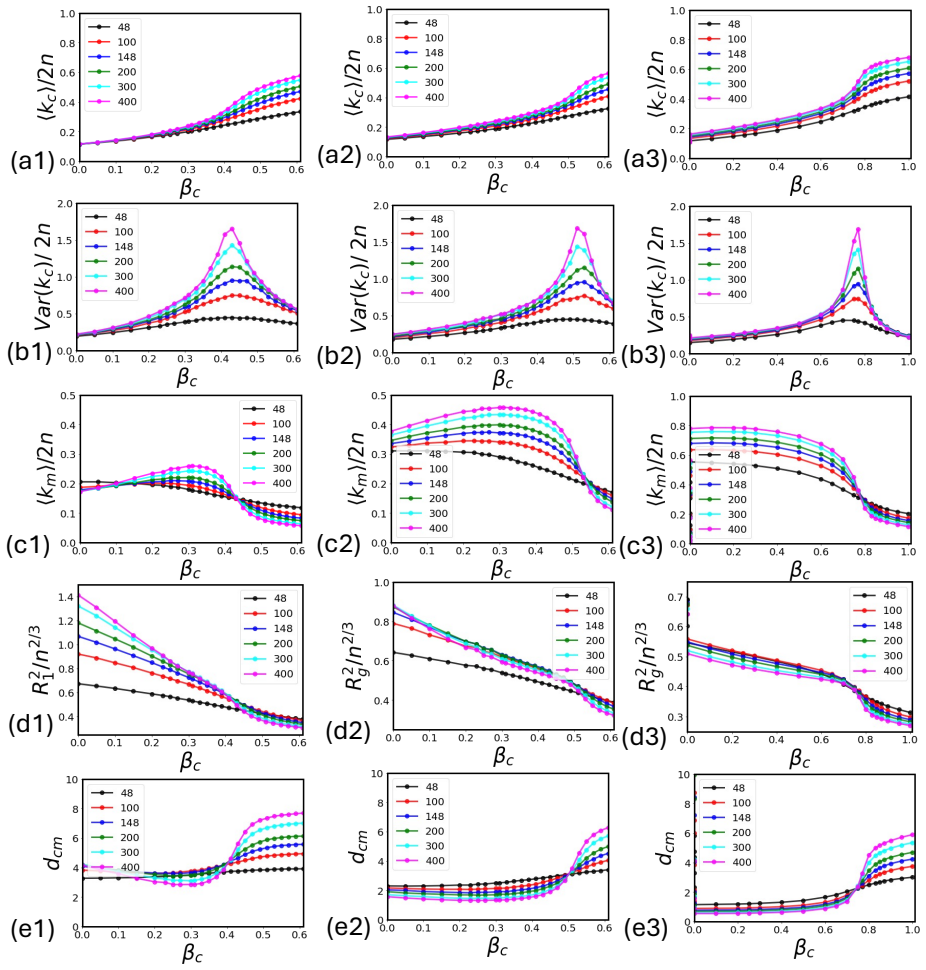
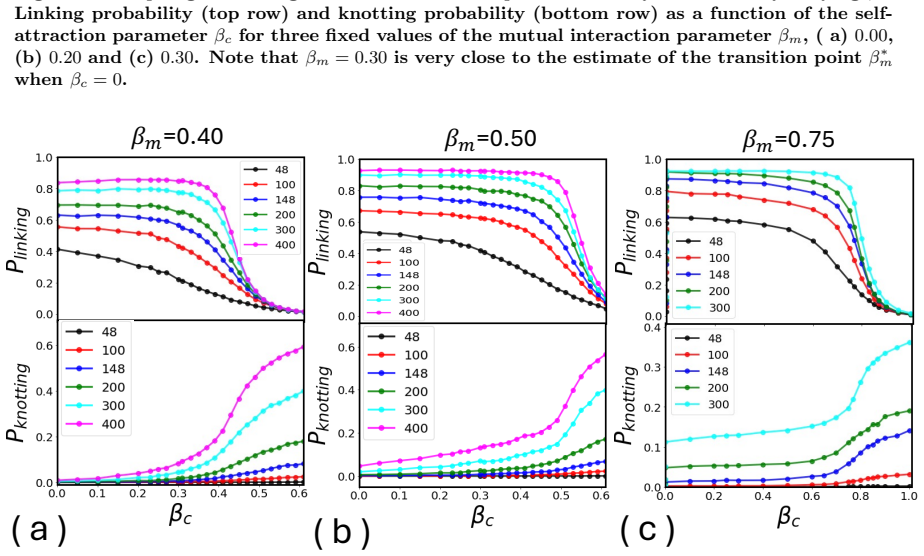
- [Figures] Figure captions should explicitly state the lattice size, interaction parameters, and number of Monte Carlo samples used for each data set.
Simulated Author's Rebuttal
We thank the referee for the constructive feedback and positive assessment of our work on the phase behavior and topology of interacting ring polymers. We address each major comment below, indicating the revisions we will implement.
read point-by-point responses
-
Referee: [Results on phase boundaries] The numerical location of phase boundaries and the assertion of their critical nature (abstract and results section) lack reported error bars, finite-size scaling collapses, or explicit checks for post-hoc parameter tuning; without these the central phase diagram remains only moderately supported.
Authors: We agree that reporting error bars and finite-size scaling would strengthen the support for the phase boundaries. In the revised manuscript we will add error bars estimated from at least five independent Monte Carlo runs for each boundary location. We have already generated data for multiple lattice sizes (N=100, 200, 400) and will include finite-size scaling collapses for the mixing and compactness order parameters to confirm the critical character of the transitions. No post-hoc parameter tuning occurred; the interaction strengths were scanned systematically over a grid chosen from physical considerations of self-avoiding and attractive interactions. revision: yes
-
Referee: [Topological properties analysis] The topological claims that the rings are 'likely to be linked' in the mixed phase and 'knotted' in the segregated-collapsed phase rest on lattice projections and invariants; no quantitative comparison to off-lattice bead-spring or worm-like-chain realizations is provided, leaving open the possibility of lattice-specific artifacts near the collapse transition.
Authors: Our topological conclusions rely on well-established lattice projections and polynomial invariants, which are standard and combinatorially exact for the model. We will expand the revised manuscript with an explicit discussion of possible lattice artifacts near the collapse transition and will cite literature comparing lattice and continuum results for knotting probabilities in polymers. A full quantitative off-lattice comparison (bead-spring or worm-like chain) lies outside the scope of the present study due to the prohibitive computational cost of equivalent sampling and invariant calculation; we maintain that the qualitative trends are robust and consistent with general expectations for ring polymers. revision: partial
- Quantitative comparison of topological invariants to off-lattice bead-spring or worm-like-chain models
Circularity Check
No significant circularity; phases and topologies obtained from explicit Monte Carlo sampling
full rationale
The derivation relies on Monte Carlo sampling of a lattice model with self/mutual interactions plus combinatorial arguments to locate phase boundaries and measure linking/knotted fractions. No equations reduce a prediction to a fitted input by construction, no self-definitional steps appear, and no load-bearing uniqueness theorems or ansatzes are imported via self-citation. The central claims (mixed phase linking, segregated-collapsed knotting) are outputs of the sampling procedure rather than re-statements of its inputs.
Assumptions & free parameters
free parameters (1)
- self and mutual interaction strengths
assumptions (1)
- domain assumption Lattice discretization faithfully represents continuous polymer ring statistics
Cite this review
Pith. "Pith review of Mixing, segregation, and collapse transitions of interacting copolymer rings." pith.science (2026). https://pith.science/paper/2512.24303
@misc{pith2026251224303,
  author       = {Pith},
  title        = {Pith review of: Mixing, segregation, and collapse transitions of interacting copolymer rings},
  year         = {2026},
  howpublished = {\url{https://pith.science/paper/2512.24303}},
  note         = {Machine review of arXiv:2512.24303}
}
read the original abstract
A system of two self and mutual interacting ring polymers, close together in space, can display several competing equilibrium phases and phase transitions. Using Monte Carlo simulations and combinatorial arguments on a corresponding lattice model, we determine three equilibrium phases, two in which the rings segregate in space and are either extended (the segregated-expanded phase) or compact (the segregated-collapsed phase). The third is a mixed phase where the rings interpenetrate. The corresponding phase boundaries are located numerically and their critical nature is discussed. Finally, by looking at the topological properties of the three phases, we show that the two rings are likely to be linked in the mixed phase and knotted in the segregated-collapsed phase.
Figures


Figures from the paper (13 more)






Lean theorems connected to this paper
-
IndisputableMonolith/Foundation/AlexanderDuality.leanalexander_duality_circle_linking unclear?
unclearRelation between the paper passage and the cited Recognition theorem.
Using Monte Carlo simulations and combinatorial arguments on a corresponding lattice model, we determine three equilibrium phases... the two rings are likely to be linked in the mixed phase and knotted in the segregated-collapsed phase.
-
IndisputableMonolith/Cost/FunctionalEquation.leanwashburn_uniqueness_aczel unclear?
unclearRelation between the paper passage and the cited Recognition theorem.
Z_{2n}(β_m, β_c) = ∑ p^{(2)}_{2n}(k_m, k_c) e^{β_m k_m + β_c k_c}
What do these tags mean?
- matches
- The paper's claim is directly supported by a theorem in the formal canon.
- supports
- The theorem supports part of the paper's argument, but the paper may add assumptions or extra steps.
- extends
- The paper goes beyond the formal theorem; the theorem is a base layer rather than the whole result.
- uses
- The paper appears to rely on the theorem as machinery.
- contradicts
- The paper's claim conflicts with a theorem or certificate in the canon.
- unclear
- Pith found a possible connection, but the passage is too broad, indirect, or ambiguous to say the theorem truly supports the claim.
Reference graph
Works this paper leans on
-
[1]
EJ Janse van Rensburg, E Orlandini, MC Tesi, and SG Whittington. Thermodynamic and topological properties of copolymer rings with a segregation/mixing transition.J Phys A: Math Theor, 55(43):435002, 2022
work page 2022
-
[2]
Y Ohta, Y Kushida, D Kawaguchi, Y Matsushita, and A Takano. Preparation, character- ization, and nanophase-separated structure of catenated polystyrene- polyisoprene.Macro- molecules, 41(11):3957–3961, 2008
work page 2008
-
[3]
P-F Cao, JD Mangadlao, A de Leon, Z Su, and RC Advincula. Catenated poly (ε-caprolactone) and poly (l-lactide) via ring-expansion strategy.Macromol, 48(12):3825–3833, 2015
work page 2015
-
[4]
Polycatenanes.Chem Rev, 109(11):6024–6046, 2009
Z Niu and HW Gibson. Polycatenanes.Chem Rev, 109(11):6024–6046, 2009
work page 2009
-
[5]
J Luengo-M´ arquez, S Assenza, and C Micheletti. Shape and size tunability of sheets of inter- locked ring copolymers.Soft Matter, 20(33):6595–6607, 2024
work page 2024
-
[6]
D Sun and J Cho. Monte Carlo simulations on thermodynamic and conformational properties of catenated double-ring copolymers.Phys Rev E, 90(6):062601, 2014
work page 2014
-
[7]
L Tubiana, F Ferrari, and E Orlandini. Circular polycatenanes: Supramolecular structures with topologically tunable properties.Phys Rev Lett, 129(22):227801, 2022
work page 2022
-
[8]
MC Tesi, EJ Janse van Rensburg, Enzo Orlandini, DW Sumners, and SG Whittington. Knot- ting and supercoiling in circular DNA: A model incorporating the effect of added salt.Physical Review E, 49(1):868–872, 1994
work page 1994
Show all 36 references
-
[9]
Entangled polymers in condensed phases.J Chem Phys, 121(23):12094–12099, 2004
E Orlandini and SG Whittington. Entangled polymers in condensed phases.J Chem Phys, 121(23):12094–12099, 2004. 24
2004
-
[10]
A study of the entanglement in systems with periodic boundary conditions.Progr Theo Phys Supp, 191:172–181, 2011
E Panagiotou, C Tzoumanekas, S Lambropoulou, K C Millett, and D N Theodorou. A study of the entanglement in systems with periodic boundary conditions.Progr Theo Phys Supp, 191:172–181, 2011
2011
-
[11]
Exact enumeration study of free energies of interacting polygons and walks in two dimensions.J Phys A: Math Gen, 31(20):4725–4741, 1998
D Bennett-Wood, IG Enting, DS Gaunt, AJ Guttmann, JL Leask, AL Owczarek, and SG Whit- tington. Exact enumeration study of free energies of interacting polygons and walks in two dimensions.J Phys A: Math Gen, 31(20):4725–4741, 1998
1998
-
[12]
Interacting self-avoiding walks and polygons in three dimensions.J Phys A: Math Gen, 29(10):2451–2463, 1996
MC Tesi, EJ Janse van Rensburg, E Orlandini, and SG Whittington. Interacting self-avoiding walks and polygons in three dimensions.J Phys A: Math Gen, 29(10):2451–2463, 1996
1996
-
[13]
Annealing Markov chain Monte Carlo with applications to ancestral inference.J Amer Stat Ass, 90(431):909–920, 1995
CJ Geyer and EA Thompson. Annealing Markov chain Monte Carlo with applications to ancestral inference.J Amer Stat Ass, 90(431):909–920, 1995
1995
-
[14]
Monte Carlo study of the interacting self-avoiding walk model in three dimensions.J Stat Phys, 82(1):155–181, 1996
MC Tesi, EJ Janse van Rensburg, E Orlandini, and SG Whittington. Monte Carlo study of the interacting self-avoiding walk model in three dimensions.J Stat Phys, 82(1):155–181, 1996
1996
-
[15]
Equation of state calculations by fast computing machines.J Chem Phys, 21(6):1087–1092, 1953
N Metropolis, AW Rosenbluth, MN Rosenbluth, AH Teller, and E Teller. Equation of state calculations by fast computing machines.J Chem Phys, 21(6):1087–1092, 1953
1953
-
[16]
Monte Carlo calculations on the dynamics of polymers in dilute solution.J Chem Phys, 36(1):227–235, 1962
PH Verdier and WH Stockmayer. Monte Carlo calculations on the dynamics of polymers in dilute solution.J Chem Phys, 36(1):227–235, 1962
1962
-
[17]
Monte Carlo generation of self-avoiding walks with fixed endpoints and fixed length.J Stat Phys, 58(1):159–183, 1990
N Madras, A Orlitsky, and LA Shepp. Monte Carlo generation of self-avoiding walks with fixed endpoints and fixed length.J Stat Phys, 58(1):159–183, 1990
1990
-
[18]
On the number of self-avoiding walks.J Math Phys, 4:960–969, 1963
H Kesten. On the number of self-avoiding walks.J Math Phys, 4:960–969, 1963
1963
-
[19]
Adsorption and collapse of self-avoiding walks and polygons in three dimensions.J Phys A: Math Gen, 29:6253–6264, 1996
T Vrbov´ a and SG Whittington. Adsorption and collapse of self-avoiding walks and polygons in three dimensions.J Phys A: Math Gen, 29:6253–6264, 1996
1996
-
[20]
Adsorption and collapse of self-avoiding walks in three dimen- sions: a Monte Carlo study.J Phys A: Math Gen, 31:3989–3998, 1998
T Vrbov´ a and SG Whittington. Adsorption and collapse of self-avoiding walks in three dimen- sions: a Monte Carlo study.J Phys A: Math Gen, 31:3989–3998, 1998
1998
-
[21]
Adsorption and collapse of self-avoiding walks at a defect plane.J Phys A: Math Gen, 31:7031–7041, 1998
T Vrbov´ a and SG Whittington. Adsorption and collapse of self-avoiding walks at a defect plane.J Phys A: Math Gen, 31:7031–7041, 1998
1998
-
[22]
Collapsing and adsorbing polygons.J Phys A: Math Gen, 31(41):8295– 8306, 1998
EJ Janse van Rensburg. Collapsing and adsorbing polygons.J Phys A: Math Gen, 31(41):8295– 8306, 1998
1998
-
[23]
Cambridge University Press, 1952
GH Hardy, JE Littlewood, and G P´ olya.Inequalities. Cambridge University Press, 1952
1952
-
[24]
Markov chain Monte Carlo maximum likelihood.Comp Sci and Stat: Proc 23rd Symp on the Interface, pages 156–163, 1991
CJ Geyer. Markov chain Monte Carlo maximum likelihood.Comp Sci and Stat: Proc 23rd Symp on the Interface, pages 156–163, 1991
1991
-
[25]
Accurate estimate of the critical exponentνfor self-avoiding walks via a fast imple- mentation of the pivot algorithm.Phys Rev Lett, 104:055702, Feb 2010
N Clisby. Accurate estimate of the critical exponentνfor self-avoiding walks via a fast imple- mentation of the pivot algorithm.Phys Rev Lett, 104:055702, Feb 2010
2010
-
[26]
Self-avoiding walks interacting with a surface.J Phys A: Math Gen, 15:539–571, 1982
JM Hammersley, GM Torrie, and SG Whittington. Self-avoiding walks interacting with a surface.J Phys A: Math Gen, 15:539–571, 1982. 25
1982
-
[27]
Oxford University Press, 2015
EJ Janse Van Rensburg.The Statistical Mechanics of Interacting Walks, Polygons, Animals and Vesicles, 2ed. Oxford University Press, 2015
2015
-
[28]
On the Alexander polynomial.Ann Math, 57(1):57–89, 1953
G Torres. On the Alexander polynomial.Ann Math, 57(1):57–89, 1953
1953
-
[29]
Classification of knot projections.Top Appl, 16(1):19–31, 1983
CH Dowker and MB Thistlethwaite. Classification of knot projections.Top Appl, 16(1):19–31, 1983
1983
-
[30]
The knot probability in lattice polygons.J Phys A: Math Gen, 23(15):3573–3590, 1990
EJ Janse van Rensburg and SG Whittington. The knot probability in lattice polygons.J Phys A: Math Gen, 23(15):3573–3590, 1990
1990
-
[31]
The probability of knotting in lattice polygons.Contemp Math, 304:125–136, 2002
EJ Janse van Rensburg. The probability of knotting in lattice polygons.Contemp Math, 304:125–136, 2002
2002
-
[32]
Random paths and random surfaces on a digital computer.Phys Lett B, 106(4):323–326, 1981
B Berg and D Foerster. Random paths and random surfaces on a digital computer.Phys Lett B, 106(4):323–326, 1981
1981
-
[33]
A new Monte Carlo approach to the critical properties of self-avoiding random walks.J de Physique, 44(3):323–331, 1983
C Aragao De Carvalho and S Caracciolo. A new Monte Carlo approach to the critical properties of self-avoiding random walks.J de Physique, 44(3):323–331, 1983
1983
-
[34]
Knotted globular ring polymers: How topology affects statistics and thermodynamics.Macromol, 47(23):8466–8476, 2014
M Baiesi, E Orlandini, and AL Stella. Knotted globular ring polymers: How topology affects statistics and thermodynamics.Macromol, 47(23):8466–8476, 2014
2014
-
[35]
Identifying knots in proteins.Biochem Soc Trans, 41(2):533–537, 2013
KC Millett, EJ Rawdon, A Stasiak, and JI Su lkowska. Identifying knots in proteins.Biochem Soc Trans, 41(2):533–537, 2013
2013
-
[36]
Development of knotting during the collapse transition of polymers.J Chem Phys, 127(24):244902, 2007
ML Mansfield. Development of knotting during the collapse transition of polymers.J Chem Phys, 127(24):244902, 2007. 26
2007
Reviewed May 16, 2026 · model on record in the stance chip above.
Discussion (0). Continue with ORCID to comment.