REVIEW 3 major objections 6 minor 30 references
WHALES: an optimized retracker for satellite radar altimeter waveforms in sea state applications
T0 review · 3 major / 6 minor · reviewed 2026-08-15 · deepseek-v4-flash
Pith's one-line read WHALES, a two-pass weighted retracker for radar altimetry, retrieves significant wave height with up to 70% less along-track noise and 30% more valid coastal records than the previous Sea State CCI processing.
desk verdict Solid retracker description with a clean coastal validation, but the 30%/70% headline numbers mix the retracker's effect with unrelated database changes. read the letter →
The pith
A machine-rendered reading of the paper's core claim, the machinery that carries it, and where it could break.
The reading
What carries the argument
The load-bearing object is a weighted least-squares cost function $F(\theta) = \sum_i w_i (y_i - \hat{y}_i)^2$ used with the Brown waveform, where the weights $w_i$ are the inverse of the Monte-Carlo-estimated standard deviation of the fitting residuals at each range gate for a given SWH. The SWH-dependent stopgate relation controls how much trailing edge is included, and the two-pass procedure makes the subwaveform and weights adaptive to each echo. This combination carries the argument because it reduces speckle-noise influence without importing trailing-edge contamination from land or bright targets; it also changes the effective averaging kernel of the SWH estimate, shortening the zero-crossing scale compared with ordinary least squares.
What would settle it
Compute the actual standard deviation of WHALES fitting residuals at each range gate from a large set of real Jason-3 20 Hz waveforms, bin by SWH, and compare with the Monte Carlo table used for the weights; a large mismatch would show the weighting is miscalibrated for real echoes. A second decisive test is to rerun WHALES with unit weights on the same coastal and open-ocean datasets: if the weighted version does not consistently lower 20 Hz SWH RMS and improve scatter index against buoys, the simulated-noise premise fails on real waveforms.
Extended reading notes
Core claim
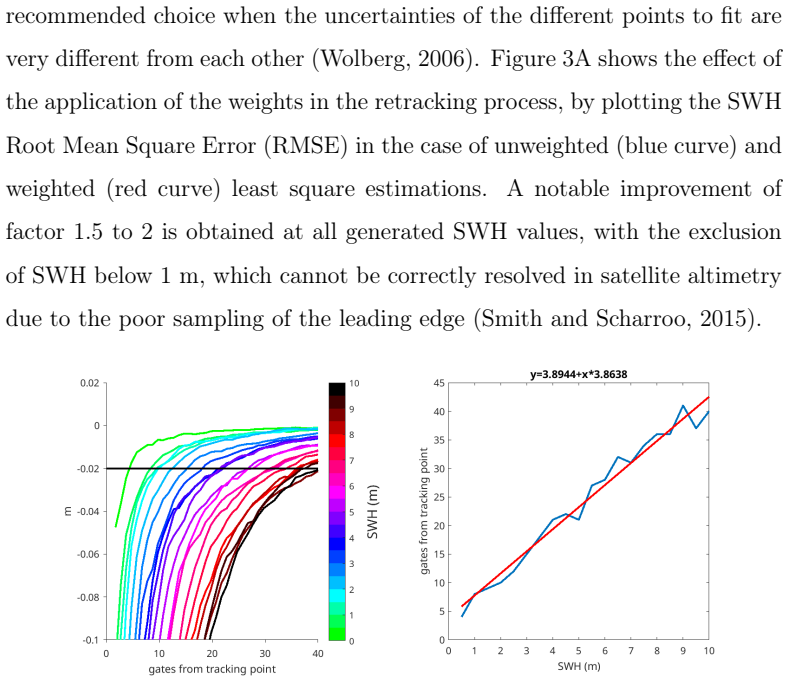
The discovery is that the statistical weighting of residuals, derived from the standard deviation of residuals over 10,000 simulated Brown waveforms per SWH level, makes a subwaveform retracker simultaneously less noisy and more usable near land. WHALES first fits the leading edge with unit weights, uses the resulting SWH to extend the subwaveform according to the stopgate relation, then refits with weights equal to the inverse of the Monte Carlo residual standard deviation. In simulations the weighted fit improves SWH RMSE by a factor of 1.5 to 2 across SWH values above 1 m. In the Sea State CCI v3 database the along-track SWH RMS falls by up to 70% compared to v1 and the number of valid records rises 30% at 5 km from the coast; in coastal-buoy comparisons within 20 km, WHALES has the lowest scatter index of the tested retrackers.
Load-bearing premise
The paper assumes that the error statistics of real altimeter waveforms, including contaminated coastal ones, match the Brown-model-plus-Rayleigh-speckle simulations used to set the stopgate coefficients and the SWH-dependent weights, so that the two-pass adaptive fit stays near-optimal.
Editorial extensions
If this is right
- The Sea State CCI v3 LRM record contains about 30% more valid SWH records at 5 km from the coast and 15% more at 10 km than version 1.
- Along-track SWH noise, measured by the 20 Hz SWH RMS, drops by up to 70% over the 0-10 m SWH range and becomes more similar across the six missions analyzed.
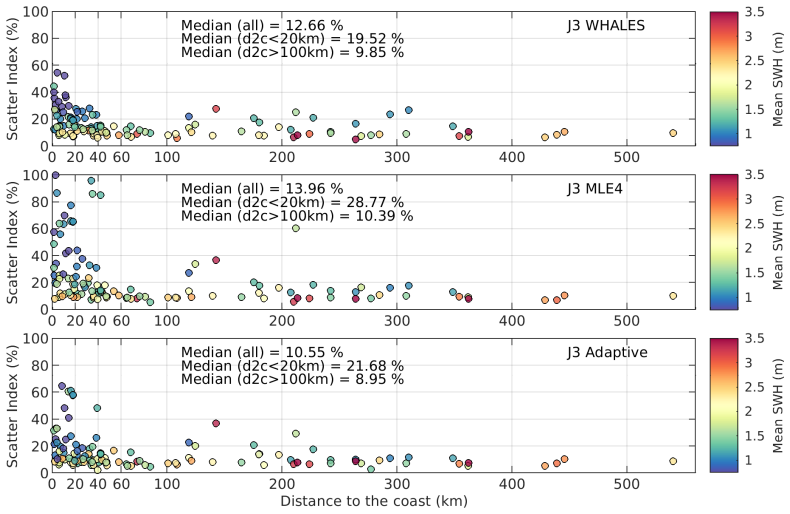
- In coastal matchups with 122 buoys, WHALES achieves the lowest scatter index among the three retrackers compared within 20 km of the coast.
- Because the weighting changes the effective footprint kernel, WHALES resolves shorter along-track scales of wave-height variability than a plain three-parameter least-squares fit, which matters for wave-group and coastal studies.
- The same two-pass weighted scheme can be ported to other waveform models and to missions not yet in the archive, extending three decades of consistent SWH records.
Reading between the lines
- An implication the paper leaves implicit is that the 30% valid-record gain may partly reflect v3's edited compression scheme rather than WHALES alone; a controlled rerun with identical editing would separate the retracker's contribution.
- Because the weights are tuned on Brown-model waveforms, the noise advantage should transfer most faithfully to open-ocean echoes; for strongly non-Brown coastal echoes the gain may shrink, consistent with the paper's own report that Saral 40 Hz data did not improve in the 0-5 km band.
- One testable extension is to use the same inverse-variance weighting for the epoch parameter, since leading-edge residuals carry the same speckle statistics; the paper does not report that extension.
- Another consequence not drawn by the authors is that the stopgate tolerance acts as a tunable resolution knob: lowering the allowed RMSE difference would trade more noise for a shorter effective footprint, and raising it would do the opposite.
Signed reviews
Editorial analysis
A structured set of objections, weighed in public.
Referee Report
Summary. The manuscript describes WHALES, a two-pass adaptive subwaveform retracker for low-resolution-mode (LRM) altimetry that estimates significant wave height (SWH). The first pass is a leading-edge-only least-squares fit; the stopgate for the second pass is set from Eq. (3) as a linear function of the first-pass SWH, and the second-pass fit uses SWH-dependent weights derived from Monte Carlo simulations of Brown-model waveforms with Rayleigh speckle. The paper evaluates WHALES in two ways: a comparison of the ESA Sea State CCI version 3 database (produced with WHALES) against version 1, reporting a 30% increase in valid records at 5 km from the coast and up to 70% reduction in SWH RMS noise; and a comparison of Jason-3 SWH from WHALES, MLE-4, and the Adaptive retracker against 122 coastal buoys, reporting that WHALES achieves the best scatter index within 20 km of the coast. The paper also analyzes the effective along-track weighting kernel J_H of the cost function and discusses three waveform pathologies (sigma0 blooms, phenomenal seas, icebergs) with possible refinements.
Significance. If the headline results are attributable to WHALES, the paper documents a practical improvement in coastal SWH retrieval across multiple LRM missions, with potential value for the Sea State CCI climate record. The manuscript has real strengths: the retracker source code is openly available; the Sea State CCI v1 and v3 data are publicly accessible; the buoy comparison in Section 3.2 is an external, independent check on WHALES versus two operational retrackers; and the Section 4 kernel analysis connects design choices to measurement physics rather than relying solely on aggregate skill scores. These assets make the paper suitable for RSE if the attribution of the quantitative headline claims is strengthened.
major comments (3)
- [Section 3.1, Figures 4-5, Abstract] The abstract states that valid data records increased by 30% at 5 km from the coast 'after applying the retracker discussed here', and Section 3.1 reports up to 70% SWH RMS reduction between version 3 and version 1. This comparison does not isolate the retracker: version 3 differs from version 1 simultaneously in the retracker, the 20-Hz-to-1-Hz compression scheme (including the flagging of negative SWH values), editing/quality flags, and cross-calibration, as the manuscript itself notes when it attributes the low-SWH behavior of the RMS curves to 'the treatment of negative values in the 20Hz to 1Hz compression scheme implemented in version3' and the Saral coastal degradation to an 'artifact of the WHALES retracker'. The 30% and 70% figures are therefore not demonstrably caused by WHALES, and the abstract overstates attribution. Please add an ablation that holds the rest of the processing chain fixed, for example by retracking the version 1 waveforms with WHALES while keeping the version 1 editing and compression, or by comparing version 3 processed with WHALES against version 3 processed with ALES or another retracker, and report the resulting data-count and RMS differences.
- [Section 2.2-2.3, Figures 2-3] The stopgate coefficients in Eq. (3) and the SWH-dependent weight table are fitted to Monte Carlo simulations of Brown-model waveforms with multiplicative Rayleigh speckle, with the tolerance chosen as a 2 cm RMSE at 20 Hz. Consequently the improvement in SWH RMSE shown in Figures 2 and 3 is partly built into the design and does not by itself demonstrate that WHALES is near-optimal on real waveforms, especially coastal ones with non-Brown leading edges. The buoy validation is independent but tests SWH accuracy, not the along-track noise reduction claimed in Section 3.1. I suggest an out-of-sample or real-waveform check, for example comparing the RMSE of the fitted stopgate and weights against one or two alternative coefficient sets on the Jason-2 and Jason-3 waveforms used in Sections 3.2 and 5, or validating the noise reduction on 20-Hz real data with the editing and compression chain held fixed.
- [Section 3.2, Figure 6] The claim that WHALES gives the best scatter index within 20 km from the coast rests on a single median over an unspecified number of buoys in that distance bin, and the SI values are strongly correlated with the mean buoy SWH (used as the color scale), which is itself a function of distance to the coast. Please report the number of matchups per distance bin, the uncertainty of the median SI (e.g., a bootstrap or rank-sum test), and, if possible, a distance-binned or SWH-stratified breakdown so that the reader can assess whether the coastal advantage is statistically robust and not driven by one or two sheltered buoys.
minor comments (6)
- [Section 2.1, Eq. (3)] Please state the units of SWH and 'Tracking point' explicitly; as written, a reader cannot tell whether 'Tracking point' is in gates or range units, and whether Eq. (3) is intended for all LRM missions or only for Jason-3.
- [Section 2.2] The sentence '10,000 waveforms were simulated ... and then averaged to create a simulated high-rate waveform' is ambiguous: each simulated waveform already represents a high-rate echo, and the subsequent RMSE computation would be inconsistent with a single averaged waveform; please rephrase to describe the simulation and retracking procedure more precisely.
- [Figure 3 caption] The caption says 'unweighted (blue) and weighted (right)', but the panel labels and body text indicate 'weighted (red)'; please correct this.
- [Section 5.2] The text 'altimeters are in fact the only instruments that routinely report SHW values over 15 m' contains a typo: 'SHW' should be 'SWH'.
- [Section 3.1, Figure 5] The text refers to 'grey bars' for the number of valid data, but Figure 5 as printed appears to contain only RMS curves; please ensure the data-count overlay is visible or move it to a separate panel.
- [Section 1, Eq. (1)] Equation (1) uses H_s, while the paper later introduces SWH as a distinct quantity; please align the notation in the introduction to avoid confusing the theoretical wave height with the retracker-derived estimate.
Circularity Check
Synthetic-noise improvement is in-sample by construction; real-buoy validation is independent, but the v3-v1 30%/70% attribution mixes retracker with compression/editing/cross-calibration changes.
-
fitted input called prediction
[Section 2.3 / Figure 3A (WHALES weights; Section 3.1 real-data validation)]
"The std of the residuals for varying SWH is shown in figure 3B. ... The weights chosen in the WHALES retracking are the inverse of this std, i.e., the so-called “Statistical Weighting” ... Figure 3A shows the effect of the application of the weights in the retracking process, by plotting the SWH Root Mean Square Error (RMSE) in the case of unweighted (blue curve) and weighted (red curve) least square estimations. A notable improvement of factor 1.5 to 2 is obtained at all generated SWH values"
The weights are literally the inverse of the residual standard deviation computed from the same Monte-Carlo Brown-waveform ensemble that is used to compute the RMSE in Figure 3A. For a known error covariance, inverse-variance weighting is the minimum-variance linear estimator, so applying these weights to the very data that generated the weight table cannot fail to reduce RMSE. The displayed 1.5-2x improvement is therefore a built-in consequence of the construction rather than an independent test of WHALES' noise performance; the independent evidence is the buoy comparison in Section 3.2, not this figure.
full rationale
WHALES' core derivation is mostly self-contained: Eq. (2) is a standard weighted least-squares fit; Eq. (3) and the SWH-dependent weight table are tuned on Brown-model Monte-Carlo waveforms with an explicit RMSE tolerance; and Section 3.2 compares WHALES against MLE-4 and Adaptive retrackers on the same Jason-3 data with common quality flags, providing independent coastal validation. The one genuinely circular element is the synthetic noise-reduction demonstration (Fig. 3A): weights defined as inverse residual std from the same simulation ensemble that produces the RMSE, so the improvement is expected by estimator theory, not an empirical confirmation. Separately, the abstract's '30% at 5 km from the coast after applying the retracker' and the 'up to 70%' noise reduction in Section 3.1 compare Sea State CCI v3 with v1, while the paper itself notes that v3 also changed 20Hz-to-1Hz compression, editing of negative SWH values, and cross-calibration (Piolle and Dodet, 2025); the low-SWH differences and Saral's coastal behavior are even attributed to those non-retracker factors. This is an attribution/confounding issue rather than a circular derivation, and it does not reduce the independent buoy comparison. The Schlembach et al. (2020) self-citation is not load-bearing because Section 3.2 independently reproduces the coastal ranking.
Assumptions & free parameters
free parameters (4)
- Stopgate linear coefficients (Eq. 3: stopgate = tracking point + 3.89 + 3.86*SWH) =
3.89, 3.86
- SWH-dependent weight table =
Inverse of residual std from 10,000 Monte Carlo waveforms per SWH (0.5 to 10 m in 0.5 m steps)
- Leading edge detection thresholds =
Rise 0.01, validity 0.1 for 4 gates, stopgate on first decrease, normalization 1.3 * median
- Quality flag threshold Err =
0.3
assumptions (4)
- domain assumption The Brown (1977) waveform model, assuming a Gaussian surface elevation distribution and spatially homogeneous SWH and sigma0 over the footprint, is an adequate model for the leading edge and the fitted subwaveform.
- domain assumption Simulated waveforms in Sections 2.2 and 2.3, generated from the Brown model with multiplicative Rayleigh speckle noise, faithfully represent the error statistics of real altimeter waveforms across missions.
- domain assumption The linear kernel analysis JH from De Carlo and Ardhuin (2024) accurately describes the retracker's response to localized wave-height perturbations.
- domain assumption The number of averaged pulses and other radar parameters used implicitly in the Monte Carlo simulations match each mission's LRM configuration.
Cite this review
Pith. "Pith review of WHALES: an optimized retracker for satellite radar altimeter waveforms in sea state applications." pith.science (2026). https://pith.science/paper/253CKCJC
@misc{pith2026250512881,
  author       = {Pith},
  title        = {Pith review of: WHALES: an optimized retracker for satellite radar altimeter waveforms in sea state applications},
  year         = {2026},
  howpublished = {\url{https://pith.science/paper/253CKCJC}},
  note         = {Machine review of arXiv:2505.12881}
}
read the original abstract
The latest version of the European Space Agency's Sea State Climate Change Initiative database adopts a dedicated algorithm (retracker) to reprocess two decades of satellite altimetry measurements and provide long time series of significant wave height in the global ocean. This paper describes the main characteristics of this algorithm, called WHALES, and analyzes the impact of algorithm choices on measurement physics, particularly the weighted analysis of residuals in the cost function. Moreover, the impact of WHALES on the sea state database is analyzed in terms of noise reduction and scatter index with in situ data, with a particular focus on the coastal zone, where WHALES primarily improves data quality and quantity compared to previous approaches. We found that valid data records increased by 30% at 5 km from the coast after applying the retracker discussed here.
Figures


Figures from the paper (7 more)




Reference graph
Works this paper leans on
-
[1]
write newline
" write newline "" before.all 'output.state := FUNCTION n.dashify 't := "" t empty not t #1 #1 substring "-" = t #1 #2 substring "--" = not "--" * t #2 global.max substring 't := t #1 #1 substring "-" = "-" * t #2 global.max substring 't := while if t #1 #1 substring * t #2 global.max substring 't := if while FUNCTION word.in bbl.in ":" * " " * FUNCTION f...
-
[2]
write newline
" write newline "" before.all 'output.state := FUNCTION n.dashify 't := "" t empty not t #1 #1 substring "-" = t #1 #2 substring "--" = not "--" * t #2 global.max substring 't := t #1 #1 substring "-" = "-" * t #2 global.max substring 't := while if t #1 #1 substring * t #2 global.max substring 't := if while FUNCTION word.in bbl.in ":" * " " * FUNCTION f...
-
[3]
write newline
" write newline "" before.all 'output.state := FUNCTION n.dashify 't := "" t empty not t #1 #1 substring "-" = t #1 #2 substring "--" = not "--" * t #2 global.max substring 't := t #1 #1 substring "-" = "-" * t #2 global.max substring 't := while if t #1 #1 substring * t #2 global.max substring 't := if while FUNCTION word.in bbl.in ":" * " " * FUNCTION f...
-
[4]
author Ardhuin, F. , author De Carlo, M. , year 2025 . title A database of "very high" and "phenomenal" sea states from the esa seastate cci v4 database, with complements from cnes cfosat and swot nadir altimeters. version 1 (not inter-calibrated) . :10.17882/105378
-
[5]
author Battjes, J. , year 1984 . title A review of methods to establish the wave climate for breakwater design . journal Coastal Eng. volume 8 , pages 141--160
work page 1984
-
[6]
author Brown, G.S. , year 1977 . title The average impulse response of a rough surface and its applications . journal IEEE J. Oceanic Eng. volume 2 , pages 67--63 . :10.1109/JOE.1977.1145328
-
[7]
author Challenor, P.G. , author Srokosz, M.A. , year 1989 . title The extraction of geophysical parameters from radar altimeter returns from a nonlinear sea surface , in: editor Brooks, S.R. (Ed.), booktitle Mathematics in remote sensing . publisher Clarendon Press, Oxford , pp. pages 256--268
work page 1989
-
[8]
author Chelton, D.B. , author Walsh, E.J. , author MacArthur, J.L. , year 1989 . title Pulse compression and sea level tracking in satellite altimetry . journal J. Atmos. Ocean Technol. volume 6 , pages 407--438 . :10.1175/1520-0426(1989)006<0407:pcaslt>2.0.co;2
Show all 30 references
-
[9]
, author Munk, W
author Cox, C. , author Munk, W. , year 1954 . title Measurement of the roughness of the sea surface from photographs of the sun's glitter . journal J. Opt. Soc. Am. volume 44 , pages 838--850 . :10.1364/josa.44.000838
1954 doi
-
[10]
, author Gentemann, C.L
author Cronin, M.F. , author Gentemann, C.L. , author Edson, J. , author Ueki, I. , author Bourassa, M. , author Brown, S. , author Clayson, C.A. , author Fairall, C. , author Farrar, T. , author Gille, S.T. , author Gulev, S. , author Josey, S. , author Kato, S. , author Kats...
2019
-
[11]
, author Ardhuin, F
author De Carlo, M. , author Ardhuin, F. , year 2024 . title Along-track resolution and uncertainty of altimeter-derived wave height and sea level: re-defining the significant wave height in extreme storms . journal J. Geophys. Res. volume 134 . :10.1029/2023JC020832
2024 doi
-
[12]
, author Ardhuin, F
author De Carlo, M. , author Ardhuin, F. , author Ollivier, A. , author Nigou, A. , year 2023 . title Wave groups and small scale variability of wave heights observed by altimeters . journal J. Geophys. Res. volume 133 , pages e2023JC019740 . :10.1029/2023JC019740
2023 doi
-
[13]
, author Boy, F
author Dibarboure, G. , author Boy, F. , author Desjonqueres, J.D. , author Labroue, S. , author Lasne, Y. , author Picot, N. , author Poisson, J.C. , author Thibaut, P. , year 2014 . title Investigating short-wavelength correlated errors on low-resolution mode altimetry . jou...
2014 doi
-
[14]
, author Mureau, G
author Dodet, G. , author Mureau, G. , author Accensi, M. , author Piollé, J.F. , year 2025 . title Impact of altimeter-buoy data-pairing methods on the validation of Sentinel - 3A coastal significant wave heights . journal Remote Sensing of Environment volume 316 , pages 1144...
2025
-
[15]
, author Piolle, J.F
author Dodet, G. , author Piolle, J.F. , author Quilfen, Y. , author Abdalla, S. , author Accensi, M. , author Ardhuin, F. , author Ash, E. , author Bidlot, J.R. , author Gommenginger, C. , author Marechal, G. , author Passaro, M. , author Quartly, G. , author Stopa, J. , auth...
2020
-
[16]
, author Gommenginger, C.P
author G \'o mez-Enri, J. , author Gommenginger, C.P. , author Srokosz, M.A. , author Challenor, P.G. , year 2007 . title Measuring global ocean wave skewness by retracking RA-2 E nvisat waveforms . journal J. Atmos. Ocean Technol. volume 24 , pages 1102--1107 . :10.1175/JTECH2014.1
2007 doi
-
[17]
, author Quilfen, Y
author Hanafin, J. , author Quilfen, Y. , author Ardhuin, F. , author Sienkiewicz, J. , author Queffeulou, P. , author Obrebski, M. , author Chapron, B. , author Reul, N. , author Collard, F. , author Corman, D. , author de Azevedo, E.B. , author Vandemark, D. , author Stutzma...
2012 doi
-
[18]
, author Mead, R
author Nelder, J.A. , author Mead, R. , year 1965 . title A simplex method for function minimization . journal The C omputer J ournal volume 7 , pages 308--313
1965
-
[19]
, author Cipollini, P
author Passaro, M. , author Cipollini, P. , author Vignudelli, S. , author Quartly, G. , author Snaith, H. , year 2014 a. title ALES : A multi-mission subwaveform retracker for coastal and open ocean altimetry . journal Remote Sensing of the Environment volume 145 , pages 173-...
2014 doi
-
[20]
, author Cipollini, P
author Passaro, M. , author Cipollini, P. , author Vignudelli, S. , author Quartly, G.D. , author Snaith, H.M. , year 2014 b. title ALES : A multi-mission adaptive subwaveform retracker for coastal and open ocean altimetry . journal Remote sensing of Environment volume 145 , p...
2014
-
[21]
, author Hemer, M.A
author Passaro, M. , author Hemer, M.A. , author Quartly, G.D. , author Schwatke, C. , author Dettmering, D. , author Seitz, F. , year 2021 . title Global coastal attenuation of wind-waves observed with radar altimetry . journal Nature communications volume 12 , pages 3812 . :...
2021 doi
-
[22]
, author Dodet, G
author Piolle, J. , author Dodet, G. , year 2025 . title Sea State Climate Change Initiative, Product User Guide Version 3.1 . https://climate.esa.int/media/documents/Sea_State_cci_PUG_v3.1-signed.pdf. note last accessed on April 4, 2025
2025
-
[23]
, author Guymer, T.H
author Quartly, G.D. , author Guymer, T.H. , author Srokosz, M.A. , year 1996 . title The effect of rain on Topex radar altimeter data . journal J. Atmos. Ocean Technol. volume 13 , pages 1209--1229 . :10.1175/1520-0426(1996)013<1209:TEOROT>2.0.CO;2
1996 doi
-
[24]
, author Passaro, M
author Schlembach, F. , author Passaro, M. , author Quartly, G.D. , author Kurekin, A. , author Nencioli, F. , author Dodet, G. , author Pioll \'e , J.F. , author Ardhuin, F. , author Bidlot, J. , author Schwatke, C. , author Seitz, F. , author Cipollini, P. , author Donlon, C...
2020
-
[25]
, author Scharroo, R
author Smith, W.H. , author Scharroo, R. , year 2015 . title Waveform aliasing in satellite radar altimetry . journal IEEE Transactions on Geoscience and Remote Sensing volume 53 , pages 1671--1682 . :10.1109/TGRS.2014.2331193
2015
-
[26]
, author Poisson, J
author Thibaut, P. , author Poisson, J. , author Bronner, E. , author Picot, N. , year 2010 . title Relative performance of the MLE3 and MLE4 retracking algorithms on J ason-2 altimeter waveforms . journal Mar. Geod. volume 33 , pages 317--335
2010
-
[27]
, author Piras, F
author Tourain, C. , author Piras, F. , author Ollivier, A. , author Hauser, D. , author Poisson, J.C. , author Boy, F. , author Thibaut, P. , author Hermozo, L. , author Tison, C. , year 2021 . title Benefits of the adaptive algorithm for retracking altimeter nadir echoes: re...
2021
-
[28]
, author B
author Tournadre, J. , author B. Chapron, N.R. , author Vandemark, D.C. , year 2006 . title A satellite altimeter model for ocean slick detection . journal J. Geophys. Res. volume 111 , pages C02006 . :10.1029/2005JC003109
2006 doi
-
[29]
, author Chapron, B
author Vandemark, D. , author Chapron, B. , author Sun, J. , author Crescenti, G.H. , author Graber, H.C. , year 2004 . title Ocean wave slope observations using radar backscatter and laser altimeters . journal J. Phys. Oceanogr. volume 34 , pages 2825--2842
2004
-
[30]
, year 2006
author Wolberg, J. , year 2006 . title Data Analysis Using the Method of Least Squares: Extracting the Most Information from Experiments . publisher Springer , address Berlin, Heidelberg . :10.1007/3-540-31720-1
2006 doi
Reviewed August 15, 2026 · model on record in the stance chip above.
Discussion (0). Continue with ORCID to comment.