REVIEW 5 major objections 6 minor 40 references
Audit & Repair: An Agentic Framework for Consistent Story Visualization in Text-to-Image Diffusion Models
T0 review · 5 major / 6 minor · reviewed 2026-08-15 · deepseek-v4-flash
Pith's one-line read An agentic audit-and-repair loop detects and fixes character inconsistencies in generated story panels without retraining the diffusion model.
desk verdict A genuine post-generation audit-and-repair loop for story panels, with consistent but modest gains and a load-bearing VLM sensor that is never validated against human labels. read the letter →
The pith
A machine-rendered reading of the paper's core claim, the machinery that carries it, and where it could break.
The reading
What carries the argument
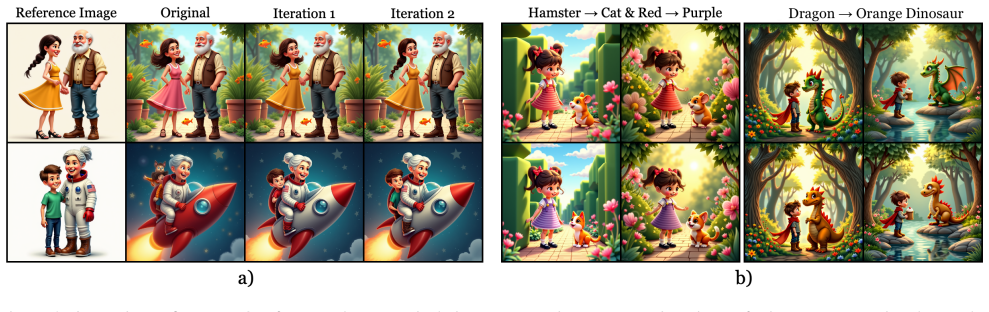
The load-bearing mechanism is the iterative audit-and-repair loop coordinated by specialized agents around a shared memory that holds the panel set, the latest consistency report, and a Consistency Index. The Audit Agent uses a vision-language model to match characters across panels and against a reference image, describe persistent attributes, and flag mismatches; the global Consistency Index rescales the average DINO similarity between frames and the reference image to a 0-100 score. Only validated, visible fixes become text edits, and the Repair Agent applies them to individual frames with an image-conditioned diffusion editor, adjusting the conditioning scale in response to how visible the edit was. The Consistency Director re-audits after each repair cycle and stops when the index exceeds 90 or the maximum of two iterations is reached. The argument turns on mismatch detection being a vision-language alignment task, so no new architecture or training is needed to improve an existing backbone.
What would settle it
Build a benchmark of stories with manually labeled per-panel attribute mismatches, then run the audit with a VLM known to hallucinate object attributes and compare the flagged edits against the labels. If the loop edits correct regions while the CI rises on hallucination-driven flags, the claimed consistency gains are an artifact of the VLM rather than the audit-and-repair mechanism.
Extended reading notes
Core claim
On the paper's own terms, the contribution is an inference-time mechanism for story visualization consistency: a vision-language model audits a generated panel sequence, identifies which attributes of recurring characters or objects have drifted, and a separate repair agent edits only the inconsistent frames. The audit distinguishes intentional story changes, because it consults the original panel prompt, and it validates suggested fixes with a two-step self-verification before converting them into text edits. The repair agent applies these edits with an image-conditioned diffusion editor and adapts the conditioning strength when an edit is too weak or over-edits. Compared with StoryDiffusion, StoryGen, ConsiStory, AutoStudio, and DSD, the paper reports higher image- and character-level consistency metrics, higher alignment metrics such as TIFA and HPS, and higher user ratings for visual consistency and narrative alignment.
Load-bearing premise
The framework's entire loop depends on the vision-language model's descriptions faithfully capturing whether character and object attributes actually match across panels; if that model hallucinates attributes, the Consistency Index is corrupted and repairs can be triggered by false positives or miss genuine inconsistencies.
Editorial extensions
If this is right
- Any of the tested story backbones, StoryDiffusion, ConsiStory, or DSD, gains DINO and HPS and loses LPIPS when run through the loop, meaning consistency can be improved post-hoc without retraining.
- Because repairs target only flagged frames, a user can request a fine-grained change, such as a dress color, or a semantic change, such as replacing a hamster with a cat, and only affected panels are regenerated.
- A second audit-and-repair pass produces further consistency gains, so users can trade compute for coherence by changing the iteration cap.
- The improvement persists in foreground-only metrics computed after segmentation, indicating the gain is in character appearance and not just background similarity.
- The same modular pipeline works with rectified-flow transformers and latent diffusion models, so the method transfers across generation architectures.
Reading between the lines
- If the VLM auditor is a source of hallucination, one natural extension is an ensemble of VLMs voting on each mismatch; this follows from the paper's stated limitation and could reduce unnecessary or missed corrections.
- Because the Consistency Index averages similarity to a single reference image, it could reward static re-renderings of the reference over narrative evolution; a metric that credits intentional changes while penalizing drift would separate these effects.
- The audit could be grounded in the same foreground segmentation used for evaluation, focusing comparison on the characters rather than the background and reducing spurious textual mismatches.
- The loop's panel-level edits suggest a direct path to temporal domains such as video, though that would require propagating edits through time rather than frame-by-frame as the paper currently does.
Signed reviews
Editorial analysis
A structured set of objections, weighed in public.
Referee Report
Summary. This paper proposes Audit & Repair, an inference-time multi-agent framework for improving cross-panel visual consistency in text-to-image story visualization. The framework consists of a Story Initialization Agent that generates panels using an off-the-shelf backbone (DSD, StoryDiffusion, or ConsiStory), an Audit Agent that uses a VLM (GPT-4) to describe each panel, compare it against a reference image, and produce a structured consistency report together with a DINO-based Consistency Index, a Repair Agent that performs localized edits with Flux-ControlNet-Union, and a Consistency Director that iterates the audit-repair cycle until the Consistency Index exceeds a threshold or a maximum iteration count is reached. The experiments on 100 stories with 7 panels per story report improvements in DINO, LPIPS, CLIP-I, HPS, TIFA, foreground-region metrics, and user-study ratings (50 participants) over five baselines, including ablations on multiple backbones and an iterative-refinement study. The paper is clearly written and includes an explicit discussion of limitations, notably the assumption that VLM scores faithfully reflect cross-panel coherence.
Significance. If the framework performs as claimed, it would offer a practical, training-free route to enforce character and object consistency across arbitrary diffusion backbones, which is a recognized bottleneck in story visualization. Strengths include the modular agent design, the breadth of quantitative evaluation (including SAM-based foreground metrics), and a human user study. The candid limitation statement in Section 5 is commendable. However, the current evidence is weakened by three issues: the Consistency Index used as the loop's stopping criterion is a DINO-based score and DINO is also a headline evaluation metric, making part of the reported improvement circular; the default CI threshold (90) appears unreachable for the reported DINO values, so the loop effectively reduces to a fixed two-iteration pipeline; and the VLM auditor's precision and recall are never validated, leaving the central detection-and-repair claim contingent on an unverified assumption. With deconfounded evaluation, calibration of the stopping rule, and audit validation, the contribution could be significant for the story-visualization community.
major comments (5)
- [§3.1 (Audit Agent), §4.2 (Table 1)] The Consistency Index CI is defined as a linear rescaling of the mean DINO similarity between each panel and the reference image, and the Consistency Director terminates the loop when CI exceeds τ. The headline DINO metric in Tables 1 and 3 is the average pairwise DINO similarity between frames, which is strongly correlated with (and indirectly optimized by) the same DINO-based objective. Consequently, the DINO improvements (e.g., 0.549→0.568 in Table 1, 0.549→0.586 in Table 3) are confounded with the optimization target. The authors should either use a VLM-derived textual consistency score or another non-DINO criterion as the stopping signal, or relegate DINO to a secondary metric and rely on independent measures such as LPIPS, foreground DINO, and user ratings as primary evidence.
- [§3.1 (Consistency Director), §4.2 (Tables 1 and 3)] Given the reported DINO values and the definition CI = 100 * (mean DINO + 1) / 2, the corrected outputs have CI values of roughly 78–84 (e.g., DINO 0.568 gives CI ≈ 78.4, and DINO 0.586 gives CI ≈ 79.3). This is far below the default threshold τ = 90. The paper does not report CI distributions, so it appears the stopping rule is never satisfied and the system always terminates at T_max = 2. The loop is therefore effectively a fixed two-iteration procedure, which undermines the claimed dynamic, consistency-driven control. The authors should report the actual CI trajectories and calibrate τ (or remove the threshold) so that the stopping logic is meaningful.
- [§5 (Limitations)] The framework's detection and correction decisions are made entirely by the VLM-based Audit Agent, yet the authors state in Section 5 that 'our consistency agent assumes that VLM scores faithfully capture cross-panel coherence. Hallucinations in these textual descriptions propagate directly to the Consistency Index and may trigger unnecessary—or miss—corrections.' No experiment measures the audit false-positive or false-negative rate against human labels, no second VLM is tested, and all experiments couple GPT-4 as both story generator and auditor with Flux-ControlNet as the repairer. This leaves open the possibility that the observed gains are an artifact of GPT-4's specific hallucination patterns rather than a robust general mechanism. The authors should add an audit-quality study (e.g., human-annotated consistency reports), an ablation with an alternative open-source VLM, and a failure analysis of repair outcomes.
- [§4.2 (Quantitative Experiments)] The improvements over DSD in Table 1 are modest relative to the reported standard deviations (e.g., DINO 0.568 ± 0.15 vs. 0.549 ± 0.13; LPIPS 0.472 ± 0.07 vs. 0.497 ± 0.05). No paired significance tests are reported for any metric, including the foreground metrics in Table 2 and the user-study ratings in Table 4. The authors should provide paired statistical tests (e.g., bootstrap or Wilcoxon signed-rank) with effect sizes and confidence intervals to establish that the gains are not due to noise.
- [§1 (Introduction), §4.1 (Qualitative Experiments)] The abstract and introduction claim compatibility with rectified-flow transformers such as Flux and latent diffusion models such as Stable Diffusion. However, the three generation backbones evaluated in the paper (DSD, StoryDiffusion, ConsiStory) are all based on Stable Diffusion; Flux appears only as the editing model (Flux-ControlNet-Union) inside the Repair Agent. No experiment generates initial panels with a Flux backbone. The authors should either add a Flux-based generation experiment or explicitly temper the model-agnostic claim to what is actually demonstrated.
minor comments (6)
- [§3.1 (Repair Agent)] The description of the conditioning-scale adjustment appears contradictory: 'if the changes are too subtle or not visible, the scale is decreased to encourage stronger edits' — decreasing the scale would normally weaken the edit. Please clarify the intended direction of the adjustment.
- [§4.3 (Ablation Studies)] The first paragraph states that the framework is applied to StoryDiffusion and ConsiStory, while the second paragraph describes the iterative-refinement ablation only on DSD. Please clearly specify that the iteration study is DSD-only or extend it to the other backbones.
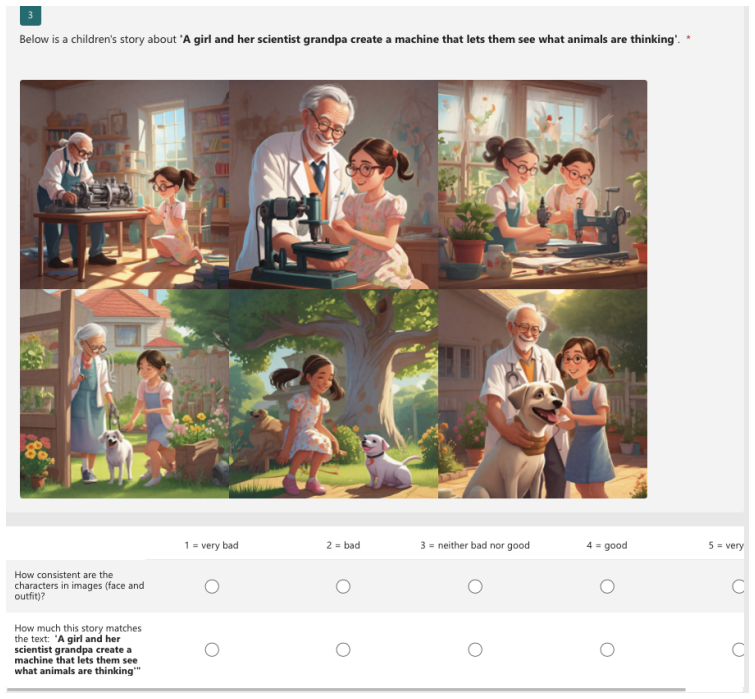
- [Appendix B (User Study)] The appendix says each participant saw 'five different story prompts' and 'a sequence of six images,' whereas the main experiments use 100 stories and 7 panels per story. Please reconcile these numbers and clarify whether the user study used a different subset.
- [§4.4 (User Study)] Cohen's Kappa is typically used for categorical ratings; its use for 1–5 Likert-scale ratings requires explanation of how ratings were categorized or justification that Kappa is appropriate for ordinal data.
- [Table 2] The parenthetical percentages (e.g., '+14.5%' for StoryDiffusion DINO-FG) are not defined; please state whether they are relative improvements over the standard metrics or something else.
- [References] Several reference URLs appear truncated or malformed (e.g., [2] ends with '2005.141658' and [3] with '2411.186161'). Please verify the arXiv IDs and URLs.
Circularity Check
The DINO metric used as the loop's stopping objective is also reported as a headline consistency metric, making part of the claimed DINO improvement circular; other metrics and the user study provide independent support.
-
self definitional
[Section 3.1 (Audit Agent / Consistency Director) and Section 4.2 (Metrics / Table 1)]
"Scons = 1/N Σ_{i=1}^N DINO(I_i,R), Scons∈[−1,1]. ... This is linearly rescaled to define the Consistency Index: CI = 100((Scons+1)/2) ∈[0,100]. ... If the CI remains below the threshold τ (default 90) ... it initiates another audit–repair loop. ... CLIP-I and DINO are image-image similarity metrics ... we compute the average pairwise similarity between all frames in a story."
The Consistency Index that controls the audit-and-repair loop is defined as a linear rescaling of the mean DINO similarity between each panel and the reference image, and the loop terminates when CI exceeds 90. The paper then reports the average pairwise DINO similarity across all frames as a headline consistency result (Table 1: DSD 0.549 -> Ours 0.568). Because the controller explicitly drives panels toward higher DINO-to-reference similarity, the reported DINO improvement is at least in part a direct consequence of the optimization objective rather than an independent evaluation.
full rationale
The core circularity is confined to the DINO evaluation. The Consistency Index that drives the loop is a linear function of DINO similarity to the reference, and the loop's termination condition optimizes this index. At the same time, Table 1 reports DINO pairwise similarity as a key quantitative claim of improvement (0.549 to 0.568). Thus the DINO improvement is partly forced by the control loop's objective, not discovered as an independent outcome. The paper also reports LPIPS, CLIP-I, TIFA, HPS, foreground metrics, and a user study, all of which are not explicitly the loop's optimization objective and provide partially independent evidence of consistency improvement. The manuscript's own limitation statement acknowledges the VLM as a load-bearing assumption, but that is a correctness risk rather than a circularity. Overall, the central claim 'outperforms prior approaches' is not entirely circular because other metrics and human evaluation corroborate it, but the DINO headline number is contaminated by construction, so a score of 6 is appropriate.
Assumptions & free parameters
free parameters (3)
- CI threshold tau =
90
- Max iterations T_max =
2
- Initial conditioning scale =
0.37
assumptions (4)
- domain assumption Vision-language model descriptions faithfully capture cross-panel coherence; hallucinations are rare enough that the audit loop remains beneficial.
- domain assumption DINO similarity between each panel and a single reference image is a valid proxy for character consistency across panels.
- domain assumption Flux-ControlNet-Union can apply localized edits that change only the intended attribute while preserving the rest of the panel.
- domain assumption A single reference image R can anchor all persistent character attributes across panels.
Cite this review
Pith. "Pith review of Audit & Repair: An Agentic Framework for Consistent Story Visualization in Text-to-Image Diffusion Models." pith.science (2026). https://pith.science/paper/257R6BLA
@misc{pith2026250618900,
  author       = {Pith},
  title        = {Pith review of: Audit & Repair: An Agentic Framework for Consistent Story Visualization in Text-to-Image Diffusion Models},
  year         = {2026},
  howpublished = {\url{https://pith.science/paper/257R6BLA}},
  note         = {Machine review of arXiv:2506.18900}
}
read the original abstract
Story visualization has become a popular task where visual scenes are generated to depict a narrative across multiple panels. A central challenge in this setting is maintaining visual consistency, particularly in how characters and objects persist and evolve throughout the story. Despite recent advances in diffusion models, current approaches often fail to preserve key character attributes, leading to incoherent narratives. In this work, we propose a collaborative multi-agent framework that autonomously identifies, corrects, and refines inconsistencies across multi-panel story visualizations. The agents operate in an iterative loop, enabling fine-grained, panel-level updates without re-generating entire sequences. Our framework is model-agnostic and flexibly integrates with a variety of diffusion models, including rectified flow transformers such as Flux and latent diffusion models such as Stable Diffusion. Quantitative and qualitative experiments show that our method outperforms prior approaches in terms of multi-panel consistency.
Figures


Figures from the paper (6 more)




Reference graph
Works this paper leans on
-
[1]
arXiv preprint arXiv:2303.08774 (2023) 5
Achiam, J., Adler, S., Agarwal, S., Ahmad, L., Akkaya, I., Aleman, F.L., Almeida, D., Altenschmidt, J., Alt- man, S., Anadkat, S., et al.: Gpt-4 technical report. arXiv preprint arXiv:2303.08774 (2023) 5
arXiv 2023
-
[2]
Brown, T.B., Mann, B., Ryder, N., Subbiah, M., Ka- plan, J., Dhariwal, P., Neelakantan, A., Shyam, P., Sastry, G., Askell, A., Agarwal, S., Herbert-V oss, A., Krueger, G., Henighan, T., Child, R., Ramesh, A., Ziegler, D.M., Wu, J., Winter, C., Hesse, C., Chen, M., Sigler, E., Litwin, M., Gray, S., Chess, B., Clark, J., Berner, C., McCandlish, S., Radford,...
work page 2020
-
[3]
org/abs/2411.186161, 3, 5, 6, 13
Cai, S., Chan, E., Zhang, Y ., Guibas, L., Wu, J., Wet- zstein, G.: Diffusion self-distillation for zero-shot cus- tomized image generation (2024), https://arxiv. org/abs/2411.186161, 3, 5, 6, 13
arXiv 2024
-
[4]
In: Proceedings of the International Conference on Computer Vision (ICCV) (2021) 6
Caron, M., Touvron, H., Misra, I., Jégou, H., Mairal, J., Bojanowski, P., Joulin, A.: Emerging properties in self-supervised vision transformers. In: Proceedings of the International Conference on Computer Vision (ICCV) (2021) 6
work page 2021
-
[5]
arXiv preprint arXiv:2406.01388 (2024) 2, 5, 6, 13
Cheng, J., Lu, X., Li, H., Zai, K.L., Yin, B., Cheng, Y ., Yan, Y ., Liang, X.: Autostudio: Crafting consis- tent subjects in multi-turn interactive image generation. arXiv preprint arXiv:2406.01388 (2024) 2, 5, 6, 13
arXiv 2024
-
[6]
MUSES: 3D-Controllable Image Generation via Multi-Modal Agent Collaboration
Ding, Y ., Zhuang, S., Li, K., Yue, Z., Qiao, Y ., Wang, Y .: Muses: 3d-controllable image generation via multi- modal agent collaboration (2024), https://arxiv. org/abs/2408.106053
work page Pith review arXiv 2024
-
[7]
arXiv preprint arXiv:2305.18247 (2023) 2
Gong, Y ., Pang, Y ., Cun, X., Xia, M., He, Y ., Chen, H., Wang, L., Zhang, Y ., Wang, X., Shan, Y ., et al.: Tale- crafter: Interactive story visualization with multiple characters. arXiv preprint arXiv:2305.18247 (2023) 2
arXiv 2023
-
[8]
Communications of the ACM63(11), 139–144 (2020) 2
Goodfellow, I., Pouget-Abadie, J., Mirza, M., Xu, B., Warde-Farley, D., Ozair, S., Courville, A., Bengio, Y .: Generative adversarial networks. Communications of the ACM63(11), 139–144 (2020) 2
work page 2020
Show all 40 references
-
[9]
arXiv preprint arXiv:2106.09685 (2021) 2
Hu, E.J., Shen, Y ., Wallis, P., Allen-Zhu, Z., Li, Y ., Wang, S., Wang, L., Chen, W.: Lora: Low-rank adaptation of large language models. arXiv preprint arXiv:2106.09685 (2021) 2
2021 arXiv
-
[10]
Hu, P., Jiang, J., Chen, J., Han, M., Liao, S., Chang, X., Liang, X.: Storyagent: Customized storytelling video generation via multi-agent collaboration (2024), https://arxiv.org/abs/2411.049253
2024 arXiv
-
[11]
arXiv preprint arXiv:2303.11897 (2023) 7, 8
Hu, Y ., Liu, B., Kasai, J., Wang, Y ., Ostendorf, M., Kr- ishna, R., Smith, N.A.: Tifa: Accurate and interpretable text-to-image faithfulness evaluation with question an- swering. arXiv preprint arXiv:2303.11897 (2023) 7, 8
2023 arXiv
-
[12]
arXiv preprint arXiv:2202.12359 (2022) 8
Khashabi, D., Kordi, Y ., Hajishirzi, H.: Unifiedqa- v2: Stronger generalization via broader cross-format training. arXiv preprint arXiv:2202.12359 (2022) 8
2022 arXiv
-
[13]
arXiv:2304.02643 (2023) 7, 13
Kirillov, A., Mintun, E., Ravi, N., Mao, H., Rolland, C., Gustafson, L., Xiao, T., Whitehead, S., Berg, A.C., Lo, W.Y ., Dollár, P., Girshick, R.: Segment anything. arXiv:2304.02643 (2023) 7, 13
2023 arXiv
-
[14]
https://github.com/black- forest-labs/flux(2024) 2, 4, 5
Labs, B.F.: Flux. https://github.com/black- forest-labs/flux(2024) 2, 4, 5
2024
-
[15]
Lee, D., Yoon, J., Cho, J., Bansal, M.: Videorepair: Improving text-to-video generation via misalignment evaluation and localized refinement (2025), https: //arxiv.org/abs/2411.151153
2025 arXiv
-
[16]
Li, Y ., Gan, Z., Shen, Y ., Liu, J., Cheng, Y ., Wu, Y ., Carin, L., Carlson, D., Gao, J.: Storygan: A sequential conditional gan for story visualization (2019), https: //arxiv.org/abs/1812.027842
2019 arXiv
-
[17]
In: The IEEE/CVF Con- ference on Computer Vision and Pattern Recognition (CVPR)
Liu, C., Wu, H., Zhong, Y ., Zhang, X., Wang, Y ., Xie, W.: Intelligent grimm - open-ended visual storytelling via latent diffusion models. In: The IEEE/CVF Con- ference on Computer Vision and Pattern Recognition (CVPR). pp. 6190–6200 (2024) 2, 5, 6, 13
2024
-
[18]
Liu, T., Wang, K., Li, S., van de Weijer, J., Khan, F.S., Yang, S., Wang, Y ., Yang, J., Cheng, M.M.: One- prompt-one-story: Free-lunch consistent text-to-image generation using a single prompt (2025), https:// arxiv.org/abs/2501.135542
2025 arXiv
-
[19]
Madaan, A., Tandon, N., Gupta, P., Hallinan, S., Gao, L., Wiegreffe, S., Alon, U., Dziri, N., Prabhumoye, S., Yang, Y ., Gupta, S., Majumder, B.P., Hermann, K., Welleck, S., Yazdanbakhsh, A., Clark, P.: Self- refine: Iterative refinement with self-feedback (2023), https://arxi...
2023 arXiv
-
[20]
Biochemia medica : ˇcasopis Hrvatskoga društva medicinskih biokemi ˇcara / HDMB22, 276–82 (10 2012)
McHugh, M.: Interrater reliability: The kappa statis- tic. Biochemia medica : ˇcasopis Hrvatskoga društva medicinskih biokemi ˇcara / HDMB22, 276–82 (10 2012). https://doi.org/10.11613/BM.2012.031 9
2012 doi
-
[21]
In: Proceedings of the IEEE/CVF Winter Conference on Applications of Computer Vision
Pan, X., Qin, P., Li, Y ., Xue, H., Chen, W.: Synthe- sizing coherent story with auto-regressive latent diffu- sion models. In: Proceedings of the IEEE/CVF Winter Conference on Applications of Computer Vision. pp. 2920–2930 (2024) 2
2024
-
[22]
Radford, A., Kim, J.W., Hallacy, C., Ramesh, A., Goh, G., Agarwal, S., Sastry, G., Askell, A., Mishkin, P., Clark, J., Krueger, G., Sutskever, I.: Learning trans- ferable visual models from natural language supervi- sion (2021), https://arxiv.org/abs/2103. 000206
2021
-
[23]
In: Proceedings of the IEEE/CVF Conference on Computer Vision and Pattern Recognition
Rahman, T., Lee, H.Y ., Ren, J., Tulyakov, S., Mahajan, S., Sigal, L.: Make-a-story: Visual memory condi- tioned consistent story generation. In: Proceedings of the IEEE/CVF Conference on Computer Vision and Pattern Recognition. pp. 2493–2502 (2023) 2
2023
-
[24]
arXiv preprint arXiv:2204.06125 (2022) 2
Ramesh, A., Dhariwal, P., Nichol, A., Chu, C., Chen, M.: Hierarchical text-conditional image generation with clip latents. arXiv preprint arXiv:2204.06125 (2022) 2
2022 arXiv
-
[25]
Rombach, R., Blattmann, A., Lorenz, D., Esser, P., Om- mer, B.: High-resolution image synthesis with latent diffusion models (2021) 2
2021
-
[26]
Saharia, C., Chan, W., Saxena, S., Li, L., Whang, J., Denton, E., Ghasemipour, S.K.S., Ayan, B.K., Mah- davi, S.S., Lopes, R.G., Salimans, T., Ho, J., Fleet, D.J., Norouzi, M.: Photorealistic text-to-image diffu- sion models with deep language understanding (2022), https://arx...
2022 arXiv
-
[27]
org/abs/2303.175803
Shen, Y ., Song, K., Tan, X., Li, D., Lu, W., Zhuang, Y .: Hugginggpt: Solving ai tasks with chatgpt and its friends in hugging face (2023), https://arxiv. org/abs/2303.175803
2023 arXiv
-
[28]
arXiv preprint arXiv:2404.05979 (2024) 2
Tao, M., Bao, B.K., Tang, H., Wang, Y ., Xu, C.: Sto- ryimager: A unified and efficient framework for coher- ent story visualization and completion. arXiv preprint arXiv:2404.05979 (2024) 2
2024 arXiv
-
[29]
org/abs/2402.032862, 5, 6, 8, 13
Tewel, Y ., Kaduri, O., Gal, R., Kasten, Y ., Wolf, L., Chechik, G., Atzmon, Y .: Training-free consistent text-to-image generation (2024), https://arxiv. org/abs/2402.032862, 5, 6, 8, 13
2024 arXiv
-
[30]
arXiv preprint arXiv:2311.11243 (2023) 2
Wang, W., Zhao, C., Chen, H., Chen, Z., Zheng, K., Shen, C.: Autostory: Generating diverse storytelling images with minimal human effort. arXiv preprint arXiv:2311.11243 (2023) 2
2023 arXiv
-
[31]
Wang, Z., Li, A., Li, Z., Liu, X.: Genartist: Multi- modal llm as an agent for unified image generation and editing (2024), https://arxiv.org/abs/ 2407.056003
2024 arXiv
-
[32]
org/abs/2303.046713
Wu, C., Yin, S., Qi, W., Wang, X., Tang, Z., Duan, N.: Visual chatgpt: Talking, drawing and editing with visual foundation models (2023), https://arxiv. org/abs/2303.046713
2023 arXiv
-
[33]
arXiv preprint arXiv:2308.08155 (2023) 5
Wu, Q., Bansal, G., Zhang, J., Wu, Y ., Li, B., Zhu, E., Jiang, L., Zhang, X., Zhang, S., Liu, J., et al.: Autogen: Enabling next-gen llm applications via multi-agent con- versation. arXiv preprint arXiv:2308.08155 (2023) 5
2023 arXiv
-
[34]
Wu, T.H., Lian, L., Gonzalez, J.E., Li, B., Darrell, T.: Self-correcting llm-controlled diffusion models (2023), https://arxiv.org/abs/2311.160903
2023 arXiv
-
[35]
093417, 8
Wu, X., Hao, Y ., Sun, K., Chen, Y ., Zhu, F., Zhao, R., Li, H.: Human preference score v2: A solid benchmark for evaluating human preferences of text-to-image syn- thesis (2023), https://arxiv.org/abs/2306. 093417, 8
2023
-
[36]
Xu, X., Mei, J., Li, C., Wu, Y ., Yan, M., Lai, S., Zhang, J., Wu, M.: Mm-storyagent: Immersive nar- rated storybook video generation with a multi-agent paradigm across text, image and audio (2025),https: //arxiv.org/abs/2503.052423
2025 arXiv
-
[37]
arXiv preprint arXiv:2407.08683 (2024), https://arxiv.org/ abs/2407.086832
Yang, S., Ge, Y ., Li, Y ., Chen, Y ., Ge, Y ., Shan, Y ., Chen, Y .: Seed-story: Multimodal long story gen- eration with large language model. arXiv preprint arXiv:2407.08683 (2024), https://arxiv.org/ abs/2407.086832
2024 arXiv
-
[38]
Zhang, L., Agrawala, M.: Adding conditional control to text-to-image diffusion models (2023) 4, 5
2023
-
[39]
In: CVPR (2018) 6
Zhang, R., Isola, P., Efros, A.A., Shechtman, E., Wang, O.: The unreasonable effectiveness of deep features as a perceptual metric. In: CVPR (2018) 6
2018
-
[40]
A girl and her brave hamster must work together to find their way out of a tricky maze
Zhou, Y ., Zhou, D., Cheng, M.M., Feng, J., Hou, Q.: Storydiffusion: Consistent self-attention for long- range image and video generation. arXiv preprint arXiv:2405.01434 (2024) 2, 3, 5, 6, 8, 13 Table of Contents A . Additional Qualitative Results and Comparison 13 B . Detail...
2024 arXiv
Reviewed August 15, 2026 · model on record in the stance chip above.
Discussion (0). Continue with ORCID to comment.