A Teflon-based system for applying multidirectional voltages to lipid bilayers as a novel platform for membrane proteins
Pith reviewed 2026-05-24 22:15 UTC · model grok-4.3
The pith
A Teflon microaperture system with surrounding electrodes applies lateral voltages to lipid bilayers and alters ion channel activity without changing baseline membrane properties.
A machine-rendered reading of the paper's core claim, the machinery that carries it, and where it could break.
Core claim
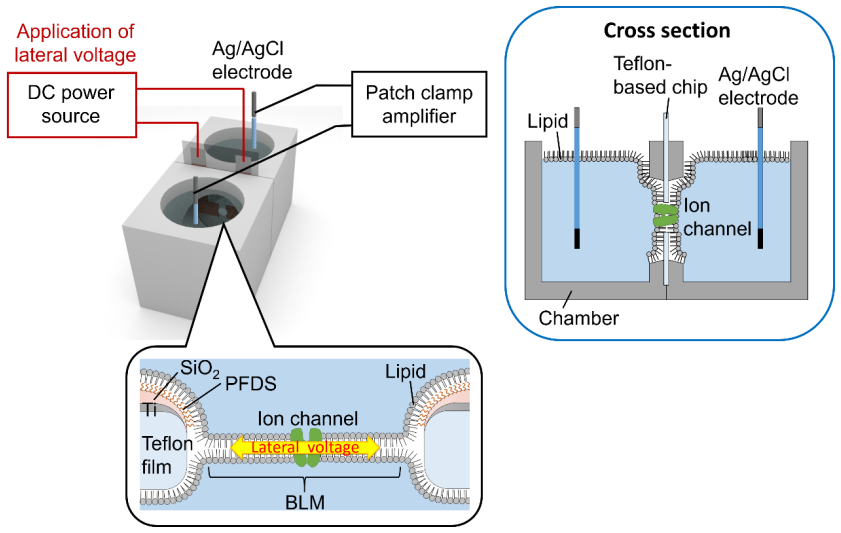
The authors report construction of a BLM system on a Teflon film containing a microaperture surrounded by Ti electrodes. Bilayers form reproducibly in the aperture. Application of lateral voltage produces no significant alteration in baseline current, transmembrane resistance, or transmembrane capacitance. The same lateral voltage, however, clearly modulates the activities of biological ion channels, indicating that lateral voltage constitutes a useful additional parameter for analyzing channel function. The resulting multidirectional-voltage platform is presented as a tool for functional studies of membrane proteins.
What carries the argument
Teflon film microaperture with evaporated Ti electrodes positioned around its perimeter, enabling independent application of lateral membrane voltage alongside the transmembrane voltage.
If this is right
- Lateral voltage becomes an independent experimental variable that can modulate ion channel gating.
- Stable artificial bilayers can be formed reproducibly even with electrodes present at the aperture edge.
- Baseline electrical properties of the bilayer remain intact under applied lateral voltage.
- The platform extends functional analysis of membrane proteins to conditions with multidirectional electric fields.
Where Pith is reading between the lines
- The approach could be used to test whether membrane proteins respond differently to in-plane versus perpendicular fields, a distinction that may matter inside cells where local fields are rarely purely transmembrane.
- Quantitative mapping of channel open probability versus lateral field strength could reveal direction-dependent gating mechanisms not accessible with conventional setups.
- The system might be combined with fluorescence or patch-clamp recordings to correlate lateral-field effects with structural changes in the same bilayer.
- A direct test would be to apply the lateral field to channels whose pore axis is known to lie parallel or perpendicular to the membrane plane.
Load-bearing premise
Observed changes in ion channel activity are produced by the intended lateral electric field rather than by electrode artifacts such as local heating, chemical reactions, or nonuniform fields.
What would settle it
A control run in which the same lateral voltage is applied through insulating barriers or with temperature and pH sensors placed at the aperture while channel activity remains unchanged would falsify the claim that the field itself drives the observed effects.
Figures


read the original abstract
Artificial bilayer lipid membranes (BLMs), along with patch-clamped membranes, are frequently used for functional analyses of membrane proteins. In both methods, the electric properties of membranes are characterized by only one parameter, namely, transmembrane potential. Here the construction of a novel BLM system was reported, in which membrane voltages can be controlled in a lateral direction in addition to conventional transmembrane direction. A microaperture was fabricated in a Teflon film and Ti electrodes were evaporated around the aperture. BLMs were reproducibly formed in the aperture without being affected by the presence of the electrodes. The application of a lateral voltage induced no significant changes in the electric properties of the BLMs, such as baseline current, transmembrane resistance, and transmembrane capacitance. In contrast, lateral voltages clearly affected the activities of biological ion channels, suggesting that the lateral voltage might be a useful parameter for analyzing channel activities. The present Teflon-based system in which multidirectional voltages can be applied to BLMs represent a promising platform for the analysis of underlying functional properties of membrane proteins.
Editorial analysis
A structured set of objections, weighed in public.
Referee Report
Summary. The manuscript describes construction of a Teflon-film microaperture BLM system with evaporated Ti electrodes surrounding the aperture. This enables simultaneous application of conventional transmembrane voltage and a novel lateral voltage. The authors report reproducible BLM formation unaffected by electrode presence, no significant change in baseline current, transmembrane resistance or capacitance upon lateral-voltage application, and clear effects on biological ion-channel activities, proposing lateral voltage as an additional useful parameter for membrane-protein analysis.
Significance. If the reported channel-activity changes are shown to arise from the intended lateral electric field rather than electrode artifacts, the platform would add a controllable experimental variable to BLM studies of membrane proteins. The reproducible formation and invariance of baseline electrical properties are methodologically useful observations. However, the absence of quantitative field characterization and artifact controls limits the strength of the mechanistic claim and therefore the immediate significance of the work.
major comments (2)
- [Abstract/Results] Abstract and Results: the central claim that lateral voltages 'clearly affected the activities of biological ion channels' is load-bearing for the utility argument, yet the abstract supplies no supporting data tables, figures, error bars, replicate numbers, or statistical tests. The full manuscript must include these quantitative results to substantiate differential channel effects.
- [Methods/Results] Methods/Results: the interpretation that observed channel changes are produced by the lateral electric field (rather than Ti-electrode side-effects such as local electrochemistry, redox products, Joule heating, or nonuniform gradients) rests on the statement that baseline BLM properties remain unchanged. No finite-element field maps, direct field measurements inside the aperture, temperature/pH sensors at the membrane, inert-electrode controls, or matched-heating experiments without net field are described. These controls are required to establish the claimed mechanism.
minor comments (1)
- [Abstract] Abstract, final sentence: subject-verb agreement error ('system ... represent' should read 'system ... represents').
Simulated Author's Rebuttal
We thank the referee for the constructive comments, which have helped us improve the clarity and rigor of our manuscript. Below we provide point-by-point responses to the major comments.
read point-by-point responses
-
Referee: [Abstract/Results] Abstract and Results: the central claim that lateral voltages 'clearly affected the activities of biological ion channels' is load-bearing for the utility argument, yet the abstract supplies no supporting data tables, figures, error bars, replicate numbers, or statistical tests. The full manuscript must include these quantitative results to substantiate differential channel effects.
Authors: We agree that the abstract should better highlight the quantitative aspects of our findings to support the central claim. The full manuscript's Results section includes data from multiple experiments showing the effects on ion channels. We will revise the abstract to include a summary of the key quantitative results, such as the observed modulation of channel activity with replicate numbers and basic statistical information. We will also ensure that the figures in the Results section prominently display error bars and report the number of replicates and any statistical tests performed. revision: yes
-
Referee: [Methods/Results] Methods/Results: the interpretation that observed channel changes are produced by the lateral electric field (rather than Ti-electrode side-effects such as local electrochemistry, redox products, Joule heating, or nonuniform gradients) rests on the statement that baseline BLM properties remain unchanged. No finite-element field maps, direct field measurements inside the aperture, temperature/pH sensors at the membrane, inert-electrode controls, or matched-heating experiments without net field are described. These controls are required to establish the claimed mechanism.
Authors: The lack of change in baseline BLM properties upon lateral voltage application is our primary evidence against significant artifacts, as electrochemistry or heating would be expected to alter resistance or capacitance. We acknowledge that more direct controls would strengthen the mechanistic interpretation. In the revised manuscript, we will expand the Discussion to include a more thorough consideration of possible artifacts and how the unchanged properties mitigate them. We will also add a description of the electrode geometry to support the assumption of field application. However, performing finite-element simulations, direct field measurements, or additional control experiments with inert electrodes would require substantial new work beyond the scope of the current study; we will note this as a limitation and suggest it for future investigations. revision: partial
Circularity Check
No circularity: purely experimental methods paper with no derivations, predictions, or self-referential logic
full rationale
The paper reports fabrication of a Teflon-based BLM system with Ti electrodes for applying lateral voltages, followed by direct experimental observations that lateral voltage leaves baseline BLM properties unchanged but affects ion-channel activity. No equations, fitted parameters, predictions, ansatzes, or derivation chains exist. Claims rest on reproducible experimental formation of BLMs and measured electrical properties, with no self-citation load-bearing steps or reductions of results to inputs by construction. This is a standard experimental report whose central observations are independent of any looped logic.
Axiom & Free-Parameter Ledger
Reference graph
Works this paper leans on
- [1]
- [2]
- [3]
- [4]
-
[5]
A. Hirano-Iwata, Y. Ishinari, H. Yamamoto, M. Niwano, Chem. An Asian J. 2015, 10, 1266
work page 2015
- [6]
-
[7]
S. Leptihn, J.R. Thompson, J.C. Ellory, S.J. Tucker, M.I. Wallace, J. Am. Chem. Soc. 2011, 133, 9370
work page 2011
- [8]
-
[9]
S. Kalsi, A.M. Powl, B.A. Wallace, H. Morgan, M.R.R. de Planque, Biophys. J. 2014, 106, 1650
work page 2014
-
[10]
X. Han, A. Studer, H. Sehr, I. Geissbühler, M. Di Berardino, F.K. Winkler, L.X. Tiefenauer, Adv. Mater. 2007, 19, 4466
work page 2007
- [11]
-
[12]
M. Sugawara, A. Hirano, M. Rehák, J. Nakanishi, K. Kawai, H. Sato, Y. Umezawa, Biosens. Bioelectron. 1997, 12, 425
work page 1997
- [13]
-
[14]
Miller, Ion Channel Reconsitution, New York, Plenum Press, 1986
C. Miller, Ion Channel Reconsitution, New York, Plenum Press, 1986
work page 1986
-
[15]
M. Mayer, J.K. Kriebel, M.T. Tosteson, G.M. Whitesides, Biophys. J. 2003, 85, 2684
work page 2003
- [16]
-
[17]
A. Beyder, J.L. Rae, C. Bernard, P.R. Strege, F. Sachs, G. Farrugia, J. Physiol. 2010, 588, 4969
work page 2010
-
[18]
A. Oshima, A. Hirano-Iwata, H. Mozumi, Y. Ishinari, Y. Kimura, M. Niwano, Anal. Chem. 2013, 85, 4363 Figure 1. A schematic illustration of a BLM in a Teflon-based chip with embedded Ti electrodes. Figure 2. (a) Schematics of the procedure for fabricating Teflon -based chips. (b) Schematics of a fabricated Teflon -based chip. (c) (left) A photograph of a T...
work page 2013
discussion (0)
Sign in with ORCID, Apple, or X to comment. Anyone can read and Pith papers without signing in.