REVIEW 3 major objections 5 minor 15 references
Regulation or Competition:Major-Minor Optimal Liquidation across Dark and Lit Pools
T0 review · 3 major / 5 minor · reviewed 2026-08-05 · deepseek-v4-flash
Pith's one-line read A regulated market with exchange-designed fees and compensation reduces permanent price impact compared with a no-fee competitive market, with a second dark pool adding further improvement.
desk verdict Genuine theoretical kernel (explicit minor-MFG ODE reduction) but the headline 'regulation beats competition' comparison is uncontrolled because the regulated crowd is passive while the competitive crowd is strategic; needs a major revision, not a desk reject. read the letter →
The pith
A machine-rendered reading of the paper's core claim, the machinery that carries it, and where it could break.
The reading
What carries the argument
The load-bearing object is the exchange's dynamic make-take fee schedule together with the compensation contract; these turn the market into a leader-follower principal-agent control problem. On the agent side, the value function is characterized as the solution of a quadratic BSDE with jumps whose driver encodes the large trader's inventory, dark-pool execution uncertainty, and market impact; its first-order conditions give explicit optimal dark-pool allocations and lit selling rates. On the principal side, the exchange's HJB equation over fees and the contract is solved numerically with an actor-critic deep-learning method. The comparison benchmark is a major-minor mean-field game whose HJ
What would settle it
Run the regulated-market solver with the small traders' trading rate replaced by the mean-field optimal response to the same fee schedule; if the resulting permanent-impact distribution is no narrower than the competitive benchmark's, then the reported policy advantage is an artifact of assuming passive small traders.
Extended reading notes
Core claim
The paper's core claim is that a regulated market designed by an exchange—a time-dependent make-take fee schedule on lit and dark venues plus a terminal compensation offered to the large trader—can reduce permanent price impact and speed up inventory liquidation compared with a purely competitive market in which small traders act strategically and no fees are charged. For the regulated side, the large trader's optimal lit-pool selling rate and dark-pool allocation are derived from a BSDE with jumps; the exchange's fee and compensation problem becomes a high-dimensional HJB equation solved numerically. For the competitive side, the paper reduces the major-minor mean-field game to coupled ODEs
Load-bearing premise
The regulated and competitive markets model the small traders differently—fixed predictable order flow under the fee regime, fully strategic behavior under competition—so the fee advantage rests on the assumption that small traders would not change their behavior in response to the fees.
Editorial extensions
If this is right
- Exchanges can implement a time-varying dark-pool fee—low early to attract liquidity, high later—and a capped constant lit fee to reduce permanent impact without sacrificing displayed-market transparency.
- Adding a second dark pool with differentiated fees lowers both the mean and variance of permanent impact, even though the required compensation to the large trader increases.
- In a no-fee competitive market, the large trader's lit selling rate is flatter and the permanent-impact distribution has a fatter left tail, so regulation through fees outperforms pure competition on market quality.
- The explicit major-minor mean-field-game solution provides a closed-form benchmark that can be used to evaluate other market-design proposals for liquidation in fragmented venues.
- The compensation contract can be represented through the BSDE state variables, so the exchange can compute the required payment from observables rather than by solving a separate abstract mechanism.
Reading between the lines
- The headline comparison treats small traders as passive in the regulated market but strategic in the competitive one; if small traders in the regulated market optimized against the same fees, the fee schedule could change and the market-quality gap could shrink.
- The staggered fee profile across two dark pools suggests a testable design principle: more liquid dark venues should charge higher fees earlier, acting as a liquidity premium, while less liquid venues stay cheap to attract flow.
- The S-shaped fee pattern should be robust to parameter changes; a direct numerical test would fix all parameters, replace the dynamic fee by its time-averaged constant, and check whether permanent impact worsens.
- Extending the regulated model to let the large trader learn latent dark-pool liquidity from observed order flow would turn the policy claim into one usable with real market data.
Editorial analysis
A structured set of objections, weighed in public.
Referee Report
Summary. This paper studies optimal liquidation across lit and dark pools under two market designs. In the regulated design (Sections 2–3), an exchange designs dynamic make-take fees and a terminal compensation for a large trader, while small traders' order flow is fixed exogenously as a predictable process λ; the large trader's best response is characterized through BSDEs (Theorems 1–2), and the exchange's contracting problem is formulated as a five-dimensional HJB equation (Theorem 3, conditional on a classical solution). In the competitive design (Section 4), a zero-fee major–minor mean-field game is set up: small traders are strategic and solve an HJB equation, and the minor equilibrium is reduced to coupled ODEs (Theorem 4), while the major trader's controls are expressed in terms of an unspecified value function (Theorem 5). Section 5 presents actor-critic and finite-difference numerical solvers and compares permanent price impact across the two designs. The paper concludes that dynamic fees plus compensation outperform a purely competitive market and that an additional dark pool improves buffering capacity. The BSDE and ODE derivations are mostly coherent, but the headline comparison is not controlled.
Significance. If the policy claim were established, the paper would be a valuable contribution to execution algorithms and market design, combining contract theory, BSDEs, major–minor MFGs, and deep learning. The explicit BSDE characterizations of the large trader's problem and the reduction of the minor MFG to a low-dimensional ODE system are useful technical pieces, and the fee-schedule shapes are falsifiable numerical predictions. However, the central conclusion that 'regulation outperforms competition' is not supported by the presented comparison: the two models differ simultaneously in the fee/compensation policy and in whether small traders are passive or strategic. In addition, the regulated-market solution rests on an unproved regularity assumption for the exchange's HJB and on an actor-critic scheme without convergence guarantees or reproducible code. The useful components do not yet justify the advertised policy recommendation.
major comments (3)
- [§2.2/Table 1 vs §4.1/Table 2, and §5.3] The main policy claim is based on an uncontrolled comparison. In the regulated model, small traders' trading rate λ is a fixed predictable process (Section 2.2) and is set to the constant -0.01 in Table 1; these small traders do not optimize or respond to fees. In the competitive model, the same crowd is a mean field of strategic agents solving the HJB equation (4.1), with equilibrium μ determined through the FP/HJB system (4.2). The lower permanent impact reported in Figures 5a–5b relative to Figure 5c therefore confounds the fee schedule with the passive-versus-strategic treatment of the crowd. A fixed-rate crowd cannot react to the major trader's orders or to the fee, so the reduction in impact could be an artifact of imposing λ. The paper should either model the regulated small traders as optimizing agents, or add a zero-fee benchmark with passive small traders, and report sensitivit
- [§3.4, Theorem 3, and §5.1.2] Theorem 3 is conditional on the existence of a C^{1,1,2,2,2,1} solution to the five-dimensional HJB equation (3.5) with polynomial growth; no existence or regularity proof is provided. The paper then replaces the HJB solution with an actor-critic neural-network approximation (Section 5.1.2) and reports fee schedules and market-impact histograms from that approximation. There is no convergence proof, no grid/network-size sensitivity analysis, and no code or seeds. Since the central regulatory conclusion is a numerical output of this unverified scheme, this is a load-bearing gap. The authors should either prove the required regularity, or provide a numerical convergence study (e.g., varying time step, network width, batch size, and independent solvers) and make the code and data available.
- [§4, Theorem 4 and Theorem 5] The paper claims 'explicit solutions' for the competitive market, but this is overstated. Theorem 4 solves the minor-player MFG only for a fixed major-player strategy, and the proof reduces the system to the linear BVP (4.5)–(4.6) while assuming ν0(t,\bar Q0_t) enters linearly; for a general feedback ν0 this is not a linear BVP. Theorem 5 gives the major player's optimal controls in terms of an unknown value function h0 solving (4.8), which is not solved explicitly. The numerical finite-difference solver in Section 5.2 therefore supplies the missing solution, but the 'explicit solution' claim and the theorem statements should be narrowed or supplemented with conditions guaranteeing the BVP and the concavity/invertibility assumptions used in Remark 4.6 and Theorem 5.
minor comments (5)
- [§5.1.1] There is a sign inconsistency in the operator \tilde F: in (3.5) the term involving Σ( (e^{-ρu_i}E[...]+ρu_i-1) e^{kθν}θ_i/ρ ) appears with a minus inside the bracket, whereas in the reduced operator in Section 5.1.1 it appears with a plus. Since ∂_y v = -1, the signs should be reconciled; otherwise the actor-critic loss is evaluating the wrong Hamiltonian.
- [§5.3, Figures 1–5] The histograms and fee curves lack axis labels and error bars. The text says fees are flat 'within estimation error' and that distributions shift by 'roughly 7%', but no confidence intervals or repeated-seed standard deviations are reported. Adding these would make the numerical claims checkable.
- [Throughout] Typographical issues: 'compesnation', 'tow dark pools', 'has been developped', and Table 1's 'k 102' presumably means k_c = 10^2. Clarify the notation and proofread.
- [§3.2, Theorem 1(a)] The dark-pool allocation condition in Theorem 1(a) uses Q_t in place of the state variable q appearing in the driver f^{ν,ℓ}(t,q,z). If the allocation is evaluated along the optimal inventory path, say so explicitly; otherwise the statement mixes state and path variables.
- [§4.2, Theorem 5] The proof of Theorem 5 is only a sketch. The existence of b(t) = (∂_q h0(t,·))^{-1}(0), the concavity of h0, and the verification of the HJB solution require precise assumptions. Please provide a full proof or a precise statement of the standing assumptions.
Circularity Check
No significant circularity: the BSDE/HJB and MFG derivations are self-contained, and the policy comparison is a modeling asymmetry rather than a circular reduction.
full rationale
The paper's derivation chain is not circular. The large trader's optimal controls in the regulated market are obtained by explicit maximization of BSDE drivers derived from the cash, inventory, and price dynamics (Theorems 1 and 2), and the exchange's fee/compensation policy solves the HJB equation (3.5) with terminal condition ΨE(ι−y). The numerically reported fee schedules and impact histograms are outputs of an actor-critic optimization, not parameters fitted to reproduce the impact targets: no equation in Section 5 is constructed from the claim that fees reduce impact. The competitive major-minor MFG is solved by reducing the HJB-FP system to the coupled ODEs (4.5)-(4.7), with existence and uniqueness argued from the explicit Riccati solution, the linear boundary-value problem for E, and the pushforward solution of the continuity equation; the citation to [CL18, Theorem 5.1] is for a standard contraction result and is not the load-bearing derivation. Self-citations ([BMMR19] for the RL algorithm, [EMRT21]/[MX25] for fee-modeling assumptions) are methodological imports rather than uniqueness or prediction claims. The main substantive concern is that the regulated and competitive models treat small traders asymmetrically: in §2.2 λ is a fixed predictable process (set to −0.01 in Table 1), while in §4.1 the same crowd solves the HJB equation (4.1) and optimally front-runs the major trader. This confounds the fee-vs-competition comparison, and the claim that dynamic fees outperform competition should be read as conditional on that behavioral difference. However, this is a modeling asymmetry and a correctness risk, not an equation-level reduction of the conclusion to its inputs, so it does not constitute circularity under the stated criteria.
Assumptions & free parameters
free parameters (6)
- R0 (reservation utility) =
not specified
- lambda (small trader rate) =
-0.01
- theta (dark-pool Poisson intensities) =
(30,20) regulated, 30 competitive
- a (dark-pool liquidity size parameter) =
(100,150) regulated, 200 competitive
- k_c (fee exponent) =
10^2
- phi (running inventory penalty) =
absent from Table 1
assumptions (6)
- standard math Existence and uniqueness of BSDEs with jumps (Pardoux-Peng; [OS07], [AM16])
- standard math Girsanov theorem and Poisson measure change ([Pri16], [CT03])
- ad hoc to paper The exchange HJB (3.5) admits a C^{1,1,2,2,2,1} solution with polynomial growth
- ad hoc to paper Major player's value function h0 is concave with invertible marginal derivative
- domain assumption Small traders do not optimize in the regulated market (exogenous lambda), while comparable minors optimize in the competitive market
- domain assumption Dark pool matching model with Poisson rate e^{ktheta nu} theta_i and liquidity r = A e^{-k_c c^d}
invented entities (2)
-
Exchange compensation contract xi
-
Dynamic make-take fee schedule (c^l, c^{d,i})
Cite this review
Pith. "Pith review of Regulation or Competition:Major-Minor Optimal Liquidation across Dark and Lit Pools." pith.science (2026). https://pith.science/paper/25GZZ3YM
@misc{pith2026250903916,
  author       = {Pith},
  title        = {Pith review of: Regulation or Competition:Major-Minor Optimal Liquidation across Dark and Lit Pools},
  year         = {2026},
  howpublished = {\url{https://pith.science/paper/25GZZ3YM}},
  note         = {Machine review of arXiv:2509.03916}
}
read the original abstract
We study the optimal liquidation problem in both lit and dark pools for investors facing execution uncertainty in a continuous-time setting with market impact. First, we design an optimal make--take fee policy for a large investor liquidating her position across both pools, interacting with small investors who pay trading fees. We explicitly characterize the large investor's optimal liquidation strategies in both lit and dark pools using BSDEs under a compensation scheme proposed by an exchange to mitigate market impact in the lit venue. Second, we consider a purely competitive model with major--minor traders in the absence of regulation. We provide explicit solutions to the associated HJB--Fokker--Planck system. Finally, we illustrate our results through numerical experiments, comparing market impact under a regulated market with a strategic large investor to that in a purely competitive market with both small and large investors.
Figures


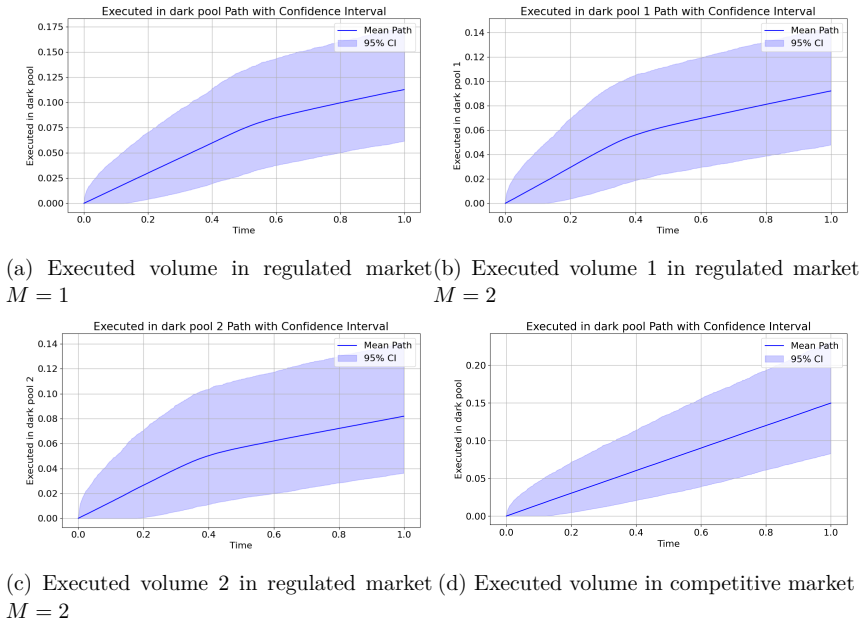
Figures from the paper (5 more)


Reference graph
Works this paper leans on
-
[7]
Nash equilibrium between brokers and traders.arXiv preprint arXiv:2407.10561,
[CJSB24] Álvaro Cartea, Sebastian Jaimungal, and Leandro Sánchez-Betancourt. Nash equilibrium between brokers and traders.arXiv preprint arXiv:2407.10561,
-
[13]
[JPPZ22] Shaolin Ji, Shige Peng, Ying Peng, and Xichuan Zhang. A deep learning method for solving stochastic optimal control problems driven by fully-coupled fbsdes.arXiv preprint arXiv:2204.05796,
-
[15]
Optimal Rebate Design: Incentives, Competition and Efficiency in Auction Markets
[MX25] Thibaut Mastrolia and Tianrui Xu. Optimal rebate design: Incentives, competition and efficiency in auction markets.arXiv preprint arXiv:2501.12591,
-
[16]
Optimal contract, delegated investment, and information acquisition
[XZ25] Hao Xing and Yuyang Zhang. Optimal contract, delegated investment, and information acquisition. Delegated Investment, and Information Acquisition (June 04, 2025),
work page 2025
-
[2003]
[CWXZ24] Yufan Chen, Lan Wu, Renyuan Xu, and Ruixun Zhang. Periodic trading activities in financial markets: Mean-field liquidation game with major-minor players.arXiv preprint arXiv:2408.09505,
-
[2004]
Closed-loop equilibria for stackelberg games: it’s all about stochastic targets
[HSHP24] Camilo Hernández, Nicolás Hernández Santibánez, Emma Hubert, and Dylan Possamaï. Closed-loop equilibria for stackelberg games: it’s all about stochastic targets. arXiv preprint arXiv:2406.19607,
-
[2009]
[BHJK20] Christian Beck, Martin Hutzenthaler, Arnulf Jentzen, and Benno Kuckuck. An overview on deep learning-based approximation methods for partial differential equations.arXiv preprint arXiv:2012.12348,
arXiv 2012
-
[2012]
Delegated portfolio management with random default
[GM24] Alberto Gennaro and Thibaut Mastrolia. Delegated portfolio management with random default. arXiv preprint arXiv:2410.13103,
Show all 15 references
-
[2015]
A new approach to principal-agent problems with volatility control.arXiv preprint arXiv:2407.09471,
[CH24] Alessandro Chiusolo and Emma Hubert. A new approach to principal-agent problems with volatility control.arXiv preprint arXiv:2407.09471,
-
[2019]
Market making with fads, informed, and uninformed traders.arXiv preprint arXiv:2501.03658,
[BMSB25] Emilio Barucci, Adrien Mathieu, and Leandro Sánchez-Betancourt. Market making with fads, informed, and uninformed traders.arXiv preprint arXiv:2501.03658,
-
[2021]
A mean-field game of market entry: Portfolio liquidation with trading constraints.arXiv preprint arXiv:2403.10441,
[FHH24] Guanxing Fu, Paul P Hager, and Ulrich Horst. A mean-field game of market entry: Portfolio liquidation with trading constraints.arXiv preprint arXiv:2403.10441,
-
[2022]
A mean field game approach to equilibrium pricing with market clearing condition.arXiv preprint arXiv:1912.01129,
[FT20] Masaaki Fujii and Akihiko Takahashi. A mean field game approach to equilibrium pricing with market clearing condition.arXiv preprint arXiv:1912.01129,
1912 arXiv
-
[2023]
Doyne Farmer, and Fabrizio Lillo
[BFL09] Jean-Philippe Bouchaud, J. Doyne Farmer, and Fabrizio Lillo. How markets slowly digest changes in supply and demand.arXiv preprint arXiv:0910.1166,
-
[2024]
Market in financial instruments directive (mifid) and market quality.arXiv preprint arXiv:1805.02741,
[Cim17] David Cimon. Market in financial instruments directive (mifid) and market quality.arXiv preprint arXiv:1805.02741,
-
[2025]
Clearing time randomization and transaction fees for auction market design.arXiv preprint arXiv:2405.09764,
[MX24] Thibaut Mastrolia and Tianrui Xu. Clearing time randomization and transaction fees for auction market design.arXiv preprint arXiv:2405.09764,
Reviewed August 5, 2026 · model on record in the stance chip above.
Discussion (0). Continue with ORCID to comment.