REVIEW 3 major objections 5 minor 40 references
Robust ID-Specific Face Restoration via Alignment Learning
T0 review · 3 major / 5 minor · reviewed 2026-08-06 · deepseek-v4-flash
Pith's one-line read Alignment Learning, which aligns the predicted denoising noise from two same-identity reference images, lets a single reference image drive robust identity-specific face restoration that suppresses pose, expression, makeup, and hair style.
desk verdict Alignment Learning is a genuinely new objective, but Table 4 doesn't prove it separates ID-irrelevant semantics from the identity itself. read the letter →
The pith
A machine-rendered reading of the paper's core claim, the machinery that carries it, and where it could break.
The reading
What carries the argument
The object that carries the argument is Alignment Learning, a finetuning objective that aligns the predicted denoising noises from two different same-identity reference images. Formally, $L_{\text{align}} = \mathbb{E}[\|\hat{\epsilon}_{ID1} - \hat{\epsilon}_{ID2}\|_2^2]$ (Eq. 4), and the total loss is $L_{\text{diffusion}} + \lambda L_{\text{align}}$ with $\lambda = 1.0$. The mechanism works because the diffusion model's noise prediction is the component that injects stochastic detail; forcing it to be invariant across same-identity references suppresses pose, expression, makeup, and hair style, while the identity feature $c_{ID}$ from the Identity Injection Module (ArcFace features queried through a Q-Former into CLIP space, injected via decoupled cross-attention) keeps the identity. The Content Injection Module concatenates the low-quality image in pixel space to the noisy latent, preserving content without color shift.
What would settle it
Find a test pair where the LQ face has a closed mouth and the same-identity reference has an open, laughing mouth; if the restored image produced by the trained framework shows an open mouth matching the reference rather than the closed mouth of the LQ input, then Alignment Learning has not actually removed expression as an ID-irrelevant semantic. A quantitative version is to compute the variance of mouth-openness scores across multiple same-identity references with contrasting expressions: the claim predicts near-zero variance in that attribute, while a failure would show the variance tracking the references.
Extended reading notes
Core claim
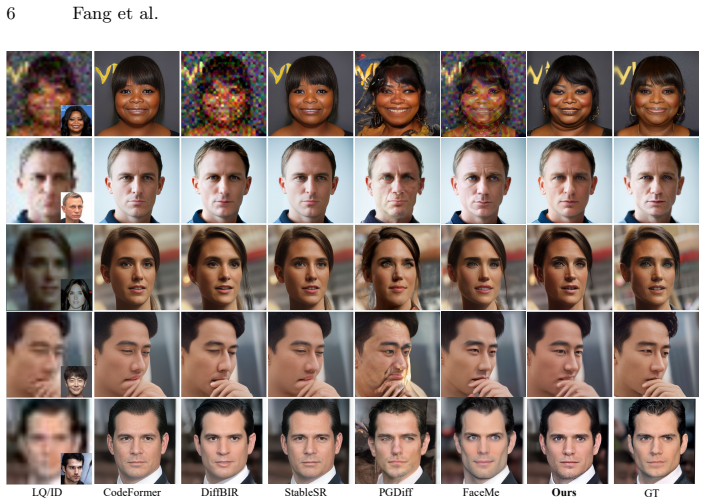
The central claim is that aligning the predicted denoising noises of the U-Net under two different reference images of the same identity, via the Alignment Learning objective $L_{\text{align}} = \mathbb{E}_{z_t,t,\epsilon}[\|\hat{\epsilon}_{ID1} - \hat{\epsilon}_{ID2}\|_2^2]$ (Eq. 4), removes the interference of ID-irrelevant face semantics in identity-specific face restoration. The authors argue that no identity encoder extracts exactly the same identity embedding from all same-identity images, so pose, expression, makeup, and hair style always leak into the restored face; Alignment Learning, applied as a finetuning stage after the Content Injection Module is trained, forces the diffusion model's noise prediction to be invariant to these variations while retaining enough identity and following the low-quality input's content. The full objective combines the standard diffusion loss with $\lambda L_{\text{align}}$ ($\lambda=1.0$), and at inference only a single identity image is needed. Experiments on CelebRef-HQ-Test and LFW-Ref-Test show the framework matching or beating reference-based baselines on identity similarity (IDS-HQ) while leading on perceptual quality metrics, and ablation reports Identity Variance dropping from 0.3610 (baseline) and 0.2387 (naive finetuning) to 0.1447 with Alignment Learning.
Load-bearing premise
Driving the predicted noises from two same-identity references to be identical assumes the only differences between those predictions are pose, expression, makeup, and hair style, and that erasing those differences never erases content that should follow the low-quality input, such as a closed mouth that the reference shows open.
Editorial extensions
If this is right
- With only a single identity image at inference, the restored face keeps the identity of the reference while following the content of the LQ input, even when the reference differs in pose, expression, makeup, hair style, or illumination.
- The framework is robust to low-resolution identity references: downsampling ID images to 64×64 or 128×128 produces nearly unchanged restoration quality and identity scores.
- Alignment Learning lowers identity variance across same-identity references (I.V. 0.1447 vs 0.2387 for naive finetuning and 0.3610 for no alignment), directly quantifying the suppression of ID-irrelevant semantics.
- On CelebRef-HQ-Test, RIDFR matches the identity similarity of the reference-based method PGDiff while leading on perceptual quality metrics, and outperforms blind restoration methods by over 50% in identity fidelity.
Reading between the lines
- The same noise-alignment principle could be applied to identity customization for image generation, where the goal is also to suppress pose, expression, and style leakage from reference images; the paper's result suggests that aligning predicted noises in diffusion finetuning is a cheaper alternative to contrastive identity-embedding losses.
- If noise-space alignment truly removes ID-irrelevant semantics, one would expect that also aligning the intermediate attention features or the final output images would yield even lower variation, but the paper only aligns predicted noises; a testable extension is to add feature-level alignment and measure whether identity variance drops further without hurting fidelity.
- The method currently uses two references during training; sampling more than two same-identity references per step could give a better estimate of the per-identity noise centroid and might improve global alignment, at the cost of memory.
- Because the loss is symmetric in the two references, it may also regularize the identity embedding itself: the identity encoder is effectively trained to produce embeddings whose induced noises are invariant, which could be measured by checking whether ArcFace embeddings of the restored images become closer to the true identity than the reference embeddings.
Editorial analysis
A structured set of objections, weighed in public.
Referee Report
Summary. The paper proposes RIDFR, a diffusion-based face restoration framework that combines content injection from the low-quality image with identity injection from a single reference image. The key novelty is Alignment Learning: during finetuning, the predicted denoising noises for two same-identity references are aligned with an L2 loss (Eq. 4), with the claim that this suppresses ID-irrelevant semantics such as pose, expression, makeup, and hairstyle. Experiments on CelebRef-HQ-Test and LFW-Ref-Test compare against blind and reference-based restoration methods, with additional ablations on pixel-level concatenation and Alignment Learning; the latter is evaluated using a new Identity Variance (I.V.) metric. The paper reports superior image quality and identity fidelity, and visual robustness to reference-image variations.
Significance. If the central claim holds, RIDFR would be a practically valuable single-reference ID-specific face restoration method: it promises identity fidelity from a severely degraded input, robustness to reference images of varying quality and expression, and no test-time optimization. Strengths include the use of an independently trained ArcFace model for identity evaluation, testing on both synthetic and real-world data, and explicit experiments on low-resolution reference images. The main weakness is that the most load-bearing evidence, Table 4, rests on a variance metric that is minimized by constant outputs, so the selective-suppression interpretation is not yet established. The paper is a reasonable empirical contribution for a computer vision venue, but the mechanism and its evaluation need strengthening.
major comments (3)
- [Section 3.3, Eqs. (4)-(6)] The alignment loss in Eq. (4) is an L2 distance between predicted noises conditioned on two same-identity references, with no anchor to either reference; the diffusion term in Eq. (5) can still be minimized from the LQ input alone because the Content Injection Module is already trained to do so via Eq. (2). Therefore the objective does not distinguish 'remove ID-irrelevant variation' from 'remove all reference-dependent variation', and the paper's own observation that large λ harms identity fidelity shows that this collapse is a real risk. To support the headline claim, Table 4 needs IDS-HQ and quality scores for baseline, naive finetuning, and Alignment Learning, and ideally a control with the identity branch ablated, so the I.V. drop can be attributed to selective suppression rather than to ignoring cID.
- [Table 4, Section 4.3] Identity Variance (I.V.) is defined only in Table 4 and not in the metrics section, and it is minimized by any constant output across references. The table reports I.V. alone; without IDS-HQ, LPIPS, or a content-consistency measure, the reader cannot tell whether the drop from 0.3610 to 0.1447 reflects suppression of pose/expression/makeup or weaker identity injection and reduced fidelity to LQ-controlled attributes. Please add identity-fidelity and image-quality metrics for all three rows, plus a measure of LQ-controlled attribute consistency, for example agreement with the LQ image on mouth and eye attributes.
- [Section 3.3, Section 4.3] The motivating example in Section 3.3 (LQ image with a closed mouth, ID image laughing) directly defines what 'suppressing ID-irrelevant semantics' should mean, but neither Table 4 nor Figure 7 measures whether LQ-controlled attributes are preserved across different references. I.V. captures only variance of identity embeddings. Please add an attribute-level or landmark-level consistency evaluation, or a targeted experiment with controlled LQ/ID attribute pairs; without it, the semantic-level claim is not directly tested.
minor comments (5)
- [Throughout] There are several typos and formatting issues: 'T able 1', 'T able 3', and 'T able 4' appear in the text, 'rougly' should be 'roughly', 'ID-irrelavant' should be 'ID-irrelevant', and Eq. (7) is typeset as '↓r +nδ]JP EGq' and should be cleaned.
- [Section 4.1] The I.V. metric should be defined in Section 4.1 alongside the other metrics rather than only in Table 4, including the exact identity-embedding extractor used and the number of references sampled per LQ image.
- [Abstract and Introduction] The claim of 'over 50% increment in identity fidelity' is not directly supported by Table 1: compared with the best non-reference method (GPEN, IDS-HQ 0.389), the reported RIDFR value 0.549 is a 41% relative increase, and compared with CodeFormer (0.376) it is about 46%. Please specify the baseline and whether the comparison is relative or absolute.
- [Section 4.2] The real-world LFW-Ref-Test contains only 16 identities and 76 images and is reported only qualitatively; a quantitative table for this subset would make the real-world robustness claim easier to assess.
- [Section 4.2] The paper does not mention whether code or trained models will be released; for an empirical method with a new training objective, code release would substantially aid reproducibility.
Circularity Check
No significant circularity: RIDFR is an empirical training/evaluation paper whose central claims are supported by external benchmarks and metrics that are not identical to the training objective.
full rationale
RIDFR is an empirical training method, not a formal derivation, and its central claims are supported by external benchmarks and metrics that are not identical to the training objectives. The Alignment Learning loss (Eq. 4) minimizes the L2 distance between predicted noises conditioned on two same-identity references. The Identity Variance metric in Table 4 measures variance of output identity embeddings across references; these are different quantities, separated by the full denoising/generation process, so the reported I.V. drop is an empirical observation rather than a forced consequence of Eq. 4. Identity fidelity in Table 1 is measured with an ArcFace model using an alternative backbone and training set from the identity encoder used in the Identity Injection Module, and perceptual metrics (LPIPS, MANIQA, MUSIQ, CLIP-IQA, HyperIQA, PI) are standard external measures. The paper explicitly acknowledges the trivial 'ignore identity' solution by noting that a high lambda harms identity fidelity and then sets lambda to 1.0, showing awareness of the trade-off; this is an experimental design choice, not circular reasoning. Citations to IP-Adapter and PuLID are external prior work used for architecture initialization and motivation, not self-citations carrying the argument. No load-bearing step reduces, by construction or by self-citation chain, to its own inputs.
Assumptions & free parameters
free parameters (5)
- Lambda (alignment loss weight) =
1.0
- Number of same-identity references used in Alignment Learning =
2
- ID image downsampling range in training =
64x64 to 512x512
- Training iterations and batch size =
87,500 content; 45,000 alignment; batch 8
- Degradation parameters in Eq. 7 =
k_sigma, n_delta, JPEG q (values in supplementary)
assumptions (6)
- standard math Diffusion denoising training: the U-Net predicts noise epsilon_t and an L2 denoising loss is used (Eqs. 2 and 5).
- domain assumption Stable Diffusion v1.5 is an adequate generative prior for face restoration.
- domain assumption ArcFace embeddings capture identity while ID-irrelevant semantics can be separated from them.
- domain assumption At inference the user's ID image is recognizable and carries the desired identity; training always pairs ILQ, IHQ, and IID with the same identity.
- ad hoc to paper Aligning predicted noises (Eq. 4) from two same-identity references suppresses ID-irrelevant semantics in the final output images.
- ad hoc to paper The Identity Variance metric I.V. is a valid measure of ID-irrelevant interference.
invented entities (1)
-
Identity Variance (I.V.) metric
Cite this review
Pith. "Pith review of Robust ID-Specific Face Restoration via Alignment Learning." pith.science (2026). https://pith.science/paper/25JV4FDB
@misc{pith2026250710943,
  author       = {Pith},
  title        = {Pith review of: Robust ID-Specific Face Restoration via Alignment Learning},
  year         = {2026},
  howpublished = {\url{https://pith.science/paper/25JV4FDB}},
  note         = {Machine review of arXiv:2507.10943}
}
read the original abstract
The latest developments in Face Restoration have yielded significant advancements in visual quality through the utilization of diverse diffusion priors. Nevertheless, the uncertainty of face identity introduced by identity-obscure inputs and stochastic generative processes remains unresolved. To address this challenge, we present Robust ID-Specific Face Restoration (RIDFR), a novel ID-specific face restoration framework based on diffusion models. Specifically, RIDFR leverages a pre-trained diffusion model in conjunction with two parallel conditioning modules. The Content Injection Module inputs the severely degraded image, while the Identity Injection Module integrates the specific identity from a given image. Subsequently, RIDFR incorporates Alignment Learning, which aligns the restoration results from multiple references with the same identity in order to suppress the interference of ID-irrelevant face semantics (e.g. pose, expression, make-up, hair style). Experiments demonstrate that our framework outperforms the state-of-the-art methods, reconstructing high-quality ID-specific results with high identity fidelity and demonstrating strong robustness.
Figures


Figures from the paper (4 more)


Reference graph
Works this paper leans on
-
[1]
In: Proceedings of the European conference on computer vision (ECCV) workshops
Blau, Y., Mechrez, R., Timofte, R., Michaeli, T., Zelnik-Manor, L.: The 2018 pirm challenge on perceptual image super-resolution. In: Proceedings of the European conference on computer vision (ECCV) workshops. pp. 0–0 (2018)
work page 2018
-
[2]
IEEE Transactions on Image Processing 30, 1219–1231 (2020)
Chen, C., Gong, D., Wang, H., Li, Z., Wong, K.Y.K.: Learning spatial attention for face super-resolution. IEEE Transactions on Image Processing 30, 1219–1231 (2020)
work page 2020
-
[3]
In: Proceedings of the IEEE Conference on Computer Vision and Pattern Recognition
Chen, Y., Tai, Y., Liu, X., Shen, C., Yang, J.: Fsrnet: End-to-end learning face super-resolution with facial priors. In: Proceedings of the IEEE Conference on Computer Vision and Pattern Recognition. pp. 2492–2501 (2018)
work page 2018
-
[4]
arXiv preprint arXiv:2403.13535 (2024)
Cui, S., Deng, J., Guo, J., An, X., Zhao, Y., Wei, X., Feng, Z.: Idadapter: Learn- ing mixed features for tuning-free personalization of text-to-image models. arXiv preprint arXiv:2403.13535 (2024)
arXiv 2024
-
[5]
In: Proceedings of the IEEE/CVF conference on computer vision and pattern recognition
Deng, J., Guo, J., Xue, N., Zafeiriou, S.: Arcface: Additive angular margin loss for deep face recognition. In: Proceedings of the IEEE/CVF conference on computer vision and pattern recognition. pp. 4690–4699 (2019)
2019
-
[6]
In: The IEEE Conference on Computer Vision and Pattern Recognition (CVPR) Workshops (June 2019)
Dogan, B., Gu, S., Timofte, R.: Exemplar guided face image super-resolution with- out facial landmarks. In: The IEEE Conference on Computer Vision and Pattern Recognition (CVPR) Workshops (June 2019)
work page 2019
-
[7]
VQFR: Blind Face Restoration with Vector-Quantized Dictionary and Parallel Decoder
Gu, Y., Wang, X., Xie, L., Dong, C., Li, G., Shan, Y., Cheng, M.M.: Vqfr: Blind face restoration with vector-quantized dictionary and parallel decoder. arXiv preprint arXiv:2205.06803 (2022)
work page Pith review arXiv 2022
-
[8]
arXiv preprint arXiv:2404.16022 (2024)
Guo, Z., Wu, Y., Chen, Z., Chen, L., He, Q.: Pulid: Pure and lightning id cus- tomization via contrastive alignment. arXiv preprint arXiv:2404.16022 (2024)
arXiv 2024
Show all 40 references
-
[9]
Advances in neural information processing systems 25 (2012)
Huang, G., Mattar, M., Lee, H., Learned-Miller, E.: Learning to align from scratch. Advances in neural information processing systems 25 (2012)
2012
-
[10]
In: Workshop on faces in’Real-Life’Images: detection, alignment, and recognition (2008)
Huang, G.B., Mattar, M., Berg, T., Learned-Miller, E.: Labeled faces in the wild: A database forstudying face recognition in unconstrained environments. In: Workshop on faces in’Real-Life’Images: detection, alignment, and recognition (2008)
2008
-
[11]
In: CVPR (2019)
Karras, T., Laine, S., Aila, T.: A style-based generator architecture for generative adversarial networks. In: CVPR (2019)
2019
-
[12]
In: Proceedings of the IEEE/CVF international conference on computer vision
Ke, J., Wang, Q., Wang, Y., Milanfar, P., Yang, F.: Musiq: Multi-scale image quality transformer. In: Proceedings of the IEEE/CVF international conference on computer vision. pp. 5148–5157 (2021)
2021
-
[13]
arXiv preprint arXiv:1908.08239 (2019) 14 Fang et al
Kim, D., Kim, M., Kwon, G., Kim, D.S.: Progressive face super-resolution via attention to facial landmark. arXiv preprint arXiv:1908.08239 (2019) 14 Fang et al
2019 arXiv
-
[14]
In: Proceedings of the IEEE/CVF Winter Conference on Applications of Computer Vision
Lau, Y.F., Zhang, T., Rao, Z., Chen, Q.: Ented: Enhanced neural texture extraction and distribution for reference-based blind face restoration. In: Proceedings of the IEEE/CVF Winter Conference on Applications of Computer Vision. pp. 5162–5171 (2024)
2024
-
[15]
In: International conference on machine learning
Li, J., Li, D., Savarese, S., Hoi, S.: Blip-2: Bootstrapping language-image pre- training with frozen image encoders and large language models. In: International conference on machine learning. pp. 19730–19742. PMLR (2023)
2023
-
[16]
In: Proceed- ings of the IEEE/CVF Conference on Computer Vision and Pattern Recognition
Li, X., Li, W., Ren, D., Zhang, H., Wang, M., Zuo, W.: Enhanced blind face restora- tion with multi-exemplar images and adaptive spatial feature fusion. In: Proceed- ings of the IEEE/CVF Conference on Computer Vision and Pattern Recognition. pp. 2706–2715 (2020)
2020
-
[17]
In: The European Conference on Computer Vision (ECCV) (September 2018)
Li, X., Liu, M., Ye, Y., Zuo, W., Lin, L., Yang, R.: Learning warped guidance for blind face restoration. In: The European Conference on Computer Vision (ECCV) (September 2018)
2018
-
[18]
IEEE Transactions on Pattern Analysis and Machine Intelligence (2022)
Li, X., Zhang, S., Zhou, S., Zhang, L., Zuo, W.: Learning dual memory dictionaries for blind face restoration. IEEE Transactions on Pattern Analysis and Machine Intelligence (2022)
2022
-
[19]
arXiv preprint arXiv:2312.04461 (2023)
Li, Z., Cao, M., Wang, X., Qi, Z., Cheng, M.M., Shan, Y.: Photomaker: Customizing realistic human photos via stacked id embedding. arXiv preprint arXiv:2312.04461 (2023)
2023 arXiv
-
[20]
arXiv preprint arXiv:2308.15070 (2023)
Lin, X., He, J., Chen, Z., Lyu, Z., Fei, B., Dai, B., Ouyang, W., Qiao, Y., Dong, C.: Diffbir: Towards blind image restoration with generative diffusion prior. arXiv preprint arXiv:2308.15070 (2023)
2023 arXiv
-
[21]
arXiv preprint arXiv:2501.05177 (2025)
Liu, S., Duan, Z.P., OuYang, J., Fu, J., Park, H., Liu, Z., Guo, C.L., Li, C.: Faceme: Robust blind face restoration with personal identification. arXiv preprint arXiv:2501.05177 (2025)
2025 arXiv
-
[22]
In: International conference on machine learning
Radford, A., Kim, J.W., Hallacy, C., Ramesh, A., Goh, G., Agarwal, S., Sastry, G., Askell, A., Mishkin, P., Clark, J., et al.: Learning transferable visual models from natural language supervision. In: International conference on machine learning. pp. 8748–8763. PMLR (2021)
2021
-
[23]
In: IEEE/CVF Conference on Computer Vision and Pattern Recognition (CVPR) (June 2020)
Su, S., Yan, Q., Zhu, Y., Zhang, C., Ge, X., Sun, J., Zhang, Y.: Blindly assess image quality in the wild guided by a self-adaptive hyper network. In: IEEE/CVF Conference on Computer Vision and Pattern Recognition (CVPR) (June 2020)
2020
-
[24]
arXiv preprint arXiv:2410.04161 (2024)
Tao, K., Gu, J., Zhang, Y., Wang, X., Cheng, N.: Overcoming false illusions in real-world face restoration with multi-modal guided diffusion model. arXiv preprint arXiv:2410.04161 (2024)
2024 arXiv
-
[25]
In: Proceedings of the IEEE/CVF Confer- ence on Computer Vision and Pattern Recognition
Varanka, T., Toivonen, T., Tripathy, S., Zhao, G., Acar, E.: Pfstorer: Personalized face restoration and super-resolution. In: Proceedings of the IEEE/CVF Confer- ence on Computer Vision and Pattern Recognition. pp. 2372–2381 (2024)
2024
-
[26]
In: AAAI (2023)
Wang, J., Chan, K.C., Loy, C.C.: Exploring clip for assessing the look and feel of images. In: AAAI (2023)
2023
-
[27]
arXiv preprint arXiv:2305.07015 (2023)
Wang, J., Yue, Z., Zhou, S., Chan, K.C., Loy, C.C.: Exploiting diffusion prior for real-world image super-resolution. arXiv preprint arXiv:2305.07015 (2023)
2023 arXiv
-
[28]
arXiv preprint arXiv:2401.07519 (2024)
Wang, Q., Bai, X., Wang, H., Qin, Z., Chen, A.: Instantid: Zero-shot identity- preserving generation in seconds. arXiv preprint arXiv:2401.07519 (2024)
2024 arXiv
-
[29]
In: The IEEE Conference on Computer Vision and Pattern Recognition (CVPR) (2021)
Wang, X., Li, Y., Zhang, H., Shan, Y.: Towards real-world blind face restoration with generative facial prior. In: The IEEE Conference on Computer Vision and Pattern Recognition (CVPR) (2021)
2021
-
[30]
In: ICCV (2021) Robust ID-Specific Face Restoration via Alignment Learning 15
Wang, X., Xie, L., Dong, C., Shan, Y.: Real-ESRGAN: Training real-world blind super-resolution with pure synthetic data. In: ICCV (2021) Robust ID-Specific Face Restoration via Alignment Learning 15
2021
-
[31]
In: Proceed- ings of the IEEE/CVF Conference on Computer Vision and Pattern Recognition
Wang, Z., Zhang, Z., Zhang, X., Zheng, H., Zhou, M., Zhang, Y., Wang, Y.: Dr2: Diffusion-based robust degradation remover for blind face restoration. In: Proceed- ings of the IEEE/CVF Conference on Computer Vision and Pattern Recognition. pp. 1704–1713 (2023)
2023
-
[32]
Advances in Neural Information Processing Systems 36 (2024)
Yang, P., Zhou, S., Tao, Q., Loy, C.C.: Pgdiff: Guiding diffusion models for versatile face restoration via partial guidance. Advances in Neural Information Processing Systems 36 (2024)
2024
-
[33]
In: Proceedings of the IEEE/CVF Conference on Computer Vision and Pattern Recog- nition
Yang, S., Wu, T., Shi, S., Lao, S., Gong, Y., Cao, M., Wang, J., Yang, Y.: Maniqa: Multi-dimension attention network for no-reference image quality assessment. In: Proceedings of the IEEE/CVF Conference on Computer Vision and Pattern Recog- nition. pp. 1191–1200 (2022)
2022
-
[34]
In: Proceedings of the IEEE/CVF Conference on Computer Vision and Pattern Recognition
Yang, T., Ren, P., Xie, X., Zhang, L.: Gan prior embedded network for blind face restoration in the wild. In: Proceedings of the IEEE/CVF Conference on Computer Vision and Pattern Recognition. pp. 672–681 (2021)
2021
-
[35]
arXiv preprint arXiv:2308.06721 (2023)
Ye, H., Zhang, J., Liu, S., Han, X., Yang, W.: Ip-adapter: Text compati- ble image prompt adapter for text-to-image diffusion models. arXiv preprint arXiv:2308.06721 (2023)
2023 arXiv
-
[36]
arXiv preprint arXiv:2212.06512 (2022)
Yue, Z., Loy, C.C.: Difface: Blind face restoration with diffused error contraction. arXiv preprint arXiv:2212.06512 (2022)
2022 arXiv
-
[37]
In: Proceedings of the IEEE/CVF International Conference on Computer Vision
Zhang, L., Rao, A., Agrawala, M.: Adding conditional control to text-to-image diffusion models. In: Proceedings of the IEEE/CVF International Conference on Computer Vision. pp. 3836–3847 (2023)
2023
-
[38]
In: Proceedings of the IEEE conference on computer vision and pattern recognition
Zhang, R., Isola, P., Efros, A.A., Shechtman, E., Wang, O.: The unreasonable effectiveness of deep features as a perceptual metric. In: Proceedings of the IEEE conference on computer vision and pattern recognition. pp. 586–595 (2018)
2018
-
[39]
Advances in Neural Information Processing Systems 36 (2024)
Zhao, W., Bai, L., Rao, Y., Zhou, J., Lu, J.: Unipc: A unified predictor-corrector framework for fast sampling of diffusion models. Advances in Neural Information Processing Systems 36 (2024)
2024
-
[40]
Advances in Neural Information Processing Systems 35, 30599–30611 (2022)
Zhou, S., Chan, K., Li, C., Loy, C.C.: Towards robust blind face restoration with codebook lookup transformer. Advances in Neural Information Processing Systems 35, 30599–30611 (2022)
2022
Reviewed August 6, 2026 · model on record in the stance chip above.
Discussion (0). Sign in to comment.