Are most detected tidal disruption events partial?
Pith reviewed 2026-06-26 08:11 UTC · model grok-4.3
The pith
Partial tidal disruptions produce reprocessing layers and luminosities matching most detected events for beta at least 0.8.
A machine-rendered reading of the paper's core claim, the machinery that carries it, and where it could break.
Core claim
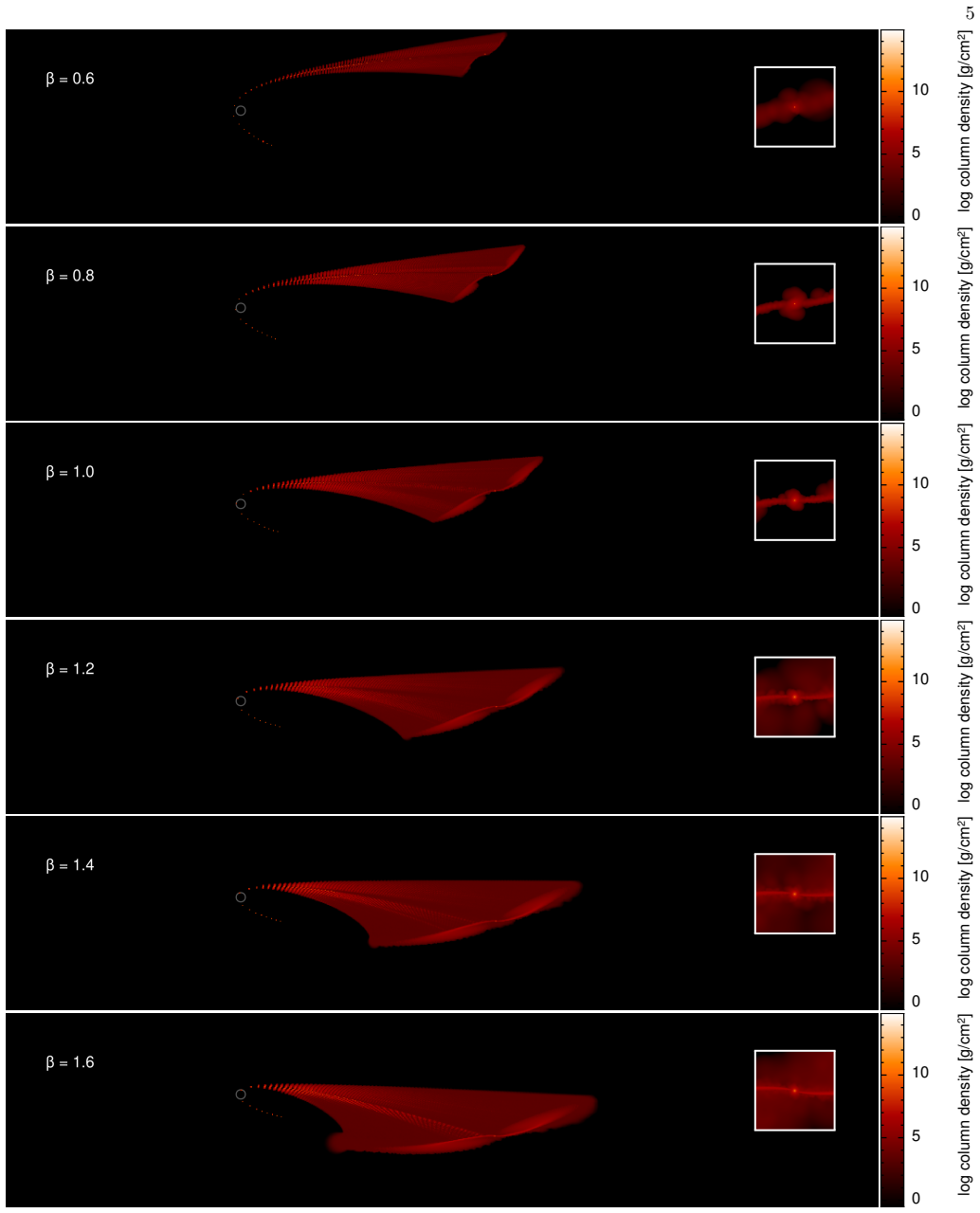
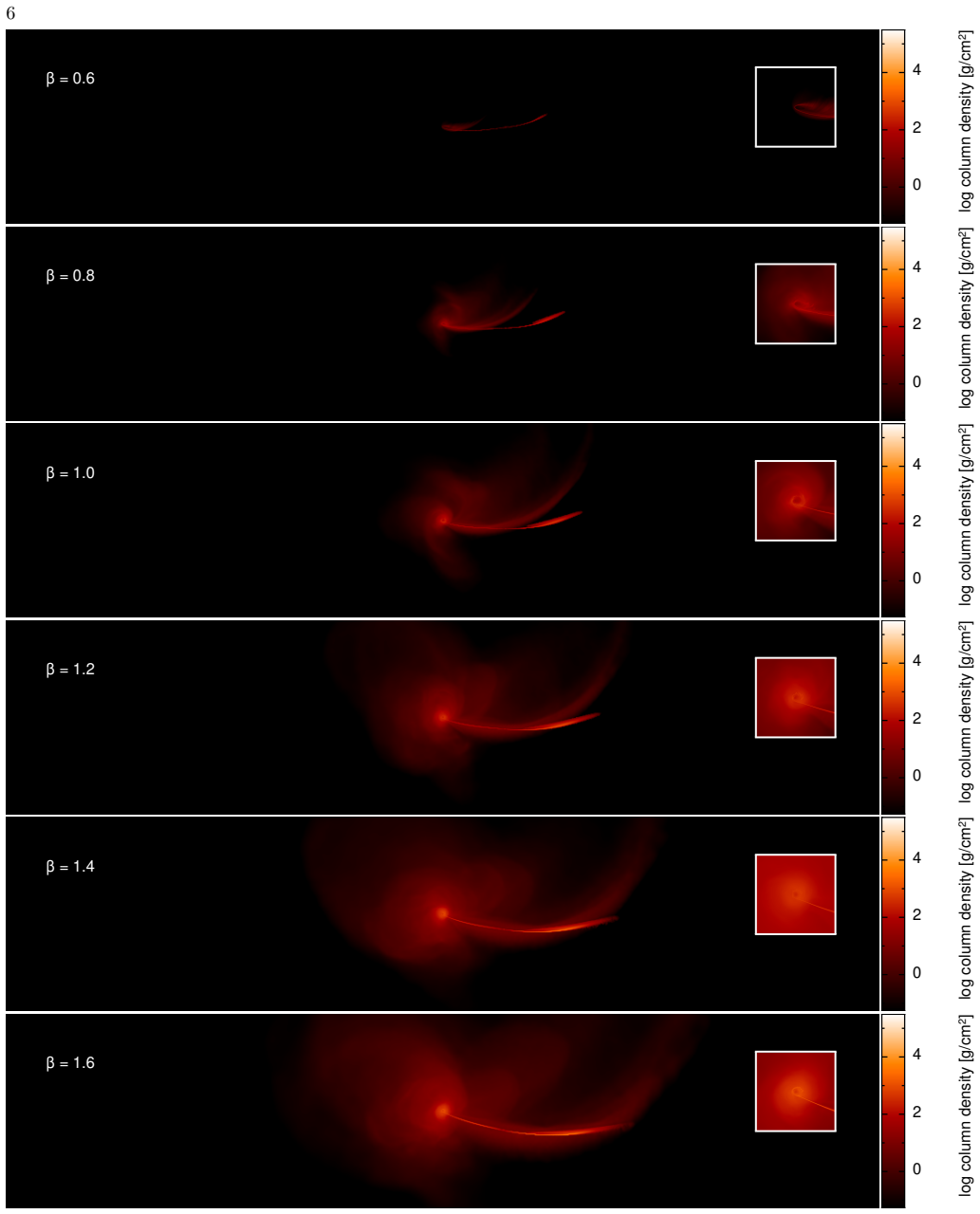
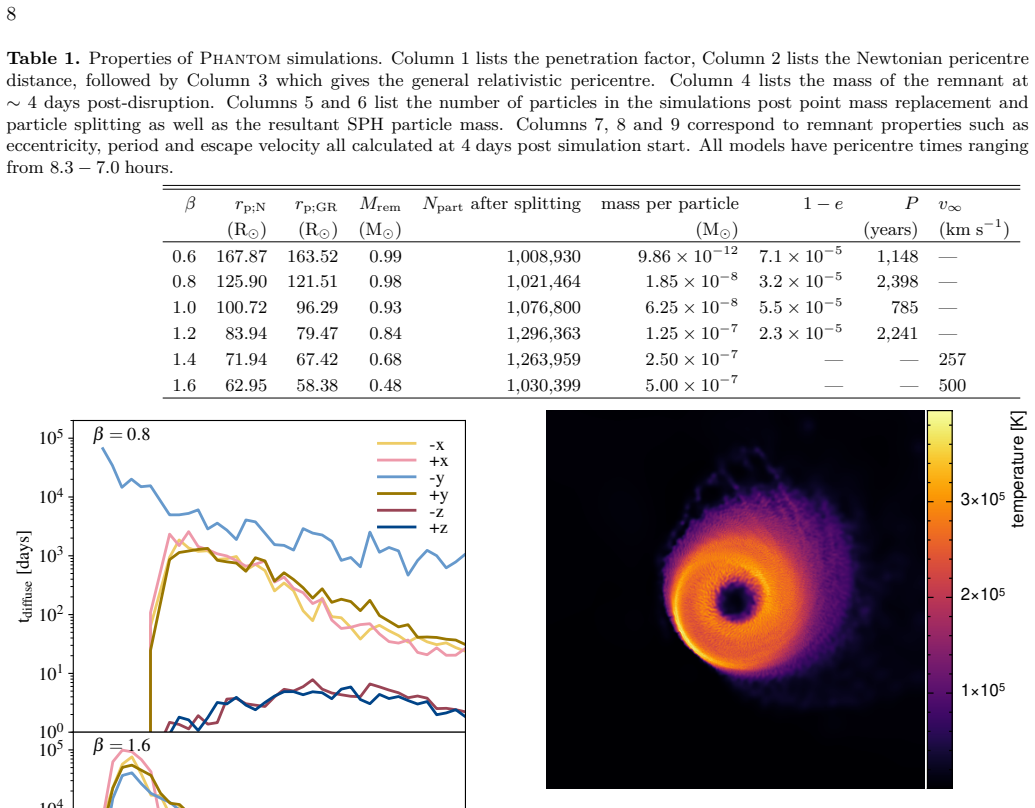
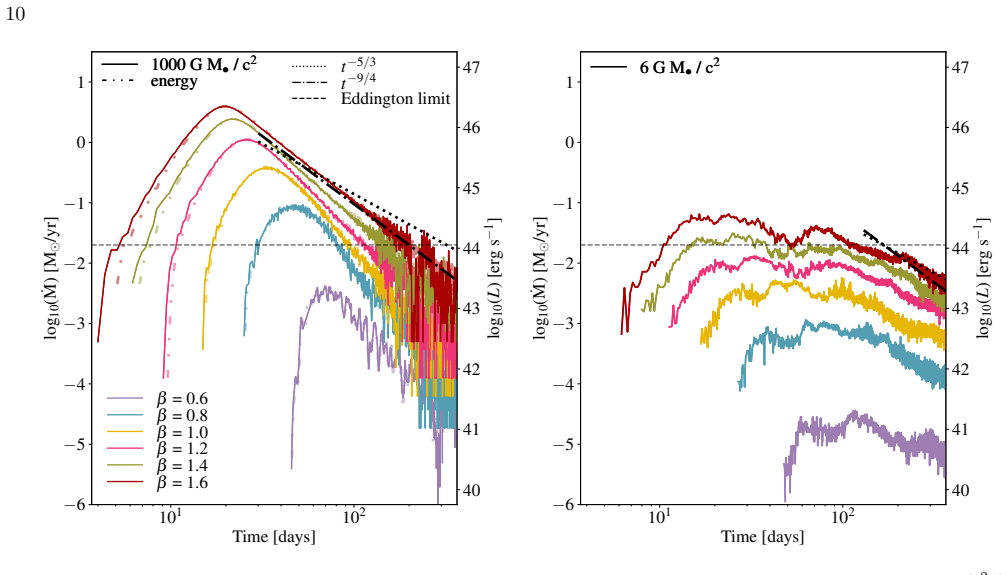
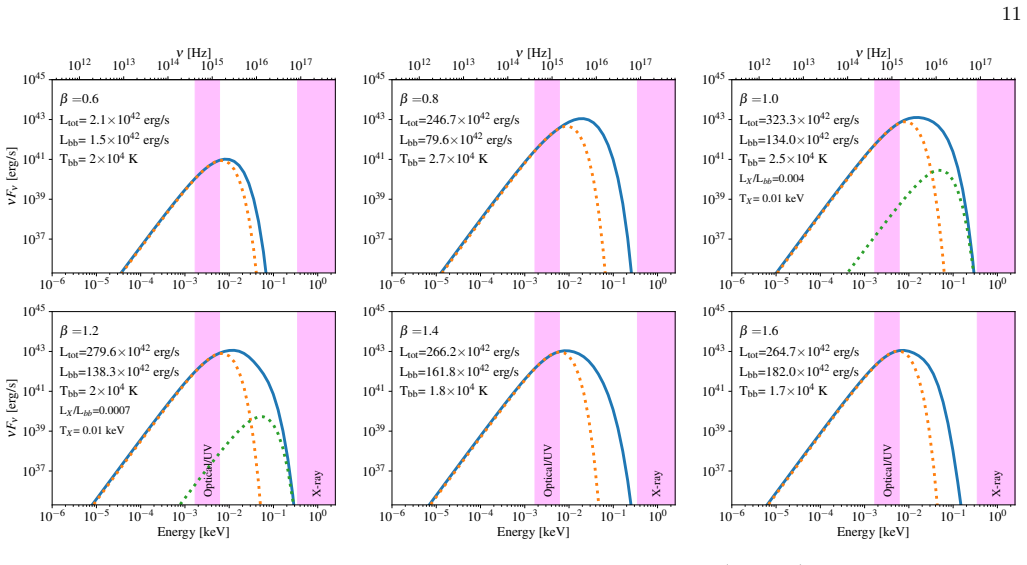
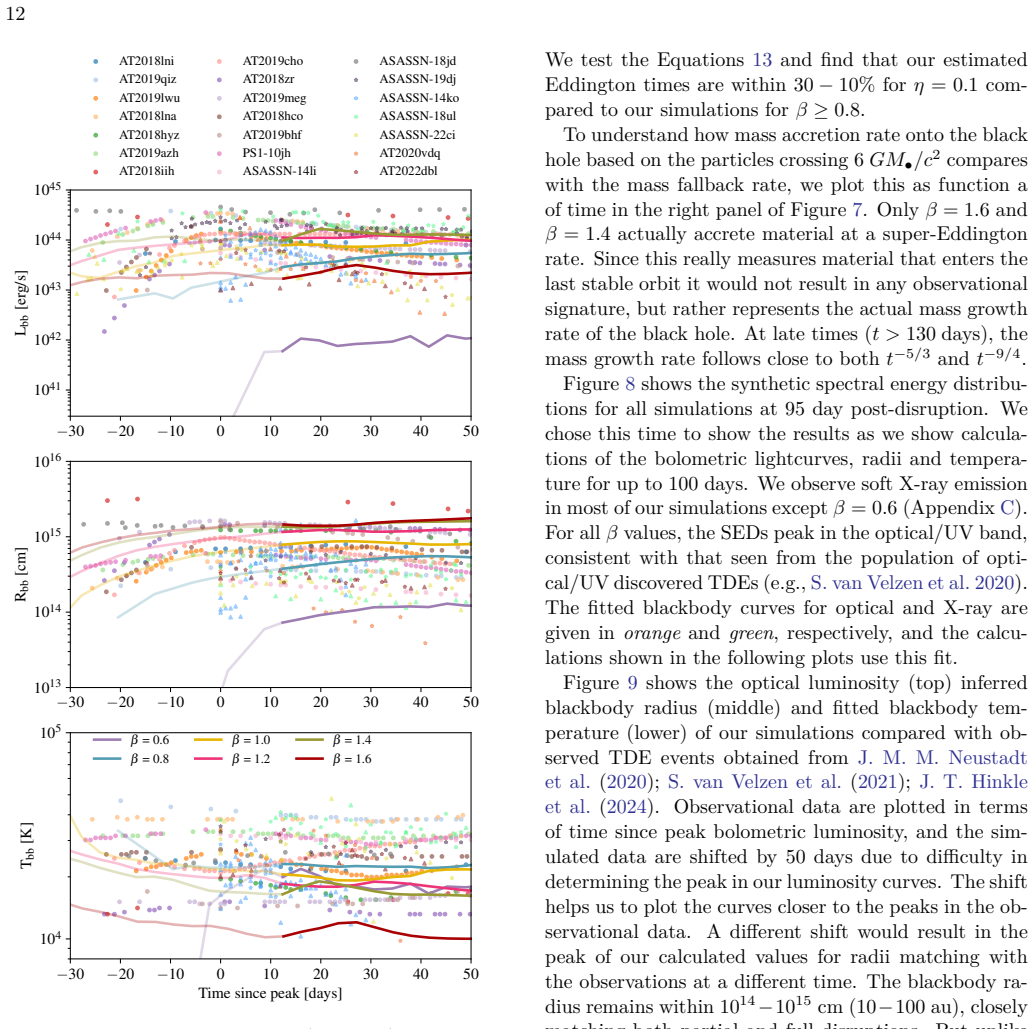
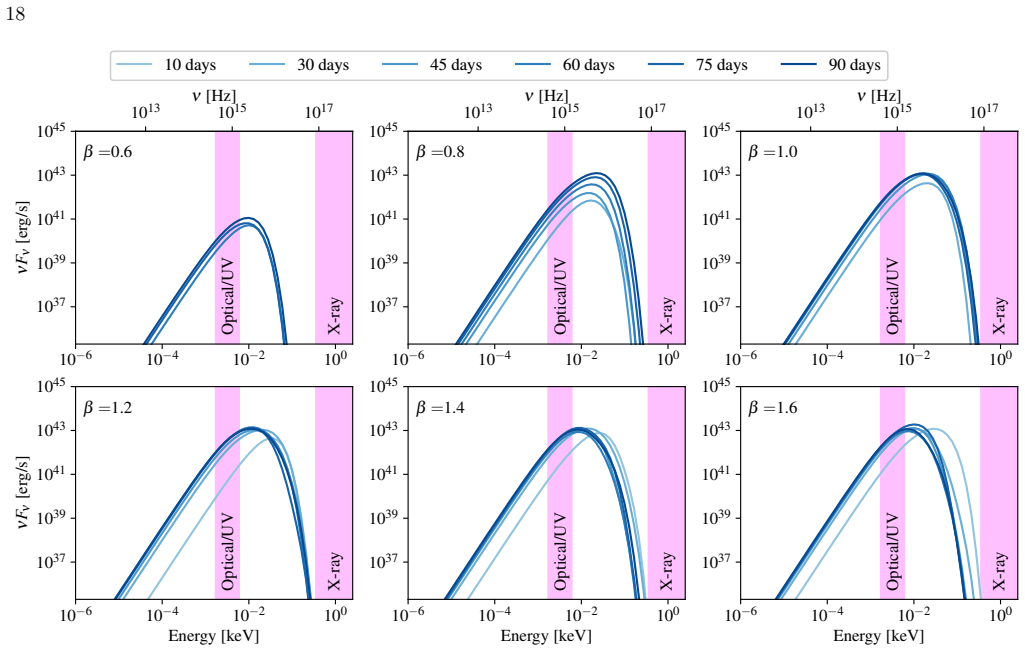
Using SPH simulations of partial TDEs with mass loss up to fifty percent, the authors find that for beta greater than or equal to 0.8 the mass fallback rate exceeds the Eddington limit, allowing the debris to form a reprocessing layer that obscures the accretion disc and produces optical emission similar to full TDEs. The fallback rate follows a power law closer to t to the minus nine-fourths than the canonical t to the minus five-thirds. With the stated thermal-emission assumptions the models yield blackbody temperatures of about ten thousand kelvin, bolometric luminosities of ten to the forty-two to ten to the forty-four erg per second, and radii of ten to one hundred au, values that match
What carries the argument
the mass fallback rate exceeding the Eddington limit for beta greater than or equal to 0.8, which permits the returning debris to form an optically thick reprocessing layer around the accretion disc
If this is right
- Mass fallback tracks closer to t to the minus nine-fourths than the usual t to the minus five-thirds.
- Derived temperatures near ten thousand kelvin and optical luminosities of ten to the forty-two to ten to the forty-four erg per second match detected optical and ultraviolet TDEs.
- Properties are similar to those of repeating partial TDEs such as ASASSN-19dj, ASASSN-14ko, ASASSN-18ul, ASASSN-22ci, AT2020vdq and AT2022dbl.
- Some events currently classified as full disruptions may instead be partial ones that leave a stellar remnant.
Where Pith is reading between the lines
- If the reprocessing mechanism works the same way, the observational boundary between full and partial TDEs becomes harder to draw from light curves alone.
- The fraction of partial events among all detected TDEs may be larger than current estimates that assume only full disruptions produce bright optical flares.
- Simulations that include non-zero energy orbits would test whether the same Eddington-exceeding fallback and reprocessing still occur for more typical stellar encounters.
Load-bearing premise
The emission calculation assumes thermal emission from the debris, that shock heating is trapped, that electron scattering dominates the opacity, and a color correction f_col of 1.7.
What would settle it
A well-observed TDE with estimated beta around 0.8 that shows bright X-rays without any optical reprocessing signature, or a light curve whose decay slope is measured to be inconsistent with t to the minus nine-fourths.
Figures
read the original abstract
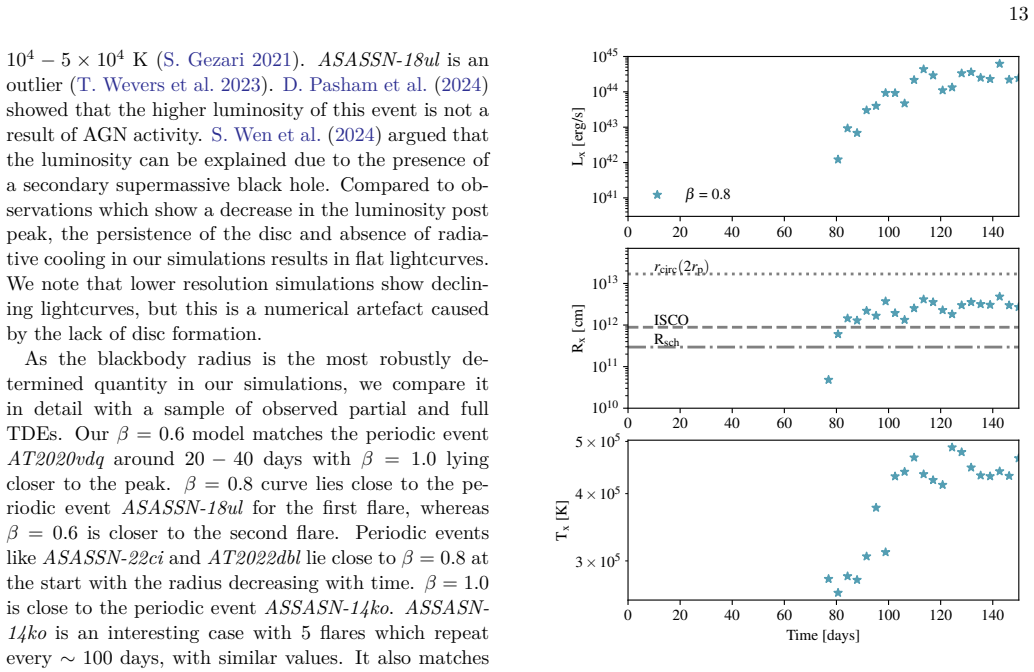
During a tidal disruption event (TDE), a star loses mass due to the tidal gravitational forces of the black hole. In a partial tidal disruption event, a stellar remnant is left behind. Several dozen TDEs have been detected so far, including repeating partial events. We use the Phantom smoothed particle hydrodynamics code to model the disruption of a 1 Msun star around a 10^6 Msun black hole for impact parameters resulting in less than equal to 50 % mass loss. We only consider zero energy orbits. Our simulations show that the mass fallback rate can exceed the Eddington limit for beta greater than or equal to 0.8, allowing debris to obscure the accretion disc by forming a reprocessing layer, similar to full TDEs. The mass fallback rate is shallower than t^{-5/3}, tracking closer to t^{-9/4}. Assuming thermal emission from the debris, that shock heating is trapped, that electron scattering dominates the opacity, and a color correction f_{col} of 1.7, we find temperatures of ~10^4 K, optical bolometric luminosities of ~ 10^{42-44} erg/s and blackbody radii ranging from 10-100 au for our simulations. We compare our values with observations and find support for the previous argument that some TDEs classified as full disruptions might actually be partial. Moreover, our results explain the detected optical/UV TDEs. We also find that our zero energy partial TDEs have properties similar to the repeating partial TDEs such as ASSASN-19dj, ASSASN-14ko, ASSASN-18ul, ASSASN-22ci, AT2020vdq and AT2022dbl. In the beta=0.8, isentropic simulation where radiation is assumed to escape, we find X-ray luminosities of ~ 10^{44-45} erg/s and radii lower than the inner most stable circular orbit.
Editorial analysis
A structured set of objections, weighed in public.
Referee Report
Summary. The paper uses Phantom SPH simulations to model partial tidal disruptions (≤50% mass loss) of a 1 M⊙ star by a 10^6 M⊙ black hole on zero-energy orbits. For β ≥ 0.8 the mass fallback rate exceeds Eddington, enabling a reprocessing layer. Post-processing assuming thermal emission, trapped shock heating, electron-scattering opacity and f_col=1.7 yields T≈10^4 K, L_bol≈10^{42-44} erg/s and R_bb≈10-100 au. These are compared to observations to argue that some TDEs classified as full disruptions are actually partial, that this explains optical/UV TDEs, and that zero-energy partials resemble repeating events such as ASASSN-19dj.
Significance. If the emission post-processing is robust, the result would imply that partial TDEs with β≥0.8 can reproduce the luminosities, temperatures and radii of many observed optical/UV TDEs, potentially revising event classification and the inferred fraction of full versus partial disruptions. The hydrodynamic fallback rates are generated independently of the observational sample, which is a methodological strength.
major comments (3)
- [Abstract] Abstract (emission calculation): The mapping from simulated fallback rates to the reported T~10^4 K, L_bol~10^{42-44} erg/s and R_bb~10-100 au rests entirely on four assumptions (thermal emission, trapped shocks, electron-scattering opacity, fixed f_col=1.7). No sensitivity tests or radiative-transfer validation are shown for the super-Eddington debris regime; if absorption opacity contributes or heating is not fully trapped, the match to observations does not hold. This is load-bearing for the central claim.
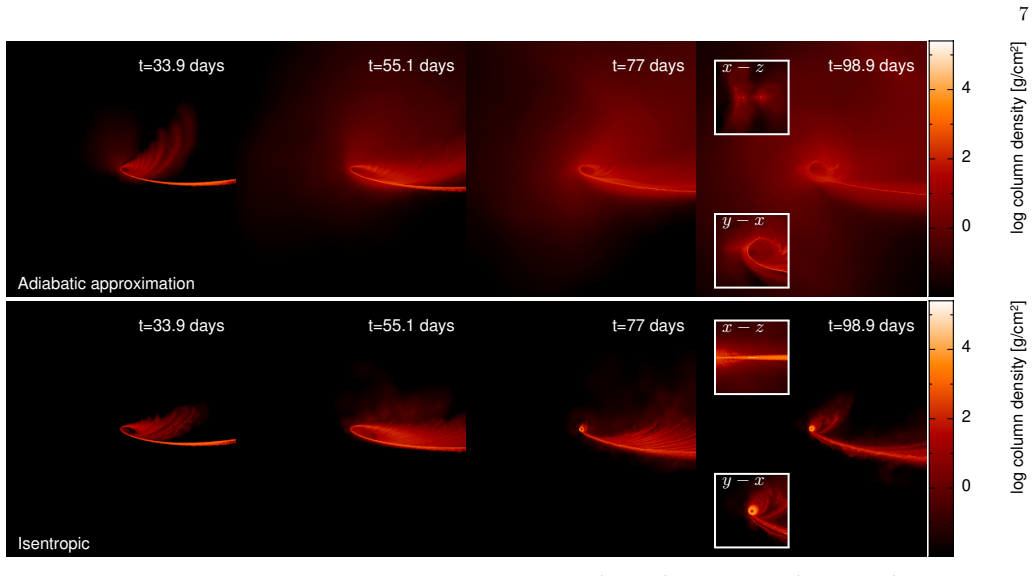
- [Results (X-ray case)] X-ray results (β=0.8 isentropic case): X-ray luminosities ~10^{44-45} erg/s and radii below the ISCO are obtained only when radiation is assumed to escape. The justification for switching from trapped to escaping radiation between the optical and X-ray cases is not provided and directly affects the claimed distinction between emission regimes.
- [Comparison with observations] Comparison with observations: The argument that some events classified as full TDEs are partial, and that partial TDEs explain optical/UV detections, relies on the derived quantities matching data. No error bars, convergence tests on the fallback rates, or quantitative fit statistics are reported, so the strength of the observational support cannot be assessed.
minor comments (2)
- [Abstract] The fallback rate is stated to track closer to t^{-9/4} than t^{-5/3}; specify the time interval over which this power-law holds and any β dependence.
- Clarify the precise range of β values simulated that correspond to ≤50% mass loss.
Simulated Author's Rebuttal
We thank the referee for their constructive report and positive assessment of the methodological approach. We address each major comment below. Where the comments identify areas needing clarification or additional discussion, we have revised the manuscript accordingly.
read point-by-point responses
-
Referee: [Abstract] Abstract (emission calculation): The mapping from simulated fallback rates to the reported T~10^4 K, L_bol~10^{42-44} erg/s and R_bb~10-100 au rests entirely on four assumptions (thermal emission, trapped shocks, electron-scattering opacity, fixed f_col=1.7). No sensitivity tests or radiative-transfer validation are shown for the super-Eddington debris regime; if absorption opacity contributes or heating is not fully trapped, the match to observations does not hold. This is load-bearing for the central claim.
Authors: We agree that the post-processing relies on standard assumptions also used in prior TDE modeling (e.g., thermal emission and electron-scattering opacity in super-Eddington flows). Full radiative-transfer calculations are beyond the scope of this hydrodynamic study. In revision we have expanded the methods section to discuss the sensitivity of the derived T, L_bol and R_bb to variations in f_col (tested between 1.5-2.0) and to the assumption of trapped heating, noting that the optical/UV match holds provided electron scattering remains dominant. We have also added a caveat paragraph on the limitations of the simple post-processing. revision: partial
-
Referee: [Results (X-ray case)] X-ray results (β=0.8 isentropic case): X-ray luminosities ~10^{44-45} erg/s and radii below the ISCO are obtained only when radiation is assumed to escape. The justification for switching from trapped to escaping radiation between the optical and X-ray cases is not provided and directly affects the claimed distinction between emission regimes.
Authors: The switch is motivated by the lower mass-loss fraction and correspondingly lower column density in the β=0.8 isentropic run, which permits radiation to escape rather than being trapped. We have added an explicit paragraph in the results section justifying this choice on physical grounds and clarifying that the optical case assumes trapping while the X-ray case does not. revision: yes
-
Referee: [Comparison with observations] Comparison with observations: The argument that some events classified as full TDEs are partial, and that partial TDEs explain optical/UV detections, relies on the derived quantities matching data. No error bars, convergence tests on the fallback rates, or quantitative fit statistics are reported, so the strength of the observational support cannot be assessed.
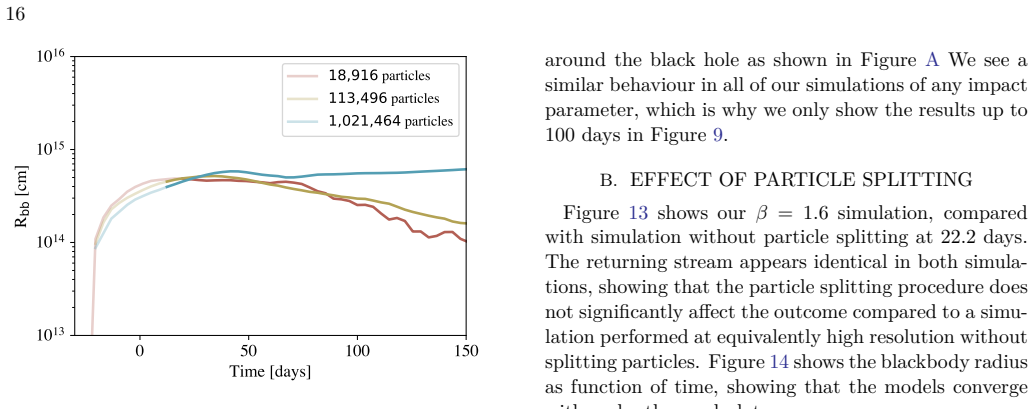
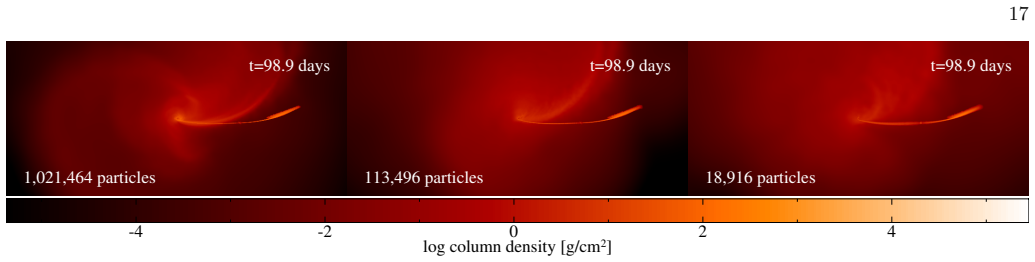
Authors: We acknowledge that quantitative fit statistics and formal error bars on the fallback rates would allow a more rigorous assessment. The SPH runs use standard Phantom resolution; we have added a brief convergence note in the methods. The comparison is presented as qualitative consistency rather than a statistical claim, given the limited parameter space explored. We have revised the discussion to emphasize this indicative nature and to avoid overstatement of the observational support. revision: partial
Circularity Check
No significant circularity; forward modeling from independent hydrodynamics
full rationale
The derivation begins with Phantom SPH simulations that generate mass fallback rates for partial disruptions (beta <=1) on zero-energy orbits. These rates are then post-processed under four explicitly listed assumptions (thermal emission from debris, trapped shock heating, electron-scattering opacity, f_col=1.7) to obtain T~10^4 K, L_bol~10^42-44 erg/s and R_bb~10-100 au. The resulting quantities are compared to observations rather than fitted to them; no equation reduces the predicted luminosities or temperatures to a quantity derived from the same observational sample, and no load-bearing step relies on self-citation or an imported uniqueness theorem. The central claim therefore remains an independent prediction from the hydrodynamic inputs.
Axiom & Free-Parameter Ledger
free parameters (2)
- f_col =
1.7
- beta threshold =
0.8
axioms (3)
- domain assumption Only zero-energy orbits are considered
- domain assumption Thermal emission, trapped shock heating, electron-scattering opacity
- domain assumption Mass fallback rate directly sets the reprocessing-layer properties
Reference graph
Works this paper leans on
-
[1]
On the Spectral Hardening Factor of the X-Ray Emission from Accretion Disks in Black Hole Candidates. , keywords =. doi:10.1086/175740 , adsurl =
-
[2]
A Grid of Relativistic, non-LTE Accretion Disk Models for Spectral Fitting of Black Hole Binaries
A Grid of Relativistic, Non-LTE Accretion Disk Models for Spectral Fitting of Black Hole Binaries. , keywords =. doi:10.1086/503549 , archivePrefix =. astro-ph/0602499 , primaryClass =
work page internal anchor Pith review Pith/arXiv arXiv doi:10.1086/503549
-
[3]
Hyperaccretion during tidal disruption events: weakly bound debris envelopes and jets
Hyperaccretion during Tidal Disruption Events: Weakly Bound Debris Envelopes and Jets. , keywords =. doi:10.1088/0004-637X/781/2/82 , archivePrefix =. 1312.5314 , primaryClass =
work page internal anchor Pith review Pith/arXiv arXiv doi:10.1088/0004-637x/781/2/82
-
[4]
A numerical approach to the testing of the fission hypothesis. , keywords =. doi:10.1086/112164 , adsurl =
-
[5]
Smoothed particle hydrodynamics: theory and application to non-spherical stars. , keywords =. doi:10.1093/mnras/181.3.375 , adsurl =
-
[6]
Smoothed particle hydrodynamics. , keywords =. doi:10.1146/annurev.aa.30.090192.002551 , adsurl =
-
[7]
Adaptive particle refinement for compressible smoothed particle hydrodynamics. , keywords =. doi:10.1017/pasa.2024.88 , archivePrefix =. 2409.11470 , primaryClass =
-
[8]
The Center of the Galaxy , year = 1989, editor =
Manifestations of a Massive Black Hole in the Galactic Center. The Center of the Galaxy , year = 1989, editor =
1989
-
[9]
Presupernova evolution of massive stars. , keywords =. doi:10.1086/156569 , adsurl =
-
[10]
General relativistic smoothed particle hydrodynamics
General relativistic smoothed particle hydrodynamics. , keywords =. doi:10.1093/mnras/stz111 , archivePrefix =. 1901.08064 , primaryClass =
work page internal anchor Pith review Pith/arXiv arXiv doi:10.1093/mnras/stz111 1901
-
[11]
Phantom: A smoothed particle hydrodynamics and magnetohydrodynamics code for astrophysics
Phantom: A Smoothed Particle Hydrodynamics and Magnetohydrodynamics Code for Astrophysics. , keywords =. doi:10.1017/pasa.2018.25 , archivePrefix =. 1702.03930 , primaryClass =
work page internal anchor Pith review Pith/arXiv arXiv doi:10.1017/pasa.2018.25 2018
-
[12]
Common envelopes in massive stars: towards the role of radiation pressure and recombination energy in ejecting red supergiant envelopes. , keywords =. doi:10.1093/mnras/stac049 , archivePrefix =. 2111.00923 , primaryClass =
-
[13]
Partial tidal disruption events: the elixir of life. , keywords =. doi:10.1093/mnras/stae1455 , archivePrefix =. 2403.04211 , primaryClass =
-
[14]
Optical Appearance of Eccentric Tidal Disruption Events. , keywords =. doi:10.3847/2041-8213/ad29ec , archivePrefix =. 2312.03210 , primaryClass =
-
[15]
Eddington Envelopes: The Fate of Stars on Parabolic Orbits Tidally Disrupted by Supermassive Black Holes. , keywords =. doi:10.3847/2041-8213/ad6862 , archivePrefix =. 2404.09381 , primaryClass =
-
[16]
Common envelope binary interaction simulations between a thermally pulsating AGB star and a low mass companion. , keywords =. doi:10.1093/mnras/stac2301 , archivePrefix =. 2205.09749 , primaryClass =
-
[17]
Tidal disruption of stars by black holes of 10 ^ 6 - 10 ^ 8 solar masses in nearby galaxies. , keywords =. doi:10.1038/333523a0 , adsurl =
-
[18]
Tidal Disruption Eddington Envelopes around Massive Black Holes
Tidal disruption Eddington envelopes around massive black holes. , keywords =. doi:10.48550/arXiv.astro-ph/9711199 , archivePrefix =. astro-ph/9711199 , primaryClass =
work page internal anchor Pith review Pith/arXiv arXiv doi:10.48550/arxiv.astro-ph/9711199
-
[19]
Multiband light curves of tidal disruption events. , keywords =. doi:10.1111/j.1365-2966.2010.17448.x , archivePrefix =. 1008.4589 , primaryClass =
-
[20]
Stellar disruption by a supermassive black hole: is the light curve really proportional to t ^ -5/3 ?. , keywords =. doi:10.1111/j.1365-2966.2008.14049.x , archivePrefix =. 0810.1288 , primaryClass =
-
[21]
Hydrodynamical Simulations to Determine the Feeding Rate of Black Holes by the Tidal Disruption of Stars: The Importance of the Impact Parameter and Stellar Structure. , keywords =. doi:10.1088/0004-637X/767/1/25 , archivePrefix =. 1206.2350 , primaryClass =
work page internal anchor Pith review Pith/arXiv arXiv doi:10.1088/0004-637x/767/1/25
-
[22]
Follow the Mass A Concordance Picture of Tidal Disruption Events. , keywords =. doi:10.3847/1538-4357/ade797 , archivePrefix =. 2409.02894 , primaryClass =
-
[23]
Stream-disk shocks as the origins of peak light in tidal disruption events. , keywords =. doi:10.1038/s41586-023-06875-y , archivePrefix =. 2206.10641 , primaryClass =
-
[24]
Tidal Disruption Events. , keywords =. doi:10.1146/annurev-astro-111720-030029 , archivePrefix =. 2104.14580 , primaryClass =
-
[25]
Partial stellar tidal disruption events and their rates. , keywords =. doi:10.1093/mnras/stad2024 , archivePrefix =. 2303.03408 , primaryClass =
-
[26]
Revisit the Rate of Tidal Disruption Events: The Role of the Partial Tidal Disruption Event. , keywords =. doi:10.3847/1538-4357/ac71ad , archivePrefix =. 2205.09945 , primaryClass =
-
[27]
Rates of Stellar Tidal Disruption as Probes of the Supermassive Black Hole Mass Function
Rates of stellar tidal disruption as probes of the supermassive black hole mass function. , keywords =. doi:10.1093/mnras/stv2281 , archivePrefix =. 1410.7772 , primaryClass =
work page internal anchor Pith review Pith/arXiv arXiv doi:10.1093/mnras/stv2281
-
[28]
Possible power source of Seyfert galaxies and QSOs. , keywords =. doi:10.1038/254295a0 , adsurl =
-
[29]
Light Curves of Partial Tidal Disruption Events. , keywords =. doi:10.3847/1538-4357/abf9a7 , archivePrefix =. 2104.08827 , primaryClass =
-
[30]
Coevolution (Or Not) of Supermassive Black Holes and Host Galaxies
Coevolution (Or Not) of Supermassive Black Holes and Host Galaxies. , keywords =. doi:10.1146/annurev-astro-082708-101811 , archivePrefix =. 1304.7762 , primaryClass =
work page internal anchor Pith review Pith/arXiv arXiv doi:10.1146/annurev-astro-082708-101811
-
[31]
Science China Physics, Mechanics, and Astronomy , keywords =
Science objectives of the Einstein Probe mission. Science China Physics, Mechanics, and Astronomy , keywords =. doi:10.1007/s11433-024-2600-3 , archivePrefix =. 2501.07362 , primaryClass =
-
[32]
Science with the 2.5-meter Wide Field Survey Telescope (WFST). Science China Physics, Mechanics, and Astronomy , keywords =. doi:10.1007/s11433-023-2197-5 , archivePrefix =. 2306.07590 , primaryClass =
-
[33]
Rubin Observatory LSST Transients and Variable Stars Roadmap. , keywords =. doi:10.1088/1538-3873/acdb9a , archivePrefix =. 2208.04499 , primaryClass =
-
[34]
New Physical Insights about Tidal Disruption Events from a Comprehensive Observational Inventory at X-Ray Wavelengths. , keywords =. doi:10.3847/1538-4357/aa633b , archivePrefix =. 1611.02291 , primaryClass =
work page internal anchor Pith review Pith/arXiv arXiv doi:10.3847/1538-4357/aa633b
-
[35]
The Final Season Reimagined: 30 Tidal Disruption Events from the ZTF-I Survey. , keywords =. doi:10.3847/1538-4357/aca283 , archivePrefix =. 2203.01461 , primaryClass =
-
[36]
"Circularization" vs. Accretion -- What Powers Tidal Disruption Events?
‧Disk Formation Versus Disk Accretion What Powers Tidal Disruption Events?. , keywords =. doi:10.1088/0004-637X/806/2/164 , archivePrefix =. 1502.05792 , primaryClass =
work page internal anchor Pith review Pith/arXiv arXiv doi:10.1088/0004-637x/806/2/164
-
[37]
A Bright Year for Tidal Disruptions?
A bright year for tidal disruptions. , keywords =. doi:10.1093/mnras/stw1394 , archivePrefix =. 1506.03453 , primaryClass =
work page internal anchor Pith review Pith/arXiv arXiv doi:10.1093/mnras/stw1394
-
[38]
Stellar Tidal Disruption Events with Abundances and Realistic Structures (STARS): Library of Fallback Rates. , keywords =. doi:10.3847/1538-4357/abc489 , archivePrefix =. 2007.10996 , primaryClass =
-
[39]
Stellar Revival and Repeated Flares in Deeply Plunging Tidal Disruption Events. , keywords =. doi:10.3847/2041-8213/ac5118 , archivePrefix =. 2202.00014 , primaryClass =
-
[40]
Tidal Disruptions of Main-sequence Stars. III. Stellar Mass Dependence of the Character of Partial Disruptions. , keywords =. doi:10.3847/1538-4357/abb3ce , archivePrefix =. 2001.03503 , primaryClass =
-
[41]
Smoothed Particle Hydrodynamics and Magnetohydrodynamics
Smoothed particle hydrodynamics and magnetohydrodynamics. Journal of Computational Physics , keywords =. doi:10.1016/j.jcp.2010.12.011 , archivePrefix =. 1012.1885 , primaryClass =
work page internal anchor Pith review Pith/arXiv arXiv doi:10.1016/j.jcp.2010.12.011 2010
-
[42]
Seventeen Tidal Disruption Events from the First Half of ZTF Survey Observations: Entering a New Era of Population Studies. , keywords =. doi:10.3847/1538-4357/abc258 , archivePrefix =. 2001.01409 , primaryClass =
-
[43]
The Zwicky Transient Facility: System Overview, Performance, and First Results
The Zwicky Transient Facility: System Overview, Performance, and First Results. , keywords =. doi:10.1088/1538-3873/aaecbe , archivePrefix =. 1902.01932 , primaryClass =
work page internal anchor Pith review Pith/arXiv arXiv doi:10.1088/1538-3873/aaecbe 1902
-
[44]
On the Double: Two Luminous Flares from the Nearby Tidal Disruption Event ASASSN-22ci (AT2022dbl) and Connections to Repeating TDE Candidates. arXiv e-prints , keywords =. doi:10.48550/arXiv.2412.15326 , archivePrefix =. 2412.15326 , primaryClass =
-
[45]
Tidal scattering of stars on supermassive black holes in galactic centers
Tidal Scattering of Stars on Supermassive Black Holes in Galactic Centers. , keywords =. doi:10.1086/324324 , archivePrefix =. astro-ph/0109237 , primaryClass =
work page internal anchor Pith review Pith/arXiv arXiv doi:10.1086/324324
-
[46]
Turbovelocity Stars: Kicks Resulting From the Tidal Disruption of Solitary Stars
Turbovelocity Stars: Kicks Resulting from the Tidal Disruption of Solitary Stars. , keywords =. doi:10.1088/2041-8205/771/2/L28 , archivePrefix =. 1305.4634 , primaryClass =
work page internal anchor Pith review Pith/arXiv arXiv doi:10.1088/2041-8205/771/2/l28 2041
-
[47]
To TDE or not to TDE: the luminous transient ASASSN-18jd with TDE-like and AGN-like qualities. , keywords =. doi:10.1093/mnras/staa859 , archivePrefix =. 1910.01142 , primaryClass =
-
[48]
MOSFiT: Modular Open-Source Fitter for Transients
MOSFiT: Modular Open Source Fitter for Transients. , keywords =. doi:10.3847/1538-4365/aab761 , archivePrefix =. 1710.02145 , primaryClass =
work page internal anchor Pith review Pith/arXiv arXiv doi:10.3847/1538-4365/aab761
-
[49]
Weighing Black Holes using Tidal Disruption Events
Weighing Black Holes Using Tidal Disruption Events. , keywords =. doi:10.3847/1538-4357/ab010f , archivePrefix =. 1801.08221 , primaryClass =
work page internal anchor Pith review Pith/arXiv arXiv doi:10.3847/1538-4357/ab010f
-
[50]
and Millman, K
Harris, Charles R. and Millman, K. Jarrod and van der Walt, Stéfan J and Gommers, Ralf and Virtanen, Pauli and Cournapeau, David and Wieser, Eric and Taylor, Julian and Berg, Sebastian and Smith, Nathaniel J. and Kern, Robert and Picus, Matti and Hoyer, Stephan and van Kerkwijk, Marten H. and Brett, Matthew and Haldane, Allan and Fernández del Río, Jaime ...
-
[51]
Hunter, J. D. , Title =. Computing in Science & Engineering , Volume =
-
[52]
SPLASH: An interactive visualisation tool for Smoothed Particle Hydrodynamics simulations
splash: An Interactive Visualisation Tool for Smoothed Particle Hydrodynamics Simulations. , keywords =. doi:10.1071/AS07022 , archivePrefix =. 0709.0832 , primaryClass =
work page internal anchor Pith review Pith/arXiv arXiv doi:10.1071/as07022
-
[53]
and Haberland, Matt and Reddy, Tyler and Cournapeau, David and Burovski, Evgeni and Peterson, Pearu and Weckesser, Warren and Bright, Jonathan and
Virtanen, Pauli and Gommers, Ralf and Oliphant, Travis E. and Haberland, Matt and Reddy, Tyler and Cournapeau, David and Burovski, Evgeni and Peterson, Pearu and Weckesser, Warren and Bright, Jonathan and. Nature Methods , year =
-
[54]
Optical flares from the tidal disruption of stars by massive black holes. , keywords =. doi:10.1111/j.1365-2966.2009.15599.x , archivePrefix =. 0905.3735 , primaryClass =
-
[55]
SMBH in Galactic Nuclei with Tidal Disruption of Stars
Super Massive Black Hole in Galactic Nuclei with Tidal Disruption of Stars. , keywords =. doi:10.1088/0004-637X/792/2/137 , archivePrefix =. 1407.3537 , primaryClass =
work page internal anchor Pith review Pith/arXiv arXiv doi:10.1088/0004-637x/792/2/137
-
[56]
Tidal disruption events with SPH-EXA: resolving the return of the stream
Tidal disruption events with SPH-EXA: resolving the return of the stream. arXiv e-prints , keywords =. doi:10.48550/arXiv.2510.26663 , archivePrefix =. 2510.26663 , primaryClass =
work page internal anchor Pith review Pith/arXiv arXiv doi:10.48550/arxiv.2510.26663
-
[57]
Converged simulations of the nozzle shock in tidal disruption events. arXiv e-prints , keywords =. doi:10.48550/arXiv.2510.04790 , archivePrefix =. 2510.04790 , primaryClass =
-
[58]
The nature of the central parsec of the Galaxy. , keywords =. doi:10.1086/160402 , adsurl =
-
[59]
Partial Stellar Disruption by a Supermassive Black Hole: Is the Light Curve Really Proportional to t ^ -9/4 ?. , keywords =. doi:10.3847/2041-8213/ab412d , archivePrefix =. 1907.03034 , primaryClass =
-
[60]
The La Silla Schmidt Southern Survey. , keywords =. doi:10.1088/1538-3873/ae02c5 , archivePrefix =. 2503.14579 , primaryClass =
-
[61]
ATLAS: A High-cadence All-sky Survey System. , keywords =. doi:10.1088/1538-3873/aabadf , archivePrefix =. 1802.00879 , primaryClass =
work page internal anchor Pith review Pith/arXiv arXiv doi:10.1088/1538-3873/aabadf
-
[62]
The All-Sky Automated Survey for Supernovae (ASAS-SN) Light Curve Server v1.0
The All-Sky Automated Survey for Supernovae (ASAS-SN) Light Curve Server v1.0. , keywords =. doi:10.1088/1538-3873/aa80d9 , archivePrefix =. 1706.07060 , primaryClass =
work page internal anchor Pith review Pith/arXiv arXiv doi:10.1088/1538-3873/aa80d9
-
[63]
Soft X-ray Temperature Tidal Disruption Events from Stars on Deep Plunging Orbits
Soft X-Ray Temperature Tidal Disruption Events from Stars on Deep Plunging Orbits. , keywords =. doi:10.1088/2041-8205/812/2/L39 , archivePrefix =. 1507.04333 , primaryClass =
work page internal anchor Pith review Pith/arXiv arXiv doi:10.1088/2041-8205/812/2/l39 2041
-
[64]
The Tidal Disruption of a Star by a Massive Black Hole. , keywords =. doi:10.1086/185567 , adsurl =
-
[65]
Optical Appearance of the Debris of a Star Disrupted by a Massive Black Hole
Optical Appearance of the Debris of a Star Disrupted by a Massive Black Hole. , keywords =. doi:10.1086/304814 , archivePrefix =. astro-ph/9703079 , primaryClass =
work page internal anchor Pith review Pith/arXiv arXiv doi:10.1086/304814
-
[66]
Long-term stream evolution in tidal disruption events
Long-term stream evolution in tidal disruption events. , keywords =. doi:10.1093/mnras/stw2547 , archivePrefix =. 1608.00970 , primaryClass =
work page internal anchor Pith review Pith/arXiv arXiv doi:10.1093/mnras/stw2547
-
[67]
Examining a Peak-luminosity/Decline-rate Relationship for Tidal Disruption Events. , keywords =. doi:10.3847/2041-8213/ab89a2 , archivePrefix =. 2001.08215 , primaryClass =
-
[68]
A Mildly Relativistic Outflow Launched Two Years after Disruption in Tidal Disruption Event AT2018hyz. , keywords =. doi:10.3847/1538-4357/ac88d0 , archivePrefix =. 2206.14297 , primaryClass =
-
[69]
Modeling the UV/Optical Light Curve of Re-brightening Tidal Disruption Events. , keywords =. doi:10.3847/1538-4357/adc005 , archivePrefix =. 2412.12549 , primaryClass =
-
[70]
Prompt Radiation and Mass Outflows from the Stream-Stream Collisions of Tidal Disruption Events
Prompt Radiation and Mass Outflows from the Stream-Stream Collisions of Tidal Disruption Events. , keywords =. doi:10.3847/0004-637X/830/2/125 , archivePrefix =. 1603.07733 , primaryClass =
work page internal anchor Pith review Pith/arXiv arXiv doi:10.3847/0004-637x/830/2/125
-
[71]
Cooling Envelope Model for Tidal Disruption Events. , keywords =. doi:10.3847/2041-8213/ac90ba , archivePrefix =. 2207.07136 , primaryClass =
-
[72]
Little Red Dots: An Abundant Population of Faint Active Galactic Nuclei at z 5 Revealed by the EIGER and FRESCO JWST Surveys. , keywords =. doi:10.3847/1538-4357/ad2345 , archivePrefix =. 2306.05448 , primaryClass =
-
[73]
Evidence for the Preferential Disruption of Moderately Massive Stars by Supermassive Black Holes. , keywords =. doi:10.3847/1538-4357/ac35d5 , archivePrefix =. 2110.03013 , primaryClass =
-
[74]
Tidal disruption events: the role of stellar spin
Tidal Disruption Events: The Role of Stellar Spin. , keywords =. doi:10.3847/1538-4357/aafd2f , archivePrefix =. 1901.03717 , primaryClass =
work page internal anchor Pith review Pith/arXiv arXiv doi:10.3847/1538-4357/aafd2f 1901
-
[75]
Disc formation from tidal disruption of stars on eccentric orbits by Kerr black holes using GRSPH. arXiv e-prints , keywords =. doi:10.48550/arXiv.1910.10154 , archivePrefix =. 1910.10154 , primaryClass =
-
[76]
The Maximum Gravity Model for Partial Tidal Disruption Events: Mass Loss, Peak Fallback Rate, and Dependence on Stellar Properties. , keywords =. doi:10.3847/1538-4357/ae31e3 , archivePrefix =. 2601.02476 , primaryClass =
-
[77]
Simulating disc formation in tidal disruption events. , keywords =. doi:10.1093/mnras/staa1246 , archivePrefix =. 1906.05865 , primaryClass =
-
[78]
Finite, Intense Accretion Bursts from Tidal Disruption of Stars on Bound Orbits
Finite, intense accretion bursts from tidal disruption of stars on bound orbits. , keywords =. doi:10.1093/mnras/stt871 , archivePrefix =. 1210.1333 , primaryClass =
work page internal anchor Pith review Pith/arXiv arXiv doi:10.1093/mnras/stt871
-
[79]
Tidal Disruption Events. arXiv e-prints , keywords =. doi:10.48550/arXiv.2511.14911 , archivePrefix =. 2511.14911 , primaryClass =
-
[80]
On the Mass and Luminosity Functions of Tidal Disruption Flares: Rate Suppression due to Black Hole Event Horizons. , keywords =. doi:10.3847/1538-4357/aa998e , archivePrefix =. 1707.03458 , primaryClass =
work page internal anchor Pith review Pith/arXiv arXiv doi:10.3847/1538-4357/aa998e
discussion (0)
Sign in with ORCID, Apple, or X to comment. Anyone can read and Pith papers without signing in.