Recent Progress in Ultrafast Dynamics of Transition-Metal Compounds Studied by Time-Resolved X-ray Techniques
Pith reviewed 2026-05-16 18:25 UTC · model grok-4.3
The pith
Time-resolved X-ray absorption and scattering now give element-specific access to ultrafast charge, spin, and lattice dynamics in transition-metal compounds.
A machine-rendered reading of the paper's core claim, the machinery that carries it, and where it could break.
Core claim
Time-resolved X-ray absorption spectroscopy, X-ray magnetic circular dichroism, and resonant soft X-ray scattering provide direct, complementary access to element- and momentum-resolved ultrafast dynamics, as shown in recent measurements of demagnetization, spin-state transitions, and valence or structural changes in transition-metal compounds.
What carries the argument
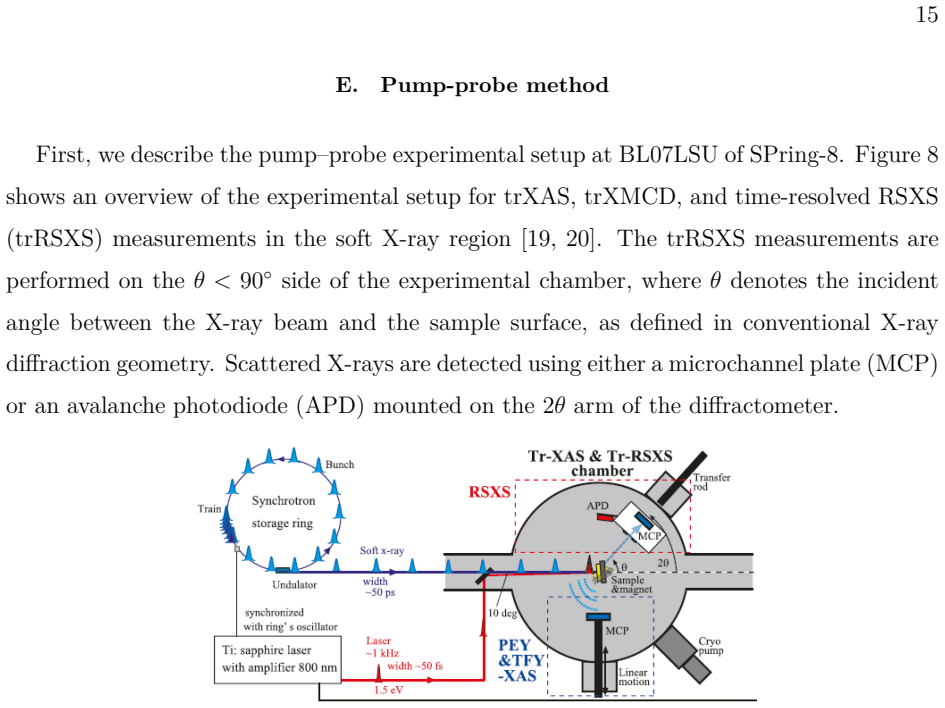
Pump-probe time-resolved X-ray absorption spectroscopy (TR-XAS), X-ray magnetic circular dichroism (XMCD), and resonant soft X-ray scattering (RSXS) using XFEL and HHG sources for element-selective tracking of nonequilibrium charge, spin, orbital, and lattice evolution.
If this is right
- These techniques separate the individual time scales of charge, spin, and lattice responses within one material.
- Integration of tabletop HHG sources with XFEL facilities expands access to ultrafast experiments.
- The methods support visualization of nonequilibrium states that govern ultrafast control of quantum materials.
Where Pith is reading between the lines
- The same element-selective approach could be applied to photo-induced phase transitions in other correlated systems to reveal hidden coupling pathways.
- Combining these measurements with theoretical modeling of nonequilibrium states would allow quantitative prediction of control protocols.
- Extension to higher momentum resolution might expose spatial inhomogeneities in ultrafast dynamics that current setups average over.
Load-bearing premise
The selected recent studies accurately represent the full scope of progress and limitations in the field without major omissions.
What would settle it
A controlled comparison in which time-resolved X-ray methods miss a major ultrafast process that optical probes detect in the same transition-metal sample would falsify the claim of direct complementary access.
Figures




read the original abstract
X-ray absorption spectroscopy and X-ray magnetic circular dichroism have long served as indispensable tools for probing the electronic and magnetic properties of transition-metal compounds with elemental selectivity. In recent years, the emergence of femtosecond lasers has opened a new avenue for studying nonequilibrium dynamics in condensed matter. However, conventional optical techniques lack elemental and orbital specificity, making it difficult to disentangle the coupled charge, spin, and lattice responses in complex materials. The development of X-ray free-electron lasers (XFEL) and laboratory high-harmonic generation (HHG) sources has enabled the extension of X-ray absorption and scattering techniques into the femtosecond time domain. Time-resolved X-ray absorption spectroscopy, X-ray magnetic circular dichroism, and resonant soft X-ray scattering now provide direct, complementary access to element- and momentum-resolved ultrafast dynamics. This review summarizes recent progress in these techniques, focusing on pump-probe measurements of laser-induced demagnetization, spin-state transitions, and valence and structural changes in transition-metal compounds. We also discuss advances in tabletop HHG-based X-ray spectroscopy and its integration with large-scale XFEL facilities. These developments provide powerful routes for visualizing the nonequilibrium evolution of charge, spin, orbital, and lattice degrees of freedom, offering new insights into the ultrafast control of quantum materials.
Editorial analysis
A structured set of objections, weighed in public.
Referee Report
Summary. The manuscript is a review article summarizing recent progress in ultrafast dynamics of transition-metal compounds using time-resolved X-ray absorption spectroscopy (XAS), X-ray magnetic circular dichroism (XMCD), and resonant soft X-ray scattering. It focuses on pump-probe experiments enabled by XFEL and HHG sources to study laser-induced demagnetization, spin-state transitions, valence changes, and structural dynamics, highlighting element- and momentum-resolved access to charge, spin, orbital, and lattice degrees of freedom.
Significance. If the cited primary studies are accurately represented, the review provides a useful consolidation of how these X-ray techniques complement conventional optical methods by offering elemental selectivity and momentum resolution in nonequilibrium processes. It is particularly valuable for researchers working on quantum materials control, as it integrates advances in both large-scale XFEL facilities and tabletop HHG sources.
minor comments (2)
- Abstract: The general claims about complementary access to dynamics would be strengthened by naming one or two specific transition-metal compounds (e.g., a nickelate or manganite) as illustrative examples of the phenomena discussed.
- Throughout: Verify that all referenced experimental works include accurate summaries of their key quantitative findings (e.g., time scales or effect sizes) to maintain the review's reliability as a reference.
Simulated Author's Rebuttal
We thank the referee for the positive summary of our review and the recommendation for minor revision. No specific major comments were listed in the report, so we have no point-by-point revisions to address at this stage.
Circularity Check
No significant circularity: review of external literature
full rationale
This is a review summarizing capabilities of time-resolved XAS, XMCD, and resonant soft X-ray scattering drawn from cited external pump-probe studies on demagnetization, spin transitions, and valence changes. No derivations, equations, fitted parameters, or predictions appear in the text. Central claims rest on independent experimental literature rather than any self-referential reduction or self-citation chain. The structure is self-contained against external benchmarks with no load-bearing internal steps that collapse to the paper's own inputs.
Axiom & Free-Parameter Ledger
Reference graph
Works this paper leans on
-
[1]
The most successful ap- proach is HHG [ 30–32]
High-harmonic generation In parallel with the development of XFELs, ultrafast X-ray sources have also made great progress due to dramatic advances in tabletop laser technology. The most successful ap- proach is HHG [ 30–32]. HHG is a nonlinear optical phenomenon that generates light at a high frequency, an integer multiple of the original laser frequency,...
work page 2000
-
[2]
Complementarity with neutron scattering Recent advancements in neutron techniques provide information that is highly comple- mentary to X-ray–based approaches. Unlike X-rays, neutron scattering cross-sections do not scale monotonically with atomic number, and neutrons couple directly to magnetic moments. Owing to this sensitivity, neutron scattering has l...
-
[3]
In the visible to infrared laser range, only electrons whose energy satisfies EF − hν < E < E F respond to laser irradiation and absorb photons almost instantly. Therefore, the laser first interacts with the sample, generating electron-hole pairs on a time scale of about 1 fs
-
[4]
The electron system equilibrates to high-temperature Te by electron-electron interac- tions within about 50-500 fs
-
[5]
The equilibrated electronic excitations heat the lattice and increase Tl on a time scale determined by the electron-lattice interaction time, which is about 100 fs - 1 ps. 25 Thus, after about 1 ps, the electron system and the lattice system are in thermal equilibrium with each other, i.e., Te = Tl. These three processes are summarized as panels (a)-(c) i...
work page 1996
-
[6]
H. Ueda, M. García-Fernández, S. Agrestini, C. P. Romao, J. van den Brink, N. A. Spaldin, K.-J. Zhou, and U. Staub, Nature 618, 946 (2023)
work page 2023
-
[7]
C. T. Chantler, G. Bunker, P. D’Angelo, and S. Diaz-Moreno, Nature Reviews Methods Primers 4, 89 (2024)
work page 2024
-
[8]
C. A. F. Vaz, G. van der Laan, S. A. Cavill, H. A. Dürr, A. Fraile Rodríguez, F. Kronast, W. Kuch, P. Sainctavit, G. Schütz, H. Wende, E. Weschke, and F. Wilhelm, Nature Reviews Methods Primers 5, 27 (2025)
work page 2025
-
[9]
J. Stöhr and H. C. Siegmann, Magnetism (Springer Berlin Heidelberg, 2006). 53
work page 2006
- [10]
-
[11]
E. Beaurepaire, J.-C. Merle, A. Daunois, and J.-Y. Bigot, Phys. Rev. Lett. 76, 4250 (1996)
work page 1996
-
[12]
R. Schoenlein, T. Elsaesser, K. Holldack, Z. Huang, H. Kapteyn, M. Murnane, and M. Wo- erner, Philosophical Transactions of the Royal Society A: Mathematical, Physical and Engi- neering Sciences 377, 20180384 (2019)
work page 2019
-
[13]
P. Emma, R. Akre, J. Arthur, R. Bionta, C. Bostedt, J. Bozek, A. Brachmann, P. Bucks- baum, R. Coffee, F.-J. Decker, Y. Ding, D. Dowell, S. Edstrom, A. Fisher, J. Frisch, S. Gile- vich, J. Hastings, G. Hays, P. Hering, Z. Huang, R. Iverson, H. Loos, M. Messerschmidt, A. Miahnahri, S. Moeller, H.-D. Nuhn, G. Pile, D. Ratner, J. Rzepiela, D. Schultz, T. Smi...
work page 2010
-
[14]
T. Ishikawa, H. Aoyagi, T. Asaka, Y. Asano, N. Azumi, T. Bizen, H. Ego, K. Fukami, T. Fukui, Y. Furukawa, S. Goto, H. Hanaki, T. Hara, T. Hasegawa, T. Hatsui, A. Hi- gashiya, T. Hirono, N. Hosoda, M. Ishii, T. Inagaki, Y. Inubushi, T. Itoga, Y. Joti, M. Kago, T. Kameshima, H. Kimura, Y. Kirihara, A. Kiyomichi, T. Kobayashi, C. Kondo, T. Kudo, H. Maesaka, ...
work page 2012
-
[15]
Y. Uemura, A. S. M. Ismail, S. H. Park, S. Kwon, M. Kim, H. Elnaggar, F. Frati, H. Wadati, Y. Hirata, Y. Zhang, K. Yamagami, S. Yamamoto, I. Matsuda, U. Halisdemir, G. Koster, C. Milne, M. Ammann, B. M. Weckhuysen, and F. M. F. de Groot, The Journal of Physical Chemistry Letters 13, 4207–4214 (2022)
work page 2022
-
[16]
Y. Shen, D. Kan, I.-C. Lin, M.-W. Chu, I. Suzuki, and Y. Shimakawa, Applied Physics Letters 117, 042408 (2020)
work page 2020
- [17]
-
[18]
Sato, Light and magnetism (Asakura, 2001)
K. Sato, Light and magnetism (Asakura, 2001). 54
work page 2001
-
[19]
Y. Kubota, Magnetism of buried layers studied by soft X-ray resonant magneto-optical effect using polarization modulation , Ph.D. thesis, University of Tokyo (2016)
work page 2016
-
[20]
D. Attwood, Soft X-Rays and Extreme Ultraviolet Radiation: Principles and Applications (Cambridge University Press, 2007)
work page 2007
-
[21]
C. T. Chen, Y. U. Idzerda, H.-J. Lin, N. V. Smith, G. Meigs, E. Chaban, G. H. Ho, E. Pel- legrin, and F. Sette, Phys. Rev. Lett. 75, 152 (1995)
work page 1995
-
[22]
G. van der Laan and A. I. Figueroa, Coordination Chemistry Reviews 277-278, 95 (2014) , following Chemical Structures using Synchrotron Radiation
work page 2014
-
[23]
J. Fink, E. Schierle, E. Weschke, and J. Geck, Reports on Progress in Physics 76, 056502 (2013)
work page 2013
-
[24]
S. Yamamoto, Y. Senba, T. Tanaka, H. Ohashi, T. Hirono, H. Kimura, M. Fujisawa, J. Miyawaki, A. Harasawa, T. Seike, S. Takahashi, N. Nariyama, T. Matsushita, M. Takeuchi, T. Ohata, Y. Furukawa, K. Takeshita, S. Goto, Y. Harada, S. Shin, H. Kitamura, A. Kak- izaki, M. Oshima, and I. Matsuda, Journal of Synchrotron Radiation 21, 352 (2014)
work page 2014
- [25]
- [26]
- [27]
-
[28]
D. J. Higley, K. Hirsch, G. L. Dakovski, E. Jal, E. Yuan, T. Liu, A. A. Lutman, J. P. MacArthur, E. Arenholz, Z. Chen, G. Coslovich, P. Denes, P. W. Granitzka, P. Hart, M. C. Hoffmann, J. Joseph, L. Le Guyader, A. Mitra, S. Moeller, H. Ohldag, M. Seaberg, P. Shafer, J. Stöhr, A. Tsukamoto, H.-D. Nuhn, A. H. Reid, H. A. Dürr, and W. F. Schlotter, Review of...
work page 2016
-
[29]
S. Yamamoto and I. Matsuda, Journal of the Physical Society of Japan 82, 021003 (2013)
work page 2013
-
[30]
R. W. Schoenlein, S. Chattopadhyay, H. H. W. Chong, T. E. Glover, P. A. Heimann, C. V. Shank, A. A. Zholents, and M. S. Zolotorev, Science 287, 2237–2240 (2000) . 55
work page 2000
-
[31]
S. Khan, K. Holldack, T. Kachel, R. Mitzner, and T. Quast, Phys. Rev. Lett. 97, 074801 (2006)
work page 2006
-
[32]
K. Holldack, J. Bahrdt, A. Balzer, U. Bovensiepen, M. Brzhezinskaya, A. Erko, A. Eschen- lohr, R. Follath, A. Firsov, W. Frentrup, L. Le Guyader, T. Kachel, P. Kuske, R. Mitzner, R. Müller, N. Pontius, T. Quast, I. Radu, J.-S. Schmidt, C. Schüßler-Langeheine, M. Sper- ling, C. Stamm, C. Trabant, and A. Föhlisch, Journal of Synchrotron Radiation 21, 1090 (2014)
work page 2014
- [33]
-
[34]
M. Labat, J.-B. Brubach, A. Ciavardini, M.-E. Couprie, E. Elkaim, P. Fertey, T. Ferte, P. Hollander, N. Hubert, E. Jal, C. Laulhé, J. Luning, O. Marcouillé, T. Moreno, P. Morin, F. Polack, P. Prigent, S. Ravy, J.-P. Ricaud, P. Roy, M. Silly, F. Sirotti, A. Taleb, M.-A. Tordeux, and A. Nadji, Journal of Synchrotron Radiation 25, 385 (2018)
work page 2018
-
[35]
X. F. Li, A. L’Huillier, M. Ferray, L. A. Lompré, and G. Mainfray, Phys. Rev. A 39, 5751 (1989)
work page 1989
-
[36]
P. M. Paul, E. S. Toma, P. Breger, G. Mullot, F. Augé, P. Balcou, H. G. Muller, and P. Agostini, Science 292, 1689–1692 (2001)
work page 2001
-
[37]
M. Hentschel, R. Kienberger, C. Spielmann, G. A. Reider, N. Milosevic, T. Brabec, P. Corkum, U. Heinzmann, M. Drescher, and F. Krausz, Nature 414, 509 (2001)
work page 2001
-
[38]
J. Jarecki, M. Hennecke, T. Sidiropoulos, M. Schnuerer, S. Eisebitt, and D. Schick, Structural Dynamics 11, 054303 (2024)
work page 2024
-
[39]
S. Chakraborty, S. Britto, M. Gomez-Gonzalez, A. G. Buzanich, and I. Mikulska, Cell Reports Physical Science 6 (2025), 10.1016/j.xcrp.2025.102806
-
[40]
X. Chen, R. Adam, D. E. Bürgler, F. Wang, Z. Lu, L. Pan, S. Heidtfeld, C. Greb, M. Liu, Q. Liu, J. Wang, C. M. Schneider, and D. Cao, Physics Reports 1102, 1 (2025) , ultrafast demagnetization in ferromagnetic materials: Origins and progress
work page 2025
-
[41]
J. Hohlfeld, S.-S. Wellershoff, J. Güdde, U. Conrad, V. Jähnke, and E. Matthias, Chemical Physics 251, 237 (2000)
work page 2000
-
[42]
C.-H. Lambert, S. Mangin, B. S. D. C. S. Varaprasad, Y. K. Takahashi, M. Hehn, M. Cinchetti, G. Malinowski, K. Hono, Y. Fainman, M. Aeschlimann, and E. E. Fuller- ton, Science 345, 1337–1340 (2014) . 56
work page 2014
- [43]
- [44]
-
[45]
K. Yamamoto, Y. Kubota, M. Suzuki, Y. Hirata, K. Carva, M. Berritta, K. Takubo, Y. Uemura, R. Fukaya, K. Tanaka, W. Nishimura, T. Ohkochi, T. Katayama, T. Togashi, K. Tamasaku, M. Yabashi, Y. Tanaka, T. Seki, K. Takanashi, P. M. Oppeneer, and H. Wa- dati, New Journal of Physics 21, 123010 (2019)
work page 2019
- [46]
-
[47]
S. Ueda, M. Mizuguchi, Y. Miura, J. G. Kang, M. Shirai, and K. Takanashi, Applied Physics Letters 109, 042404 (2016)
work page 2016
-
[48]
M. Battiato, K. Carva, and P. M. Oppeneer, Phys. Rev. Lett. 105, 027203 (2010)
work page 2010
-
[49]
M. Hofherr, S. Moretti, J. Shim, S. Häuser, N. Y. Safonova, M. Stiehl, A. Ali, S. Sakshath, J. W. Kim, D. H. Kim, H. J. Kim, J. I. Hong, H. C. Kapteyn, M. M. Murnane, M. Cinchetti, D. Steil, S. Mathias, B. Stadtmüller, M. Albrecht, D. E. Kim, U. Nowak, and M. Aeschli- mann, Phys. Rev. B 98, 174419 (2018)
work page 2018
-
[50]
S. Yamamoto, M. Taguchi, M. Fujisawa, R. Hobara, S. Yamamoto, K. Yaji, T. Nakamura, K. Fujikawa, R. Yukawa, T. Togashi, M. Yabashi, M. Tsunoda, S. Shin, and I. Matsuda, Phys. Rev. B 89, 064423 (2014)
work page 2014
-
[51]
K. Yamamoto, S. E. Moussaoui, Y. Hirata, S. Yamamoto, Y. Kubota, S. Owada, M. Yabashi, T. Seki, K. Takanashi, I. Matsuda, and H. Wadati, Applied Physics Letters 116, 172406 (2020)
work page 2020
-
[52]
C. D. Stanciu, F. Hansteen, A. V. Kimel, A. Kirilyuk, A. Tsukamoto, A. Itoh, and T. Rasing, Phys. Rev. Lett. 99, 047601 (2007)
work page 2007
-
[53]
I. Radu, K. Vahaplar, C. Stamm, T. Kachel, N. Pontius, H. A. Dürr, T. A. Ostler, J. Barker, R. F. L. Evans, R. W. Chantrell, A. Tsukamoto, A. Itoh, A. Kirilyuk, T. Rasing, and A. V. Kimel, Nature 472, 205 (2011) . 57
work page 2011
-
[54]
I. Radu, C. Stamm, N. Pontius, T. Kachel, P. Ramm, J.-U. Thiele, H. A. Dürr, and C. H. Back, Phys. Rev. B 81, 104415 (2010)
work page 2010
- [55]
-
[56]
T. Katayama, A. Chikamatsu, Y. Zhang, S. Yasui, H. Wadati, and T. Hasegawa, Chemistry of Materials 33, 5675 (2021)
work page 2021
-
[57]
T. Tsuyama, S. Chakraverty, S. Macke, N. Pontius, C. Schüßler-Langeheine, H. Y. Hwang, Y. Tokura, and H. Wadati, Phys. Rev. Lett. 116, 256402 (2016)
work page 2016
-
[58]
K. Yamamoto, T. Tsuyama, S. Ito, K. Takubo, I. Matsuda, N. Pontius, C. Schüßler- Langeheine, M. Minohara, H. Kumigashira, Y. Yamasaki, H. Nakao, Y. Murakami, T. Katase, T. Kamiya, and H. Wadati, New Journal of Physics 24, 043012 (2022)
work page 2022
-
[59]
J. Okamoto, D. J. Huang, K. S. Chao, S. W. Huang, C.-H. Hsu, A. Fujimori, A. Masuno, T. Terashima, M. Takano, and C. T. Chen, Phys. Rev. B 82, 132402 (2010)
work page 2010
-
[60]
S. Chakraverty, T. Matsuda, H. Wadati, J. Okamoto, Y. Yamasaki, H. Nakao, Y. Murakami, S. Ishiwata, M. Kawasaki, Y. Taguchi, Y. Tokura, and H. Y. Hwang, Phys. Rev. B 88, 220405 (2013)
work page 2013
-
[61]
K. Yamamoto, Y. Hirata, M. Horio, Y. Yokoyama, K. Takubo, M. Minohara, H. Kumigashira, Y. Yamasaki, H. Nakao, Y. Murakami, A. Fujimori, and H. Wadati, Phys. Rev. B 97, 075134 (2018)
work page 2018
-
[62]
M. Minohara, M. Kitamura, H. Wadati, H. Nakao, R. Kumai, Y. Murakami, and H. Kumi- gashira, Journal of Applied Physics 120, 025303 (2016)
work page 2016
-
[63]
A. D. Caviglia, M. Först, R. Scherwitzl, V. Khanna, H. Bromberger, R. Mankowsky, R. Singla, Y.-D. Chuang, W. S. Lee, O. Krupin, W. F. Schlotter, J. J. Turner, G. L. Dakovski, M. P. Minitti, J. Robinson, V. Scagnoli, S. B. Wilkins, S. A. Cavill, M. Gibert, S. Gariglio, P. Zubko, J.-M. Triscone, J. P. Hill, S. S. Dhesi, and A. Cavalleri, Phys. Rev. B 88, 22...
work page 2013
-
[64]
Y. Zhu, J. Hoffman, C. E. Rowland, H. Park, D. A. Walko, J. W. Freeland, P. J. Ryan, R. D. Schaller, A. Bhattacharya, and H. Wen, Nature Communications 9, 1799 (2018)
work page 2018
-
[65]
N. Thielemann-Kühn, D. Schick, N. Pontius, C. Trabant, R. Mitzner, K. Holldack, H. Zabel, A. Föhlisch, and C. Schüßler-Langeheine, Phys. Rev. Lett. 119, 197202 (2017) . 58
work page 2017
-
[66]
I. Radu, G. Woltersdorf, M. Kiessling, A. Melnikov, U. Bovensiepen, J.-U. Thiele, and C. H. Back, Phys. Rev. Lett. 102, 117201 (2009)
work page 2009
-
[67]
G. Wortmann, I. Nowik, B. Perscheid, G. Kaindl, and I. Felner, Phys. Rev. B 43, 5261 (1991)
work page 1991
-
[68]
H. Wada, A. Nakamura, A. Mitsuda, M. Shiga, T. Tanaka, H. Mitamura, and T. Goto, Journal of Physics: Condensed Matter 9, 7913 (1997)
work page 1997
-
[69]
K. Yamamoto, K. Horiba, M. Taguchi, M. Matsunami, N. Kamakura, A. Chainani, Y. Takata, K. Mimura, M. Shiga, H. Wada, Y. Senba, H. Ohashi, and S. Shin, Phys. Rev. B 72, 161101 (2005)
work page 2005
-
[70]
K. Yamamoto, K. Horiba, M. Taguchi, M. Matsunami, N. Kamakura, Y. Takata, A. Chainani, K. Mimura, M. Shiga, H. Wada, Y. Senba, H. Ohashi, and S. Shin, Phys- ica B: Condensed Matter 378-380, 681 (2006) , proceedings of the International Conference on Strongly Correlated Electron Systems
work page 2006
- [71]
-
[72]
R. Shimokasa, N. Kawamura, T. Matsumoto, K. Kawakami, T. Kawabata, G. Isumi, T. Uozumi, A. Mitsuda, H. Wada, M. Mizumaki, and K. Mimura, Radiation Physics and Chemistry 175, 108150 (2020) , 17th International Conference on X-ray Absorption Fine Structure - XAFS2018
work page 2020
-
[73]
Y. H. Matsuda, T. Inami, K. Ohwada, Y. Murata, H. Nojiri, Y. Murakami, A. Mitsuda, H. Wada, H. Miyazaki, and I. Harada, Journal of the Physical Society of Japan 77, 054713 (2008)
work page 2008
-
[74]
Y. H. Matsuda, Z. W. Ouyang, H. Nojiri, T. Inami, K. Ohwada, M. Suzuki, N. Kawamura, A. Mitsuda, and H. Wada, Phys. Rev. Lett. 103, 046402 (2009)
work page 2009
-
[75]
T. Nakamura, T. Hirono, T. Kinoshita, Y. Narumi, M. Hayashi, H. Nojiri, A. Mitsuda, H. Wada, K. Kodama, K. Kindo, and A. Kotani, Journal of the Physical Society of Japan 81, 103705 (2012)
work page 2012
-
[76]
H. Wada, M. F. Hundley, R. Movshovich, and J. D. Thompson, Phys. Rev. B 59, 1141 (1999). 59
work page 1999
-
[77]
Y. Yokoyama, K. Kawakami, Y. Hirata, K. Takubo, K. Yamamoto, K. Abe, A. Mitsuda, H. Wada, T. Uozumi, S. Yamamoto, I. Matsuda, S. Kimura, K. Mimura, and H. Wadati, Phys. Rev. B 100, 115123 (2019)
work page 2019
-
[78]
J. R. L. Mardegan, S. Zerdane, G. Mancini, V. Esposito, J. R. Rouxel, R. Mankowsky, C. Svetina, N. Gurung, S. Parchenko, M. Porer, B. Burganov, Y. Deng, P. Beaud, G. Ingold, B. Pedrini, C. Arrell, C. Erny, A. Dax, H. Lemke, M. Decker, N. Ortiz, C. Milne, G. Smo- lentsev, L. Maurel, S. L. Johnson, A. Mitsuda, H. Wada, Y. Yokoyama, H. Wadati, and U. Staub, ...
work page 2021
-
[79]
K. Yamagami, H. Ueda, U. Staub, Y. Zhang, K. Yamamoto, S. H. Park, S. Kwon, A. Mitsuda, H. Wada, T. Uozumi, K. Mimura, and H. Wadati, Phys. Rev. Res. 6, 023099 (2024)
work page 2024
-
[80]
S. H. Park, M. Kim, C.-K. Min, I. Eom, I. Nam, H.-S. Lee, H.-S. Kang, H.-D. Kim, H. Y. Jang, S. Kim, S.-m. Hwang, G.-S. Park, J. Park, T.-Y. Koo, and S. Kwon, Review of Scientific Instruments 89, 055105 (2018)
work page 2018
discussion (0)
Sign in with ORCID, Apple, or X to comment. Anyone can read and Pith papers without signing in.