REVIEW 3 major objections 5 minor 1 cited by
Binarisation-loophole-free observation of high-dimensional quantum nonlocality
T0 review · 3 major / 5 minor · reviewed 2026-08-03 · deepseek-v4-flash
Pith's one-line read True four-outcome measurements close the binarisation loophole and show genuine 4D quantum nonlocality.
desk verdict A strong experiment closing the binarisation loophole with ququart Bell violations, but the 'genuine high-dimensional' claim leans on heuristic qutrit bounds that need hardening. read the letter →
The pith
A machine-rendered reading of the paper's core claim, the machinery that carries it, and where it could break.
The reading
What carries the argument
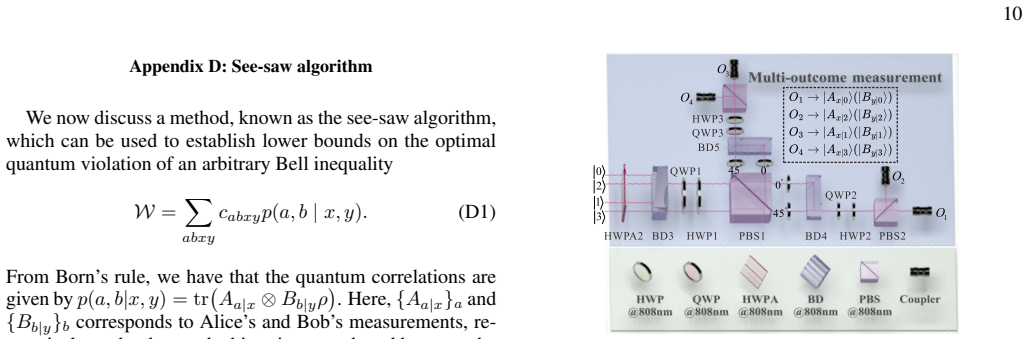
The key device is a four-outcome projective measurement built by converting path-encoded states into a hybrid path-polarisation encoding and projecting onto four spatially separated modes, so that all four outcomes are registered simultaneously and the measurement normalisation is physically enforced rather than assumed. The supporting argument is the derivation of upper bounds for three-dimensional entanglement, I4 ≤ 0.305 and S4 ≤ 0.2117, obtained with a heuristic rank-constrained semidefinite-programming sampling method described in Appendix B.
What would settle it
Compute the exact maximum of I4 and S4 for qutrit measurements on qutrit states, or find a qutrit strategy exceeding 0.305 or 0.2117; either would disprove the claim. Alternatively, repeat the experiment with a measurement device whose multi-outcome normalisation is independently certified and check whether the violations persist.
Extended reading notes
Core claim
On its own terms, the paper establishes that true four-outcome projective measurements on four-dimensional path-mode entanglement produce Bell-inequality violations large enough to rule out every quantum model based on lower-dimensional entanglement. Specifically, the measured values I4 = 0.3346 ± 0.0030 and S4 = 0.2832 ± 0.0027 exceed the respective upper bounds I4 ≤ 0.305 and S4 ≤ 0.2117 that the authors derive for any qutrit model. Because the measurement device physically enforces the normalisation condition that the measurement operators sum to the identity, by counting all four outcomes in every round, the binarisation loophole is closed. The paper therefore claims the first demonstrat
Load-bearing premise
The load-bearing premise is that the upper bounds on what qutrit entanglement can achieve in these two Bell tests (I4 ≤ 0.305 and S4 ≤ 0.2117) are correct; they are computed with a heuristic sampling method that the paper labels a proof but for which no rigorous certificate is given.
Editorial extensions
If this is right
- Binarised implementations of high-dimensional Bell tests lose the noise-tolerance advantage of higher dimension; this experiment shows that advantage is recovered with true multi-outcome measurements.
- The measured violations certify genuine four-dimensional nonlocality, a prerequisite for high-dimensional device-independent quantum information protocols.
- The physical enforcement of measurement normalisation removes the unwarranted dimension and orthogonality assumptions that binarisation introduces.
- The multi-outcome measurement technique, implemented with beam displacers and wave plates, provides a route to scalable high-dimensional Bell tests without post-selection.
- The achieved visibilities (97.3% for I4 and 98.8% for S4) indicate that near-ideal high-dimensional Bell experiments are within reach.
Reading between the lines
- The heuristic status of the qutrit bounds is the main caveat: a rigorous certificate would put the claim on firmer footing, but the large margins make it unlikely the conclusion would change.
- The same multi-outcome measurement approach could extend to higher dimensions or more parties, and to other correlation tests such as steering and dimension witnesses that also suffer from binarisation.
- A natural testable extension is to combine these multi-outcome measurements with high-efficiency detectors to also close the detection loophole.
- The physical design demonstrates that single-shot multi-outcome measurements are feasible with bulk optics, suggesting integrated-optics versions could be practical in the near term.
Editorial analysis
A structured set of objections, weighed in public.
Referee Report
Summary. This paper reports a photonic Bell experiment using four-dimensional path entanglement and genuine four-outcome measurements, testing the CGLMP inequality and the related S4 inequality tailored for maximally entangled states. The measured values I4=0.3346±0.0030 and S4=0.2832±0.0027 (Eq. (4)) exceed the local bounds and the qutrit bounds reported in Eq. (3). The authors argue that because the measurements are performed as single-shot multi-outcome detections rather than binarised click/no-click projections, the binarisation loophole is closed, and because the values exceed the qutrit bounds, the nonlocality is genuinely four-dimensional. The paper includes detailed joint probability tables (Appendix F), Poisson Monte Carlo error bars, and a Chernoff finite-count analysis (Appendix G).
Significance. The experiment addresses a timely loophole in high-dimensional Bell tests and provides a concrete implementation of multi-outcome measurements. The full data tables and statistical analysis are valuable. If the claimed lower-dimensional bounds are rigorous, this is a milestone demonstration of genuinely high-dimensional nonlocality. However, the central claim depends on the validity of the qutrit upper bounds, which are not established rigorously in the manuscript.
major comments (3)
- [Appendix B and Eq. (3)] The qutrit upper bounds I4≤0.305 and S4≤0.2117 are described in the main text as proven in Appendix B, but the method is the heuristic sampling of Ref. [32]. It builds moment matrices from a finite random sample of projectors and stops on numerical linear dependence, with no stated tolerance or convergence certificate. Such a procedure does not yield a rigorous upper bound on the qutrit quantum set; it gives an estimate. The claim in the abstract and in §High-dimensional Bell tests that the experiment rules out 'any quantum model based on entanglement of lower dimension' rests entirely on these numbers. The large experimental margins (9σ and 26σ) are reassuring, but they do not replace a rigorous bound.
- [Appendix B, rank-vector argument] The optimisation is explicitly restricted to projective rank-one measurements (each outcome is either a rank-one projector or zero). However, the conclusion 'no possible quantum measurements {A_{a|x}} and {B_{b|y}} and no possible entangled state ρ of dimension D<d' must allow general POVMs on the qutrit. In fixed-dimension Bell scenarios, POVMs can outperform projective measurements; the rank-vector enumeration does not cover them. Thus Eq. (3) does not bound all qutrit quantum models, and the genuine-high-dimensional claim is not fully supported. To fix this, the authors should either prove that projective measurements are optimal for these inequalities in dimension three, provide a rigorous bound that includes POVMs, or soften the claim to state that the data rule out lower-dimensional models with projective measurements.
- [Appendix G] The finite-count analysis uses the qutrit bounds of Eq. (3) as the null hypothesis. Since those bounds are heuristic and projective-only, the reported p-values inherit the same gap. The statistical argument would be sound if the null-hypothesis bound were rigorous over all qutrit models.
minor comments (5)
- [Experiment (typo)] The state preparation line reads 'λ0 = λ3 = 0.5686, λ2 = λ4 = 0.4204'; there is no λ4 in the four-dimensional state. It should be λ1 = λ2 = 0.4204.
- [Abstract and Introduction] Typographical issues: 'high-dimensional tests Bell inequalities' should be 'Bell inequality tests'; 'the the amounts' should be 'the amounts'.
- [Appendix C] The heading 'Binarsed inequalitites' should be 'Binarised inequalities'; 'infered' should be 'inferred'.
- [Experiment / Appendix E] The statement 'none of the photons are post-selected' is potentially misleading: the analysis conditions on coincidence detection, which is a form of post-selection that leaves the detection loophole open. The Discussion correctly acknowledges this; please rephrase the earlier statement to avoid confusion.
- [Table I] The table entries are lower bounds from a see-saw search, not exact quantum values. Please add a note in the caption to make this clear.
Circularity Check
No circularity: measured violations are compared against independent theoretical bounds; self-citations are background, not load-bearing.
full rationale
The central claim is an experimental comparison: I4^exp = 0.3346 ± 0.0030 and S4^exp = 0.2832 ± 0.0027 are tested against the D=3 upper bounds I4 ≤ 0.305 and S4 ≤ 0.2117 from Eq. (3). Those bounds are computed in Appendix B by rank-constrained semidefinite sampling following the Navascués–Vértesi heuristic; they do not use the experimental data. The optimal state and measurement settings are taken from known CGLMP/S4 theory rather than fitted to the observed violations. The finite-statistics analysis is a Chernoff-bound p-value, not a posterior fit. The self-citations — Tavakoli et al. for the binarisation loophole, the SDP-review reference, and related experiments — provide background and external benchmarks; the paper does not substitute a self-citation for the derivation of its measured result. The Appendix B heuristic, and its restriction to rank-one projective measurements, is a possible validity/correctness concern rather than circularity: an incorrect upper bound would weaken the conclusion, but the bound is not constructed from the data it is used to evaluate. Hence no step in the derivation chain reduces to its own input.
Assumptions & free parameters
assumptions (4)
- standard math Standard quantum mechanics (Born rule, projective measurements) describes the experiment.
- domain assumption The four path modes of each photon define a complete 4D Hilbert space, and the four detector ports O1-O4 correspond to a rank-one projective measurement.
- domain assumption The Navascués-Vértesi heuristic SDP gives valid upper bounds on the maximum Bell value for qutrit systems in the 2-input, 4-output scenario.
- domain assumption Fair sampling: detected coincidence counts are representative of the whole ensemble (no detection loophole).
Cite this review
Pith. "Pith review of Binarisation-loophole-free observation of high-dimensional quantum nonlocality." pith.science (2026). https://pith.science/paper/KYUF4NSL
@misc{pith2026260102350,
  author       = {Pith},
  title        = {Pith review of: Binarisation-loophole-free observation of high-dimensional quantum nonlocality},
  year         = {2026},
  howpublished = {\url{https://pith.science/paper/KYUF4NSL}},
  note         = {Machine review of arXiv:2601.02350}
}
read the original abstract
Bell inequality tests based on high-dimensional entanglement usually require measurements that can resolve multiple possible outcomes. However, the implementation of high-dimensional multi-outcome measurements is often only emulated via a collection of ``click or no-click'' measurements. This reduction of multi-outcome measurements to binary-outcome measurements opens a loophole in high-dimensional tests Bell inequalities which can be exploited by local hidden variable models [Tavakoli et al., Phys. Rev. A 111, 042433 (2025)]. Here, we close this loophole by using four-dimensional photonic path-mode entanglement and multi-outcome detection. We test both the well-known Collins-Gisin-Linden-Massar-Popescu inequality and a related Bell inequality tailored for maximally entangled states in high-dimension. We observe violations that are large enough to also rule out any quantum model based on entanglement of lower dimension, thereby demonstrating genuinely high-dimensional nonlocality free of the binarisation loophole.
Figures


Figures from the paper (3 more)


Forward citations
Cited by 1 Pith paper
-
Experimental high-dimensional multi-qubit Bell non-locality on a superconducting quantum processor
Experimental observation of high-dimensional Bell nonlocality between two d=64 systems encoded in 12 qubits, with violations exceeding d=2 bounds and evidence that the nonlocality is genuinely collective across all qubits.
Reference graph
Works this paper leans on
-
[33]
M. Navascués and T. Vértesi, Bounding the set of finite di- mensional quantum correlations, Physical Review Letters115, 10.1103/physrevlett.115.020501 (2015)
-
[34]
Zhang, J.-L
C. Zhang, J.-L. Miao, X.-M. Hu, J. Pauwels, Y . Guo, C.-F. Li, G.-C. Guo, A. Tavakoli, and B.-H. Liu, Quantum stochastic communication via high-dimensional entanglement, Phys. Rev. Lett.135, 120802 (2025)
2025
-
[32]
A. Tavakoli, A. Pozas-Kerstjens, P. Brown, and M. Araújo, Semidefinite programming relaxations for quantum corre- lations, Reviews of Modern Physics96, 10.1103/revmod- phys.96.045006 (2024)
doi:10.1103/revmod- 2024
-
[1]
N. J. Cerf, M. Bourennane, A. Karlsson, and N. Gisin, Security of quantum key distribution usingd-level systems, Phys. Rev. Lett.88, 127902 (2002)
2002
-
[2]
Horodecki and P
M. Horodecki and P. Horodecki, Reduction criterion of separa- bility and limits for a class of distillation protocols, Phys. Rev. A59, 4206 (1999)
1999
-
[3]
H. M. Wiseman, S. J. Jones, and A. C. Doherty, Steering, entan- glement, nonlocality, and the einstein-podolsky-rosen paradox, Phys. Rev. Lett.98, 140402 (2007)
2007
-
[4]
Erhard, M
M. Erhard, M. Krenn, and A. Zeilinger, Advances in high- dimensional quantum entanglement, Nature Reviews Physics2, 365 (2020)
2020
-
[5]
Brunner, D
N. Brunner, D. Cavalcanti, S. Pironio, V . Scarani, and S. Wehner, Bell nonlocality, Reviews of Modern Physics86, 419–478 (2014)
2014
Show all 43 references
-
[6]
Tavakoli, A
A. Tavakoli, A. Pozas-Kerstjens, M.-X. Luo, and M.-O. Renou, Bell nonlocality in networks, Reports on Progress in Physics 85, 056001 (2022)
2022
-
[7]
Šupi ´c and J
I. Šupi ´c and J. Bowles, Self-testing of quantum systems: a re- view, Quantum4, 337 (2020)
2020
-
[8]
Zhang, T
W. Zhang, T. van Leent, K. Redeker, R. Garthoff, R. Schwon- nek, F. Fertig, S. Eppelt, W. Rosenfeld, V . Scarani, C. C.-W. Lim, and H. Weinfurter, A device-independent quantum key distribution system for distant users, Nature607, 687 (2022)
2022
-
[9]
D. P. Nadlinger, P. Drmota, B. C. Nichol, G. Araneda, D. Main, R. Srinivas, D. M. Lucas, C. J. Ballance, K. Ivanov, E. Y .-Z. Tan, P. Sekatski, R. L. Urbanke, R. Renner, N. Sangouard, and J.-D. Bancal, Experimental quantum key distribution certified by bell’s theorem, Nature60...
2022
-
[10]
Collins, N
D. Collins, N. Gisin, N. Linden, S. Massar, and S. Popescu, Bell inequalities for arbitrarily high-dimensional systems, Physical Review Letters88, 10.1103/physrevlett.88.040404 (2002)
2002 doi
-
[11]
A. Acín, T. Durt, N. Gisin, and J. I. Latorre, Quantum nonlocal- ity in two three-level systems, Phys. Rev. A65, 052325 (2002)
2002
-
[12]
Zohren and R
S. Zohren and R. D. Gill, Maximal violation of the collins- gisin-linden-massar-popescu inequality for infinite dimensional states, Phys. Rev. Lett.100, 120406 (2008)
2008
-
[13]
Vaziri, G
A. Vaziri, G. Weihs, and A. Zeilinger, Experimental two- photon, three-dimensional entanglement for quantum commu- nication, Phys. Rev. Lett.89, 240401 (2002)
2002
-
[14]
R. T. Thew, A. Acín, H. Zbinden, and N. Gisin, Bell-type test of energy-time entangled qutrits, Phys. Rev. Lett.93, 010503 (2004)
2004
-
[15]
Richart, Y
D. Richart, Y . Fischer, and H. Weinfurter, Experimental im- plementation of higher dimensional time–energy entanglement, Applied Physics B106, 543 (2012)
2012
-
[16]
Bernhard, B
C. Bernhard, B. Bessire, T. Feurer, and A. Stefanov, Shaping frequency-entangled qudits, Phys. Rev. A88, 032322 (2013)
2013
-
[17]
Bessire, C
B. Bessire, C. Bernhard, T. Feurer, and A. Stefanov, Versatile shaper-assisted discretization of energy–time entangled pho- tons, New Journal of Physics16, 033017 (2014)
2014
-
[18]
Ikuta and H
T. Ikuta and H. Takesue, Enhanced violation of the collins- gisin-linden-massar-popescu inequality with optimized time- bin-entangled ququarts, Phys. Rev. A93, 022307 (2016)
2016
-
[19]
Lo, C.-M
H.-P. Lo, C.-M. Li, A. Yabushita, Y .-N. Chen, C.-W. Luo, and T. Kobayashi, Experimental violation of bell inequalities for multi-dimensional systems, Scientific Reports6, 22088 (2016)
2016
-
[21]
Zhang, X
D. Zhang, X. Qiu, and L. Chen, Experimental test of the collins- gisin-linden-massar-popescu inequality for multisetting and multidimensional orbital angular momentum systems, Phys. Rev. A110, 012202 (2024)
2024
-
[22]
A. C. Dada, J. Leach, G. S. Buller, M. J. Padgett, and E. Ander- sson, Experimental high-dimensional two-photon entanglement and violations of generalized bell inequalities, Nature Physics 7, 677–680 (2011)
2011
-
[23]
J. Wang, S. Paesani, Y . Ding, R. Santagati, P. Skrzypczyk, A. Salavrakos, J. Tura, R. Augusiak, L. Man ˇcinska, D. Bacco, D. Bonneau, J. W. Silverstone, Q. Gong, A. Acín, K. Rot- twitt, L. K. Oxenløwe, J. L. O’Brien, A. Laing, and M. G. Thompson, Multidimensional quantum enta...
2018 doi
-
[24]
W. Son, J. Lee, and M. S. Kim, Generic bell inequalities for multipartite arbitrary dimensional systems, Phys. Rev. Lett.96, 060406 (2006)
2006
-
[25]
Salavrakos, R
A. Salavrakos, R. Augusiak, J. Tura, P. Wittek, A. Acín, and S. Pironio, Bell inequalities tailored to maximally entangled states, Phys. Rev. Lett.119, 040402 (2017)
2017
-
[26]
X.-M. Hu, C. Zhang, B.-H. Liu, Y . Guo, W.-B. Xing, C.- X. Huang, Y .-F. Huang, C.-F. Li, and G.-C. Guo, High- 6 dimensional bell test without detection loophole, Phys. Rev. Lett.129, 060402 (2022)
2022
-
[27]
Hu, C.-X
X.-M. Hu, C.-X. Huang, N. d’Alessandro, G. Cobucci, C. Zhang, Y . Guo, Y .-F. Huang, C.-F. Li, G.-C. Guo, X. Gao, M. Huber, A. Tavakoli, and B.-H. Liu, Observation of genuine high-dimensional multi-partite non-locality in entangled pho- ton states, Nature Communications16, 5017 (2025)
2025
-
[29]
Collins and N
D. Collins and N. Gisin, A relevant two qubit bell inequality inequivalent to the chsh inequality, Journal of Physics A: Math- ematical and General37, 1775–1787 (2004)
2004
-
[30]
Salavrakos, R
A. Salavrakos, R. Augusiak, J. Tura, P. Wittek, A. Acín, and S. Pironio, Bell inequalities tailored to maximally en- tangled states, Physical Review Letters119, 10.1103/phys- revlett.119.040402 (2017)
2017 doi
-
[31]
As seen above, demonstrating genuine four-dimensional nonlo- cality is more demanding than basic nonlocality
following the technique of Ref [32]; see Appendix B. As seen above, demonstrating genuine four-dimensional nonlo- cality is more demanding than basic nonlocality. One can esti- mate this difference by considering the mixture of the optimal entangled state with white noise. Vio...
2023
-
[35]
Dekkers, L
K. Dekkers, L. Serino, N. DAlessandro, A. Bhattacharjee, B. Brecht, A. Tavakoli, C. Silberhorn, and J. Leach, Observ- ing high-dimensional bell inequality violations using multi- outcome spectral measurements (2025), arXiv:2506.20796 [quant-ph]
2025 arXiv
-
[36]
Z.-G. Li, J. Mao, Y .-J. Zhou, J.-W. Guo, S. Chen, H. Hao, Y .-H. Huang, S.-Y . Ru, N.-T. Liu, Z. Liu,et al., Surpassing 99% de- tection efficiency by cascading two superconducting nanowires on one waveguide with self-calibration, Light: Science & Ap- plications14, 369 (2025)
2025
-
[37]
A. Acín, N. Gisin, and L. Masanes, From bell’s theorem to secure quantum key distribution, Physical Review Letters97, 10.1103/physrevlett.97.120405 (2006)
2006 doi
-
[38]
Cai, J.-D
Y . Cai, J.-D. Bancal, J. Romero, and V . Scarani, A new device- independent dimension witness and its experimental implemen- tation, Journal of Physics A: Mathematical and Theoretical49, 305301 (2016)
2016
-
[39]
Chernoff, A measure of asymptotic efficiency for tests of a hypothesis based on the sum of observations, The Annals of Mathematical Statistics23, 493 (1952)
H. Chernoff, A measure of asymptotic efficiency for tests of a hypothesis based on the sum of observations, The Annals of Mathematical Statistics23, 493 (1952). 7 Appendix A: High-dimensional Bell tests Here we introduce in detail the CGLMP inequality and its related variant t...
1952
-
[40]
The generated outputs take valuesa, b∈ {0, ..., d−1}
CGLMP inequality Consider the CGLMP scenario in which Alice and Bob se- lect binary inputsx, y∈ {1,2}, and perform associated mea- surements on a bipartite stateρ∈C D ⊗C D. The generated outputs take valuesa, b∈ {0, ..., d−1}. For any integerd≥2 a facet of the local polytope i...
-
[41]
Like CGLMP, it has two inputs per party andd-outcomes per party
Bell inequality for maximally entangled state We now consider a Bell inequality related to the CGLMP inequality, which is tailored for high-dimensional maximally entangled states [24, 30]. Like CGLMP, it has two inputs per party andd-outcomes per party. The relevant correlatio...
-
[42]
For each measurement setting x, y, we assume thatDof the measurement outcomesa, bare associated with a rank-one projector whereas the remaining are associated with zero projectors
Heuristic sampling method Consider that Alice and Bob performd-outcome measure- ments{A a|x}a and{B b|y}b. For each measurement setting x, y, we assume thatDof the measurement outcomesa, bare associated with a rank-one projector whereas the remaining are associated with zero p...
-
[43]
⃗ r(1) A = (1,0,1,1), ⃗ r (2) A = (0,1,1,1), ⃗ r(1) B = (0,1,1,1), ⃗ r (2) B = (1,0,1,1)
Optimal rank-vectors Lastly, we include the optimal rank-vector that yields max- imal valuationI 4 ≤0.305of the CGLMP inequality with qutrit measurements acting on a qutrit state. ⃗ r(1) A = (1,0,1,1), ⃗ r (2) A = (0,1,1,1), ⃗ r(1) B = (0,1,1,1), ⃗ r (2) B = (1,0,1,1). (B6) We...
-
[44]
Constructing Bell inequalitites for binarised distribution We now show how to construct Bell inequalitites specif- ically tailored for certifying Bell nonlocality of a binarised distribution generated by projective measurements. In gen- eral, correlations are Bell nonlocal if ...
-
[45]
Binarsed inequalitites We analyse the binarised four-outcome CGLMP inequal- ity and its related inequality tailored for maximally entangled states. To start with, the binarised CGLMP distribution em- ulated from the optimal multi-outcome CGLMP distribution yields Ibin =−0.186....
Reviewed August 3, 2026 · model on record in the stance chip above.
Discussion (0). Sign in to comment.