Batch-of-Thought: Cross-Instance Learning for Enhanced LLM Reasoning
Pith reviewed 2026-05-16 17:10 UTC · model grok-4.3
The pith
Processing batches of related queries lets LLMs extract shared reasoning patterns and consistency checks unavailable to isolated queries.
A machine-rendered reading of the paper's core claim, the machinery that carries it, and where it could break.
Core claim
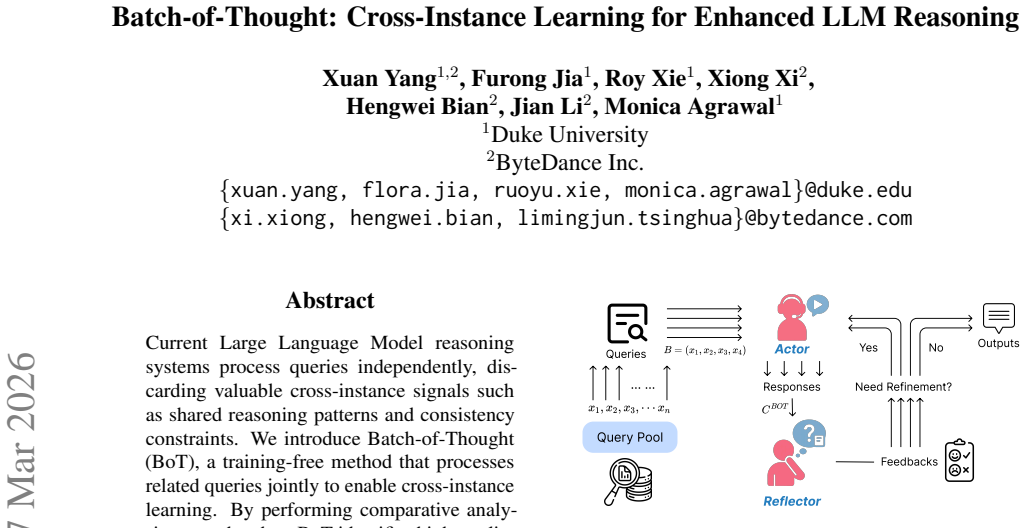
Batch-of-Thought (BoT) is a training-free procedure that jointly processes batches of related queries so that comparative analysis can identify high-quality reasoning templates, consistency checks can detect errors, and computational costs can be amortized; when instantiated as the reflector component of a multi-agent architecture (BoT-R), this joint evaluation yields measurable improvements in accuracy, calibration, and efficiency on standard reasoning benchmarks.
What carries the argument
The reflector agent inside the BoT-R multi-agent architecture, which receives a batch of queries and performs joint comparative evaluation to surface shared high-quality reasoning templates and consistency violations.
If this is right
- Accuracy rises on reasoning benchmarks because shared templates identified across the batch are more reliable than those found in isolation.
- Inference cost falls by amortizing repeated reasoning steps and by early termination on inconsistent paths.
- Calibration improves because consistency checks across instances provide an additional signal for uncertainty estimation.
- The gains appear across multiple model families without any parameter updates.
- Benefits are largest when queries share underlying structure; the method supplies both theoretical and experimental guidance on when this occurs.
Where Pith is reading between the lines
- Production inference pipelines could adopt dynamic batching policies that group incoming queries by topic or structure before calling the model.
- The same joint-evaluation idea could be tested on multimodal or code-generation tasks where cross-example consistency is also observable.
- If batch size is increased further, the reflector might itself become a bottleneck, suggesting a need for lighter-weight consistency metrics.
- Existing single-query benchmarks may systematically underestimate LLM capability once cross-instance signals are routinely exploited.
Load-bearing premise
Batches of related queries contain exploitable shared reasoning patterns and consistency constraints that isolated processing cannot reach, and a reflector can identify high-quality templates from them without any extra training.
What would settle it
Running BoT-R on a collection of completely unrelated queries and finding no accuracy or cost improvement relative to independent single-query processing would falsify the claim that cross-instance signals drive the gains.
Figures
read the original abstract
Current Large Language Model reasoning systems process queries independently, discarding valuable cross-instance signals such as shared reasoning patterns and consistency constraints. We introduce Batch-of-Thought (BoT), a training-free method that processes related queries jointly to enable cross-instance learning. By performing comparative analysis across batches, BoT identifies high-quality reasoning templates, detects errors through consistency checks, and amortizes computational costs. We instantiate BoT within a multi-agent reflection architecture (BoT-R), where a Reflector performs joint evaluation to unlock mutual information gain unavailable in isolated processing. Experiments across three model families and six benchmarks demonstrate that BoT-R consistently improves accuracy and confidence calibration while reducing inference costs by up to 61%. Our theoretical and experimental analysis reveals when and why batch-aware reasoning benefits LLM systems. Our code is available at https://github.com/xuanyang19/BoT
Editorial analysis
A structured set of objections, weighed in public.
Referee Report
Summary. The paper introduces Batch-of-Thought (BoT), a training-free method that jointly processes batches of related queries to exploit cross-instance reasoning patterns, consistency constraints, and template sharing unavailable in independent query processing. It instantiates this as BoT-R, a multi-agent system with a Reflector agent for joint evaluation, error detection, and cost amortization. Experiments across three model families and six benchmarks report consistent gains in accuracy and confidence calibration together with inference cost reductions of up to 61%. The manuscript also provides theoretical analysis of when batch-aware reasoning helps and releases code at https://github.com/xuanyang19/BoT.
Significance. If the empirical gains and cost reductions hold under transparent token accounting, the work offers a practical route to improve LLM reasoning efficiency and calibration without training. The training-free design and open code are clear strengths that facilitate adoption and further study. The emphasis on amortizing computation across related queries addresses a real limitation of current independent-query pipelines.
major comments (2)
- [§4.3] §4.3 and associated tables: the headline 61% inference-cost reduction is load-bearing for the efficiency claim, yet the manuscript does not supply a complete token ledger that includes all Reflector-agent calls and batch-formation overhead. Without this breakdown, it is impossible to verify whether the net savings survive comparison to single-query baselines run with matched total compute.
- [§3.2] §3.2 (Reflector design): the central assumption that the Reflector can reliably surface high-quality cross-instance templates without additional training or fine-tuning is not supported by an ablation that isolates its contribution (e.g., random template selection or no-reflector baseline). This leaves open whether observed gains derive from batch structure itself or from the specific reflector mechanism.
minor comments (2)
- [§4.2] Results tables omit error bars, standard deviations, or statistical significance tests, making it difficult to assess the reliability of the reported accuracy and calibration improvements.
- [§4.1] The abstract and §4.1 leave batch-construction rules and the precise definition of consistency metrics underspecified; explicit pseudocode or a small worked example would improve reproducibility.
Simulated Author's Rebuttal
We thank the referee for the constructive comments on our manuscript. We address each major comment below and commit to revisions that will strengthen the empirical rigor and transparency of the work.
read point-by-point responses
-
Referee: [§4.3] §4.3 and associated tables: the headline 61% inference-cost reduction is load-bearing for the efficiency claim, yet the manuscript does not supply a complete token ledger that includes all Reflector-agent calls and batch-formation overhead. Without this breakdown, it is impossible to verify whether the net savings survive comparison to single-query baselines run with matched total compute.
Authors: We agree that a complete token ledger is required to substantiate the efficiency claims. In the revised manuscript we will add a detailed token accounting table that enumerates every Reflector-agent call, batch-formation overhead, and prompt tokens for both BoT-R and the single-query baselines. We will also report results under matched total compute budgets so that net savings can be directly verified. revision: yes
-
Referee: [§3.2] §3.2 (Reflector design): the central assumption that the Reflector can reliably surface high-quality cross-instance templates without additional training or fine-tuning is not supported by an ablation that isolates its contribution (e.g., random template selection or no-reflector baseline). This leaves open whether observed gains derive from batch structure itself or from the specific reflector mechanism.
Authors: We appreciate the request for an ablation that isolates the Reflector. While the current experiments demonstrate gains from the full BoT-R pipeline, we will add two new baselines in the revision: (1) a no-reflector variant that processes the batch jointly but without the Reflector’s template selection and consistency checks, and (2) a random-template-selection variant. These ablations will clarify whether the observed improvements stem primarily from batch structure or from the specific Reflector mechanism. revision: yes
Circularity Check
No significant circularity in claimed derivation
full rationale
The paper introduces Batch-of-Thought as a training-free empirical technique for joint batch processing of related queries, with benefits demonstrated via direct experiments on public benchmarks against standard single-query baselines. No mathematical derivation chain, equations, or fitted parameters are presented that reduce by construction to the method's own outputs or to self-citations. The reflector agent and cross-instance analysis are described as procedural steps whose value is measured externally rather than assumed or renamed from prior results by the same authors. The theoretical analysis of when batch-aware reasoning helps is framed as post-hoc insight supported by the same empirical ledger, not as a load-bearing premise that loops back to itself.
Axiom & Free-Parameter Ledger
axioms (1)
- domain assumption Related queries share useful reasoning patterns and consistency constraints that joint processing can exploit
Reference graph
Works this paper leans on
-
[1]
Measuring massive multitask language under- standing.arXiv preprint arXiv:2009.03300. Sirui Hong, Mingchen Zhuge, Jiaqi Chen, Xiawu Zheng, Yuheng Cheng, Ceyao Zhang, Jinlin Wang, Zili Wang, Steven Ka Shing Yau, Zijuan Lin, Liyang Zhou, Chenyu Ran, Lingfeng Xiao, Chenglin Wu, and J¨urgen Schmidhuber. 2023. MetaGPT: Meta pro- gramming for a multi-agent coll...
work page internal anchor Pith review Pith/arXiv arXiv 2009
-
[2]
Karan Singhal, Tao Tu, Juraj Gottweis, R
When do LLMs need retrieval augmentation? mitigating LLMs overconfidence helps retrieval aug- mentation.Preprint, arXiv:2402.11457. Karan Singhal, Tao Tu, Juraj Gottweis, R. Sayres, Ellery Wulczyn, Mohamed Amin, Le Hou, Kevin Clark, Stephen R. Pfohl, Heather Cole-Lewis, Darlene Neal, Q. Rashid, Mike Schaekermann, Amy Wang, Dev Dash, Jonathan H. Chen, Niga...
-
[3]
Qwen3 technical report.arXiv preprint arXiv:2505.09388. Tiankai Yang, Yi Nian, Shawn Li, Ruiyao Xu, Yuan- gang Li, Jiaqi Li, Zhuo Xiao, Xiyang Hu, Ryan Rossi, Kaize Ding, and 1 others. 2024. Ad-llm: Benchmark- ing large language models for anomaly detection. arXiv preprint arXiv:2412.11142. Shunyu Yao, Jeffrey Zhao, Dian Yu, Nan Du, Izhak Shafran, Karthik...
work page internal anchor Pith review Pith/arXiv arXiv 2024
-
[4]
Curran Associates, Inc. 8 A Experiment Settings Confidence Calibration Metrics.We use two complementary measures: (a) the Kol- mogorov–Smirnov (KS) statistic (Smirnov, 1939), which measures the maximum difference between the cumulative distributions of confidence scores for correct versus incorrect predictions—higher KS values indicate better separation a...
work page 1939
-
[5]
confidence estimates. These methods are ef- ficient but highly sensitive to prompt formatting (Si et al., 2024) and often produce overconfident pre- dictions (Kadavath et al., 2022). Recent efforts employ chain-of-thought reasoning for confidence elicitation (Xiong et al., 2023) or fine-tune models on calibration data (Lin et al., 2022), yet these re- mai...
work page 2024
-
[6]
studies role-playing conversations yet main- tains per-query boundaries. The closest work to ours isbatch prompt- ing(Cheng et al., 2023), which groups multiple queries into a single API call for efficiency. How- ever, batch prompting lacks reflective evaluation mechanisms and does not perform comparative analysis—it simply concatenates queries without le...
work page 2023
-
[7]
aggregates multiple reasoning paths for a sin- gle query but does not transfer knowledge across distinct queries. BoT differs by enablingmutual information gain across queries at inference time: each query in the batch provides signal for evaluating others through comparative reflection. This creates a feed- back loop where batch-level patterns inform ind...
-
[8]
**Shop/Company Name Verification:** Based on the shop name and company name, does this appear to be a reliable/established seller? 17 - If names seem generic, suspicious, or unfamiliar, search for the company/shop name to verify legitimacy - Note: Only use search results if they are clearly relevant to the specific shop or company name
-
[9]
**Email Domain Assessment:** Based on the email domain, does this suggest a professional business? - If using unfamiliar business domains, consider searching to check if it belongs to an established company - Note: Only use search results if they are clearly relevant to the email domain
-
[10]
**Product Information Check:** Based on the sample product name, description and the product categories, do you think it is reasonable for the seller to sell the products in the shop?
-
[11]
**Product Price Verification:** Does the product pricing seem reasonable for the category? - If pricing appears suspiciously low or high, search for typical market prices of similar products
-
[12]
Based on all the information, do you think this seller is a fraudulent seller? Assign a confidence score: rate your confidence in the assessment. Return your response in a single JSON object with the following keys: - ‘is fraudulent shop‘: (boolean) ‘true‘ if the shop exhibits indicators of fraudulent operations, otherwise ‘false‘. - ‘confidence score‘: (...
discussion (0)
Sign in with ORCID, Apple, or X to comment. Anyone can read and Pith papers without signing in.