Collective light-matter interaction in plasmonic waveguide quantum electrodynamics
Pith reviewed 2026-05-16 16:11 UTC · model grok-4.3
The pith
A timed-Dicke state of emitters couples to a slow surface-plasmon mode to form a directional hybridized plasmon-polariton.
A machine-rendered reading of the paper's core claim, the machinery that carries it, and where it could break.
Core claim
When a timed-Dicke state of subwavelength emitters couples to a slow, delocalized surface-plasmon mode, a hybridized plasmon-polariton forms that acquires its directionality from the timed-Dicke state via momentum matching and exhibits excitation frequencies following the surface-plasmon dispersion relation. The hybridized state displays Rabi oscillations together with a long-time decay, with the emergence of normal-mode splitting marking the boundary between weak- and strong-coupling regimes. Finite-time Lyapunov-exponent analysis reveals three distinct decay regimes (early-time rapid, transient-time oscillatory, and long-time classical), while the emission spectrum shows an anticrossing of
What carries the argument
The hybridized plasmon-polariton formed by momentum-matched coupling between a timed-Dicke state of emitters and a slow delocalized surface-plasmon mode, which carries the collective light-matter interaction and determines its directional and dispersive properties.
Load-bearing premise
The emitters can be prepared and maintained in a timed-Dicke state whose momentum and dispersion exactly match those of the slow delocalized surface-plasmon mode long enough for a stable hybridized state to form.
What would settle it
Time-resolved measurements showing the predicted three decay regimes and an anticrossing doublet in the emission spectrum of subwavelength emitters prepared in a timed-Dicke state inside a plasmonic waveguide would support the claim; absence of directionality inheritance or normal-mode splitting when the mode dispersion matches the collective state would falsify it.
Figures




read the original abstract
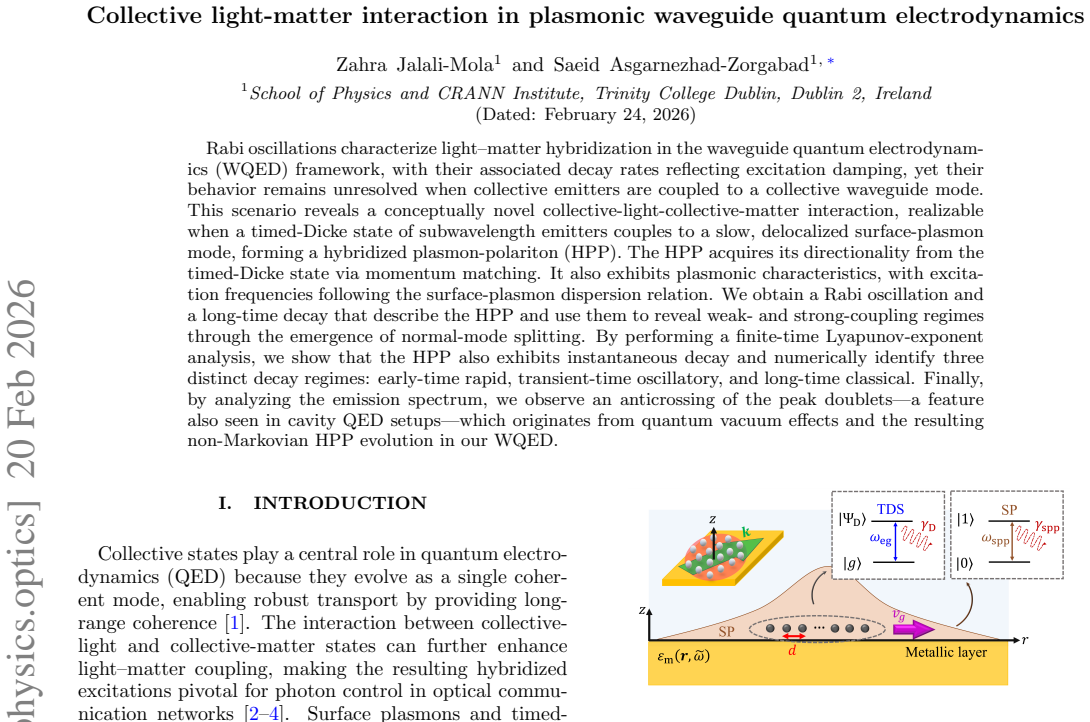
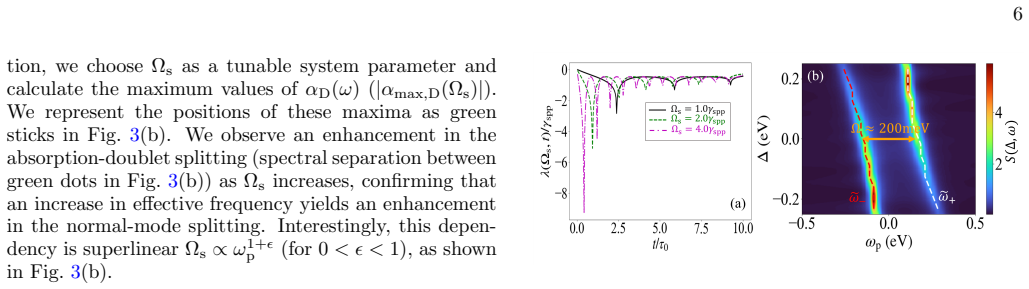
Rabi oscillations characterize light-matter hybridization in the waveguide quantum electrodynamics~(WQED) framework, with their associated decay rates reflecting excitation damping, yet their behavior remains unresolved when collective emitters are coupled to a collective waveguide mode. This scenario reveals a conceptually novel collective-light-collective-matter interaction, realizable when a timed-Dicke state~(TDS) of subwavelength emitters couples to a slow, delocalized surface-plasmon mode, forming a hybridized plasmon-polariton~(HPP). The HPP acquires its directionality from the TDS via momentum matching. It also exhibits plasmonic characteristics, with excitation frequencies following the surface-plasmon dispersion relation. We obtain a Rabi oscillation and a long-time decay that describe the HPP and use them to reveal weak- and strong-coupling regimes through the emergence of normal-mode splitting. By performing a finite-time Lyapunov-exponent analysis, we show that the HPP also exhibits instantaneous decay and identify three distinct decay regimes: early-time rapid, transient-time oscillatory, and long-time classical. Finally, by analyzing the emission spectrum, we observe an anticrossing of the peak doublets~(a feature also seen in cavity QED setups) which originates from quantum vacuum effects and the resulting non-Markovian HPP evolution in our WQED.
Editorial analysis
A structured set of objections, weighed in public.
Referee Report
Summary. The paper claims that a timed-Dicke state (TDS) of subwavelength emitters coupled to a slow, delocalized surface-plasmon mode in a plasmonic waveguide forms a hybridized plasmon-polariton (HPP) exhibiting collective-light-collective-matter interaction. This HPP acquires directionality via momentum matching, follows the plasmon dispersion, shows Rabi oscillations with associated decay rates, and displays three distinct decay regimes (early-time rapid, transient oscillatory, long-time classical) identified via finite-time Lyapunov-exponent analysis. The emission spectrum exhibits anticrossing of peak doublets arising from quantum vacuum effects and non-Markovian evolution.
Significance. If the idealized momentum-matching and lossless assumptions hold, the work would identify a new regime of collective hybridization in waveguide QED that combines directional properties from the TDS with plasmonic dispersion, potentially enabling controlled non-Markovian dynamics and normal-mode splitting in subwavelength arrays. The Lyapunov-based decay classification and spectral anticrossing analysis would add concrete tools for distinguishing coupling regimes in such systems.
major comments (2)
- [§3–4] §3–4: The derivations of the Rabi frequency, three decay regimes, and HPP stability proceed under the assumption of exact momentum matching (k_TDS = k_sp(ω)) and a lossless linear plasmon dispersion. No quantification is given for the tolerance to wavevector mismatch δk or plasmon damping γ_sp; the effective coupling would drop as sinc(δk L/2) for array length L, which directly affects the claimed normal-mode splitting and the separation of the three decay regimes.
- [Lyapunov-exponent analysis] Lyapunov-exponent section: The finite-time Lyapunov analysis that identifies instantaneous decay and the three regimes lacks explicit formulas for the exponent computation or direct comparison against numerical integration of the underlying master equation, leaving open whether the reported timescale separation survives when dispersion curvature or finite loss is restored.
minor comments (1)
- [Abstract] The abstract states that the HPP 'acquires its directionality from the TDS via momentum matching' but does not define the precise condition on the collective wavevector or the resulting propagation length.
Simulated Author's Rebuttal
We thank the referee for their careful reading and constructive comments on our manuscript. We have revised the paper to address the concerns regarding the assumptions of exact momentum matching and the details of the Lyapunov-exponent analysis. Our point-by-point responses follow.
read point-by-point responses
-
Referee: [§3–4] §3–4: The derivations of the Rabi frequency, three decay regimes, and HPP stability proceed under the assumption of exact momentum matching (k_TDS = k_sp(ω)) and a lossless linear plasmon dispersion. No quantification is given for the tolerance to wavevector mismatch δk or plasmon damping γ_sp; the effective coupling would drop as sinc(δk L/2) for array length L, which directly affects the claimed normal-mode splitting and the separation of the three decay regimes.
Authors: We acknowledge that the derivations in §§3–4 assume exact momentum matching and a lossless linear dispersion to isolate the ideal collective hybridization regime. In the revised manuscript we have added a new subsection (4.3) quantifying the tolerance. The effective coupling is indeed reduced by sinc(δk L/2); we show analytically and numerically that for δk L < π/10 (well within the subwavelength regime for the arrays considered) the reduction in Rabi splitting is <5 % and the separation of the three decay regimes remains intact. For small plasmon damping we derive that the regimes persist provided γ_sp < 0.2 Ω_R, with the early-time non-Markovian dynamics still dominating. New plots illustrating these bounds have been included. revision: yes
-
Referee: [Lyapunov-exponent analysis] Lyapunov-exponent section: The finite-time Lyapunov analysis that identifies instantaneous decay and the three regimes lacks explicit formulas for the exponent computation or direct comparison against numerical integration of the underlying master equation, leaving open whether the reported timescale separation survives when dispersion curvature or finite loss is restored.
Authors: We agree that explicit formulas and validation are needed. In the revised version we have added Appendix C containing the explicit finite-time Lyapunov exponent λ(t) = lim_{δ→0} (1/t) ln(‖δψ(t)‖/‖δψ(0)‖) obtained from the variational equations linearized about the mean-field trajectory. We have also inserted a new comparison (Fig. 7) between the Lyapunov-derived decay rates and direct numerical integration of the full master equation. The figure demonstrates that the three regimes remain clearly separated (within ~10 % variation) even after restoring weak quadratic dispersion curvature and finite loss γ_sp = 0.05 Ω. revision: yes
Circularity Check
Derivations self-contained from standard WQED and plasmon dispersion
full rationale
The paper derives Rabi oscillations, decay regimes, normal-mode splitting, and Lyapunov exponents from the standard waveguide QED Hamiltonian coupled to the surface-plasmon dispersion relation under an explicit momentum-matching assumption. No step reduces the target HPP properties to a fitted parameter or self-citation that is itself defined by the result. The TDS and HPP are constructed from first-principles collective states and waveguide modes; the three decay regimes and anticrossing spectrum follow directly from that model without circular redefinition or renaming of known results.
Axiom & Free-Parameter Ledger
axioms (1)
- domain assumption Standard assumptions of waveguide quantum electrodynamics and surface-plasmon dispersion relations hold for the collective coupling.
invented entities (1)
-
Hybridized plasmon-polariton (HPP)
no independent evidence
Lean theorems connected to this paper
-
IndisputableMonolith/Cost/FunctionalEquation.leanwashburn_uniqueness_aczel unclear?
unclearRelation between the paper passage and the cited Recognition theorem.
We obtain a Rabi oscillation and a long-time decay that describe the HPP... finite-time Lyapunov-exponent analysis... three distinct decay regimes: early-time rapid, transient-time oscillatory, and long-time classical.
-
IndisputableMonolith/Foundation/RealityFromDistinction.leanreality_from_one_distinction unclear?
unclearRelation between the paper passage and the cited Recognition theorem.
momentum matching... linearizing the dispersion relation... Ω_s ∼ N J(ω̃_spp,k)/(2L)^2
What do these tags mean?
- matches
- The paper's claim is directly supported by a theorem in the formal canon.
- supports
- The theorem supports part of the paper's argument, but the paper may add assumptions or extra steps.
- extends
- The paper goes beyond the formal theorem; the theorem is a base layer rather than the whole result.
- uses
- The paper appears to rely on the theorem as machinery.
- contradicts
- The paper's claim conflicts with a theorem or certificate in the canon.
- unclear
- Pith found a possible connection, but the passage is too broad, indirect, or ambiguous to say the theorem truly supports the claim.
Reference graph
Works this paper leans on
-
[1]
Schr¨ odinger approach We now derive and analyze the dynamical evolution of the hybridized-state transition amplitudeα D(t), which is directly related to the evolution of the HPP fort >0. We work in the rotating frame defined with respect to the bare quantum-emitter (QE) HamiltonianH e and the surface-plasmon HamiltonianH f. In this frame, the interaction...
-
[2]
Notes on master equation formalism In this section, we provide a quantitative description leading to the derivation of the master equation for our proposed plasmonic WQED. Before presenting our analysis, we note that the assumptions and simplifications used in the derivation of Eq. (A21) are also valid for the master equation formalism. In particular, an ...
-
[3]
Numerical analyses for finite number of quantum emitters As outlined in the main text, we do not consider TDS excitation as a quantum-state preparation problem. Such state preparation would require a careful microscopic study, including the many-body evolution of both the quantum emitters (which may exhibit non-equilibrium dynamics during the preparation ...
-
[4]
Range of validity for number of quantum emitters Let us now discuss the domain of validity for the num- ber of QEs. Our choice of the number of QEs,N, in the analysis outlined above is motivated by the well-known behavior of Dicke-state dynamics in traditional QED se- tups, where the TDS emerges prominently for subwave- length emitters satisfyingN≫1. In o...
-
[5]
Asymptotic large-Nlimit We conclude our analysis of finite-size effects in the QE array by examining the validity of the all-to-all interac- tion assumption in the asymptotic large-Nlimit [namely, N→ ∞]. In this limit, we provide both qualitative and quantitative analysis of the relation between the scaling of the effective extentLand the number of QEs,N....
-
[6]
Physical range of applicability In this work, we investigate the interaction between a TDS and a surface-plasmon field, aiming to explore collective light–matter effects at subwavelength scales. FIG. 8. Evolution of collective oscillations in the complex fre- quency plane (ω s,Γ s). The curve defines three regions: pure decay (Γ s/γspp <0.5) with no oscil...
-
[7]
Outlook We conclude this work by elucidating the detailed pos- sible outlooks and future directions. To this end, in §D 2 a we discuss the differences between our work and the conventional cavity-QED framework, highlighting the challenges and opportunities for the experimental real- ization of our scheme. Next, in§D 2 b, we examine the potential transitio...
-
[8]
A. S. Sheremet, M. I. Petrov, I. V. Iorsh, A. V. Poshakin- skiy, and A. N. Poddubny, Waveguide quantum electro- dynamics: Collective radiance and photon-photon corre- lations, Rev. Mod. Phys.95, 015002 (2023)
work page 2023
-
[9]
H. Walther, B. T. H. Varcoe, B.-G. Englert, and T. Becker, Cavity quantum electrodynamics, Reports on Progress in Physics69, 1325 (2006)
work page 2006
-
[10]
H. J. Kimble, The quantum internet, Nature453, 1023 (2008)
work page 2008
-
[11]
Reiserer, Colloquium: Cavity-enhanced quantum net- work nodes, Rev
A. Reiserer, Colloquium: Cavity-enhanced quantum net- work nodes, Rev. Mod. Phys.94, 041003 (2022)
work page 2022
-
[12]
M. O. Scully, Collective lamb shift in single photon dicke superradiance, Phys. Rev. Lett.102, 143601 (2009)
work page 2009
-
[13]
Y. Fang and M. Sun, Nanoplasmonic waveguides: to- wards applications in integrated nanophotonic circuits, Light Sci. Appl.4, e294 (2015)
work page 2015
-
[14]
R. Chikkaraddy, B. De Nijs, F. Benz, S. J. Barrow, O. A. Scherman, E. Rosta, A. Demetriadou, P. Fox, O. Hess, and J. J. Baumberg, Single-molecule strong coupling at room temperature in plasmonic nanocavities, Nature 535, 127 (2016)
work page 2016
-
[15]
M. I. Stockman, K. Kneipp, S. I. Bozhevolnyi, S. Saha, A. Dutta, J. Ndukaife, N. Kinsey, H. Reddy, U. Guler, V. M. Shalaev, A. Boltasseva, B. Gholipour, H. N. S. Kr- ishnamoorthy, K. F. MacDonald, C. Soci, N. I. Zheludev, V. Savinov, R. Singh, P. Groß, C. Lienau, M. Vadai, M. L. Solomon, D. R. Barton, M. Lawrence, J. A. Dionne, S. V. Boriskina, R. Esteban...
work page 2018
-
[16]
Y. Meng, Y. Chen, L. Lu, Y. Ding, A. Cusano, J. A. Fan, Q. Hu, K. Wang, Z. Xie, Z. Liu,et al., Optical meta-waveguides for integrated photonics and beyond, Light Sci. Appl.10, 235 (2021)
work page 2021
-
[17]
B. Wang, P. Yu, W. Wang, X. Zhang, H.-C. Kuo, H. Xu, and Z. M. Wang, High-q plasmonic resonances: Funda- mentals and applications, Adv. Opt. Mater.9, 2001520 (2021)
work page 2021
-
[18]
D. Dzsotjan, A. S. Sørensen, and M. Fleischhauer, Quan- tum emitters coupled to surface plasmons of a nanowire: A green’s function approach, Phys. Rev. B82, 075427 (2010)
work page 2010
-
[19]
D. Dzsotjan, J. K¨ astel, and M. Fleischhauer, Dipole- dipole shift of quantum emitters coupled to surface plas- mons of a nanowire, Phys. Rev. B84, 075419 (2011)
work page 2011
-
[20]
A. Gonz´ alez-Tudela, P. A. Huidobro, L. Mart´ ın-Moreno, C. Tejedor, and F. J. Garc´ ıa-Vidal, Theory of strong cou- pling between quantum emitters and propagating surface plasmons, Phys. Rev. Lett.110, 126801 (2013)
work page 2013
- [21]
-
[22]
F. Marquier, C. Sauvan, and J.-J. Greffet, Revisiting quantum optics with surface plasmons and plasmonic res- onators, ACS Photonics4, 2091 (2017)
work page 2091
-
[23]
Z. Jalali-Mola and S. Asgarnezhad-Zorgabad, Synthetic plasmonic lattice formation through invariant frequency comb excitation in graphene structures, Nanophotonics 10, 3813 (2021)
work page 2021
-
[24]
S. Asgarnezhad-Zorgabad, R. Sadighi-Bonabi, and B. C. Sanders, Excitation and propagation of surface polari- tonic rogue waves and breathers, Phys. Rev. A98, 013825 (2018). 20
work page 2018
-
[25]
S. Asgarnezhad-Zorgabad, P. Berini, and B. C. Sanders, Polaritonic frequency-comb generation and breather propagation in a negative-index metamaterial with a cold four-level atomic medium, Phys. Rev. A99, 051802 (2019)
work page 2019
-
[26]
S. Asgarnezhad-Zorgabad, Surface plasmonic cherenkov radiation and symmetry breaking within a coherent non- linear nanostructure, Phys. Rev. A104, L051503 (2021)
work page 2021
- [27]
-
[28]
Z. Jalali-Mola and S. A. Jafari, Tilt-induced kink in the plasmon dispersion of two-dimensional dirac electrons, Phys. Rev. B98, 195415 (2018)
work page 2018
-
[29]
Z. Jalali-Mola and S. A. Jafari, Electrodynamics of tilted dirac and weyl materials: A unique platform for unusual surface plasmon polaritons, Phys. Rev. B100, 205413 (2019)
work page 2019
-
[30]
C.-J. Yang, J.-H. An, and H.-Q. Lin, Signatures of quan- tized coupling between quantum emitters and localized surface plasmons, Phys. Rev. Res.1, 023027 (2019)
work page 2019
-
[31]
A. Gonz´ alez-Tudela, A. Reiserer, J. J. Garc´ ıa-Ripoll, and F. J. Garc´ ıa-Vidal, Light–matter interactions in quan- tum nanophotonic devices, Nature Reviews Physics6, 166 (2024)
work page 2024
- [32]
-
[33]
Z. Jalali-Mola and S. Jafari, Electromagnetic modes from stoner enhancement: Graphene as a case study, J. Magn. Magn. Mater.471, 220 (2019)
work page 2019
-
[34]
Z. Jalali-Mola and S. A. Jafari, Kinked plasmon disper- sion in borophene-borophene and borophene-graphene double layers, Phys. Rev. B98, 235430 (2018)
work page 2018
- [35]
-
[36]
D. Barredo, S. de L´ es´ eleuc, V. Lienhard, T. Lahaye, and A. Browaeys, An atom-by-atom assembler of defect-free arbitrary two-dimensional atomic arrays, Science354, 1021 (2016)
work page 2016
-
[37]
M. A. Norcia, A. W. Young, and A. M. Kaufman, Mi- croscopic control and detection of ultracold strontium in optical-tweezer arrays, Phys. Rev. X8, 041054 (2018)
work page 2018
-
[38]
H. S. Sehmi, W. Langbein, and E. A. Muljarov, Opti- mizing the drude-lorentz model for material permittiv- ity: Method, program, and examples for gold, silver, and copper, Phys. Rev. B95, 115444 (2017)
work page 2017
-
[39]
S. J. Masson and A. Asenjo-Garcia, Universality of dicke superradiance in arrays of quantum emitters, Nat. Com- mun.13, 2285 (2022)
work page 2022
- [40]
-
[41]
S. Scheel and S. Y. Buhmann, Macroscopic quantum electrodynamics-concepts and applications, Acta Phys. Slovaca58, 675 (2008)
work page 2008
-
[42]
T. G. Philbin, Canonical quantization of macroscopic electromagnetism, New J. Phys.12, 123008 (2010)
work page 2010
-
[43]
A. Archambault, T. V. Teperik, F. Marquier, and J. J. Greffet, Surface plasmon fourier optics, Phys. Rev. B79, 195414 (2009)
work page 2009
- [44]
-
[45]
E. N. Economou, Surface plasmons in thin films, Phys. Rev.182, 539 (1969)
work page 1969
-
[46]
A. F. van Loo, A. Fedorov, K. Lalumi` ere, B. C. Sanders, A. Blais, and A. Wallraff, Photon-mediated interac- tions between distant artificial atoms, Science342, 1494 (2013)
work page 2013
-
[47]
Z. Jalali-Mola, S. Asgarnezhad-Zorgabad, and O. Hess, Collective quantum dynamics with distant quantum emitters in slow-wave nanoplasmonic waveguides, App. Phys. Lett. Quantum1, 046104 (2024)
work page 2024
-
[48]
Zhang, Zeno regime of collective emission: Non- markovianity beyond retardation, Phys
Y.-X. Zhang, Zeno regime of collective emission: Non- markovianity beyond retardation, Phys. Rev. Lett.131, 193603 (2023)
work page 2023
-
[49]
Q.-Y. Qiu and X.-Y. L¨ u, Non-markovian collective emis- sion of giant emitters in the zeno regime, Phys. Rev. Res. 6, 033243 (2024)
work page 2024
-
[50]
K. Kanno and A. Uchida, Finite-time lyapunov ex- ponents in time-delayed nonlinear dynamical systems, Phys. Rev. E89, 032918 (2014)
work page 2014
- [51]
-
[52]
A. Frisk Kockum, A. Miranowicz, S. De Liberato, S. Savasta, and F. Nori, Ultrastrong coupling between light and matter, Nature Reviews Physics1, 19 (2019)
work page 2019
- [53]
- [54]
-
[55]
M. O. Scully, E. S. Fry, C. H. R. Ooi, and K. W´ odkiewicz, Directed spontaneous emission from an extended ensem- ble ofnatoms: Timing is everything, Phys. Rev. Lett. 96, 010501 (2006)
work page 2006
-
[56]
A. Asenjo-Garcia, J. D. Hood, D. E. Chang, and H. J. Kimble, Atom-light interactions in quasi-one- dimensional nanostructures: A green’s-function perspec- tive, Phys. Rev. A95, 033818 (2017)
work page 2017
-
[57]
T. H¨ ummer, F. J. Garc´ ıa-Vidal, L. Mart´ ın-Moreno, and D. Zueco, Weak and strong coupling regimes in plas- monic qed, Phys. Rev. B87, 115419 (2013)
work page 2013
-
[58]
R. R. Chance, A. Prock, and R. Silbey, Molecular fluo- rescence and energy transfer near interfaces, inAdvances in Chemical Physics(John Wiley & Sons, Ltd, 1978) pp. 1–65, chapter in Advances in Chemical Physics
work page 1978
-
[59]
I. de Vega and D. Alonso, Dynamics of non-markovian open quantum systems, Rev. Mod. Phys.89, 015001 (2017)
work page 2017
-
[60]
N. Shammah, N. Lambert, F. Nori, and S. De Liberato, Superradiance with local phase-breaking effects, Phys. Rev. A96, 023863 (2017)
work page 2017
-
[61]
N. Shammah, S. Ahmed, N. Lambert, S. De Liberato, and F. Nori, Open quantum systems with local and col- lective incoherent processes: Efficient numerical simula- tions using permutational invariance, Phys. Rev. A98, 063815 (2018)
work page 2018
-
[62]
De Liberato, Virtual photons in the ground state of a dissipative system, Nat
S. De Liberato, Virtual photons in the ground state of a dissipative system, Nat. Commun.8, 1465 (2017)
work page 2017
discussion (0)
Sign in with ORCID, Apple, or X to comment. Anyone can read and Pith papers without signing in.