Recognition: 1 theorem link
· Lean TheoremBenchmarking projected generator coordinate method for nuclear Gamow-Teller transitions
Pith reviewed 2026-05-16 16:20 UTC · model grok-4.3
The pith
Extended projected generator coordinate method reproduces Gamow-Teller strengths and 2νββ matrix elements in agreement with exact shell-model results for calcium isotopes.
A machine-rendered reading of the paper's core claim, the machinery that carries it, and where it could break.
Core claim
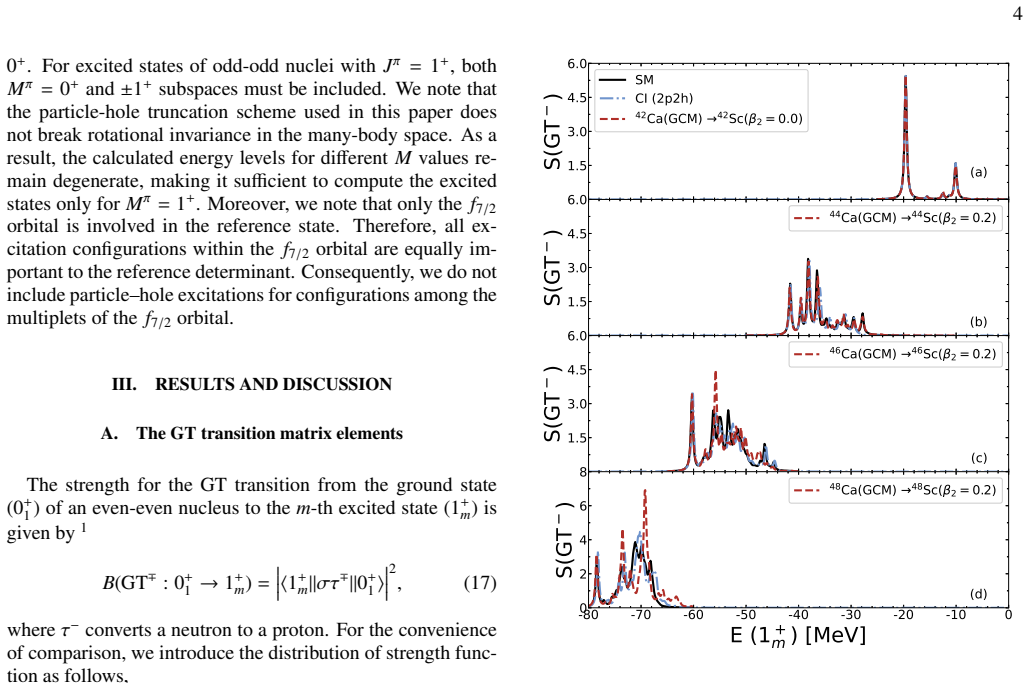
Within the PGCM framework the wave functions of odd-odd nuclei are constructed as superpositions of neutron and proton quasiparticle configurations built on quasiparticle vacua constrained to have, on average, odd neutron and odd proton particle numbers; angular momentum and particle numbers are restored through projection. Using a shell-model Hamiltonian defined in the fp shell, the extended method yields GT transition strengths and the 2νββ NME for 48Ca that agree well with exact shell-model solutions.
What carries the argument
Superposition of neutron and proton quasiparticle configurations on particle-number-constrained vacua, followed by angular-momentum and particle-number projection.
Load-bearing premise
The selected quasiparticle configurations on constrained vacua, once projected, already contain the essential correlations that determine the Gamow-Teller matrix elements inside the fp shell.
What would settle it
A clear mismatch between the projected-GCM GT strengths or 2νββ NME and the exact shell-model values for any fp-shell calcium or titanium isotope would show that the extension misses required correlations.
Figures


read the original abstract
In this work, we aim to achieve a minimal extension of the quantum-number projected generator coordinate method (PGCM) to describe Gamow-Teller (GT) transition strengths in even-even nuclei and to compute the NME of $2\nu\beta\beta$ decay. Within the PGCM framework, the wave functions of odd-odd nuclei are constructed as superpositions of neutron and proton quasiparticle configurations built on quasiparticle vacua constrained to have, on average, odd neutron and odd proton particle numbers. The angular momentum and particle numbers associated with the underlying mean-field states are restored through projection techniques. Using a shell-model Hamiltonian defined in the $fp$ shell, we assess the validity of this approach by benchmarking GT transitions in calcium and titanium isotopes, as well as the $2\nu\beta\beta$ decay of $^{48}$Ca to $^{48}$Ti, against exact solutions. For comparison, we also confront our results with those obtained from configuration-interaction calculations employing different particle-hole truncation schemes, both with and without in-medium similarity renormalization group (IMSRG) evolution.
Editorial analysis
A structured set of objections, weighed in public.
Referee Report
Summary. The manuscript benchmarks a minimal extension of the projected generator coordinate method (PGCM) for Gamow-Teller (GT) transition strengths in even-even nuclei and the 2νββ nuclear matrix element (NME). Odd-odd nuclei wave functions are constructed as superpositions of neutron and proton quasiparticle configurations on particle-number-constrained vacua, followed by angular-momentum and particle-number projection. Using an fp-shell Hamiltonian, results for Ca and Ti isotopes and the 48Ca 2νββ NME are compared to exact shell-model diagonalizations, configuration-interaction calculations with varying truncations, and IMSRG-evolved interactions.
Significance. If the reported agreement holds, the work provides a direct, parameter-free validation of the extended PGCM against exact solutions in a tractable model space. This strengthens confidence in the method for GT strengths and double-beta decay NMEs, as the benchmark tests the capture of essential correlations internally via comparison to exact diagonalization of the same Hamiltonian. Such controlled benchmarks are valuable for extending the approach to heavier systems where exact methods are unavailable.
minor comments (4)
- §4 (results for GT strengths): provide explicit quantitative metrics (e.g., RMS deviation or average percentage difference) between PGCM and exact shell-model values rather than qualitative statements of 'good agreement'.
- §3.2 (wave-function construction): specify the selection criterion and number of quasiparticle configurations included in the superposition to allow assessment of convergence.
- Table 1 or equivalent (comparison to CI truncations): clarify the precise particle-hole truncation levels used in the CI calculations and whether the same effective interaction is employed throughout.
- Figure 2 (2νββ NME): add error estimates or sensitivity analysis with respect to the choice of generator coordinates.
Simulated Author's Rebuttal
We thank the referee for the positive assessment of our manuscript, the recognition of its significance as a controlled benchmark, and the recommendation for minor revision. We are pleased that the work is viewed as strengthening in the extended PGCM approach for GT strengths and 2νββ NMEs.
Circularity Check
No significant circularity: external benchmarks against exact solutions
full rationale
The paper benchmarks the minimally extended PGCM (quasiparticle configurations on particle-number-constrained vacua with J and N projection) directly against exact fp-shell shell-model diagonalizations and independent CI/IMSRG results for GT strengths and the 2νββ NME of 48Ca, using the identical Hamiltonian. No equations or self-citations reduce the reported matrix elements to fitted parameters or prior results by construction; discrepancies would appear as measurable differences in the numerical comparisons. This is a self-contained validation against external exact solutions.
Axiom & Free-Parameter Ledger
axioms (2)
- domain assumption The fp-shell effective Hamiltonian provides a faithful representation of the low-energy structure for Ca and Ti isotopes.
- standard math Angular-momentum and particle-number projections applied to quasiparticle vacua restore the correct quantum numbers without significant truncation artifacts in the GT operator matrix elements.
Lean theorems connected to this paper
-
IndisputableMonolith/Foundation/Cost/FunctionalEquation.leanwashburn_uniqueness_aczel unclear?
unclearRelation between the paper passage and the cited Recognition theorem.
Within the PGCM framework, the wave functions of odd-odd nuclei are constructed as superpositions of neutron and proton quasiparticle configurations built on quasiparticle vacua constrained to have, on average, odd neutron and odd proton particle numbers. The angular momentum and particle numbers ... are restored through projection techniques.
What do these tags mean?
- matches
- The paper's claim is directly supported by a theorem in the formal canon.
- supports
- The theorem supports part of the paper's argument, but the paper may add assumptions or extra steps.
- extends
- The paper goes beyond the formal theorem; the theorem is a base layer rather than the whole result.
- uses
- The paper appears to rely on the theorem as machinery.
- contradicts
- The paper's claim conflicts with a theorem or certificate in the canon.
- unclear
- Pith found a possible connection, but the passage is too broad, indirect, or ambiguous to say the theorem truly supports the claim.
Reference graph
Works this paper leans on
-
[1]
K. Langanke and G. Martínez-Pinedo, Nuclear weak- interaction processes in stars, Rev. Mod. Phys.75, 819 (2003)
work page 2003
-
[2]
T. Fischer, G. Guo, K. Langanke, G. Martinez-Pinedo, Y .-Z. Qian, and M.-R. Wu, Neutrinos and nucleosynthesis of elements, Prog. Part. Nucl. Phys.137, 104107 (2024), arXiv:2308.03962 [astro-ph.HE]
-
[3]
Suzuki, Nuclear weak rates and nuclear weak pro- cesses in stars, Prog
T. Suzuki, Nuclear weak rates and nuclear weak pro- cesses in stars, Prog. Part. Nucl. Phys.126, 103974 (2022), arXiv:2205.09262 [nucl-th]. 2 Note that the value ofM 2ν effdoes not depend on the choice of thegA quench- ing factorq, while theM 2ν does. For example, theM 2ν by the shell model calculation based on Eq.(20) is 0.0539/q2 ≃0.090 MeV −1
- [4]
-
[5]
Herczeg, Beta decay beyond the standard model, Prog
P. Herczeg, Beta decay beyond the standard model, Prog. Part. Nucl. Phys.46, 413 (2001)
work page 2001
-
[6]
N. Severijns, M. Beck, and O. Naviliat-Cuncic, Tests of the standard electroweak model in nuclear beta decay, Rev. Mod. Phys.78, 991 (2006)
work page 2006
-
[7]
E. W. Otten and C. Weinheimer, Neutrino mass limit from tri- tiumβdecay, Rep. Prog. Phys.71, 086201 (2008)
work page 2008
-
[8]
A. Falkowski, M. González-Alonso, and O. Naviliat-Cuncic, Comprehensive analysis of beta decays within and beyond the Standard Model, JHEP04, 126, arXiv:2010.13797 [hep-ph]. 8
-
[9]
F. T. Avignone, S. R. Elliott, and J. Engel, Double beta decay, majorana neutrinos, and neutrino mass, Rev. Mod. Phys.80, 481 (2008)
work page 2008
-
[10]
J. Engel and J. Menéndez, Status and future of nuclear matrix elements for neutrinoless double-beta decay: a review, Reports on Progress in Physics80, 046301 (2017)
work page 2017
-
[11]
H. Ejiri, Neutrino-mass sensitivity and nuclear matrix element for neutrinoless double beta decay, Universe6, 10.3390/uni- verse6120225 (2020)
-
[12]
J. C. Hardy and I. S. Towner, Superallowed 0 + →0 + nuclearβ decays: 2020 critical survey, with implications forV ud and ckm unitarity, Phys. Rev. C102, 045501 (2020)
work page 2020
-
[13]
N. Severijns, L. Hayen, V . De Leebeeck, S. Vanlangendonck, K. Bodek, D. Rozpedzik, and I. S. Towner,Ftvalues of the mirrorβtransitions and the weak-magnetism-induced current in allowed nuclearβdecay, Phys. Rev. C107, 015502 (2023)
work page 2023
-
[14]
M. Agostini, G. Benato, J. A. Detwiler, J. Menéndez, and F. Vissani, Toward the discovery of matter creation with neutrinolessββdecay, Rev. Mod. Phys.95, 025002 (2023), arXiv:2202.01787 [hep-ex]
- [15]
-
[16]
H. Hergert, A Guided Tour ofab initioNuclear Many-Body Theory, Front. in Phys.8, 379 (2020), arXiv:2008.05061 [nucl- th]
-
[17]
Weinberg, Effective chiral Lagrangians for nucleon - pion interactions and nuclear forces, Nucl
S. Weinberg, Effective chiral Lagrangians for nucleon - pion interactions and nuclear forces, Nucl. Phys. B363, 3 (1991)
work page 1991
- [18]
-
[19]
J. M. Yao, J. Engel, L. J. Wang, C. F. Jiao, and H. Hergert, Generator-coordinate reference states for spectra and 0νββde- cay in the in-medium similarity renormalization group, Phys. Rev. C98, 054311 (2018), arXiv:1807.11053 [nucl-th]
work page internal anchor Pith review Pith/arXiv arXiv 2018
-
[20]
J. M. Yao, B. Bally, J. Engel, R. Wirth, T. R. Rodríguez, and H. Hergert, Ab initio treatment of collective correlations and the neutrinoless double beta decay of48Ca, Phys. Rev. Lett.124, 232501 (2020)
work page 2020
- [21]
- [22]
- [23]
-
[24]
H. Hergert, S. K. Bogner, T. D. Morris, S. Binder, A. Calci, J. Langhammer, and R. Roth, Ab initio multireference in- medium similarity renormalization group calculations of even calcium and nickel isotopes, Phys. Rev. C90, 041302 (2014)
work page 2014
-
[25]
P. Ring and P. Schuck,The nuclear many-body problem (Springer-Verlag, New York, 1980)
work page 1980
- [26]
-
[27]
Gamov-Teller transitions from 14N ground to 14C ground and excited states
Y . Kanada-En’yo and T. Suhara, Gamow-Teller transitions from the 14N ground state to the 14C ground and excited states, Phys. Rev. C89, 044313 (2014), arXiv:1401.5517 [nucl-th]
work page internal anchor Pith review Pith/arXiv arXiv 2014
-
[28]
M. Konieczka, P. B˛ aczyk, and W. Satuła,β-decay study within multireference density functional theory and beyond, Phys. Rev. C93, 042501 (2016)
work page 2016
-
[29]
H. Morita and Y . Kanada-En’yo, Low-energy gamow-teller transitions in deformedn=zodd-odd nuclei, Phys. Rev. C98, 034307 (2018)
work page 2018
-
[30]
J. Mi ´skiewicz, M. Konieczka, and W. Satuła, Two-neutrino 0+→0+double-βdecay of Ca48 within the density-functional- theory–based no-core configuration-interaction framework, Phys. Rev. C112, 055502 (2025), arXiv:2506.13747 [nucl-th]
-
[31]
The Shell Model as Unified View of Nuclear Structure
E. Caurier, G. Martinez-Pinedo, F. Nowacki, A. Poves, and A. P. Zuker, The Shell Model as Unified View of Nuclear Structure, Rev. Mod. Phys.77, 427 (2005), arXiv:nucl-th/0402046
work page internal anchor Pith review Pith/arXiv arXiv 2005
- [32]
-
[33]
The In-Medium Similarity Renormalization Group: A Novel Ab Initio Method for Nuclei
H. Hergert, S. K. Bogner, T. D. Morris, A. Schwenk, and K. Tsukiyama, The In-Medium Similarity Renormalization Group: A Novel Ab Initio Method for Nuclei, Phys. Rept.621, 165 (2016), arXiv:1512.06956 [nucl-th]
work page internal anchor Pith review Pith/arXiv arXiv 2016
-
[34]
A. Barabash, Precise Half-Life Values for Two-Neutrino Double-βDecay: 2020 Review, Universe6, 159 (2020), arXiv:2009.14451 [nucl-ex]
-
[35]
J. Kotila and F. Iachello, Phase-space factors for double-βde- cay, Phys. Rev. C85, 034316 (2012)
work page 2012
- [36]
discussion (0)
Sign in with ORCID, Apple, or X to comment. Anyone can read and Pith papers without signing in.