REVIEW 3 major objections 5 minor 1 cited by
FlowLet: Conditional 3D Brain MRI Synthesis using Wavelet Flow Matching
T0 review · 3 major / 5 minor · reviewed 2026-08-03 · deepseek-v4-flash
Pith's one-line read FlowLet claims that flow matching in an invertible 3D Haar wavelet domain produces age-conditioned brain MRIs in 10 steps, and that using them to augment training lowers brain-age prediction error for adults 44+ from 4.91 to 4.01 years mean
desk verdict A serious wavelet-flow-matching MRI generator with a rich evaluation, but the headline BAP gain is confounded by dataset size and lacks significance testing. read the letter →
The pith
A machine-rendered reading of the paper's core claim, the machinery that carries it, and where it could break.
The reading
What carries the argument
The central object is the 3D Haar discrete wavelet transform, which maps a 3D MRI volume into eight subbands — one low-frequency approximation (dominant anatomy) and seven high-frequency detail subbands — giving an 8x reduction in spatial feature-map size while remaining perfectly invertible and energy-preserving. Flow matching trains a conditional 3D U-Net to predict a velocity field in this wavelet space; at inference the learned ODE is integrated with Euler's method (typically 10 steps) and the inverse wavelet transform reconstructs the volume. Age conditioning is carried by two complementary mechanisms: feature-wise linear modulation (a scale-and-shift applied at every residual block) an
What would settle it
Train FlowLet on one imaging site, generate synthetic 'old' and 'young' volumes, and run a site classifier on them: if the classifier can detect the acquisition site from the apparent aging features, or if intensity harmonization across sites removes the BAP gain for the 44+ group, then the age-conditioning signal is confounded with site/sex effects and the synthetic-augmentation claim collapses.
Extended reading notes
Core claim
The paper's central claim is that learning a flow-matching velocity field on the eight-subband 3D Haar wavelet representation of a brain MRI, with age injected through both per-layer modulation and spatial cross-attention, yields high-fidelity, diverse, age-conditional volumes with very few sampling steps, and that these volumes have real functional utility. Specifically, the rectified-flow version of FlowLet at 10 ODE steps produces synthetic-training data that lowers brain-age prediction error on adults aged 44 and older from a real-data-only baseline of 4.91±3.92 years to 4.01±3.38 years; the variance-preserving and conditional-flow variants also beat the real-data baseline, while uncondi
Load-bearing premise
The load-bearing premise is that a single number — age, normalized to [0,1] and injected via layer-wise scale-and-shift plus attention — is enough to encode all age-related morphological variation across a dozen-plus imaging sites; the model does not condition on scanner, site, or sex, and if those correlate with age the learned 'age effect' could partly be a site/sex artifact.
Editorial extensions
If this is right
- Training a brain-age predictor with FlowLet-RFM 10-step synthetic volumes improves test MAE on adults 44+ from 4.91±3.92 (real data only) to 4.01±3.38 years, so synthetic data can partially compensate for demographic skew.
- Ten ODE steps is the practical optimum: 1- and 2-step samples already beat the real-data baseline on BAP, while going to 200 steps yields no statistically significant quality gain (p>0.05) for the straight-path flow variants.
- Removing either conditioning mechanism hurts: FiLM-only gives 6.40 years test MAE and spatial-only gives 5.05, versus 4.01 for the combined model, identifying both as necessary for age-specific anatomy.
- Region-based metrics across 95 ROIs indicate RFM and VP variants preserve local intensity and morphology better than latent-diffusion baselines, even though some baselines have competitive global FID.
- Because wavelet-domain operation shrinks memory roughly 8x, FlowLet trains in about 22 GB (versus over 40 GB for diffusion baselines), making conditional 3D MRI synthesis feasible on consumer GPUs.
Reading between the lines
- Editorial — a direct test of the conditioning claim: add site/scanner/sex as additional conditioning inputs. If BAP transfer to real held-out MRI improves further, the current single-scalar age condition is confounded with acquisition effects.
- Editorial — the gap between FID and downstream/ROI rankings suggests that for volumetric medical imaging, global distribution metrics should not be used as the primary quality signal; task-based and region-based evaluation are more informative.
- Editorial — because the wavelet transform is fixed and invertible rather than learned, the approach should transfer to other 3D modalities (CT, PET) where latent compression artifacts are equally problematic; the extra assumption is that a Haar basis is sufficiently expressive for those domains.
- Editorial — the strongest external validation would be a multi-site randomized evaluation where synthetic-augmented models are tested on sites unseen during training and compared against real-data-only models; the paper's current held-out test comes from the same distribution family as training.
Editorial analysis
A structured set of objections, weighed in public.
Referee Report
Summary. The paper introduces FlowLet, a conditional generative model for 3D brain MRI synthesis. It applies flow matching (RFM, CFM, VP, and Trigonometric variants) in an invertible 3D Haar wavelet domain, using a U-Net conditioned on age via FiLM and cross-attention, and generates volumes by Euler integration of the learned ODE followed by inverse DWT. Evaluation on a merged OpenBHB+ADNI+OASIS-3 cohort covers global fidelity/diversity (FID, MMD, MS-SSIM), a 95-ROI anatomical protocol (iMAE, KL divergence, DICE), and a downstream Brain Age Prediction (BAP) task on real subjects aged ≥44. The main claims are: (1) FlowLet outperforms five baselines in fidelity and speed at 10 ODE steps; (2) augmenting BAP training with FlowLet-generated data improves test MAE for the underrepresented older group (4.01±3.38 vs 4.91±3.92 years for real-only training); (3) region-based metrics confirm anatomical plausibility. The central flow-matching derivation is standard and correctly implemented; the main concerns are experimental and interpretive.
Significance. If the claims hold, FlowLet is a practically useful synthesis framework: it combines an invertible, learning-free wavelet domain with flow matching to reduce sampling steps, and it is evaluated with unusual thoroughness — four flow formulations under identical training settings, five retrained baselines, step/wavelet/conditioning/solver ablations, age-stratified metrics, 95-ROI structural metrics, and a downstream BAP benchmark, with code release. The global-metrics results (Table 1), 10-step sampling efficiency, and ROI analysis (Table 2b) are credible strengths, and the paper's own limitations (§5) and MS-SSIM interpretation caveat (A.10) are honestly stated. The main load-bearing weaknesses are two: the headline BAP gain is not size-matched and lacks significance testing, and the '8x memory reduction' claim is mathematically incorrect for the DWT. Both are fixable within the manuscript's scope; the synthesis methodology deserves publication, but the downstream claim needs additional controls before it can be stated as in the abstract.
major comments (3)
- [§4.1 / Table 2a / Appendix A.11] The headline BAP claim — FlowLet-augmented training reduces test MAE from 4.91±3.92 (real-only) to 4.01±3.38 (RFM 10-step) for age≥44 — is not yet supported because the comparison is not size-matched. The reference model is trained exclusively on the real training set, while each augmented model is trained on real data plus 3,000 synthetic volumes (A.11). Adding 3,000 age-relevant samples can improve MAE regardless of the generation method. Controls needed: (i) oversampling and/or geometric/intensity augmentation of real volumes matched to the +3,000 count; (ii) a per-subject paired significance test or bootstrap CI for the 4.01 vs. 4.91 difference. With per-subject σ≈3.4–3.9 and no reported test-set size, the 0.9-year gap may be within sampling noise. The §2 critique of oversampling is not an empirical control.
- [§3 (FlowLet Framework)] The '8x memory reduction' claim is mathematically unwarranted. An orthonormal 3D DWT maps x∈R^{D×H×W} to x_w∈R^{8×(D/2)×(H/2)×(W/2)}, which has exactly D·H·W coefficients — the same count as the voxel domain. The transform does not reduce the representation's dimensionality, so it cannot by itself produce an 8x reduction in feature-map memory. The savings in Table 4 (22 GB vs 40+ GB baselines) follow from the specific U-Net/batch configuration, not from an 8x factor of the wavelet domain. Please remove or re-derive this claim and state the element-count invariance of the DWT explicitly.
- [§3.2 / A.6 with §4.1 BAP protocol] Age is the only conditioning variable, yet the training data span 12+ imaging sites (OpenBHB, ADNI, OASIS-3) with strong age-site correlation (OpenBHB predominantly young; ADNI/OASIS predominantly old). Because continuous age is normalized and injected identically across sites, the learned 'age' effect may partially encode site/scanner intensity patterns; this weakens the causal reading of the downstream BAP gain on the OpenBHB test set. I am not claiming circularity, but this is a correctness risk. Please report site-stratified BAP results or show that age-conditioned samples vary along age-specific morphology rather than site-specific appearance (e.g., add site as an auxiliary condition and compare; evaluate generated volumes' BAP within each site). Also report the number of subjects in the age≥44 test set, which is needed to interpret the MAE difference.
minor comments (5)
- [Title / headers] Typographical: 'CONDITIONAL3D' and 'Conditional3D' should have a space; appears in the title and running header.
- [§3 Preliminaries] The phrase 'reducing dimensionality' misstates the effect of the DWT — it is a change of basis with equal coefficient count (related to the memory-claim major comment). Please rephrase to 'multi-resolution representation.'
- [Table 2a] The caption should explicitly flag that the 'Real Data' row is not size-matched to the synthetic-augmented rows, and should report the test-set N for the age≥44 group.
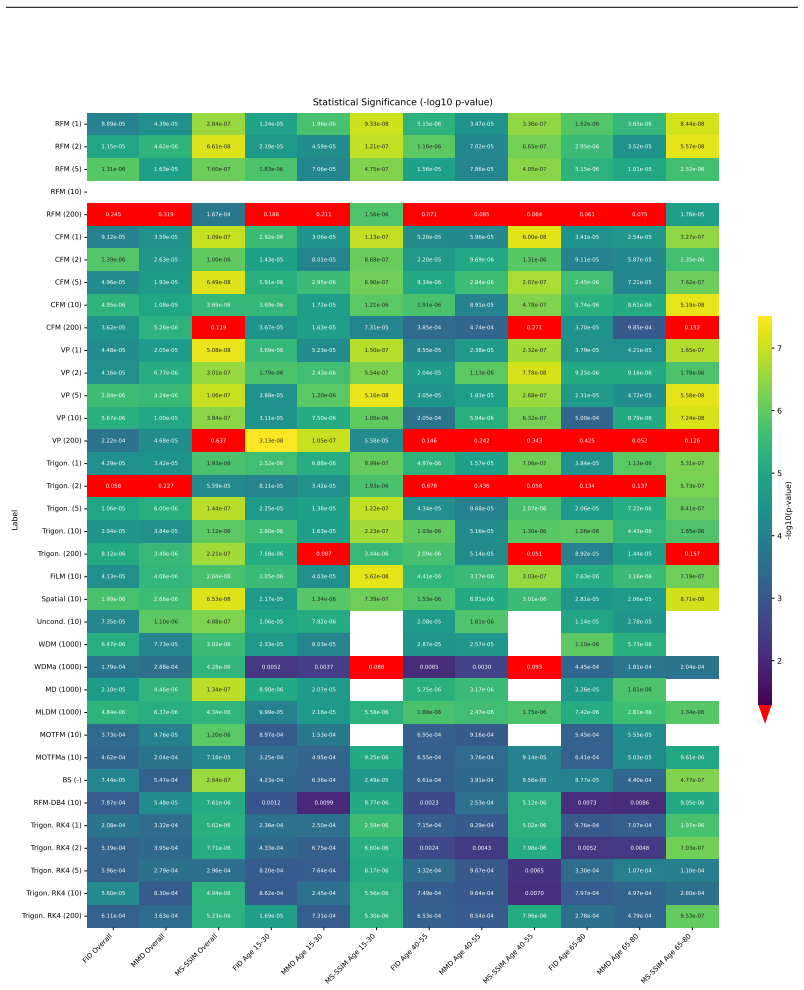
- [Appendix A.13 / Figure 9] The significance display mixes a heatmap with raw p-values and is hard to read; a machine-readable table (e.g., CSV with all pairwise p-values) would improve verifiability.
- [Table 6 / §4.4] BAP MAE vs ODE steps is non-monotonic (1 step: 4.81; 5: 4.23; 10: 4.01; 200: 4.80). Without confidence intervals or a repeated-seed analysis, the 10-step optimum may reflect noise; please add error bars or a brief explanation.
Circularity Check
No significant circularity; central derivation is self-contained and externally benchmarked.
full rationale
FlowLet's core contribution is a generative framework combining wavelet transforms, flow matching, and age conditioning. The flow-matching equations (RFM, CFM, VP, Trigonometric) are standard formulations from cited literature, not fitted or redefined to produce results. The paper explicitly implements and compares four flow variants under identical hyperparameters, and the reported predictions (FID, MMD, MS-SSIM, BAP MAE) are measured on held-out/real data rather than being equivalent to any fitted parameter by construction. The BAP pipeline is inherited from De Bonis et al. (2024) but used as an external benchmark; the authors do not invoke a uniqueness theorem or self-citation to justify their choice of flow matching. The strongest concern—that the BAP comparison conflates data quantity with method—is a validity/confounding issue, not circularity: adding synthetic samples is an experimental design choice, not an equation that reduces to its inputs. The paper even reports a reference model trained on real data alone, providing an external anchor. No step in the derivation is self-definitional, no fitted parameter is renamed as a prediction, and no load-bearing conclusion depends on an unverified self-citation. Score 0 per the rules; the confounding criticism belongs under correctness/fairness, not circularity.
Assumptions & free parameters
free parameters (4)
- ODE steps at inference =
10
- VP diffusion schedule β_min, β_max =
0.1, 20.0
- U-Net architecture hyperparameters =
base channels=128, channel multipliers=(1,2,4,8), attention heads=8, condition dim=512
- Training hyperparameters =
LR=3e-6, batch size=4, epochs=200, weight decay=1e-5
assumptions (4)
- standard math 3D Haar DWT is orthonormal and perfectly invertible; energy is preserved (Parseval).
- domain assumption The flow-matching velocity field learned by MSE regression yields the marginal probability path ODE.
- domain assumption A scalar age embedding, injected via FiLM and cross-attention, is sufficient to condition anatomical variation.
- domain assumption A BAP model trained on synthetic or augmented data transfers to real MRI without shortcut artifacts.
Cite this review
Pith. "Pith review of FlowLet: Conditional 3D Brain MRI Synthesis using Wavelet Flow Matching." pith.science (2026). https://pith.science/paper/S2BVSLJT
@misc{pith2026260105212,
  author       = {Pith},
  title        = {Pith review of: FlowLet: Conditional 3D Brain MRI Synthesis using Wavelet Flow Matching},
  year         = {2026},
  howpublished = {\url{https://pith.science/paper/S2BVSLJT}},
  note         = {Machine review of arXiv:2601.05212}
}
read the original abstract
Brain Magnetic Resonance Imaging (MRI) plays a central role in studying neurological development, aging, and diseases. One key application is Brain Age Prediction (BAP), which estimates an individual's biological brain age from MRI data. Effective BAP models require large, diverse, and age-balanced datasets, whereas existing 3D MRI datasets are demographically skewed, limiting fairness and generalizability. Acquiring new data is costly and ethically constrained, motivating generative data augmentation. Current generative methods are often based on latent diffusion models, which operate in learned low dimensional latent spaces to address the memory demands of volumetric MRI data. However, these methods are typically slow at inference, may introduce artifacts due to latent compression, and are rarely conditioned on age, thereby affecting the BAP performance. In this work, we propose FlowLet, a conditional generative framework that synthesizes age-conditioned 3D MRIs by leveraging flow matching within an invertible 3D wavelet domain, helping to avoid reconstruction artifacts and reducing computational demands. Experiments show that FlowLet generates high-fidelity volumes with few sampling steps. Training BAP models with data generated by FlowLet improves performance for underrepresented age groups, and region-based analysis confirms preservation of anatomical structures.
Figures


Figures from the paper (6 more)


Forward citations
Cited by 1 Pith paper
-
VoxStruct3D: Structure-Leading Flow Matching for Voxel-Space 3D MRI Synthesis
A voxel-space flow-matching model with overlapping volumetric decoding and structure-first guidance achieves state-of-the-art quality on 3D T1 brain MRI synthesis.
Reference graph
Works this paper leans on
-
[1]
Load the NIfTI volume and normalize intensities by clipping to the 0.5th and 99.5th per- centiles, then scaling to the range[−1,1]
-
[2]
Pad the volume to the required input size of112×112×112using replication padding
-
[3]
These aug- mentations are designed to preserve anatomical structures while increasing data variance
For training samples, apply minimal, non-invasive data augmentation using the MONAI 12 library, including random 3D rotations, intensity scaling, and Gaussian noise. These aug- mentations are designed to preserve anatomical structures while increasing data variance. No augmentations were applied to the validation set
-
[4]
This tensor is directly used as input to the U-Net
Apply a 3D Haar DWT, implemented using the PyWavelets13 library, to convert the single- channel input into an 8-channel tensor representing approximation and detail subbands. This tensor is directly used as input to the U-Net. Training DynamicsThe model was trained for 200 epochs using the AdamW optimizer with an initial learning rate of3×10 −6, decayed v...
arXiv 2022
-
[8119]
doi: https://doi.org/10.1016/S1053-8119(09)70884-5. URL https://www.sciencedirect. com/science/article/pii/S1053811909708845. Organization for Human Brain Mapping 2009 An- nual Meeting. Paul Friedrich, Julia Wolleb, Florentin Bieder, Alicia Durrer, and Philippe C. Cattin. WDM: 3d wavelet diffusion models for high-resolution medical image synthesis. In DGM...
arXiv 2009
Reviewed August 3, 2026 · model on record in the stance chip above.
Discussion (0). Sign in to comment.