REVIEW 4 major objections 4 minor 2 references
Rotational Kinematics in the Globular Cluster System of M31: Insights from Bayesian Inference
T0 review · 4 major / 4 minor · reviewed 2026-08-03 · deepseek-v4-flash
Pith's one-line read M31's metal-poor and substructure globular clusters appear to form a single fast-rotating population, distinct from the rest of the cluster system.
desk verdict Solid Bayesian comparison, but the common-rotation claim for the inner metal-poor GCs is only indirect — the model set never lets those nine clusters move independently. read the letter →
The pith
A machine-rendered reading of the paper's core claim, the machinery that carries it, and where it could break.
The reading
What carries the argument
The machinery is a Bayesian change-point kinematic model: each GC's line-of-sight velocity is modeled as a sinusoidal function of sky position (the 'V model'), with a free metallicity cut Mcrit that partitions inner GCs into two components, while outer GCs are partitioned by substructure status. Nested sampling computes marginal likelihoods for each assignment rule, and Bayes factors compare models 2.1 (low-metallicity + substructure grouped together) versus 2.2 (the opposite grouping), along with one- and three-component alternatives.
What would settle it
A concrete test would be to measure accurate metallicities for the outer GCs and check whether substructure-associated outer GCs are systematically more metal-poor than non-substructure ones; if they are not, the proposed common origin loses a key physical motivation. Additionally, refitting the model with a probabilistic (overlapping) assignment of inner GCs to the two components, rather than a hard Mcrit cutoff, would show whether the support for Model 2.1 persists.
Extended reading notes
Core claim
The central claim is that the combined inner and outer GC population of M31 is best described by a two-component kinematic model in which the low-metallicity inner GCs (the 'Dulais structure', [Fe/H] ≲ -2.14) and the outer GCs associated with substructures share a single, relatively fast rotation (A/σ ≈ 1.4, PA ≈ 347°), whereas the higher-metallicity inner GCs and non-substructure outer GCs form a more slowly rotating, dispersion-dominated component (A/σ ≈ 0.44, PA ≈ 289°). This grouping is preferred over the opposite pairing by a Bayes factor of ≈ 11, providing formal evidence for the association originally suggested by the alignment of rotation axes in separate inner and outer studies.
Load-bearing premise
The paper assumes that a single hard metallicity threshold neatly splits the inner GC population into two discrete kinematic groups, even though the real populations would overlap in metallicity; the posterior isolates only about 9 inner GCs below the threshold, so the result rests on the metallicities and velocities of these few clusters.
Editorial extensions
If this is right
- If correct, the Dulais structure and the outer substructure GCs share a common origin, likely a single accreted satellite system.
- The distinct rotation axes of the two components imply different accretion epochs, with the rotation-dominated component retaining its orbital angular momentum.
- The higher-metallicity GCs' alignment with the stellar disk suggests they formed in situ or were accreted early and dynamically heated.
- The data support a low metallicity floor (≈ -2.14) for the accreted component, indicating a very ancient, metal-poor progenitor.
Reading between the lines
- A testable prediction is that outer GCs associated with substructures should, on average, be more metal-poor than non-substructure outer GCs; the paper notes existing photometric metallicities hint at this but do not confirm it.
- The hard metallicity cut at [Fe/H] ≈ -2.14 isolates only about 9 inner GCs; if future spectroscopy revises even a few of these metallicities, the evidence for Model 2.1 could weaken, suggesting a sensitivity analysis with a fuzzy (overlapping) partition would clarify robustness.
- The success of Model 2.1 invites a search for a common orbital plane or stream-like alignment among the low-metallicity inner and substructure outer GCs in three-dimensional space, which could be tested with proper motions or distance estimates.
Signed reviews
Editorial analysis
A structured set of objections, weighed in public.
Referee Report
Summary. The paper combines inner (R_p < 25 kpc) and outer (R_p >= 25 kpc) globular cluster populations of M31 to test whether low-metallicity inner GCs (the previously identified 'Dulais structure') share a common rotating component with outer GCs associated with substructure. Four models are compared with Bayesian evidence: a single-component model (Model 1), two two-component models with opposite pairing rules (Models 2.1 and 2.2), and a three-component model (Model 3). The best model, Model 2.1, pairs low-metallicity inner GCs with substructure-associated outer GCs and finds this combined component has A/sigma ~ 1.4 and PA ~ 347 deg, while the complement is dispersion-dominated with A/sigma ~ 0.44. The reported Bayes factor favors Model 2.1 over Model 2.2 by ~11, and the paper concludes that these GC subgroups were likely accreted together. The statistical machinery is appropriate, but the key association is not tested against a model in which the inner low-metallicity GCs have independent kinematics, and there are several internal numerical inconsistencies.
Significance. If the central association is correct, the paper would provide a direct kinematic link between an inner halo substructure and outer halo tidal debris, supporting a multi-accretion history for M31. The methodology is a strength: nested sampling is used to compute marginal likelihoods, metallicity uncertainties are propagated through 278 latent parameters, and an explicit alternative pairing (Model 2.2) is considered. The paper also compares three functional forms of the rotation curve. However, the headline claim of a 'common' rotation between the ~9 inner low-metallicity GCs and the 32 outer substructure GCs is not directly tested, and the numeric discrepancies in the quoted orientations and evidence values currently undermine the quantitative conclusions. The result is interesting but requires a stronger model comparison and corrected numbers before it can be accepted.
major comments (4)
- [§4.2, Table 3, Eq. (8)] The central claim—that lower-metallicity inner GCs and outer substructure GCs share a common rotation—is never tested against a model that allows the inner low-metallicity GCs to have independent kinematics. In Model 2.1, component 2 contains 32 GCsub plus only about 9 inner low-metallicity GCs, so the inferred A2≈148 km/s and PA2≈347° are dominated by the GCsub. The Bayes factor of ~11 versus Model 2.2 mainly compares whether GCsub fits better with the 9 inner low-metallicity GCs or with the complementary inner population; it does not demonstrate that the 9 inner clusters share GCsub's rotation. A model with three components (inner low-metallicity, GCsub, and the rest), or a nested parameter-sharing test, is required to directly support the abstract's wording of a 'common, more rapid rotation'.
- [§4.2.1 vs Table 4] The quoted orientation of component 2 is internally inconsistent. Section 4.2.1 states φ2 = 108±16° (PA = 18±16°), but Table 4 reports φ2 = 76.69° (+13.69/−14.85) and PA2 = 346.69° (+13.69/−14.85). These values differ by about 31° and are not merely different conventions. Since the alignment of this component is a primary conclusion, this discrepancy must be resolved and the correct posterior values quoted consistently in the text, table, and figure captions.
- [§4.1/Table 8 vs Appendix Table 10] The evidence for Model 1 under the V model is reported as lnZ = −2141.09 in Section 4.1 and Table 8, but Appendix Table 10 lists lnZ(Model 1, V) = −2140.09. This changes the Bayes factor for Model 2.1 versus Model 1 from exp(−2139.40+2141.09) ≈ 5.4 to exp(−2139.40+2140.09) ≈ 2.0, which alters the Kass–Raftery classification in Section 4.4 ('substantial' vs 'not worth more than a bare mention'). The correct value needs to be established and used consistently.
- [Abstract, §2, Table 8] The abstract and discussion state that 'higher-metallicity GCs rotate in alignment with Andromeda's stellar disk.' This result comes from Model 3, which is the second-best model (lnZ = −2141.03, only 0.37 below Model 2.1), and it applies only to the subset with [Fe/H] < −0.4, because all GCs with [Fe/H] ≥ −0.4 were deliberately excluded in Section 2. The most metal-rich, disk-associated population is therefore not included in this analysis. The claims should be qualified to avoid overstating the coverage and the strength of evidence for disk-aligned rotation.
minor comments (4)
- [§4.2.1] The sentence 'There are 278 inner GCs of M31 with a metallicity value above -2.14 and only 9 inner GCs with a metallicity value less than or equal to -2.14' sums to 287, but the final inner sample contains 278 GCs (Section 2). The number above the cutoff should be 269 if 9 are below.
- [Figure 6] The caption says the orientation of component 2 'agrees with that found in Lewis et al. (2023)'. Please verify that the plotted orientation matches the corrected Table 4 values after the inconsistency in §4.2.1 is fixed.
- [Appendix Table 10] The table shows that the F model has slightly higher evidence than V for Models 1, 2.1, and 2.2 (e.g., −2138.23 vs −2139.40 for Model 2.1). The statement that 'none of the substantial conclusions... are affected by this choice' is plausible, but the evidence differences should be quantified to support it.
- [§5] The phrase 'higher-metallicity GCs rotate in alignment with Andromeda's stellar disk' should specify that this refers to the subset with −2.8 < [Fe/H] < −0.4, not the full metal-rich population.
Circularity Check
The central 'common rotation' claim is partly built into Model 2.1, and the binary metallicity split is imported from the authors' own Lewis et al. (2023), though the Model 2.1-vs-2.2 Bayes factor provides some independent evidential content.
-
ansatz smuggled in via citation
[Section 1 / Figure 1 caption]
"While the two populations would overlap in reality, our modelling assumptions simplify matters by assuming that a critical metallicity value neatly divides the GC population into two parts, following Lewis et al. (2023)."
The hard metallicity split defines the low-metallicity 'Dulais' subset whose kinematics are then claimed to be common with GCsub. Its only cited justification is Lewis et al. (2023), a paper by the same group that had itself adopted the same discrete-split ansatz; the paper explicitly acknowledges the populations would actually overlap. Hence the central partition is imported by self-citation rather than independently established, so the subsequent inference is conditional on an untested ansatz.
-
self definitional
[Table 3 / Section 4.2.1 / Section 5]
"Model 2.1 ... GCsub or Metallicity≤Mcrit ... A2,ϕ2, andσ2 ... the lower-metallicity or substructure GCs rotate about 2.4 times faster than their higher-metallicity or non-substructure counterparts."
In Model 2.1, rotational component 2 is defined as the union of outer GCsub and inner low-metallicity GCs (only ~9 clusters, versus 32 GCsub). The fitted A2≈148 km/s and PA2≈347° therefore characterize the joint group; attributing them to the low-metallicity inner GCs as evidence of a 'common rotation' is an imposition of the assignment rule, not an independent measurement of those 9 clusters. No model gives the inner low-metallicity GCs their own free kinematics, so the Bayes factor vs Model 2.2 only tests which outer population they are paired with, not whether they themselves share the GCsub rotation.
full rationale
The paper is not fundamentally circular: Model 2.1 is compared against Model 2.2, so the data can, in principle, prefer the opposite pairing, and the Bayes factor of ~11 comes from integrated likelihoods rather than from a parameter that was fitted to the claimed conclusion. However, the central claim is partially built into the model set. The low-metallicity inner subset is defined by a free critical metallicity, but the binary split itself is imported from the authors' own Lewis et al. (2023) work, which the paper admits is a simplification (the populations would overlap in reality). Moreover, the statement that lower-metallicity GCs and GCsub share a common, faster rotation is an interpretation of a joint component's fitted parameters; with only ~9 inner low-metallicity GCs compared to 32 GCsub, those parameters are not a direct measurement of the inner subset's independent kinematics. This is a genuine limitation and a partial by-construction feature, but it is not a full reduction of the result to the model definition, because the alternative Model 2.2 does provide some evidential contrast. I also note internal numerical inconsistencies—Section 4.2.1 quotes phi2=108±16°/PA=18±16° versus Table 4's phi2=76.7°/PA2=346.7°, and Appendix Table 10 gives lnZ(Model 1, V)=-2140.09 while Section 4.1 and Table 8 state -2141.09—but these affect reported values and Bayes factors rather than constituting circularity per se.
Assumptions & free parameters
free parameters (5)
- Mcrit (metallicity cutoff) =
-2.14 (Model 2.1), -0.58 (Model 2.2), -2.23 (Model 3)
- Rotational amplitudes A_j =
A1=60.6, A2=148.0 km/s (Model 2.1)
- Orientation angles phi_j =
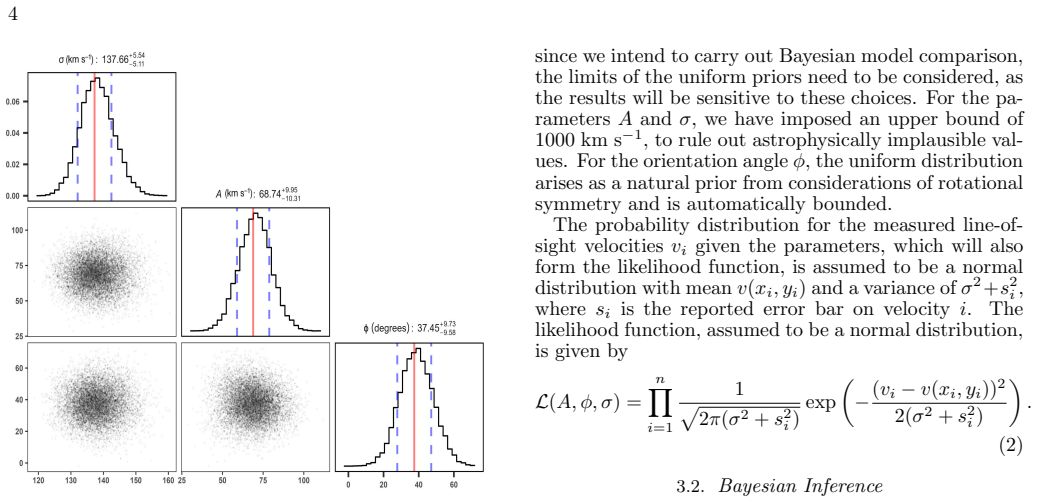
phi1=19.3 deg, phi2=76.7 deg (Model 2.1)
- Velocity dispersions sigma_j =
sigma1=137.4, sigma2=101.7 km/s (Model 2.1)
- True metallicity latent parameters (278) =
Not listed individually
assumptions (4)
- domain assumption Rotational velocity field follows v(r) = A sin(theta - phi) (V model)
- standard math Line-of-sight velocity likelihood is Gaussian with variance sigma^2 + s_i^2
- domain assumption Outer GC classification into substructure (sub) and non-substructure (non) is correct
- domain assumption M31-centric velocities are known; no systemic velocity uncertainty
Cite this review
Pith. "Pith review of Rotational Kinematics in the Globular Cluster System of M31: Insights from Bayesian Inference." pith.science (2026). https://pith.science/paper/CBUOQAEE
@misc{pith2026260105380,
  author       = {Pith},
  title        = {Pith review of: Rotational Kinematics in the Globular Cluster System of M31: Insights from Bayesian Inference},
  year         = {2026},
  howpublished = {\url{https://pith.science/paper/CBUOQAEE}},
  note         = {Machine review of arXiv:2601.05380}
}
read the original abstract
As ancient stellar systems, globular clusters (GCs) offer valuable insights into the dynamical histories of large galaxies. Previous studies of GC populations in the inner and outer regions of the Andromeda Galaxy (M31) have revealed intriguing subpopulations with distinct kinematic properties. Here, we build upon earlier studies by employing Bayesian modelling to investigate the kinematics of the combined inner and outer GC populations of M31. Given the heterogeneous nature of the data, we examine subpopulations defined by GCs' metallicity and by associations with substructure, in order to characterise possible relationships between the inner and outer GC populations. We find that lower-metallicity GCs and those linked to substructures exhibit a common, more rapid rotation, whose alignment is distinct from that of higher-metallicity and non-substructure GCs. Furthermore, the higher-metallicity GCs rotate in alignment with Andromeda's stellar disk. These pronounced kinematic differences reinforce the idea that different subgroups of GCs were accreted to M31 at distinct epochs, shedding light on the complex assembly history of the galaxy.
Figures


Figures from the paper (7 more)


Reference graph
Works this paper leans on
-
[1]
Akib I., Hammer F., Yang Y., Pawlowski M. S., Wang J., 2025a, A&A, 694, A66 Akib I., Hammer F., Yang Y., 2025b, A&A, 695, L5 Ashton G., et al., 2022, Nature Reviews Methods Primers, 2, 39 Barmby P., Huchra J. P., 2001, AJ, 122, 2458 Beasley M. A., 2020, in , Reviews in Frontiers of Modern Astrophysics; From Space Debris to Cosmology. pp 245–277, doi:10.10...
-
[10]
The results also indicate that kinematic modelsVandFare vastly preferred overS
This shows a slight preference for modelFover modelVexcept for Model 3, which favours model V. The results also indicate that kinematic modelsVandFare vastly preferred overS. However, for pragmatic reasons, we decided to prioritize ModelVin the main part of the paper, similar to Mackey et al. (2019b) but different from Lewis et al. (2023), who presented m...
2023
Reviewed August 3, 2026 · model on record in the stance chip above.
Discussion (0). Continue with ORCID to comment.