Recognition: no theorem link
Analysis of the semileptonic decays of Xi_{cc} and Ω_{cc} baryons in QCD sum rules
Pith reviewed 2026-05-16 16:05 UTC · model grok-4.3
The pith
QCD sum rules calculate form factors for 1/2+ to 3/2+ weak transitions in doubly charmed baryons and predict rates for their semileptonic decays.
A machine-rendered reading of the paper's core claim, the machinery that carries it, and where it could break.
Core claim
In the three-point QCD sum-rule framework the authors compute the transition form factors for the listed 1/2+ → 3/2+ semileptonic decays by equating the phenomenological representation (containing all allowed baryon couplings) to the operator-product expansion that includes the perturbative term together with the condensates ⟨q̄q⟩, ⟨g_s² GG⟩, ⟨q̄ g_s σ G q⟩ and g_s² ⟨q̄q⟩²; after numerical evaluation in the Euclidean domain the form factors are fitted and continued to the physical region, yielding decay widths and branching fractions for the four channels with electron and muon leptons.
What carries the argument
Three-point correlation functions whose QCD-side operator-product expansion (perturbative plus condensates up to dimension six) is matched to a phenomenological side that retains all possible couplings of the interpolating currents to the initial and final baryon states.
If this is right
- Decay widths and branching fractions are predicted for each of the four specified semileptonic channels with both electron and muon final states.
- The form-factor results supply numerical inputs that can be directly compared with data from hadron-collider experiments.
- Deviations between the predicted rates and future measurements would indicate either deficiencies in the sum-rule calculation or the presence of new physics.
- The same form factors can be reused to evaluate other processes sharing the same initial and final baryon states.
Where Pith is reading between the lines
- The calculated form factors could serve as benchmarks for lattice-QCD computations of the identical transitions.
- Consistency checks between the extrapolated form factors and dispersion relations would test the reliability of the fitting procedure.
- Repeating the analysis for other heavy-baryon systems might expose systematic patterns in the form-factor behavior.
- The predictions provide a baseline against which any observed excess or deficit in charm-baryon decays can be interpreted as a possible new-physics signal.
Load-bearing premise
The chosen fitting function is assumed to give an accurate analytic continuation of the form factors from the spacelike into the timelike region.
What would settle it
A high-precision measurement of the branching fraction for Ξ_cc^{++} → Σ_c^{*+} e^+ ν_e that differs substantially from the predicted central value.
Figures
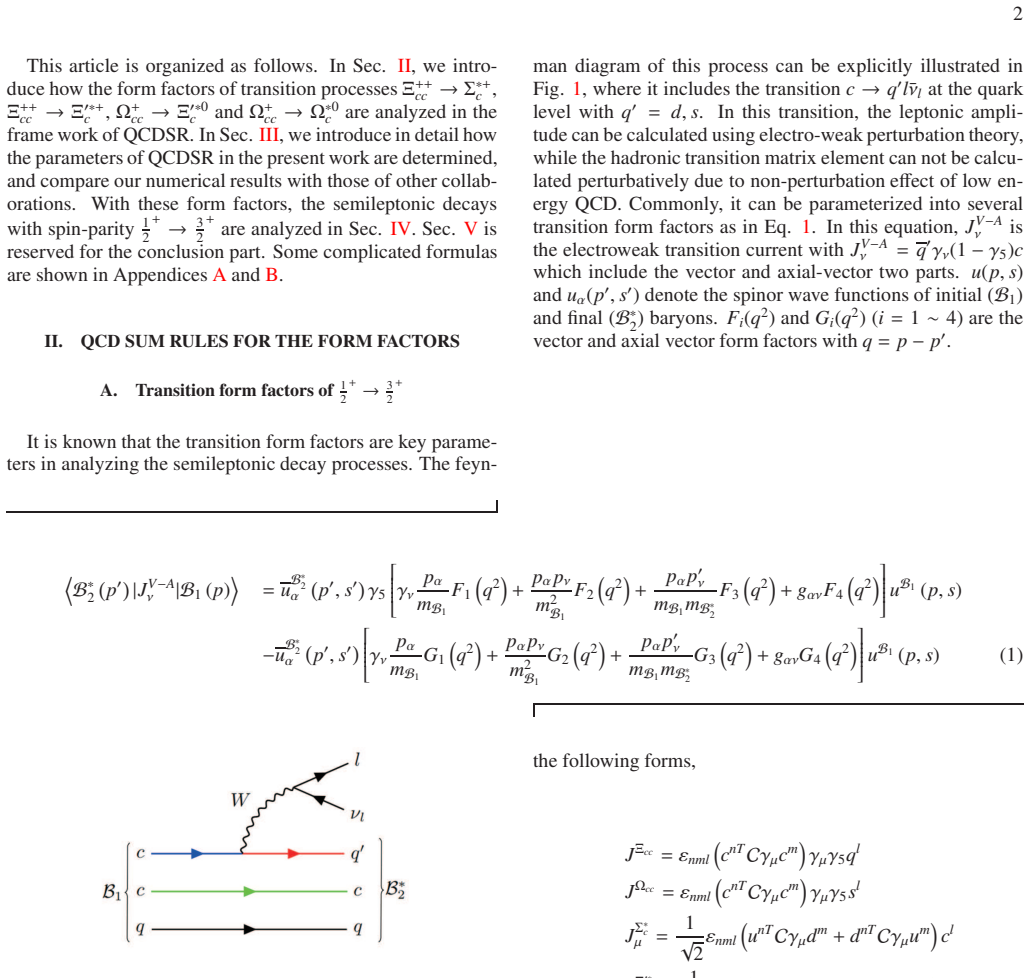


read the original abstract
We firstly carry out a systematic analysis on the spin $\frac{1}{2}^{+}\rightarrow\frac{3}{2}^{+}$ weak transition process in the framework of three-point QCD sum rules, where the initial and final states are doubly and singly charmed baryons. In the phenomenological side, all possible couplings of interpolating current to hadronic states are considered. In doing operator production expansion at QCD side, the contributions of the perturbative part, vacuum condensate terms of $\langle{\bar qq}\rangle$, $\langle g_{s}^{2}GG\rangle$, $\langle \bar q g_{s}\sigma Gq\rangle$ and $g_{s}^{2}\langle{\bar qq}\rangle^{2}$ are all considered. After the form factors in space-like region ($Q^2>0$) are obtained, the numerical results are extrapolated into time-like region ($Q^2<0$) by a fitting function. Using the predicted form factors, we finally analyze the semileptonic decays of $\Xi_{cc}^{++}\rightarrow \Sigma_{c}^{*+}l^{+}\nu_{l}$, $\Xi_{cc}^{++}\rightarrow \Xi_{c}^{\prime*+}l^{+}\nu_{l}$, $\Omega_{cc}^{+}\rightarrow\Xi_{c}^{\prime*0}l^{+}\nu_{l}$ and $\Omega_{cc}^{+}\rightarrow \Omega_{c}^{*0}l^{+}\nu_{l}$ with $l=e,\mu$. The predictions in this work can deepen our understanding of the dynamics in the decay processes of doubly heavy baryons and provide useful information to explore the possibility of new physics in heavy baryonic decay channels.
Editorial analysis
A structured set of objections, weighed in public.
Referee Report
Summary. The paper performs a three-point QCD sum rules analysis of spin-1/2+ to spin-3/2+ weak transitions between doubly charmed baryons (Ξ_cc, Ω_cc) and singly charmed baryons. It includes perturbative contributions plus condensates up to dimension six, extracts form factors in the space-like region (Q²>0), extrapolates them to the time-like region via a fitting function, and uses the results to predict semileptonic decay widths for Ξ_cc^{++}→Σ_c^{*+}ℓ⁺ν_ℓ, Ξ_cc^{++}→Ξ_c^{′*+}ℓ⁺ν_ℓ, Ω_cc⁺→Ξ_c^{′*0}ℓ⁺ν_ℓ and Ω_cc⁺→Ω_c^{*0}ℓ⁺ν_ℓ with ℓ=e,μ.
Significance. If the results hold, the work supplies new numerical predictions for these semileptonic channels that can be confronted with future LHCb or Belle-II data, thereby improving our understanding of heavy-baryon weak dynamics. The systematic treatment of multiple condensate terms up to dimension six is a methodological strength.
major comments (2)
- [Numerical results / extrapolation procedure] The section on numerical analysis and form-factor extrapolation: form factors are computed only for Q²>0 and then fitted to an unspecified functional form before evaluation at physical q²<0. No dispersion-relation derivation, stability test against alternative ansätze (dipole, z-expansion, etc.), or uncertainty estimate from the choice of fit is supplied. Because the quoted decay widths rest entirely on the extrapolated values, this step introduces an uncontrolled systematic uncertainty that directly affects the central predictions.
- [Phenomenological side] Phenomenological side of the sum rules (likely §3): while all possible couplings of the interpolating currents to hadronic states are stated to be considered, the explicit isolation of the desired 1/2+→3/2+ matrix elements from possible contaminating poles or the precise definition of the continuum threshold for the 3/2+ states is not shown in sufficient detail to confirm that the extracted form factors are free of systematic bias.
minor comments (2)
- [Abstract] Abstract: the phrasing 'We firstly carry out' should be changed to 'We first carry out'.
- [Figures and tables] Figure captions and tables: ensure that the Borel-parameter and continuum-threshold windows used for each channel are explicitly tabulated so that readers can reproduce the stability analysis.
Simulated Author's Rebuttal
We thank the referee for the careful reading of the manuscript and the constructive comments. We address each major point below and will revise the paper to improve clarity and robustness.
read point-by-point responses
-
Referee: [Numerical results / extrapolation procedure] The section on numerical analysis and form-factor extrapolation: form factors are computed only for Q²>0 and then fitted to an unspecified functional form before evaluation at physical q²<0. No dispersion-relation derivation, stability test against alternative ansätze (dipole, z-expansion, etc.), or uncertainty estimate from the choice of fit is supplied. Because the quoted decay widths rest entirely on the extrapolated values, this step introduces an uncontrolled systematic uncertainty that directly affects the central predictions.
Authors: We agree that the extrapolation step requires additional documentation to control systematic uncertainty. The form factors obtained for Q²>0 were extrapolated to the physical region using a fitting function whose explicit form is stated in the numerical section. In the revision we will (i) quote the precise functional form, (ii) test stability against the dipole and z-expansion parametrizations, and (iii) attach an uncertainty band arising from the choice of ansatz. These additions will be placed in a dedicated subsection so that the impact on the quoted decay widths is transparent. revision: yes
-
Referee: [Phenomenological side] Phenomenological side of the sum rules (likely §3): while all possible couplings of the interpolating currents to hadronic states are stated to be considered, the explicit isolation of the desired 1/2+→3/2+ matrix elements from possible contaminating poles or the precise definition of the continuum threshold for the 3/2+ states is not shown in sufficient detail to confirm that the extracted form factors are free of systematic bias.
Authors: We thank the referee for this observation. On the phenomenological side we have included all possible couplings of the interpolating currents and isolated the 1/2+→3/2+ matrix elements by matching the independent Lorentz structures while subtracting lower-lying pole contributions via the continuum threshold. To make the procedure fully reproducible we will expand the relevant subsection with an explicit step-by-step projection onto the desired structures and will tabulate the numerical values chosen for the continuum thresholds of the 3/2+ states together with the stability criteria used to fix them. revision: yes
Circularity Check
Extrapolation of form factors from space-like (Q²>0) to time-like (Q²<0) region uses an arbitrary fitting function without first-principles justification
specific steps
-
fitted input called prediction
[Abstract]
"After the form factors in space-like region (Q^2>0) are obtained, the numerical results are extrapolated into time-like region (Q^2<0) by a fitting function. Using the predicted form factors, we finally analyze the semileptonic decays of Ξ_cc^{++}→Σ_c^{*+}l^+ν_l, Ξ_cc^{++}→Ξ_c^{′*+}l^+ν_l, Ω_cc^+→Ξ_c^{′*0}l^+ν_l and Ω_cc^+→Ω_c^{*0}l^+ν_l with l=e,μ."
The space-like form factors are computed from the sum rules; the time-like values needed for the decay rates are produced only by fitting a function to those computed points and evaluating the fit at Q²<0. The decay-rate predictions therefore depend on the arbitrary choice of fitting function rather than on a direct, parameter-free derivation from the sum rules.
full rationale
The three-point QCD sum-rule computation of form factors for Q²>0 is a self-contained first-principles step with no evident circularity in the provided text. However, the physical semileptonic decays lie entirely in the time-like domain (q²<0), and the manuscript obtains the required form-factor values solely by fitting an unspecified functional form to the space-like numerical results and then evaluating the fit at q²<0. Because the quoted decay widths rest on these extrapolated values, the final predictions inherit dependence on the chosen ansatz rather than emerging directly from the sum rules. This matches the 'fitted input called prediction' pattern at a moderate level: the extrapolation is not forced by construction to reproduce the input, yet it is the load-bearing bridge to the observable quantities. No self-citation chains, uniqueness theorems, or renamings are evident. The score is therefore set at 6 rather than 0-2 or 8-10.
Axiom & Free-Parameter Ledger
free parameters (2)
- Borel parameters
- Continuum thresholds
axioms (2)
- domain assumption Quark-hadron duality
- domain assumption Truncation of OPE after dimension-six condensates
Forward citations
Cited by 1 Pith paper
-
Analysis of the semileptonic decays $\Sigma_b\to\Sigma_cl\bar{\nu}_l$, $\Xi'_b\to\Xi'_cl\bar{\nu}_l$ and $\Omega_b\to\Omega_cl\bar{\nu}_l$ in QCD sum rules
Electroweak form factors for Σ_b→Σ_c, Ξ'_b→Ξ'_c and Ω_b→Ω_c transitions are computed in QCD sum rules, producing decay widths that approximately obey SU(3) flavor symmetry along with branching ratios and new-physics p...
Reference graph
Works this paper leans on
-
[1]
u(p, s) and uα(p′, s′) denote the spinor wave functions of initial ( B1) and final ( B∗
In this equation, JV−A ν is the electroweak transition current with JV−A ν = q′γν(1 −γ5)c which include the vector and axial-vector two parts. u(p, s) and uα(p′, s′) denote the spinor wave functions of initial ( B1) and final ( B∗
-
[2]
Fi(q2) and Gi(q2) (i = 1 ∼4) are the vector and axial vector form factors with q = p −p′
baryons. Fi(q2) and Gi(q2) (i = 1 ∼4) are the vector and axial vector form factors with q = p −p′. ⣨ B∗ 2 (p′) |JV−A ν |B1 (p) ⟩ = u B∗ 2 α (p′, s′) γ5 γν pα mB1 F1 ( q2) + pαpν m2 B1 F2 ( q2) + pαp′ ν mB1mB∗ 2 F3 ( q2) + gανF4 ( q2) uB1 (p, s) − u B∗ 2 α (p′, s′) γν pα mB1 G1 ( q2) + pαpν m2 B1 G2 ( q2) + pαp′ ν mB1m...
-
[3]
will be calculated at both hadron and quark levels, which are called the phenomenological sid e and the QCD side, respectively. In the phenomenological side, a complete sets of hadron states which can couple to the corresponding interpolating currents are inserted into the correlation function. Finis h- ing the integral of coordinate space and using the d...
-
[4]
and (10) for ΠQCD−V µν and ΠQCD−A µν , respectively. In Eq. ( 15), ΠQCD−V i and ΠQCD−A i (i = 1, 2 · · ·16) are scalar invariant amplitudes in QCD side. These scalar invariant amplitudes can be represented as the summation of perturbative part and vacuum condensate terms. The Feynman diagrams about the perturbative part, vacuum condensate terms of ⟨ ¯qq⟩,...
-
[5]
The superscript 0 denotes that the dimension of perturbativ e term is zero
Nµν(16) where Nµν= (/k1 + m1)γα(/k2 −m2)γν(/k3 −m3)γµ(/k4 + m4)γ5γα. The superscript 0 denotes that the dimension of perturbativ e term is zero. By setting all quark lines on-shell with the Cutkosky’s rule [ 51], the QCD spectral density function of this contribution can be derived as, ρQCD−V0 µν (s, u, q2) = −12 √ 2 (2π)8 (−2πi)5 (2πi)3 × ( √u−m3)2 ∫ (m1...
-
[6]
and the fourth term in Eq. ( 13). For Fig. 2 (d) as an example, it can finally be expressed as, ΠQCD−V5 µν (p, p′) = i √ 2⟨qgsσGq⟩ 192 (2π)4 ∂ ∂d { ∫ d4k3 × NV5 µν3 [ (p′−k3)2 −d ] [ (p −p′+ k3)2 −m2 2 ] [ k2 3 −m2 3 ] } d→m2 1 (22) Similar to quark condensate, the QCD spectral density of these mixed condensate terms can also be derived as, ρQCD−V5 µν (s, ...
-
[7]
It is shown by Eqs. (
-
[8]
Using quark-hadron duality condition, we can establish 16 linear equations abo ut form factors
and ( 15) that there are both 16 dirac structures at the phenomenological and QCD sides. Using quark-hadron duality condition, we can establish 16 linear equations abo ut form factors. By solving these linear equations, we obtain t he momentum dependent form factors Fi(Q2) and Gi(Q2) which are shown in Eq. ( A3) in Appendix A. In Eq. ( A3), s0 and u0 are ...
-
[9]
The blue bounds denote the Borel platform
These results are for the form factors F1 and F4 of transition Ξ++ cc → Σ∗+ c . The blue bounds denote the Borel platform. (Pole) decreases with the increase of Borel parameters. In addition, we can also see that main contributions come from quark condensate (D3) and purturbative part (D0), and more larger values of the Borel parameters are taken more sma...
-
[10]
In this region, the average value of pole contribution is about 50% and at the same time the contributions of different dimensions satisfy the relation, D3 > D0 > D5 ≫ D4 > D6. The contributions orig- inate from high dimension condensates ⣨ g2 sGG ⟩ and g2 s⟨ qq⟩2 are both smaller than 2%. Another two parameters to be selected are the threshold pa- rameter...
-
[11]
From this figure, we can see that the /s49 /s50 /s51 /s52 /s53 /s54 /s55 /s52 /s51 /s50 /s49 /s48 /s49 /s50 /s32/s32/s70 /s49 /s32/s32/s70 /s50 /s32/s32/s70 /s51 /s32/s32/s70 /s52 /s77 /s50 /s50 /s40/s71/s101/s86 /s50 /s41 /s32/s32/s32/s32/s32 /s77 /s50 /s49 /s61/s55/s40/s71/s101/s86 /s50 /s41 /s70/s111/s114/s109/s32/s70/s97/s99/s116/s111/s114/s115/s40/s81...
-
[12]
+ f V 4 (q2) q2mB1 ] HV 1 2 0 = − √ 2 3 αV 1 2 0 [ f V 1 (q2)(mB1ω−mB∗
-
[13]
−f V 2 (q2)(ω+ 1)m− + f V 3 (q2)(ω2 −1)mB∗ 2 ] HV 1 2 1 = √ 1 6 αV 1 2 1 [ f V 1 (q2) −2 f V 2 (q2)(ω+ 1) ] HV 3 2 1 = − 1√ 2 αV 1 2 1 f V 1 (q2) HA 1 2 t = √ 2 3 αA 1 2 t(ω+ 1) [ f A 1 (q2)mB1 −f A 2 (q2)m− + f A 3 (q2) mB∗ 2 mB1 (mB1ω−mB∗
-
[14]
+ f A 4 (q2) q2mB1 ] HA 1 2 0 = √ 2 3 αA 1 2 0 [ f A 1 (q2)(mB1ω−mB∗
-
[15]
The parametrization about the transition matrix element in the present work (See Eq
−f A 2 (q2)(ω−1)m+ + f A 3 (q2)(ω2 −1)mB∗ 2 ] HA 1 2 1 = √ 1 6 αA 1 2 1 [ f A 1 (q2) −2 f A 2 (q2)(ω−1) ] HA 3 2 1 = 1√ 2 αA 1 2 1 f A 1 (q2) (34) 11 where αV 1 2 t = αA 1 2 0 = √ 2mB1mB∗ 2(ω+ 1)q2 αV 1 2 0 = αA 1 2 t = √ 2mB1mB∗ 2(ω−1)q2 αV 1 2 1 = 2 √ mB1mB∗ 2(ω−1) αA 1 2 1 = 2 √ mB1mB∗ 2(ω+ 1) and ω= m2 B1 +m2 B∗ 2 −q2 2mB1 mB∗ 2 , m±= mB1 ±mB∗ 2 with ...
-
[16]
096+0. 02 −0. 01 0. 37+0. 07 −0. 05 1. 65+0. 12 −0. 08 0.14 0.92 Ξ++ cc → Σ∗+ c µ+νµ
-
[17]
091+0. 02 −0. 01 0. 35+0. 06 −0. 05 1. 62+0. 12 −0. 08 0.14 0.92 Ξ++ cc → Ξ′∗+ c e+νe
-
[18]
01+0. 24 −0. 18 3. 93+0. 93 −0. 72 1. 59+0. 13 −0. 10 1.74 1.08 Ξ++ cc → Ξ′∗+ c µ+νµ
-
[19]
95+0. 23 −0. 17 3. 68+0. 88 −0. 68 1. 55+0. 12 −0. 10 1.74 1.08 Ω+ cc → Ξ′∗0 c e+νe
-
[20]
085+0. 02 −0. 01 0. 27+0. 07 −0. 05 1. 60+0. 17 −0. 11 0.14 0.93 Ω+ cc → Ξ′∗0 c µ+νµ
-
[21]
081+0. 02 −0. 01 0. 25+0. 06 −0. 04 1. 57+0. 17 −0. 11 0.14 0.93 Ω+ cc → Ω∗0 c e+νe
-
[22]
95+0. 53 −0. 38 4. 82+0. 45 −0. 35 1. 54+0. 14 −0. 11 3.45 1.07 Ω+ cc → Ω∗0 c µ+νµ
-
[23]
83+0. 50 −0. 36 4. 69+0. 44 −0. 35 1. 50+0. 14 −0. 11 3.45 1.07 V . CONCLUSIONS In the present work, we firstly analyze the form factors of transition processes Ξ++ cc → Σ∗+ c , Ξ++ cc → Ξ′∗+ c , Ω+ cc → Ξ′∗0 c and Ω++ cc → Ω∗0 c in the framework of three-point QCDSR. Considering the spin-parity of the initial and final baryons , these transition processes ...
- [24]
- [25]
- [26]
- [27]
-
[28]
R. N. Faustov and V . O. Galkin, Phys. Rev. D 98, 093006 (2018)
work page 2018
-
[29]
C. Q. Geng, C. W. Liu and T. H. Tsai, Phys. Rev. D 102, 034033 (2020)
work page 2020
- [30]
- [31]
-
[32]
H. Y . Cheng, Phys. Rev. D 56, 2799 (1997) . 13
work page 1997
-
[33]
M. A. Ivanov, J. G. Korner, V . E. Lyubovitskij and A. G. Ruset- sky, Mod. Phys. Lett. A 13, 181 (1998)
work page 1998
-
[34]
M. A. Ivanov, J. G. Korner, V . E. Lyubovitskij and A. G. Ruset- sky, Phys. Rev. D 57, 5632 (1998)
work page 1998
-
[35]
A. Faessler, T. Gutsche, M. A. Ivanov, J. G. Korner and V . E. Lyubovitskij,Phys. Rev. D 80, 034025 (2009)
work page 2009
-
[36]
T. Gutsche, M. A. Ivanov, J. G. K¨ orner and V . E. Lyubovitskij, Phys. Rev. D 98, 074011 (2018)
work page 2018
-
[37]
T. Gutsche, M. A. Ivanov, J. G. K¨ orner, V . E. Lyubovitskij and Z. Tyulemissov, Phys. Rev. D 100, 114037 (2019)
work page 2019
-
[38]
W. Wang, Z. P . Xing and J. Xu, Eur. Phys. J. C 77, 800 (2017)
work page 2017
-
[39]
Z. X. Zhao, Eur. Phys. J. C 78, 756 (2018)
work page 2018
-
[40]
Z. X. Zhao, Chin. Phys. C 42, 093101 (2018)
work page 2018
-
[41]
C. K. Chua, Phys. Rev. D 99, 014023 (2019)
work page 2019
-
[42]
C. K. Chua, Phys. Rev. D 100, 034025 (2019)
work page 2019
-
[43]
H. W. Ke, N. Hao and X. Q. Li, Eur. Phys. J. C 79 (2019), 540
work page 2019
-
[44]
J. Zhu, Z. T. Wei and H. W. Ke, Phys. Rev. D 99, 054020 (2019)
work page 2019
-
[45]
Y . S. Li, X. Liu and F. S. Y u,Phys. Rev. D 104, 013005 (2021)
work page 2021
-
[46]
X. H. Hu, R. H. Li and Z. P . Xing, Eur. Phys. J. C 80, 320 (2020)
work page 2020
-
[47]
Y . S. Li and X. Liu, Phys. Rev. D 105, 013003 (2022)
work page 2022
-
[48]
F. Lu, H. W. Ke, X. H. Liu and Y . L. Shi, Eur. Phys. J. C 83, 412 (2023)
work page 2023
-
[49]
M. A. Shifman, A. I. V ainshtein and V . I. Zakharov, Nucl. Phys. B 147, 385 (1979)
work page 1979
-
[50]
M. A. Shifman, A. I. V ainshtein and V . I. Zakharov, Nucl. Phys. B 147, 448 (1979)
work page 1979
-
[51]
QCD Sum Rules, a Modern Perspective
P . Colangelo and A. Khodjamirian, arXiv:hep-ph/0010175
work page internal anchor Pith review Pith/arXiv arXiv
-
[52]
Z. G. Wang, Front. Phys. (Beijing) 21, 016300 (2026)
work page 2026
-
[53]
Z. G. Wang, Eur. Phys. J. C 78, 826 (2018)
work page 2018
-
[54]
Z. G. Wang, Nucl. Phys. B 926, 467 (2018)
work page 2018
- [55]
-
[56]
J. Lu, D. Y . Chen, G. L. Y u, Z. G. Wang and Z. Zhou, Eur. Phys. J. C 85, no.9, 1061 (2025)
work page 2025
-
[57]
Y . m. Wang, Y . Li and C. D. Lu,Eur. Phys. J. C 59, 861 (2009)
work page 2009
-
[58]
Y . M. Wang and Y . L. Shen,JHEP 02, 179 (2016)
work page 2016
-
[59]
A. Khodjamirian, C. Klein, T. Mannel and Y . M. Wang, JHEP 09, 106 (2011)
work page 2011
-
[60]
Z. X. Zhao, R. H. Li, Y . L. Shen, Y . J. Shi and Y . S. Yang, Eur. Phys. J. C 80, 1181 (2020)
work page 2020
-
[61]
Y . J. Shi, W. Wang and Z. X. Zhao, Eur. Phys. J. C 80, 568 (2020)
work page 2020
- [62]
-
[63]
T. M. Aliev, S. Bilmis and M. Savci, Phys. Lett. B 847, 138287 (2023)
work page 2023
- [64]
-
[65]
Y . Miao, H. Deng, K. S. Huang, J. Gao and Y . L. Shen, Chin. Phys. C 46, 113107 (2022)
work page 2022
-
[66]
Z. P . Xing and Z. X. Zhao, Eur. Phys. J. C 81, 1111 (2021)
work page 2021
-
[67]
Z. X. Zhao, X. Y . Sun, F. W. Zhang, Y . P . Xing and Y . T. Yang, Phys. Rev. D 108, 116008 (2023)
work page 2023
-
[68]
S. Q. Zhang and C. F. Qiao, Phys. Rev. D 108, 074017 (2023)
work page 2023
-
[69]
Z. Neishabouri, K. Azizi and H. R. Moshfegh, Phys. Rev. D 110, 014010 (2024)
work page 2024
-
[70]
M. S. Tousi, K. Azizi and H. R. Moshfegh, Phys. Rev. D 110, 114001 (2024)
work page 2024
-
[71]
J. Lu, G. L. Y u, D. Y . Chen, Z. G. Wang and B. Wu, Eur. Phys. J. C 85, 1382 (2025)
work page 2025
-
[72]
P .Pascual,R.Tarrach, QCD:Renormalization for the Pr acti- tioner, vol. 194 (1984)
work page 1984
- [73]
- [74]
-
[75]
Z. G. Wang, Eur. Phys. J. C 68, 459 (2010)
work page 2010
-
[76]
G. L. Y u, Z. Y . Li, Z. G. Wang, J. Lu and M. Yan, Eur. Phys. J. A 59, 126 (2023)
work page 2023
-
[77]
G. L. Y u, Z. Y . Li, Z. G. Wang, J. Lu and M. Yan, Nucl. Phys. B 990, 116183 (2023)
work page 2023
-
[78]
Z. Y . Li, G. L. Y u, Z. G. Wang, J. Z. Gu, J. Lu and H. T. Shen, Chin. Phys. C 47, 073105 (2023)
work page 2023
-
[79]
C. G. Boyd, B. Grinstein and R. F. Lebed, Phys. Rev. Lett. 74, 4603 (1995)
work page 1995
- [80]
discussion (0)
Sign in with ORCID, Apple, or X to comment. Anyone can read and Pith papers without signing in.