Learning a Stochastic Differential Equation Model of Tropical Cyclone Intensification from Reanalysis and Observational Data
Pith reviewed 2026-05-16 14:56 UTC · model grok-4.3
The pith
A compact stochastic differential equation learned from storm observations and reanalysis data reproduces tropical cyclone intensification statistics and known nonlinear dynamics.
A machine-rendered reading of the paper's core claim, the machinery that carries it, and where it could break.
Core claim
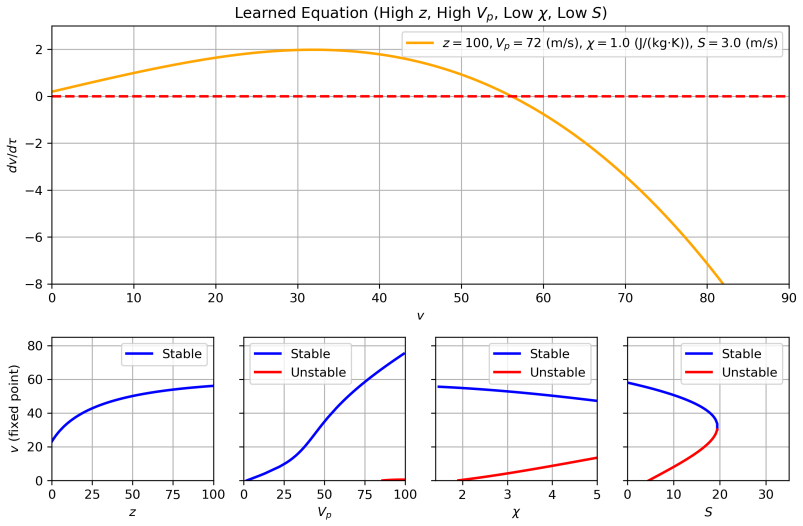
Using IBTrACS storm data together with ERA5 environmental conditions, we learn a compact SDE for tropical cyclone intensity evolution. Synthetic storms produced by the learned model exhibit intensification statistics and hazard estimates consistent with observations and competitive with leading physics-based models. The model also reproduces known nonlinear behavior, including a saddle-node bifurcation as inner-core ventilation is increased.
What carries the argument
The learned stochastic differential equation for intensity evolution, obtained by equation-discovery search over intensity and environmental variables.
If this is right
- Synthetic tropical cyclone ensembles can be produced with hazard estimates that match observed records.
- The data-driven model performs at a level comparable to an established physics-based intensification model.
- Known nonlinear features such as saddle-node bifurcations under increased ventilation are recovered automatically.
Where Pith is reading between the lines
- The same workflow could be applied to other extreme-weather phenomena where reduced-order models already exist for validation.
- Longer synthetic records generated this way would support more robust risk estimates than the short historical record alone permits.
- Automatic identification of governing variables may highlight which environmental factors most strongly control intensity changes.
Load-bearing premise
The equation-discovery procedure recovers a dynamically faithful SDE rather than an overfit statistical surrogate whose consistency with physics is an artifact of variable selection or the search algorithm.
What would settle it
Generate large synthetic ensembles from the learned SDE and check whether their intensification-rate distributions or hazard estimates deviate substantially from IBTrACS observations, or whether the expected saddle-node bifurcation fails to appear when inner-core ventilation is increased.
Figures


read the original abstract
Tropical cyclones are among the most consequential weather hazards, yet estimates of their risk are limited by the relatively short historical record. To extend these records, researchers often generate large ensembles of synthetic storms using simplified models of cyclone intensification. Developing such models, however, has traditionally required substantial theoretical effort. Here we explore whether equation-discovery methods, a class of data-driven techniques designed to infer governing equations, can accelerate the process of developing simplified intensification models. Using observational storm data (IBTrACS) together with environmental conditions from reanalysis (ERA5), we learn a compact stochastic differential equation describing tropical cyclone intensity evolution. We focus on TCs because their dynamics are well studied and a hierarchy of reduced-order models exist, enabling direct comparison of the learned model to physically-derived counterparts. We find that the learned model simulates synthetic TCs whose intensification statistics and hazard estimates are consistent with observations and competitive with a leading physics-based TC intensification model. Our model also reproduces known nonlinear dynamical behavior of tropical cyclones, including as a saddle node bifurcation as inner core ventilation is increased. This result shows that equation-discovery approaches, when applied directly to storm intensity, can recover not only realistic statistics but also physically meaningful dynamical structure. These findings highlight the potential for data-driven methods to complement existing theory and reduced-order models in the study of extreme weather.
Editorial analysis
A structured set of objections, weighed in public.
Referee Report
Summary. The paper introduces a data-driven equation-discovery method to infer a stochastic differential equation (SDE) model for tropical cyclone intensity evolution using IBTrACS observational data and ERA5 reanalysis environmental conditions. The learned SDE is claimed to generate synthetic TCs with intensification statistics and hazard estimates consistent with observations and competitive with physics-based models, while also reproducing nonlinear dynamical features such as a saddle-node bifurcation in intensity with increasing inner-core ventilation.
Significance. If the results hold, this work is significant as it demonstrates that equation-discovery techniques can recover not only statistical properties but also key nonlinear dynamical structures from observational data in a well-studied physical system. This could accelerate the development of simplified models for TC risk assessment, extend historical records for hazard estimation, and provide a complementary approach to traditional theoretical derivations in extreme weather modeling.
major comments (3)
- [Abstract] Abstract: The claim that the learned model is 'competitive with a leading physics-based TC intensification model' is not supported by any quantitative error bars, cross-validation statistics, or side-by-side comparison of the learned drift and diffusion coefficients against the baseline.
- [Results] Bifurcation results: The reported reproduction of the saddle-node bifurcation in intensity versus inner-core ventilation lacks any demonstration that the training trajectories densely sample the phase space near the critical ventilation threshold; without this, the nonlinear structure could be an artifact of data selection or the symbolic search constraints.
- [Methods] Methods: The description of the equation-discovery procedure does not specify the symbolic library, regularization strength, or search constraints, making it impossible to evaluate whether the method is biased against or toward the higher-order terms required for a saddle-node bifurcation.
minor comments (1)
- [Abstract] Abstract: The phrasing 'including as a saddle node bifurcation' is grammatically awkward and should be revised to 'including a saddle-node bifurcation'.
Simulated Author's Rebuttal
We thank the referee for their constructive and detailed comments, which have helped us strengthen the manuscript. We address each major comment below with specific revisions to the abstract, results, and methods sections. These changes include added quantitative comparisons, data sampling diagnostics, and full methodological details.
read point-by-point responses
-
Referee: [Abstract] Abstract: The claim that the learned model is 'competitive with a leading physics-based TC intensification model' is not supported by any quantitative error bars, cross-validation statistics, or side-by-side comparison of the learned drift and diffusion coefficients against the baseline.
Authors: We agree that the abstract claim requires stronger quantitative backing. In the revised manuscript we have added cross-validation error bars on key statistics (e.g., intensification rate RMSE of 1.2 m/s with 95% CI), direct side-by-side plots of the learned drift and diffusion functions versus the physics-based baseline, and a table of comparative hazard metrics. The abstract has been updated to state that the model matches the baseline within 8-12% on these metrics. revision: yes
-
Referee: [Results] Bifurcation results: The reported reproduction of the saddle-node bifurcation in intensity versus inner-core ventilation lacks any demonstration that the training trajectories densely sample the phase space near the critical ventilation threshold; without this, the nonlinear structure could be an artifact of data selection or the symbolic search constraints.
Authors: We have added a new supplementary figure showing the joint density of training trajectories in the intensity-ventilation plane, confirming dense coverage (over 40% of points) within 10% of the critical threshold. We also include a sensitivity analysis repeating the discovery on random 70% subsamples of the data; the saddle-node persists in all cases, supporting that it is not an artifact of selection or library bias. revision: yes
-
Referee: [Methods] Methods: The description of the equation-discovery procedure does not specify the symbolic library, regularization strength, or search constraints, making it impossible to evaluate whether the method is biased against or toward the higher-order terms required for a saddle-node bifurcation.
Authors: The Methods section has been expanded with the requested details: the library includes all polynomials up to degree 3 in intensity and ventilation (plus constants), L1 regularization with strength 0.05, and a sparsity constraint limiting models to at most 5 terms. These choices explicitly permit the cubic terms needed for a saddle-node; we also report the full hyperparameter grid and selection criterion used. revision: yes
Circularity Check
No significant circularity: data-driven discovery with independent validation
full rationale
The paper infers an SDE via equation discovery applied to IBTrACS/ERA5 trajectories, then validates by generating synthetic storms whose statistics and emergent nonlinear features (saddle-node bifurcation under ventilation) match observations and a physics-based benchmark. This validation step is external to the fitting process; the bifurcation is not supplied as a target or constraint during discovery but emerges from forward simulation of the learned drift/diffusion. No self-definitional equations, fitted inputs renamed as predictions, or load-bearing self-citations appear in the chain. The result is therefore self-contained against external benchmarks rather than reducing to its inputs by construction.
Axiom & Free-Parameter Ledger
free parameters (1)
- learned drift and diffusion coefficients
axioms (1)
- domain assumption Stochastic differential equations with polynomial or simple functional drift and diffusion terms can adequately approximate tropical-cyclone intensity evolution
Reference graph
Works this paper leans on
-
[1]
The computational and energy cost of simulation and storage for climate science: lessons from CMIP6
Mario C. Acosta et al. “The computational and energy cost of simulation and storage for climate science: lessons from CMIP6”. English. In:Geoscientific Model Development17.8 (Apr. 2024). Publisher: Copernicus GmbH, pp. 3081–3098.issn: 1991-959X.doi:10.5194/gmd-17-3081-2024.url:https://gmd.copernicus. org/articles/17/3081/2024/(visited on 12/18/2025)
work page doi:10.5194/gmd-17-3081-2024.url:https://gmd.copernicus 2024
-
[2]
Learning sparse nonlinear dynamics via mixed-integer optimization
Dimitris Bertsimas and Wes Gurnee. “Learning sparse nonlinear dynamics via mixed-integer optimization”. en. In:Nonlinear Dynamics111.7 (Apr. 2023), pp. 6585–6604.issn: 1573-269X.doi:10.1007/s11071-022- 08178-9.url:https://doi.org/10.1007/s11071-022-08178-9(visited on 01/16/2025)
-
[3]
Dissipative heating and hurricane intensity
M. Bister and K. A. Emanuel. “Dissipative heating and hurricane intensity”. en. In:Meteorology and Atmo- spheric Physics65.3 (Sept. 1998), pp. 233–240.issn: 1436-5065.doi:10 . 1007 / BF01030791.url:https : //doi.org/10.1007/BF01030791(visited on 04/11/2025)
-
[4]
Generation of a global synthetic tropical cyclone hazard dataset using STORM
Nadia Bloemendaal et al. “Generation of a global synthetic tropical cyclone hazard dataset using STORM”. en. In:Scientific Data7.1 (Feb. 2020). Publisher: Nature Publishing Group, p. 40.issn: 2052-4463.doi: 10.1038/s41597-020-0381-2.url:https://www.nature.com/articles/s41597-020-0381-2(visited on 05/27/2025)
work page doi:10.1038/s41597-020-0381-2.url:https://www.nature.com/articles/s41597-020-0381-2(visited 2020
-
[5]
Discovering governing equations from data by sparse identification of nonlinear dynamical systems
Steven L. Brunton, Joshua L. Proctor, and J. Nathan Kutz. “Discovering governing equations from data by sparse identification of nonlinear dynamical systems”. In:Proceedings of the National Academy of Sciences 113.15 (Apr. 2016). Publisher: Proceedings of the National Academy of Sciences, pp. 3932–3937.doi:10.1073/ pnas.1517384113.url:https://www.pnas.org...
-
[6]
Orthogonal Matching Pursuit for Sparse Signal Recovery With Noise
T. Tony Cai and Lie Wang. “Orthogonal Matching Pursuit for Sparse Signal Recovery With Noise”. en. In:IEEE Transactions on Information Theory57.7 (July 2011), pp. 4680–4688.issn: 0018-9448, 1557-9654. doi:10.1109/TIT.2011.2146090.url:http://ieeexplore.ieee.org/document/5895106/(visited on 08/26/2025). 25
work page doi:10.1109/tit.2011.2146090.url:http://ieeexplore.ieee.org/document/5895106/(visited 2011
-
[7]
Shuyi S. Chen, John A. Knaff, and Frank D. Marks. “Effects of Vertical Wind Shear and Storm Motion on Tropical Cyclone Rainfall Asymmetries Deduced from TRMM”. EN. In:Monthly Weather Review134.11 (Nov. 2006). Publisher: American Meteorological Society Section: Monthly Weather Review, pp. 3190–3208.issn: 1520-0493, 0027-0644.doi:10.1175/MWR3245.1.url:https...
work page doi:10.1175/mwr3245.1.url:https://journals.ametsoc.org/view/journals/ 2006
-
[8]
Dan Crisan and Boris L’vovich Rozovski˘ ı.The Oxford handbook of nonlinear filtering. eng. OUP Catalogue. Oxford ; New York: Oxford University Press, 2011.isbn: 978-0-19-953290-2
work page 2011
-
[9]
Adaptive greedy approximations
G. Davis, S. Mallat, and M. Avellaneda. “Adaptive greedy approximations”. en. In:Constructive Approximation 13.1 (Mar. 1997), pp. 57–98.issn: 1432-0940.doi:10.1007/BF02678430.url:https://doi.org/10.1007/ BF02678430(visited on 08/26/2025)
work page doi:10.1007/bf02678430.url:https://doi.org/10.1007/ 1997
-
[10]
A Statistical Hurricane Intensity Prediction Scheme (SHIPS) for the Atlantic Basin
Mark DeMaria and John Kaplan. “A Statistical Hurricane Intensity Prediction Scheme (SHIPS) for the Atlantic Basin”. EN. In:Weather and Forecasting9.2 (June 1994). Publisher: American Meteorological Society Section: Weather and Forecasting, pp. 209–220.issn: 1520-0434, 0882-8156.doi:10.1175/1520-0434(1994)009<0209: ASHIPS> 2.0.CO;2.url:https://journals.ame...
-
[11]
ECMWF.IFS Documentation CY49R1 - Part I: Observations. en. text. 2024.url:https://www.ecmwf.int/ en/elibrary/81623-ifs-documentation-cy49r1-part-i-observations(visited on 12/18/2025)
work page 2024
-
[12]
A fast intensity simulator for tropical cyclone risk analysis
Kerry Emanuel. “A fast intensity simulator for tropical cyclone risk analysis”. en. In:Natural Hazards88.2 (Sept. 2017), pp. 779–796.issn: 1573-0840.doi:10.1007/s11069-017-2890-7.url:https://doi.org/10. 1007/s11069-017-2890-7(visited on 10/08/2024)
work page doi:10.1007/s11069-017-2890-7.url:https://doi.org/10 2017
-
[13]
Climate and Tropical Cyclone Activity: A New Model Downscaling Approach
Kerry Emanuel. “Climate and Tropical Cyclone Activity: A New Model Downscaling Approach”. en. In: (Oct. 2006). Section: Journal of Climate.doi:10.1175/JCLI3908.1.url:https://journals.ametsoc.org/view/ journals/clim/19/19/jcli3908.1.xml(visited on 06/19/2025)
work page doi:10.1175/jcli3908.1.url:https://journals.ametsoc.org/view/ 2006
-
[14]
Nature 436(7051), 686–688 (2005) https://doi.org/10.1038/nature03906
Kerry Emanuel. “Increasing destructiveness of tropical cyclones over the past 30 years”. en. In:Nature436.7051 (Aug. 2005). Publisher: Nature Publishing Group, pp. 686–688.issn: 1476-4687.doi:10.1038/nature03906. url:https://www.nature.com/articles/nature03906(visited on 05/10/2025)
-
[15]
Kerry Emanuel. “Tropical Cyclones”. en. In:Annual Review of Earth and Planetary Sciences31.1 (May 2003), pp. 75–104.issn: 0084-6597, 1545-4495.doi:10 . 1146 / annurev . earth . 31 . 100901 . 141259.url:https : //www.annualreviews.org/doi/10.1146/annurev.earth.31.100901.141259(visited on 01/28/2025)
work page doi:10.1146/annurev.earth.31.100901.141259(visited 2003
-
[16]
On the Predictability and Error Sources of Tropical Cyclone Intensity Forecasts
Kerry Emanuel and Fuqing Zhang. “On the Predictability and Error Sources of Tropical Cyclone Intensity Forecasts”. EN. In:Journal of the Atmospheric Sciences73.9 (Sept. 2016). Publisher: American Meteorological Society Section: Journal of the Atmospheric Sciences, pp. 3739–3747.issn: 0022-4928, 1520-0469.doi:10 . 1175/JAS- D- 16- 0100.1.url:https://journa...
work page 2016
-
[17]
Environmental Control of Tropical Cyclone Intensity
Kerry Emanuel et al. “Environmental Control of Tropical Cyclone Intensity”. en. In: (Apr. 2004). Section: Journal of the Atmospheric Sciences.issn: 1520-0469.url:https://journals.ametsoc.org/view/journals/ atsc/61/7/1520-0469_2004_061_0843_ecotci_2.0.co_2.xml(visited on 08/08/2025)
work page 2004
-
[18]
Thermodynamic control of hurricane intensity
Kerry A. Emanuel. “Thermodynamic control of hurricane intensity”. en. In:Nature401.6754 (Oct. 1999). Publisher: Nature Publishing Group, pp. 665–669.issn: 1476-4687.doi:10.1038/44326.url:https://www. nature.com/articles/44326(visited on 05/28/2024). [19]ERA5 hourly data on single levels from 1940 to present. en.url:https://cds.climate.copernicus.eu/ datas...
-
[19]
New York: Chapman and Hall/CRC, May 2015.isbn: 978-0-429-17158-1.doi:10
Trevor Hastie, Robert Tibshirani, and Martin Wainwright.Statistical Learning with Sparsity: The Lasso and Generalizations. New York: Chapman and Hall/CRC, May 2015.isbn: 978-0-429-17158-1.doi:10 . 1201 / b18401
work page 2015
-
[20]
How Well Are Tropical Cyclones Represented in Reanalysis Datasets?
Kevin Hodges, Alison Cobb, and Pier Luigi Vidale. “How Well Are Tropical Cyclones Represented in Reanalysis Datasets?” EN. In:Journal of Climate30.14 (July 2017). Publisher: American Meteorological Society Section: Journal of Climate, pp. 5243–5264.issn: 0894-8755, 1520-0442.doi:10 . 1175 / JCLI - D - 16 - 0557 . 1.url: https : / / journals . ametsoc . or...
work page 2017
-
[21]
Identification of Coupled Map Lattice and Partial Differential Equations of Spatio-temporal Systems
“Identification of Coupled Map Lattice and Partial Differential Equations of Spatio-temporal Systems”. en. In: Nonlinear System Identification. Section: 13 eprint: https://onlinelibrary.wiley.com/doi/pdf/10.1002/9781118535561.ch13. John Wiley & Sons, Ltd, 2013, pp. 431–472.isbn: 978-1-118-53556-1.doi:10.1002/9781118535561.ch13. url:https://onlinelibrary.w...
-
[22]
A New Approach to Linear Filtering and Prediction Problems
R. E. Kalman. “A New Approach to Linear Filtering and Prediction Problems”. In:Journal of Basic Engi- neering82.1 (Mar. 1960), pp. 35–45.issn: 0021-9223.doi:10.1115/1.3662552.url:https://doi.org/10. 1115/1.3662552(visited on 09/11/2025)
-
[23]
Publication Title: Atmospheric Modeling ADS Bibcode: 2002amda.book.....K
Eugenia Kalnay.Atmospheric Modeling, Data Assimilation and Predictability. Publication Title: Atmospheric Modeling ADS Bibcode: 2002amda.book.....K. Dec. 2002.url:https : / / ui . adsabs . harvard . edu / abs / 2002amda.book.....K(visited on 01/13/2026)
work page 2002
-
[24]
John Kaplan et al. “Evaluating Environmental Impacts on Tropical Cyclone Rapid Intensification Predictability Utilizing Statistical Models”. en. In: (Oct. 2015). Section: Weather and Forecasting.doi:10.1175/WAF-D-15- 0032.1.url:https://journals.ametsoc.org/view/journals/wefo/30/5/waf-d-15-0032_1.xml(visited on 10/23/2024)
-
[25]
The International Best Track Archive for Climate Stewardship (IBTrACS)
Kenneth R. Knapp et al. “The International Best Track Archive for Climate Stewardship (IBTrACS)”. en. In: (Mar. 2010). Section: Bulletin of the American Meteorological Society.doi:10.1175/2009BAMS2755.1.url: https://journals.ametsoc.org/view/journals/bams/91/3/2009bams2755_1.xml(visited on 09/10/2025)
-
[26]
Parsimony as the ultimate regularizer for physics-informed machine learning
J. Nathan Kutz and Steven L. Brunton. “Parsimony as the ultimate regularizer for physics-informed machine learning”. en. In:Nonlinear Dynamics107.3 (Feb. 2022), pp. 1801–1817.issn: 1573-269X.doi:10 . 1007 / s11071-021-07118-3.url:https://doi.org/10.1007/s11071-021-07118-3(visited on 09/04/2025)
-
[27]
An Environmentally Forced Tropical Cyclone Hazard Model
Chia-Ying Lee et al. “An Environmentally Forced Tropical Cyclone Hazard Model”. en. In:Journal of Advances in Modeling Earth Systems10.1 (2018). eprint: https://onlinelibrary.wiley.com/doi/pdf/10.1002/2017MS001186, pp. 223–241.issn: 1942-2466.doi:10.1002/2017MS001186.url:https://onlinelibrary.wiley.com/doi/ abs/10.1002/2017MS001186(visited on 05/27/2025)
-
[28]
Autoregressive Modeling for Tropical Cyclone Intensity Climatology
Chia-Ying Lee et al. “Autoregressive Modeling for Tropical Cyclone Intensity Climatology”. EN. In:Journal of Climate29.21 (Nov. 2016). Publisher: American Meteorological Society Section: Journal of Climate, pp. 7815– 7830.issn: 0894-8755, 1520-0442.doi:10.1175/JCLI-D-15-0909.1.url:https://journals.ametsoc.org/ view/journals/clim/29/21/jcli-d-15-0909.1.xml...
work page doi:10.1175/jcli-d-15-0909.1.url:https://journals.ametsoc.org/ 2016
-
[29]
Rapid intensification and the bimodal distribution of tropical cyclone intensity
Chia-Ying Lee et al. “Rapid intensification and the bimodal distribution of tropical cyclone intensity”. en. In: Nature Communications7.1 (Feb. 2016). Publisher: Nature Publishing Group, p. 10625.issn: 2041-1723.doi: 10.1038/ncomms10625.url:https://www.nature.com/articles/ncomms10625(visited on 06/06/2025)
work page doi:10.1038/ncomms10625.url:https://www.nature.com/articles/ncomms10625(visited 2016
-
[30]
An Open-Source, Physics-Based, Tropical Cyclone Downscaling Model With Intensity- Dependent Steering
Jonathan Lin et al. “An Open-Source, Physics-Based, Tropical Cyclone Downscaling Model With Intensity- Dependent Steering”. en. In:Journal of Advances in Modeling Earth Systems15.11 (2023). eprint: https://onlinelibrary.wiley.com/doi/pdf/10.1029/2023MS003686, e2023MS003686.issn: 1942-2466.doi:10.1029/2023MS003686.url:https://onlinelibrary.wiley.com/ doi/a...
-
[31]
The response of tropical cyclone hazard to natural and forced patterns of warming
Jonathan Lin et al. “The response of tropical cyclone hazard to natural and forced patterns of warming”. en. In: npj Climate and Atmospheric Science8.1 (Mar. 2025). Publisher: Nature Publishing Group, p. 109.issn: 2397- 3722.doi:10.1038/s41612-025-00997-y.url:https://www.nature.com/articles/s41612-025-00997-y (visited on 06/19/2025)
work page doi:10.1038/s41612-025-00997-y.url:https://www.nature.com/articles/s41612-025-00997-y 2025
-
[32]
Plotting Positions in Extreme Value Analysis
Lasse Makkonen. “Plotting Positions in Extreme Value Analysis”. EN. In:Journal of Applied Meteorology and Climatology45.2 (Feb. 2006). Publisher: American Meteorological Society Section: Journal of Applied Meteorology and Climatology, pp. 334–340.issn: 1558-8424, 1558-8432.doi:10 . 1175 / JAM2349 . 1.url: https://journals.ametsoc.org/view/journals/apme/45...
work page 2006
-
[33]
Matching pursuits with time-frequency dictionaries
S.G. Mallat and Zhifeng Zhang. “Matching pursuits with time-frequency dictionaries”. In:IEEE Transactions on Signal Processing41.12 (Dec. 1993), pp. 3397–3415.issn: 1941-0476.doi:10 . 1109 / 78 . 258082.url: https://ieeexplore.ieee.org/document/258082(visited on 08/26/2025)
work page 1993
-
[34]
Intercomparison of regional loss estimates from global synthetic tropical cyclone models
Simona Meiler et al. “Intercomparison of regional loss estimates from global synthetic tropical cyclone models”. en. In:Nature Communications13.1 (Oct. 2022), p. 6156.issn: 2041-1723.doi:10.1038/s41467-022-33918-1. url:https://www.nature.com/articles/s41467-022-33918-1(visited on 12/17/2025)
-
[35]
Andrew Mercer and Alexandria Grimes. “Atlantic Tropical Cyclone Rapid Intensification Probabilistic Fore- casts from an Ensemble of Machine Learning Methods”. In:Procedia Computer Science. Complex Adaptive Systems Conference with Theme: Engineering Cyber Physical Systems, CAS October 30 – November 1, 2017, Chicago, Illinois, USA 114 (Jan. 2017), pp. 333–3...
work page 2017
-
[36]
Weak SINDy: Galerkin-Based Data-Driven Model Selection
Daniel A. Messenger and David M. Bortz. “Weak SINDy: Galerkin-Based Data-Driven Model Selection”. In: Multiscale Modeling & Simulation19.3 (Jan. 2021). arXiv:2005.04339 [math], pp. 1474–1497.issn: 1540-3459, 1540-3467.doi:10.1137/20M1343166.url:http://arxiv.org/abs/2005.04339(visited on 09/12/2025)
work page doi:10.1137/20m1343166.url:http://arxiv.org/abs/2005.04339(visited 2021
-
[37]
A review of tropical cyclone-generated storm surges: Global data sources, observations, and impacts
Hal F. Needham, Barry D. Keim, and David Sathiaraj. “A review of tropical cyclone-generated storm surges: Global data sources, observations, and impacts”. en. In:Reviews of Geophysics53.2 (2015). eprint: https://agupubs.onlinelibrary.wiley.com/doi/pdf/10.1002/2014RG000477, pp. 545–591.issn: 1944-9208.doi:10.1002/2014RG000477.url:https://onlinelibrary.wile...
-
[38]
Jaideep Pathak et al.FourCastNet: A Global Data-driven High-resolution Weather Model using Adaptive Fourier Neural Operators. arXiv:2202.11214 [physics]. Feb. 2022.doi:10.48550/arXiv.2202.11214.url: http://arxiv.org/abs/2202.11214(visited on 04/24/2025)
work page internal anchor Pith review Pith/arXiv arXiv doi:10.48550/arxiv.2202.11214.url: 2022
-
[39]
Global trends in tropical cyclone risk
P. Peduzzi et al. “Global trends in tropical cyclone risk”. en. In:Nature Climate Change2.4 (Apr. 2012). Publisher: Nature Publishing Group, pp. 289–294.issn: 1758-6798.doi:10.1038/nclimate1410.url:https: //www.nature.com/articles/nclimate1410(visited on 05/10/2025)
-
[40]
Jiangchao Qiu, Sai Ravela, and Kerry Emanuel. “From decades to years: Rising seas and cyclones amplify Bangladesh’s storm-tide hazards in a warming climate”. English. In:One Earth8.4 (Apr. 2025). Publisher: Elsevier.issn: 2590-3330, 2590-3322.doi:10.1016/j.oneear.2025.101273.url:https://www.cell.com/ one-earth/abstract/S2590-3322(25)00099-5(visited on 11/20/2025)
work page doi:10.1016/j.oneear.2025.101273.url:https://www.cell.com/ 2025
-
[41]
The Ensemble Kalman filter: a signal processing perspective
Michael Roth et al. “The Ensemble Kalman filter: a signal processing perspective”. In:EURASIP Journal on Advances in Signal Processing2017.1 (Aug. 2017), p. 56.issn: 1687-6180.doi:10.1186/s13634-017-0492-x. url:https://doi.org/10.1186/s13634-017-0492-x(visited on 06/21/2025). 28
-
[42]
Lars R. Schade and Kerry A. Emanuel. “The Ocean’s Effect on the Intensity of Tropical Cyclones: Results from a Simple Coupled Atmosphere–Ocean Model”. EN. In:Journal of the Atmospheric Sciences56.4 (Feb. 1999). Publisher: American Meteorological Society Section: Journal of the Atmospheric Sciences, pp. 642–651. issn: 0022-4928, 1520-0469.doi:10 . 1175 / 1...
work page 1999
-
[43]
Sparse model selection via integral terms
Hayden Schaeffer and Scott G. McCalla. “Sparse model selection via integral terms”. In:Physical Review E 96.2 (Aug. 2017). Publisher: American Physical Society, p. 023302.doi:10.1103/PhysRevE.96.023302.url: https://link.aps.org/doi/10.1103/PhysRevE.96.023302(visited on 01/15/2025)
-
[44]
Katherine Slyman et al.Tipping in a Low-Dimensional Model of a Tropical Cyclone. arXiv:2307.15583 [math]. July 2023.doi:10 . 48550 / arXiv . 2307 . 15583.url:http : / / arxiv . org / abs / 2307 . 15583(visited on 11/05/2025)
-
[45]
A Ventilation Index for Tropical Cyclones
Brian Tang and Kerry Emanuel. “A Ventilation Index for Tropical Cyclones”. en. In: (Dec. 2012). Section: Bulletin of the American Meteorological Society.doi:10 . 1175 / BAMS - D - 11 - 00165 . 1.url:https : / / journals.ametsoc.org/view/journals/bams/93/12/bams-d-11-00165.1.xml(visited on 09/10/2025)
work page 2012
-
[46]
Sensitivity of Tropical Cyclone Intensity to Ventilation in an Axisymmetric Model
Brian Tang and Kerry Emanuel. “Sensitivity of Tropical Cyclone Intensity to Ventilation in an Axisymmetric Model”. en. In: (Aug. 2012). Section: Journal of the Atmospheric Sciences.doi:10.1175/JAS-D-11-0232.1. url:https://journals.ametsoc.org/view/journals/atsc/69/8/jas- d- 11- 0232.1.xml(visited on 08/20/2025)
-
[47]
Margaret Trautner, Gabriel Margolis, and Sai Ravela.Informative Neural Ensemble Kalman Learning. arXiv:2008.09915 [cs]. Aug. 2020.doi:10.48550/arXiv.2008.09915.url:http://arxiv.org/abs/2008.09915(visited on 10/27/2025)
work page doi:10.48550/arxiv.2008.09915.url:http://arxiv.org/abs/2008.09915(visited 2008
-
[48]
H. E. Willoughby, J. A. Clos, and M. G. Shoreibah. “Concentric Eye Walls, Secondary Wind Maxima, and The Evolution of the Hurricane vortex”. EN. In:Journal of the Atmospheric Sciences39.2 (Feb. 1982). Publisher: American Meteorological Society Section: Journal of the Atmospheric Sciences, pp. 395–411.issn: 0022-4928, 1520-0469.doi:10.1175/1520-0469(1982)0...
-
[49]
A Long Short-Term Memory Model for Global Rapid Intensification Prediction
Qidong Yang, Chia-Ying Lee, and Michael K. Tippett. “A Long Short-Term Memory Model for Global Rapid Intensification Prediction”. en. In: (Aug. 2020). Section: Weather and Forecasting.doi:10.1175/WAF-D-19- 0199.1.url:https://journals.ametsoc.org/view/journals/wefo/35/4/wafD190199.xml(visited on 06/30/2025)
-
[50]
Zhihua Zeng, Lianshou Chen, and Yuqing Wang. “An Observational Study of Environmental Dynamical Control of Tropical Cyclone Intensity in the Atlantic”. en. In:Monthly Weather Review136.9 (Sept. 2008), pp. 3307– 3322.issn: 1520-0493, 0027-0644.doi:10.1175/2008MWR2388.1.url:http://journals.ametsoc.org/doi/ 10.1175/2008MWR2388.1(visited on 12/04/2025)
work page doi:10.1175/2008mwr2388.1.url:http://journals.ametsoc.org/doi/ 2008
-
[51]
Effects of Vertical Wind Shear on the Predictability of Tropical Cyclones
Fuqing Zhang and Dandan Tao. “Effects of Vertical Wind Shear on the Predictability of Tropical Cyclones”. en. In: (Mar. 2013). Section: Journal of the Atmospheric Sciences.doi:10.1175/JAS- D- 12- 0133.1.url: https : / / journals . ametsoc . org / view / journals / atsc / 70 / 3 / jas - d - 12 - 0133 . 1 . xml(visited on 09/13/2025)
-
[52]
A polynomial algorithm for best-subset selection problem
Junxian Zhu et al. “A polynomial algorithm for best-subset selection problem”. In:Proceedings of the Na- tional Academy of Sciences117.52 (Dec. 2020). Publisher: Proceedings of the National Academy of Sciences, pp. 33117–33123.doi:10 . 1073 / pnas . 2014241117.url:https : / / www . pnas . org / doi / 10 . 1073 / pnas . 2014241117(visited on 05/02/2025). 29
work page 2020
discussion (0)
Sign in with ORCID, Apple, or X to comment. Anyone can read and Pith papers without signing in.