Lattice fermion simulation of spontaneous time-reversal symmetry breaking in a helical Luttinger liquid
Pith reviewed 2026-05-16 14:41 UTC · model grok-4.3
The pith
Helical liquid enters gapped phase with broken time-reversal symmetry
A machine-rendered reading of the paper's core claim, the machinery that carries it, and where it could break.
Core claim
By discretizing the helical Luttinger liquid Hamiltonian with a tangent dispersion that avoids the fermion-doubling obstruction of the usual sine dispersion while preserving time-reversal symmetry, the authors perform tensor network simulations on finite lattices. These simulations confirm the analytic expectation that a gapped phase with spontaneously broken time-reversal symmetry appears precisely when the Fermi level is tuned to the Dirac point and the Luttinger parameter crosses its critical value.
What carries the argument
The tangent dispersion relation used to discretize the kinetic term of the helical Luttinger liquid, which allows inclusion of backscattering interactions on the lattice without breaking time-reversal symmetry or introducing doublers.
If this is right
- The numerical method validates the analytic prediction for the location of the critical point where the gap opens.
- The lattice model enables future studies of finite-size effects and other interaction terms in helical liquids.
- Confirmation of the gapped phase supports the possibility of realizing spontaneous symmetry breaking in experimental realizations of helical edge states.
- Tensor networks prove effective for capturing the strong-coupling regime in these one-dimensional systems.
Where Pith is reading between the lines
- This discretization technique could be adapted to simulate other symmetry-breaking phenomena in Luttinger liquids with different interactions.
- Connections to the physics of Majorana zero modes or fractional charges might emerge if the broken symmetry phase is further analyzed for topological properties.
- Experimental tuning of the Luttinger parameter via gating or screening in quantum wires could test the predicted critical value directly.
Load-bearing premise
The tangent dispersion relation accurately captures the low-energy physics of the helical Luttinger liquid without introducing lattice artifacts that would alter the symmetry-breaking behavior.
What would settle it
A direct measurement showing no gap or no symmetry breaking in a helical liquid system when the Luttinger parameter is tuned below the critical value predicted by the analytics and numerics would falsify the claim.
Figures
read the original abstract
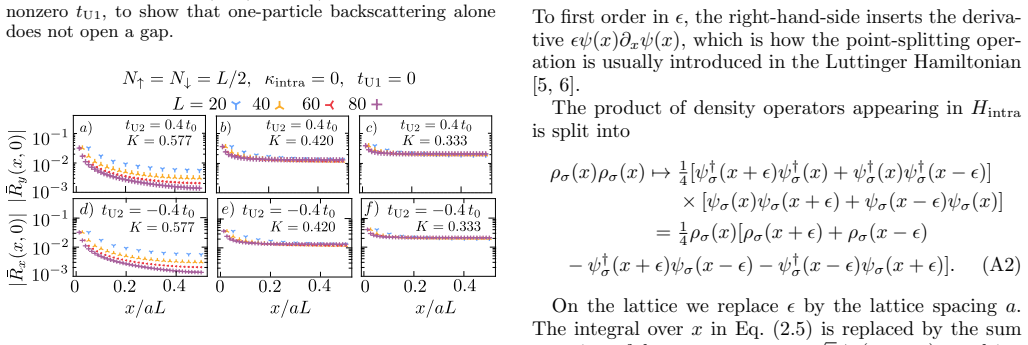
We extend a recently developed "tangent fermion" method to discretize the Hamiltonian of a helical Luttinger liquid on a one-dimensional lattice, including two-particle backscattering processes that may open a gap in the spectrum. The fermion-doubling obstruction of the sine dispersion is avoided by working with a tangent dispersion, preserving the time-reversal symmetry of the Hamiltonian. The numerical results from a tensor network calculation on a finite lattice confirm the expectation from infinite-system analytics, that a gapped phase with spontaneously broken time-reversal symmetry emerges when the Fermi level is tuned to the Dirac point and the Luttinger parameter crosses a critical value.
Editorial analysis
A structured set of objections, weighed in public.
Referee Report
Summary. The manuscript extends the tangent fermion discretization to the helical Luttinger liquid Hamiltonian on a 1D lattice, incorporating two-particle backscattering while preserving time-reversal symmetry. Tensor-network calculations on finite lattices are reported to confirm analytic predictions of a gapped phase with spontaneously broken time-reversal symmetry when the Fermi level is tuned to the Dirac point and the Luttinger parameter K exceeds a critical value.
Significance. If the numerical confirmation holds after proper scaling analysis, the work supplies a concrete lattice realization and simulation protocol for interaction-driven TRS breaking in helical liquids. This could aid studies of quantum-wire edges or related 1D topological phases by bridging Luttinger-liquid analytics with tensor-network numerics.
major comments (2)
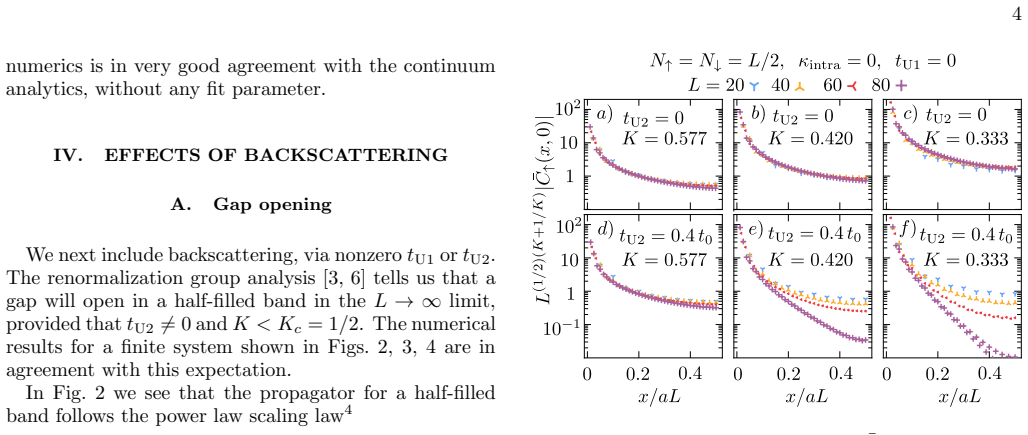
- [Abstract and Numerical Results] Abstract and Numerical Results section: the claim that finite-lattice tensor-network data confirm the infinite-system analytic critical K rests on an unexamined extrapolation. No system-size dependence, bond-dimension convergence, or scaling collapse of the gap versus (K - Kc) is presented, leaving open the possibility that the reported gapped phase is a finite-size crossover or lattice artifact.
- [Method section on tangent dispersion] Method section on tangent dispersion: the assertion that the tangent dispersion faithfully reproduces the low-energy backscattering operator without shifting its scaling dimension requires explicit verification. The manuscript does not quantify deviations from linear dispersion at momenta away from the Dirac point or demonstrate that these do not alter the critical K value obtained from renormalization-group analysis.
minor comments (2)
- [Abstract] Abstract: specify the tensor-network ansatz (MPS/DMRG), maximum bond dimension, and range of lattice sizes employed.
- [Figures] Figures showing the gap or order parameter versus K should overlay the analytic critical value together with any available error estimates.
Simulated Author's Rebuttal
We thank the referee for the careful reading and constructive comments on our manuscript. We address each major comment below and will revise the manuscript to incorporate additional analysis as requested.
read point-by-point responses
-
Referee: Abstract and Numerical Results section: the claim that finite-lattice tensor-network data confirm the infinite-system analytic critical K rests on an unexamined extrapolation. No system-size dependence, bond-dimension convergence, or scaling collapse of the gap versus (K - Kc) is presented, leaving open the possibility that the reported gapped phase is a finite-size crossover or lattice artifact.
Authors: We agree that a more detailed finite-size scaling analysis is required to confirm the extrapolation to the infinite-system limit. In the revised manuscript we will add plots of the gap versus system size, bond-dimension convergence checks, and a scaling collapse of the gap as a function of (K - Kc) for multiple lattice sizes. These additions will demonstrate that the gapped phase with broken time-reversal symmetry persists in the thermodynamic limit and that the extracted critical K matches the analytic prediction. revision: yes
-
Referee: Method section on tangent dispersion: the assertion that the tangent dispersion faithfully reproduces the low-energy backscattering operator without shifting its scaling dimension requires explicit verification. The manuscript does not quantify deviations from linear dispersion at momenta away from the Dirac point or demonstrate that these do not alter the critical K value obtained from renormalization-group analysis.
Authors: We acknowledge the need for explicit verification. In the revision we will include a quantitative analysis of deviations from linear dispersion at momenta away from the Dirac point. We will show, via direct comparison of the dispersion and additional numerical checks, that these deviations do not shift the scaling dimension of the backscattering operator or change the critical K obtained from the renormalization-group analysis. revision: yes
Circularity Check
No circularity: finite-lattice tensor-network data independently confirm separate analytic bosonization predictions for the critical Luttinger parameter.
full rationale
The paper constructs a lattice Hamiltonian via the tangent-fermion discretization (to preserve TRS and eliminate doubling), adds explicit two-particle backscattering, and computes the gap and TRS-breaking order parameter with tensor networks on finite chains. These numerical outputs are then compared to independent analytic expressions for the critical K obtained from standard Luttinger-liquid RG flow of the backscattering operator. No equation in the manuscript equates a numerical observable to a fitted parameter of the same data set, nor does any central claim reduce to a self-citation whose content is itself defined by the present result. The tangent dispersion is introduced as a regularization choice whose low-energy limit matches the continuum helical liquid; the comparison to analytics therefore constitutes an external check rather than a tautology.
Axiom & Free-Parameter Ledger
axioms (1)
- domain assumption The tangent dispersion relation preserves the time-reversal symmetry of the Hamiltonian while avoiding fermion doubling.
Reference graph
Works this paper leans on
-
[1]
Intra-band scattering Point splitting [31, 32] is the operation that replaces the product of fermion fields at the same position by an infinitesimal displacement±ϵ, ψσ(x)ψσ(x)7→ 1 2 ψσ(x)ψσ(x+ϵ)+ 1 2 ψσ(x−ϵ)ψσ(x).(A1) To first order inϵ, the right-hand-side inserts the deriva- tiveϵψ(x)∂ xψ(x), which is how the point-splitting oper- ation is usually intro...
-
[2]
Two-particle Umklapp scattering In a similar manner, the product of operatorsχ(x) = ψ† ↑(x)ψ↓(x) appearing inH U2 is split into χ(x)χ(x)7→ 1 4[ψ† ↑(x+ϵ)ψ † ↑(x) +ψ † ↑(x)ψ† ↑(x−ϵ)] ×[ψ ↓(x)ψ↓(x+ϵ) +ψ ↓(x−ϵ)ψ ↓(x)] = 1 4 χ(x)[χ(x+ϵ) +χ(x−ϵ) −ψ † ↑(x+ϵ)ψ ↓(x−ϵ)−ψ † ↑(x−ϵ)ψ ↓(x+ϵ)],(A7) which on the lattice reduces to a Z dx χ(x)χ(x)7→ 1 4 X n χn[χn+1 +χ n−1...
-
[3]
Single-particle Umklapp scattering For theH U1 interaction (2.7) the point splitting is of the form ψ† ↑(x)ψ† ↑(x)ψ↑(x)ψ↓(x)7→ 1 2[ψ† ↑(x+ϵ)ψ † ↑(x) +ψ † ↑(x)ψ† ↑(x−ϵ)]ψ ↑(x)ψ↓(x).(A12) The corresponding lattice regularization is H= 1 2(gU1/a) X n (ρn+1,↑ +ρ n↓)(ic† n↑cn+1,↓ + H.c.) −(ρ n+1,↓ +ρ n↑)(ic† n+1,↑cn↓ + H.c.) .(A13) To implement this as a matri...
-
[4]
M. Z. Hasan and C. L. Kane,Topological insulators, Rev. Mod. Phys.82, 3045 (2010)
work page 2010
-
[5]
J. Maciejko, T. L. Hughes, and S.-C. Zhang,The quan- tum spin Hall effect, Annu. Rev. Condens. Matter Phys. 2, 31 (2011)
work page 2011
-
[6]
C. Wu, B. A. Bernevig, and S.-C. Zhang,Helical liquid and the edge of quantum spin Hall systems, Phys. Rev. Lett.96, 106401 (2006)
work page 2006
- [7]
- [8]
-
[9]
N. Kainaris, I. V. Gornyi, S. T. Carr, and A. D. Mirlin, Conductivity of a generic helical liquid, Phys. Rev. B90, 075118 (2014)
work page 2014
-
[10]
Schreiber, Xiaoyang Mu, Xiaoxue Liu, Gerard Sulli- van, G´ abor A
Tingxin Li, Pengjie Wang, Hailong Fu, Lingjie Du, Kate 7 A. Schreiber, Xiaoyang Mu, Xiaoxue Liu, Gerard Sulli- van, G´ abor A. Cs´ athy, Xi Lin, and Rui-Rui Du,Observa- tion of a helical Luttinger liquid in InAs/GaSb quantum spin Hall edges, Phys. Rev. Lett.115, 136804 (2015)
work page 2015
-
[11]
G. Dolcetto, M. Sassetti, and T. L. Schmidt,Edge physics in two-dimensional topological insulators, Riv. Nuovo Cim.39, 113 (2016)
work page 2016
-
[12]
R. St¨ uhler, F. Reis, T. M¨ uller, T. Helbig, T. Schwemmer, R. Thomale, J. Sch¨ afer, and R. Claesse, Nature Phys.16, 47 (2020)
work page 2020
-
[13]
C.-H. Hsu, P. Stano, J. Klinovaja, and D. Loss,Heli- cal liquids in semiconductors, Semicond. Sci. Technol. 36,123003 (2021)
work page 2021
-
[14]
Junxiang Jia, Elizabeth Marcellina, Anirban Das, Michael S. Lodge, BaoKai Wang, Duc-Quan Ho, Riddhi Biswas, Tuan Anh Pham, Wei Tao, Cheng-Yi Huang, Hsin Lin, Arun Bansil, Shantanu Mukherjee, and Bent Weber,Tuning the many-body interactions in a helical Luttinger liquid, Nature Comm.13, 6046 (2022)
work page 2022
-
[15]
Giamarchi,Quantum Physics in One Dimension (Clarendon Press, Oxford, 2003)
T. Giamarchi,Quantum Physics in One Dimension (Clarendon Press, Oxford, 2003)
work page 2003
-
[16]
C. L. Kane and E. J. Mele,Z 2 Topological order and the quantum spin Hall effect, Phys. Rev. Lett.95, 146802 (2005)
work page 2005
-
[17]
V. A. Zakharov, J. Tworzyd lo, C. W. J. Beenakker, and M. J. Pacholski,Helical Luttinger liquid on a space-time lattice, Phys. Rev. Lett.133, 116501 (2024)
work page 2024
-
[18]
V. A. Zakharov, S. Polla, A. Don´ ıs Vela, P. Emonts, M. J. Pacholski, J. Tworzyd lo, and C. W. J. Beenakker,Lut- tinger liquid tensor network: Sine versus tangent disper- sion of massless Dirac fermions,Physical Review Re- search6, 043059 (2024)
work page 2024
-
[19]
J. Haegeman, L. Lootens, Q. Mortier, A. Stottmeis- ter, A. Ueda, and F. Verstraete,Interacting chiral fermions on the lattice with matrix product operator norms, arXiv:2405.10285
-
[20]
Stacey,Eliminating lattice fermion doubling, Phys
R. Stacey,Eliminating lattice fermion doubling, Phys. Rev. D26, 468 (1982)
work page 1982
-
[21]
C. W. J. Beenakker, A. Don´ ıs Vela, G. Lemut, M. J. Pacholski, and J. Tworzyd lo,Tangent fermions: Dirac or Majorana fermions on a lattice without fermion doubling, Annalen Physik535, 2300081 (2023)
work page 2023
-
[22]
M. J. Pacholski, G. Lemut, J. Tworzyd lo, and C. W. J. Beenakker,Generalized eigenproblem without fermion doubling for Dirac fermions on a lattice, SciPost Phys. 11, 105 (2021)
work page 2021
-
[23]
M. Hohenadler, T. C. Lang, and F. F. Assaad,Correla- tion effects in Qquantum spin-Hall insulators: A quan- tum Monte Carlo study, Phys. Rev. Lett.106, 100403 (2011);Erratum, Phys. Rev. Lett.109, 229902 (2012)
work page 2011
-
[24]
M. Hohenadler, Z. Y. Meng, T. C. Lang, S. Wessel, A. Muramatsu, and F. F. Assaad,Quantum phase transi- tions in the Kane-Mele-Hubbard model, Phys. Rev. B85, 115132 (2012)
work page 2012
-
[25]
Yixin Ma, Shenghan Jiang, and Chao Xu,Variational tensor wavefunctions for the interacting quantum spin Hall phase, Phys. Rev. Lett.132, 126504 (2024)
work page 2024
-
[26]
R. Soni, H. Radhakrishnan, B. Rosenow, G. Alvarez, and A. Del Maestro,Topological and magnetic properties of the interacting Bernevig-Hughes-Zhang model, Phys. Rev. B109, 245115 (2024)
work page 2024
-
[27]
R. Soni, M. Thamm, G. Alvarez, B. Rosenow, and A. Del Maestro,Edge reconstruction in a quantum spin Hall insulator, arXiv:2508.10726
work page internal anchor Pith review arXiv
-
[28]
F. Verstraete, J. J. Garcia-Ripoll, and J. I. Cirac, Matrix product density operators: Simulation of finite- temperature and dissipative systems, Phys. Rev. Lett.93, 207204 (2004)
work page 2004
-
[29]
M. Zwolak and G. Vidal,Mixed-state dynamics in one- dimensional quantum lattice systems: A time-dependent superoperator renormalization algorithm, Phys. Rev. Lett.93, 207205 (2004)
work page 2004
-
[30]
U. Schollw¨ ock,The density-matrix renormalization group in the age of matrix product states, Annals Physics326, 96 (2011)
work page 2011
-
[31]
J. Hauschild and F. PollmannEfficient numerical sim- ulations with Tensor Networks: Tensor Network Python (TeNPy), SciPost Phys. Lect. Notes5(2018)
work page 2018
-
[32]
Computer codes are available at this Zenodo repository
-
[33]
J. von Delft and H. Schoeller,Bosonization for beginners — refermionization for experts, Ann. Physik510, 225 (1998)
work page 1998
-
[34]
Shankar,Quantum Field Theory and Condensed Mat- ter(Cambridge, 2017)
R. Shankar,Quantum Field Theory and Condensed Mat- ter(Cambridge, 2017)
work page 2017
-
[35]
Juven Wang and Xiao-Gang Wen,Solution to the1 + 1 dimensional gauged chiral Fermion problem, Phys. Rev. D99, 111501(R) (2019)
work page 2019
discussion (0)
Sign in with ORCID, Apple, or X to comment. Anyone can read and Pith papers without signing in.