Recognition: 2 theorem links
· Lean TheoremHigher order trade-offs in hypergraph community detection
Pith reviewed 2026-05-16 13:54 UTC · model grok-4.3
The pith
A Bethe Hessian operator for non-uniform hypergraphs enables spectral clustering whose detectability threshold diverges from belief propagation limits.
A machine-rendered reading of the paper's core claim, the machinery that carries it, and where it could break.
Core claim
Under the Hypergraph Stochastic Block Model, a Bethe Hessian operator can be derived for non-uniform hypergraphs that supports spectral clustering with principled model selection; the associated detectability threshold coincides with belief-propagation limits for uniform hypergraphs but diverges once hyperedge orders differ.
What carries the argument
The Bethe Hessian operator generalized to non-uniform hypergraphs, which encodes higher-order connectivity into a matrix whose eigenvectors yield community assignments and whose eigenvalues guide model selection.
If this is right
- Spectral and belief-propagation methods produce identical detectability thresholds when all hyperedges share one order.
- The thresholds separate in non-uniform cases, so optimal performance depends on the distribution of hyperedge orders.
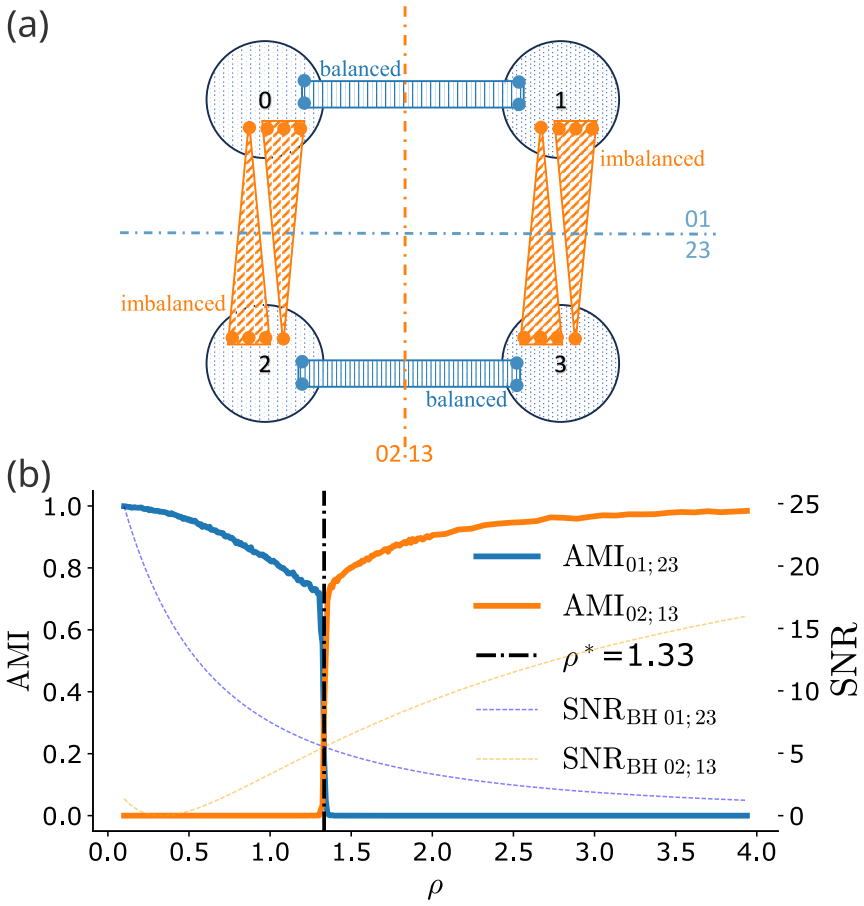
- Detection on synthetic data systematically favors higher-order and balanced hyperedges over lower-order or unbalanced ones.
- The same trade-offs appear in empirical hypergraphs, altering which communities are recovered in practice.
Where Pith is reading between the lines
- When hyperedge orders vary widely, a practitioner may obtain better recovery by deliberately retaining only the highest-order hyperedges even if they are scarce.
- The computational advantage of the spectral method could be traded against the statistical accuracy of belief propagation depending on how uniform the input hypergraph is.
- The signal-to-noise construction could be adapted to generative models other than the HSBM by re-deriving the ratio for each new edge-probability rule.
Load-bearing premise
The Hypergraph Stochastic Block Model generates every hyperedge independently according to fixed probabilities that depend only on the community labels of its nodes.
What would settle it
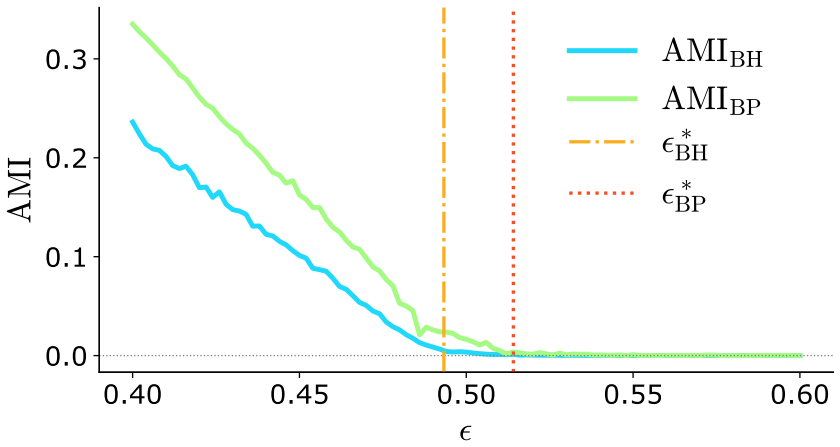
Generate non-uniform hypergraphs from the HSBM near the predicted spectral threshold and measure whether the Bethe Hessian recovers communities exactly at the calculated limit while belief propagation recovers them at a different limit.
Figures





read the original abstract
Extending community detection from pairwise networks to hypergraphs introduces fundamental theoretical challenges. Hypergraphs exhibit structural heterogeneity with no direct graph analogue: hyperedges of varying orders can connect nodes across communities in diverse configurations, introducing new trade-offs in defining and detecting community structure. We address these challenges by developing a unified framework for community detection in non-uniform hypergraphs under the Hypergraph Stochastic Block Model. We introduce a general signal-to-noise ratio that enables a quantitative analysis of trade-offs unique to higher-order networks, such as which hypergedges we choose to split across communities and how we choose to split them. Building on this framework, we derive a Bethe Hessian operator for non-uniform hypergraphs that provides efficient spectral clustering with principled model selection. We characterize the resulting spectral detectability threshold and compare it to belief propagation limits, showing the methods coincide for uniform hypergraphs but diverge in non-uniform settings. Synthetic experiments confirm our analytical predictions and reveal systematic biases toward preserving higher-order and balanced-shape hyperedges. Application to empirical data demonstrates the practical relevance of these higher-order detectability trade-offs in real-world systems.
Editorial analysis
A structured set of objections, weighed in public.
Referee Report
Summary. The manuscript develops a unified framework for community detection in non-uniform hypergraphs under the Hypergraph Stochastic Block Model (HSBM). It introduces a general signal-to-noise ratio to quantify trade-offs in hyperedge splitting across communities, derives a Bethe Hessian operator for spectral clustering with principled model selection, characterizes the resulting spectral detectability threshold, and shows that this threshold coincides with belief-propagation limits for uniform hypergraphs but diverges in non-uniform settings. Synthetic experiments confirm the analytic predictions, and the framework is applied to empirical data to illustrate practical relevance of the higher-order trade-offs.
Significance. If the derivations and comparisons hold, the work provides a valuable extension of spectral methods to non-uniform hypergraphs, quantifying structural trade-offs absent from graphs or uniform hypergraphs. The explicit divergence between the Bethe Hessian threshold and belief propagation in non-uniform cases, together with the model-selection mechanism, would be a substantive contribution to higher-order network analysis. Synthetic validation is a strength; the empirical section would carry more weight with direct checks on model fit.
major comments (1)
- [Empirical application section] Empirical application section: the claim that the identified higher-order detectability trade-offs are relevant to real-world systems rests on the assumption that observed hyperedges are generated by the fixed-probability HSBM used to derive the SNR and thresholds. No diagnostic (e.g., goodness-of-fit test or comparison to alternative generative processes) is reported to verify this assumption on the empirical datasets, which is load-bearing for the practical-relevance assertion.
Simulated Author's Rebuttal
We thank the referee for the positive assessment of the theoretical contributions and for highlighting the need to strengthen the empirical section. We address the major comment below and will incorporate the suggested diagnostics in the revision.
read point-by-point responses
-
Referee: Empirical application section: the claim that the identified higher-order detectability trade-offs are relevant to real-world systems rests on the assumption that observed hyperedges are generated by the fixed-probability HSBM used to derive the SNR and thresholds. No diagnostic (e.g., goodness-of-fit test or comparison to alternative generative processes) is reported to verify this assumption on the empirical datasets, which is load-bearing for the practical-relevance assertion.
Authors: We agree that the empirical claims would be strengthened by explicit checks on the HSBM assumption. In the revised manuscript we will add a diagnostic subsection that (i) estimates HSBM parameters from each dataset, (ii) generates synthetic hypergraphs under the fitted model, and (iii) compares observed hyperedge-order distributions, intra- versus inter-community edge fractions, and community-size statistics against the synthetic ensembles. Any systematic deviations will be discussed in relation to the relevance of the derived trade-offs. revision: yes
Circularity Check
No significant circularity; derivations follow directly from HSBM assumptions as standard theoretical analysis.
full rationale
The paper assumes the Hypergraph Stochastic Block Model (HSBM) as the generative process and derives the signal-to-noise ratio, Bethe Hessian operator, spectral clustering method, and detectability thresholds as mathematical consequences of that model. Synthetic experiments generated from the same HSBM confirm the analytic predictions, which is the expected verification procedure rather than a circularity. No quoted steps reduce by construction to fitted parameters renamed as predictions, self-definitional loops, or load-bearing self-citations that lack independent support. The empirical section applies the method to real data but does not alter the internal derivation chain, which remains self-contained under the stated model assumptions. This is a normal, non-circular theoretical contribution in the community detection literature.
Axiom & Free-Parameter Ledger
free parameters (1)
- hyperedge probability parameters
axioms (1)
- domain assumption Hyperedges are generated independently according to community membership probabilities under the HSBM
Lean theorems connected to this paper
-
IndisputableMonolith/Foundation/RealityFromDistinction.leanreality_from_one_distinction unclear?
unclearRelation between the paper passage and the cited Recognition theorem.
We derive a Bethe Hessian operator for non-uniform hypergraphs... SNR_BH := (∑_κ (κ−1)(d_in^(κ)−d_out^(κ)))^2 / ∑_κ (κ−1)d^(κ) = 1
-
IndisputableMonolith/Cost/FunctionalEquation.leanwashburn_uniqueness_aczel unclear?
unclearRelation between the paper passage and the cited Recognition theorem.
Synthetic experiments confirm our analytical predictions and reveal systematic biases toward preserving higher-order and balanced-shape hyperedges.
What do these tags mean?
- matches
- The paper's claim is directly supported by a theorem in the formal canon.
- supports
- The theorem supports part of the paper's argument, but the paper may add assumptions or extra steps.
- extends
- The paper goes beyond the formal theorem; the theorem is a base layer rather than the whole result.
- uses
- The paper appears to rely on the theorem as machinery.
- contradicts
- The paper's claim conflicts with a theorem or certificate in the canon.
- unclear
- Pith found a possible connection, but the passage is too broad, indirect, or ambiguous to say the theorem truly supports the claim.
Forward citations
Cited by 2 Pith papers
-
Achieving the Kesten-Stigum bound in the non-uniform hypergraph stochastic block model
Weak recovery in the non-uniform HSBM is possible above the sum of per-layer SNRs equaling 1, achieved by an optimally weighted non-backtracking spectral algorithm.
-
Detectability of minority communities in networks
Minority communities in stochastic block models enter three phases of detectability—detectable, distinguishable, and resolvable—separated by the Kesten-Stigum threshold and two additional thresholds from the eigenvalu...
Reference graph
Works this paper leans on
-
[1]
S. Fortunato. “Community detection in graphs”. In:Physics reports486.3-5 (2010), pp. 75–174
work page 2010
-
[2]
M. A. Porter, J.-P. Onnela, P. J. Mucha, et al. “Communities in networks”. In: (2009)
work page 2009
-
[3]
Fast unfolding of communities in large networks
V. D. Blondel et al. “Fast unfolding of communities in large networks”. In:Journal of statistical mechanics: theory and experiment2008.10 (2008), P10008. 19
work page 2008
-
[4]
A tutorial on spectral clustering
U. Von Luxburg. “A tutorial on spectral clustering”. In:Statistics and computing 17.4 (2007), pp. 395–416
work page 2007
-
[5]
Stochastic blockmodels: First steps
P. W. Holland, K. B. Laskey, and S. Leinhardt. “Stochastic blockmodels: First steps”. In:Social networks5.2 (1983), pp. 109–137
work page 1983
-
[6]
A. Decelle et al. “Asymptotic analysis of the stochastic block model for modu- lar networks and its algorithmic applications”. In:Physical Review E—Statistical, Nonlinear, and Soft Matter Physics84.6 (2011), p. 066106
work page 2011
-
[7]
Spectral redemption in clustering sparse networks
F. Krzakala et al. “Spectral redemption in clustering sparse networks”. In:Proceed- ings of the National Academy of Sciences110.52 (2013), pp. 20935–20940
work page 2013
-
[8]
Spectral clustering of graphs with the bethe hessian
A. Saade, F. Krzakala, and L. Zdeborov´ a. “Spectral clustering of graphs with the bethe hessian”. In:Advances in neural information processing systems27 (2014)
work page 2014
-
[9]
What are higher-order networks?
C. Bick et al. “What are higher-order networks?” In:SIAM review65.3 (2023), pp. 686–731
work page 2023
- [10]
-
[11]
High-order interactions distort the functional land- scape of microbial consortia
A. Sanchez-Gorostiaga et al. “High-order interactions distort the functional land- scape of microbial consortia”. In:PLoS biology17.12 (2019), e3000550
work page 2019
-
[12]
Networks beyond pairwise interactions: Structure and dynam- ics
F. Battiston et al. “Networks beyond pairwise interactions: Structure and dynam- ics”. In:Physics reports874 (2020), pp. 1–92
work page 2020
-
[13]
The physics of higher-order interactions in complex systems
F. Battiston et al. “The physics of higher-order interactions in complex systems”. In:Nature physics17.10 (2021), pp. 1093–1098
work page 2021
-
[14]
Generative hypergraph clustering: From blockmodels to modularity
P. S. Chodrow, N. Veldt, and A. R. Benson. “Generative hypergraph clustering: From blockmodels to modularity”. In:Science Advances7.28 (2021), eabh1303
work page 2021
-
[15]
Consistency of spectral hypergraph partition- ing under planted partition model
D. Ghoshdastidar and A. Dukkipati. “Consistency of spectral hypergraph partition- ing under planted partition model”. In: (2017)
work page 2017
-
[16]
Nonbacktracking spectral clustering of nonuniform hypergraphs
P. Chodrow, N. Eikmeier, and J. Haddock. “Nonbacktracking spectral clustering of nonuniform hypergraphs”. In:SIAM Journal on Mathematics of Data Science5.2 (2023), pp. 251–279
work page 2023
-
[17]
Spectral detection on sparse hypergraphs
M. C. Angelini et al. “Spectral detection on sparse hypergraphs”. In:2015 53rd An- nual Allerton Conference on Communication, Control, and Computing (Allerton). IEEE. 2015, pp. 66–73
work page 2015
-
[18]
Message-passing on hypergraphs: de- tectability, phase transitions and higher-order information
N. Ruggeri, A. Lonardi, and C. De Bacco. “Message-passing on hypergraphs: de- tectability, phase transitions and higher-order information”. In:Journal of Statistical Mechanics: Theory and Experiment2024.4 (2024), p. 043403
work page 2024
-
[19]
Sparse random hypergraphs: Non-backtracking spectra and community detection
L. Stephan and Y. Zhu. “Sparse random hypergraphs: Non-backtracking spectra and community detection”. In:Information and Inference: A Journal of the IMA 13.1 (2024), iaae004. 20
work page 2024
-
[20]
Consistency of spectral partitioning of uni- form hypergraphs under planted partition model
D. Ghoshdastidar and A. Dukkipati. “Consistency of spectral partitioning of uni- form hypergraphs under planted partition model”. In:Advances in Neural Informa- tion Processing Systems27 (2014)
work page 2014
-
[21]
Reconstruction and estimation in the planted partition model
E. Mossel, J. Neeman, and A. Sly. “Reconstruction and estimation in the planted partition model”. In:Probability Theory and Related Fields162.3 (2015), pp. 431– 461
work page 2015
-
[22]
Community detection thresholds and the weak Ramanujan prop- erty
L. Massouli´ e. “Community detection thresholds and the weak Ramanujan prop- erty”. In:Proceedings of the forty-sixth annual ACM symposium on Theory of com- puting. 2014, pp. 694–703
work page 2014
-
[23]
Community detection and stochastic block models: recent developments
E. Abbe. “Community detection and stochastic block models: recent developments”. In:Journal of Machine Learning Research18.177 (2018), pp. 1–86
work page 2018
-
[24]
Information theoretic measures for clusterings comparison: is a correction for chance necessary?
N. X. Vinh, J. Epps, and J. Bailey. “Information theoretic measures for clusterings comparison: is a correction for chance necessary?” In:Proceedings of the 26th annual international conference on machine learning. 2009, pp. 1073–1080
work page 2009
-
[25]
Detectability of hierarchical communities in networks
L. Peel and M. T. Schaub. “Detectability of hierarchical communities in networks”. In:Physical Review E110.3 (2024), p. 034306
work page 2024
-
[26]
High-resolution measurements of face-to-face contact patterns in a primary school
J. Stehl´ e et al. “High-resolution measurements of face-to-face contact patterns in a primary school”. In:PloS one6.8 (2011), e23176
work page 2011
-
[27]
R. Mastrandrea, J. Fournet, and A. Barrat. “Contact Patterns in a High School: A Comparison between Data Collected Using Wearable Sensors, Contact Diaries and Friendship Surveys”. In:PLOS ONE10.9 (2015). Ed. by C. Viboud, e0136497.doi: 10.1371/journal.pone.0136497.url:https://doi.org/10.1371/journal. pone.0136497. [28]url:https://www.yelp.com/dataset
work page doi:10.1371/journal.pone.0136497.url:https://doi.org/10.1371/journal 2015
-
[28]
Graph wavelets for multiscale community mining
N. Tremblay and P. Borgnat. “Graph wavelets for multiscale community mining”. In:IEEE Transactions on Signal Processing62.20 (2014), pp. 5227–5239
work page 2014
-
[29]
Hierarchical community structure in networks
M. T. Schaub, J. Li, and L. Peel. “Hierarchical community structure in networks”. In:Physical Review E107.5 (2023), p. 054305
work page 2023
-
[30]
The ground truth about metadata and community detection in networks
L. Peel, D. B. Larremore, and A. Clauset. “The ground truth about metadata and community detection in networks”. In:Science advances3.5 (2017), e1602548
work page 2017
-
[31]
Detectability of communities in heterogeneous networks
F. Radicchi. “Detectability of communities in heterogeneous networks”. In:Phys. Rev. E88 (1 2013), p. 010801.doi:10.1103/PhysRevE.88.010801
-
[32]
Community detection in networks with unequal groups
P. Zhang, C. Moore, and M. Newman. “Community detection in networks with unequal groups”. In:Physical review E93.1 (2016), p. 012303
work page 2016
-
[33]
Revisiting the bethe-hessian: im- proved community detection in sparse heterogeneous graphs
L. Dall’Amico, R. Couillet, and N. Tremblay. “Revisiting the bethe-hessian: im- proved community detection in sparse heterogeneous graphs”. In:Advances in neu- ral information processing systems32 (2019). 21
work page 2019
-
[34]
P. Erd˝ os and A. R´ enyi. “On random graphs I”. In:Publ. math. debrecen6.290-297 (1959), p. 18
work page 1959
-
[35]
The Computer Science and Physics of Community Detection: Landscapes, Phase Transitions, and Hardness
C. Moore et al. “The Computer Science and Physics of Community Detection: Landscapes, Phase Transitions, and Hardness”. In:Bulletin of EATCS1.121 (2017)
work page 2017
-
[36]
Spectral Inference Methods on Sparse Graphs: Theory and Applications
A. Saade. “Spectral inference methods on sparse graphs: theory and applications”. In:arXiv preprint arXiv:1610.04337(2016)
work page internal anchor Pith review Pith/arXiv arXiv 2016
-
[37]
G. H. Golub and C. F. Van Loan.Matrix computations. JHU press, 2013
work page 2013
-
[38]
M. Mezard and A. Montanari.Information, physics, and computation. Oxford Uni- versity Press, 2009. 22 A Detectability limit and the Bethe Hessian for dyadic networks In this section, we first introduce the Stochastic Block Model, a generative model for networks with community structure. Then we review the non-backtracking matrix and Bethe Hessian matrix u...
work page 2009
discussion (0)
Sign in with ORCID, Apple, or X to comment. Anyone can read and Pith papers without signing in.