REVIEW 6 minor 90 references
Optimal universal bounds for waves with varied coherence based on supremum and infimum coherence spectra
T0 review · 0 major / 6 minor · reviewed 2026-08-03 · deepseek-v4-flash
Pith's one-line read For any set of partially coherent waves, two extremal coherence spectra—the set's supremum and infimum under the majorization order, which may lie outside the set—give optimal universal bounds: every measurement's achievable range is squeez
desk verdict The sup/inf construction is correct and the optimality argument holds; the paper's real value is turning per-measurement optimization into two universal spectra, with a few scoping and presentation issues to fix. read the letter →
The pith
A machine-rendered reading of the paper's core claim, the machinery that carries it, and where it could break.
The reading
What carries the argument
The central object is the majorization order on coherence spectra: for ordered probability vectors x,y ∈ Δ↓_n, x ≺ y iff all partial sums of x are ≤ those of y. The load-bearing identity is Eq. (11): λ↓(ρ1) ≺ λ↓(ρ2) iff, for every Hermitian O, the range of possible values of tr(ρ O) for ρ1 is a subset of that for ρ2. The paper exploits the fact that (Δ↓_n, ≺) is a complete lattice, so any subset Λ has a unique least upper bound (supremum) and greatest lower bound (infimum), even if these lie outside Λ. These two spectra then serve as single 'most coherent' and 'least coherent' stand-ins that dominate or are dominated by every element, allowing universal bounds for all measurements.
What would settle it
Perform a dense random search over Hermitian measurement operators O for the n=3 elliptical-disk set of Fig. 3, evaluating the exact achievable range {o}_k for every element k of a fine grid inside the set. If any measured value lies outside the supremum interval [λ_sup·λ↑(O), λ_sup·λ↓(O)]—or, for the inner bound, if the infimum interval fails to be contained in the intersection of all achievable ranges—then Eq. (27) is false. The paper's examples show agreement but do not exhaust the search space.
Extended reading notes
Core claim
The central claim is that, for any compact set Λ of coherence spectra (ordered eigenvalue vectors of density matrices), the supremum λ_sup and infimum λ_inf of Λ in the majorization order satisfy for every Hermitian measurement O: {o}_inf ⊆ ⋂_k {o}_k ⊆ ⋃_k {o}_k ⊆ {o}_sup, where {o}_k is the interval of achievable values for spectrum k. Moreover, if any spectrum λ_u yields universal outer bounds, then λ_sup ≺ λ_u, and if λ_l yields universal inner bounds, then λ_l ≺ λ_inf; hence no single spectrum can produce tighter universal constraints. The proof hinges on the equivalence between majorization and containment of achievable ranges for all measurements (Eq. 11), and on the complete-lattice p
Load-bearing premise
The whole construction rests on the premise that one coherence spectrum majorizes another exactly when every linear measurement's achievable range for the first is contained in that for the second; if that equivalence has any exception, the universal bounds and their optimality claim collapse.
Editorial extensions
If this is right
- For any family of partially coherent waves, one can precompute the supremum and infimum spectra once and then bound any observable without re-optimising per measurement.
- Scalar measures such as entropy are insufficient for n≥3; the majorization-based sup/inf replace them as the correct notion of 'most/least coherent' for bounding purposes.
- The tightness result means the universal bounds cannot be improved by any single spectrum; improvements would require abandoning single-spectrum bounds or using more than one spectrum.
- The geometric classification tells designers that for smooth sets of coherence spectra, the extremal bounding spectra are not physically realisable inputs—they are virtual limits—so exact worst/best cases are approached, not attained, within the set.
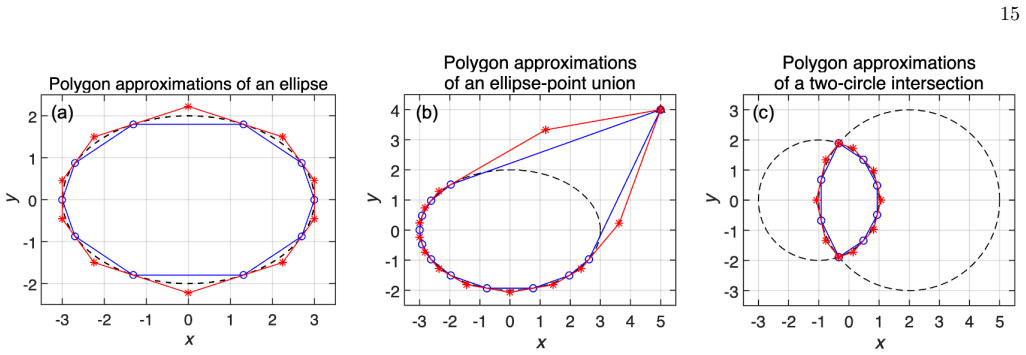
- The algorithm gives a practical route to compute these bounds for closed infinite sets via convex hull and polygon approximations with O(N^-2) convergence.
Reading between the lines
- The same machinery should apply to any resource theory where a partial order captures universal constraints on linear functions—for example, entanglement or thermodynamic resource theories—so the sup/inf of a set in the appropriate order could yield optimal universal bounds there too.
- A testable extension: for a fixed measurement O, the gap between the supremum bound and the exact outer bound measures how much is lost by insisting on a single spectrum; the paper's examples suggest the gap can be small, and it would be interesting to bound this gap as a function of the geometry of Λ.
- The paper's claim that sup/inf lie outside smooth Λ implies that for smooth families, no single physically realisable state attains the universal bound; experiments would need to approach it asymptotically, which could be probed by sampling dense subsets of Λ.
- The dependence of the algorithm's convergence rate on boundary smoothness (O(N^-2) in examples) might be generalised to higher dimensions, where inscribing/circumscribing polytopes would have more complex convergence behaviour.
Signed reviews
Editorial analysis
A structured set of objections, weighed in public.
Referee Report
Summary. The manuscript develops a majorization-based theory for bounding linear observables of partially coherent waves when the input coherence spectrum varies over a set Λ ⊆ Δ↓_n. For compact Λ it proves that the exact outer and inner bounds of an observable o = tr(ρO) over Λ are attained by maximal and minimal elements of Λ (Eqs. (21)–(22)). It then introduces the supremum λ_sup and infimum λ_inf of Λ in the majorization order, which exist because (Δ↓_n, ≺) is a complete lattice, and proves that these two spectra give universal, and optimal, single-spectrum bounds: for every Hermitian O, {o}_inf ⊆ ⋂_k {o}_k ⊆ ⋃_k {o}_k ⊆ {o}_sup, and any other spectrum with a universal outer (inner) bound lies above λ_sup (below λ_inf), so the bounds cannot be tightened (Eqs. (27)–(29)). An algorithm for computing λ_sup and λ_inf by polytope bracketing is presented, and the geometric location theorem states that for compact convex Λ with nonempty interior these extrema lie at singular boundary points or outside Λ. Numerical simulations for waveguide transport and n = 3, 4 examples illustrate the results.
Significance. The core optimality result is significant and, given the two cited inputs (Eq. (11) and completeness of the majorization lattice), rigorously established. It replaces scalar coherence measures, which fail for n ≥ 3, with a parameter-free, measurement-independent pair of spectral bounds. The proof of Eqs. (27)–(29) is clean and does not rely on fitting or ad hoc assumptions. The numerical demonstrations are consistent with the theory and include a physically relevant diffusive-waveguide setting. The paper's strengths are its conceptual clarity and the fact that the key optimality claims are checkable from standard majorization facts.
minor comments (6)
- [Abstract and Sec. VI] The location theorem is proved in Appendix G under the assumptions that Λ is compact, convex, and has nonempty interior (and n ≥ 3), but the abstract and introduction state it without these qualifications. Please restrict the claim or state the assumptions clearly where the theorem is advertised.
- [Sec. II, Eqs. (8)–(9)] The union and intersection of the intervals {o}_k are written as single intervals. This is true because every {o}_k contains tr(O)/n, so the union and intersection are themselves intervals with endpoints attained by compactness. A sentence explaining this would prevent an apparent gap.
- [Sec. V and Appendix F] The algorithm is called convergent with an O(N^{-2}) trend, but Appendix F only presents numerical fits; no proof is given for general compact convex sets. Please either provide a proof for the claimed convergence rate or soften the language to numerical evidence.
- [Sec. V] The algorithm is described and demonstrated for two-dimensional convex hulls in Δ↓_3. The paper's scope is n-mode waves; please clarify the extent to which the algorithm generalizes to n > 3.
- [Appendix G] In Proposition 2, 'singular boundary point' is defined via the normal cone after assuming convexity. Please make that definition and the convexity assumption explicit in the main-text statement of the location theorem.
- [Sec. III, Eq. (11)] Equation (11) is load-bearing for the central optimality argument. It is cited to Ref. [43]; a short proof or derivation in an appendix would make the paper more self-contained. This is a presentation issue rather than a correctness concern.
Circularity Check
No significant circularity: the sup/inf optimality proof is a corollary of an independent, parameter-free prior theorem (Eq. 11) and the external complete-lattice property; no fitted parameter is relabeled as a prediction.
full rationale
The derivation chain is: Eq. (6) gives the exact measurement range from a coherence spectrum; Eq. (11), cited to Ref. [43], states the equivalence between majorization and containment of all Hermitian-measurement ranges; Eqs. (23)-(24) define the supremum and infimum via the lattice property of majorization; Eqs. (27)-(29) then prove that these give optimal universal bounds. The only load-bearing assumptions are Eq. (11) and the completeness of (Delta_down_n, ≺). Eq. (11) is a parameter-free theorem with stated assumptions (n-dimensional density matrices and Hermitian measurements) and does not include the target result of this paper; it is independently derivable from the explicit interval formula in Eq. (6) by checking partial-sum inequalities. Although Ref. [43] shares an author with the present paper, the citation is real, checkable evidence rather than an unverified self-citation, so under the review rules it does not raise the circularity score. The complete-lattice property is cited to external Refs. [79-81] and is a standard mathematical fact, not an input tailored to the conclusion. The optimality proof is a direct translation of the defining universal property of a supremum/infimum through Eq. (11); it is a corollary, not an assumption of the result. No parameters are fitted to data and then announced as predictions: the numerical examples compare the computed sup/inf intervals with independently computed exact outer and inner bounds, and the geometric location theorem (Sec. VI, Appendix G) is proved from scratch. Any potential concern about Eq. (8)'s union-as-a-single-interval representation would be a correctness matter, not a circularity, and it does not affect the central optimality argument.
Assumptions & free parameters
assumptions (5)
- standard math The partially ordered set (Δ↓_n, ≺) is a complete lattice; every subset Λ has a unique supremum and infimum in Δ↓_n.
- domain assumption Eq. (11): λ↓(ρ_1)≺λ↓(ρ_2) iff {o}_1 ⊆ {o}_2 for all Hermitian O.
- domain assumption Eq. (6): For a single ρ, the range of a Hermitian measurement O under unitary control is [λ↓(ρ)·λ↑(O), λ↓(ρ)·λ↓(O)].
- domain assumption The coherence spectrum set Λ is compact (and for the location theorem, convex with nonempty interior).
- domain assumption Unitary control can realize any U∈U(n) to generate all density matrices with the same spectrum.
Cite this review
Pith. "Pith review of Optimal universal bounds for waves with varied coherence based on supremum and infimum coherence spectra." pith.science (2026). https://pith.science/paper/AKNXY23H
@misc{pith2026260110665,
  author       = {Pith},
  title        = {Pith review of: Optimal universal bounds for waves with varied coherence based on supremum and infimum coherence spectra},
  year         = {2026},
  howpublished = {\url{https://pith.science/paper/AKNXY23H}},
  note         = {Machine review of arXiv:2601.10665}
}
read the original abstract
We establish a majorization-based theory for bounding observables of waves with varied coherence. For any measurement, exact bounds are attained by the maximal and minimal elements in the set of input coherence spectra. The set's supremum and infimum, which may lie outside the set, provide optimal universal bounds: any alternative spectrum yielding universal bounds produces weaker constraints. We present an algorithm to compute the supremum and infimum, and prove that they lie either at singular boundary points or strictly outside the set of coherence spectra.
Figures


Figures from the paper (9 more)



Reference graph
Works this paper leans on
-
[1]
Born and E
M. Born and E. Wolf,Principles of Optics: Electromag- netic Theory of Propagation, Interference and Diffrac- tion of Light, 7th ed. (Cambridge University Press, Cam- 6 bridge, 1999)
1999
-
[2]
J. W. Goodman,Statistical Optics, Wiley Classics Li- brary (Wiley, New York, 2000)
2000
-
[3]
Mandel and E
L. Mandel and E. Wolf,Optical Coherence and Quantum Optics(Cambridge University Press, Cambridge; New York, 1995)
1995
-
[4]
E. L. O’Neill,Introduction to Statistical Optics(Dover Publications, Mineola, New York, 2003)
2003
-
[5]
Wolf,Introduction to the Theory of Coherence and Polarization of Light(Cambridge University Press, Cam- bridge; England, 2007)
E. Wolf,Introduction to the Theory of Coherence and Polarization of Light(Cambridge University Press, Cam- bridge; England, 2007)
2007
-
[6]
R. J. Glauber, The quantum theory of optical coherence, Phys. Rev.130, 2529 (1963)
1963
-
[7]
Mandel and E
L. Mandel and E. Wolf, Coherence properties of optical fields, Rev. Mod. Phys.37, 231 (1965)
1965
-
[8]
Peˇ rina,Coherence of Light, 2nd ed
J. Peˇ rina,Coherence of Light, 2nd ed. (D. Reidel Pub- lishing Company, Dordrecht, Holland, 1985)
1985
Show all 90 references
-
[9]
Korotkova,Theoretical Statistical Optics(World Sci- entific, Singapore, 2022)
O. Korotkova,Theoretical Statistical Optics(World Sci- entific, Singapore, 2022)
2022
-
[10]
Hariharan, Optical interferometry, Rep
P. Hariharan, Optical interferometry, Rep. Prog. Phys. 54, 339 (1991)
1991
-
[11]
T. Udem, R. Holzwarth, and T. W. H¨ ansch, Optical fre- quency metrology, Nature416, 233 (2002)
2002
-
[12]
B. P. Abbott, R. Abbott, T. D. Abbott, M. R. Aber- nathy, F. Acernese, K. Ackley,et al., Observation of grav- itational waves from a binary black hole merger, Phys. Rev. Lett.116, 061102 (2016)
2016
-
[13]
Schnars and W
U. Schnars and W. J¨ uptner, Direct recording of holo- grams by a CCD target and numerical reconstruction, Appl. Opt.33, 179 (1994)
1994
-
[14]
Genevet and F
P. Genevet and F. Capasso, Holographic optical meta- surfaces: A review of current progress, Rep. Prog. Phys. 78, 024401 (2015)
2015
-
[15]
Javidi, A
B. Javidi, A. Carnicer, A. Anand, G. Barbastathis, W. Chen, P. Ferraro,et al., Roadmap on digital hologra- phy [Invited], Opt. Express29, 35078 (2021)
2021
-
[16]
Pierrottet, F
D. Pierrottet, F. Amzajerdian, L. Petway, B. Barnes, G. Lockard, and M. Rubio, Linear FMCW laser radar for precision range and vector velocity measurements, MRS Online Proc. Libr.1076, 10760406 (2008)
2008
-
[17]
C. V. Poulton, A. Yaacobi, D. B. Cole, M. J. Byrd, M. Raval, D. Vermeulen, and M. R. Watts, Coherent solid-state LiDAR with silicon photonic optical phased arrays, Opt. Lett.42, 4091 (2017)
2017
-
[18]
Huang, E
D. Huang, E. A. Swanson, C. P. Lin, J. S. Schuman, W. G. Stinson, W. Chang, M. R. Hee, T. Flotte, K. Gre- gory, C. A. Puliafito, and J. G. Fujimoto, Optical coher- ence tomography, Science254, 1178 (1991)
1991
-
[19]
A. F. Fercher, W. Drexler, C. K. Hitzenberger, and T. Lasser, Optical coherence tomography—principles and applications, Rep. Prog. Phys.66, 239 (2003)
2003
-
[20]
J. W. Goodman, Some fundamental properties of speckle*, J. Opt. Soc. Am.66, 1145 (1976)
1976
-
[21]
Redding, M
B. Redding, M. A. Choma, and H. Cao, Speckle-free laser imaging using random laser illumination, Nat. Photonics 6, 355 (2012)
2012
-
[22]
Lin, Partially coherent imaging in two dimensions and the theoretical limits of projection printing in microfab- rication, IEEE Trans
B. Lin, Partially coherent imaging in two dimensions and the theoretical limits of projection printing in microfab- rication, IEEE Trans. Electron Devices27, 931 (1980)
1980
-
[23]
Y. Luo, D. Mengu, N. T. Yardimci, Y. Rivenson, M. Veli, M. Jarrahi, and A. Ozcan, Design of task-specific opti- cal systems using broadband diffractive neural networks, Light Sci. Appl.8, 112 (2019)
2019
-
[24]
Q. Jia, B. Shi, Y. Zhang, H. Li, X. Li, R. Feng,et al., Par- tially coherent diffractive optical neural network, Optica 11, 1742 (2024)
2024
-
[25]
Zernike, The concept of degree of coherence and its application to optical problems, Physica5, 785 (1938)
F. Zernike, The concept of degree of coherence and its application to optical problems, Physica5, 785 (1938)
1938
-
[26]
Karczewski, Degree of coherence of the electromag- netic field, Phys
B. Karczewski, Degree of coherence of the electromag- netic field, Phys. Lett.5, 191 (1963)
1963
-
[27]
Tervo, T
J. Tervo, T. Set¨ al¨ a, and A. T. Friberg, Degree of coher- ence for electromagnetic fields, Opt. Express11, 1137 (2003)
2003
-
[28]
R´ efr´ egier and F
P. R´ efr´ egier and F. Goudail, Invariant degrees of coher- ence of partially polarized light, Opt. Express13, 6051 (2005)
2005
-
[29]
Set¨ al¨ a, J
T. Set¨ al¨ a, J. Tervo, and A. T. Friberg, Contrasts of Stokes parameters in Young’s interference experiment and elec- tromagnetic degree of coherence, Opt. Lett.31, 2669 (2006)
2006
-
[30]
Laue, Die entropie von partiell koh¨ arenten strahlenb¨ undeln, Ann
M. Laue, Die entropie von partiell koh¨ arenten strahlenb¨ undeln, Ann. Phys. (Berlin)328, 1 (1907)
1907
-
[31]
Gamo, Thermodynamic entropy of partially coherent light beams, J
H. Gamo, Thermodynamic entropy of partially coherent light beams, J. Phys. Soc. Jpn.19, 1955 (1964)
1955
-
[32]
H. Cao, A. P. Mosk, and S. Rotter, Shaping the prop- agation of light in complex media, Nat. Phys.18, 994 (2022)
2022
-
[33]
Shaughnessy, R
L. Shaughnessy, R. E. McIntosh, A. Goetschy, C. W. Hsu, N. Bender, H. Yılmaz, A. Yamilov, and H. Cao, Multiregion light control in diffusive media via wavefront shaping, Phys. Rev. Lett.133, 146901 (2024)
2024
-
[34]
Guo and S
C. Guo and S. Fan, Majorization theory for unitary con- trol of optical absorption and emission, Phys. Rev. Lett. 130, 146202 (2023)
2023
-
[35]
C. Guo, D. A. B. Miller, and S. Fan, Unitary control of multiport wave transmission, Phys. Rev. A111, 023507 (2025)
2025
-
[36]
Guo and S
C. Guo and S. Fan, Unitary control of partially coherent waves. I. Absorption, Phys. Rev. B110, 035430 (2024)
2024
-
[37]
Guo and S
C. Guo and S. Fan, Unitary control of partially coherent waves. II. Transmission or reflection, Phys. Rev. B110, 035431 (2024)
2024
-
[38]
M. A. Nielsen, Conditions for a class of entanglement transformations, Phys. Rev. Lett.83, 436 (1999)
1999
-
[39]
G. Gour, M. P. M¨ uller, V. Narasimhachar, R. W. Spekkens, and N. Yunger Halpern, The resource theory of informational nonequilibrium in thermodynamics, Phys. Rep.583, 1 (2015)
2015
-
[40]
Luis, Coherence for vectorial waves and majorization, Opt
A. Luis, Coherence for vectorial waves and majorization, Opt. Lett.41, 5190 (2016)
2016
-
[41]
Bengtsson and K
I. Bengtsson and K. ˙Zyczkowski,Geometry of Quantum States: An Introduction to Quantum Entanglement, 2nd ed. (Cambridge University Press, Cambridge; England, 2017)
2017
-
[42]
G. Gour, D. Jennings, F. Buscemi, R. Duan, and I. Mar- vian, Quantum majorization and a complete set of en- tropic conditions for quantum thermodynamics, Nat. Commun.9, 5352 (2018)
2018
-
[43]
C. Guo, D. A. Miller, and S. Fan, Transport measure- ments of majorization order for wave coherence, Phys. Rev. Lett.135, 053801 (2025)
2025
-
[44]
Wolf and G
P.-E. Wolf and G. Maret, Weak localization and coher- ent backscattering of photons in disordered media, Phys. Rev. Lett.55, 2696 (1985)
1985
-
[45]
Yamazoe, Coherency matrix formulation for partially coherent imaging to evaluate the degree of coherence for 7 image, J
K. Yamazoe, Coherency matrix formulation for partially coherent imaging to evaluate the degree of coherence for 7 image, J. Opt. Soc. Am. A29, 1529 (2012)
2012
-
[46]
Okoro, H
C. Okoro, H. E. Kondakci, A. F. Abouraddy, and K. C. Toussaint Jr, Demonstration of an optical-coherence con- verter, Optica4, 1052 (2017)
2017
-
[47]
B. E. A. Saleh,Quantum Photonics: Bimodes, Qubits, and Biphotons, Graduate Texts in Physics (Springer Na- ture Switzerland, Cham, 2025)
2025
-
[48]
I. M. Vellekoop and A. P. Mosk, Focusing coherent light through opaque strongly scattering media, Opt. Lett.32, 2309 (2007)
2007
-
[49]
S. M. Popoff, A. Goetschy, S. Liew, A. D. Stone, and H. Cao, Coherent control of total transmission of light through disordered media, Phys. Rev. Lett.112, 133903 (2014)
2014
-
[50]
H. Yu, K. Lee, and Y. Park, Ultrahigh enhancement of light focusing through disordered media controlled by mega-pixel modes, Opt. Express25, 8036 (2017)
2017
-
[51]
M. Reck, A. Zeilinger, H. J. Bernstein, and P. Bertani, Experimental realization of any discrete unitary opera- tor, Phys. Rev. Lett.73, 58 (1994)
1994
-
[52]
D. A. Miller, Establishing optimal wave communication channels automatically, J. Lightwave Technol.31, 3987 (2013)
2013
-
[53]
D. A. Miller, Self-aligning universal beam coupler, Opt. Express21, 6360 (2013)
2013
-
[54]
D. A. Miller, Self-configuring universal linear optical component, Photonics Res.1, 1 (2013)
2013
-
[55]
Carolan, C
J. Carolan, C. Harrold, C. Sparrow, E. Mart ´ ın-L´ opez, N. J. Russell, J. W. Silverstone, P. J. Shadbolt, N. Mat- suda, M. Oguma, M. Itoh,et al., Universal linear optics, Science349, 711 (2015)
2015
-
[56]
D. A. Miller, Perfect optics with imperfect components, Optica2, 747 (2015)
2015
-
[57]
W. R. Clements, P. C. Humphreys, B. J. Metcalf, W. S. Kolthammer, and I. A. Walmsley, Optimal design for uni- versal multiport interferometers, Optica3, 1460 (2016)
2016
-
[58]
Ribeiro, A
A. Ribeiro, A. Ruocco, L. Vanacker, and W. Bogaerts, Demonstration of a 4×4-port universal linear circuit, Op- tica3, 1348 (2016)
2016
-
[59]
C. M. Wilkes, X. Qiang, J. Wang, R. Santagati, S. Paesani, X. Zhou, D. A. Miller, G. D. Marshall, M. G. Thompson, and J. L. O’Brien, 60 dB high- extinction auto-configured Mach–Zehnder interferome- ter, Opt. Lett.41, 5318 (2016)
2016
-
[60]
Annoni, E
A. Annoni, E. Guglielmi, M. Carminati, G. Fer- rari, M. Sampietro, D. A. Miller, A. Melloni, and F. Morichetti, Unscrambling light—automatically undo- ing strong mixing between modes, Light Sci. Appl.6, e17110 (2017)
2017
-
[61]
Perez, I
D. Perez, I. Gasulla, F. J. Fraile, L. Crudgington, D. J. Thomson, A. Z. Khokhar, K. Li, W. Cao, G. Z. Mashanovich, and J. Capmany, Silicon photonics rectan- gular universal interferometer, Laser Photonics Rev.11, 1700219 (2017)
2017
-
[62]
D. A. Miller, Setting up meshes of interferometers– reversed local light interference method, Opt. Express25, 29233 (2017)
2017
-
[63]
N. C. Harris, J. Carolan, D. Bunandar, M. Prabhu, M. Hochberg, T. Baehr-Jones, M. L. Fanto, A. M. Smith, C. C. Tison, P. M. Alsing,et al., Linear programmable nanophotonic processors, Optica5, 1623 (2018)
2018
-
[64]
S. Pai, B. Bartlett, O. Solgaard, and D. A. B. Miller, Ma- trix optimization on universal unitary photonic devices, Phys. Rev. Appl.11, 064044 (2019)
2019
-
[65]
Morizur, L
J.-F. Morizur, L. Nicholls, P. Jian, S. Armstrong, N. Treps, B. Hage, M. Hsu, W. Bowen, J. Janousek, and H.-A. Bachor, Programmable unitary spatial mode ma- nipulation, J. Opt. Soc. Am. A27, 2524 (2010)
2010
-
[66]
Labroille, B
G. Labroille, B. Denolle, P. Jian, P. Genevaux, N. Treps, and J.-F. Morizur, Efficient and mode selective spatial mode multiplexer based on multi-plane light conversion, Opt. Express22, 15599 (2014)
2014
-
[67]
Kupianskyi, S
H. Kupianskyi, S. A. R. Horsley, and D. B. Phillips, High- dimensional spatial mode sorting and optical circuit de- sign using multi-plane light conversion, APL Photonics 8, 026101 (2023)
2023
-
[68]
Taguchi, Y
Y. Taguchi, Y. Wang, R. Tanomura, T. Tanemura, and Y. Ozeki, Iterative configuration of programmable uni- tary converter based on few-layer redundant multiplane light conversion, Phys. Rev. Appl.19, 054002 (2023)
2023
-
[69]
Zhang and N
Y. Zhang and N. K. Fontaine, Multi-plane light con- version: A practical tutorial (2023), arXiv:2304.11323 [physics.optics]
2023 arXiv
-
[70]
A. W. Marshall, I. Olkin, and B. C. Arnold,Inequalities: Theory of Majorization and Its Applications, 2nd ed., Springer Series in Statistics (Springer Science+Business Media, LLC, New York, 2011)
2011
-
[71]
B. A. Davey and H. A. Priestley,Introduction to Lattices and Order, 2nd ed. (Cambridge university press, Cam- bridge, England, 2002)
2002
-
[72]
Cicalese and U
F. Cicalese and U. Vaccaro, Supermodularity and sub- additivity properties of the entropy on the majorization lattice, IEEE Trans. Inf. Theory48, 933 (2002)
2002
-
[73]
F. D. Cunden, P. Facchi, G. Florio, and G. Gramegna, Generic aspects of the resource theory of quantum coher- ence, Phys. Rev. A103, 022401 (2021)
2021
-
[74]
V. Jain, M. Kwan, and M. Michelen, Entangled states are typically incomparable, arXiv:2406.03335 (2024)
2024
-
[75]
Harling, V
M. Harling, V. A. Kelkar, K. C. Toussaint, and A. F. Abouraddy, Isoentropic partially coherent optical fields that cannot be interconverted unitarily, Phys. Rev. A 110, 013505 (2024)
2024
-
[76]
B. S. W. Schr¨ oder,Ordered Sets(Birkh¨ auser Boston, Boston, MA, 2003)
2003
-
[77]
Boyd and L
S. Boyd and L. Vandenberghe,Convex Optimization, 1st ed. (Cambridge University Press, Cambridge, 2004)
2004
-
[78]
Roman,Lattices and Ordered Sets, 1st ed
S. Roman,Lattices and Ordered Sets, 1st ed. (Springer, New York, NY, 2008)
2008
-
[79]
P. M. Alberti and A. Uhlmann,Stochasticity and Par- tial Order: Doubly Stochastic Maps and Unitary Mixing, Mathematics and Its Applications, Vol. 9 (D. Reidel Pub- lishing Co., Dordrecht, Holland, 1982)
1982
-
[80]
Bapat, Majorization and singular values
R. Bapat, Majorization and singular values. III, Linear Algebra Appl.145, 59 (1991)
1991
-
[81]
G. M. Bosyk, G. Bellomo, F. Holik, H. Freytes, and G. Sergioli, Optimal common resource in majorization- based resource theories, New J. Phys.21, 083028 (2019)
2019
-
[82]
P. M. Gruber,Convex and Discrete Geometry, Grundlehren Der Mathematischen Wissenschaften (Springer Berlin Heidelberg, Berlin; New York, 2007)
2007
-
[83]
H.-C. Lin, Z. Wang, and C. W. Hsu, MESTI,https: //github.com/complexphoton/MESTI.m
-
[84]
H.-C. Lin, Z. Wang, and C. W. Hsu, Fast multi-source nanophotonic simulations using augmented partial fac- torization, Nat. Comput. Sci.2, 815 (2022)
2022
-
[85]
Prince and A
J. Prince and A. Willsky, Reconstructing convex sets from support line measurements, IEEE Trans. Pattern Anal. Mach. Intell.12, 377 (1990). 8 Appendix A: Simulation of power delivery in a diffusive waveguide In this section, we provide computational details for the power deliv...
1990
-
[86]
Data for Fig. 1 Forn= 2, the eigenvalues ofI A andI B are λ↓(IA) = (1.47,0.53),λ ↓(IB) = (1.36,0.64).(B1) The eigenvalues of inputs{ρ}={ρ a, ρb, ρc}are λ↓(ρa) = (0.81,0.19),λ ↓(ρb) = (0.71,0.29),λ ↓(ρc) = (0.61,0.39).(B2) 9 Forn= 3, the eigenvalues ofI A andI B are λ↓(IA) = (1...
-
[87]
permutation
Data for Fig. 3 The set Λ in Fig. 3(a) is an elliptical disk in ∆ ↓ 3 centered at (0.55,0.32,0.13), with major axis of length 0.32 along the (0.05,0.04,−0.09) direction and minor axis of length 0.12. Its supremum and infimum are λ↓ sup = (0.65,0.29,0.06),λ ↓ inf = (0.45,0.36,0...
-
[88]
Finite set Figure 6 shows a finite set Λ withn= 4 comprising partially coherent waves with coherence spectra λ↓(ρg) = (0.55,0.35,0.08,0.02),λ ↓(ρm) = (0.62,0.17,0.15,0.06),λ ↓(ρn) = (0.56,0.23,0.14,0.07).(D1) The supremum and infimum of Λ are λ↓ sup = (0.62,0.28,0.08,0.02),λ ↓...
-
[89]
The set Λ is a line segment in ∆ ↓ 2 with endpoints (0.90,0.10) and (0.60,0.40)
Closed infinite set Figure 7 shows a closed infinite set withn= 2. The set Λ is a line segment in ∆ ↓ 2 with endpoints (0.90,0.10) and (0.60,0.40). The supremum and infimum are its endpoints: λ↓ sup = (0.90,0.10),λ ↓ inf = (0.60,0.40).(D6) The outer and inner bounds (light and...
-
[90]
Inscribing polygon.—We construct the inscribing polygon by identifying boundary points of conv(Λ) that are tangent to a series of supporting lines
We focus on the cases where the convex hull conv(Λ) is a 2D region embedded in ∆ ↓ 3. Inscribing polygon.—We construct the inscribing polygon by identifying boundary points of conv(Λ) that are tangent to a series of supporting lines. For each angleθ i =i(2π/N) withi= 1, . . . ...
Reviewed August 3, 2026 · model on record in the stance chip above.
Discussion (0). Continue with ORCID to comment.