The Static Heavy Quark-Antiquark Potential within String Theory in Arbitrary Stationary Backgrounds
Pith reviewed 2026-05-16 13:52 UTC · model grok-4.3
The pith
Certain stationary metrics preserve symmetry for static open strings, isolating the linear term in the heavy quark-antiquark potential even in non-diagonal backgrounds.
A machine-rendered reading of the paper's core claim, the machinery that carries it, and where it could break.
Core claim
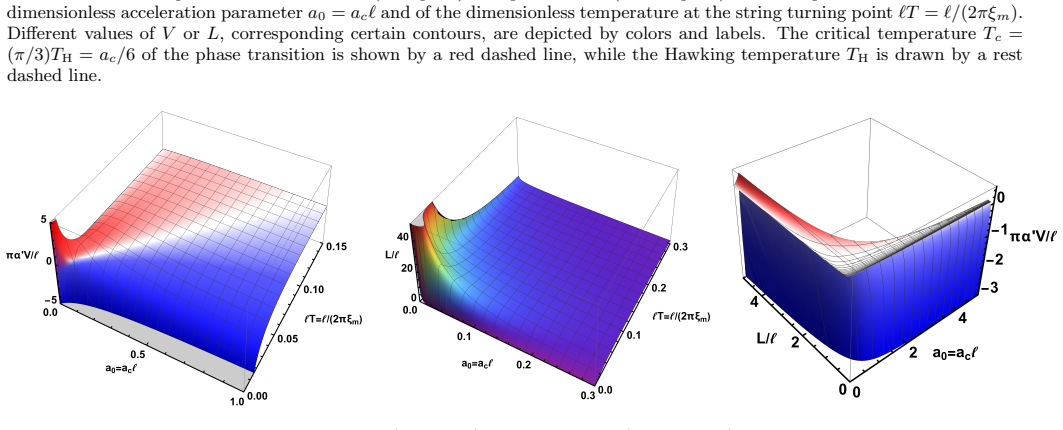
In arbitrary stationary spacetimes the static open string for a quark-antiquark pair is generally asymmetric about its turning point, yet symmetry is restored whenever the metric satisfies a set of explicit constraints on its components. These constraints allow the linear term in the static potential to be isolated for simple symmetric string configurations. Explicit evaluation in the black brane geometry dual to N=4 SYM plasma at finite temperature gives the separation L via a hypergeometric function while the potential V splits into a term linear in L plus a term involving its temperature derivative; temperature corrections produce swallowtail behavior. In Rindler-AdS, which is dual to an
What carries the argument
The set of constraints on stationary metric components that force the static string profile to be symmetric about the turning point, thereby isolating the linear contribution to the potential.
If this is right
- For the black brane dual of N=4 SYM plasma the quark separation is given by a hypergeometric function and the potential contains a linear term plus a temperature-derivative contribution.
- Temperature corrections to the separation produce swallowtail behavior in the series expansion of the potential.
- In Rindler-AdS the separation and potential are expressed with elliptic integrals that reduce to pure AdS results in the large-acceleration limit.
- Increasing acceleration decreases the quark separation while increasing the potential, yet the scaled combination a_c V versus a_c L becomes independent of the specific acceleration value.
Where Pith is reading between the lines
- The symmetry constraints may simplify potential calculations in other holographic models of strongly coupled plasmas beyond N=4 SYM.
- The acceleration independence of the scaled potential hints at a universal scaling that could be checked by applying the same method to additional stationary backgrounds.
- The approach could be extended to slowly varying time-dependent metrics to see how the linear term evolves under dynamical changes.
Load-bearing premise
The open string remains static and its embedding restores symmetry around the turning point precisely when the background metric obeys the derived constraints.
What would settle it
A numerical minimization of the Nambu-Goto action for a stationary metric that violates the symmetry constraints, producing a clearly asymmetric string profile, would falsify the claim.
Figures



read the original abstract
We consider a static open string in arbitrary stationary spacetime, which can represent a heavy quark-antiquark pair within the holographic framework or effective theory. Generally, the string profile is not symmetric with respect to the turning point, and the symmetry restores for a simple string configuration in backgrounds with certain constraints. We identify a wide family of metrics for which the symmetry is preserved, enabling a direct isolation of the linear-in-distance term in the static potential for simple symmetric string configurations, even in non-diagonal backgrounds. As a first example, we apply our formulas to the black brane dual to the $\mathcal{N}=4$ SYM plasma at finite temperature. We find that the separation distance between quarks, $L$, is given in terms of a hypergeometric function, while the potential, $V$, consists of two distinct contributions: a term linear in the separation and a term that involves its derivative by temperature. Analysis of the leading terms in the series expansion reveals that the temperature corrections of the separation distance leads to the "swallowtail" behavior. Further, applying our formulas to the Rindler-AdS spacetime dual to an accelerated $\mathcal{N}=4$ SYM plasma, we obtain analytic expressions for the distance and potential in terms of the elliptic integrals, which in the large Hawking temperature (large acceleration or small curvature) limit come to the conformal results for pure AdS. Then, we show that the distance between quarks decreases, the static potential between them increases, and the characteristic temperatures increase with an acceleration, $a_c$. However, we observe that an acceleration-scaled potential, $a_c V$ as a function of the acceleration-scaled distance, $a_c L$, does not depend on the certain value of the acceleration.
Editorial analysis
A structured set of objections, weighed in public.
Referee Report
Summary. The paper claims that in a wide family of stationary metrics, the profile of a static open string dual to a heavy quark-antiquark pair restores symmetry about the turning point. This symmetry permits direct isolation of the linear-in-separation term in the static potential, even when the background is non-diagonal. Explicit applications are given to the black-brane metric (yielding a hypergeometric expression for L(T) and a potential containing a linear term plus a temperature derivative that produces swallowtail behavior) and to Rindler-AdS (yielding elliptic-integral expressions that recover the pure-AdS conformal limit at large acceleration). The work further shows that an acceleration-scaled potential a_c V(a_c L) is independent of the value of a_c.
Significance. If the metric constraints and symmetry ansatz are validated, the framework supplies a general, analytic route to the linear confining piece of the holographic potential in stationary backgrounds, including accelerated plasmas. The explicit closed-form results in standard special functions, the recovery of known AdS and conformal limits, and the demonstration of physical consistency (swallowtail instability, scaled independence) constitute concrete strengths that would be useful for further holographic modeling.
major comments (2)
- [General setup and metric family identification] The central claim rests on the assertion that the identified metric family admits a symmetric static string solution. The manuscript must explicitly verify that the symmetric ansatz satisfies the full Euler-Lagrange equations obtained from the Nambu-Goto action when off-diagonal metric components are present; without this check the isolation of the linear term remains formal rather than derived.
- [Application to the black brane] In the black-brane example the decomposition of the potential into a strictly linear term plus a temperature-derivative contribution is stated to follow from symmetry restoration. The derivation of this separation (including the precise coefficient of the linear piece) should be shown step-by-step from the on-shell Nambu-Goto action under the symmetric profile.
minor comments (2)
- [Rindler-AdS application] The notation for the acceleration parameter a_c and its relation to the Rindler horizon temperature should be defined once at the beginning of the Rindler-AdS section to avoid later ambiguity.
- [Abstract] The phrase 'does not depend on the certain value of the acceleration' in the abstract is unclear; rephrase to 'is independent of the specific value of the acceleration' for precision.
Simulated Author's Rebuttal
We thank the referee for the careful reading, positive assessment of the significance, and constructive major comments. We have revised the manuscript to address both points explicitly, adding the required verification and step-by-step derivation while preserving the original results.
read point-by-point responses
-
Referee: [General setup and metric family identification] The central claim rests on the assertion that the identified metric family admits a symmetric static string solution. The manuscript must explicitly verify that the symmetric ansatz satisfies the full Euler-Lagrange equations obtained from the Nambu-Goto action when off-diagonal metric components are present; without this check the isolation of the linear term remains formal rather than derived.
Authors: We agree that an explicit verification strengthens the foundation. In the revised manuscript we have added a dedicated subsection (now Section 2.2) that derives the full Euler-Lagrange equations from the Nambu-Goto action for a general stationary metric containing off-diagonal components. Substituting the symmetric ansatz (string profile symmetric about the turning point) shows that the equations are satisfied identically precisely when the metric satisfies the family of constraints we identified. This confirms that the symmetry is preserved and justifies the subsequent isolation of the linear term. revision: yes
-
Referee: [Application to the black brane] In the black-brane example the decomposition of the potential into a strictly linear term plus a temperature-derivative contribution is stated to follow from symmetry restoration. The derivation of this separation (including the precise coefficient of the linear piece) should be shown step-by-step from the on-shell Nambu-Goto action under the symmetric profile.
Authors: We appreciate the request for transparency. The revised black-brane section now contains a complete step-by-step derivation: we begin with the Nambu-Goto action evaluated on the symmetric profile, compute the on-shell energy and the quark separation L as functions of the turning-point coordinate, and explicitly separate the resulting potential V into a term strictly linear in L (whose coefficient is the value of the relevant metric function at the turning point) plus a remainder proportional to the temperature derivative of L. The swallowtail behavior then follows directly from the sign of that derivative term in the series expansion. revision: yes
Circularity Check
No significant circularity; derivation self-contained
full rationale
The central derivation identifies metric constraints that restore turning-point symmetry for static strings, permitting direct isolation of the linear term in V(L) via the Nambu-Goto action. This step is algebraic and does not reduce to a fitted parameter or prior self-result. Explicit applications to the black-brane and Rindler-AdS metrics yield closed-form expressions in hypergeometric and elliptic integrals that recover the known AdS limit without renormalization or redefinition of inputs. No load-bearing self-citations, ansatz smuggling, or uniqueness theorems imported from the same authors appear in the chain. The symmetry-restoration condition is stated as an external constraint on the metric components and is independently verifiable.
Axiom & Free-Parameter Ledger
free parameters (2)
- temperature T
- acceleration a_c
axioms (2)
- domain assumption The dynamics of the open string are governed by the Nambu-Goto action in the given stationary background.
- domain assumption The background metrics belong to the identified family that restores symmetry of the string profile around the turning point.
Forward citations
Cited by 1 Pith paper
-
Spatial confinement-deconfinement transition in accelerated gluodynamics within lattice simulation
Lattice simulations in Rindler spacetime show that acceleration turns the confinement-deconfinement transition in gluodynamics into a spatial crossover that approximately follows the Tolman-Ehrenfest law, while the cr...
Reference graph
Works this paper leans on
-
[1]
The formulas (48) and (49) were also obtained in Ref. [247], however, the authors did not recognize the expression (50). It is exciting that the potential (50) is expressed completely in terms of the quarks separation,L, and its derivative, ∂L ∂z . The derivative with respect tozcarries a direct physical meaning when one recalls that the temperature at a ...
-
[2]
D. N. Voskresensky and N. Yu. Anisimov. Properties of a pion condensate in a magnetic field.Zh. Eksp. Teor. Fiz., 78:2845–2853, 1980. [Sov. Phys. JETP51, 13 (1980)]
work page 1980
- [3]
-
[4]
Event-by-event fluctuations of magnetic and electric fields in heavy ion collisions
Adam Bzdak and Vladimir Skokov. Event-by-event fluctuations of magnetic and electric fields in heavy ion collisions. Phys. Lett. B, 710:171–174, 2012
work page 2012
-
[5]
Event-by-event generation of electromagnetic fields in heavy-ion collisions.Phys
Wei-Tian Deng and Xu-Guang Huang. Event-by-event generation of electromagnetic fields in heavy-ion collisions.Phys. Rev. C, 85:044907, 2012
work page 2012
-
[6]
Azimuthally fluctuating magnetic field and its impacts on observables in heavy-ion collisions.Phys
John Bloczynski, Xu-Guang Huang, Xilin Zhang, and Jinfeng Liao. Azimuthally fluctuating magnetic field and its impacts on observables in heavy-ion collisions.Phys. Lett. B, 718:1529–1535, 2013
work page 2013
-
[7]
Magnetohydrodynamics, charged currents and directed flow in heavy ion collisions.Phys
Umut Gursoy, Dmitri Kharzeev, and Krishna Rajagopal. Magnetohydrodynamics, charged currents and directed flow in heavy ion collisions.Phys. Rev. C, 89(5):054905, 2014
work page 2014
-
[8]
Numerical magneto-hydrodynamics for relativistic nuclear collisions.Eur
Gabriele Inghirami, Luca Del Zanna, Andrea Beraudo, Mohsen Haddadi Moghaddam, Francesco Becattini, and Marcus Bleicher. Numerical magneto-hydrodynamics for relativistic nuclear collisions.Eur. Phys. J. C, 76(12):659, 2016
work page 2016
- [9]
-
[10]
Charge-dependent Flow Induced by Magnetic and Electric Fields in Heavy Ion Collisions.Phys
Umut G¨ ursoy, Dmitri Kharzeev, Eric Marcus, Krishna Rajagopal, and Chun Shen. Charge-dependent Flow Induced by Magnetic and Electric Fields in Heavy Ion Collisions.Phys. Rev. C, 98(5):055201, 2018
work page 2018
-
[11]
Bogdan V. Galilo and Sergei N. Nedelko. Impact of the strong electromagnetic field on the QCD effective potential for homogeneous Abelian gluon field configurations.Phys. Rev. D, 84:094017, 2011
work page 2011
-
[12]
G. S. Bali, F. Bruckmann, G. Endrodi, Z. Fodor, S. D. Katz, and A. Schafer. QCD quark condensate in external magnetic fields.Phys. Rev. D, 86:071502, 2012
work page 2012
-
[13]
Loewe, Ana Julia Mizher, and R
Alejandro Ayala, M. Loewe, Ana Julia Mizher, and R. Zamora. Inverse magnetic catalysis for the chiral transition induced by thermo-magnetic effects on the coupling constant.Phys. Rev. D, 90(3):036001, 2014
work page 2014
- [14]
-
[15]
Inverse magnetic catalysis in Nambu–Jona-Lasinio model beyond mean field.Phys
Shijun Mao. Inverse magnetic catalysis in Nambu–Jona-Lasinio model beyond mean field.Phys. Lett. B, 758:195–199, 2016
work page 2016
-
[16]
R. L. S. Farias, V. S. Timoteo, S. S. Avancini, M. B. Pinto, and G. Krein. Thermo-magnetic effects in quark matter: Nambu–Jona-Lasinio model constrained by lattice QCD.Eur. Phys. J. A, 53(5):101, 2017
work page 2017
-
[17]
V. V. Braguta, M. N. Chernodub, A. Yu Kotov, A. V. Molochkov, and A. A. Nikolaev. Finite-density QCD transition in a magnetic background field.Phys. Rev. D, 100(11):114503, 2019
work page 2019
-
[18]
Kenji Fukushima, Dmitri E. Kharzeev, and Harmen J. Warringa. The Chiral Magnetic Effect.Phys. Rev. D, 78:074033, 2008
work page 2008
-
[19]
A. V. Sadofyev, V. I. Shevchenko, and V. I. Zakharov. Notes on chiral hydrodynamics within effective theory approach. Phys. Rev. D, 83:105025, 2011
work page 2011
-
[20]
V. D. Toneev, V. P. Konchakovski, V. Voronyuk, E. L. Bratkovskaya, and W. Cassing. Event-by-event background in estimates of the chiral magnetic effect.Phys. Rev. C, 86:064907, 2012
work page 2012
- [21]
- [22]
-
[23]
Magnetic Field Induced Polarization Difference between Hyperons and Anti-hyperons.Phys
Yu Guo, Shuzhe Shi, Shengqin Feng, and Jinfeng Liao. Magnetic Field Induced Polarization Difference between Hyperons and Anti-hyperons.Phys. Lett. B, 798:134929, 2019
work page 2019
-
[24]
Spin polarization formula for Dirac fermions at local equilibrium.Sci
Yu-Chen Liu and Xu-Guang Huang. Spin polarization formula for Dirac fermions at local equilibrium.Sci. China Phys. Mech. Astron., 65(7):272011, 2022
work page 2022
-
[25]
Λ/Λ¯polarization and splitting induced by rotation and magnetic field.Phys
Kun Xu, Fan Lin, Anping Huang, and Mei Huang. Λ/Λ¯polarization and splitting induced by rotation and magnetic field.Phys. Rev. D, 106(7):L071502, 2022
work page 2022
-
[26]
Spin polarization induced by magnetic field and the relativistic Barnett effect.Nucl
Matteo Buzzegoli. Spin polarization induced by magnetic field and the relativistic Barnett effect.Nucl. Phys. A, 1036:122674, 2023
work page 2023
-
[27]
Exploring spin polarization of heavy quarks in magnetic fields and hot medium.Phys
Zhiwei Liu, Yunfan Bai, Shiqi Zheng, Anping Huang, and Baoyi Chen. Exploring spin polarization of heavy quarks in magnetic fields and hot medium.Phys. Rev. C, 110(3):034910, 2024
work page 2024
-
[28]
Estimation of electric field in intermediate-energy heavy-ion colli- sions.Phys
Hidetoshi Taya, Toru Nishimura, and Akira Ohnishi. Estimation of electric field in intermediate-energy heavy-ion colli- sions.Phys. Rev. C, 110(1):014901, 2024
work page 2024
- [29]
-
[30]
Electron-Positron Pair Production in Relativistic Heavy Ion Collisions
Gerhard Baur, Kai Hencken, and Dirk Trautmann. Electron-Positron Pair Production in Relativistic Heavy Ion Collisions. Phys. Rept., 453:1–27, 2007
work page 2007
-
[31]
Schwinger mechanism revisited.Prog
Francois Gelis and Naoto Tanji. Schwinger mechanism revisited.Prog. Part. Nucl. Phys., 87:1–49, 2016
work page 2016
-
[32]
B. I. Abelev et al. Global polarization measurement in Au+Au collisions.Phys. Rev. C, 76:024915, 2007. [Erratum: Phys.Rev.C 95, 039906 (2017)]
work page 2007
-
[33]
L. Adamczyk et al. Global Λ hyperon polarization in nuclear collisions: evidence for the most vortical fluid.Nature, 548:62–65, 2017
work page 2017
-
[34]
J. Adam et al. Global Polarization of Ξ and Ω Hyperons in Au+Au Collisions at √sN N = 200 GeV.Phys. Rev. Lett., 126(16):162301, 2021. [Erratum: Phys.Rev.Lett. 131, 089901 (2023)]
work page 2021
-
[35]
R. Abou Yassine et al. Measurement of global polarization of Λ hyperons in few-GeV heavy-ion collisions.Phys. Lett. B, 835:137506, 2022
work page 2022
-
[36]
Apostolos D. Panagiotou. Λ 0 nonpolarization: Possible signature of quark matter.Phys. Rev. C, 33:1999–2002, 1986
work page 1999
-
[37]
J. W. Harris, A. Sandoval, R. Stock, H. Stroebele, R. E. Renfordt, J. V. Geaga, H. G. Pugh, L. S. Schroeder, K. L. Wolf, and A. Dacal. Λ production near threshold in central nucleus-nucleus collisions.Phys. Rev. Lett., 47:229–232, 1981
work page 1981
-
[38]
M. Anikina et al. Characteristics ofλandk 0 particles produced in central nucleus-nucleus collisions at a 4.5 gev/c momentum per incident nucleon.Z. Phys. C, 25:1–11, 1984
work page 1984
-
[39]
Chiral anomaly and local polarization effect from the quantum kinetic approach.Phys
Jian-Hua Gao, Zuo-Tang Liang, Shi Pu, Qun Wang, and Xin-Nian Wang. Chiral anomaly and local polarization effect from the quantum kinetic approach.Phys. Rev. Lett., 109:232301, 2012
work page 2012
-
[40]
F. Becattini, V. Chandra, L. Del Zanna, and E. Grossi. Relativistic distribution function for particles with spin at local thermodynamical equilibrium.Annals Phys., 338:32–49, 2013
work page 2013
-
[41]
Axial anomaly and energy dependence of hyperon polarization in Heavy-Ion Collisions
Alexander Sorin and Oleg Teryaev. Axial anomaly and energy dependence of hyperon polarization in Heavy-Ion Collisions. Phys. Rev. C, 95(1):011902, 2017
work page 2017
-
[42]
Oleg V. Teryaev and Valentin I. Zakharov. From the chiral vortical effect to polarization of baryons: A model.Phys. Rev. D, 96(9):096023, 2017
work page 2017
-
[43]
L. P. Csernai, J. I. Kapusta, and T. Welle. Λ and ¯Λ spin interaction with meson fields generated by the baryon current in high energy nuclear collisions.Phys. Rev. C, 99(2):021901, 2019
work page 2019
-
[44]
F. Becattini, M. Buzzegoli, and A. Palermo. Spin-thermal shear coupling in a relativistic fluid.Physics Letters B, 820:136519, 2021
work page 2021
-
[45]
Shuai Y. F. Liu and Yi Yin. Spin polarization induced by the hydrodynamic gradients.JHEP, 07:188, 2021
work page 2021
-
[46]
Cong Yi, Shi Pu, and Di-Lun Yang. Reexamination of local spin polarization beyond global equilibrium in relativistic heavy ion collisions.Phys. Rev. C, 104(6):064901, 2021
work page 2021
-
[47]
Shuai Y. F. Liu and Yi Yin. Spin hall effect in heavy-ion collisions.Phys. Rev. D, 104:054043, 2021
work page 2021
-
[48]
Shear induced polarization: collisional contributions.JHEP, 12:030, 2022
Shu Lin and Ziyue Wang. Shear induced polarization: collisional contributions.JHEP, 12:030, 2022
work page 2022
-
[49]
F. Becattini, L. Csernai, and D. J. Wang. Λ polarization in peripheral heavy ion collisions.Phys. Rev. C, 88(3):034905,
-
[50]
[Erratum: Phys.Rev.C 93, 069901 (2016)]
work page 2016
-
[51]
F. Becattini, G. Inghirami, V. Rolando, A. Beraudo, L. Del Zanna, A. De Pace, M. Nardi, G. Pagliara, and V. Chandra. A study of vorticity formation in high energy nuclear collisions.Eur. Phys. J. C, 75(9):406, 2015. [Erratum: Eur.Phys.J.C 78, 354 (2018)]
work page 2015
-
[52]
F. Becattini, F. Piccinini, and J. Rizzo. Angular momentum conservation in heavy ion collisions at very high energy. Phys. Rev. C, 77:024906, 2008
work page 2008
-
[53]
Global quark polarization in non-central A+A collisions.Phys
Jian-Hua Gao, Shou-Wan Chen, Wei-Tian Deng, Zuo-Tang Liang, Qun Wang, and Xin-Nian Wang. Global quark polarization in non-central A+A collisions.Phys. Rev. C, 77:044902, 2008
work page 2008
-
[54]
Rotating quark-gluon plasma in relativistic heavy ion collisions.Phys
Yin Jiang, Zi-Wei Lin, and Jinfeng Liao. Rotating quark-gluon plasma in relativistic heavy ion collisions.Phys. Rev. C, 94(4):044910, 2016. [Erratum: Phys.Rev.C 95, 049904 (2017)]
work page 2016
-
[55]
Global angular momentum generation in heavy-ion reactions within a hadronic transport approach.Phys
Nils Sass, Marco M¨ uller, Oscar Garcia-Montero, and Hannah Elfner. Global angular momentum generation in heavy-ion reactions within a hadronic transport approach.Phys. Rev. C, 108(4):044903, 2023
work page 2023
-
[56]
N. S. Tsegelnik, E. E. Kolomeitsev, and V. Voronyuk. Helicity and vorticity in heavy-ion collisions at energies available at the JINR Nuclotron-based Ion Collider facility.Phys. Rev. C, 107(3):034906, 2023
work page 2023
-
[57]
Vorticity and hydrodynamic helicity in heavy-ion collisions in the hadron-string dynamics model.Phys
Oleg Teryaev and Rahim Usubov. Vorticity and hydrodynamic helicity in heavy-ion collisions in the hadron-string dynamics model.Phys. Rev. C, 92(1):014906, 2015
work page 2015
-
[58]
Femto-vortex sheets and hyperon polarization in heavy-ion collisions.Phys
Mircea Baznat, Konstantin Gudima, Alexander Sorin, and Oleg Teryaev. Femto-vortex sheets and hyperon polarization in heavy-ion collisions.Phys. Rev. C, 93:031902, 2016
work page 2016
-
[59]
Vorticity in heavy-ion collisions.Phys
Wei-Tian Deng and Xu-Guang Huang. Vorticity in heavy-ion collisions.Phys. Rev. C, 93:064907, 2016
work page 2016
-
[60]
Yu. B. Ivanov and A. A. Soldatov. Vorticity in heavy-ion collisions at the JINR Nuclotron-based Ion Collider fAcility. Phys. Rev. C, 95(5):054915, 2017
work page 2017
-
[61]
Probing vorticity structure in heavy-ion collisions by local Λ polarization.Phys
Xiao-Liang Xia, Hui Li, Ze-Bo Tang, and Qun Wang. Probing vorticity structure in heavy-ion collisions by local Λ polarization.Phys. Rev. C, 98:024905, 2018
work page 2018
-
[62]
E. E. Kolomeitsev, V. D. Toneev, and V. Voronyuk. Vorticity and hyperon polarization at energies available at JINR Nuclotron-based Ion Collider fAcility.Phys. Rev. C, 97(6):064902, 2018
work page 2018
-
[63]
Vorticity in low-energy heavy-ion collisions.Phys
Xian-Gai Deng, Xu-Guang Huang, Yu-Gang Ma, and Song Zhang. Vorticity in low-energy heavy-ion collisions.Phys. Rev. C, 101:064908, 2020
work page 2020
- [64]
-
[65]
G. Yu. Prokhorov, D. A. Shohonov, O. V. Teryaev, N. S. Tsegelnik, and V. I. Zakharov. Modeling of acceleration in heavy-ion collisions: Occurrence of temperature below the Unruh temperature.Phys. Rev. C, 112(6):064907, 2025. 22
work page 2025
-
[66]
W. G. Unruh. Second quantization in the Kerr metric.Phys. Rev. D, 10:3194–3205, 1974
work page 1974
- [67]
-
[68]
John R. Letaw and Jonathan D. Pfautsch. The Quantized Scalar Field in Rotating Coordinates.Phys. Rev. D, 22:1345, 1980
work page 1980
-
[69]
Bala R. Iyer. Dirac field theory in rotating coordinates.Phys. Rev. D, 26:1900–1905, 1982
work page 1900
-
[70]
Paul C. W. Davies, Tevian Dray, and Corinne A. Manogue. The Rotating quantum vacuum.Phys. Rev. D, 53:4382–4387, 1996
work page 1996
- [71]
-
[72]
Uwe R. Fischer and Gordon Baym. Vortex states of rapidly rotating dilute Bose-Einstein condensates.Phys. Rev. Lett., 90:140402, 2003
work page 2003
-
[73]
Lattice QCD in rotating frames.Phys
Arata Yamamoto and Yuji Hirono. Lattice QCD in rotating frames.Phys. Rev. Lett., 111:081601, 2013
work page 2013
-
[74]
Ambru¸ s and Elizabeth Winstanley
Victor E. Ambru¸ s and Elizabeth Winstanley. Rotating quantum states.Phys. Lett. B, 734:296–301, 2014
work page 2014
-
[75]
Boundary effects and gapped dispersion in rotating fermionic matter.Phys
Shu Ebihara, Kenji Fukushima, and Kazuya Mameda. Boundary effects and gapped dispersion in rotating fermionic matter.Phys. Lett. B, 764:94–99, 2017
work page 2017
-
[76]
Pairing Phase Transitions of Matter under Rotation.Phys
Yin Jiang and Jinfeng Liao. Pairing Phase Transitions of Matter under Rotation.Phys. Rev. Lett., 117(19):192302, 2016
work page 2016
-
[77]
M. N. Chernodub and Shinya Gongyo. Interacting fermions in rotation: chiral symmetry restoration, moment of inertia and thermodynamics.JHEP, 01:136, 2017
work page 2017
-
[78]
Quark matter under rotation in the NJL model with vector interaction.Phys
Xinyang Wang, Minghua Wei, Zhibin Li, and Mei Huang. Quark matter under rotation in the NJL model with vector interaction.Phys. Rev. D, 99(1):016018, 2019
work page 2019
-
[79]
Mesonic Condensation in Isospin Matter under Rotation.Chin
Hui Zhang, Defu Hou, and Jinfeng Liao. Mesonic Condensation in Isospin Matter under Rotation.Chin. Phys. C, 44(11):111001, 2020
work page 2020
-
[80]
M. N. Chernodub. Inhomogeneous confining-deconfining phases in rotating plasmas.Phys. Rev. D, 103(5):054027, 2021
work page 2021
discussion (0)
Sign in with ORCID, Apple, or X to comment. Anyone can read and Pith papers without signing in.