Recognition: no theorem link
Astrometric microlensing probes of the isolated neutron star population with Roman
Pith reviewed 2026-05-16 13:34 UTC · model grok-4.3
The pith
Roman will detect about 100 isolated neutron stars via astrometric microlensing in its Galactic Bulge survey.
A machine-rendered reading of the paper's core claim, the machinery that carries it, and where it could break.
Core claim
Using state-of-the-art Galactic models tailored for compact-object microlensing, the authors simulate events with neutron-star lenses drawn from Maxwellian kick distributions with means of 150, 250, 350, and 450 km/s. They show that the log10 t_E – log10 theta_E plane is maximally efficient for classifying stellar remnants and contains a feature characteristic of NS lenses that supports selection of high-purity candidate samples. The expected Roman yield is approximately 11,000 microlensing events whose photometric and astrometric signals are both detectable, including roughly 100 with NS lenses; the yield falls by 38 percent without gap-filling low-cadence observations.
What carries the argument
The log10 t_E – log10 theta_E parameter space, where t_E is the Einstein crossing time and theta_E is the Einstein radius, which exhibits a distribution feature that distinguishes neutron-star lenses from other compact objects.
If this is right
- Optimal samples of NS candidates can be constructed from Roman-like datasets by selecting events near the characteristic feature in the log10 t_E – log10 theta_E plane.
- Observable parameter distributions for NS events depend on the assumed mean natal kick velocity.
- Complex and mutually counteracting effects of natal kicks imply that detailed dynamical studies of NS populations are needed before Roman data arrive.
- Omitting gap-filling low-cadence observations reduces the total detectable microlensing event yield by 38 percent.
Where Pith is reading between the lines
- Similar astrometric microlensing techniques could be extended to search for isolated black holes or other faint compact objects in future wide-field surveys.
- Roman NS detections could provide empirical constraints on supernova explosion physics by testing which kick-velocity distributions best match the observed sample.
- The publicly released simulated event catalogs allow independent groups to develop classification algorithms and forecast yields for modified survey strategies.
Load-bearing premise
The chosen Maxwellian natal kick distributions with mean velocities of 150 to 450 km/s and the state-of-the-art Galactic models accurately represent the true isolated neutron star population and its kinematics.
What would settle it
Roman observations yielding a number of NS microlensing events differing substantially from the predicted ~100, or showing no characteristic feature in the log10 t_E – log10 theta_E plane among candidate events.
Figures


read the original abstract
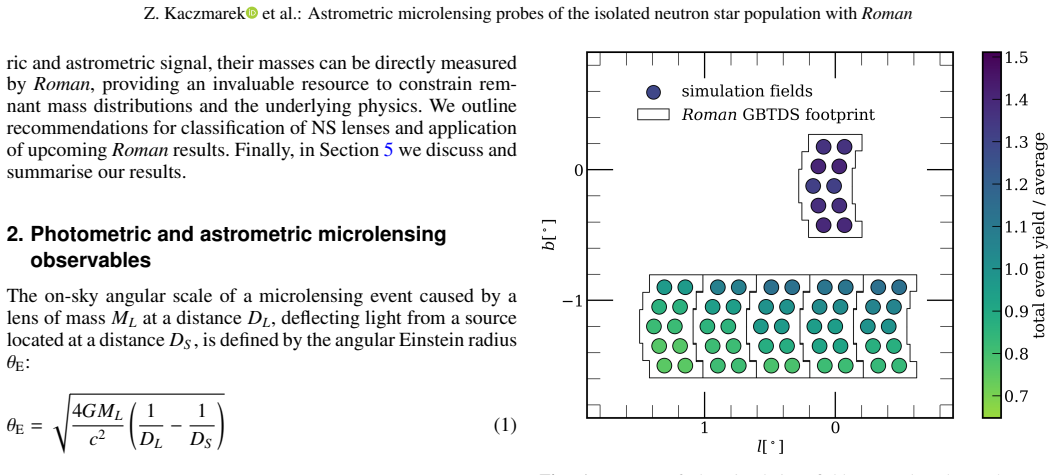
Notoriously hard to detect and study, isolated neutron stars (NS) could provide valuable answers to fundamental questions about stellar evolution and explosion physics. With the upcoming Roman Space Telescope, scheduled for launch in 2026, a new and powerful channel for their detection - astrometric microlensing - will become available. We set out to create a realistic sample of simulated gravitational microlensing events as observed by Roman with the Galactic Bulge Time Domain Survey. We focus in particular on the population of NS lenses, which has until now been largely understudied. We use state-of-the-art Galactic models tailored for application to microlensing by compact objects. We simulate four different NS populations with Maxwellian natal kick distributions: $\bar{v} = (150, \ 250, \ 350, \ 450)$ km/s. We apply projected Roman precision, cadence, and detectability criteria. We find the parameter space $\log_{10} t_{\rm E}$ - $\log_{10} \theta_{\rm E}$, which will be accessible to Roman observations, to be maximally efficient for classification of stellar remnants. We find a feature in this space that is characteristic to NS; using this feature, optimal samples of NS candidates can be constructed from Roman-like datasets. We describe the dependence of observable parameter distributions on the assumed mean kick velocities. As the effects of natal kicks are very complex and mutually counteracting, we suggest more detailed studies focused on the dynamics of NS are needed in anticipation of Roman and future surveys. We estimate Roman will observe approximately $11\,000$ microlensing events - including $\sim100$ with NS lenses - whose both photometric and astrometric signal are detectable; the event yield decreases by $38\%$ if gap-filling low-cadence observations are not included. We make all simulated microlensing event datasets publicly available in preparation for Roman data.
Editorial analysis
A structured set of objections, weighed in public.
Referee Report
Summary. This paper simulates gravitational microlensing events observable by the Roman Space Telescope's Galactic Bulge Time Domain Survey, emphasizing isolated neutron star (NS) lenses. Using state-of-the-art Galactic models and four Maxwellian natal kick distributions with mean velocities of 150, 250, 350, and 450 km/s, the authors apply projected Roman precision, cadence, and detectability criteria in the log t_E - log θ_E plane. They estimate ~11,000 total detectable events including ~100 with NS lenses, identify a characteristic NS feature in this parameter space for classification, describe dependence on kick velocities, and release the simulated datasets publicly.
Significance. If the estimates hold, this provides a valuable forecast for Roman's ability to detect isolated neutron stars via combined photometric and astrometric microlensing, offering new probes of stellar evolution and explosion physics. The public release of the simulated event datasets is a clear strength that enables community follow-up. The analysis of how distributions vary with assumed kick velocities usefully illustrates the dynamical complexities involved.
major comments (3)
- [Results section] Results section (yield estimates): The central claims of approximately 11,000 total events and ~100 NS-lens events are given as point estimates without quoted uncertainties, ranges, or sensitivity tests to the mean natal kick velocity (a free parameter in the simulations). The text notes that kick effects are complex and counteracting with exponential sensitivity in the high-velocity tail, so the NS count could shift by a factor of two under modest changes; this makes the headline numbers load-bearing but insufficiently robust.
- [Simulation setup (Section 3)] Simulation setup (Section 3): The adopted Maxwellian kick distributions are not compared to or validated against observed pulsar proper-motion or velocity distributions. Given that the fraction of bound NS producing detectable θ_E > 0.1 mas events depends critically on the velocity tail, the lack of such anchoring or marginalization over kick parameters undermines in the ~100 NS yield.
- [Parameter space analysis] Parameter space analysis: The claim that the log10 t_E - log10 θ_E space is 'maximally efficient for classification of stellar remnants' and contains a 'feature characteristic to NS' is presented qualitatively without supporting quantitative metrics such as classification efficiencies, ROC curves, or separation statistics between NS and other lenses.
minor comments (2)
- [Abstract] Abstract: The 38% yield reduction without gap-filling low-cadence observations is stated but not tied to a specific figure or table; a brief cross-reference would improve clarity.
- [Figures] Figure captions and text: Labels distinguishing the four kick-velocity cases (150-450 km/s) could be made more consistent across plots to aid reader comparison of distributions.
Simulated Author's Rebuttal
We thank the referee for their constructive and detailed comments on our manuscript. We address each major comment point by point below, indicating the revisions we will make where appropriate.
read point-by-point responses
-
Referee: [Results section] Results section (yield estimates): The central claims of approximately 11,000 total events and ~100 NS-lens events are given as point estimates without quoted uncertainties, ranges, or sensitivity tests to the mean natal kick velocity (a free parameter in the simulations). The text notes that kick effects are complex and counteracting with exponential sensitivity in the high-velocity tail, so the NS count could shift by a factor of two under modest changes; this makes the headline numbers load-bearing but insufficiently robust.
Authors: We agree that the yield estimates would be more robust with explicit sensitivity information. In the revised manuscript, we will report the NS event yields obtained from each of the four simulated kick velocity distributions (150, 250, 350, and 450 km/s), which span a factor of approximately two, and present the headline ~100 as the central value within this range. We will also clarify that the total event count of ~11,000 corresponds to the fiducial model and reiterate the 38% reduction when gap-filling observations are omitted. revision: yes
-
Referee: [Simulation setup (Section 3)] Simulation setup (Section 3): The adopted Maxwellian kick distributions are not compared to or validated against observed pulsar proper-motion or velocity distributions. Given that the fraction of bound NS producing detectable θ_E > 0.1 mas events depends critically on the velocity tail, the lack of such anchoring or marginalization over kick parameters undermines in the ~100 NS yield.
Authors: The four Maxwellian distributions were chosen to span a range of plausible mean natal kick velocities for isolated neutron stars. In the revised manuscript, we will add a brief discussion in Section 3 that places these values in the context of observed mean velocities from pulsar studies (typically 200-400 km/s). Full marginalization over the kick distribution or detailed comparison to proper-motion catalogs would require a separate population-synthesis effort that lies outside the scope of the present work; we retain our existing call for more detailed dynamical studies in the conclusions. revision: partial
-
Referee: [Parameter space analysis] Parameter space analysis: The claim that the log10 t_E - log10 θ_E space is 'maximally efficient for classification of stellar remnants' and contains a 'feature characteristic to NS' is presented qualitatively without supporting quantitative metrics such as classification efficiencies, ROC curves, or separation statistics between NS and other lenses.
Authors: We accept that the description of the parameter space as 'maximally efficient' and the identification of the NS feature rest on qualitative inspection of the simulated distributions. In the revised version, we will moderate the wording to 'particularly efficient' and add quantitative support, including the fraction of NS events lying in the characteristic short-t_E region relative to other lens populations and a simple measure of distributional overlap. While constructing full ROC curves would require defining an explicit classifier (which is not the focus of this work), these additions will provide a clearer quantitative basis for the utility of the space. revision: yes
Circularity Check
Forward simulation yields contain no circular reduction to inputs
full rationale
The reported event yields (~11,000 total, ~100 NS-lens) are produced by drawing NS lenses from four externally chosen Maxwellian kick distributions, embedding them in state-of-the-art Galactic models, and counting those that satisfy the adopted Roman photometric and astrometric cuts. No equation, fit, or self-citation chain equates the final counts to quantities defined by the same simulation; the derivation is a direct Monte Carlo forward pass whose numerical outputs are independent of any internal redefinition or renaming of the input assumptions.
Axiom & Free-Parameter Ledger
free parameters (1)
- mean natal kick velocity =
150, 250, 350, 450 km/s
axioms (1)
- domain assumption State-of-the-art Galactic models tailored for microlensing by compact objects accurately represent the true distribution of isolated neutron stars.
Reference graph
Works this paper leans on
-
[1]
Abbott, B. P., Abbott, R., Abbott, T. D., et al. 2020, ApJ, 892, L3
work page 2020
-
[2]
Abbott, B. P., Abbott, R., Abbott, T. D., et al. 2017, Phys. Rev. Lett., 119, 161101
work page 2017
-
[3]
Abbott, R., Abbott, T. D., Abraham, S., et al. 2021, Physical Review X, 11, 021053
work page 2021
- [4]
-
[5]
2023, Nature Communications, 14, 8451
Annala, E., Gorda, T., Hirvonen, J., et al. 2023, Nature Communications, 14, 8451
work page 2023
-
[6]
Annala, E., Gorda, T., Kurkela, A., Nättilä, J., & Vuorinen, A. 2020, Nature Physics, 16, 907
work page 2020
-
[7]
Bailyn, C. D., Jain, R. K., Coppi, P., & Orosz, J. A. 1998, ApJ, 499, 367
work page 1998
-
[8]
1987, Journal of Computational Physics, 72, 202
Barlow, R. 1987, Journal of Computational Physics, 72, 202
work page 1987
-
[9]
2018, Reports on Progress in Physics, 81, 056902
Baym, G., Hatsuda, T., Kojo, T., et al. 2018, Reports on Progress in Physics, 81, 056902
work page 2018
-
[10]
Belczynski, K., Wiktorowicz, G., Fryer, C. L., Holz, D. E., & Kalogera, V . 2012, ApJ, 757, 91 Bell Burnell, J. 2017, Nature Astronomy, 1, 831
work page 2012
-
[11]
2010, Advances in Space Research, 45, 949
Bhattacharyya, S. 2010, Advances in Space Research, 45, 949
work page 2010
-
[12]
Bramich, D. M. 2018, A&A, 618, A44
work page 2018
-
[13]
Bray, J. C. & Eldridge, J. J. 2016, MNRAS, 461, 3747
work page 2016
-
[14]
B., El-Badry, K., Kara, E., et al
Burdge, K. B., El-Badry, K., Kara, E., et al. 2024, Nature, 635, 316
work page 2024
-
[15]
Chatziioannou, K., Cromartie, H. T., Gandolfi, S., et al. 2024, arXiv e-prints, arXiv:2407.11153
-
[16]
Coulter, D. A., Jones, D. O., McGill, P., et al. 2023, PASP, 135, 064501
work page 2023
- [17]
-
[18]
DeRocco, W., Frangipane, E., Hamer, N., Profumo, S., & Smyth, N. 2024, Phys. Rev. D, 109, 023013 Di Stefano, R. 2008a, ApJ, 684, 59 Di Stefano, R. 2008b, ApJ, 684, 46
work page 2024
-
[19]
Disberg, P., Gaspari, N., & Levan, A. J. 2025, A&A, 700, A75
work page 2025
- [20]
- [21]
- [22]
-
[23]
M., Sravan, N., Cantrell, A., et al
Farr, W. M., Sravan, N., Cantrell, A., et al. 2011, ApJ, 741, 103
work page 2011
-
[24]
Fonseca, E., Cromartie, H. T., Pennucci, T. T., et al. 2021, ApJ, 915, L12
work page 2021
-
[25]
Fortin, F., García, F., Chaty, S., Chassande-Mottin, E., & Simaz Bunzel, A. 2022, A&A, 665, A31
work page 2022
-
[26]
S., Kurkela, A., & Vuorinen, A
Fraga, E. S., Kurkela, A., & Vuorinen, A. 2016, European Physical Journal A, 52, 49
work page 2016
-
[27]
Fryer, C. L. & Kalogera, V . 2001, ApJ, 554, 548
work page 2001
- [28]
-
[29]
Golovich, N., Dawson, W., Bartoli´c, F., et al. 2022, ApJS, 260, 2
work page 2022
-
[30]
Gunn, J. E. & Ostriker, J. P. 1970, ApJ, 160, 979
work page 1970
-
[31]
Haensel, P., Potekhin, A. Y ., & Yakovlev, D. G. 2007, Neutron stars 1: Equation of state and structure, V ol. 326 (New York, USA: Springer)
work page 2007
-
[32]
Harding, A. J., Stefano, R. D., Lépine, S., et al. 2018, MNRAS, 475, 79
work page 2018
-
[33]
Hewish, A., Bell, S. J., Pilkington, J. D. H., Scott, P. F., & Collins, R. A. 1968, Nature, 217, 709
work page 1968
-
[34]
Hobbs, G., Lorimer, D. R., Lyne, A. G., & Kramer, M. 2005, MNRAS, 360, 974
work page 2005
- [35]
- [36]
-
[37]
Howil, K., Wyrzykowski, Ł., Kruszy´nska, K., et al. 2025, A&A, 694, A94
work page 2025
-
[38]
Hunt, J. A. S. & Vasiliev, E. 2025, New A Rev., 100, 101721
work page 2025
-
[39]
Husseiniova, A., McGill, P., Smith, L. C., & Evans, N. W. 2021, MNRAS, 506, 2482
work page 2021
-
[40]
Igoshev, A. P. 2020, MNRAS, 494, 3663
work page 2020
-
[41]
P., Chruslinska, M., Dorozsmai, A., & Toonen, S
Igoshev, A. P., Chruslinska, M., Dorozsmai, A., & Toonen, S. 2021, MNRAS, 508, 3345
work page 2021
- [42]
- [43]
-
[44]
Janka, H.-T. & Kresse, D. 2024, Ap&SS, 369, 80 Jankoviˇc, T., Gomboc, A., Wyrzykowski, Ł., et al. 2025, A&A, 699, A156
work page 2024
-
[45]
2025, arXiv e-prints, arXiv:2505.05241
Ji, Z., Chen, J., & Wu, G. 2025, arXiv e-prints, arXiv:2505.05241
-
[46]
Johnson, S. A., Penny, M., Gaudi, B. S., et al. 2020, AJ, 160, 123
work page 2020
- [47]
- [48]
-
[49]
Kalogera, V ., Kolb, U., & King, A. R. 1998, ApJ, 504, 967
work page 1998
-
[50]
Kapil, V ., Mandel, I., Berti, E., & Müller, B. 2023, MNRAS, 519, 5893
work page 2023
-
[51]
Kim, M., Kim, Y .-M., Sung, K. H., Lee, C.-H., & Kwak, K. 2021, A&A, 650, A139
work page 2021
-
[52]
2016, Journal of Korean Astronomical Society, 49, 37
Kim, S.-L., Lee, C.-U., Park, B.-G., et al. 2016, Journal of Korean Astronomical Society, 49, 37
work page 2016
-
[53]
Koehn, H., Rose, H., Pang, P. T. H., et al. 2025, Physical Review X, 15, 021014
work page 2025
-
[54]
Koshimoto, N., Baba, J., & Bennett, D. P. 2021, ApJ, 917, 78
work page 2021
- [55]
-
[56]
2024, MNRAS, 535, 3577 Article number, page 11 of 12 A&A proofs:manuscript no
Kotko, I., Banerjee, S., & Belczynski, K. 2024, MNRAS, 535, 3577 Article number, page 11 of 12 A&A proofs:manuscript no. aanda
work page 2024
-
[57]
2024, Living Reviews in Relativity, 27, 3
Kumar, R., Dexheimer, V ., Jahan, J., et al. 2024, Living Reviews in Relativity, 27, 3
work page 2024
-
[58]
2004, in Cosmic explosions in three dimensions, ed
Lai, D. 2004, in Cosmic explosions in three dimensions, ed. P. Höflich, P. Kumar, & J. C. Wheeler, 276
work page 2004
-
[59]
Y ., Abrams, N., Andrews, J., et al
Lam, C. Y ., Abrams, N., Andrews, J., et al. 2023, arXiv e-prints, arXiv:2306.12514
-
[60]
Lam, C. Y ., Lu, J. R., Hosek, Matthew W., J., Dawson, W. A., & Golovich, N. R. 2020, ApJ, 889, 31
work page 2020
-
[61]
Lattimer, J. M. 2012, Annual Review of Nuclear and Particle Science, 62, 485
work page 2012
-
[62]
Lattimer, J. M. 2021, Annual Review of Nuclear and Particle Science, 71, 433
work page 2021
-
[63]
Lattimer, J. M. & Prakash, M. 2004, Science, 304, 536
work page 2004
-
[64]
Lu, J. R., Medford, M., Lam, C. Y ., et al. 2025, arXiv e-prints, arXiv:2512.03364
- [65]
-
[66]
Lyne, A. G. & Lorimer, D. R. 1994, Nature, 369, 127
work page 1994
- [67]
- [68]
-
[69]
McGill, P., Anderson, J., Casertano, S., et al. 2023, MNRAS, 520, 259
work page 2023
-
[70]
Miyamoto, M. & Yoshii, Y . 1995, AJ, 110, 1427 Mróz, P., Udalski, A., & Gould, A. 2022, ApJ, 937, L24 Mróz, P., Udalski, A., Szyma´nski, M. K., et al. 2020, ApJS, 249, 16
work page 1995
-
[71]
Nagarajan, P. & El-Badry, K. 2025, PASP, 137, 034203 O’Doherty, T. N., Bahramian, A., Miller-Jones, J. C. A., et al. 2023, MNRAS, 521, 2504
work page 2025
-
[72]
Ofek, E. O. 2018, ApJ, 866, 144
work page 2018
-
[73]
Ono, K., Eda, K., & Itoh, Y . 2015, Phys. Rev. D, 91, 084032 Özel, F., Psaltis, D., Narayan, R., & McClintock, J. E. 2010, ApJ, 725, 1918
work page 2015
- [74]
- [75]
-
[76]
2011, Journal of Machine Learning Research, 12, 2825
Pedregosa, F., Varoquaux, G., Gramfort, A., et al. 2011, Journal of Machine Learning Research, 12, 2825
work page 2011
- [77]
-
[78]
E., McGill, P., Dawson, W., et al
Perkins, S. E., McGill, P., Dawson, W., et al. 2024, ApJ, 961, 179
work page 2024
-
[79]
Piffl, T., Scannapieco, C., Binney, J., et al. 2014, A&A, 562, A91
work page 2014
-
[80]
2005, in Astronomical Society of the Pacific Conference Series, V ol
Podsiadlowski, P., Pfahl, E., & Rappaport, S. 2005, in Astronomical Society of the Pacific Conference Series, V ol. 328, Binary Radio Pulsars, ed. F. A. Rasio & I. H. Stairs, 327
work page 2005
discussion (0)
Sign in with ORCID, Apple, or X to comment. Anyone can read and Pith papers without signing in.