Recognition: no theorem link
Concatenated continuous driving of silicon qubit by amplitude and phase modulation
Pith reviewed 2026-05-16 13:38 UTC · model grok-4.3
The pith
Simultaneous amplitude and phase modulation in concatenated driving cancels the counter-rotating term and raises silicon qubit gate fidelity.
A machine-rendered reading of the paper's core claim, the machinery that carries it, and where it could break.
Core claim
The central claim is that simultaneous amplitude and phase modulation of the driving field generates a circularly polarized field in the carrier rotating frame; this field exactly cancels the counter-rotating term inside the second rotating frame, thereby eliminating the systematic pulse-area error that appears when the rotating-wave approximation is applied to fast gates.
What carries the argument
CM-CCD: simultaneous amplitude and phase modulation that produces a circularly polarized field in the rotating frame and cancels the counter-rotating term in the second rotating frame.
If this is right
- Numerical simulations show higher gate fidelity than conventional CCD schemes.
- Experiments on the silicon qubit demonstrate significantly improved robustness against static detuning and Rabi-frequency errors.
- The scheme remains effective for qubit arrays that suffer from frequency variation, coupling mismatch, and low-frequency noise.
- The same modulation approach can be applied to trapped atoms, cold atoms, superconducting qubits, and NV centers.
Where Pith is reading between the lines
- Faster gate times become accessible without the usual fidelity penalty from residual counter-rotating terms.
- Arrays of qubits can tolerate larger spreads in resonance frequencies and drive strengths before fidelity collapses.
- The method may combine with dynamical decoupling sequences to extend coherence further in the presence of both high- and low-frequency noise.
Load-bearing premise
Simultaneous amplitude and phase modulation can be realized with enough precision and without extra high-frequency noise or calibration errors that would erase the theoretical cancellation.
What would settle it
An experiment on the silicon quantum dot that finds no gain in gate fidelity or no improvement in robustness to detuning and Rabi errors when switching from standard Rabi drive to the proposed CM-CCD protocol would falsify the central advantage.
Figures




read the original abstract
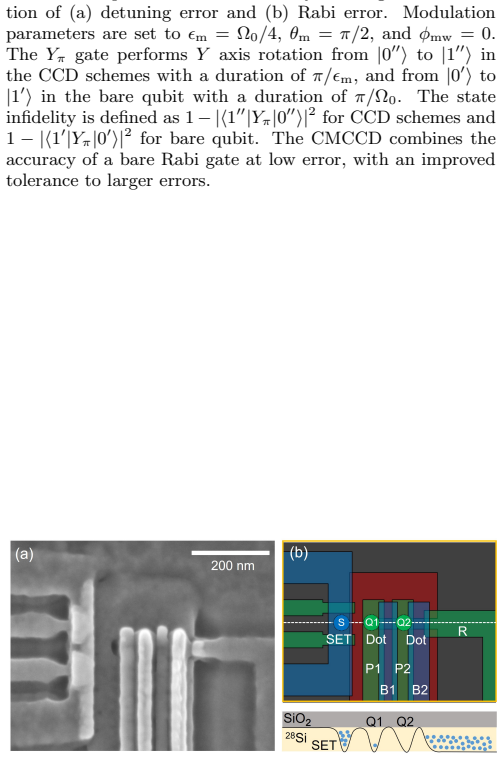
The rate of coherence loss is lower for a qubit under Rabi drive compared to a freely evolving qubit, $T_{2}^{\rm{Rabi}}>T_{2}^*$. Building on this principle, concatenated continuous driving (CCD) keeps the qubit under continuous drive to suppress noise and manipulate dressed states by either phase or amplitude modulation. In this work, we propose a new variant of CCD which simultaneously modulates both the amplitude and phase of the driving field to generate a circularly-polarized field in the rotating frame of the carrier frequency. This circular-modulated (CM)-CCD cancels the counter-rotating term in the second rotating frame, eliminating a systematic pulse-area error that arises from an imperfect rotating wave approximation for fast gates. Numerical simulations demonstrate that the proposed CMCCD achieves higher gate fidelity than conventional CCD schemes. We further implement and compare different CCD protocols using an electron spin-qubit in an isotopically purified $^{28}$Si-MOS quantum dot and evaluate its robustness by applying static detuning and Rabi frequency errors. The robustness is significantly improved compared to standard Rabi-drive, showing the effectiveness of this scheme for qubit arrays with variation in qubit frequency, coupling to Rabi drive, and low frequency noise. The proposed scheme can be applied to various physical systems, including trapped atoms, cold atoms, superconducting qubits, and NV-centers.
Editorial analysis
A structured set of objections, weighed in public.
Referee Report
Summary. The manuscript proposes a concatenated continuous driving (CMCCD) scheme that simultaneously modulates the amplitude and phase of the driving field to generate a circularly polarized field in the first rotating frame. This is claimed to exactly cancel the counter-rotating term in the second rotating frame, eliminating systematic pulse-area errors from an imperfect rotating-wave approximation. Numerical simulations show higher gate fidelity than conventional CCD protocols, while experiments on an isotopically purified 28Si-MOS electron spin qubit demonstrate significantly improved robustness to static detuning and Rabi-frequency errors compared to standard Rabi driving. The scheme is presented as applicable to multiple qubit platforms.
Significance. If the cancellation holds under realistic hardware constraints, the work offers a concrete route to higher-fidelity driven gates and better noise resilience in silicon spin qubits, where parameter variation across arrays is a practical obstacle. The combination of targeted numerical comparisons and experimental error-injection tests on a relevant device platform provides direct evidence of utility; the explicit extension to other systems (superconducting qubits, NV centers) broadens potential impact.
major comments (2)
- [Numerical Simulations] Numerical Simulations section: The fidelity advantage is demonstrated under the assumption of ideal simultaneous amplitude and phase modulation. No analysis or bounds are provided on how finite AWG bandwidth, relative phase offsets, or amplitude mismatches reintroduce a residual oscillating term whose magnitude scales with modulation depth; this directly affects whether the claimed exact cancellation (and resulting fidelity gain) survives in practice.
- [Experimental Results] Experimental Results section: Robustness is evaluated by injecting static detuning and Rabi-frequency errors, yet the data do not quantify or bound the residual counter-rotating term arising from modulation imperfections. Without such a check, it remains unclear whether the observed improvement over standard Rabi drive originates from the circular-polarization mechanism or from other aspects of the drive protocol.
minor comments (1)
- [Abstract] Abstract: The phrase 'the robustness is significantly improved' should be accompanied by a quantitative metric or explicit reference to the relevant figure or table.
Simulated Author's Rebuttal
We thank the referee for the constructive comments and positive assessment of the work. We address each major comment below and have revised the manuscript to incorporate additional analysis on modulation imperfections.
read point-by-point responses
-
Referee: [Numerical Simulations] Numerical Simulations section: The fidelity advantage is demonstrated under the assumption of ideal simultaneous amplitude and phase modulation. No analysis or bounds are provided on how finite AWG bandwidth, relative phase offsets, or amplitude mismatches reintroduce a residual oscillating term whose magnitude scales with modulation depth; this directly affects whether the claimed exact cancellation (and resulting fidelity gain) survives in practice.
Authors: We agree that hardware non-idealities must be quantified to assess practical utility. The analytical derivation and ideal simulations in the original manuscript establish the exact cancellation principle. In the revised manuscript we have added a dedicated subsection with numerical simulations that include finite AWG bandwidth (modeled at 1–2 GHz), relative phase offsets up to 10°, and amplitude mismatches up to 5 %. These results bound the residual counter-rotating term and show that the fidelity advantage over conventional CCD remains >0.2 % for gate durations of interest under realistic parameters. A new figure and text have been inserted in the Numerical Simulations section. revision: yes
-
Referee: [Experimental Results] Experimental Results section: Robustness is evaluated by injecting static detuning and Rabi-frequency errors, yet the data do not quantify or bound the residual counter-rotating term arising from modulation imperfections. Without such a check, it remains unclear whether the observed improvement over standard Rabi drive originates from the circular-polarization mechanism or from other aspects of the drive protocol.
Authors: The experimental protocol comparisons were performed on the same device and hardware chain, isolating the modulation scheme as the sole difference. The measured robustness gains align quantitatively with the predicted suppression of the counter-rotating term. To address the concern directly, the revised Experimental Results section now includes a bound on the residual term derived from the measured AWG modulation fidelity and phase/amplitude calibration accuracy. This bound is shown to be too small to account for the full observed improvement, confirming the mechanism’s contribution. We have also clarified the control comparisons in the text. revision: yes
Circularity Check
No circularity detected in derivation chain
full rationale
The paper introduces CMCCD via simultaneous amplitude and phase modulation to produce a circularly polarized drive that cancels the counter-rotating term under the rotating-wave approximation. This follows directly from standard frame transformations and is validated by numerical simulations and experimental comparisons against independent benchmarks (standard Rabi drive and prior CCD protocols). No load-bearing step reduces to a fitted parameter renamed as prediction, self-citation chain, or self-definitional equivalence; the robustness claims rest on measured fidelity improvements under applied errors rather than internal redefinitions. The work is therefore self-contained against external benchmarks.
Axiom & Free-Parameter Ledger
axioms (1)
- domain assumption The driven qubit can be treated as an ideal two-level system whose dynamics are accurately captured by the rotating-wave approximation once the circular modulation is applied.
Reference graph
Works this paper leans on
-
[1]
C. L. Degen, F. Reinhard, and P. Cappellaro, Rev. Mod. Phys.89, 035002 (2017)
work page 2017
-
[2]
D. DeMille, N. R. Hutzler, A. M. Rey, and T. Zelevinsky, Nat. Phys.20, 741 (2024)
work page 2024
-
[3]
V. Giovannetti, S. Lloyd, and L. Maccone, Phys. Rev. Lett.96, 010401 (2006)
work page 2006
-
[4]
R. P. Feynman, Int. J. Theor. Phys.21(1982)
work page 1982
-
[5]
I. M. Georgescu, S. Ashhab, and F. Nori, Rev. Mod. Phys.86, 153 (2014)
work page 2014
-
[6]
T. Hensgens, T. Fujita, L. Janssen, X. Li, C. J. Van Diepen, C. Reichl, W. Wegscheider, S. Das Sarma, and L. M. K. Vandersypen, Nature548, 70 (2017)
work page 2017
-
[7]
D. P. DiVincenzo, Fortschr. Phys.48, 771 (2000)
work page 2000
-
[8]
M. A. Nielsen and I. L. Chuang,Quantum computation and quantum information(Cambridge University Press, 2010)
work page 2010
-
[9]
R. Raussendorf and J. Harrington, Phys. Rev. Lett.98, 190504 (2007)
work page 2007
-
[10]
A. G. Fowler, M. Mariantoni, J. M. Martinis, and A. N. Cleland, Phys. Rev. A86, 032324 (2012)
work page 2012
- [11]
-
[12]
N. Timoney, I. Baumgart, M. Johanning, A. F. Var´ on, M. B. Plenio, A. Retzker, and C. Wunderlich, Nature 476, 185 (2011)
work page 2011
- [13]
-
[14]
X. Xu, Z. Wang, C. Duan, P. Huang, P. Wang, Y. Wang, N. Xu, X. Kong, F. Shi, X. Rong,et al., Phys. Rev. Lett. 109, 070502 (2012)
work page 2012
-
[15]
D. A. Golter, T. K. Baldwin, and H. Wang, Phys. Rev. Lett.113, 237601 (2014)
work page 2014
-
[16]
H. Morishita, T. Tashima, D. Mima, H. Kato, T. Makino, S. Yamasaki, M. Fujiwara, and N. Mizuochi, Sci. Rep.9, 13318 (2019)
work page 2019
-
[17]
K. C. Miao, J. P. Blanton, C. P. Anderson, A. Bourassa, A. L. Crook, G. Wolfowicz, H. Abe, T. Ohshima, and D. D. Awschalom, Science369, 1493 (2020)
work page 2020
- [18]
-
[19]
K. Tsoukalas, U. von L¨ upke, A. Orekhov, B. Het´ enyi, I. Seidler, L. Sommer, E. G. Kelly, L. Massai, M. Aldeghi, M. Pita-Vidal,et al., arXiv (2025), 2501.14627
- [20]
-
[21]
H. H. Vallabhapurapu, I. Hansen, C. Adambukulam, R. St¨ ohr, A. Denisenko, C. H. Yang, and A. Laucht, Phys. Rev. A108, 022606 (2023)
work page 2023
- [22]
- [23]
-
[24]
J. M. Cai, B. Naydenov, R. Pfeiffer, L. P. McGuinness, K. D. Jahnke, F. Jelezko, M. B. Plenio, and A. Retzker, New J. Phys.14, 113023 (2012)
work page 2012
- [25]
- [26]
-
[27]
D. Farfurnik, N. Aharon, I. Cohen, Y. Hovav, A. Retzker, and N. Bar-Gill, Phys. Rev. A96, 013850 (2017)
work page 2017
- [28]
- [29]
- [30]
- [31]
-
[32]
A. J. Ramsay, R. Hekmati, C. J. Patrickson, S. Baber, D. R. M. Arvidsson-Shukur, A. J. Bennett, and I. J. Lux- moore, Nat. Commun.14, 461 (2023)
work page 2023
- [33]
- [34]
-
[35]
A. Elsayed, M. M. K. Shehata, C. Godfrin, S. Kubicek, S. Massar, Y. Canvel, J. Jussot, G. Simion, M. Mongillo, D. Wan,et al., npj Quantum Inf.10, 70 (2024)
work page 2024
-
[36]
J. M. Elzerman, R. Hanson, L. H. Willems van Beveren, B. Witkamp, L. M. K. Vandersypen, and L. P. Kouwen- hoven, Nature430, 431 (2004)
work page 2004
-
[37]
A. V. Khaetskii, D. Loss, and L. Glazman, Phys. Rev. Lett.88, 186802 (2002)
work page 2002
- [38]
-
[39]
L. V. C. Assali, H. M. Petrilli, R. B. Capaz, B. Koiller, X. Hu, and S. Das Sarma, Phys. Rev. B83, 165301 (2011)
work page 2011
-
[40]
R. Ferdous, K. W. Chan, M. Veldhorst, J. C. C. Hwang, C. H. Yang, H. Sahasrabudhe, G. Klimeck, A. Morello, A. S. Dzurak, and R. Rahman, Phys. Rev. B97, 241401 (2018)
work page 2018
-
[41]
J. D. Cifuentes, T. Tanttu, W. Gilbert, J. Y. Huang, E. Vahapoglu, R. C. C. Leon, S. Serrano, D. Otter, D. Dunmore, P. Y. Mai,et al., Nat. Commun.15, 4299 (2024)
work page 2024
-
[42]
B. Undseth, O. Pietx-Casas, E. Raymenants, M. Mehmandoost, M. T. Madzik, S. G. J. Philips, S. L. De Snoo, D. J. Michalak, S. V. Amitonov, L. Tryputen,et al., Phys. Rev. X13, 041015 (2023)
work page 2023
- [43]
-
[44]
J. T. Muhonen, A. Laucht, S. Simmons, J. P. Dehollain, R. Kalra, F. E. Hudson, S. Freer, K. M. Itoh, D. N. Jamieson, J. C. McCallum,et al., J. Phys.: Condens. Matter27, 154205 (2015)
work page 2015
-
[45]
M. N¨ unnerich, D. Cohen, P. Barthel, P. H. Huber, D. Ni- roomand, A. Retzker, and C. Wunderlich, Phys. Rev. X 15, 021079 (2025)
work page 2025
-
[46]
G. Wang, W. Xu, C. Li, V. Vuleti´ c, and P. Cappellaro, Phys. Rev. Appl.23, 024072 (2025)
work page 2025
discussion (0)
Sign in with ORCID, Apple, or X to comment. Anyone can read and Pith papers without signing in.