REVIEW 3 major objections 5 minor 1 cited by
The XL Instances and the CVRPLib Best Known Solution Challenge
T0 review · 3 major / 5 minor · reviewed 2026-08-03 · deepseek-v4-flash
Pith's one-line read This paper introduces the XL set, a collection of 100 capacitated vehicle routing instances with 1,000 to 10,000 customers, provides initial best-known solutions from eight heuristics, and reports that a 30-day community challenge improved
desk verdict The XL benchmark is a genuinely useful new resource and the experiments are careful, but the abstract's post-competition claims (1,932 BKS improvements, LLM-assisted discovery) appear nowhere in the body and are impossible given the dates; fix that and this deserves serious refereeing. read the letter →
The pith
A machine-rendered reading of the paper's core claim, the machinery that carries it, and where it could break.
The reading
What carries the argument
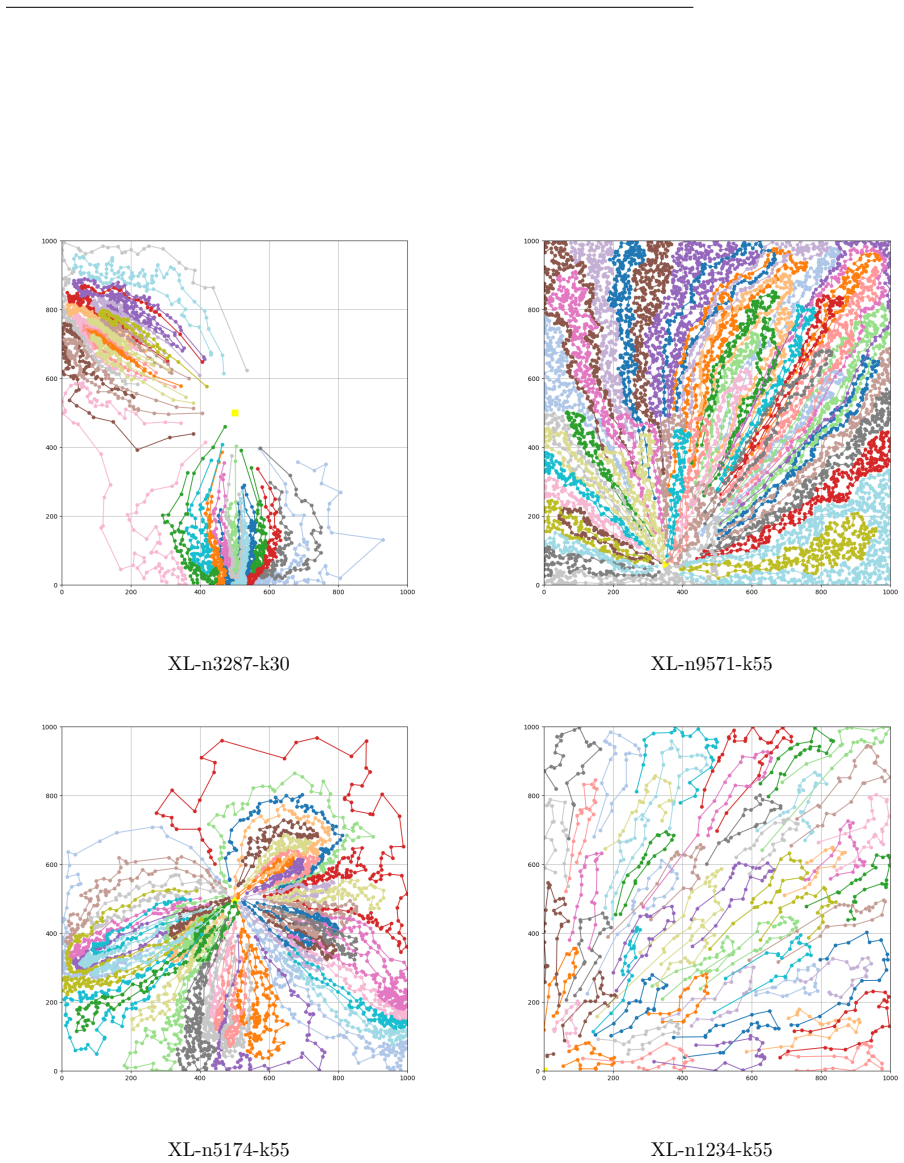
The load-bearing machinery is the attribute-based instance generator (depot/customer positioning, demand distributions, average route size) inherited from the X/XML sets and scaled to 1,000–10,000 customers, combined with a community challenge whose lead-time scoring rewards long-held improvements. The generator produces instances spanning a wide range of structural characteristics; the challenge turns the resulting best-known solutions into a continuously moving baseline.
What would settle it
Check the public leaderboard's per-instance percentage improvements: if the 1,932 updates average more than roughly 1% gain per instance, the initial best-known solutions were not a demanding baseline; if they average well below 0.1%, they were. Alternatively, run the standard-scale heuristics on a sample of XL instances with per-instance parameter tuning and longer time budgets; systematic improvements beyond 1% would undercut the baseline claim.
Extended reading notes
Core claim
The paper's central claim is that the XL instance set, 100 capacitated vehicle routing problems with 1,000 to 10,000 customers, generated with the attribute-based scheme of the X and XML sets, is a suitable and much-needed testbed for large-scale routing. The initial best-known solutions, obtained from 60 runs of eight heuristics with a two-hour limit, are strong enough that 1,932 challenge improvements over 30 days were needed to refine them. The experiments also show a scale-dependent methodological transition: at this size, a single-trajectory iterated local search variant produces the best results, ahead of two other large-scale methods and well ahead of standard-scale population-based m
Load-bearing premise
The initial best-known solutions, computed with default parameters and a two-hour limit per run, are strong enough to serve as a demanding baseline for the challenge.
Editorial extensions
If this is right
- The XL set fills the 1,001-to-2,999-customer gap and gives researchers a common, diverse testbed for comparing large-scale CVRP algorithms.
- Because the public generator can produce statistically similar instances, the set supports both evaluation and training of machine-learning methods at scale.
- The reported method ranking suggests that for instances of this size, single-trajectory improvement methods (like iterated local search) are currently more effective than population-based approaches.
- The 1,932 challenge improvements imply that the initial solutions, while strong, leave clear headroom, so new methods have a concrete target and a live leaderboard to measure progress.
- The challenge's lead-time scoring model could be applied to other benchmark families to incentivize sustained improvements rather than one-shot results.
Reading between the lines
- If the scale-dependent transition the paper observes is real, we can predict that future large-scale routing heuristics will converge on ILS-style refinement of a single solution, and that challenge winners will be variants of such methods rather than genetic or population-based hybrids.
- The reported 1,932 improvements were made within a 30-day window; the final best-known solutions are likely to be substantially different from the initial ones, so researchers should treat the initial BKSs as provisional and re-check before using them as references.
- The generator's public availability could establish a de facto training/evaluation standard for ML-based routing at scale, analogous to what the 100-customer XML set did; a testable consequence is that new ML papers will adopt this generator for their large-scale tests.
- Re-running the standard-scale methods after calibration would clarify whether the observed ranking is a property of the algorithms themselves or an artifact of default parameters; if calibrated versions close the gap to the leading method, the claim of a methodological transition weakens.
Signed reviews
Editorial analysis
A structured set of objections, weighed in public.
Referee Report
Summary. The paper introduces the XL set, a new collection of 100 CVRP benchmark instances with 1,000 to 10,000 customers, generated according to the attribute scheme of the earlier X/XML sets (depot and customer placement, demand distribution, route size, capacity). Section 4 reports an extensive initial computational study: 60 runs of eight state-of-the-art heuristics per instance, with a two-hour per-run limit on a single CPU thread. The best solutions found become the initial BKSs used for the CVRPLib BKS Challenge described in Section 3. Section 5 reports additional experiments on the X and XML sets. The abstract further claims that over the 30-day challenge participating teams submitted 1,932 BKS improvements and that the results highlight LLM-assisted algorithm discovery, but no such results appear in the body.
Significance. If the benchmark generation is sound, the XL set fills a real gap in the CVRP benchmark literature (the 1,001–2,999 customer range) and usefully extends the influential X/XML family. The public availability of the generator, the transparent experimental protocol (fixed time limit, multiple seeds, linked source codes), and the detailed per-instance results in Table 2 are concrete strengths. The additional X/XML comparisons in Section 5 are also valuable as a cross-method snapshot across instance scales. However, the abstract's unsupported and internally inconsistent claim about 1,932 post-competition BKS improvements is a serious credibility problem: it is the headline quantitative result and it cannot be verified from the manuscript. The core benchmark contribution is sound and publishable after this claim is corrected.
major comments (3)
- [Abstract; §3–§4] The abstract claims: 'over 30 days, participating teams submitted 1,932 BKS improvements, substantially refining the initial solution set and highlighting promising research directions for large-scale CVRPs, notably through LLM-assisted algorithm discovery.' No such result is reported anywhere in the body: Section 3 describes only the design of the BKS Challenge, Section 4 reports the authors' own initial BKS experiments, and Section 5 contains retrospective analyses on X/XML instances. Moreover, the arXiv submission is dated 16 Jan 2026, while Section 3 states the challenge starts on 12 Jan 2026 and lasts 30 days; at submission only four days had elapsed. The claim is therefore both unsubstantiated and impossible on the stated timeline. The manuscript must be corrected by either adding the full post-competition data or removing the claim from the abstract.
- [§3; §4, Tables 1–2] Section 3 states that the initial BKSs 'already represent a strong baseline' and that the competition is 'demanding and scientifically meaningful.' This claim depends on the quality of the initial BKSs, but Section 4 observes that SISRs, HGS-CVRP, OR-Tools, and LKH-3 'were not originally designed and calibrated for instances with up to 10,000 customers' and were run with default parameters under a two-hour limit identical to the limit used for 1,000-customer instances in the DIMACS Challenge. Since 93 of the 100 BKSs come from a single method (AILS-II), the baseline strength is only as credible as that method's default configuration at this scale. The paper is transparent about this limitation, but it does not provide evidence that the baseline is actually demanding, e.g., a sensitivity test with longer runs or calibrated parameters on a subset of instances. Please either supply such evi
- [§5, Tables 3–4] The paper uses the additional X/XML experiments to draw comparative conclusions, e.g., in Section 6 'HGS-CVRP achieves the best average solution quality consistently' on small/medium instances and 'AILS-II clearly outperforms the other approaches' on larger instances. These statements are based on a single time budget per instance family (10 minutes for X, 1 minute for XML) and default parameters, with no variance or significance measures. The aggregate gaps in Table 4 are not accompanied by instance counts per subgroup or standard deviations, so subgroup comparisons are hard to interpret. This does not invalidate the main benchmark contribution, but the comparative conclusions in Section 6 should be presented as descriptive observations under a specific protocol rather than as general findings.
minor comments (5)
- [§2] In the route-size bullet, 'The inclusion of instances with ultra long routes was demand from a number of users' is ungrammatical; it should be 'was in demand from' or 'was requested by.'
- [§4] The hardware sentence 'All our experiments were run on a single thread of 2 x AMD EPYC 9654 ...' is ambiguous. Clarify whether each run used one logical processor of one of the two CPUs, and how the 'up to 50 parallel executions' interacted with the two-hour wall-clock limit.
- [Table 1] The 'Dem' column uses abbreviations (U, Q, SL, 1–10, etc.). Most are defined in Section 2, but a compact legend directly under the table would help readers parse the instance attributes without rereading the generation description.
- [Table 4] The table reports average optimality gaps per attribute subgroup but no subgroup sizes or standard deviations. Given the 10,000 instances, per-subgroup counts would be easy to include and would make the comparisons more interpretable.
- [Abstract; §1] If the post-competition claim is retained after correction, the phrase 'LLM-assisted algorithm discovery' needs a reference or a pointer to the relevant section; currently reference [14] is cited only in the introduction and no connection is made to the claimed challenge results.
Circularity Check
No circularity found in the benchmark construction or experiments; the abstract's post-competition claims are unsupported by the body, but that is an internal-consistency issue, not circularity.
full rationale
The XL set is an instance-generation and benchmarking contribution, not a derivation. The generator follows the attribute scheme of Uchoa et al. [22] and Queiroga et al. [19], both established external benchmarks, so the self-citations are provenance rather than load-bearing proof. The initial BKSs are openly defined as the best values from the authors' own 60-run experiments (Table 1: 'Column BKS is the Best Known Solution and the Method that found it during the experiments described in Section 4'), and Table 2 gaps are computed relative to 'the best solution obtained by any method.' This makes AILS-II's 0.00 Best gap and its '93 out of 100' count a summary of the table by construction, but the paper presents these as experimental observations, not as predictions or first-principles results. Section 5 anchors the same codes against external CVRPLib BKSs and XML optima, so the experimental pipeline is not circularly evaluated. The stated limitations—default parameters, a fixed two-hour limit, no calibration—weaken the claim that the initial BKSs are a strong baseline, but that is a risk to benchmark usefulness, not circularity. Separately, the abstract's assertion of '1,932 BKS improvements' over 30 days and 'LLM-assisted algorithm discovery' appears in no body section and is inconsistent with the 16 Jan 2026 submission date versus the 12 Jan 2026 challenge start; I flag this as an unsupported/inconsistent claim, but it is not a circular step, so it does not change the circularity score.
Assumptions & free parameters
assumptions (5)
- domain assumption The Euclidean 2D grid instance structure with depot/customer distributions is a meaningful proxy for real-world CVRPs.
- standard math K_min computed by exact bin packing is a sufficient route-count reference; solutions using more routes are permitted.
- domain assumption The "established generation principles" from X/XML transfer to 1,000–10,000 customer sizes.
- domain assumption Existing BKS and optimal values for X and XML sets can be used as ground truth for gap computations.
- domain assumption Default parameter settings and a two-hour time limit yield a fair and meaningful method comparison at 1,000–10,000 customers.
Cite this review
Pith. "Pith review of The XL Instances and the CVRPLib Best Known Solution Challenge." pith.science (2026). https://pith.science/paper/ZNX4WNQN
@misc{pith2026260111467,
  author       = {Pith},
  title        = {Pith review of: The XL Instances and the CVRPLib Best Known Solution Challenge},
  year         = {2026},
  howpublished = {\url{https://pith.science/paper/ZNX4WNQN}},
  note         = {Machine review of arXiv:2601.11467}
}
read the original abstract
This paper introduces the XL set, a new collection of large-scale benchmark instances for the capacitated vehicle routing problem (CVRP). The set extends previous benchmarks by covering instances with 1,000 to 10,000 customers and a wide range of structural characteristics, following established generation principles from prior CVRP studies. To provide strong reference solutions, we conducted an extensive computational study with several state-of-the-art algorithms and retained the best solutions obtained as the starting point for a community-driven BKS challenge hosted on the CVRPLib website. The XL instances are publicly available to support the experimental evaluation and comparison of future solution methods. The post-competition results demonstrate the impact of the challenge: over 30 days, participating teams submitted 1,932 BKS improvements, substantially refining the initial solution set and highlighting promising research directions for solving large-scale CVRPs, notably through LLM-assisted algorithm discovery.
Figures

Forward citations
Cited by 1 Pith paper
-
SpecAHD: Localize to Specialize for Automated Heuristic Design in Large-Scale Routing Problems
A coupled bilevel LLM search that specializes repair heuristics to local regions within one routing solution cuts held-out cost by up to 57.7% versus competing AHD methods.
Reference graph
Works this paper leans on
-
[1]
Accessed: December 28, 2025
12th DIMACS implementation challenge: Capacitated Vehicle Routing Problem (CVRP).http: //dimacs.rutgers.edu/programs/challenge/vrp/cvrp/, 2022. Accessed: December 28, 2025
2022
-
[2]
Accessed: December 28, 2025
EURO Meets NeurIPS 2022 Vehicle Routing Competition.https://euro-neurips-vrp-2022.chal lenges.ortec.com/, 2023. Accessed: December 28, 2025. 16
2022
-
[3]
A fast and scalable heuristic for the solution of large-scale capacitated vehicle routing problems.Transportation Science, 55(4):832–856, 2021
Luca Accorsi and Daniele Vigo. A fast and scalable heuristic for the solution of large-scale capacitated vehicle routing problems.Transportation Science, 55(4):832–856, 2021
2021
-
[4]
Routing one million customers in a handful of minutes.Computers & Operations Research, 164:106562, 2024
Luca Accorsi and Daniele Vigo. Routing one million customers in a handful of minutes.Computers & Operations Research, 164:106562, 2024
2024
-
[5]
Florian Arnold, Michel Gendreau, and Kenneth S¨ orensen. Efficiently solving very large-scale routing problems.Computers & Operations Research, 107:32–42, 2019. ISSN 0305-0548. doi: https://doi.org/ 10.1016/j.cor.2019.03.006
-
[6]
Augerat, J
P. Augerat, J. Belenguer, E. Benavent, A. Corber´ an, D. Naddef, and G. Rinaldi. Computational results with a branch and cut code for the capacitated vehicle routing problem. Technical Report 949-M, Universit´ e Joseph Fourier, Grenoble, France, 1995
1995
-
[7]
Slack induction by string removals for vehicle routing problems.Transportation Science, 54(2):417–433, 2020
Jan Christiaens and Greet Vanden Berghe. Slack induction by string removals for vehicle routing problems.Transportation Science, 54(2):417–433, 2020
2020
-
[8]
An algorithm for the vehicle-dispatching problem.Journal of the Operational Research Society, 20(3):309–318, 1969
Nicos Christofides and Samuel Eilon. An algorithm for the vehicle-dispatching problem.Journal of the Operational Research Society, 20(3):309–318, 1969
1969
Show all 24 references
-
[9]
Exact branch-price-and-cut algorithms for vehicle routing.Transportation Science, 53(4):946–985, 2019
Luciano Costa, Claudio Contardo, and Guy Desaulniers. Exact branch-price-and-cut algorithms for vehicle routing.Transportation Science, 53(4):946–985, 2019
2019
-
[10]
The truck dispatching problem.Management science, 6(1): 80–91, 1959
George B Dantzig and John H Ramser. The truck dispatching problem.Management science, 6(1): 80–91, 1959
1959
-
[11]
Ferraz and Jo˜ ao Marcelo G
Arthur M. Ferraz and Jo˜ ao Marcelo G. Soares. Implementation in C++ of slack induction by string removals for vehicle routing problems. Personal communication, 2025. Private source code repository shared directly by the authors
2025
-
[12]
M. Fisher. Optimal solution of vehicle routing problem using minimum k-trees.Operations Research, 42:626–642, 1994
1994
-
[13]
Golden, E
B. Golden, E. Wasil, J. Kelly, and I. Chao. The impact of metaheuristics on solving the vehicle routing problem: algorithms, problem sets, and computational results. InFleet management and logistics, pages 33–56. Springer, 1998
1998
-
[14]
VR- PAgent: LLM-driven discovery of heuristic operators for vehicle routing problems.arXiv preprint arXiv:2510.07073, 2025
Andr´ e Hottung, Federico Berto, Chuanbo Hua, Nayeli Gast Zepeda, Daniel Wetzel, Michael R¨ omer, Haoran Ye, Davide Zago, Michael Poli, Stefano Massaroli, Jinkyoo Park, and Kevin Tierney. VR- PAgent: LLM-driven discovery of heuristic operators for vehicle routing problems.arXi...
2025
-
[15]
M´ aximo, Jean-Fran¸ cois Cordeau, and Mari´ a C
Vin ´ ıcius R. M´ aximo, Jean-Fran¸ cois Cordeau, and Mari´ a C. V. Nascimento. AILS-II: An Adaptive Iterated Local Search Heuristic for the Large-Scale Capacitated Vehicle Routing Problem.INFORMS Journal on Computing, 36(4):974–986, 2024. doi: 10.1287/ijoc.2023.0106
2024
-
[16]
Improved branch-cut-and-price for capacitated vehicle routing.Mathematical Programming Computation, 9(1):61–100, 2017
Diego Pecin, Artur Pessoa, Marcus Poggi, and Eduardo Uchoa. Improved branch-cut-and-price for capacitated vehicle routing.Mathematical Programming Computation, 9(1):61–100, 2017
2017
-
[17]
A generic exact solver for vehicle routing and related problems.Mathematical Programming, 183(1):483–523, 2020
Artur Pessoa, Ruslan Sadykov, Eduardo Uchoa, and Fran¸ cois Vanderbeck. A generic exact solver for vehicle routing and related problems.Mathematical Programming, 183(1):483–523, 2020
2020
-
[18]
New exact algorithms for the capacitated vehicle routing problem
Marcus Poggi and Eduardo Uchoa. New exact algorithms for the capacitated vehicle routing problem. In Paolo Toth and Daniele Vigo, editors,Vehicle Routing: Problems, Methods, and Applications, Second Edition, pages 59–86. SIAM, 2014
2014
-
[19]
10,000 optimal CVRP so- lutions for testing machine learning based heuristics
Eduardo Queiroga, Ruslan Sadykov, Eduardo Uchoa, and Thibaut Vidal. 10,000 optimal CVRP so- lutions for testing machine learning based heuristics. InAAAI-22 workshop on machine learning for operations research (ML4OR), 2021. 17
2021
-
[20]
Probabilistic diversification and intensification in local search for vehicle routing.Journal of heuristics, 1(1):147–167, 1995
Yves Rochat and ´Eric D Taillard. Probabilistic diversification and intensification in local search for vehicle routing.Journal of heuristics, 1(1):147–167, 1995
1995
-
[21]
Cluster branching for vehicle routing problems.INFORMS Journal on Computing, 2025
Jo˜ ao Marcos Pereira Silva, Eduardo Uchoa, and Anand Subramanian. Cluster branching for vehicle routing problems.INFORMS Journal on Computing, 2025
2025
-
[22]
New benchmark instances for the capacitated vehicle routing problem.European Journal of Operational Research, 257(3):845–858, 2017
Eduardo Uchoa, Diego Pecin, Artur Pessoa, Marcus Poggi, Thibaut Vidal, and Anand Subramanian. New benchmark instances for the capacitated vehicle routing problem.European Journal of Operational Research, 257(3):845–858, 2017
2017
-
[23]
Hybrid genetic search for the CVRP: Open-source implementation and SW AP* neigh- borhood.Computers & Operations Research, 140:105643, 2022
Thibaut Vidal. Hybrid genetic search for the CVRP: Open-source implementation and SW AP* neigh- borhood.Computers & Operations Research, 140:105643, 2022
2022
-
[24]
RouteOpt: An open-source modular exact solver for vehicle routing problems.Available at SSRN 5314242, 2025
Zhengzhong You and Yu Yang. RouteOpt: An open-source modular exact solver for vehicle routing problems.Available at SSRN 5314242, 2025. 18
2025
Reviewed August 3, 2026 · model on record in the stance chip above.
Discussion (0). Continue with ORCID to comment.