Indoor Occupancy Classification using a Compact Hybrid Quantum-Classical Model Enabled by a Physics-Informed Radar Digital Twin
Pith reviewed 2026-05-16 13:33 UTC · model grok-4.3
The pith
A two-qubit hybrid quantum neural network classifies indoor occupancy from 60 GHz radar signals with accuracy comparable to CNNs but using up to 170 times fewer parameters.
A machine-rendered reading of the paper's core claim, the machinery that carries it, and where it could break.
Core claim
The two-qubit HQNN reaches 99.7 percent accuracy on synthetic range-Doppler maps and 97.0 percent on real measurements with only 0.066 million parameters, and ablation of its parameterized quantum circuit drops real-data performance to 68.5 percent or 31.5 percent, confirming that the quantum component supplies a structural advantage in parameter efficiency and shapes a distinct noise-recovery profile.
What carries the argument
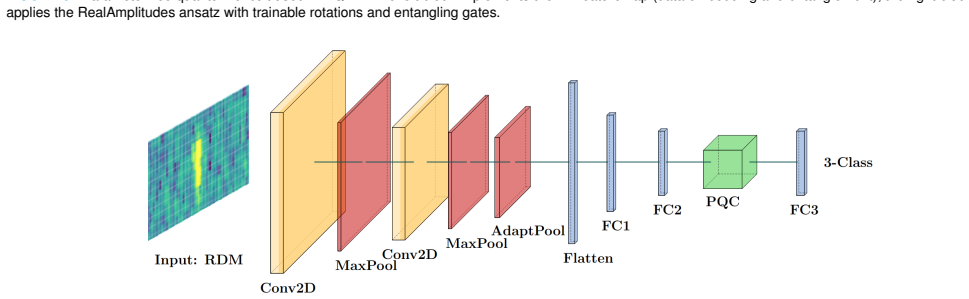
The parameterized quantum circuit inside the hybrid quantum neural network, which maps radar features into a low-dimensional quantum state before classical post-processing for occupancy classification.
If this is right
- The HQNN maintains high accuracy on both synthetic and real data under matched training protocols.
- Removing the parameterized quantum circuit produces sharp drops in real-data performance, showing the quantum part is not merely additive.
- Under additive noise the HQNN begins recovery sooner on synthetic data while CNNs recover more steeply and reach higher peaks on real data.
- CNNs remain more sample-efficient on real range-Doppler maps, with the gap largest at 50 percent label fractions and largely closing on synthetic data.
Where Pith is reading between the lines
- The extreme parameter reduction could allow the model to run on low-power edge hardware for continuous, always-on radar monitoring.
- The differing noise-recovery curves suggest that hybrid ensembles might combine the early recovery of the quantum model with the higher peak of the classical model.
- The same digital-twin training strategy could be tested on other radar frequencies or related sensing tasks to check whether similar parameter efficiencies appear.
Load-bearing premise
The physics-informed digital twin produces training data whose statistical distribution is close enough to actual 60 GHz radar measurements that the observed accuracy gaps and noise behaviors will appear under other measurement conditions.
What would settle it
Collecting new real radar recordings from environments outside the digital twin's modeled scenarios and finding that the HQNN accuracy falls below 90 percent while the CNN baseline stays above 95 percent would falsify the generalization of the efficiency claim.
Figures




read the original abstract
Indoor occupancy classification enables privacy-preserving monitoring in settings such as remote elder care, where presence information helps triage alarms without cameras or wearables. Radar suits this role by sensing motion through occlusions and in darkness. Modern deep-learning pipelines are the standard for interpreting radar returns effectively; however, they are often parameter-heavy and sensitive at low signal-to-noise ratios (SNR), motivating compact alternatives like Hybrid Quantum Neural Networks (HQNNs). A two-qubit HQNN is benchmarked against convolutional neural networks (CNNs) using a physics-informed 60GHz digital twin and real radar measurements under matched training protocols. In clean conditions, the HQNN achieves high accuracy (99.7% synthetic; 97.0% real) with up to 170x fewer parameters (0.066M). Its parameter efficiency is shown to be structural, as an ablation of the parameterized quantum circuit (PQC) causes sharp performance drops on real data (to 68.5% and 31.5% for the control heads). A domain-dependent sensitivity emerges under additive-noise evaluation, where the HQNN begins recovery earlier in synthetic data while CNNs recover more steeply and peak higher on real measurements. In label-fraction ablations, CNNs prove more sample-efficient on real Range-Doppler Maps (RDMs), with the performance gap being most pronounced (at 50% labels, BA 0.89-0.99 vs. HQNN 0.75). On synthetic data, this gap narrows significantly, largely vanishing by the 50% label mark. Overall, the HQNN's value lies in parameter efficiency and a compact inductive bias that shapes its distinct sensitivity profile; this work establishes a rigorous baseline for hybrid quantum models in privacy-preserving radar occupancy sensing.
Editorial analysis
A structured set of objections, weighed in public.
Referee Report
Summary. The manuscript introduces a compact two-qubit Hybrid Quantum Neural Network (HQNN) for classifying indoor occupancy from radar Range-Doppler Maps (RDMs). It compares the HQNN to convolutional neural networks (CNNs) using both synthetic data from a physics-informed 60 GHz digital twin and real radar measurements under matched protocols. Key results include 99.7% accuracy on synthetic data and 97.0% on real data with only 0.066M parameters (170x fewer than baselines), structural parameter efficiency demonstrated by PQC ablation leading to drops to 68.5% and 31.5% on real data, and analyses of noise sensitivity and label efficiency showing distinct profiles for the hybrid model.
Significance. If the results hold under broader validation, this work provides a concrete empirical baseline for hybrid quantum-classical models in privacy-preserving radar sensing. The reported parameter efficiency (0.066M parameters), ablation drops, and domain-dependent noise/label sensitivities offer evidence that the hybrid inductive bias can yield compact, distinct performance profiles compared to CNNs, which is relevant for resource-constrained sensing applications such as elder-care monitoring.
major comments (1)
- [Data generation and experimental protocols] The claims of real-data performance (97.0% accuracy, noise-recovery profiles, and label-fraction gaps at 50% labels) and the interpretation of HQNN vs. CNN differences as arising from hybrid inductive bias rest on the fidelity of the physics-informed 60 GHz digital twin. No quantitative validation of the synthetic RDM distribution against real measurements is provided (e.g., no feature-wise statistics, Wasserstein distances, or cross-protocol hold-out tests beyond protocol matching). This is load-bearing for the generalization of the observed sensitivities and efficiency advantages.
minor comments (2)
- [Results] Error bars or standard deviations are not reported on the real-data accuracy curves or label-fraction plots, making it difficult to assess the reliability of the gaps (e.g., BA 0.89-0.99 vs. 0.75 at 50% labels).
- [Abstract] The exact parameter count of the CNN baseline should be stated explicitly in the abstract and methods to support the 'up to 170x fewer parameters (0.066M)' claim.
Simulated Author's Rebuttal
We thank the referee for the constructive feedback and for emphasizing the importance of rigorously validating the physics-informed digital twin. We address the major comment below and will incorporate additional quantitative analyses in the revised manuscript to strengthen the claims.
read point-by-point responses
-
Referee: The claims of real-data performance (97.0% accuracy, noise-recovery profiles, and label-fraction gaps at 50% labels) and the interpretation of HQNN vs. CNN differences as arising from hybrid inductive bias rest on the fidelity of the physics-informed 60 GHz digital twin. No quantitative validation of the synthetic RDM distribution against real measurements is provided (e.g., no feature-wise statistics, Wasserstein distances, or cross-protocol hold-out tests beyond protocol matching). This is load-bearing for the generalization of the observed sensitivities and efficiency advantages.
Authors: We agree that explicit quantitative validation of the synthetic RDM distribution is necessary to support the generalization of the reported sensitivities and efficiency advantages. While the training protocols were matched between the digital twin and real measurements to ensure direct comparability, we acknowledge that this alone does not fully quantify distributional fidelity. In the revised manuscript, we will add: (1) feature-wise statistical comparisons including means, variances, skewness, and kurtosis of RDM pixel intensities; (2) Wasserstein distances computed between the synthetic and real RDM distributions in both clean and noisy conditions; and (3) results from cross-protocol hold-out experiments where models trained on one protocol are evaluated on the other. These additions will provide a more robust foundation for attributing performance differences to the hybrid inductive bias rather than data mismatch. revision: yes
Circularity Check
No circularity: claims rest on direct empirical measurements and ablations
full rationale
The paper reports measured accuracies (99.7% synthetic, 97.0% real), parameter counts (0.066M), and ablation drops (to 68.5%/31.5%) from training HQNN and CNN models on data generated by the physics-informed digital twin and real radar. These are outcome statistics, not quantities derived from equations that reduce to the inputs by construction. No self-citations, ansatzes, or uniqueness theorems are invoked to force the performance gaps or efficiency claims; the digital twin is treated as an external data generator whose fidelity is assumed rather than mathematically derived within the paper. The central results are therefore falsifiable benchmarks rather than tautological re-statements of fitted parameters or prior self-citations.
Axiom & Free-Parameter Ledger
free parameters (1)
- PQC rotation angles
axioms (2)
- domain assumption The digital twin radar returns are statistically representative of real 60 GHz measurements under the tested conditions.
- standard math Standard cross-entropy loss and gradient-based optimization suffice to train the hybrid model without barren-plateau issues for two qubits.
Lean theorems connected to this paper
-
IndisputableMonolith/Cost/FunctionalEquation.leanwashburn_uniqueness_aczel unclear?
unclearRelation between the paper passage and the cited Recognition theorem.
A compact two-qubit quantum circuit that alternates between data encoding and trainable processing... ZZFeatureMap... RealAmplitudes ansatz (reps=1)... expectation values of Pauli-Z operators... f(x;θ) = [⟨ψ|ZI|ψ⟩, ⟨ψ|IZ|ψ⟩]
-
IndisputableMonolith/Foundation/AlexanderDuality.leanalexander_duality_circle_linking unclear?
unclearRelation between the paper passage and the cited Recognition theorem.
physics-informed 60 GHz digital twin... SBR scattering model (GO/PO)... Range-Doppler Maps
What do these tags mean?
- matches
- The paper's claim is directly supported by a theorem in the formal canon.
- supports
- The theorem supports part of the paper's argument, but the paper may add assumptions or extra steps.
- extends
- The paper goes beyond the formal theorem; the theorem is a base layer rather than the whole result.
- uses
- The paper appears to rely on the theorem as machinery.
- contradicts
- The paper's claim conflicts with a theorem or certificate in the canon.
- unclear
- Pith found a possible connection, but the passage is too broad, indirect, or ambiguous to say the theorem truly supports the claim.
Reference graph
Works this paper leans on
-
[1]
World Health Organization, “Falls,” Apr. 2021, accessed 2025-08-19. [Online]. Available: https://www.who.int/news-room/fact-sheets/detail/ falls
work page 2021
-
[2]
Centers for Disease Control and Prevention, “Facts about falls,” May 2024, accessed 2025-08-19. [Online]. Available: https://www.cdc.gov/ falls/data-research/facts-stats/index.html
work page 2024
-
[3]
M.-H. Wen, C.-L. Chen, Y .-C. Lin, Y .-H. Hsu, D. Bai, and C.-H. Chen, “Enhancing patient safety through an integrated internet of things patient care system: Large quasi-experimental study on fall prevention,” Journal of Medical Internet Research, vol. 26, no. 1, p. e58380, 2024. [Online]. Available: https://www.jmir.org/2024/1/e58380/
work page 2024
-
[4]
Reducing the safety hazards of monitor alert and alarm fatigue,
S. Jacques and B. Denham, “Reducing the safety hazards of monitor alert and alarm fatigue,” AHRQ PSNet Perspective, 2023, cites 80–99% false/clinically insignificant monitor alarms; accessed 2025-08-19. [Online]. Available: https://psnet.ahrq.gov/perspective/ reducing-safety-hazards-monitor-alert-and-alarm-fatigue
work page 2023
-
[5]
The methods of fall detection: A literature review,
N. T. Newaz, M. A. Rahman et al., “The methods of fall detection: A literature review,” Sensors, vol. 23, no. 11, p. 5212, 2023. [Online]. Available: https://www.mdpi.com/1424-8220/23/11/5212
work page 2023
-
[6]
T. Mujirishvili, C. Maidhof, F. Florez-Revuelta, M. Ziefle, M. Richart- Martinez, and J. Cabrero-García, “Acceptance and privacy perceptions toward video-based active and assisted living technologies: Scoping review,” Journal of Medical Internet Research, vol. 25, p. e45297, 2023. [Online]. Available: https://www.jmir.org/2023/1/e45297/
work page 2023
-
[7]
Wi-fi sensing techniques for human activity recognition: A survey,
X. Zhang, Y . Li, Z. Wang et al., “Wi-fi sensing techniques for human activity recognition: A survey,” ACM Computing Surveys, 2025. [Online]. Available: https://dl.acm.org/doi/10.1145/3705893
-
[8]
A comprehensive survey of research trends in mmwave-based medical sensing systems,
X. Zhang, Y . Zhao, J. Chen et al., “A comprehensive survey of research trends in mmwave-based medical sensing systems,” IEEE Access / PMC preprint, 2025, accessed 2025-08-19. [Online]. Available: https://pmc.ncbi.nlm.nih.gov/articles/PMC12197076/
work page 2025
-
[9]
I. Roldan, C. R. del Blanco, Á. Duque de Quevedo, F. Ibañez Urzaiz, J. Gismero Menoyo, A. Asensio López, D. Berjón, F. Jaureguizar, and N. García, “Dopplernet: a convolutional neural network for recognising targets in real scenarios using a persistent range–doppler radar,” IET Radar, Sonar & Navigation, vol. 14, no. 4, pp. 593–600,
-
[10]
Yoshua Bengio, Aaron Courville, and Pascal Vincent
[Online]. Available: https://ietresearch.onlinelibrary.wiley.com/doi/ abs/10.1049/iet-rsn.2019.0307
-
[11]
M. Mboyi Gilles Yowel, D.-H. Oh, and J.-H. Han, “Hybrid dcnn–transfer learning model coupled with background clutter mitigation for fmcw radar-based people counting improvement,” IEEE Transactions on Instru- mentation and Measurement, vol. 74, pp. 1–14, 2025
work page 2025
-
[12]
Fmcw radar sensor based human activity recognition using deep learning,
S. Ahmed, J. Park, and S. H. Cho, “Fmcw radar sensor based human activity recognition using deep learning,” in Proceedings of the 2022 International Conference on Electronics, Information, and Communication (ICEIC), 2022, pp. 1–5
work page 2022
-
[13]
Analysis of processing pipelines for indoor human tracking using fmcw radar,
D. Wang, F. Fioranelli, and A. Yarovoy, “Analysis of processing pipelines for indoor human tracking using fmcw radar,” in Proceedings of the 2024 IEEE Radar Conference (RadarConf24), 2024, pp. 1–6
work page 2024
-
[14]
Unsupervised adversarial domain adaptation for micro-doppler based human activity classification,
H. Du, T. Jin, Y . Song, and Y . Dai, “Unsupervised adversarial domain adaptation for micro-doppler based human activity classification,” IEEE Trans. Geosci. Remote Sens., vol. 17, no. 1, pp. 62–66, 2020. VOLUME 4, 2016 19 Ratto V.et al.: Compact HQNN for Radar Occupancy via Physics-Informed Digital Twin
work page 2020
-
[15]
Unsuper- vised domain adaptation for micro-doppler human motion classification via feature fusion,
Y . Lang, Q. Wang, Y . Yang, C. Hou, D. Huang, and W. Xiang, “Unsuper- vised domain adaptation for micro-doppler human motion classification via feature fusion,” IEEE Trans. Geosci. Remote Sens., vol. 16, no. 3, pp. 392–396, 2019
work page 2019
-
[16]
Radar-based human activity recognition: A study on cross-environment robustness,
R. E. Hail, P. Mehrjouseresht, D. M. M.-P. Schreurs, and P. Karsmakers, “Radar-based human activity recognition: A study on cross-environment robustness,” Electronics, vol. 14, no. 5, p. Art. no. 875, 2025
work page 2025
-
[17]
Gaitsada: Self-aligned domain adaptation for mmwave gait recognition,
S. Pinyoanuntapong et al., “Gaitsada: Self-aligned domain adaptation for mmwave gait recognition,” in IEEE International Symposium on Wearable and Implantable Body Sensor Networks (BSN), 2023, pp. 1–4
work page 2023
-
[18]
U. Chipengo, A. P. Sligar, S. M. Canta et al., “High-fidelity physics simulation-based cnn for automotive radar target classification using micro-doppler,” IEEE Access, vol. 9, pp. 82 597–82 610, 2021
work page 2021
-
[19]
Severity of fall detection using digital twin for radar systems,
A. Elbadrawy, H. Abedi, A. Sligar, O. Ramahi, and G. Shaker, “Severity of fall detection using digital twin for radar systems,” in IEEE MAPCON, 2023, pp. 1–6
work page 2023
-
[20]
Unmanned aerial vehicle classification using neural net- works and radar digital twins,
A. N. Sayed, M. M. Y . R. Riad, A. Ansariyan, L. Salman, O. M. Ramahi, and G. Shaker, “Unmanned aerial vehicle classification using neural net- works and radar digital twins,” IEEE Microwave Magazine, vol. 25, no. 4, pp. 30–43, 2024
work page 2024
-
[21]
Digital twin system for realistic radar optimization in health- care monitoring,
S. R. V , A. N. Sayed, A. Elbadrawy, A. Sligar, O. M. Ramahi, and G. Shaker, “Digital twin system for realistic radar optimization in health- care monitoring,” in 2025 IEEE 20th International Symposium on Antenna Technology and Applied Electromagnetics (ANTEM), 2025, pp. 182–185
work page 2025
-
[22]
Enhancing healthcare monitoring through a fully integrated radar digital twin,
S. Ratto V ., A. N. Sayed, A. Elbadrawy, A. Sligar, O. M. Ramahi, and G. Shaker, “Enhancing healthcare monitoring through a fully integrated radar digital twin,” in 2025 International Applied Computational Electro- magnetics Society Symposium (ACES), Florida-USA, 2025, pp. 1–1
work page 2025
-
[23]
Digital twin-driven radar for human monitoring optimization,
S. Ratto, A. N. Sayed, A. Elbadrawy, A. Sligar, O. Ramahi, and G. Shaker, “Digital twin-driven radar for human monitoring optimization,” in Ex- tended Reality, L. T. De Paolis, P. Arpaia, and M. Sacco, Eds. Cham: Springer Nature Switzerland, 2026, pp. 33–45
work page 2026
-
[24]
Hybrid quantum- classical generative adversarial network for high-resolution image genera- tion,
S. L. Tsang, M. T. West, S. M. Erfani, and M. Usman, “Hybrid quantum- classical generative adversarial network for high-resolution image genera- tion,” IEEE Transactions on Quantum Engineering, vol. 4, pp. 1–19, 2023
work page 2023
-
[25]
Mixed quantum-classical method for fraud detection with quantum feature selection,
M. Grossi, N. Ibrahim, V . Radescu, R. Loredo, K. V oigt, C. von Altrock, and A. Rudnik, “Mixed quantum-classical method for fraud detection with quantum feature selection,” IEEE Transactions on Quantum Engineering, vol. 3, pp. 1–12, 2022
work page 2022
-
[26]
Quantum kernels for real-world predictions based on electronic health records,
Z. Krunic, F. F. Flöther, G. Seegan, N. D. Earnest-Noble, and O. Shehab, “Quantum kernels for real-world predictions based on electronic health records,” IEEE Transactions on Quantum Engineering, vol. 3, pp. 1–11, 2022
work page 2022
-
[27]
Exploiting the quantum advantage for satellite image processing: Review and assessment,
S. Otgonbaatar and D. Kranzlmüller, “Exploiting the quantum advantage for satellite image processing: Review and assessment,” IEEE Transactions on Quantum Engineering, vol. 5, pp. 1–9, 2023
work page 2023
-
[28]
B. O. Community, Blender: A 3D Modelling and Rendering Package, Blender Foundation, Stichting Blender Foundation, Amsterdam, 2018. [Online]. Available: http://www.blender.org
work page 2018
-
[29]
Mixamo: Characters and animations,
Adobe, “Mixamo: Characters and animations,” 2021, available: https: //www.mixamo.com/, Accessed: Aug. 19, 2025
work page 2021
-
[30]
CMU Graphics Lab Motion Capture Database, “CMU motion capture database,” http://mocap.cs.cmu.edu/, 2003–2007
work page 2003
-
[31]
Bgt60tr13c rf microelectromechanical sensor datasheet,
Infineon Technologies AG, “Bgt60tr13c rf microelectromechanical sensor datasheet,” 2023, [Online; accessed: Jul. 1, 2025]. [Online]. Available: https://www.infineon.com/cms/en/product/sensor/radar-sensors/
work page 2023
-
[32]
Synopsys, “Ansys perceive em,” https://www.ansys.com/products/ electronics/ansys-perceive-em, 2025, GPU-accelerated solver for radar and wireless digital-twin simulation
work page 2025
-
[33]
Shooting and bouncing rays: calculating the rcs of an arbitrarily shaped cavity,
H. Ling, R.-C. Chou, and S.-W. Lee, “Shooting and bouncing rays: calculating the rcs of an arbitrarily shaped cavity,” IEEE Transactions on Antennas and Propagation, vol. 37, no. 2, pp. 194–205, 1989
work page 1989
-
[34]
Simulating physics with computers,
R. P. Feynman, “Simulating physics with computers,” International Journal of Theoretical Physics, vol. 21, no. 6, pp. 467–488, 1982
work page 1982
-
[35]
Supervised learning with quantum-enhanced feature spaces,
V . Havlíˇcek, A. D. Córcoles, K. Temme, A. W. Harrow, A. Kandala, J. M. Chow, and J. M. Gambetta, “Supervised learning with quantum-enhanced feature spaces,” Nature, vol. 567, no. 7747, pp. 209–212, 2019
work page 2019
-
[36]
Quantum computing with Qiskit,
A. Javadi-Abhari, M. Treinish, K. Krsulich, C. J. Wood, J. Lishman, J. Gacon, S. Martiel, P. D. Nation, L. S. Bishop, A. W. Cross, B. R. Johnson, and J. M. Gambetta, “Quantum computing with Qiskit,” 2024
work page 2024
-
[37]
A. Dolna. (2024) Bloch sphere – interactive visualization tool. Accessed: Sep. 12, 2025. [Online]. Available: https://github.com/dolnaaa/ bloch-sphere
work page 2024
-
[38]
Evaluating analytic gradients on quantum hardware,
M. Schuld, V . Bergholm, C. Gogolin, J. Izaac, and N. Killoran, “Evaluating analytic gradients on quantum hardware,” Phys. Rev. A, vol. 99, no. 3, p. 032331, 2019
work page 2019
-
[39]
Deep residual learning for image recognition,
K. He, X. Zhang, S. Ren, and J. Sun, “Deep residual learning for image recognition,” in Proceedings of the IEEE Conference on Computer Vision and Pattern Recognition (CVPR), 2016, pp. 770–778
work page 2016
-
[40]
Efficientnet: Rethinking model scaling for convolutional neural networks,
M. Tan and Q. V . Le, “Efficientnet: Rethinking model scaling for convolutional neural networks,” in Proceedings of the 36th International Conference on Machine Learning, ser. Proceedings of Machine Learning Research, vol. 97. PMLR, 2019, pp. 6105–6114. [Online]. Available: http://proceedings.mlr.press/v97/tan19a.html
work page 2019
-
[41]
Z. Wang, C. Yao, J. Ren, and X. Jiang, “Human activity recognition using 3d orthogonally-projected efficientnet on radar time–range–doppler signatures,” arXiv preprint arXiv:2111.12375, 2021. [Online]. Available: https://arxiv.org/abs/2111.12375
-
[42]
Quantum machine learning in feature hilbert spaces,
M. Schuld and N. Killoran, “Quantum machine learning in feature hilbert spaces,” Physical Review Letters, vol. 122, no. 4, p. 040504, 2019
work page 2019
-
[43]
J. Biamonte, P. Wittek, N. Pancotti, P. Rebentrost, N. Wiebe, and S. Lloyd, “Quantum machine learning,” Nature, vol. 549, no. 7671, pp. 195–202, 2017
work page 2017
-
[44]
Noise-induced barren plateaus in variational quantum algorithms,
S. Wang, E. Fontana, M. Cerezo, K. Sharma, A. Sone, L. Cincio, and P. J. Coles, “Noise-induced barren plateaus in variational quantum algorithms,” Nature communications, vol. 12, no. 1, p. 6961, 2021
work page 2021
-
[45]
Training deep quantum neural networks,
K. Beer, D. Bondarenko, T. Farrelly, T. J. Osborne, R. Salzmann, D. Scheiermann, and R. Wolf, “Training deep quantum neural networks,” Nat. Commun., vol. 11, p. Art. no. 808, 2020
work page 2020
-
[46]
M. E. Sahin, E. Altamura, O. Wallis, S. P. Wood, A. Dekusar, D. A. Millar, T. Imamichi, A. Matsuo, and S. Mensa, “Qiskit Machine Learn- ing: an open-source library for quantum machine learning tasks at scale on quantum hardware and classical simulators,” arXiv e-prints, p. arXiv:2505.17756, May 2025
-
[47]
The power of quantum neural networks,
A. Abbas, D. Sutter, C. Zoufal, A. Lucchi, A. Figalli, and S. Woerner, “The power of quantum neural networks,” Nature Computational Science, vol. 1, no. 6, pp. 403–409, 2021
work page 2021
-
[48]
Effect of data encoding on the expressive power of variational quantum machine learning models,
M. Schuld and J. J. Meyer, “Effect of data encoding on the expressive power of variational quantum machine learning models,” Physical Review A, vol. 103, no. 3, p. 032430, 2021
work page 2021
-
[49]
Quantum reservoir computing with a single nonlinear oscillator,
L. C. G. Govia, G. J. Ribeill, G. E. Rowlands, H. K. Krovi, and T. A. Ohki, “Quantum reservoir computing with a single nonlinear oscillator,” Phys. Rev. Res., vol. 3, p. 013077, Jan 2021. [Online]. Available: https://link.aps.org/doi/10.1103/PhysRevResearch.3.013077 SEBASTIAN RATTO VALDERRAMA(Student Member, IEEE) is a Chilean naval officer with 12 years ...
discussion (0)
Sign in with ORCID, Apple, or X to comment. Anyone can read and Pith papers without signing in.