Numerical study of the two-boson bound-state problem with and without partial-wave decomposition
Pith reviewed 2026-05-16 13:26 UTC · model grok-4.3
The pith
The partial-wave and vector-variable methods agree to high precision on two-boson bound states
A machine-rendered reading of the paper's core claim, the machinery that carries it, and where it could break.
Core claim
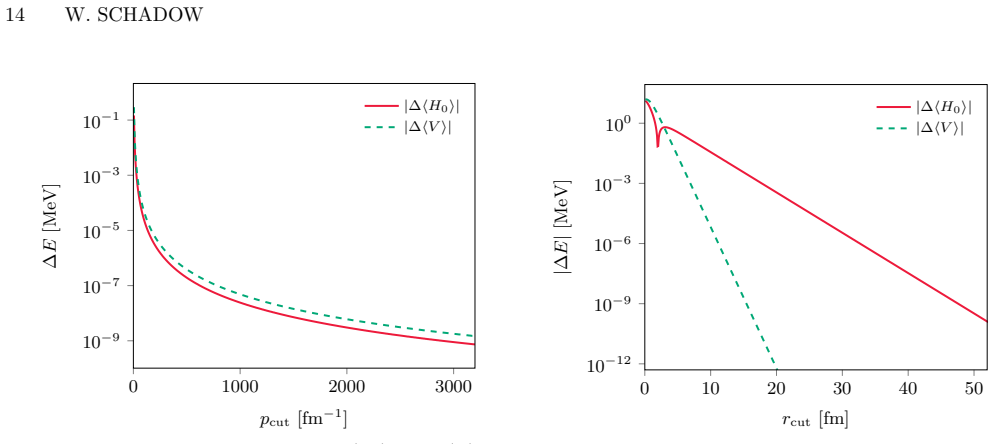
The paper solves the two-boson bound-state problem in two ways: via the one-dimensional partial-wave Lippmann-Schwinger equation and via a two-dimensional vector-variable equation. It demonstrates their high-precision numerical equivalence for Yamaguchi and Malfliet-Tjon potentials. Exact analytical expressions are derived for the systematic cutoff errors in the Yamaguchi case, offering a way to distinguish discretization errors from truncation effects in few-body codes.
What carries the argument
Direct numerical comparison of the one-dimensional partial-wave Lippmann-Schwinger equation to the two-dimensional vector-momentum formulation of the same bound-state problem.
If this is right
- The vector-variable formulation is validated for use in higher-energy scattering applications where partial-wave expansions converge slowly.
- The benchmark provides a detailed baseline for vector-variable algorithms in three- and four-body calculations.
- Analytical bounds on cutoff errors allow separation of discretization inaccuracies from other truncation effects in numerical few-body work.
- The equivalence is confirmed for both separable and non-separable interactions.
Where Pith is reading between the lines
- This validation could be used to check vector-variable implementations before applying them to problems with more particles or more complicated forces.
- The analytical error expressions might be generalized to estimate cutoff effects in other potentials or dimensions.
- Confirmation of equivalence at the two-body level supports moving directly to vector methods for nuclear scattering at energies requiring many partial waves.
Load-bearing premise
The Yamaguchi and Malfliet-Tjon potentials together with the specific discretizations employed are representative of the general case for validating vector-variable methods in few-body physics.
What would settle it
A computed bound-state energy that differs between the two formulations by more than the amount predicted by the analytical cutoff error formulas for the Yamaguchi potential.
Figures
read the original abstract
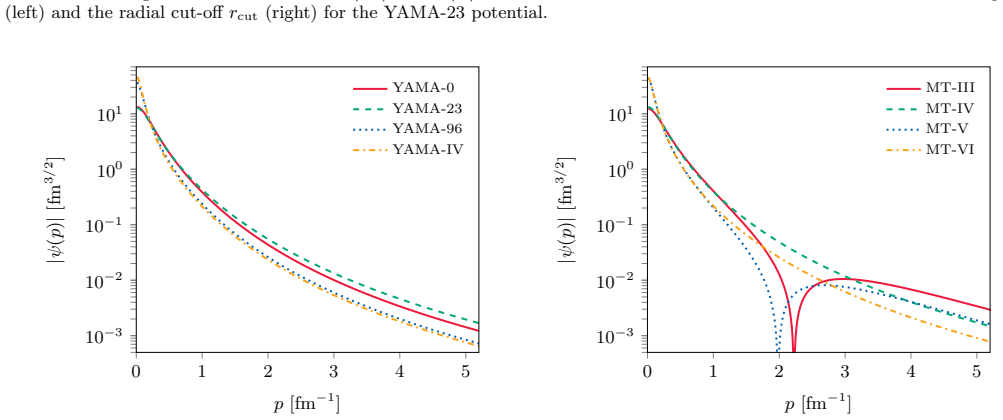
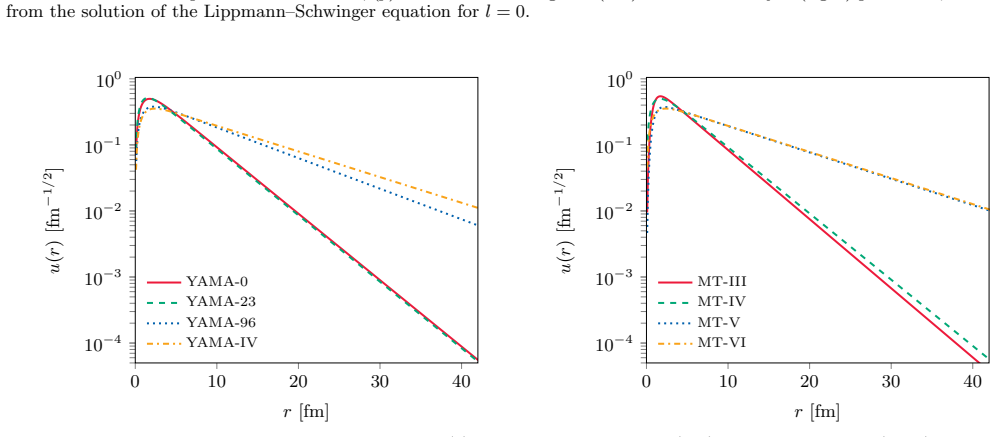
The validation of numerical methods is a prerequisite for reliable few-body calculations, particularly when moving beyond standard partial-wave decompositions. In this work, we present a precision benchmark for the two-boson bound-state problem, solving it using two complementary formulations: the standard one-dimensional partial-wave Lippmann--Schwinger equation and a two-dimensional formulation based directly on vector variables. While the partial-wave approach is computationally efficient for low-energy bound states, the vector-variable formulation becomes essential for scattering applications at higher energies where the partial-wave expansion converges slowly. We demonstrate the high-precision numerical equivalence of both methods using rank-one separable Yamaguchi potentials and non-separable Malfliet--Tjon interactions. Furthermore, for the Yamaguchi potential, we derive exact analytical expressions quantifying the systematic errors introduced by finite momentum- and coordinate-space cut-offs. These analytical bounds provide a rigorous tool for disentangling discretization errors from truncation effects in few-body codes. The results establish a highly controlled methodological benchmark that provides a detailed baseline for vector-variable algorithms intended for more complex three- and four-body calculations.
Editorial analysis
A structured set of objections, weighed in public.
Referee Report
Summary. The manuscript presents a precision benchmark for the two-boson bound-state problem by comparing the standard one-dimensional partial-wave Lippmann-Schwinger equation with a two-dimensional vector-variable formulation. It reports high-precision numerical equivalence for rank-one separable Yamaguchi potentials and non-separable Malfliet-Tjon interactions, derives exact analytical expressions for systematic cut-off errors in the Yamaguchi case, and positions the results as a controlled baseline for validating vector-variable algorithms in more complex three- and four-body calculations.
Significance. If the reported numerical equivalence and analytical error bounds hold, the work supplies a useful methodological test case for few-body nuclear physics, especially for validating non-partial-wave approaches needed at higher energies. The exact analytical cut-off error expressions for the Yamaguchi potential are a clear strength, as they allow direct separation of truncation effects from discretization errors without relying on numerical fitting.
major comments (2)
- [Numerical results and discussion sections] The equivalence and error analysis are demonstrated only for the Yamaguchi (rank-one separable) and Malfliet-Tjon (one non-separable) cases with specific discretizations. Since the central claim frames this as a general baseline for vector-variable algorithms in more complex few-body systems, the manuscript should include at least one additional interaction class (e.g., with strong momentum dependence or tensor components typical of realistic nuclear forces) to test whether the reported precision and error control generalize.
- [Analytical error analysis section] The abstract states that exact analytical expressions for finite momentum- and coordinate-space cut-off errors are derived for the Yamaguchi potential, but the main text must explicitly display these expressions (including any intermediate steps from the integral equations) so that readers can verify the claimed parameter-free character and apply them independently.
minor comments (2)
- [Abstract and results tables] The achieved numerical precision (e.g., number of matching digits between the two formulations) should be stated quantitatively in the abstract and results tables rather than described only qualitatively as 'high-precision'.
- [Methods section] Notation for the vector-variable formulation (e.g., definitions of the two-dimensional momentum variables) should be introduced with a clear diagram or explicit coordinate definitions early in the methods section to improve readability for readers unfamiliar with the approach.
Simulated Author's Rebuttal
We thank the referee for the constructive comments and positive assessment of the manuscript. We address each major comment point by point below, indicating the revisions we will implement.
read point-by-point responses
-
Referee: [Numerical results and discussion sections] The equivalence and error analysis are demonstrated only for the Yamaguchi (rank-one separable) and Malfliet-Tjon (one non-separable) cases with specific discretizations. Since the central claim frames this as a general baseline for vector-variable algorithms in more complex few-body systems, the manuscript should include at least one additional interaction class (e.g., with strong momentum dependence or tensor components typical of realistic nuclear forces) to test whether the reported precision and error control generalize.
Authors: We agree that demonstrating the equivalence for a broader set of interactions would strengthen the positioning of the work as a general baseline. The Yamaguchi and Malfliet-Tjon cases were chosen to contrast separable and non-separable forms, but we acknowledge the value of an additional test case with stronger momentum dependence. In the revised manuscript we will add numerical results for one further interaction (a simple momentum-dependent separable form) in the numerical results section to confirm that the reported precision and error control extend beyond the two cases already presented. revision: yes
-
Referee: [Analytical error analysis section] The abstract states that exact analytical expressions for finite momentum- and coordinate-space cut-off errors are derived for the Yamaguchi potential, but the main text must explicitly display these expressions (including any intermediate steps from the integral equations) so that readers can verify the claimed parameter-free character and apply them independently.
Authors: We accept this point. Although the derivations are referenced, the explicit expressions and intermediate steps were not displayed in the main text. In the revised manuscript we will add a dedicated subsection in the analytical error analysis section that presents the full analytical expressions for the momentum- and coordinate-space cut-off errors, together with the key intermediate steps from the integral equations, so that readers can verify the parameter-free character and reproduce the results independently. revision: yes
Circularity Check
No circularity: numerical equivalence and analytical error bounds derived independently from the integral equations
full rationale
The paper solves the one-dimensional partial-wave Lippmann-Schwinger equation and the two-dimensional vector-variable formulation numerically for the two-boson bound state, using rank-one separable Yamaguchi and non-separable Malfliet-Tjon potentials, then directly compares the resulting binding energies and wave functions to establish equivalence. For the Yamaguchi case, exact analytical expressions for finite momentum- and coordinate-space cut-off errors are obtained by direct manipulation of the integral equations themselves rather than by fitting to numerical output. No load-bearing step reduces to a self-definition, a fitted parameter renamed as a prediction, or a self-citation chain; the equivalence is shown by explicit computation on independent discretizations, and the error bounds follow mathematically from the chosen potential without circular reference to the numerical results.
Axiom & Free-Parameter Ledger
axioms (1)
- domain assumption The Lippmann-Schwinger equation accurately describes the two-boson bound-state problem for the Yamaguchi and Malfliet-Tjon potentials
Reference graph
Works this paper leans on
- [1]
- [2]
-
[3]
W. Schadow, Ch. Elster, and W. Gl¨ ockle, Few-Body Sys- tems28, 15 (2000)
work page 2000
-
[4]
M. Pol´ aˇ sek and M. Ingr and P.ˇC´ arsky and J. Hor´ aˇ cek, Phys. Rev. A61, 032701 (2000)
work page 2000
- [5]
-
[6]
G. L. Caia and V. Pascalutsa and L. E. Wright, Phys. Rev. C69, 034003 (2004)
work page 2004
-
[7]
B. Kessler and G. L. Payne and W. N. Polyzou, Phys. Rev. C70, 034003 (2004)
work page 2004
-
[8]
A. S. Kadyrov and I. Bray and A. T. Stelbovics and B. Saha, J. Phys. B: At. Mol. Opt. Phys.38, 509 (2005)
work page 2005
-
[9]
H. Liu, Ch. Elster, and W. Gl¨ ockle, Phys. Rev. C72, 054003 (2005)
work page 2005
-
[10]
G. Ramalho and A. Arriaga and M. T. Pe˜ na, Few-Body Systems39, 123 (2006)
work page 2006
-
[11]
H. Liu, Ch. Elster, and W. Gl¨ ockle, Nucl. Phys.A790, 262c (2007)
work page 2007
-
[12]
M. R. Hadizadeh and S. Bayegan, Few-Body Systems40, 171 (2007)
work page 2007
-
[13]
M. Rodriguez-Gallardo and A. Deltuva and E. Cravo and R. Crespo and A. C. Fonseca, Phys. Rev. C78, 034602 (2008)
work page 2008
-
[14]
M. R. Hadizadeh and S. Bayegan, Eur. Phys. J. A36, 201 (2008)
work page 2008
-
[15]
S. Bayegan, M. R. Hadizadeh, and M. Harzchi, Phys. Rev. C77, 064005 (2008)
work page 2008
- [16]
-
[17]
W. Gl¨ ockle, Ch. Elster, J. Golak, R. Skibi´ nski, H. Wita la, and H. Kamada, Few-Body Systems47, 25 (2010)
work page 2010
- [18]
- [19]
-
[20]
M. A. Shalchi and S. Bayegan, Eur. Phys. J.A48, 6 (2012)
work page 2012
-
[21]
S. Veerasamy and Ch. Elster and W. N. Polyzou, Few- Body Systems54, 2207 (2013)
work page 2013
- [22]
-
[23]
Z. C. Kuruo˘ glu, Phys. Rev. E94, 053308 (2016)
work page 2016
- [24]
- [25]
-
[26]
R. A. Malfliet and J. A. Tjon, Nucl. Phys.A127, 161 (1969)
work page 1969
- [27]
- [28]
-
[29]
M. Hamzavi, M. Movahedi, K.-E. Thylwe, and A. A. Rajabi, Chin. Phys. Lett.29, 080302 (2012)
work page 2012
-
[30]
M. Napsuciale and S. Rodr´ ıguez, Physics Letters B816, 136218 (2021)
work page 2021
-
[31]
Gl¨ ockle,Computational Nuclear Physics I
W. Gl¨ ockle,Computational Nuclear Physics I. Nuclear Structure, Edited by K. Langanke, J. A. Maruhn, and S. E. Koonin, pp 152(Springer-Verlag, Berlin-Heidelberg, 1991)
work page 1991
-
[32]
W. A. Karr and C. R. Jamell and Y. N. Joglekar, Am. J. Phys.78, 407 (2010)
work page 2010
-
[33]
J. H. Wilkinson,The Algebraic Eigenvalue Problem (Clarendon Press, Oxford, 1965)
work page 1965
- [34]
-
[35]
W. E. Arnoldi, Q. Appl. Math.9, 17 (1951)
work page 1951
- [36]
discussion (0)
Sign in with ORCID, Apple, or X to comment. Anyone can read and Pith papers without signing in.