Efficient and compact quantum network node based on a parabolic mirror on an optical chip
Pith reviewed 2026-05-16 12:38 UTC · model grok-4.3
The pith
A parabolic mirror integrated on a chip forms a compact neutral-atom node that collects 9 percent of emitted photons while generating atom-photon entanglement with 0.93 raw fidelity.
A machine-rendered reading of the paper's core claim, the machinery that carries it, and where it could break.
Core claim
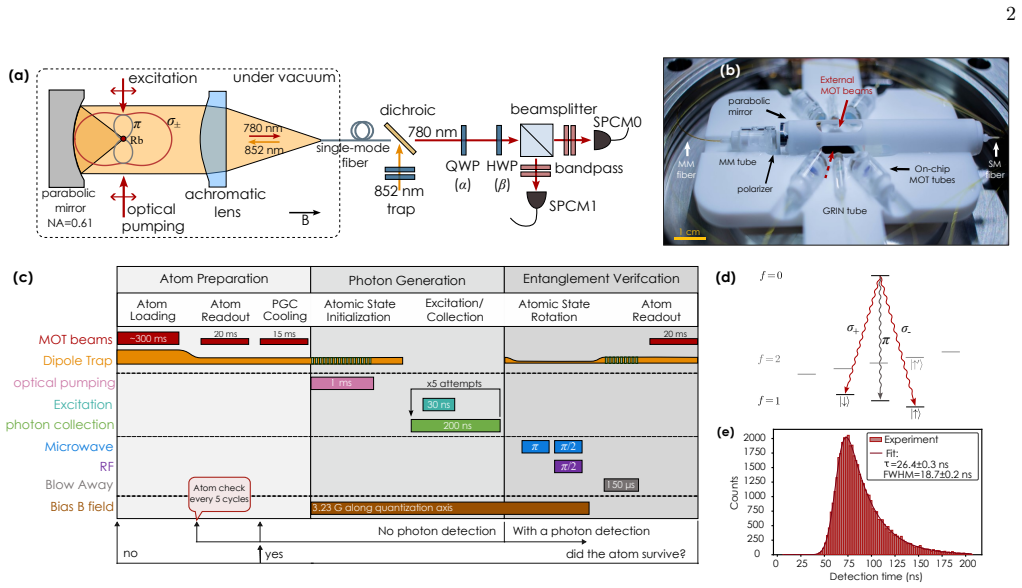
We demonstrate a neutral atom networking node that combines high photon collection efficiency with high atom photon entanglement fidelity in a compact, fiber integrated platform. A parabolic mirror is used both to form the trap and to collect fluorescence from a single rubidium atom, intrinsically mode matching sigma polarized emitted photons to the fiber and rendering the system largely insensitive to small imperfections or drifts. With this design, we measure an overall photon collection and detection efficiency of 5 percent, from which we infer an overall collection efficiency of 9 percent after the single-mode fiber coupling, and generate atom photon entangled states with a raw Bellstate
What carries the argument
The parabolic mirror that forms the optical trap for the rubidium atom and collects its fluorescence, intrinsically mode-matching the sigma-polarized photons to the single-mode fiber while providing drift insensitivity.
If this is right
- The same node design can be realized in independent setups with comparable performance.
- The architecture is compatible with adding high-NA objective lenses to create and control atomic arrays at each node.
- The interface operates near the limit set by the collection optics numerical aperture without requiring a cavity.
- The fiber-integrated monolithic assembly provides a scalable building block for quantum network nodes and repeaters.
Where Pith is reading between the lines
- The drift insensitivity could reduce the infrastructure needed for stable operation at multiple distant nodes.
- Combining the mirror with array control lenses might allow multi-atom nodes while preserving the fiber interface.
- The cavity-free approach may simplify integration with other photonic components for longer-distance quantum links.
Load-bearing premise
The parabolic mirror must intrinsically mode-match the emitted photons to the fiber and remain largely insensitive to small imperfections or drifts to reach the stated collection efficiency and entanglement fidelity.
What would settle it
Replicating the setup and measuring a collection efficiency well below 9 percent after fiber coupling, or a raw Bell-state fidelity well below 0.93, would falsify the performance claims for this compact node design.
Figures


read the original abstract
We demonstrate a neutral atom networking node that combines high photon collection efficiency with high atom photon entanglement fidelity in a compact, fiber integrated platform. A parabolic mirror is used both to form the trap and to collect fluorescence from a single rubidium atom, intrinsically mode matching $\sigma$ polarized emitted photons to the fiber and rendering the system largely insensitive to small imperfections or drifts. The core optics consist of millimeter scale components that are pre aligned, rigidly bonded on a monolithic in-vacuum assembly, and interfaced entirely via optical fibers. With this design, we measure an overall photon collection and detection efficiency of $5\%$, from which we infer an overall collection efficiency of $9\%$ after the single--mode fiber coupling. We generate atom photon entangled states with a raw Bell state fidelity of 0.93 and an inferred fidelity of 0.98 after correcting for atom readout errors. The same node design has been realized in two independent setups with comparable performance and is compatible with adding high NA objective lenses to create and control atomic arrays at each node. Our results establish a robust, cavity free neutral atom interface that operates near the limit set by the collection optics numerical aperture and provides a practical building block for scalable quantum network nodes and repeaters.
Editorial analysis
A structured set of objections, weighed in public.
Referee Report
Summary. The manuscript demonstrates a compact, fiber-integrated neutral atom quantum network node using a parabolic mirror for both trapping a single rubidium atom and collecting its fluorescence photons. The design achieves an overall photon detection efficiency of 5%, from which a collection efficiency of 9% is inferred after single-mode fiber coupling, and generates atom-photon entangled states with a raw Bell fidelity of 0.93 (inferred 0.98 after readout error correction). The core optics are millimeter-scale, pre-aligned, and rigidly bonded on a monolithic in-vacuum assembly interfaced entirely via fibers. The same node design is realized in two independent setups with comparable performance and is compatible with high-NA objective lenses for atomic arrays. The approach is cavity-free and claims robustness to small imperfections due to intrinsic mode-matching of σ-polarized photons.
Significance. If the reported performance holds, this work provides a practical, scalable building block for neutral-atom quantum networks and repeaters. The combination of high collection efficiency (near the NA limit), high entanglement fidelity, compactness, and fiber integration without cavities addresses key engineering challenges in quantum networking. Direct experimental measurements of detection efficiency and Bell fidelity, reproduced across two setups with standard loss accounting and readout correction, strengthen the claims. The monolithic pre-aligned assembly and insensitivity to drifts offer advantages for real-world deployment. This could accelerate development of quantum internet components.
minor comments (2)
- [Abstract] Abstract: The inference from 5% detection efficiency to 9% collection efficiency would benefit from a brief explicit statement of the loss factors (e.g., fiber coupling, detector quantum efficiency) used in the accounting, even if standard.
- [Results] The manuscript would be strengthened by a short table or side-by-side comparison of the key metrics (efficiency, fidelity, stability) from the two independent setups to highlight reproducibility.
Simulated Author's Rebuttal
We thank the referee for the positive assessment of our manuscript and the recommendation to accept. We are pleased that the work is recognized as providing a practical building block for neutral-atom quantum networks.
Circularity Check
No significant circularity in experimental results
full rationale
The manuscript reports direct experimental measurements of photon collection efficiency (5% detected, 9% inferred) and atom-photon entanglement fidelity (raw 0.93, corrected 0.98) in a fiber-integrated parabolic-mirror node. These quantities are obtained from calibrated detection counts and Bell-state tomography on single atoms, with readout-error correction performed via independent calibration measurements. No theoretical derivation chain, parameter fitting that is then relabeled as prediction, or load-bearing self-citation is invoked to obtain the central performance numbers; the results stand on empirical data from two independent realizations. The design description of the mirror's mode-matching property is presented as a physical consequence of the parabolic geometry rather than a fitted or self-defined quantity.
Axiom & Free-Parameter Ledger
axioms (1)
- standard math Standard quantum mechanics governs atom-photon entanglement and fluorescence emission patterns
Lean theorems connected to this paper
-
IndisputableMonolith/Foundation/RealityFromDistinction.leanreality_from_one_distinction unclear?
unclearRelation between the paper passage and the cited Recognition theorem.
A parabolic mirror is used both to form the trap and to collect fluorescence from a single rubidium atom, intrinsically mode-matching σ polarized emitted photons to the fiber
What do these tags mean?
- matches
- The paper's claim is directly supported by a theorem in the formal canon.
- supports
- The theorem supports part of the paper's argument, but the paper may add assumptions or extra steps.
- extends
- The paper goes beyond the formal theorem; the theorem is a base layer rather than the whole result.
- uses
- The paper appears to rely on the theorem as machinery.
- contradicts
- The paper's claim conflicts with a theorem or certificate in the canon.
- unclear
- Pith found a possible connection, but the passage is too broad, indirect, or ambiguous to say the theorem truly supports the claim.
Forward citations
Cited by 1 Pith paper
-
A quantum frequency conversion hub interfacing with DWDM networks
A QFC hub achieves 2 THz pump tunability via a dispersion sweet spot in PPLN and distributes polarization-encoded single photons across 16 ITU-T DWDM channels while preserving quantum information.
Reference graph
Works this paper leans on
-
[1]
H. J. Kimble, The quantum internet, Nature453, 1023 (2008)
work page 2008
-
[2]
A. Reiserer and G. Rempe, Cavity-based quantum net- works with single atoms and optical photons, Rev. Mod. Phys.87, 1379 (2015). 7
work page 2015
- [3]
- [4]
-
[5]
B. Polacchi, D. Leichtle, L. Limongi, G. Carvacho, G. Milani, N. Spagnolo, M. Kaplan, F. Sciarrino, and E. Kashefi, Multi-client distributed blind quantum com- putation with the qline architecture, Nat. Commun.14, 10.1038/s41467-023-43617-0 (2023)
-
[6]
F. Afzal, M. Akhlaghi, S. J. Beale, O. Bedroya, K. Bell, L. Bergeron, K. Bonsma-Fisher, P. Bychkova, Z. M. E. Chaisson, C. Chartrand, C. Clear, A. Dar- cie, A. DeAbreu, C. DeLisle, L. A. Duncan, C. D. Smith, J. Dunn, A. Ebrahimi, N. Evetts, D. F. Pin- heiro, P. Fuentes, T. Georgiou, B. Guha, R. Haenel, D. Higginbottom, D. M. Jackson, N. Jahed, A. Khorshi-...
-
[7]
D. Main, P. Drmota, D. P. Nadlinger, E. M. Ainley, A. Agrawal, B. C. Nichol, R. Srinivas, G. Araneda, and D. M. Lucas, Distributed quantum computing across an optical network link, Nature638, 383 (2025)
work page 2025
- [8]
- [9]
-
[10]
K. Beloy, M. I. Bodine, T. Bothwell, S. M. Brewer, S. L. Bromley, J.-S. Chen, J.-D. Deschênes, S. A. Diddams, R. J. Fasano, T. M. Fortier, Y. S. Hassan, D. B. Hume, D. Kedar, C. J. Kennedy, I. Khader, A. Koepke, D. R. Leibrandt, H. Leopardi, A. D. Ludlow, W. F. McGrew, W. R. Milner, N. R. Newbury, D. Nicolodi, E. Oelker, T. E. Parker, J. M. Robinson, S. R...
work page 2021
-
[11]
B.K.Malia, Y.Wu, J.Martínez-Rincón,andM.A.Kase- vich, Distributed quantum sensing with mode-entangled spin-squeezed atomic states, Nature612, 661 (2022)
work page 2022
-
[12]
B. C. Nichol, R. Srinivas, D. P. Nadlinger, P. Drmota, D. Main, G. Araneda, C. J. Ballance, and D. M. Lu- cas, An elementary quantum network of entangled opti- cal atomic clocks, Nature609, 689 (2022)
work page 2022
-
[13]
D. Gottesman, T. Jennewein, and S. Croke, Longer base- line telescopes using quantum repeaters, Phys. Rev. Lett. 109, 070503 (2012)
work page 2012
-
[14]
M. M. Marchese and P. Kok, Large baseline optical imag- ing assisted by single photons and linear quantum optics, Phys. Rev. Lett.130, 160801 (2023)
work page 2023
- [15]
-
[16]
D. P. Nadlinger, P. Drmota, B. C. Nichol, G. Araneda, D. Main, R. Srinivas, D. M. Lucas, C. J. Ballance, K. Ivanov, E. Y.-Z. Tan, P. Sekatski, R. L. Urbanke, R. Renner, N. Sangouard, and J.-D. Bancal, Experimen- tal quantum key distribution certified by Bell’s theorem, Nature607, 682 (2022)
work page 2022
- [17]
-
[18]
V. Zapatero, T. van Leent, R. Arnon-Friedman, W.-Z. Liu, Q. Zhang, H. Weinfurter, and M. Curty, Advances in device-independent quantum key distribution, npj Qu. Inf.9, 10 (2023)
work page 2023
-
[19]
C. Simon and W. T. M. Irvine, Robust long-distance en- tanglement and a loophole-free bell test with ions and photons, Phys. Rev. Lett.91, 110405 (2003)
work page 2003
-
[20]
L.-M. Duan and H. J. Kimble, Efficient engineering of multiatom entanglement through single-photon detec- tions, Phys. Rev. Lett.90, 253601 (2003)
work page 2003
-
[21]
D. E. Browne, M. B. Plenio, and S. F. Huelga, Robust creation of entanglement between ions in spatially sepa- rate cavities, Phys. Rev. Lett.91, 067901 (2003)
work page 2003
-
[22]
X.-L. Feng, Z.-M. Zhang, X.-D. Li, S.-Q. Gong, and Z.-Z. Xu, Entangling distant atoms by interference of polarized photons, Phys. Rev. Lett.90, 217902 (2003)
work page 2003
-
[23]
L. J. Stephenson, D. P. Nadlinger, B. C. Nichol, S. An, P. Drmota, T. G. Ballance, K. Thirumalai, J. F. Good- win, D. M. Lucas, and C. J. Ballance, High-rate, high- fidelity entanglement of qubits across an elementary quantum network, Phys. Rev. Lett.124, 110501 (2020)
work page 2020
-
[24]
V. Krutyanskiy, M. Galli, V. Krcmarsky, S. Baier, D. A. Fioretto, Y. Pu, A. Mazloom, P. Sekatski, M. Canteri, M. Teller, J. Schupp, J. Bate, M. Meraner, N. San- gouard, B. P. Lanyon, and T. E. Northup, Entanglement of trapped-ion qubits separated by 230 meters, Phys. Rev. Lett.130, 050803 (2023)
work page 2023
-
[25]
J. O’Reilly, G. Toh, I. Goetting, S. Saha, M. Sha- laev, A. L. Carter, A. Risinger, A. Kalakuntla, T. Li, A. Verma, and C. Monroe, Fast photon-mediated entan- glement of continuously cooled trapped ions for quantum networking, Phys. Rev. Lett.133, 090802 (2024)
work page 2024
-
[26]
M.Pompili, S.L.N.Hermans, S.Baier, H.K.C.Beukers, P. C. Humphreys, R. N. Schouten, R. F. L. Vermeulen, M. J. Tiggelman, L. dos Santos Martins, B. Dirkse, S. Wehner, and R. Hanson, Realization of a multinode quantum network of remote solid-state qubits, Science 372, 259 (2021)
work page 2021
-
[27]
R. Stockill, M. J. Stanley, L. Huthmacher, E. Clarke, M. Hugues, A. J. Miller, C. Matthiesen, C. Le Gall, and M. Atatüre, Phase-tuned entangled state generation be- tween distant spin qubits, Phys. Rev. Lett.119, 010503 (2017)
work page 2017
- [28]
-
[29]
T. van Leent, M. Bock, F. Fertig, R. Garthoff, S. Eppelt, Y. Zhou, P. Malik, M. Seubert, T. Bauer, W. Rosen- feld, W. Zhang, C. Becher, and H. Weinfurter, Entan- gling single atoms over 33 km telecom fibre, Nature607, 69 (2022)
work page 2022
-
[30]
M. A. Norcia, H. Kim, W. B. Cairncross, M. Stone, A. Ryou, M. Jaffe, M. O. Brown, K. Barnes, P.Battaglino, T.C.Bohdanowicz, A.Brown, K.Cassella, C. A. Chen, R. Coxe, D. Crow, J. Epstein, C. Griger, E. Halperin, F. Hummel, A. M. W. Jones, J. M. Kin- dem, J. King, K. Kotru, J. Lauigan, M. Li, M. Lu, E. Megidish, J. Marjanovic, M. McDonald, T. Mittiga, J. A....
work page 2024
- [31]
-
[32]
H. J. Manetsch, G. Nomura, E. Bataille, K. H. Leung, X. Lv, and M. Endres, A tweezer array with 6100 highly coherent atomic qubits, Nature647, 60 (2025)
work page 2025
-
[33]
C. B. Young, A. Safari, P. Huft, J. Zhang, E. Oh, R. Chinnarasu, and M. Saffman, An architecture for quantum networking of neutral atom processors, Appl.Phys. B128, 151 (2022)
work page 2022
-
[34]
B. Hu, J. Sinclair, E. Bytyqi, M. Chong, A. Rudelis, J. Ramette, Z. Vendeiro, and V. Vuletíc, Site-selective cavity readout and classical error correction of a 5-bit atomic register, Phys. Rev. Lett.134, 120801 (2025)
work page 2025
-
[35]
M. Seubert, L. Hartung, S. Welte, G. Rempe, and E. Distante, Tweezer-assisted subwavelength positioning of atomic arrays in an optical cavity, PRX Quantum6, 010322 (2025)
work page 2025
-
[36]
L. Li, X. Hu, Z. Jia, W. Huie, W. K. C. Sun, Aakash, Y. Dong, N. Hiri-O-Tuppa, and J. P. Covey, Paral- lelized telecom quantum networking with an ytterbium- 171 atom array, Nat. Phys. (2025)
work page 2025
-
[37]
J. P. Covey, H. Weinfurter, and H. Bernien, Quantum networks with neutral atom processing nodes, npj Qu. Inf.9, 90 (2023)
work page 2023
-
[38]
P. L. Ocola, I. Dimitrova, B. Grinkemeyer, E. Guardado- Sanchez, T. Ðorđević, P. Samutpraphoot, V. Vuletić, and M. D. Lukin, Control and entanglement of individual Ry- dberg atoms near a nanoscale device, Phys. Rev. Lett. 132, 113601 (2024)
work page 2024
- [39]
-
[40]
J. Volz, M. Weber, D. Schlenk, W. Rosenfeld, J. Vrana, K. Saucke, C. Kurtsiefer, and H. Weinfurter, Observation of entanglement of a single photon with a trapped atom, Phys. Rev. Lett.96, 030404 (2006)
work page 2006
-
[41]
T. Wilk, S. C. Webster, A. Kuhn, and G. Rempe, Single- atom single-photon quantum interface, Science317, 488 (2007)
work page 2007
-
[42]
T. van Leent, M. Bock, R. Garthoff, K. Redeker, W. Zhang, T. Bauer, W. Rosenfeld, C. Becher, and H. Weinfurter, Long-distance distribution of atom- photon entanglement at telecom wavelength, Phys. Rev. Lett.124, 010510 (2020)
work page 2020
-
[43]
L. Hartung, M. Seubert, S. Welte, E. Distante, and G. Rempe, A quantum-network register assembled with optical tweezers in an optical cavity, Science385, 179 (2024)
work page 2024
-
[44]
Y.-S. Chin, M. Steiner, and C. Kurtsiefer, Polarization gradient cooling of single atoms in optical dipole traps, Phys. Rev. A96, 033406 (2017)
work page 2017
-
[45]
E. R. Abraham and E. A. Cornell, Teflon feedthrough for coupling optical fibers into ultrahigh vacuum systems, Appl. Opt.37, 1762 (1998)
work page 1998
-
[46]
S. Bourdeauducq, R. Jördens, and D. Nadlinger, Artiq: A real-time experiment control system (2016)
work page 2016
-
[47]
R. H. Brown and R. Q. Twiss, Correlation between pho- tons in two coherent beams of light, Nature177, 27 (1956)
work page 1956
-
[48]
D. M. Harber, H. J. Lewandowski, J. M. McGuirk, and E. A. Cornell, Effect of cold collisions on spin coherence and resonance shifts in a magnetically trapped ultracold gas, Phys. Rev. A66, 053616 (2002)
work page 2002
-
[49]
P. Treutlein, P. Hommelhoff, T. Steinmetz, T. W. Hän- sch, and J. Reichel, Coherence in microchip traps, Phys. Rev. Lett.92, 203005 (2004)
work page 2004
-
[50]
B. B. Blinov, D. L. Moehring, L.-M. Duan, and C. Mon- roe, Observation of entanglement between a single trapped atom and a single photon, Nature428, 153 (2004)
work page 2004
-
[51]
R. Maiwald, A. Golla, M. Fischer, M. Bader, S. Heugel, B. Chalopin, M. Sondermann, and G. Leuchs, Collecting more than half the fluorescence photons from a single ion, Phys. Rev. A86, 043431 (2012)
work page 2012
-
[52]
P. Huft, Building blocks of an integrated neutral atom quantum network, PhD thesis, University of Wisconsin- Madison (2025)
work page 2025
-
[53]
J. D. Thompson, T. G. Tiecke, A. S. Zibrov, V. Vuletić, andM.D.Lukin,CoherenceandRamansidebandcooling of a single atom in an optical tweezer, Phys. Rev. Lett. 110, 133001 (2013). 9 VIII. METHODS A. On-chip architecture We present a compact and plug-and-play node design in which most of the optics are pre-aligned in vacuum on a chip with fiber interfaces. ...
work page 2013
discussion (0)
Sign in with ORCID, Apple, or X to comment. Anyone can read and Pith papers without signing in.