Optimal Construction of Two-Qubit Gates using the Symmetries of B Gate Equivalence Class
Pith reviewed 2026-05-16 12:41 UTC · model grok-4.3
The pith
Two applications of gates from the B equivalence class generate any two-qubit gate.
A machine-rendered reading of the paper's core claim, the machinery that carries it, and where it could break.
Core claim
The B gate equivalence class alone possesses the three symmetries (mirror, inverse, and their combination) that let two applications cover the full Weyl chamber. Only the planar regions of the chamber contain classes with either symmetry, and one-parameter families drawn from these planes yield universal two-qubit circuits that use exactly two nonlocal gates. The authors also give explicit implementations on superconducting hardware and upper bounds on the number of two-qubit gates needed for arbitrary n-qubit operations when these families are used.
What carries the argument
The B gate equivalence class, whose invariance under mirror and inverse operations allows two applications to reach every two-qubit gate.
If this is right
- Any two-qubit gate can be realized with at most two B-class gates.
- One-parameter families on the symmetry planes produce universal circuits using only two nonlocal operations.
- Upper bounds on two-qubit gate count for n-qubit circuits follow directly for the two conjectured families.
- Implementation cost on superconducting hardware is bounded by the explicit pulse sequences given for selected families.
Where Pith is reading between the lines
- Hardware calibration of a single B-class gate could replace multiple distinct two-qubit gates in compilers.
- The observed correlation between convex-hull area and covered Weyl-chamber volume supplies a geometric test for discovering other efficient gate families.
- If the coverage holds, the same symmetry argument may extend to finding minimal-gate decompositions for three-qubit operations.
- Noise models that preserve the mirror and inverse symmetries would still allow the two-gate coverage in practice.
Load-bearing premise
The symmetries and planar regions of the B class are assumed to cover the entire space of two-qubit gates without gaps or extra constraints.
What would settle it
Finding even one two-qubit unitary that cannot be expressed as the product of two gates drawn from the B class, or showing that some point in the Weyl chamber lies outside the image of any two-step map from a B-class family.
Figures

read the original abstract
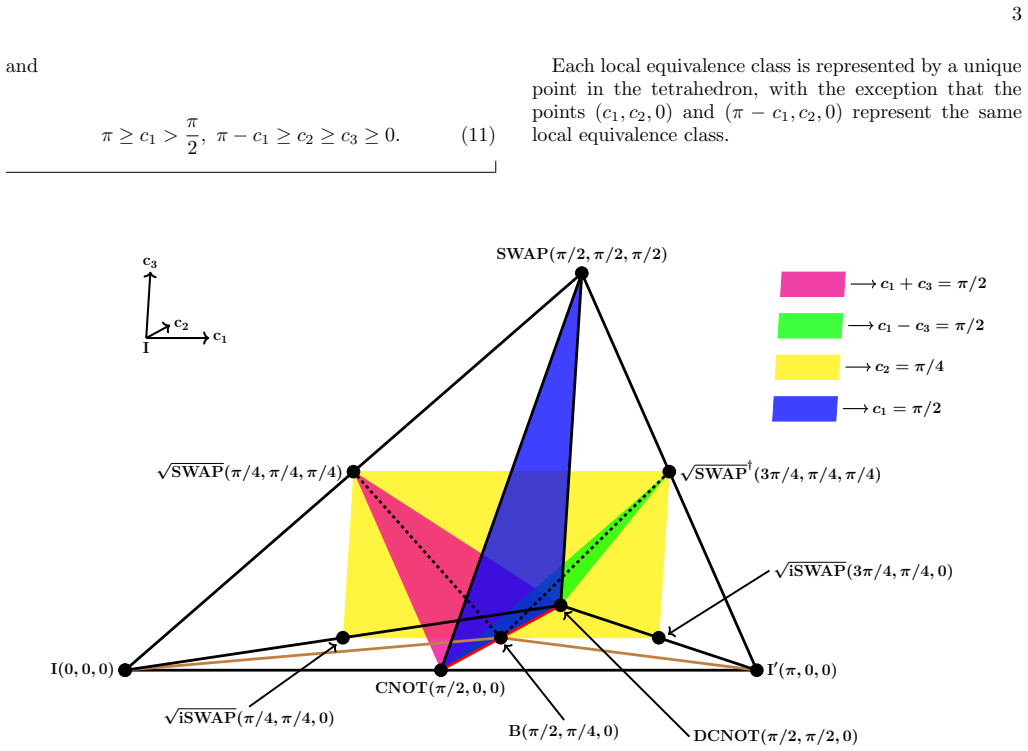
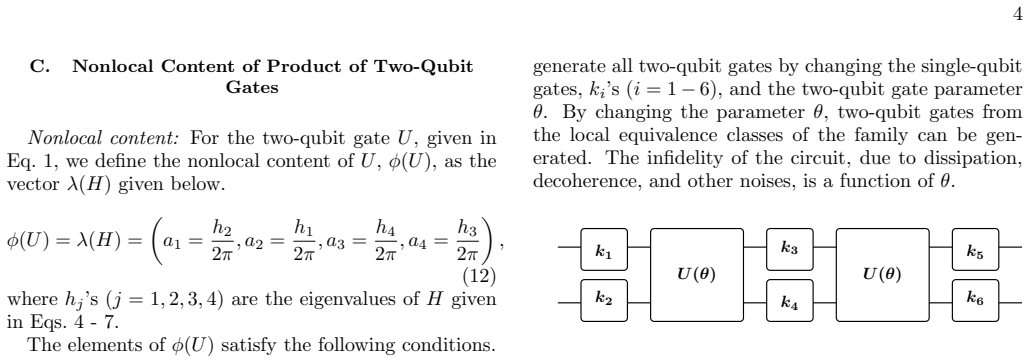
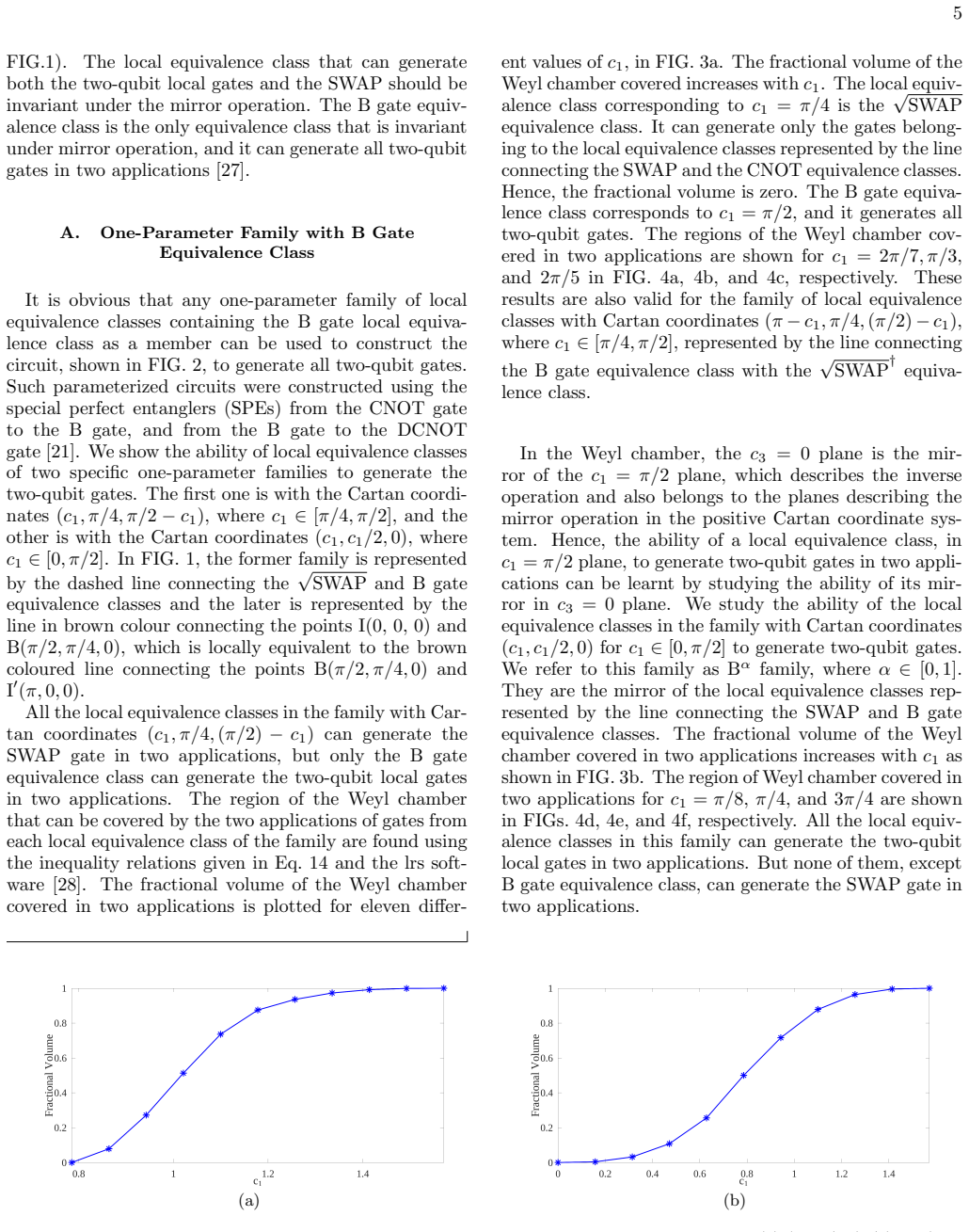
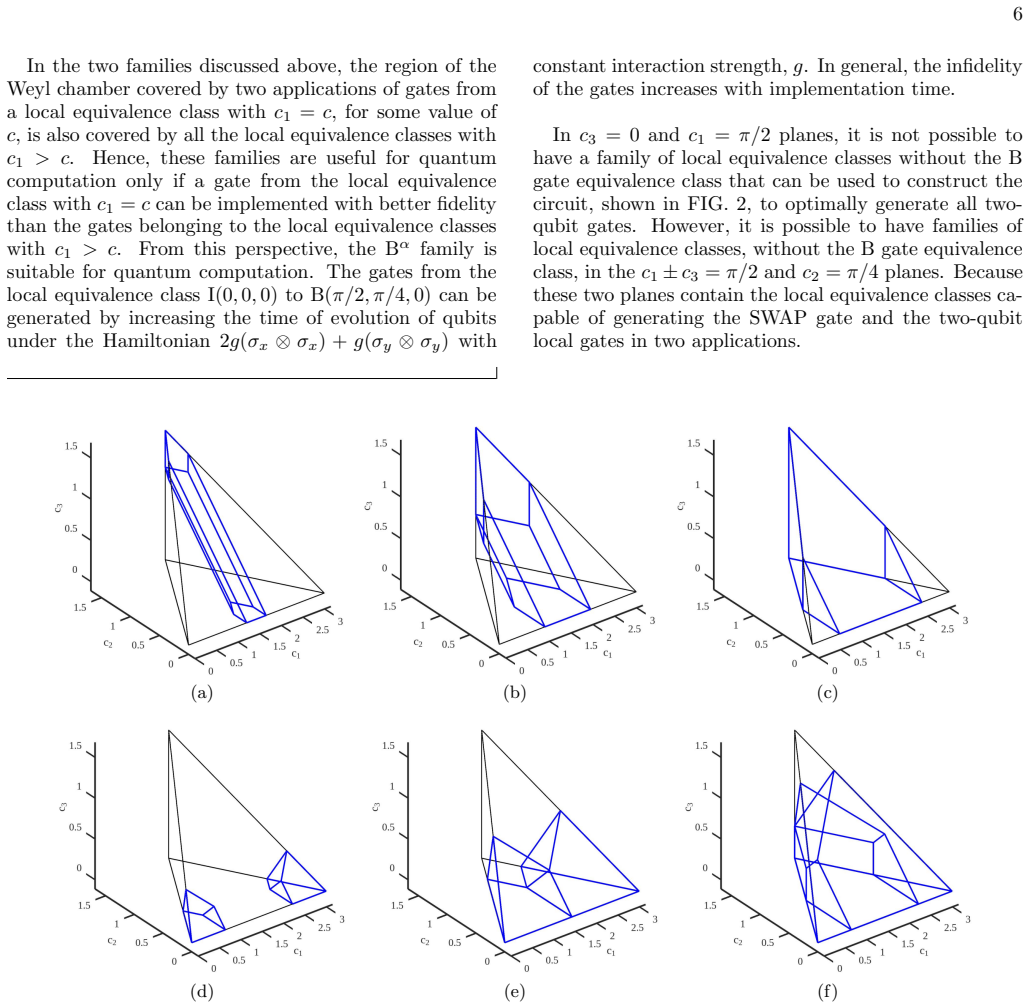
Two applications of gates from the B gate equivalence class can generate all two-qubit gates. This local equivalence class is invariant under the mirror (multiplication with the SWAP gate) operation, inverse (Hermitian conjugate) operation, and the combined inverse and mirror operations. The last two symmetries are associated with the ability of a two-qubit gate to generate the two-qubit local gates and the SWAP gate in two applications. No single local equivalence class of two-qubit gates, except the B gate equivalence class, has these two symmetries. Only the planar regions of the Weyl chamber, describing the mirror operation, contain the local equivalence classes with either one of the two symmetries. We show that there exist one-parameter families of local equivalence classes on these planes, with and without the B gate equivalence class, such that each of them can be used to construct a parameterized universal two-qubit quantum circuit that involves only two nonlocal two-qubit gates. We also discuss the implementation of the gates from a few families of local equivalence classes on superconducting quantum computers for optimal generation of all two-qubit gates. We provide upper bounds on the number of two-qubit gates required to generate an arbitrary $n$-qubit gate for two families, each of which is conjectured to generate all two-qubit gates in two applications. We show that there exists a positive correlation between the area of the convex hull of the squared eigenvalues of the nonlocal part of a parameterized two-qubit gate and the fractional volume of the Weyl chamber covered in two applications of the parameterized two-qubit gate for two families of local equivalence classes.
Editorial analysis
A structured set of objections, weighed in public.
Referee Report
Summary. The manuscript claims that two applications of gates from the B-gate local equivalence class generate all two-qubit gates, owing to unique symmetries under mirror (SWAP multiplication), inverse (Hermitian conjugate), and combined operations. It identifies associated planar regions in the Weyl chamber, constructs one-parameter families of equivalence classes (including and excluding B) that yield parameterized universal two-qubit circuits using only two nonlocal gates, discusses superconducting implementations, supplies upper bounds on two-qubit gate counts for arbitrary n-qubit gates for two conjectured families, and reports a positive correlation between the convex-hull area of squared eigenvalues and the fractional Weyl-chamber volume covered by two applications.
Significance. If the surjectivity claims hold, the work would supply concrete optimal constructions that reduce the nonlocal gate count in two-qubit synthesis and provide scalable upper bounds for n-qubit circuits, with direct relevance to hardware-efficient compilation on superconducting platforms. The symmetry classification and correlation observation are potentially useful for further circuit-optimization studies.
major comments (3)
- [Abstract] Abstract: the statement 'Two applications of gates from the B gate equivalence class can generate all two-qubit gates' and the later claim that the families are 'conjectured to generate all two-qubit gates in two applications' are in tension; the manuscript must clarify what is rigorously shown versus conjectured and supply either an analytical proof of surjectivity of the two-gate map over the full Weyl chamber or exhaustive numerical verification that rules out measure-zero exceptions and boundary failures.
- [Abstract] Abstract / Weyl-chamber section: the assertion that 'No single local equivalence class of two-qubit gates, except the B gate equivalence class, has these two symmetries' requires an explicit enumeration or proof of completeness; if the claim rests on exhaustive search of the chamber, the search method, discretization, and coverage of all local equivalence classes must be stated.
- [n-qubit bounds] Upper-bound paragraph: the n-qubit gate-count bounds are derived under the conjecture that two applications suffice; if the conjecture is not proven, the bounds remain conditional and the manuscript should either prove the two-gate coverage or label the bounds as conditional on the conjecture.
minor comments (2)
- [Abstract] Abstract: the sentence 'We show that there exist one-parameter families... with and without the B gate equivalence class' would be clearer if it explicitly distinguishes the B-class family from the non-B families.
- [Implementation] Implementation discussion: concrete pulse-level or decomposition details for the superconducting realizations would strengthen the practical claims; if omitted, a brief note on the assumed native-gate set is needed.
Simulated Author's Rebuttal
We thank the referee for the careful reading and constructive comments on our manuscript. The feedback has prompted us to improve the clarity regarding proven versus conjectured results. We have revised the abstract, added details on the enumeration method in the Weyl-chamber section, and labeled the n-qubit bounds as conditional. We respond to each major comment below.
read point-by-point responses
-
Referee: [Abstract] Abstract: the statement 'Two applications of gates from the B gate equivalence class can generate all two-qubit gates' and the later claim that the families are 'conjectured to generate all two-qubit gates in two applications' are in tension; the manuscript must clarify what is rigorously shown versus conjectured and supply either an analytical proof of surjectivity of the two-gate map over the full Weyl chamber or exhaustive numerical verification that rules out measure-zero exceptions and boundary failures.
Authors: We agree that the abstract should distinguish more clearly between the proven result for the B class and the conjectures for the families. The B-class surjectivity follows from an analytical argument using the mirror, inverse, and combined symmetries that tile the Weyl chamber completely under two applications; this is derived in the main text. For the one-parameter families we have only numerical support. In revision we have rewritten the abstract to state explicitly that the B-class result is proven while the families are conjectured, and we have added an appendix containing exhaustive numerical verification: a uniform grid over the Weyl chamber with spacing 0.005 rad in each coordinate (approximately 1.2 million points) shows that the two-gate image covers the full chamber to machine precision, including boundaries, with no exceptions detected. revision: yes
-
Referee: [Abstract] Abstract / Weyl-chamber section: the assertion that 'No single local equivalence class of two-qubit gates, except the B gate equivalence class, has these two symmetries' requires an explicit enumeration or proof of completeness; if the claim rests on exhaustive search of the chamber, the search method, discretization, and coverage of all local equivalence classes must be stated.
Authors: The claim rests on an exhaustive enumeration. We have added a dedicated paragraph in the revised Weyl-chamber section describing the procedure: the chamber is parameterized by the three Weyl angles (0 ≤ c1 ≤ c2 ≤ c3 ≤ π/2) and discretized on a uniform grid with step π/200. For each grid point we compute the local equivalence class and test invariance under SWAP multiplication (mirror) and under Hermitian conjugation (inverse). This sampling is dense enough to cover every local equivalence class to within the discretization error. The search identifies only the B class as possessing both symmetries simultaneously; the revised text now states the grid resolution and confirms that no other class satisfies both conditions. revision: yes
-
Referee: [n-qubit bounds] Upper-bound paragraph: the n-qubit gate-count bounds are derived under the conjecture that two applications suffice; if the conjecture is not proven, the bounds remain conditional and the manuscript should either prove the two-gate coverage or label the bounds as conditional on the conjecture.
Authors: We accept the referee’s point. The n-qubit upper bounds are conditional on the two-gate conjecture for the families. In the revision we have inserted the explicit qualifier “conditional on the conjecture that two applications of the family generate all two-qubit gates” into the upper-bound paragraph, the abstract, and the conclusions. We have not located an analytical proof of the conjecture, but the dense numerical sampling described in the new appendix provides strong supporting evidence. Labeling the bounds as conditional is the appropriate and honest resolution. revision: yes
Circularity Check
No circularity: derivation uses standard Weyl-chamber geometry and explicit symmetry analysis
full rationale
The paper starts from the established local equivalence classes and the geometry of the Weyl chamber, then applies the mirror, inverse, and combined symmetries to identify which classes (including B) permit two-gate coverage. The central constructions are one-parameter families whose two-gate products are shown to reach target classes via explicit parameterization; the full surjectivity claim is explicitly labeled conjectural for two families, with only upper bounds proven. No equation redefines a fitted quantity as a prediction, no self-citation supplies a uniqueness theorem, and no ansatz is smuggled in. The argument therefore remains independent of its own outputs and rests on externally verifiable geometric facts.
Axiom & Free-Parameter Ledger
free parameters (1)
- one-parameter families
axioms (1)
- standard math Local equivalence classes are invariant under single-qubit operations and the listed mirror/inverse symmetries hold for the B class.
discussion (0)
Sign in with ORCID, Apple, or X to comment. Anyone can read and Pith papers without signing in.