FeedbackSTS-Det: Sparse Frames-Based Spatio-Temporal Semantic Feedback Network for Moving Infrared Small Target Detection
Pith reviewed 2026-05-16 12:08 UTC · model grok-4.3
The pith
A closed-loop feedback network with forward and backward refinement modules improves moving infrared small target detection by exchanging semantics across sparse frames.
A machine-rendered reading of the paper's core claim, the machinery that carries it, and where it could break.
Core claim
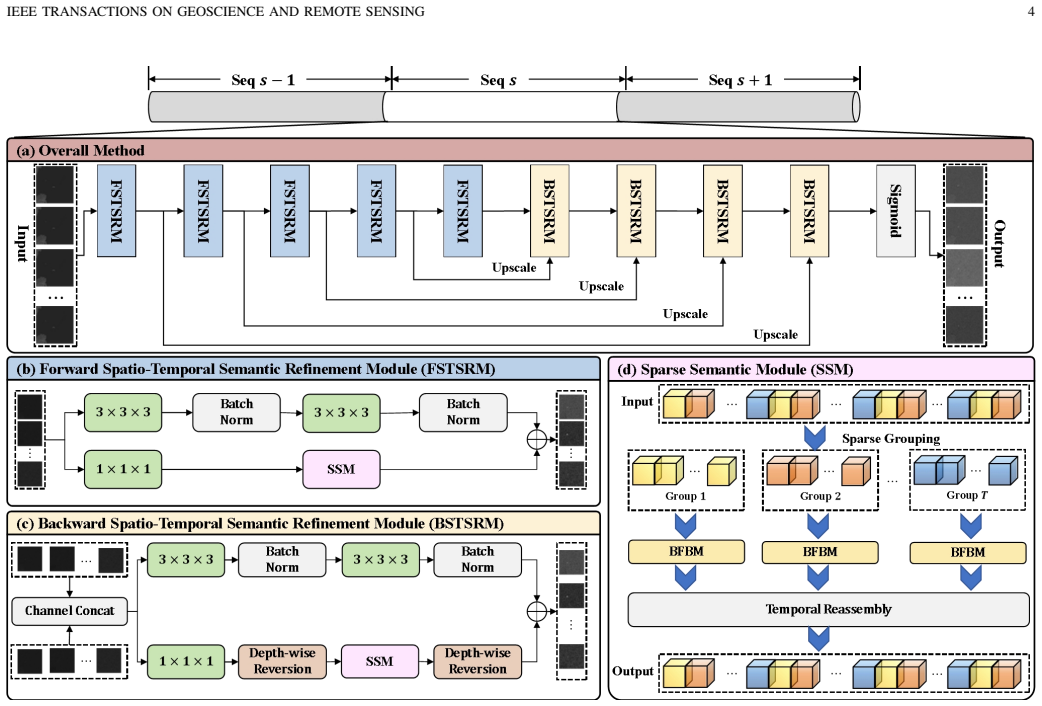
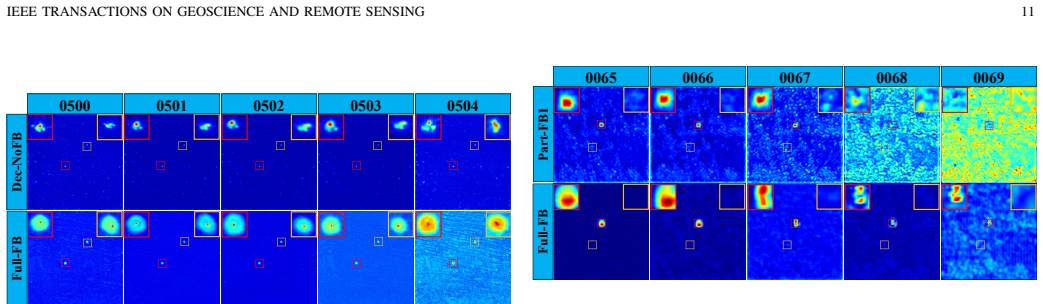
Our approach introduces a closed-loop spatio-temporal semantic feedback strategy with paired forward and backward refinement modules that work cooperatively across the encoder and decoder to enhance information exchange between consecutive frames, effectively improving detection accuracy and reducing false alarms. Moreover, we introduce an embedded sparse semantic module (SSM), which operates by strategically grouping frames by interval, propagating semantics within each group, and reassembling the sequence to efficiently capture long-range temporal dependencies with low computational overhead.
What carries the argument
Closed-loop spatio-temporal semantic feedback strategy using paired forward and backward refinement modules that cooperate in the encoder and decoder, combined with the sparse semantic module that groups frames by interval for semantic propagation and sequence reassembly.
If this is right
- Higher detection accuracy results from improved frame-to-frame semantic exchange.
- Fewer false alarms occur because refinement modules reinforce consistent target signals.
- Long-range temporal dependencies are captured at low overhead via interval grouping.
- Generalization improves across different scenes on standard multi-frame datasets.
- Practical systems for missile warning and maritime surveillance become more reliable.
Where Pith is reading between the lines
- The interval-grouping trick could be reused in other video detection pipelines that must handle long sequences without exploding memory use.
- Closed-loop refinement might reduce error buildup in any sequential vision task where early-frame mistakes propagate.
- The architecture could be paired with visible-spectrum inputs to create cross-modal detectors that inherit the same feedback efficiency.
- Real-time streaming versions would need only minor changes to the reassembly step to process live camera feeds.
Load-bearing premise
The closed-loop feedback and interval-based sparse grouping will consistently capture relevant long-range temporal dependencies across varied real-world infrared scenes without introducing new errors.
What would settle it
A test on a fresh infrared dataset with novel motion patterns or heavy background clutter that shows no statistically significant improvement in precision or false-alarm rate over non-feedback baselines would falsify the claim.
Figures




read the original abstract
Infrared small target detection (ISTD) has been a critical technology in defense and civilian applications over the past several decades, such as missile warning, maritime surveillance, and disaster monitoring. Nevertheless, moving infrared small target detection still faces considerable challenges: existing models suffer from insufficient spatio-temporal semantic correlation and are not lightweight-friendly, while algorithms with strong scene generalization capability are in great demand for real-world applications. To address these issues, we propose FeedbackSTS-Det, a sparse frames-based spatio-temporal semantic feedback network. Our approach introduces a closed-loop spatio-temporal semantic feedback strategy with paired forward and backward refinement modules that work cooperatively across the encoder and decoder to enhance information exchange between consecutive frames, effectively improving detection accuracy and reducing false alarms. Moreover, we introduce an embedded sparse semantic module (SSM), which operates by strategically grouping frames by interval, propagating semantics within each group, and reassembling the sequence to efficiently capture long-range temporal dependencies with low computational overhead. Extensive experiments on many widely adopted multi-frame infrared small target datasets demonstrate the generalization ability and scene adaptability of our proposed network. Code and models are available at: https://github.com/IDIP-Lab/FeedbackSTS-Det.
Editorial analysis
A structured set of objections, weighed in public.
Referee Report
Summary. The manuscript introduces FeedbackSTS-Det, a sparse frames-based spatio-temporal semantic feedback network for moving infrared small target detection. It proposes a closed-loop feedback strategy using paired forward and backward refinement modules that cooperate across encoder and decoder to improve inter-frame information exchange, together with an embedded sparse semantic module (SSM) that groups frames by interval, propagates semantics within groups, and reassembles the sequence to capture long-range temporal dependencies at low cost. Experiments on widely used multi-frame infrared datasets are reported to show gains in detection accuracy and reductions in false alarms, with code released.
Significance. If the performance claims hold after proper isolation of components, the work would offer a lightweight architecture that addresses insufficient spatio-temporal correlation in existing ISTD models while remaining suitable for real-world generalization in defense and surveillance applications. The combination of closed-loop feedback and sparse grouping is a concrete attempt to balance accuracy and efficiency.
major comments (1)
- [Ablation studies (typically §4.3 or equivalent)] The central claim that the paired forward/backward refinement modules operating cooperatively in a closed loop are responsible for the reported accuracy gains and false-alarm reductions is load-bearing. An ablation that freezes or removes the backward pass while retaining the forward path, SSM, and base encoder-decoder is required to isolate its contribution from the spatio-temporal backbone or sparse grouping alone. Without this, improvements on standard datasets could be explained by other elements of the architecture.
minor comments (2)
- [Abstract] The abstract asserts performance gains but supplies no numerical metrics, dataset names, or error bars; a concise quantitative summary should be added for immediate readability.
- [Method (SSM description)] Notation for the SSM grouping interval and reassembly operation should be defined explicitly with a diagram or pseudocode to clarify how semantics are propagated within each group.
Simulated Author's Rebuttal
We thank the referee for the careful review and the specific suggestion regarding ablation studies. We agree that isolating the contribution of the backward refinement module within the closed-loop feedback is important for substantiating the central claims. We will add the requested experiment to the revised manuscript.
read point-by-point responses
-
Referee: [Ablation studies (typically §4.3 or equivalent)] The central claim that the paired forward/backward refinement modules operating cooperatively in a closed loop are responsible for the reported accuracy gains and false-alarm reductions is load-bearing. An ablation that freezes or removes the backward pass while retaining the forward path, SSM, and base encoder-decoder is required to isolate its contribution from the spatio-temporal backbone or sparse grouping alone. Without this, improvements on standard datasets could be explained by other elements of the architecture.
Authors: We agree that a targeted ablation isolating the backward pass is necessary to strengthen the evidence for the closed-loop mechanism. The current manuscript reports ablations on the SSM and the overall feedback strategy but does not include the precise variant requested (backward pass disabled while retaining forward path, SSM, and base encoder-decoder). In the revision we will add this experiment to §4.3, comparing the full model against the forward-only variant on the same datasets and metrics. This will directly quantify the incremental benefit of the cooperative forward-backward interaction beyond the spatio-temporal backbone and sparse grouping. revision: yes
Circularity Check
No circularity: empirical architecture with no self-referential derivations
full rationale
The paper presents FeedbackSTS-Det as a novel encoder-decoder network with forward/backward refinement modules and an embedded sparse semantic module (SSM). All performance claims rest on experimental results across standard multi-frame ISTD datasets rather than any closed-form derivation, fitted parameter renamed as prediction, or uniqueness theorem. No equations appear that define a quantity in terms of itself, no self-citations load-bear the central mechanism, and the SSM grouping/reassembly is described as an explicit design choice rather than smuggled via prior work. The derivation chain is therefore self-contained and non-circular.
Axiom & Free-Parameter Ledger
axioms (1)
- domain assumption Widely adopted multi-frame infrared small target datasets are representative of real-world scenes and sufficient to demonstrate generalization.
Lean theorems connected to this paper
-
IndisputableMonolith/Cost/FunctionalEquation.leanwashburn_uniqueness_aczel unclear?
unclearRelation between the paper passage and the cited Recognition theorem.
closed-loop spatio-temporal semantic feedback strategy with paired forward and backward refinement modules... embedded sparse semantic module (SSM)... grouping frames by interval, propagating semantics within each group
-
IndisputableMonolith/Foundation/AlexanderDuality.leanalexander_duality_circle_linking unclear?
unclearRelation between the paper passage and the cited Recognition theorem.
balanced 3D Res-UNet backbone... 8 base channels... sampling step T=2,3,4
What do these tags mean?
- matches
- The paper's claim is directly supported by a theorem in the formal canon.
- supports
- The theorem supports part of the paper's argument, but the paper may add assumptions or extra steps.
- extends
- The paper goes beyond the formal theorem; the theorem is a base layer rather than the whole result.
- uses
- The paper appears to rely on the theorem as machinery.
- contradicts
- The paper's claim conflicts with a theorem or certificate in the canon.
- unclear
- Pith found a possible connection, but the passage is too broad, indirect, or ambiguous to say the theorem truly supports the claim.
Reference graph
Works this paper leans on
-
[1]
Y . Zhang, Y . Zhang, R. Fu, Z. Shi, J. Zhang, D. Liu, and J. Du, “Learning nonlocal quadrature contrast for detection and recognition of infrared rotary-wing uav targets in complex background,”IEEE Transactions on Geoscience and Remote Sensing, vol. 60, pp. 1–19, 2022
work page 2022
-
[2]
Local motion and contrast priors driven deep network for infrared small target superresolution,
X. Ying, Y . Wang, L. Wang, W. Sheng, L. Liu, Z. Lin, and S. Zhou, “Local motion and contrast priors driven deep network for infrared small target superresolution,”IEEE Journal of Selected Topics in Applied Earth Observations and Remote Sensing, vol. 15, pp. 5480–5495, 2022
work page 2022
-
[3]
Classification of small boats in infrared images for maritime surveillance,
M. Teutsch and W. Kr ¨uger, “Classification of small boats in infrared images for maritime surveillance,” in2010 international WaterSide security conference. IEEE, 2010, pp. 1–7
work page 2010
-
[4]
C. Hu, X. Dong, Y . Huang, L. Wang, L. Xu, T. Pu, and Z. Peng, “Smpisd-mtpnet: Scene semantic prior-assisted infrared ship detection using multi-task perception networks,”IEEE Transactions on Geo- science and Remote Sensing, 2024
work page 2024
-
[5]
V . Tramutoli, R. Corrado, C. Filizzola, N. Genzano, M. Lisi, N. Pergola et al., “From visual comparison to robust satellite techniques: 30 years of thermal infrared satellite data analyses for the study of earthquake preparation phases,”Bollettino Di Geofisica Teorica e Applicata, vol. 56, no. 2, pp. 167–202, 2015
work page 2015
-
[6]
Morphology-based algorithm for point target detection in infrared backgrounds,
V . T. Tom, T. Peli, M. Leung, and J. E. Bondaryk, “Morphology-based algorithm for point target detection in infrared backgrounds,” inSignal and Data Processing of Small Targets 1993, vol. 1954. SPIE, 1993, pp. 2–11
work page 1993
-
[7]
The two-dimensional adaptive lms (tdlms) algorithm,
M. M. Hadhoud and D. W. Thomas, “The two-dimensional adaptive lms (tdlms) algorithm,”IEEE transactions on circuits and systems, vol. 35, no. 5, pp. 485–494, 1988
work page 1988
-
[8]
Infrared patch-image model for small target detection in a single image,
C. Gao, D. Meng, Y . Yang, Y . Wang, X. Zhou, and A. G. Hauptmann, “Infrared patch-image model for small target detection in a single image,”IEEE transactions on image processing, vol. 22, no. 12, pp. 4996–5009, 2013. IEEE TRANSACTIONS ON GEOSCIENCE AND REMOTE SENSING 13
work page 2013
-
[9]
Y . Dai and Y . Wu, “Reweighted infrared patch-tensor model with both nonlocal and local priors for single-frame small target detection,”IEEE journal of selected topics in applied earth observations and remote sensing, vol. 10, no. 8, pp. 3752–3767, 2017
work page 2017
-
[10]
Infrared small target detection via non-convex rank approximation minimization joint l 2, 1 norm,
L. Zhang, L. Peng, T. Zhang, S. Cao, and Z. Peng, “Infrared small target detection via non-convex rank approximation minimization joint l 2, 1 norm,”Remote Sensing, vol. 10, no. 11, p. 1821, 2018
work page 2018
-
[11]
Y . Sun, J. Yang, and W. An, “Infrared dim and small target detection via multiple subspace learning and spatial-temporal patch-tensor model,” IEEE Transactions on Geoscience and Remote Sensing, vol. 59, no. 5, pp. 3737–3752, 2020
work page 2020
-
[12]
G. Wang, B. Tao, X. Kong, and Z. Peng, “Infrared small target detection using nonoverlapping patch spatial–temporal tensor factorization with capped nuclear norm regularization,”IEEE Transactions on Geoscience and Remote Sensing, vol. 60, pp. 1–17, 2021
work page 2021
-
[13]
Infrared small target detection via nonconvex tensor tucker decomposition with factor prior,
T. Liu, J. Yang, B. Li, Y . Wang, and W. An, “Infrared small target detection via nonconvex tensor tucker decomposition with factor prior,” IEEE Transactions on Geoscience and Remote Sensing, vol. 61, pp. 1– 17, 2023
work page 2023
-
[14]
The temporal-spatial information fusion network for multi-frame infrared small target detection,
T. Ma, H. Wang, J. Liang, Y . Wang, J. Peng, Z. Kai, and X. Liu, “The temporal-spatial information fusion network for multi-frame infrared small target detection,”IEEE Transactions on Instrumentation and Measurement, 2025
work page 2025
-
[15]
A temporal- semantic interaction network for multi-frame infrared small target de- tection,
S. Zhuang, J. Peng, M. Qi, D. Wang, K. Li, and Y . Liu, “A temporal- semantic interaction network for multi-frame infrared small target de- tection,”Knowledge-Based Systems, p. 113840, 2025
work page 2025
-
[16]
X. Ying, L. Liu, Z. Lin, Y . Shi, Y . Wang, R. Li, X. Cao, B. Li, S. Zhou, and W. An, “Infrared small target detection in satellite videos: a new dataset and a novel recurrent feature refinement framework,”IEEE Transactions on Geoscience and Remote Sensing, 2025
work page 2025
-
[17]
Deformable feature alignment and refinement for moving infrared small target detection,
D. Luo, Y . Xiang, H. Wang, L. Ji, S. Li, and M. Ye, “Deformable feature alignment and refinement for moving infrared small target detection,” Pattern Recognition, vol. 169, p. 111894, 2026
work page 2026
-
[18]
Z. Shen, S. Chen, H. Wang, T. Zhang, X. Zhang, X. Xu, and X. Yang, “Low-level matters: An efficient hybrid architecture for robust multi- frame infrared small target detection,”arXiv preprint arXiv:2503.02220, 2025
-
[19]
Mstcnet: Toward generalization improving for multi-frame infrared small target detection,
R. Cui, N. Li, J. Liu, and H. Zhao, “Mstcnet: Toward generalization improving for multi-frame infrared small target detection,”IEEE Journal of Selected Topics in Applied Earth Observations and Remote Sensing, 2025
work page 2025
-
[20]
S. Kim and J. Lee, “Scale invariant small target detection by optimizing signal-to-clutter ratio in heterogeneous background for infrared search and track,”Pattern Recognition, vol. 45, no. 1, pp. 393–406, 2012
work page 2012
-
[21]
A local contrast method for small infrared target detection,
C. P. Chen, H. Li, Y . Wei, T. Xia, and Y . Y . Tang, “A local contrast method for small infrared target detection,”IEEE transactions on geoscience and remote sensing, vol. 52, no. 1, pp. 574–581, 2013
work page 2013
-
[22]
Multiscale patch-based contrast measure for small infrared target detection,
Y . Wei, X. You, and H. Li, “Multiscale patch-based contrast measure for small infrared target detection,”Pattern recognition, vol. 58, pp. 216– 226, 2016
work page 2016
-
[23]
Small infrared target detection based on low-rank and sparse representation,
Y . He, M. Li, J. Zhang, and Q. An, “Small infrared target detection based on low-rank and sparse representation,”Infrared Physics & Technology, vol. 68, pp. 98–109, 2015
work page 2015
-
[24]
X. Wang, Z. Peng, D. Kong, and Y . He, “Infrared dim and small target detection based on stable multisubspace learning in heterogeneous scene,”IEEE Transactions on Geoscience and Remote Sensing, vol. 55, no. 10, pp. 5481–5493, 2017
work page 2017
-
[25]
Infrared small target detection via self-regularized weighted sparse model,
T. Zhang, Z. Peng, H. Wu, Y . He, C. Li, and C. Yang, “Infrared small target detection via self-regularized weighted sparse model,” Neurocomputing, vol. 420, pp. 124–148, 2021
work page 2021
-
[26]
Infrared small target detection based on partial sum of the tensor nuclear norm,
L. Zhang and Z. Peng, “Infrared small target detection based on partial sum of the tensor nuclear norm,”Remote Sensing, vol. 11, no. 4, p. 382, 2019
work page 2019
-
[27]
Infrared small target detection via non-convex tensor rank surrogate joint local contrast energy,
X. Guan, L. Zhang, S. Huang, and Z. Peng, “Infrared small target detection via non-convex tensor rank surrogate joint local contrast energy,”Remote Sensing, vol. 12, no. 9, p. 1520, 2020
work page 2020
-
[28]
Infrared small target detection via nonconvex tensor fibered rank approximation,
X. Kong, C. Yang, S. Cao, C. Li, and Z. Peng, “Infrared small target detection via nonconvex tensor fibered rank approximation,”IEEE Transactions on Geoscience and Remote Sensing, vol. 60, pp. 1–21, 2021
work page 2021
-
[29]
Small target detection in infrared videos based on spatio-temporal tensor model,
H.-K. Liu, L. Zhang, and H. Huang, “Small target detection in infrared videos based on spatio-temporal tensor model,”IEEE Transactions on Geoscience and Remote Sensing, vol. 58, no. 12, pp. 8689–8700, 2020
work page 2020
-
[30]
Nonconvex tensor low-rank approximation for infrared small target detection,
T. Liu, J. Yang, B. Li, C. Xiao, Y . Sun, Y . Wang, and W. An, “Nonconvex tensor low-rank approximation for infrared small target detection,”IEEE Transactions on Geoscience and Remote Sensing, vol. 60, pp. 1–18, 2021
work page 2021
-
[31]
Representative coefficient total variation for efficient infrared small target detection,
T. Liu, J. Yang, B. Li, Y . Wang, and W. An, “Representative coefficient total variation for efficient infrared small target detection,”IEEE Trans- actions on Geoscience and Remote Sensing, vol. 61, pp. 1–18, 2023
work page 2023
-
[32]
Sparse regularization-based spatial–temporal twist tensor model for infrared small target detection,
J. Li, P. Zhang, L. Zhang, and Z. Zhang, “Sparse regularization-based spatial–temporal twist tensor model for infrared small target detection,” IEEE Transactions on Geoscience and Remote Sensing, vol. 61, pp. 1– 17, 2023
work page 2023
-
[33]
Infrared small target detection using spatiotemporal 4-d tensor train and ring unfolding,
F. Wu, H. Yu, A. Liu, J. Luo, and Z. Peng, “Infrared small target detection using spatiotemporal 4-d tensor train and ring unfolding,”IEEE transactions on geoscience and remote sensing, vol. 61, pp. 1–22, 2023
work page 2023
-
[34]
Asymmetric contextual modulation for infrared small target detection,
Y . Dai, Y . Wu, F. Zhou, and K. Barnard, “Asymmetric contextual modulation for infrared small target detection,” inProceedings of the IEEE/CVF winter conference on applications of computer vision, 2021, pp. 950–959
work page 2021
-
[35]
T. Zhang, L. Li, S. Cao, T. Pu, and Z. Peng, “Attention-guided pyramid context networks for detecting infrared small target under complex background,”IEEE Transactions on Aerospace and Electronic Systems, vol. 59, no. 4, pp. 4250–4261, 2023
work page 2023
-
[36]
Uiu-net: U-net in u-net for infrared small object detection,
X. Wu, D. Hong, and J. Chanussot, “Uiu-net: U-net in u-net for infrared small object detection,”IEEE Transactions on Image Processing, vol. 32, pp. 364–376, 2022
work page 2022
-
[37]
Isnet: Shape matters for infrared small target detection,
M. Zhang, R. Zhang, Y . Yang, H. Bai, J. Zhang, and J. Guo, “Isnet: Shape matters for infrared small target detection,” inProceedings of the IEEE/CVF conference on computer vision and pattern recognition, 2022, pp. 877–886
work page 2022
-
[38]
H. Sun, J. Bai, F. Yang, and X. Bai, “Receptive-field and direction induced attention network for infrared dim small target detection with a large-scale dataset irdst,”IEEE Transactions on Geoscience and Remote Sensing, vol. 61, pp. 1–13, 2023
work page 2023
-
[39]
Towards dense moving infrared small target detection: New datasets and baseline,
S. Chen, L. Ji, S. Zhu, M. Ye, H. Ren, and Y . Sang, “Towards dense moving infrared small target detection: New datasets and baseline,”IEEE Transactions on Geoscience and Remote Sensing, 2024
work page 2024
-
[40]
Dim and small target detection in multi-frame sequence using bi-conv-lstm and 3d-conv structure,
X. Liu, X. Li, L. Li, X. Su, and F. Chen, “Dim and small target detection in multi-frame sequence using bi-conv-lstm and 3d-conv structure,”Ieee Access, vol. 9, pp. 135 845–135 855, 2021
work page 2021
-
[41]
Tsm: Temporal shift module for efficient video understanding,
J. Lin, C. Gan, and S. Han, “Tsm: Temporal shift module for efficient video understanding,” inProceedings of the IEEE/CVF international conference on computer vision, 2019, pp. 7083–7093
work page 2019
-
[42]
Direction- coded temporal u-shape module for multiframe infrared small target de- tection,
R. Li, W. An, C. Xiao, B. Li, Y . Wang, M. Li, and Y . Guo, “Direction- coded temporal u-shape module for multiframe infrared small target de- tection,”IEEE Transactions on Neural Networks and Learning Systems, 2023
work page 2023
-
[43]
Lmaformer: Local motion aware transformer for small moving infrared target detection,
Y . Huang, X. Zhi, J. Hu, L. Yu, Q. Han, W. Chen, and W. Zhang, “Lmaformer: Local motion aware transformer for small moving infrared target detection,”IEEE Transactions on Geoscience and Remote Sensing, 2024
work page 2024
-
[44]
A low-signal-to-noise ratio infrared small-target detection network,
F. Li, P. Rao, W. Sun, Y . Su, and X. Chen, “A low-signal-to-noise ratio infrared small-target detection network,”IEEE Journal of Selected Topics in Applied Earth Observations and Remote Sensing, 2025
work page 2025
-
[45]
S. Zhu, L. Ji, J. Zhu, S. Chen, and W. Duan, “Tmp: Temporal motion perception with spatial auxiliary enhancement for moving infrared dim- small target detection,”Expert Systems with Applications, vol. 255, p. 124731, 2024
work page 2024
-
[46]
Statetrack: Infrared dim and small multi-target detection and tracking via state feature fusion,
J. Bian, S. Lin, D. Li, and X. Lu, “Statetrack: Infrared dim and small multi-target detection and tracking via state feature fusion,”Infrared Physics & Technology, p. 105954, 2025
work page 2025
-
[47]
Moving infrared dim and small target detection by mixed spatio-temporal encoding,
S. Peng, L. Ji, S. Chen, W. Duan, and S. Zhu, “Moving infrared dim and small target detection by mixed spatio-temporal encoding,”Engineering Applications of Artificial Intelligence, vol. 144, p. 110100, 2025
work page 2025
-
[48]
Deep residual learning for image recognition,
K. He, X. Zhang, S. Ren, and J. Sun, “Deep residual learning for image recognition,” inProceedings of the IEEE conference on computer vision and pattern recognition, 2016, pp. 770–778
work page 2016
-
[49]
3d u-net: learning dense volumetric segmentation from sparse anno- tation,
¨O. C ¸ ic ¸ek, A. Abdulkadir, S. S. Lienkamp, T. Brox, and O. Ronneberger, “3d u-net: learning dense volumetric segmentation from sparse anno- tation,” inInternational conference on medical image computing and computer-assisted intervention. Springer, 2016, pp. 424–432
work page 2016
-
[50]
Deformable convolutional networks,
J. Dai, H. Qi, Y . Xiong, Y . Li, G. Zhang, H. Hu, and Y . Wei, “Deformable convolutional networks,” inProceedings of the IEEE international conference on computer vision, 2017, pp. 764–773
work page 2017
-
[51]
Batching soft iou for training semantic segmentation networks,
Y . Huang, Z. Tang, D. Chen, K. Su, and C. Chen, “Batching soft iou for training semantic segmentation networks,”IEEE Signal Processing Letters, vol. 27, pp. 66–70, 2019
work page 2019
-
[52]
Dense nested attention network for infrared small target detection,
B. Li, C. Xiao, L. Wang, Y . Wang, Z. Lin, M. Li, W. An, and Y . Guo, “Dense nested attention network for infrared small target detection,” IEEE Transactions on Image Processing, vol. 32, pp. 1745–1758, 2022. IEEE TRANSACTIONS ON GEOSCIENCE AND REMOTE SENSING 14
work page 2022
-
[53]
Attentional local contrast networks for infrared small target detection,
Y . Dai, Y . Wu, F. Zhou, and K. Barnard, “Attentional local contrast networks for infrared small target detection,”IEEE transactions on geoscience and remote sensing, vol. 59, no. 11, pp. 9813–9824, 2021
work page 2021
-
[54]
Istdu-net: Infrared small-target detection u-net,
Q. Hou, L. Zhang, F. Tan, Y . Xi, H. Zheng, and N. Li, “Istdu-net: Infrared small-target detection u-net,”IEEE Geoscience and Remote Sensing Letters, vol. 19, pp. 1–5, 2022
work page 2022
-
[55]
Rpcanet: Deep unfolding rpca based infrared small target detection,
F. Wu, T. Zhang, L. Li, Y . Huang, and Z. Peng, “Rpcanet: Deep unfolding rpca based infrared small target detection,” inProceedings of the IEEE/CVF Winter Conference on Applications of Computer Vision, 2024, pp. 4809–4818
work page 2024
-
[56]
Saliency at the helm: Steering infrared small target detection with learnable kernels,
F. Wu, A. Liu, T. Zhang, L. Zhang, J. Luo, and Z. Peng, “Saliency at the helm: Steering infrared small target detection with learnable kernels,” IEEE Transactions on Geoscience and Remote Sensing, 2024
work page 2024
-
[57]
Imnn-lwec: A novel infrared small target detection based on spatial–temporal tensor model,
Y . Luo, X. Li, S. Chen, C. Xia, and L. Zhao, “Imnn-lwec: A novel infrared small target detection based on spatial–temporal tensor model,” IEEE Transactions on Geoscience and Remote Sensing, vol. 60, pp. 1– 22, 2022. VI. BIOGRAPHYSECTION Yian Huangreceived the B.S. degree in commu- nication engineering from Sun Yat-sen University (SYSU), Guangzhou, China,...
work page 2022
-
[58]
He is currently pursuing the M.S. degree with the School of Information and Communication En- gineering from University of Electronic Science and Technology of China (UESTC), Chengdu, China. His research interests include computer vision, large language model and infrared target recognition. Xiangyu Qiureceived his B.E. degree from the school of Informati...
work page 2024
discussion (0)
Sign in with ORCID, Apple, or X to comment. Anyone can read and Pith papers without signing in.