REVIEW 3 major objections 4 minor 53 references
Scaling Enhancement in Distributed Quantum Sensing via Bidirectional Causal Routing
T0 review · 3 major / 4 minor · reviewed 2026-08-03 · deepseek-v4-flash
Pith's one-line read A probe that loops a sensor network in both causal directions can estimate the average parameter with 1/N² precision, beating the 1/N Heisenberg scaling, without using entangled sensors.
desk verdict Solid theory on classical-switch distributed sensing; the experiment tests only common synchronized tilts, so the claimed demonstration of switch advantage does not hold as presented. read the letter →
The pith
A machine-rendered reading of the paper's core claim, the machinery that carries it, and where it could break.
The reading
What carries the argument
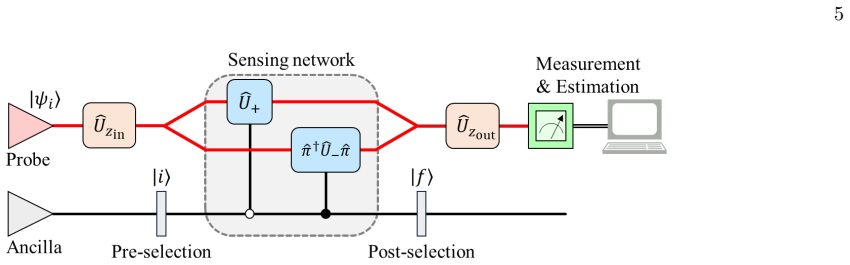
The central object is the noncommutativity between the sensing Hamiltonian (momentum kick, exp(−iθX)) and the free-space propagation Hamiltonian (exp(−izP²/2k)). This noncommutativity converts the propagation distance into an effective momentum amplification: the probe acquires a spatial displacement proportional to (z̄/2k)N²θ̄ when traversed in both causal orders. A switch ancilla—initialized either as a coherent superposition or as a classical mixture—controls the direction of traversal; a parity operation on the reverse branch plus weak-value post-selection (with imaginary weak value Aw ≈ i/ε) provide the experimental readout, mapping the amplified spatial shift to a measurable transverse
What would settle it
Measure the estimation precision (or the quantum Fisher information) for a fixed number of sensors N as the applied tilt angle θ̄ is increased from near zero to larger values. If the precision degrades faster than the prediction based on the g=0 bound, the claimed 1/N² scaling does not hold for finite signals.
Extended reading notes
Core claim
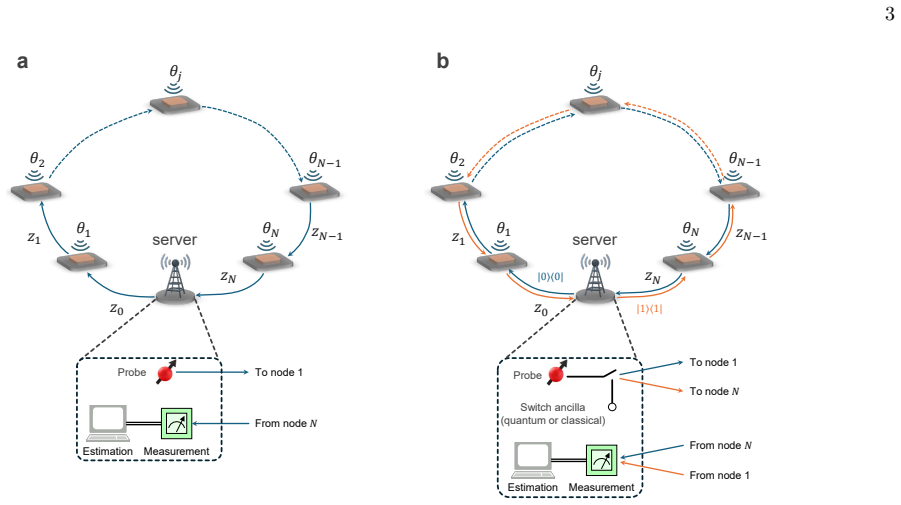
The central claim is that by sending the probe through a cyclic network in a superposition—or even in a classical probabilistic mixture—of two opposite causal orders, the estimation precision for the average parameter θ̄ improves as δθ̄ ∝ 1/N². The enhancement arises because the momentum-kick sensing unitaries exp(−iθX) and the free-space propagation unitaries exp(−izP²/2k) do not commute, so the propagation displaces the probe by an amount proportional to the accumulated momentum kick, and traversing the network in both orders adds these displacements constructively. The asymptotic QCRB is shown to be lim_{N→∞} C_{θ̄}/N⁻⁴ = k²/(z̄² ⟨ΔP²⟩ᵢ), independent of whether the switch is quantum or cl
Load-bearing premise
The 1/N² quantum Cramér–Rao bound is derived at the single point g₁=g₂=0 (zero tilt), and the paper assumes this also represents small but finite tilt amplitudes; if the quantum Fisher information drops away from g=0, the asymptotic scaling would not describe realistic signals.
Editorial extensions
If this is right
- Distributed quantum sensing can achieve super-Heisenberg scaling without multipartite entanglement, using a single coherent probe and a cyclic network.
- A classical probabilistic mixture of causal orders suffices for the 1/N² scaling; no coherent quantum switch is required for the theoretical limit.
- The protocol is robust to classical noise and can be implemented with coherent light sources, avoiding the fragility of squeezed or entangled states.
- The demonstrated picoradian-level beam-tilt sensitivity in a 9-sensor network suggests practical applications in interferometric alignment, vibration monitoring, and acoustic sensing.
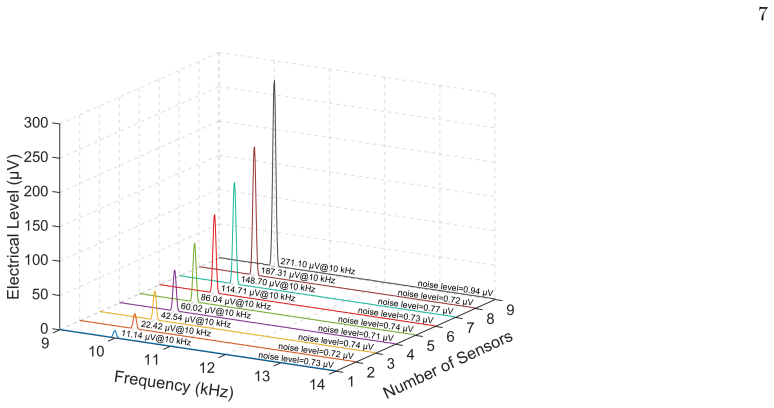
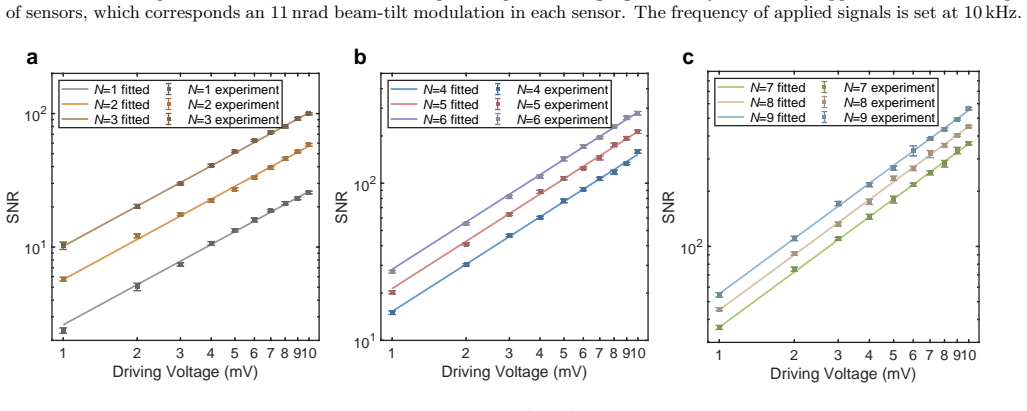
- The prediction that measured SNR grows quadratically with sensor count provides a clear, directly testable signature of the enhancement.
Reading between the lines
- If the zero-parameter QFI bound holds for finite tilts, similar noncommutativity between propagation and non-commuting sensing operations (e.g., dispersion and phase shifts in fibers) could yield analogous N² enhancements in other continuous-variable sensing platforms.
- The paper's demonstration that a classical mixture of orders matches the quantum switch suggests that the phenomenon is more about the geometry of opposing propagation paths than about indefinite causal order; this may simplify practical deployment but also invites scrutiny about whether the resource is truly quantum.
- The scaling relies on the noise floor being independent of N; a natural test is to measure the noise floor as sensors are added. If technical noise grows with N, the practical advantage will saturate earlier than the zero-noise prediction.
- The weak-value amplification used here converts the amplified spatial shift into an imaginary weak value; the same technique could be used to probe other nonlinear signal accumulations in optical networks, potentially extending the approach to distributed phase or displacement sensing.
Editorial analysis
A structured set of objections, weighed in public.
Referee Report
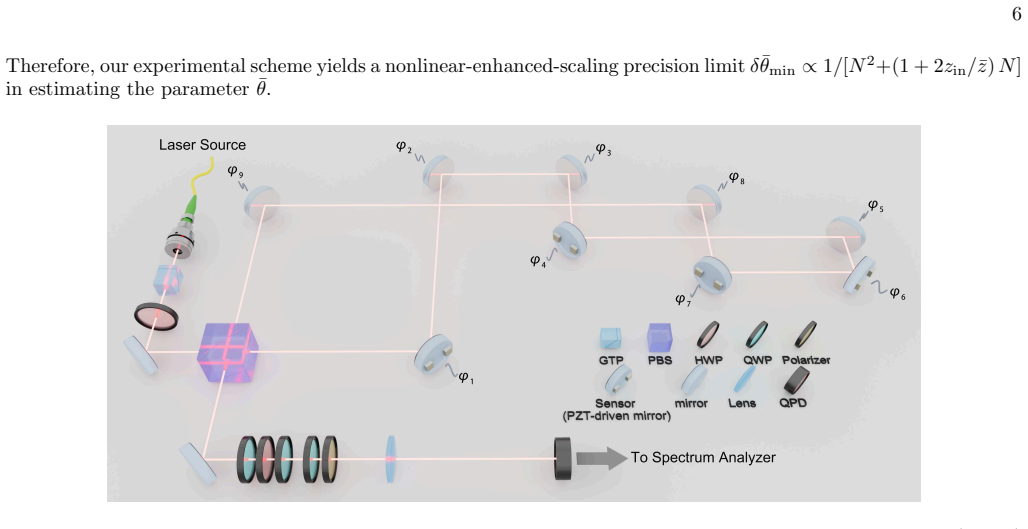
Summary. The paper proposes a distributed quantum sensing protocol in a cyclic network where a single probe sequentially interrogates N sensors in two opposite causal orders, controlled either by a quantum or a classical switch ancilla. The central theoretical claim is that noncommutativity between free-space propagation and local momentum-kick sensing turns propagation into a metrological resource, yielding a 1/N^2 precision scaling for the average of independent parameters without multipartite entanglement. The authors report an experimental implementation using a free-space Sagnac interferometer with up to 9 sensors and synchronized beam tilts, claiming picoradian-level precision and a fitted scaling δφ_min ≈ 4.77/(N^2+4.25N) nrad. The supplementary materials contain the QFIM calculations for the fixed-order, quantum-switch, and classical-switch protocols, as well as a small-parameter analysis of estimating from the probe alone.
Significance. If the theoretical claim is correct, this is a substantial conceptual advance: it identifies propagation noncommutativity and causal-order mixing as resources that can beat the conventional 1/N Heisenberg scaling for distributed sensing without entangled probes. The supplementary QFIM derivations are internally coherent and provide explicit scaling constants, and the classical-switch result is a nontrivial extension of prior indefinite-causal-order metrology. The experimental effort, with reconfigurable up-to-9-sensor network and weak-value readout, is also potentially valuable. However, as detailed below, the experimental validation is mismatched with the theoretical claim: the experiment applies synchronized identical tilts, which reduces the task to estimating a single common parameter, for which the fixed-order protocol already exhibits the same N^2 geometric amplification. Thus the experimental demonstration, as presented, does not support the central advantage of causal-order switching.
major comments (3)
- [Section II, Eq. (14); Supplementary Eq. (S12)] The experiment applies synchronized identical tilts to all sensors, so it estimates a single common parameter φ. For this task, the fixed-order evolution in Eq. (S12) already produces a momentum displacement g1/k with g1 = φ Σ_{j=0}^{N-1} z_j (N−j), which scales as O(N^2) for equal spacings. Thus a fixed-order sequential network would also produce an SNR that grows ~N^2, and the observed scaling in Figs. 4–6 does not demonstrate an advantage of causal-order switching. The theoretical fixed-order QCRB in Eqs. (S17)–(S18) applies to estimating the average of N independent unknown θ_j, not to the synchronized-common-tilt experiment. The manuscript must either test independent parameters or compare the switched network against a fixed-order baseline under the same common-tilt conditions.
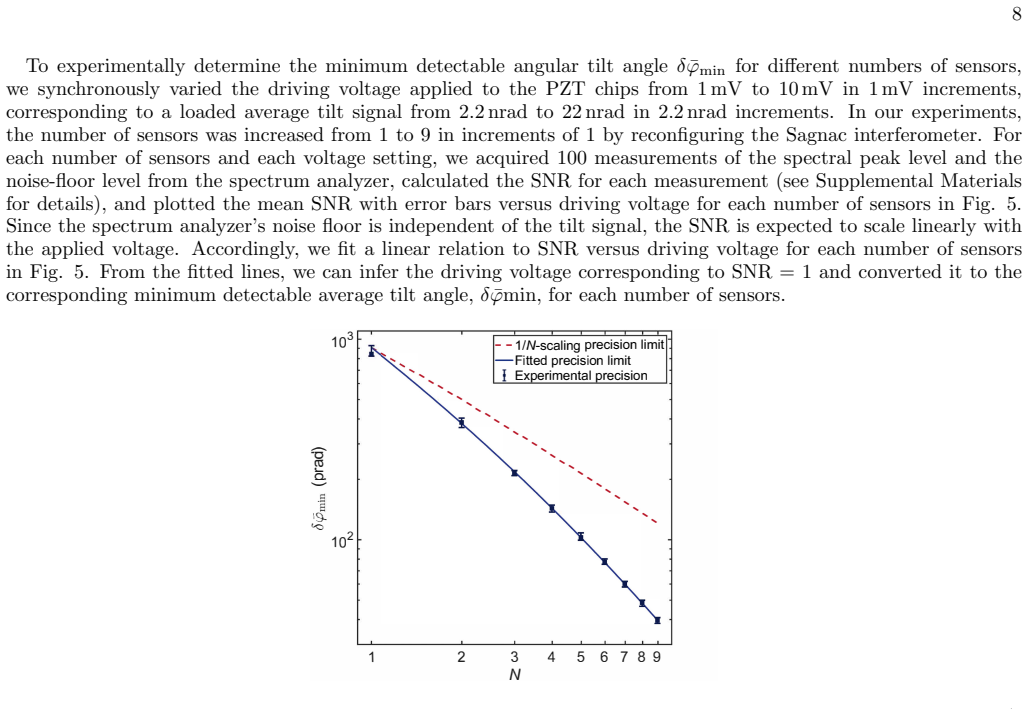
- [Fig. 6; Section II 'Experimental results'] The '1/N–scaling precision limit' shown in Fig. 6 is generated by replacing the N^2 term with 1 in the same fitted relation δφ_min ≈ 4.77/(N^2+4.25N) that is the paper's own claim. This is not an independent baseline: it uses the fitted coefficients from the switched-network data and therefore cannot serve as a comparison. A valid Heisenberg-limit baseline must be derived and preferably measured for the fixed-order protocol under identical conditions (same WVA, same detection, same common-tilt signal). Without this, the statement that the experiment surpasses Heisenberg scaling is not supported.
- [Discussion; Supplementary Note 1.5] The claim that the 1/N^2 scaling 'still holds' for estimating the average from the final mixed probe state alone is qualified in Supplementary Note 1.5 as being derived only at g1=g2=0: 'it is equivalent to calculate the QFIM at g=0.' The main text and abstract do not prominently state this small-parameter restriction. Since this caveat is explicitly acknowledged in the supplement, it should be brought into the main text to avoid overstating the classical-mixture result. The full joint-state classical-switch QCRB in Eq. (S29) appears exact, so this is a limitation of the trace-out version rather than of the central joint-state result.
minor comments (4)
- [Supplementary Note 1.4] The spectral decomposition states '|Ψ−⟩ = |ψ−⟩ ⊗ |0⟩'; this should be |ψ−⟩ ⊗ |1⟩. The subsequent orthogonality argument relies on the ancilla states being orthogonal.
- [Fig. 6] The axis labels are garbled ('103 (peJd) U!'); they should be readable and include units.
- [Methods B] The noise-floor independence assumption is stated as 'approximately independent of the number of sensors' but is not directly characterized. With increasing N the interferometer path length and number of mirrors change; even with stabilized received power, technical noise could vary. A direct measurement of the noise floor versus N would strengthen the experimental scaling claim.
- [Throughout] There are several typographical errors: 'sinuous' should be 'sinusoidal', 'spec trums' should be 'spectrums', 'of of' appears in Fig. 4 caption, and some equation references in the main text are to the supplement without equation numbers.
Circularity Check
Theoretical QFI derivation is self-contained, but the experimental 'beyond Heisenberg' claim is circular: the 1/N baseline is generated from the same fitted curve as the claim, and the synchronized-tilt experiment does not isolate causal-order switching.
-
fitted input called prediction
[Results, Eq. (15), Fig. 6]
"According to Eq. (15), we fit the dependence of δ ¯φmin on the number N of sensors, obtaining a precision limit δ ¯φmin ≈ 4.77/(N 2 + 4.25N ) nrad from the experimental data; the fitted precision limit is also shown in Fig. 6. For comparison, we also plot a 1 /N–scaling precision limit in Fig. 6 by replacing the N 2 term with 1 in our fitted relation between δ ¯φmin and N."
The '1/N Heisenberg limit' is not an independent baseline: it is produced from the same fitted relation δφmin ≈ 4.77/(N^2 + 4.25N) nrad by deleting the N^2 term, retaining the same fitted prefactor 4.77 and the same 4.25 term. The experimental precision points were themselves obtained by fitting SNR-vs-voltage lines and then fitting those inferred δφmin values to Eq. (15), the theory's own functional form. Comparing that fit to a rescaled version of itself cannot demonstrate 'beyond Heisenberg' scaling; the claimed advantage is forced by construction.
-
other
[Experimental setup, Fig. 4; Methods B; Eqs. (2), (S15)–(S18)]
"Synchronized 10 kHz sinusoidal drive signals from waveform generators were applied to the PZT chips to produce synchronized tilt modulation at each sensing node."
With synchronized identical tilts θj = φ, the fixed-order evolution already contains the same N^2 displacement: Eq. (2) defines g1 = Σ zj Σ_{l>j} θl, which for θl = φ equals φ Σ zj (N−j) ∼ N^2 φ. Thus the measured SNR ∝ N^2 follows from single-direction noncommutativity and does not require causal-order switching. The 1/N Heisenberg baseline from Eqs. (S15)–(S18) is derived for estimating the average of N independent θj, so it is not the relevant comparator for this common-tilt experiment. The experimental scaling is matched to the theory's own functional form without discriminating the claimed switching advantage.
full rationale
The theoretical core is not circular: the protocol is defined by explicit unitaries (Eq. 1, S19, S27), and the QFIMs/QCRBs are computed from standard SLD formulas, with Eq. (4)/(S25)/(S30) obtained as limits of those expressions rather than from data. There is no load-bearing self-citation: Refs. [34,35] are prior work by a coauthor, but they are used as motivation/context, not as the derivation. The main circularity is in the experimental validation. The measured precision is obtained by fitting the data to the theory's own curve, and the Heisenberg baseline in Fig. 6 is made by deleting the N^2 term from that same fitted curve, so the 'beyond Heisenberg' conclusion reduces to a self-comparison of a fitted function. The synchronized-tilt design further means the experiment tests a common parameter for which fixed-order propagation already gives N^2 amplification; the theoretical 1/N baseline applies to independent parameters and is therefore not a valid control. Supplementary Note 1.5 explicitly limits the mixed-probe N^-4 result to the g=0 regime; this is an acknowledged assumption rather than circularity, but it weakens the finite-signal claim. Overall, the theoretical scaling derivation stands on its own, while the experimental demonstration of an advantage over Heisenberg scaling is partially circular.
Assumptions & free parameters
free parameters (2)
- N²-term coefficient A =
4.77 nrad in δφ_min ≈ 4.77/(N²+4.25N) nrad
- linear-term coefficient B =
4.25 dimensionless
assumptions (6)
- standard math Standard QFI/QCRB formalism with SLD operators
- domain assumption Paraxial free-space propagation U_z=exp(-i z P²/2k) and tilt operation U_θ=exp(-iθ X) with [X,P]=i
- standard math BCH recombination in the Heisenberg-Weyl algebra, with c-number θ² phases collected as global phases
- domain assumption Small-parameter regime g1,g2 ≪ 1; QFIM evaluated at g=0 for the mixed-probe-only estimation
- domain assumption Parity operation on the reverse branch flips the sign of each sensor (π†Xπ=-X) and is realized by an odd number of mirrors
- domain assumption The measured spectrum-analyzer noise floor is independent of the number of sensors N
Cite this review
Pith. "Pith review of Scaling Enhancement in Distributed Quantum Sensing via Bidirectional Causal Routing." pith.science (2026). https://pith.science/paper/UDWOC4JV
@misc{pith2026260114708,
  author       = {Pith},
  title        = {Pith review of: Scaling Enhancement in Distributed Quantum Sensing via Bidirectional Causal Routing},
  year         = {2026},
  howpublished = {\url{https://pith.science/paper/UDWOC4JV}},
  note         = {Machine review of arXiv:2601.14708}
}
read the original abstract
Sensing networks underpin applications ranging from fundamental physics to real-world engineering. Distributed quantum sensing (DQS) can improve measurement performance, but existing protocols typically require multipartite entanglement, which poses substantial challenges for scalable implementation. Here, we introduce a DQS protocol based on bidirectional causal routing in a cyclic network, where a single probe sequentially interrogates M independent sensors along two opposite causal routes. By exploiting the noncommutativity between inter-sensor propagation and local sensing operations, the protocol turns propagation from a passive transport process into a source of sensing information, yielding an asymptotic 1/M^2 scaling of the estimation precision without multipartite entanglement. We experimentally demonstrate the protocol for distributed beam-tilt sensing in a free-space quantum optical network comprising up to 9 sensors, achieving picoradian-level precision in estimating the average tilt angle. These results identify propagation dynamics and routing geometry as active metrological resources for scalable distributed quantum sensing.
Figures
Figures from the paper (3 more)
Reference graph
Works this paper leans on
-
[1]
C. L. Degen, F. Reinhard, and P. Cappellaro, Quantum sensin g, Rev. Mod. Phys. 89, 035002 (2017)
2017
-
[2]
sandwich
Notably, although we employ a pure state as the switch ancilla, our theory does not require the ancilla to be in a pure state. This choice is motivated b y practical considerations: first, the polarization of coherent light is typically fixed; second, a pure-state ancilla en ables the utilization of the weak value amplification (WV A) technique, which can fu...
-
[3]
Abadie, B
J. Abadie, B. P. Abbott, R. Abbott, T. D. Abbott, M. Abernath y, C. Adams, R. Adhikari, C. Affeldt, B. Allen, G. S. Allen, E. Amador Ceron, D. Amariutei, R. S. Amin, S. B. Anderson, W . G. Anderson, K. Arai, M. A. Arain, M. C. Araya, S. M. Aston, D. Atkinson, P. Aufmuth, C. Aulbert, B. E. Aylott, S. Babak, P. Baker, S. Ballmer, D. Barker, B. Barr, P. Barri...
2011
-
[4]
M. Tse, H. Yu, et al. , Quantum-enhanced advanced ligo detectors in the era of gravit ational-wave astronomy, Phys. Rev. Lett. 123, 231107 (2019)
2019
-
[5]
M. Abe, P. Adamson, et al. , Matter-wave atomic gradiometer interferometric sensor (magis- 100), Quantum Science and Technology 6, 044003 (2021)
2021
-
[6]
A. D. Ludlow, M. M. Boyd, J. Ye, E. Peik, and P. O. Schmidt, Op tical atomic clocks, Rev. Mod. Phys. 87, 637 (2015)
2015
-
[7]
Bongs, M
K. Bongs, M. Holynski, J. Vovrosh, P. Bouyer, G. Condon, E. R asel, C. Schubert, W. P. Schleich, and A. Roura, Taking atom interferometric quantum sensors from the laboratory to real-world applications, Nature Reviews Physics 1, 731 (2019)
2019
-
[8]
J. S. Bennett, B. E. Vyhnalek, H. Greenall, E. M. Bridge, F. G otardo, S. Forstner, G. I. Harris, F. A. Miranda, and W. P. Bowen, Precision magnetometers for aerospace applications: A re view, Sensors 21, 10.3390/s21165568 (2021)
Show all 53 references
-
[9]
W. W.-W. Hsiao, Y. Y. Hui, P.-C. Tsai, and H.-C. Chang, Flu orescent nanodiamond: A versatile tool for long-term cell tracking, super-resolution imaging, and nanoscale temperature sensing, Accounts of Chemical Research 49, 400 (2016), pMID: 26882283, https://doi.org/10.1021/ac...
2016 doi
-
[10]
Aslam, H
N. Aslam, H. Zhou, E. K. Urbach, M. J. Turner, R. L. Walsworth, M . D. Lukin, and H. Park, Quantum sensors for biomedical applications, Nature Reviews Physics 5, 157 (2023)
2023
-
[11]
Casola, T
F. Casola, T. van der Sar, and A. Yacoby, Probing condensedmatter physics with magnetometry based on nitrogen-vacancy centres in diamond, Nature Reviews Materials 3, 17088 (2018)
2018
-
[12]
K. O. Ho, Y. Shen, Y. Y. Pang, W. K. Leung, N. Zhao, and S. Yang, Diamond quantum sensors: from physics to applications on condensed matter research, Functional Diamond 1, 160 (2021), https://doi.org/10.1080/26941112.2021.196 4926
2021 arXiv
-
[13]
Rubio, P
J. Rubio, P. A. Knott, T. J. Proctor, and J. A. Dunningham, Qu antum sensing networks for the estimation of linear functions, Journal of Physics A: Mathematical and Theoretical 53, 344001 (2020)
2020
-
[14]
Zhang and Q
Z. Zhang and Q. Zhuang, Distributed quantum sensing, Qua ntum Science and Technology 6, 043001 (2021)
2021
-
[15]
T. J. Proctor, P. A. Knott, and J. A. Dunningham, Multiparame ter estimation in networked quantum sensors, Phys. Rev. Lett. 120, 080501 (2018)
2018
-
[16]
Zhuang, Z
Q. Zhuang, Z. Zhang, and J. H. Shapiro, Distributed quantum sensing using continuous-variable multipartite entanglement, Phys. Rev. A 97, 032329 (2018)
2018
-
[17]
Eldredge, M
Z. Eldredge, M. Foss-Feig, J. A. Gross, S. L. Rolston, and A . V. Gorshkov, Optimal and secure measurement protocols for quantum sensor networks, Phys. Rev. A 97, 042337 (2018)
2018
-
[18]
W. Ge, K. Jacobs, Z. Eldredge, A. V. Gorshkov, and M. Foss-F eig, Distributed quantum metrology with linear networks and separable inputs, Phys. Rev. Lett. 121, 043604 (2018)
2018
-
[19]
Gessner, A
M. Gessner, A. Smerzi, and L. Pezz` e, Multiparameter squee zing for optimal quantum enhancements in sensor networks, Nature Communications 11, 3817 (2020)
2020
-
[20]
Liu, Y.-Z
L.-Z. Liu, Y.-Z. Zhang, Z.-D. Li, R. Zhang, X.-F. Yin, Y.- Y. Fei, L. Li, N.-L. Liu, F. Xu, Y.-A. Chen, and J.-W. Pan, Distributed quantum phase estimation with entangled photons , Nature Photonics 15, 137 (2021)
2021
-
[21]
Zhao, Y.-Z
S.-R. Zhao, Y.-Z. Zhang, W.-Z. Liu, J.-Y. Guan, W. Zhang , C.-L. Li, B. Bai, M.-H. Li, Y. Liu, L. You, J. Zhang, J. Fan, F. Xu, Q. Zhang, and J.-W. Pan, Field demonstration of distribu ted quantum sensing without post-selection, Phys. Rev. X 11, 031009 (2021)
2021
-
[22]
D.-H. Kim, S. Hong, Y.-S. Kim, Y. Kim, S.-W. Lee, R. C. Poos er, K. Oh, S.-Y. Lee, C. Lee, and H.-T. Lim, Distributed quantum sensing of multiple phases with fewer photons, Nature Communications 15, 266 (2024)
2024
-
[23]
Liu, K.-X
B. Liu, K.-X. Yang, Y.-L. Mao, L. Feng, B. Guo, S. Xu, H. Ch en, Z.-D. Li, and J. Fan, Experimental adaptive bayesian estimation for a linear function of distributed phases in photo nic quantum networks, Optica 11, 1419 (2024)
2024
-
[24]
X. Guo, C. R. Breum, J. Borregaard, S. Izumi, M. V. Larsen, T. Ge hring, M. Christandl, J. S. Neergaard-Nielsen, and U. L. Andersen, Distributed quantum sensing in a continuous-va riable entangled network, Nature Physics 16, 281 (2020)
2020
-
[25]
Y. Xia, W. Li, W. Clark, D. Hart, Q. Zhuang, and Z. Zhang, Demon stration of a reconfigurable entangled radio-frequency photonic sensor network, Phys. Rev. Lett. 124, 150502 (2020)
2020
-
[26]
Y. Xia, A. R. Agrawal, C. M. Pluchar, A. J. Brady, Z. Liu, Q. Zhuang, D. J. Wilson, and Z. Zhang, Entanglement-enhanced optomechanical sensing, Nature Photonics 17, 470 (2023)
2023
-
[27]
Flamini, N
F. Flamini, N. Spagnolo, and F. Sciarrino, Photonic quant um information processing: a review, Reports on Progress in Physics 82, 016001 (2018)
2018
-
[28]
Zhong, Y
H.-S. Zhong, Y. Li, W. Li, L.-C. Peng, Z.-E. Su, Y. Hu, Y.- M. He, X. Ding, W. Zhang, H. Li, L. Zhang, Z. Wang, L. You, X.-L. Wang, X. Jiang, L. Li, Y.-A. Chen, N.-L. Liu, C.-Y. Lu, a nd J.-W. Pan, 12-photon entanglement and scalable scattershot boson sampling with optimal ent...
2018
-
[29]
X. Jia, C. Zhai, X. Zhu, C. You, Y. Cao, X. Zhang, Y. Zheng, Z. Fu, J. Mao, T. Dai, L. Chang, X. Su, Q. Gong, and J. Wang, Continuous-variable multipartite entanglement in an integrated microcomb, Nature 639, 329 (2025)
2025
-
[30]
B. M. Escher, R. L. de Matos Filho, and L. Davidovich, Genera l framework for estimating the ultimate precision limit in noisy quantum-enhanced metrology, Nature Physics 7, 406 (2011)
2011
-
[31]
Demkowicz-Dobrza´ nski, J
R. Demkowicz-Dobrza´ nski, J. Ko/suppress lody´ nski, and M. Gut ¸˘ a, The elusive heisenberg limit in quantum-enhanced metrology , Nature Communications 3, 1063 (2012)
2012
-
[32]
Boixo, S
S. Boixo, S. T. Flammia, C. M. Caves, and J. Geremia, Genera lized limits for single-parameter quantum estimation, Phys. Rev. Lett. 98, 090401 (2007)
2007
-
[33]
S. M. Roy and S. L. Braunstein, Exponentially enhanced qu antum metrology, Phys. Rev. Lett. 100, 220501 (2008)
2008
-
[34]
Napolitano, M
M. Napolitano, M. Koschorreck, B. Dubost, N. Behbood, R. J. Sewell, and M. W. Mitchell, Interaction-based quantum metrology showing scaling beyond the heisenberg limit, Nature 471, 486 (2011), napolitano, M Koschorreck, M Dubost, B Behbood, N Sewell, R J Mitchell, M W eng Rese...
2011
-
[35]
doi: 10.1038/nature09778
-
[36]
X. Zhao, Y. Yang, and G. Chiribella, Quantum metrology wit h indefinite causal order, Phys. Rev. Lett. 124, 190503 (2020)
2020
-
[37]
P. Yin, X. Zhao, Y. Yang, Y. Guo, W.-H. Zhang, G.-C. Li, Y. -J. Han, B.-H. Liu, J.-S. Xu, G. Chiribella, G. Chen, C.-F. Li, and G.-C. Guo, Experimental super-heisenberg quantu m metrology with indefinite gate order, Nature Physics 10.1038/s41567-023-02046-y (2023)
2023 doi
-
[38]
Giovannetti, S
V. Giovannetti, S. Lloyd, and L. Maccone, Quantum metrol ogy, Phys. Rev. Lett. 96, 010401 (2006)
2006
-
[39]
Giovannetti, S
V. Giovannetti, S. Lloyd, and L. Maccone, Advances in qu antum metrology, Nature Photonics 5, 222 (2011)
2011
-
[40]
S. L. Braunstein and P. van Loock, Quantum information with continuous variables, Rev. Mod. Phys. 77, 513 (2005)
2005
-
[41]
Weedbrook, S
C. Weedbrook, S. Pirandola, R. Garc´ ıa-Patr´ on, N. J. Cerf, T.C. Ralph, J. H. Shapiro, and S. Lloyd, Gaussian quantum information, Rev. Mod. Phys. 84, 621 (2012)
2012
-
[42]
Vajente, Y
G. Vajente, Y. Huang, M. Isi, J. C. Driggers, J. S. Kissel, M. J. Szczepa´ nczyk, and S. Vitale, Machine-learning nonstationary 12 noise out of gravitational-wave detectors, Phys. Rev. D 101, 042003 (2020)
2020
-
[43]
J.-X. Peng, B. Zhu, W. Zhang, and K. Zhang, Enhanced quan tum metrology with non-phase-covariant noise, Phys. Rev. Lett. 133, 090801 (2024)
2024
-
[44]
H. Chen, Y. Chen, J. Liu, Z. Miao, and H. Yuan, Quantum met rology enhanced by leveraging informative noise with error correction, Phys. Rev. Lett. 133, 190801 (2024)
2024
-
[45]
N. Kong, H. Wang, M. Tian, Y. Xu, G. Chen, Y. Xiang, and Q. H e, Noncommutativity as a universal characterization for enhanced quantum metrology, Phys. Rev. Lett. 136, 010201 (2026)
2026
-
[46]
Chiribella, G
G. Chiribella, G. M. D’Ariano, P. Perinotti, and B. Valiron, Q uantum computations without definite causal structure, Phys. Rev. A 88, 022318 (2013)
2013
-
[47]
Q. Liu, Z. Hu, H. Yuan, and Y. Yang, Optimal strategies of q uantum metrology with a strict hierarchy, Phys. Rev. Lett. 130, 070803 (2023)
2023
-
[48]
Goswami, C
K. Goswami, C. Giarmatzi, M. Kewming, F. Costa, C. Brancia rd, J. Romero, and A. G. White, Indefinite causal order in a quantum switch, Phys. Rev. Lett. 121, 090503 (2018)
2018
-
[49]
P. B. Dixon, D. J. Starling, A. N. Jordan, and J. C. Howell, Ultrasensitive beam deflection measurement via interferometric weak value amplification, Phys. Rev. Lett. 102, 173601 (2009)
2009
-
[50]
B. Xia, J. Huang, H. Li, H. Wang, and G. Zeng, Toward incomp atible quantum limits on multiparameter estimation, Nature Communications 14, 1021 (2023)
2023
-
[51]
A. N. Jordan, J. Mart´ ınez-Rinc´ on, and J. C. Howell, Technical advantages for weak-value amplification: When less is more, Phys. Rev. X 4, 011031 (2014)
2014
-
[52]
B. Xia, J. Huang, C. Fang, H. Li, and G. Zeng, High-precisi on multiparameter weak measurement with hermite-gaussian pointer, Phys. Rev. Appl. 13, 034023 (2020)
2020
-
[53]
super-Heisenberg-scaling
B. Xia, J. Huang, H. Li, M. Liu, T. Xiao, C. Fang, and G. Zen g, Ultrasensitive measurement of angular rotations via a hermite-gaussian pointer, Photon. Res. 10, 2816 (2022). Supplementary Materials for Scaling Enhancement in Distributed Quantum Sensi ng via Causal Order Switc...
2022
Reviewed August 3, 2026 · model on record in the stance chip above.
Discussion (0). Continue with ORCID to comment.