Decomposition of angular momentum projected nuclear wave function
Pith reviewed 2026-05-16 12:08 UTC · model grok-4.3
The pith
A new identity decomposes the conventional angular momentum projected nuclear wave function into coupled projected bases from separate neutron and proton projections.
A machine-rendered reading of the paper's core claim, the machinery that carries it, and where it could break.
Core claim
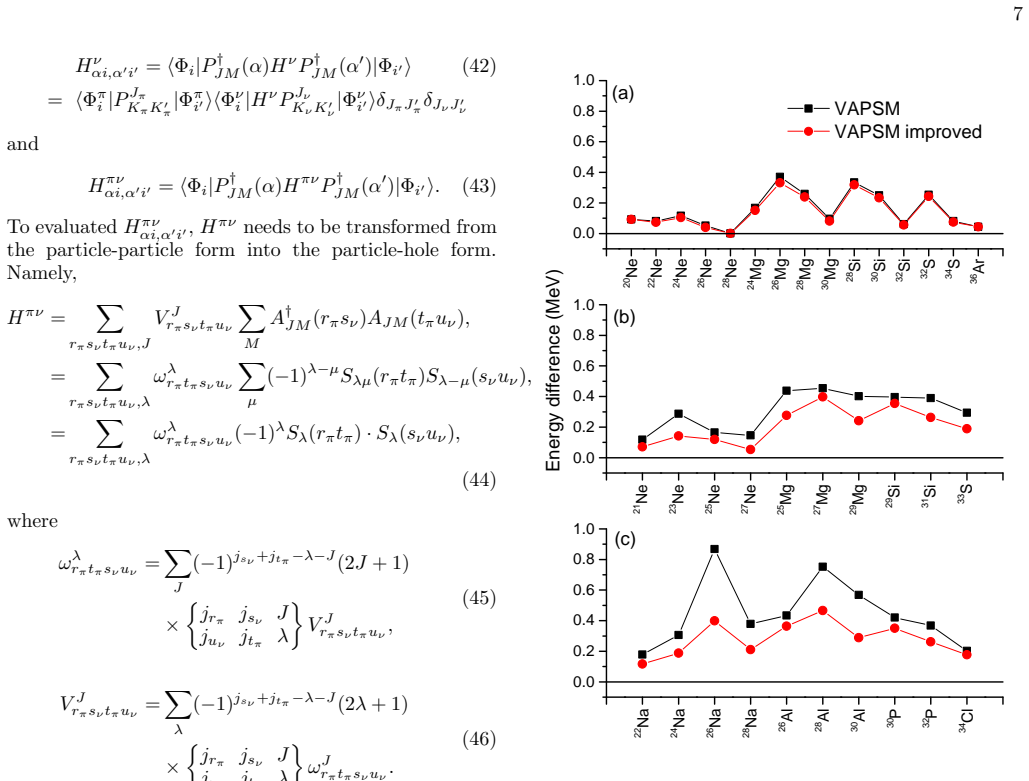
We derive a new identity that provides a decomposition of the conventional angular momentum projected nuclear wave function in terms of the coupled projected bases. The coupled bases are obtained by performing angular momentum projections on the neutron and proton reference states separately and then coupling the results via Clebsch-Gordan coefficients. When this decomposition is applied to variation-after-projection shell-model wave functions for the ground states of several sd-shell nuclei, the nucleons are found to be not fully paired even in even-even cases. The identity further demonstrates that the variational wave function can be refined by adopting the coupled projected bases.
What carries the argument
The decomposition identity that rewrites the full-system angular-momentum-projected wave function as a sum over coupled neutron-proton projected states.
If this is right
- The neutron and proton contributions to any angular-momentum-projected state become separately visible after the decomposition.
- Ground states of even-even sd-shell nuclei contain measurable components in which nucleons remain unpaired.
- Variation-after-projection shell-model calculations gain accuracy when the trial wave function is expanded in the coupled projected bases instead of the conventional single-reference form.
Where Pith is reading between the lines
- The separation into independent neutron and proton projections may reduce computational cost for heavier nuclei by allowing sector-wise treatment before final coupling.
- Analogous decompositions could be derived for additional symmetries such as parity or isospin projection.
- Checking the same identity in other mass regions would test whether incomplete pairing is a widespread feature of nuclear ground states.
Load-bearing premise
The neutron and proton projection operators can be applied independently to their reference states and then coupled without changing the physical content carried by the nuclear Hamiltonian.
What would settle it
Direct numerical evaluation of the overlap between an original projected wave function and its reconstruction from the coupled-basis decomposition for a concrete sd-shell nucleus such as 20Ne; agreement within numerical precision confirms the identity while any discrepancy falsifies it.
Figures
read the original abstract
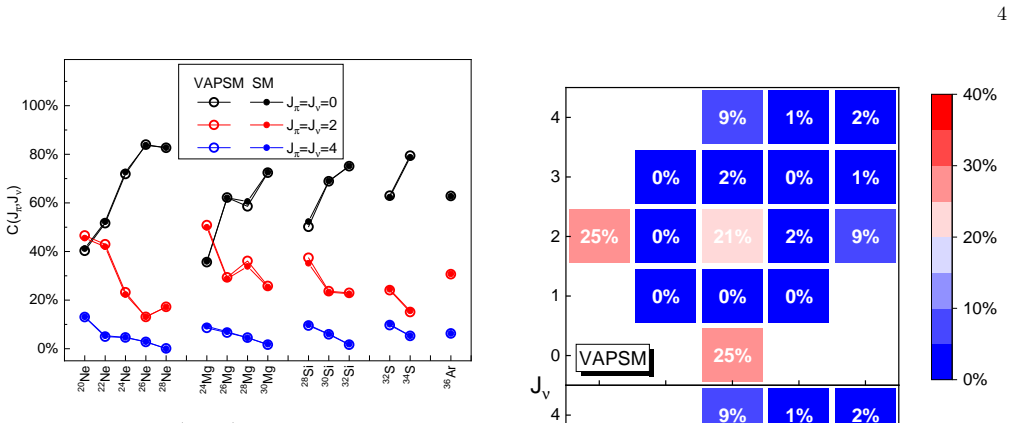
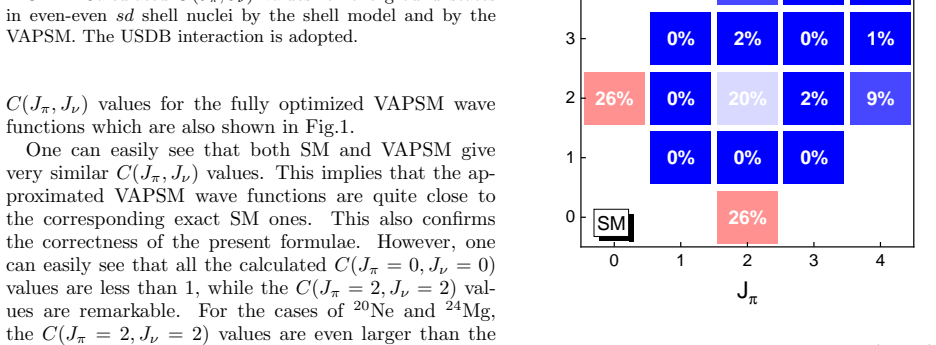
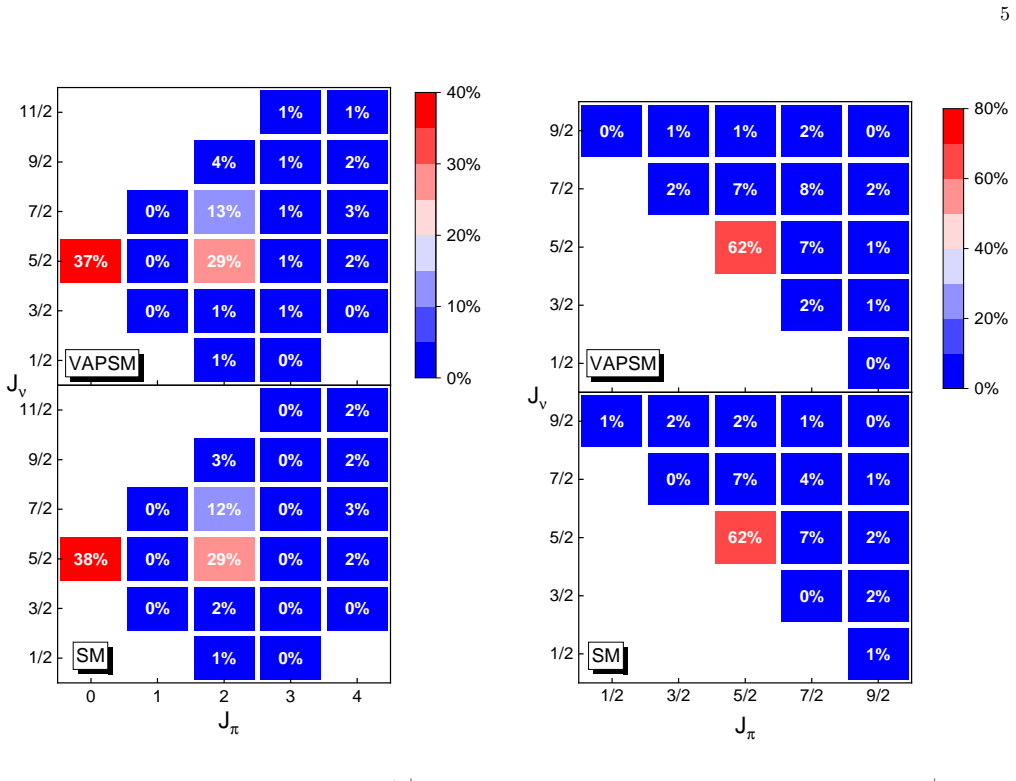
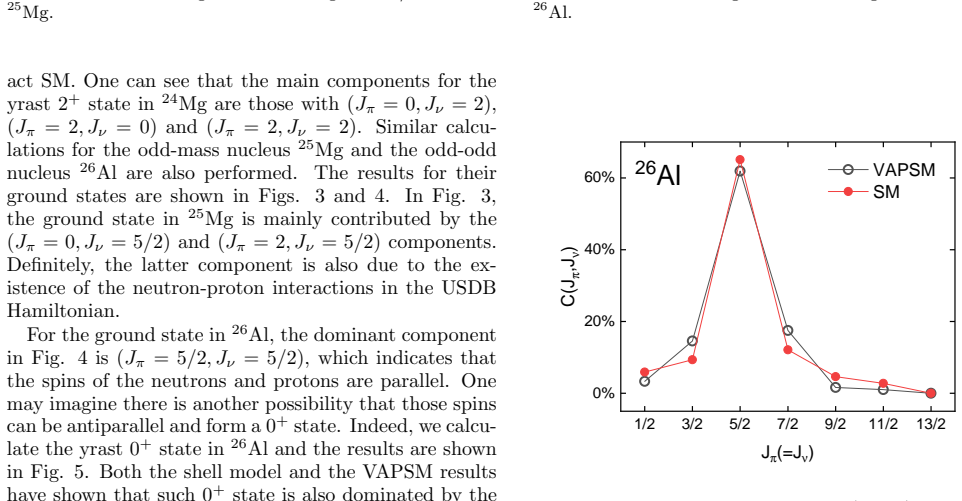
Angular momentum projection is a basic technique in constructing nuclear wave functions with good spins. Traditionally, a projected nuclear wave function is expressed in terms of the bases built by performing the angular momentum projection directly on reference states for the whole nuclear system. Alternatively, one can construct nuclear wave function with another kind of projected bases, called as the coupled projected bases, which are generated by first performing the angular momentum projections on the reference states for neutrons and protons, respectively, then coupling the neutron projected states with the proton ones via Clebsch-Gordon coefficients. In the present work, we derive a new identity, which provides a decomposition of the conventional angular momentum projected nuclear wave function in terms of the coupled projected bases. This decomposition offers direct insight into the underlying structure of nuclear states. To show this point, we present the decompositions of variation after projection shell model (VAPSM) wave functions for the ground states in some $sd$ shell nuclei. It is interesting to see that even for the ground states in even-even nuclei, the nucleons are not fully paired. Finally, we demonstrate that the VAPSM wave function can be further improved by adopting the coupled projected bases.
Editorial analysis
A structured set of objections, weighed in public.
Referee Report
Summary. The manuscript derives an algebraic identity decomposing the conventional angular momentum projected nuclear wave function (the integral over D^J_MK(Ω) R(Ω) |φ⟩) into a sum over coupled neutron-proton projected bases weighted by Clebsch-Gordan coefficients. The identity follows from factoring the reference state as |φ_n⟩|φ_p⟩ and the rotation operator as R_n(Ω)R_p(Ω). The authors apply the decomposition to VAPSM ground states of selected sd-shell nuclei, report that even-even ground states contain unpaired components, and show that variational optimization over the coupled bases yields improved wave functions.
Significance. If the identity is exact, the work supplies a concrete bridge between two standard projection techniques in nuclear structure theory and a practical route to refine variational wave functions without enlarging the model space. The numerical observation that ground states in even-even nuclei are not fully paired is a useful structural insight that can guide future calculations.
minor comments (2)
- The abstract states that VAPSM wave functions are improved by the coupled bases but supplies no quantitative measures (energy lowering, overlap, or convergence data) to support the claim; these should be added to the results section with explicit comparisons.
- The manuscript should include a short appendix or subsection that writes out the first two or three algebraic steps of the identity (starting from the definition of the projection operator and the factorization of R(Ω)) so that readers can verify the derivation without reconstructing it.
Simulated Author's Rebuttal
We thank the referee for the positive assessment of our manuscript and the recommendation for minor revision. The summary accurately captures the derivation of the algebraic identity and its application to VAPSM wave functions. We address the key points below and note that no specific major criticisms were raised that would require changes to the core results.
read point-by-point responses
-
Referee: The manuscript derives an algebraic identity decomposing the conventional angular momentum projected nuclear wave function (the integral over D^J_MK(Ω) R(Ω) |φ⟩) into a sum over coupled neutron-proton projected bases weighted by Clebsch-Gordan coefficients. The identity follows from factoring the reference state as |φ_n⟩|φ_p⟩ and the rotation operator as R_n(Ω)R_p(Ω).
Authors: We confirm the identity is exact and follows directly from the factorization of the reference state into independent neutron and proton components together with the corresponding rotation operators. The resulting expression is a sum over coupled bases weighted by Clebsch-Gordan coefficients, as stated. revision: no
-
Referee: The authors apply the decomposition to VAPSM ground states of selected sd-shell nuclei, report that even-even ground states contain unpaired components, and show that variational optimization over the coupled bases yields improved wave functions.
Authors: Our calculations for the selected sd-shell nuclei indeed reveal that the VAPSM ground states of even-even nuclei contain non-negligible unpaired neutron-proton components. Variational optimization within the coupled projected bases produces lower energies than the conventional approach while remaining within the same model space. revision: no
Circularity Check
Algebraic identity follows directly from standard definitions with no circular reduction
full rationale
The central result is an exact decomposition identity expressing the conventional total-J projected state as a sum over coupled neutron-proton projected bases via Clebsch-Gordan coefficients. This identity is obtained by factoring the reference state |φ⟩ = |φ_n⟩|φ_p⟩ and the rotation operator R(Ω) = R_n(Ω)R_p(Ω), both of which hold by construction because neutrons and protons are distinct isospin species and total J = J_n + J_p. The derivation uses only the standard definitions of angular-momentum projection operators and coupling coefficients; no parameters are fitted, no self-citation supplies a load-bearing uniqueness theorem, and no ansatz is smuggled in. The later numerical illustrations for VAPSM wave functions in sd-shell nuclei are applications, not part of the identity itself. The derivation chain is therefore self-contained against external benchmarks and contains no circular step.
Axiom & Free-Parameter Ledger
axioms (2)
- domain assumption Angular momentum projection operators can be applied separately to neutron and proton subsystems
- standard math Clebsch-Gordan coefficients correctly couple the projected neutron and proton states
Lean theorems connected to this paper
-
IndisputableMonolith/Foundation/RealityFromDistinction.leanreality_from_one_distinction unclear?
unclearRelation between the paper passage and the cited Recognition theorem.
we derive a new identity, which provides a decomposition of the conventional angular momentum projected nuclear wave function in terms of the coupled projected bases (Eq. 14, 16)
-
IndisputableMonolith/Cost/FunctionalEquation.leanwashburn_uniqueness_aczel unclear?
unclearRelation between the paper passage and the cited Recognition theorem.
C(Jπ, Jν) decomposition of VAPSM wave functions for sd-shell ground states
What do these tags mean?
- matches
- The paper's claim is directly supported by a theorem in the formal canon.
- supports
- The theorem supports part of the paper's argument, but the paper may add assumptions or extra steps.
- extends
- The paper goes beyond the formal theorem; the theorem is a base layer rather than the whole result.
- uses
- The paper appears to rely on the theorem as machinery.
- contradicts
- The paper's claim conflicts with a theorem or certificate in the canon.
- unclear
- Pith found a possible connection, but the passage is too broad, indirect, or ambiguous to say the theorem truly supports the claim.
Reference graph
Works this paper leans on
-
[1]
D. R. Hartree, The wave mechanics of an atom with a non-coulomb central field. part i. theory and methods, Mathematical Proceedings of the Cambridge Philosoph- ical Society24, 89–110 (1928)
work page 1928
-
[2]
V. Fock, N¨ aherungsmethode zur L¨ osung des quan- tenmechanischen Mehrk¨ orperproblems, Zeitschrift fur Physik61, 126 (1930)
work page 1930
-
[3]
P. Ring and P. Schuck,The Nuclear Many-Body Problem (Springer New York, NY, 1980)
work page 1980
-
[4]
N. N. Bogolyubov, V. V. Tolmachev, and D. V. Shirkov, A New method in the theory of superconductivity, Fortsch. Phys.6, 605 (1958)
work page 1958
-
[5]
J. G. Valatin, Generalized hartree-fock method, Phys. Rev.122, 1012 (1961). 9
work page 1961
-
[6]
K. Hara and Y. Sun, Projected Shell Model and High- Spin Spectroscopy, Int. J. Mod. Phys. E4, 637 (1995)
work page 1995
-
[7]
Y. Sun, Projection techniques to approach the nu- clear many-body problem, PHYSICA SCRIPTA91, 10.1088/0031-8949/91/4/043005 (2016)
-
[8]
P. W. Zhao, P. Ring, and J. Meng, Configuration interac- tion in symmetry-conserving covariant density functional theory, Phys. Rev. C94, 041301 (2016)
work page 2016
-
[9]
J. M. Yao, J. Meng, P. Ring, and D. P. Arteaga, Three-dimensional angular momentum projection in rel- ativistic mean-field theory, PHYSICAL REVIEW C79, 10.1103/PhysRevC.79.044312 (2009)
-
[10]
G. Hagen, S. J. Novario, Z. H. Sun, T. Papenbrock, G. R. Jansen, J. G. Lietz, T. Duguet, and A. Tichai, Angular-momentum projection in coupled-cluster the- ory: Structure of 34mg, PHYSICAL REVIEW C105, 10.1103/PhysRevC.105.064311 (2022)
-
[11]
J. M. Yao, J. Meng, Y. F. Niu, and P. Ring, Beyond-mean-field approaches for nuclear neutrino- less double beta decay in the standard mechanism, PROGRESS IN PARTICLE AND NUCLEAR PHYSICS 126, 10.1016/j.ppnp.2022.103965 (2022)
-
[12]
X.-X. Sun and S.-G. Zhou, Angular momentum pro- jection in the deformed relativistic hartree-bogoliubov theory in continuum, PHYSICAL REVIEW C104, 10.1103/PhysRevC.104.064319 (2021)
-
[14]
J. A. Sheikh, J. Dobaczewski, P. Ring, L. M. Rob- ledo, and C. Yannouleas, Symmetry restoration in mean-field approaches, JOURNAL OF PHYSICS G-NUCLEAR AND PARTICLE PHYSICS48, 10.1088/1361-6471/ac288a (2021)
- [15]
- [16]
-
[17]
Y. Utsuno, Monte Carlo shell model and its applications to exotic nuclei, inInternational Conference on Nuclear Theory in the Supercomputing Era(2013) pp. 26–32
work page 2013
-
[18]
Y. Alhassid, M. Bonett-Matiz, C. N. Gilbreth, and S. Vartak, Extraction of spectra in the shell model monte carlo method using imaginary-time correlation matrices, Phys. Rev. Lett.133, 182501 (2024)
work page 2024
-
[19]
K. W. Schmid, F. Gr¨ ummer, M. Kyotoku, and A. Faessler, Selfconsistent description of non-yrast states in nuclei: The excited VAMPIR approach, Nuclear Physics A452, 493 (1986)
work page 1986
-
[20]
N. Shimizu, Recent progress of shell-model calculations, monte carlo shell model, and quasi-particle vacua shell model, Physics4, 1081 (2022)
work page 2022
-
[21]
D. D. Dao and F. Nowacki, Nuclear structure within a discrete nonorthogonal shell model approach: New frontiers, PHYSICAL REVIEW C105, 10.1103/Phys- RevC.105.054314 (2022)
-
[22]
Z.-C. Gao, M. Horoi, and Y. S. Chen, Variation after projection with a triaxially deformed nuclear mean field, Phys. Rev. C92, 064310 (2015)
work page 2015
-
[23]
J.-Q. Wang, Z.-C. Gao, Y.-J. Ma, and Y. S. Chen, New algorithm in the variation after projection calculations for non-yrast nuclear states, Phys. Rev. C98, 021301 (2018)
work page 2018
-
[24]
Z.-C. Gao, Variation after projection calculations for high-spin states, Physics Letters B824, 136795 (2022)
work page 2022
-
[25]
Z.-J. Lian, Z.-C. Gao, and Y.-S. Chen, A novel algorithm to the shell model study of heavy deformed nuclei using the variation after projection approach, PHYSICS LET- TERS B853, 10.1016/j.physletb.2024.138674 (2024)
-
[26]
N. L. Iudice and F. Palumbo, New isovector collective modes in deformed nuclei, Phys. Rev. Lett.41, 1532 (1978)
work page 1978
- [27]
- [28]
- [29]
-
[30]
Otsuka, Laboratory-frame view of nuclear rotation, Phys
T. Otsuka, Laboratory-frame view of nuclear rotation, Phys. Rev. Lett.71, 1804 (1993)
work page 1993
-
[31]
B. A. Brown and W. A. Richter, New “usd” hamil- tonians for the sd shell, PHYSICAL REVIEW C74, 10.1103/PhysRevC.74.034315 (2006)
-
[32]
B. Brown and W. Rae, The shell-model code nushellx@msu, Nuclear Data Sheets120, 115 (2014)
work page 2014
discussion (0)
Sign in with ORCID, Apple, or X to comment. Anyone can read and Pith papers without signing in.