Recognition: 2 theorem links
· Lean TheoremThe long quest for vacuum birefringence in magnetars: 1E 1547.0-5408 and the elusive smoking gun
Pith reviewed 2026-05-16 11:46 UTC · model grok-4.3
The pith
Magnetar 1E 1547.0-5408 shows high X-ray polarization explained by geometry rather than vacuum birefringence.
A machine-rendered reading of the paper's core claim, the machinery that carries it, and where it could break.
Core claim
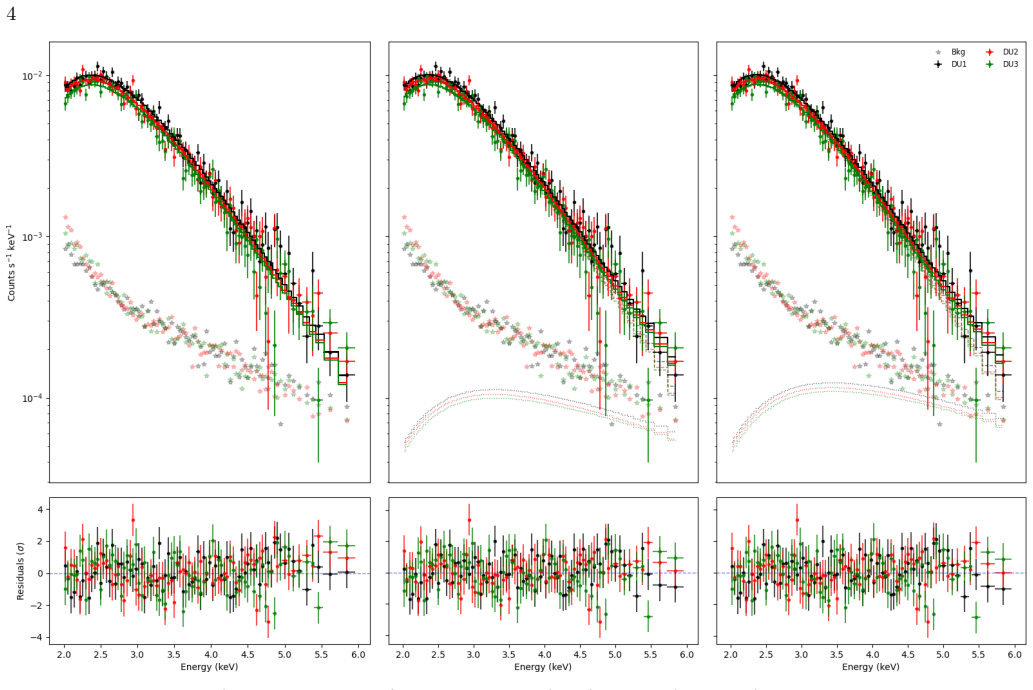
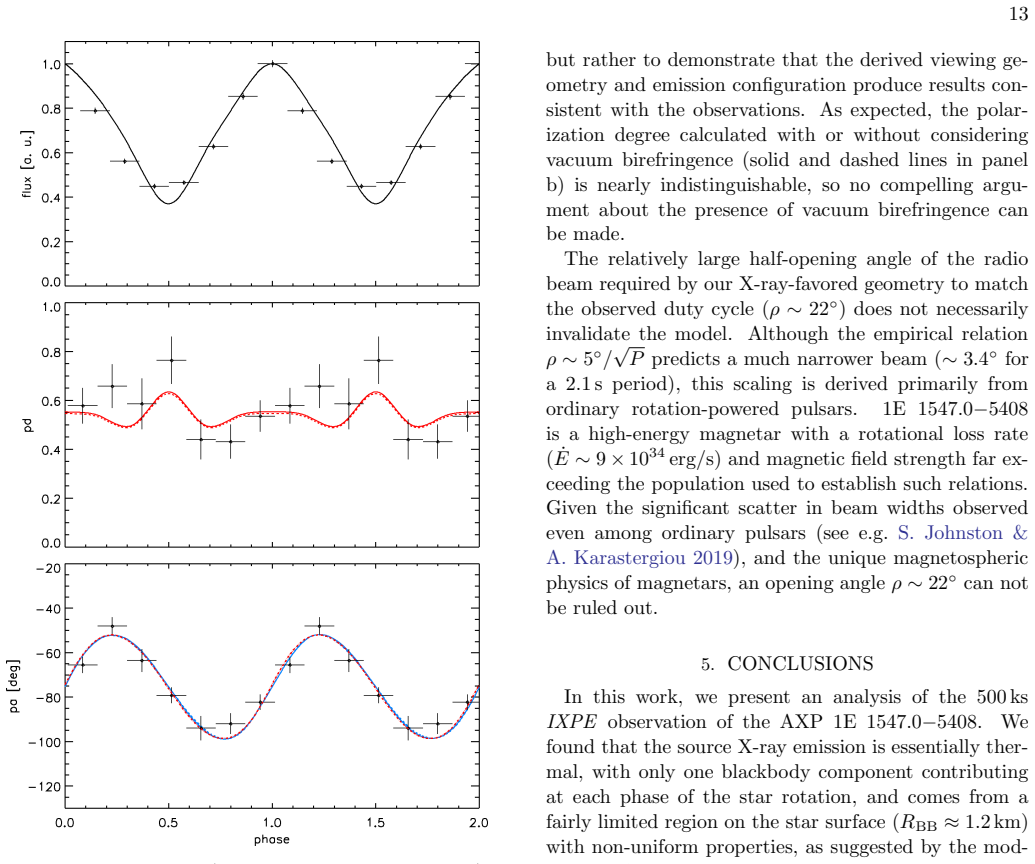
The IXPE spectrum is reproduced by a single thermal blackbody component, and the source exhibits high linear polarization with a constant polarization angle. Phase-resolved analyses show that thermal radiation originates from a single small hot spot with non-uniform temperature. Fitting the phase-dependent polarization angle with the rotating vector model constrains the geometry such that both the dipole axis and line of sight are misaligned with the spin axis, meaning the high polarization cannot be regarded as compelling evidence for vacuum birefringence. The successful reproduction of the polarization angle modulation and the energy behavior of the polarization degree, including a 1-sigma
What carries the argument
The rotating vector model (RVM) fitted to phase-resolved polarization angle data, which constrains geometry and shows high polarization can arise from misalignment without requiring vacuum birefringence.
If this is right
- X-ray emission originates from a single fairly small hot spot with non-uniform temperature distribution.
- Both the dipole axis and the line of sight are misaligned with respect to the spin axis.
- The high polarization of the source cannot be regarded as compelling evidence for vacuum birefringence.
- The rotating vector model reproduction of polarization angle modulation and polarization degree energy behavior points to the presence of QED effects.
Where Pith is reading between the lines
- Applying the same RVM analysis to polarization data from other magnetars could reveal whether misaligned geometries are common.
- Higher-sensitivity polarimetry could separate the contribution of vacuum resonance mode conversion from atmospheric effects.
- The constrained geometry implies that spin-axis misalignment may influence emission models for the broader magnetar population.
Load-bearing premise
The marginal minimum in polarization degree between 3 and 4 keV is produced by partial mode conversion at the vacuum resonance rather than by unmodeled atmospheric or instrumental effects.
What would settle it
A future observation that either detects the 3-4 keV polarization minimum at greater than 3 sigma significance or shows no such minimum at all would confirm or refute the partial mode conversion interpretation.
Figures




read the original abstract
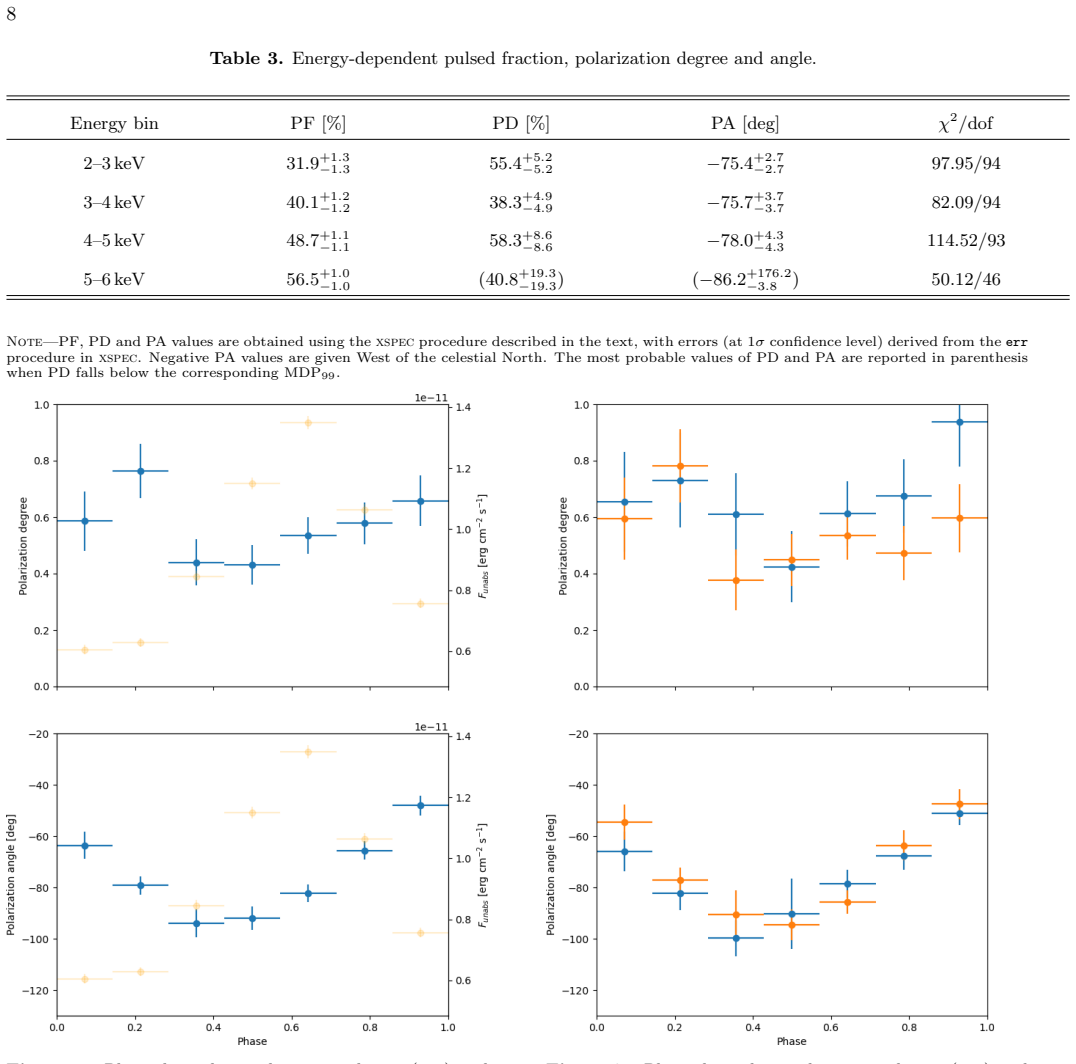
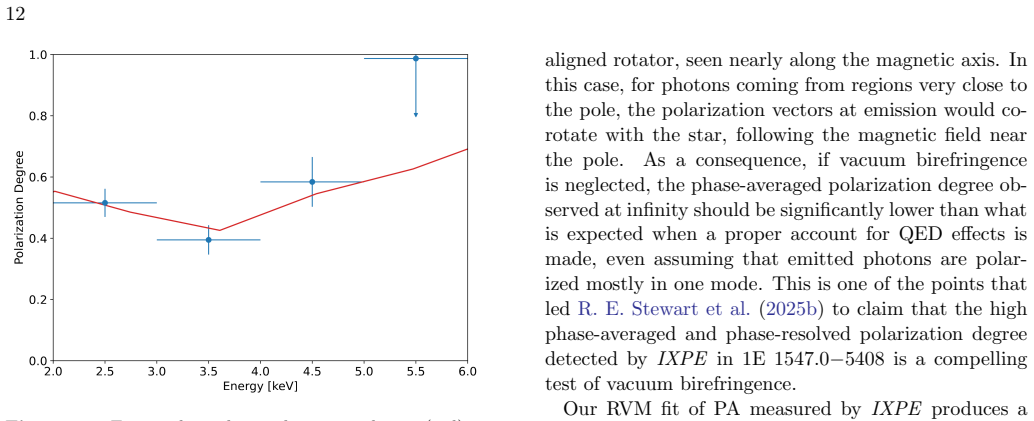
Magnetars are now known to be among the most strongly polarized celestial sources in X-rays. Here we report on the $500\,\mathrm{ks}$ observation of the magnetar 1E 1547.0-5408 performed by the Imaging X-ray Polarimetry Explorer (IXPE) in March 2025. The IXPE spectrum is well reproduced by a single thermal component with blackbody temperature $kT_\mathrm{BB}\sim 0.67\,\mathrm{keV}$ and emission radius $R_\mathrm{BB}\sim 1.2\,\mathrm{km}$. The source exhibits a high linear polarization degree in the $2$--$6\,\mathrm{keV}$ band ($\mathrm{PD}=47.7\pm2.9\%$) with polarization angle $\mathrm{PA}=75^\circ.8 \pm 1.^\circ8$, measured West of celestial North. While $\mathrm{PA}$ does not appear to vary with energy, there is some evidence (at the $1\sigma$ confidence level) of a minimum in $\mathrm{PD}$ between $3$ and $4\,\mathrm{keV}$, compatible with what is expected by partial mode conversion at the vacuum resonance in a magnetized atmosphere. Phase-resolved spectral and polarimetric analyses reveal that X-ray thermal radiation likely originates from a single, fairly small hot spot with a non-uniform temperature distribution. Fitting the phase-dependent $\mathrm{PA}$ measured by IXPE with a rotating vector model (RVM) constrains the source geometry and indicates that both the dipole axis and line-of-sight are misaligned with respect to the spin axis. Under these conditions, the high polarization of the source cannot be regarded as compelling evidence for the presence of vacuum birefringence in the star magnetosphere. Nevertheless, the fact that the RVM successfully reproduces the modulation of the X-ray polarization angle and the behavior of $\mathrm{PD}$ with the energy hint once more to the presence of QED effects in magnetars.
Editorial analysis
A structured set of objections, weighed in public.
Referee Report
Summary. The paper presents a 500 ks IXPE observation of magnetar 1E 1547.0-5408, reporting a thermal blackbody spectrum (kT_BB ≈ 0.67 keV, R_BB ≈ 1.2 km) and high linear polarization (PD = 47.7 ± 2.9%, PA = 75.8 ± 1.8°) in the 2–6 keV band. Phase-resolved analysis indicates emission from a single hot spot with non-uniform temperature. An RVM fit to the phase-dependent PA constrains the geometry (misaligned dipole and line-of-sight relative to spin axis). The authors argue that the high PD is not compelling evidence for vacuum birefringence due to this geometry, but interpret a 1σ PD minimum between 3–4 keV as a hint for partial mode conversion at the vacuum resonance, suggesting QED effects in magnetars.
Significance. If the marginal PD feature is robustly confirmed as vacuum-resonance mode conversion, the result would add a valuable observational anchor for QED vacuum birefringence predictions in magnetar atmospheres, complementing prior IXPE detections. The RVM-derived geometric constraints are a solid contribution to emission modeling. However, the 1σ level of the key feature limits the immediate significance, rendering the positive QED hint tentative rather than definitive.
major comments (2)
- [Abstract and §4] Abstract and §4 (energy-dependent polarimetry): The PD minimum between 3 and 4 keV is reported only at the 1σ level with no accompanying statistical test (e.g., Δχ², p-value, or comparison to a null flat-PD model). This marginal detection is the sole observational anchor for the claim of partial mode conversion at the vacuum resonance; without quantification or exclusion of alternatives (atmospheric opacity, instrumental residuals), the interpretation that the RVM and PD behavior 'hint once more to the presence of QED effects' is not load-bearing.
- [§5] §5 (discussion and conclusions): The statement that high PD 'cannot be regarded as compelling evidence for vacuum birefringence' is internally consistent with the RVM geometry, but the positive QED hint is then left resting on the same unquantified 1σ feature. No alternative atmospheric models are shown to be inconsistent with the data, weakening the overall interpretive claim.
minor comments (2)
- [§3] Clarify whether the reported R_BB ≈ 1.2 km is the apparent or physical radius and how it compares to the neutron-star radius in the context of the hot-spot model.
- [Abstract and §4] The abstract and text use 'some evidence (at the 1σ confidence level)' for the PD dip; expand this phrasing in the main text with explicit error bars or bin-by-bin values for transparency.
Simulated Author's Rebuttal
We are grateful to the referee for their thorough and insightful comments on our manuscript. We have carefully considered each point and made revisions to address the concerns regarding the statistical significance of the polarization degree feature and the strength of the interpretive claims. Below we provide point-by-point responses.
read point-by-point responses
-
Referee: [Abstract and §4] Abstract and §4 (energy-dependent polarimetry): The PD minimum between 3 and 4 keV is reported only at the 1σ level with no accompanying statistical test (e.g., Δχ², p-value, or comparison to a null flat-PD model). This marginal detection is the sole observational anchor for the claim of partial mode conversion at the vacuum resonance; without quantification or exclusion of alternatives (atmospheric opacity, instrumental residuals), the interpretation that the RVM and PD behavior 'hint once more to the presence of QED effects' is not load-bearing.
Authors: We agree that a formal statistical assessment of the PD minimum would strengthen the analysis. In the revised manuscript, we have added a χ² comparison between the observed energy-dependent PD and a constant PD model. This confirms the marginal ~1σ nature of the feature. We have also included a brief discussion in §4 addressing potential alternatives: the spectral fit shows no indication of energy-dependent opacity changes that could produce such a dip, and cross-checks between IXPE detectors show no instrumental artifacts at this level. We have revised the language in the abstract and §4 to describe this as a 'marginal hint' rather than evidence, aligning with the referee's view that it is tentative. revision: partial
-
Referee: [§5] §5 (discussion and conclusions): The statement that high PD 'cannot be regarded as compelling evidence for vacuum birefringence' is internally consistent with the RVM geometry, but the positive QED hint is then left resting on the same unquantified 1σ feature. No alternative atmospheric models are shown to be inconsistent with the data, weakening the overall interpretive claim.
Authors: We concur that the QED hint is based on the marginal feature and have revised §5 to explicitly note the tentative nature of this interpretation and the need for future observations with higher sensitivity. Regarding alternative models, we have added text explaining that standard magnetized atmosphere models without vacuum resonance effects predict a monotonically increasing or flat PD with energy in this band, which is inconsistent with the observed dip at the current data quality. A full grid of atmospheric models is beyond the current scope but is planned for follow-up work. The geometric argument against compelling evidence for birefringence from the high PD remains unchanged and is now better contextualized with the marginal feature. revision: yes
Circularity Check
No circularity: direct observational measurements and standard RVM fit
full rationale
The paper reports new IXPE data on polarization degree and angle for 1E 1547.0-5408, fits the rotating vector model directly to the observed phase-dependent PA, and notes a marginal 1σ PD minimum. All quantities are measured from the data or obtained via standard geometric fitting; no step re-uses a fitted parameter as a 'prediction,' invokes a self-citation as the sole justification for a uniqueness claim, or renames an input as an output. The derivation chain is self-contained against the external IXPE observations.
Axiom & Free-Parameter Ledger
free parameters (2)
- blackbody temperature kT_BB
- emission radius R_BB
axioms (2)
- domain assumption X-ray emission originates from a single, localized hot spot on the neutron-star surface
- domain assumption The rotating vector model accurately describes the observed PA swing for a misaligned dipole
Reference graph
Works this paper leans on
-
[1]
Arnaud, K. A. 1996, in Astronomical Society of the Pacific Conference Series, Vol. 101, Astronomical Data Analysis Software and Systems V, ed. G. H. Jacoby & J. Barnes, 17
work page 1996
-
[2]
Bachetti, M. 2018, HENDRICS: High ENergy Data Reduction Interface from the Command Shell,, Astrophysics Source Code Library, record ascl:1805.019 http://ascl.net/1805.019
work page 2018
-
[3]
Bachetti, M., Harrison, F. A., Cook, R., et al. 2015, ApJ, 800, 109, doi: 10.1088/0004-637X/800/2/109
- [4]
-
[5]
Bernardini, F., Israel, G. L., Stella, L., et al. 2011, A&A, 529, A19, doi: 10.1051/0004-6361/201016197 15
-
[6]
Ransom, S. M. 2008, ApJ, 679, 681, doi: 10.1086/587054
-
[7]
2025, in American Astronomical Society Meeting Abstracts, Vol
Chen, C.-T., & IXPE Science Operation Center. 2025, in American Astronomical Society Meeting Abstracts, Vol. 245, American Astronomical Society Meeting Abstracts #245, 260.01 Coti Zelati, F., Rea, N., Pons, J. A., Campana, S., &
work page 2025
-
[8]
2018, MNRAS, 474, 961, doi: 10.1093/mnras/stx2679 Coti Zelati, F., Borghese, A., Rea, N., et al
Esposito, P. 2018, MNRAS, 474, 961, doi: 10.1093/mnras/stx2679 Coti Zelati, F., Borghese, A., Rea, N., et al. 2020, A&A, 633, A31, doi: 10.1051/0004-6361/201936317 De Grandis, D., Turolla, R., Taverna, R., et al. 2022, ApJ, 936, 99, doi: 10.3847/1538-4357/ac8797 Di Marco, A., Soffitta, P., Costa, E., et al. 2023, AJ, 165, 143, doi: 10.3847/1538-3881/acba0f
-
[9]
Duncan, R. C., & Thompson, C. 1992, ApJL, 392, L9, doi: 10.1086/186413
-
[10]
Everett, J. E., & Weisberg, J. M. 2001, ApJ, 553, 341, doi: 10.1086/320652 Fern´ andez, R., & Davis, S. W. 2011, ApJ, 730, 131, doi: 10.1088/0004-637X/730/2/131 Fern´ andez, R., & Thompson, C. 2007, ApJ, 660, 615, doi: 10.1086/511810
-
[11]
Harding, A. K., & Lai, D. 2006, Reports on Progress in Physics, 69, 2631, doi: 10.1088/0034-4885/69/9/R03
-
[12]
2024, MNRAS, 527, 12219, doi: 10.1093/mnras/stad3680
Heyl, J., Taverna, R., Turolla, R., et al. 2024, MNRAS, 527, 12219, doi: 10.1093/mnras/stad3680
-
[13]
Heyl, J. S., & Hernquist, L. 1997, Journal of Physics A Mathematical General, 30, 6485, doi: 10.1088/0305-4470/30/18/022
-
[14]
Heyl, J. S., Shaviv, N. J., & Lloyd, D. 2003, MNRAS, 342, 134, doi: 10.1046/j.1365-8711.2003.06521.x
-
[15]
Ho, W. C. G., & Lai, D. 2003, MNRAS, 338, 233, doi: 10.1046/j.1365-8711.2003.06047.x
-
[16]
2019, MNRAS, 485, 640, doi: 10.1093/mnras/stz400
Johnston, S., & Karastergiou, A. 2019, MNRAS, 485, 640, doi: 10.1093/mnras/stz400
-
[17]
Kaminker, A. D., Pavlov, G. G., & Shibanov, I. A. 1982, Ap&SS, 86, 249, doi: 10.1007/BF00683336
-
[18]
Kaspi, V. M., & Beloborodov, A. M. 2017, ARA&A, 55, 261, doi: 10.1146/annurev-astro-081915-023329
-
[19]
Kelly, R. M. E., Marshall, H. L., Zane, S., et al. 2025, ApJ, 987, 113, doi: 10.3847/1538-4357/adde58
-
[20]
Kelly, R. M. E., Zane, S., Turolla, R., & Taverna, R. 2024, MNRAS, 528, 3927, doi: 10.1093/mnras/stae159
-
[21]
Komesaroff, M. M. 1970, Nature, 225, 612, doi: 10.1038/225612a0
-
[22]
2023, Proceedings of the National Academy of Science, 120, e2216534120, doi: 10.1073/pnas.2216534120
Lai, D. 2023, Proceedings of the National Academy of Science, 120, e2216534120, doi: 10.1073/pnas.2216534120
-
[23]
E., Younes, G., Scholz, P., et al
Lower, M. E., Younes, G., Scholz, P., et al. 2023, ApJ, 945, 153, doi: 10.3847/1538-4357/acbc7c
-
[24]
2021, ApJ, 911, 45, doi: 10.3847/1538-4357/abe62f
Luo, J., Ransom, S., Demorest, P., et al. 2021, ApJ, 911, 45, doi: 10.3847/1538-4357/abe62f
-
[25]
Manchester, R. N., Hobbs, G. B., Teoh, A., & Hobbs, M. 2005, AJ, 129, 1993, doi: 10.1086/428488
work page internal anchor Pith review doi:10.1086/428488 2005
-
[26]
Marshall, H. L., Heine, S. N. T., Garner, A., et al. 2021, in Society of Photo-Optical Instrumentation Engineers (SPIE) Conference Series, Vol. 11444, Society of Photo-Optical Instrumentation Engineers (SPIE) Conference Series, ed. J.-W. A. den Herder, S. Nikzad, & K. Nakazawa, 114442Y, doi: 10.1117/12.2562811
-
[27]
P., Testa, V., Gonz´ alez Caniulef, D., et al
Mignani, R. P., Testa, V., Gonz´ alez Caniulef, D., et al. 2017, MNRAS, 465, 492, doi: 10.1093/mnras/stw2798
-
[28]
2008, MNRAS, 390, 769, doi: 10.1111/j.1365-2966.2008.13778.x
Nobili, L., Turolla, R., & Zane, S. 2008, MNRAS, 386, 1527, doi: 10.1111/j.1365-2966.2008.13125.x
-
[29]
Pavlov, G. G., & Shibanov, Y. A. 1979, Soviet Journal of Experimental and Theoretical Physics, 49, 741
work page 1979
-
[30]
2004, MNRAS, 351, 161, doi: 10.1111/j.1365-2966.2004.07764.x
Piconcelli, E., Jimenez-Bail´ on, E., Guainazzi, M., et al. 2004, MNRAS, 351, 161, doi: 10.1111/j.1365-2966.2004.07764.x
-
[31]
Radhakrishnan, V., & Cooke, D. J. 1969, Astrophys. Lett., 3, 225
work page 1969
-
[32]
2025, ApJL, 985, L34, doi: 10.3847/2041-8213/adbffb
Rigoselli, M., Taverna, R., Mereghetti, S., et al. 2025, ApJL, 985, L34, doi: 10.3847/2041-8213/adbffb
-
[33]
2012, A&A, 541, A66, doi: 10.1051/0004-6361/201118489
Sartore, N., Tiengo, A., Mereghetti, S., et al. 2012, A&A, 541, A66, doi: 10.1051/0004-6361/201118489
-
[34]
Stewart, R. E., Younes, G. A., Harding, A. K., et al. 2025a, ApJL, 985, L35, doi: 10.3847/2041-8213/adbffa
-
[35]
E., Dinh Thi, H., Younes, G., et al
Stewart, R. E., Dinh Thi, H., Younes, G., et al. 2025b, arXiv e-prints, arXiv:2509.19446, doi: 10.48550/arXiv.2509.19446
-
[36]
Strohmayer, T. E. 2017, ApJ, 838, 72, doi: 10.3847/1538-4357/aa643d
-
[37]
2014, MNRAS, 438, 1686, doi: 10.1093/mnras/stt2310
Taverna, R., Muleri, F., Turolla, R., et al. 2014, MNRAS, 438, 1686, doi: 10.1093/mnras/stt2310
-
[38]
2024, Galaxies, 12, 6, doi: 10.3390/galaxies12010006
Taverna, R., & Turolla, R. 2024, Galaxies, 12, 6, doi: 10.3390/galaxies12010006
-
[39]
2015, MNRAS, 454, 3254, doi: 10.1093/mnras/stv2168
Taverna, R., Turolla, R., Gonzalez Caniulef, D., et al. 2015, MNRAS, 454, 3254, doi: 10.1093/mnras/stv2168
-
[40]
Taverna, R., Turolla, R., Suleimanov, V., Potekhin, A. Y., & Zane, S. 2020, MNRAS, 492, 5057, doi: 10.1093/mnras/staa204
-
[41]
2022, Science, 378, 646, doi: 10.1126/science.add0080 16
Taverna, R., Turolla, R., Muleri, F., et al. 2022, Science, 378, 646, doi: 10.1126/science.add0080 16
-
[42]
Thompson, C., & Duncan, R. C. 1993, ApJ, 408, 194, doi: 10.1086/172580
-
[43]
Thompson, C., Lyutikov, M., & Kulkarni, S. R. 2002, ApJ, 574, 332, doi: 10.1086/340586
-
[44]
2010, ApJ, 710, 227, doi: 10.1088/0004-637X/710/1/227
Tiengo, A., Vianello, G., Esposito, P., et al. 2010, ApJ, 710, 227, doi: 10.1088/0004-637X/710/1/227
-
[45]
Tong, H., Wang, P. F., Wang, H. G., & Yan, Z. 2021, MNRAS, 502, 1549, doi: 10.1093/mnras/stab108
-
[46]
2009, in Astrophysics and Space Science Library, Vol
Turolla, R. 2009, in Astrophysics and Space Science Library, Vol. 357, Astrophysics and Space Science Library, ed. W. Becker, 141, doi: 10.1007/978-3-540-76965-1 7
-
[47]
Turolla, R., Zane, S., & Watts, A. L. 2015, Reports on Progress in Physics, 78, 116901, doi: 10.1088/0034-4885/78/11/116901
-
[48]
Turolla, R., Taverna, R., Israel, G. L., et al. 2023, ApJ, 954, 88, doi: 10.3847/1538-4357/aced05
-
[49]
Verner, D. A., Ferland, G. J., Korista, K. T., & Yakovlev, D. G. 1996, ApJ, 465, 487, doi: 10.1086/177435
-
[50]
Wang, C., & Lai, D. 2009, MNRAS, 398, 515, doi: 10.1111/j.1365-2966.2009.14895.x
-
[51]
C., Guainazzi, M., Jahoda, K., et al
Weisskopf, M. C., Guainazzi, M., Jahoda, K., et al. 2010, ApJ, 713, 912, doi: 10.1088/0004-637X/713/2/912
-
[52]
C., Soffitta, P., Baldini, L., et al
Weisskopf, M. C., Soffitta, P., Baldini, L., et al. 2022, Journal of Astronomical Telescopes, Instruments, and Systems, 8, 1 , doi: 10.1117/1.JATIS.8.2.026002
-
[53]
2000, ApJ, 542, 914, doi: 10.1086/317016
Wilms, J., Allen, A., & McCray, R. 2000, ApJ, 542, 914, doi: 10.1086/317016
work page internal anchor Pith review doi:10.1086/317016 2000
-
[54]
2023, ApJL, 944, L27, doi: 10.3847/2041-8213/acb703
Zane, S., Taverna, R., Gonz´ alez-Caniulef, D., et al. 2023, ApJL, 944, L27, doi: 10.3847/2041-8213/acb703
-
[55]
2025, Science China Physics, Mechanics, and Astronomy, 68, 119502, doi: 10.1007/s11433-025-2786-6
Zhang, S.-N., Santangelo, A., Xu, Y., et al. 2025, Science China Physics, Mechanics, and Astronomy, 68, 119502, doi: 10.1007/s11433-025-2786-6
discussion (0)
Sign in with ORCID, Apple, or X to comment. Anyone can read and Pith papers without signing in.