Recognition: 1 theorem link
· Lean TheoremSource identification for the Swift-BAT 150-month hard X-ray catalog using soft X-ray observations
Pith reviewed 2026-05-16 12:37 UTC · model grok-4.3
The pith
Soft X-ray observations identify potential counterparts for 250 unassociated Swift-BAT hard X-ray sources.
A machine-rendered reading of the paper's core claim, the machinery that carries it, and where it could break.
Core claim
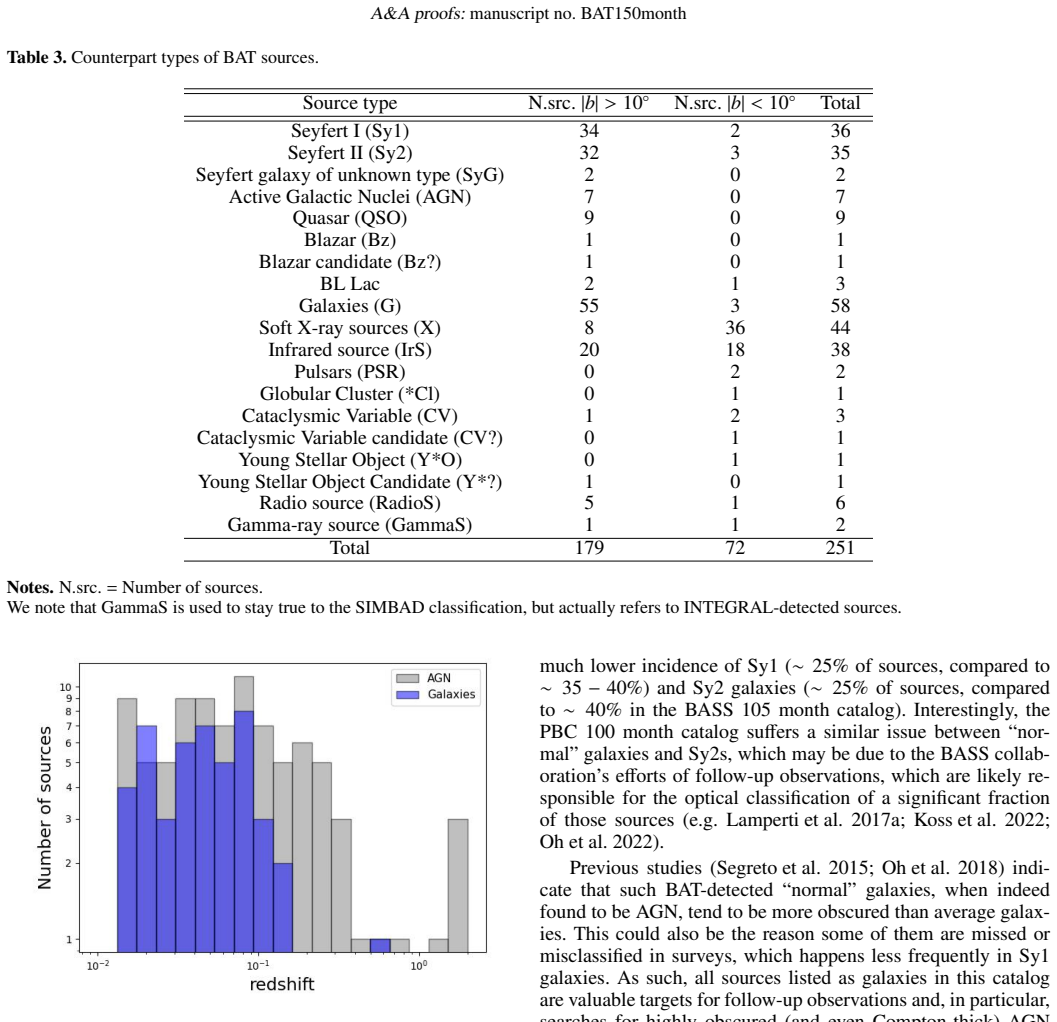
The central claim is the delivery of a catalog with 251 potential counterparts for 250 unassociated BAT hard X-ray sources, obtained by spatial overlap with soft X-ray detections from Chandra, XMM-Newton, Swift-XRT and eROSITA. Within the sample 94 sources (37 percent) are active galactic nuclei and 58 (23 percent) are galaxies, while the remaining 99 include pulsars, cataclysmic variables and unclassified soft X-ray objects. Redshift data for 139 counterparts match the distribution of prior BAT catalogs, and optical spectroscopy of nine galaxies identifies most as Seyfert 2 systems at modestly higher redshifts.
What carries the argument
Spatial overlap between BAT hard X-ray positions and soft X-ray detections from Chandra, XMM-Newton, Swift-XRT or eROSITA to establish potential physical associations.
If this is right
- The catalog increases the number of identified BAT sources available for population studies.
- The 37 percent AGN fraction and matching redshift distribution confirm the sample belongs to the same parent population as previously cataloged BAT objects.
- The 23 percent galaxy fraction and Seyfert 2 classifications from optical spectra provide new targets for black-hole activity studies.
- The 40 percent unclassified or stellar sources highlight objects that require additional multi-wavelength data for full typing.
Where Pith is reading between the lines
- Confirmed associations would allow statistical studies of how the fraction of obscured AGN changes with redshift in hard X-ray selected samples.
- The remaining unclassified sources could be searched for unusual timing or spectral properties that might reveal new classes of compact objects.
- Cross-matching this list with radio or infrared surveys would test whether the current spatial matches hold when independent wavelengths are added.
Load-bearing premise
Spatial overlap between a BAT hard X-ray position and a soft X-ray detection reliably indicates the same physical object rather than a chance alignment.
What would settle it
High-resolution or multi-epoch observations showing that a substantial fraction of the soft X-ray sources are offset from the hard X-ray positions or lack matching hard X-ray variability.
Figures




read the original abstract
We present a comprehensive catalog of 251 potential counterparts for 250 unassociated hard X-ray sources detected in the Swift Burst Alert Telescope (BAT) 150-month hard X-ray survey. Over 150 months of observation, BAT has detected 2339 sources in the 15-150 keV energy range. Among these, 344 do not have a previously identified low-energy counterpart. Our study focuses on the analysis of soft X-ray observations at energies below 10 keV, spatially overlapping with these new Swift-BAT hard X-ray sources. Such observations were taken with Chandra, Swift-XRT, eROSITA, and XMM-Newton. Within the sample of 251 potential counterparts, 94 (37 percent) are identified as active galactic nuclei and 58 (23 percent) as galaxies. The remaining 99 sources (40 percent) include pulsars, cataclysmic variables, and unclassified soft X-ray counterparts in the 0.5-10 keV band. Redshift information is available for 139 out of the 251 sources, and its distribution is in close agreement with the redshift distribution of previous BAT catalogs. We also present the results of a small optical spectroscopy campaign of 9 out of 58 galaxies. The majority of these are classified as Seyfert 2 galaxies at redshifts slightly larger than the median of the BAT AGN sample.
Editorial analysis
A structured set of objections, weighed in public.
Referee Report
Summary. The manuscript presents a catalog of 251 potential soft X-ray counterparts identified for 250 previously unassociated sources from the Swift-BAT 150-month hard X-ray survey. Using archival observations from Chandra, XMM-Newton, Swift-XRT, and eROSITA, the authors classify 94 sources (37%) as AGN, 58 (23%) as galaxies, and 99 (40%) as other types including pulsars and cataclysmic variables, with redshift information available for 139 sources whose distribution matches prior BAT catalogs; a small optical spectroscopy campaign on 9 galaxies is also reported.
Significance. If the associations hold after statistical validation, the catalog would meaningfully advance completion of the Swift-BAT source list, enabling better demographic studies of the hard X-ray sky and providing targets for follow-up. The use of multiple soft X-ray archives and the redshift consistency with earlier samples are strengths, though the small optical subsample limits its standalone impact.
major comments (2)
- [§3] §3 (Counterpart Identification): Associations are based solely on spatial overlap within BAT error circles without any Monte Carlo randomization test, background source density scaling, or false-positive fraction estimate. Given arcminute-scale BAT uncertainties and typical soft X-ray source densities, this leaves the reliability of the 251 matches unquantified and directly affects the reported type fractions and redshift distribution.
- [§4.2] §4.2 and Table 1 (Source Classifications): The breakdown into 37% AGN and 23% galaxies is presented without correction for possible spurious matches; if even 15% of associations are chance alignments, the demographic claims and comparison to prior BAT catalogs lose reliability.
minor comments (2)
- [Abstract] The abstract states the redshift distribution is 'in close agreement' with previous BAT catalogs, but no quantitative comparison (e.g., KS test statistic or overlaid histogram) appears in the text or figures.
- [Figure 3] Figure 3 (redshift histogram): Axis labels and legend could be clarified to distinguish the new sample from the reference BAT distribution.
Simulated Author's Rebuttal
We thank the referee for the constructive comments on our manuscript. We address the concerns about the lack of statistical validation for the counterpart associations by adding a Monte Carlo analysis and corrected demographics in the revised version.
read point-by-point responses
-
Referee: [§3] §3 (Counterpart Identification): Associations are based solely on spatial overlap within BAT error circles without any Monte Carlo randomization test, background source density scaling, or false-positive fraction estimate. Given arcminute-scale BAT uncertainties and typical soft X-ray source densities, this leaves the reliability of the 251 matches unquantified and directly affects the reported type fractions and redshift distribution.
Authors: We agree that a quantitative estimate of the false-positive rate is required for robustness. In the revised manuscript we have added a Monte Carlo randomization test in §3: BAT positions were shifted randomly within the survey area while preserving the local soft X-ray source density, yielding an estimated spurious association fraction of ~12 %. This value is now reported together with the original counts, and the impact on type fractions is discussed. revision: yes
-
Referee: [§4.2] §4.2 and Table 1 (Source Classifications): The breakdown into 37% AGN and 23% galaxies is presented without correction for possible spurious matches; if even 15% of associations are chance alignments, the demographic claims and comparison to prior BAT catalogs lose reliability.
Authors: As described in our response to the preceding comment, the revised §4.2 and Table 1 now present both the raw and spurious-corrected fractions (approximately 32 % AGN and 20 % galaxies after subtracting the estimated 12 % false positives). The redshift distribution of the corrected sample remains statistically consistent with earlier BAT catalogs, which we now quantify with a Kolmogorov-Smirnov test. revision: yes
Circularity Check
No circularity: purely observational catalog construction
full rationale
The paper constructs a catalog of 251 potential soft X-ray counterparts for 250 unassociated BAT sources solely via positional overlap with Chandra, XMM-Newton, Swift-XRT and eROSITA detections. No equations, model fits, predictions, or derivations appear in the abstract or described content. The central claim is the catalog itself, assembled from external archival observations; no step reduces by construction to a fitted input, self-citation chain, or renamed ansatz. Standard observational association methods are used without internal circularity.
Axiom & Free-Parameter Ledger
axioms (1)
- domain assumption Positional coincidence within the positional uncertainties of BAT and soft X-ray instruments indicates the same physical object.
Reference graph
Works this paper leans on
-
[1]
Abdollahi, S., Acero, F., Baldini, L., et al. 2022, ApJS, 260, 53
work page 2022
- [2]
-
[3]
Akylas, A., Georgantopoulos, I., Ranalli, P., et al. 2016, A&A, 594, A73
work page 2016
-
[4]
Ananna, T. T., Treister, E., Urry, C. M., et al. 2019, ApJ, 871, 240
work page 2019
- [5]
-
[6]
Antonucci, R. R. J. & Miller, J. S. 1985, ApJ, 297, 621
work page 1985
-
[7]
Arnaud, K. A. 1996, in Astronomical Society of the Pacific Conference Series, V ol. 101, Astronomical Data Analysis Software and Systems V , ed. G. H. Jacoby & J. Barnes, 17
work page 1996
-
[8]
Fermi Large Area Telescope Fourth Source Catalog Data Release 4 (4FGL-DR4)
Ballet, J., Bruel, P., Burnett, T. H., Lott, B., & The Fermi-LAT collaboration. 2023, arXiv e-prints, arXiv:2307.12546
work page internal anchor Pith review arXiv 2023
-
[9]
Barthelmy, S. D., Barbier, L. M., Cummings, J. R., et al. 2005, Space Sci. Rev., 120, 143
work page 2005
-
[10]
Baumgartner, W. H., Tueller, J., Markwardt, C. B., et al. 2013, ApJS, 207, 19
work page 2013
-
[11]
Berney, S., Koss, M., Trakhtenbrot, B., et al. 2015, MNRAS, 454, 3622
work page 2015
-
[12]
J., Malizia, A., Bazzano, A., et al
Bird, A. J., Malizia, A., Bazzano, A., et al. 2007, ApJS, 170, 175
work page 2007
-
[13]
Burlon, D., Ghirlanda, G., Ghisellini, G., et al. 2008, ApJ, 685, L19
work page 2008
-
[14]
Burrows, D. N., Hill, J. E., Nousek, J. A., et al. 2005, Space Sci. Rev., 120, 165
work page 2005
-
[15]
Clemens, J. C., Crain, J. A., & Anderson, R. 2004, in Society of Photo-Optical Instrumentation Engineers (SPIE) Conference Series, V ol. 5492, Ground- based Instrumentation for Astronomy, ed. A. F. M. Moorwood & M. Iye, 331–340
work page 2004
-
[16]
Combes, F., García-Burillo, S., Audibert, A., et al. 2019, A&A, 623, A79
work page 2019
-
[17]
S., Torres-Albà, N., Marchesi, S., et al
Cox, I. S., Torres-Albà, N., Marchesi, S., et al. 2025, ApJ, 979, 130
work page 2025
-
[18]
2010, A&A, 524, A64 Article number, page 10 K
Cusumano, G., La Parola, V ., Segreto, A., et al. 2010, A&A, 524, A64 Article number, page 10 K. Imam et al.: Source identification for theSwift-BAT 150–month hard X-ray catalog using soft X-ray observations Table 6.Summary of the originally unclassified sources in our sample that were followed-up with optical spectroscopy. Name Counterpart Optical Type R...
work page 2010
- [19]
-
[20]
Flesch, E. W. 2023, The Open Journal of Astrophysics, 6, 49
work page 2023
-
[21]
Fruscione, A., McDowell, J. C., Allen, G. E., et al. 2006, in Society of Photo- Optical Instrumentation Engineers (SPIE) Conference Series, V ol. 6270, Ob- servatory Operations: Strategies, Processes, and Systems, ed. D. R. Silva & R. E. Doxsey, 62701V
work page 2006
-
[22]
2017, in The X-ray Universe 2017, ed
Gabriel, C. 2017, in The X-ray Universe 2017, ed. J.-U. Ness & S. Migliari, 84
work page 2017
-
[23]
Giacconi, R., Gursky, H., Paolini, F. R., & Rossi, B. B. 1962, Phys. Rev. Lett., 9, 439
work page 1962
- [24]
-
[25]
Hinkle, J. T. & Mushotzky, R. 2021, MNRAS, 506, 4960 Hönig, S. F. 2019, ApJ, 884, 171
work page 2021
- [26]
- [27]
-
[28]
J., Assef, R., Balokovi ´c, M., et al
Koss, M. J., Assef, R., Balokovi ´c, M., et al. 2016, The Astrophysical Journal, 825, 85
work page 2016
-
[29]
J., Trakhtenbrot, B., Ricci, C., et al
Koss, M. J., Trakhtenbrot, B., Ricci, C., et al. 2022, ApJS, 261, 1
work page 2022
-
[30]
Liang, E. P. T. 1979, ApJ, 231, L111
work page 1979
-
[31]
Y ., Krimm, H., Markwardt, C., et al
Lien, A. Y ., Krimm, H., Markwardt, C., et al. 2025, arXiv e-prints, arXiv:2506.04109
- [32]
- [33]
-
[34]
Marinucci, A., Tamborra, F., Bianchi, S., et al. 2018, Galaxies, 6, 44
work page 2018
- [35]
-
[36]
Mohanadas, P. & Annuar, A. 2023, Research in Astronomy and Astrophysics, 23, 055002
work page 2023
-
[37]
2004, in Society of Photo-Optical Instrumentation Engineers (SPIE) Conference Series, V ol
Moretti, A., Campana, S., Tagliaferri, G., et al. 2004, in Society of Photo-Optical Instrumentation Engineers (SPIE) Conference Series, V ol. 5165, X-Ray and Gamma-Ray Instrumentation for Astronomy XIII, ed. K. A. Flanagan & O. H. W. Siegmund, 232–240 Nasa High Energy Astrophysics Science Archive Research Center. 2014, HEA- soft: Unified Release of FTOOLS...
work page 2004
- [38]
- [39]
-
[40]
Oh, K., Schawinski, K., Koss, M., et al. 2017, MNRAS, 464, 1466
work page 2017
-
[41]
Predehl, P., Andritschke, R., Arefiev, V ., et al. 2021, A&A, 647, A1
work page 2021
-
[42]
2007, in Society of Photo- Optical Instrumentation Engineers (SPIE) Conference Series, V ol
Predehl, P., Andritschke, R., Bornemann, W., et al. 2007, in Society of Photo- Optical Instrumentation Engineers (SPIE) Conference Series, V ol. 6686, UV , X-Ray, and Gamma-Ray Space Instrumentation for Astronomy XV , ed. O. H. Siegmund, 668617
work page 2007
-
[43]
2010, in American Institute of Physics Conference Series, V ol
Predehl, P., Böhringer, H., Brunner, H., et al. 2010, in American Institute of Physics Conference Series, V ol. 1248, X-ray Astronomy 2009; Present Sta- tus, Multi-Wavelength Approach and Future Perspectives, ed. A. Comastri, L. Angelini, & M. Cappi (AIP), 543–548
work page 2010
-
[44]
Ricci, C., Privon, G. C., Pfeifle, R. W., et al. 2021, MNRAS, 506, 5935
work page 2021
- [45]
- [46]
- [47]
-
[48]
Ricci, C., Walter, R., Courvoisier, T. J. L., & Paltani, S. 2011, A&A, 532, A102
work page 2011
-
[49]
Schmitt, J. L. 1968, Nature, 218, 663
work page 1968
-
[50]
Segreto, A., Cusumano, G., Ferrigno, C., et al. 2010, A&A, 510, A47
work page 2010
-
[51]
Segreto, A., Cusumano, G., La Parola, V ., & Maselli, A. 2015, PoS, SWIFT 10, 132
work page 2015
-
[52]
Sengupta, D., Marchesi, S., Vignali, C., et al. 2023, A&A, 676, A103
work page 2023
-
[53]
Silver, R., Torres-Albà, N., Zhao, X., et al. 2022, ApJ, 940, 148
work page 2022
-
[54]
Stein, W. A., O’Dell, S. L., & Strittmatter, P. A. 1976, ARA&A, 14, 173
work page 1976
-
[55]
Temple, M. J., Ricci, C., Koss, M. J., et al. 2023, MNRAS, 518, 2938
work page 2023
-
[56]
2020, ApJ, 896, 172 Torres-Albà, N., Marchesi, S., Zhao, X., et al
Toda, K., Fukazawa, Y ., & Inoue, Y . 2020, ApJ, 896, 172 Torres-Albà, N., Marchesi, S., Zhao, X., et al. 2021, ApJ, 922, 252 Tubín-Arenas, D., Krumpe, M., Lamer, G., et al. 2024, A&A, 682, A35
work page 2020
- [57]
-
[58]
Verner, D. A., Ferland, G. J., Korista, K. T., & Yakovlev, D. G. 1996, ApJ, 465, 487
work page 1996
-
[59]
Wang, C., Yu, L.-M., Bian, W.-H., & Zhao, B.-X. 2019, MNRAS, 487, 2463
work page 2019
-
[60]
C., Brinkman, B., Canizares, C., et al
Weisskopf, M. C., Brinkman, B., Canizares, C., et al. 2002, PASP, 114, 1
work page 2002
- [61]
- [62]
- [63]
discussion (0)
Sign in with ORCID, Apple, or X to comment. Anyone can read and Pith papers without signing in.