REVIEW 2 major objections 5 minor 7 references
Strategies for Span Labeling with Large Language Models
T0 review · 2 major / 5 minor · reviewed 2026-08-03 · deepseek-v4-flash
Pith's one-line read LogitMatch, a decoding-time filter, forces LLM span labels to be exact substrings of the input, removing a whole class of alignment errors without retraining.
desk verdict LogitMatch is a real engineering contribution with a useful taxonomy, but the single-run experiments leave the headline improvement over matching within the noise. read the letter →
The pith
A machine-rendered reading of the paper's core claim, the machinery that carries it, and where it could break.
The reading
What carries the argument
LogitMatch is a logit-level constrained decoding procedure with three modes: DEFAULT (normal generation), SELECT (vocabulary limited to input tokens, so the span starts with a real input token), and COPY (only the next input token or a closing quote is allowed, so the generated text can only be extended along the input). The tokenization handler whitelists prefix tokens and boundary quote tokens so that different input/output tokenizations do not accidentally forbid valid spans. This machinery converts the model's span output into a guarantee: every decoded span is a substring of the input, eliminating the need for fuzzy post-hoc matching.
What would settle it
Run LogitMatch on an input that starts a span with a byte-level BPE token that merges the opening quote with the first span character (e.g. a fused token like “London”). If the whitelist logic does not recognize this fused token as the beginning of a span, LogitMatch will reject the valid span or emit malformed JSON; a high failure rate on such inputs would show that the alignment guarantee only holds for favorable tokenizers.
Extended reading notes
Core claim
On the paper's own terms, the central claim is that span-content matching fails not because matching is a bad idea but because unconstrained LLMs do not faithfully copy input substrings. LogitMatch makes the copy step guaranteed by intervening only at decoding: while the model generates the text field of a JSON span, the vocabulary is pruned to tokens appearing in the input, and continuation is limited to the next input token or the closing quote. This preserves the model's token-efficiency and does not need fine-tuning. The paper reports that LogitMatch improves over vanilla matching on NER and GEC, where input text uses standard NLP tokenization, and occasionally matches or exceeds tagging
Load-bearing premise
The tokenization whitelisting in LogitMatch correctly handles every input tokenizer and model, so that no valid span is ever forbidden and no malformed JSON is produced; the paper's own limitations section notes that a similar constrained approach for tagging ran into severe tokenization issues.
Editorial extensions
If this is right
- If LogitMatch works as reported, matching-based span labeling becomes reliable on tasks with non-canonical input tokenization, where models previously tended to normalize punctuation and casing.
- Because it only touches decoding, the method transfers to any locally deployable LLM without fine-tuning or architecture changes.
- LogitMatch can be combined with structured-output constraints and an occurrence-index field, covering repeated spans that plain content matching cannot disambiguate.
- The approach requires logit access, so it is not directly applicable to closed API models, where the paper notes it could not be evaluated.
- On tasks like GEC, tagging still wins, suggesting the ideal method depends on average span length and how naturally tags wrap around errors.
Reading between the lines
- Editorial inference: LogitMatch could in principle be extended to tagging strategies by constraining the entire copied text, but the paper reports that tokenization at tag boundaries caused severe issues and was abandoned; a working version would let tagging gain the same alignment guarantee.
- Editorial inference: the method does nothing about label hallucination or category errors, so its ceiling is set by the model's semantic judgment; combining it with reasoning-trace generation might push both alignment and accuracy, at a token-cost trade-off the paper's reasoning experiments already hint at.
- Editorial inference: a natural stress test is to apply LogitMatch to byte-level BPE inputs where opening quotes fuse with the first span token; the paper's whitelisting logic is the fragile piece and would need to handle such fused tokens without rejecting valid spans.
Signed reviews
Editorial analysis
A structured set of objections, weighed in public.
Referee Report
Summary. The paper surveys prompting strategies for span labeling with LLMs, organizing them into tagging, indexing, and matching families, and proposes LogitMatch, a constrained-decoding method that restricts the generated 'text' field to tokens drawn from valid input spans. The method is evaluated on NER, GEC, machine-translation error detection, and a synthetic conditional pattern lookup task, using three open-weight LLMs plus GPT-5-mini for methods that do not require logit access. The central claim is that LogitMatch eliminates span-matching errors of matching-based approaches and improves over competitive matching baselines in some setups, while tagging remains a robust baseline.
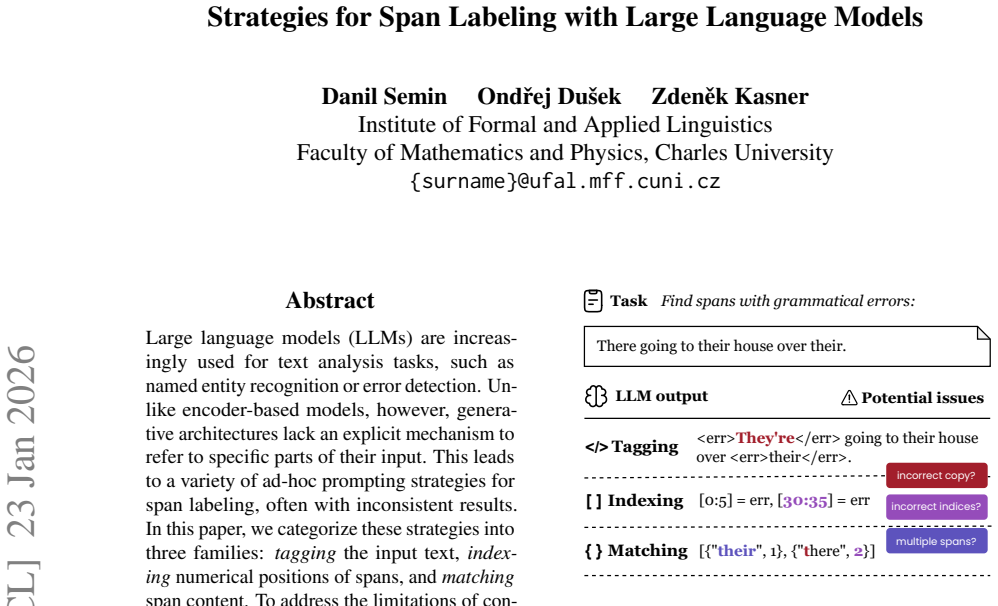
Significance. The taxonomy of span-labeling strategies is a useful organizing contribution, and LogitMatch is a simple, training-free, and reproducible method that addresses a genuine failure mode of matching-based pipelines: models' inability to copy input spans exactly. The paper ships code, evaluates across four tasks and several multilingual datasets, and provides an error decomposition that goes beyond overall F1. The qualitative example in Table 4 clearly illustrates the tokenization mismatch problem. If the empirical advantage over plain matching were statistically supported, this would be a solid and practical contribution to LLM-based span labeling.
major comments (2)
- [§5.3, Appendix A, Table 3] All experiments are single runs at seed 0, with sampling temperatures above zero (up to 1.0 for GPT-5-mini). The reported F1 differences between LogitMatch and MATCH are mostly 0.1–2.7 points and sometimes negative (e.g., NER-70B: 72.4 vs. 72.7; ESA-MT-70B: 9.2 vs. 9.1; several CPL entries tied). With no multiple seeds, confidence intervals, or significance tests, the abstract's claim that LogitMatch 'improves upon competitive matching-based methods' is not statistically supported. Please add repeated runs with different seeds, report variance, and apply a significance test (e.g., paired bootstrap). If the difference is not significant, the claim should be softened to state that LogitMatch eliminates span-matching errors while performing within noise of matching baselines.
- [§4.3, Algorithm 1, Limitations] LogitMatch's central guarantee depends on the tokenization-handling rules: whitelisting prefix tokens and quote tokens at field boundaries. Algorithm 1 is explicitly a simplification that 'does not account for tokenization,' and the Limitations state that a similar constrained approach for tagging 'ran into severe issues with tokenization handling.' The paper does not provide a systematic evaluation of tokenizer-edge-case failures on the multilingual NER/ESA-MT data, such as byte-level BPE where the opening quote is fused with the following span token, or whitespace normalization across scripts. Because the headline property is that every decoded span is a valid input span, please add a robustness analysis or formal argument that the whitelist logic is complete for the tested tokenizers; otherwise the method's generality is not fully established.
minor comments (5)
- [§3.3 and Table 7] The paper uses both 'occurence_index' and 'occurrence' for the same field; please standardize the spelling.
- [§5.1] 'analogically' should be 'analogously'.
- [§6] 'hypothetize' should be 'hypothesize'.
- [Algorithm 1] The algorithm uses X = [x1, ..., xn] as 'tokens' in V_select, but Section 2 defines X as characters. Please clarify the relationship between character-level task definition and token-level constrained decoding.
- [Appendix C.3] The heading 'our experiments with Qwen-8B' should be 'Qwen3-8B' for consistency with the model name used elsewhere.
Circularity Check
No significant circularity; LogitMatch's alignment guarantee is a construction property and the comparison rests on external benchmarks.
full rationale
No circular step is present. LogitMatch is defined by Algorithm 1: in SELECT mode the vocabulary is restricted to input tokens (V_select <- {x | x in X}), and in COPY mode to the next input token or closing quote (V_copy <- {x_{k+1}} union {"}); thus every decoded span is a valid input substring by construction. The abstract's phrase 'eliminating span matching issues' is therefore a true description of the method's guarantee, not a fitted result or a self-cited theoretical claim. The claimed improvement is evaluated on external benchmarks (UniversalNER, MultiGEC, WMT24 ESA-MT, and the synthetic CPL stress test) via overlap F1 in Table 3. The self-citations (Kasner & Dusek 2024; Kasner et al. 2025) supply the JSON matching format and an ESA-MT test set, but they are background/equipment rather than load-bearing evidence for the LogitMatch comparison; no uniqueness theorem or ansatz is imported from those papers. The single-run/no-error-bar protocol is a statistical robustness concern, not a circularity issue.
Assumptions & free parameters
assumptions (2)
- domain assumption LLMs have no explicit mechanism to ground generated output tokens in input tokens.
- domain assumption String matching of generated span content to input text suffices to determine span indices when content is unique.
Cite this review
Pith. "Pith review of Strategies for Span Labeling with Large Language Models." pith.science (2026). https://pith.science/paper/I2RDFDXP
@misc{pith2026260116946,
  author       = {Pith},
  title        = {Pith review of: Strategies for Span Labeling with Large Language Models},
  year         = {2026},
  howpublished = {\url{https://pith.science/paper/I2RDFDXP}},
  note         = {Machine review of arXiv:2601.16946}
}
read the original abstract
Large language models (LLMs) are increasingly used for text analysis tasks, such as named entity recognition or error detection. Unlike encoder-based models, however, generative architectures lack an explicit mechanism to refer to specific parts of their input. This leads to a variety of ad-hoc prompting strategies for span labeling, often with inconsistent results. In this paper, we categorize these strategies into three families: tagging the input text, indexing numerical positions of spans, and matching span content. To address the limitations of content matching, we introduce LogitMatch, a new constrained decoding method that forces the model's output to align with valid input spans. We evaluate all methods across four diverse tasks. We find that while tagging remains a robust baseline, LogitMatch improves upon competitive matching-based methods by eliminating span matching issues and outperforms other strategies in some setups.
Figures

Reference graph
Works this paper leans on
-
[1]
PER">Lina Berg</entity> joined <entity type=
[Example input] -> [Example output] ... [Notes] [Input text] Task definitions NERExtract named entities (PERSON, ORG, LOC) from the text. GECIdentify grammatical errors in learner-written text. ESA-MTIdentify translation errors by comparing the translation to the source text. CPLFind all text spans that match the given pattern queries. Tagging strategies ...
-
[5]
We Need Structured Output
Error Span Annotation: A Balanced Approach for Human Evaluation of Machine Translation. In Proceedings of the Ninth Conference on Machine Translation, WMT 2024, Miami, FL, pages 1440– 1453, USA. Woosuk Kwon, Zhuohan Li, Siyuan Zhuang, Ying Sheng, Lianmin Zheng, Cody Hao Yu, Joseph Gon- zalez, Hao Zhang, and Ion Stoica. 2023. Efficient Memory Management fo...
2024
-
[2017]
InProceed- ings of the 55th Annual Meeting of the Association for Computational Linguistics, ACL 2017 4, V olume 1: Long Papers, pages 793–805, Vancouver, Canada
Automatic Annotation and Evaluation of Error Types for Grammatical Error Correction. InProceed- ings of the 55th Annual Meeting of the Association for Computational Linguistics, ACL 2017 4, V olume 1: Long Papers, pages 793–805, Vancouver, Canada. Giovanni Da San Martino, Seunghak Yu, Alberto Barrón-Cedeño, Rostislav Petrov, and Preslav Nakov
2017
-
[2019]
Fine-Grained Analysis of Propaganda in News Article. InProceedings of the 2019 Conference on Empirical Methods in Natural Language Processing and the 9th International Joint Conference on Natu- ral Language Processing (EMNLP-IJCNLP), pages 5636–5646. Association for Computational Linguis- tics. Jacob Devlin, Ming-Wei Chang, Kenton Lee, and Kristina Toutan...
2019
-
[2023]
Evaluating factual accuracy in complex data- to-text.Comput. Speech Lang., 80:101482. 10 Marcos V . Treviso, Nuno Miguel Guerreiro, Sweta Agrawal, Ricardo Rei, José Pombal, Tânia Vaz, He- lena Wu, Beatriz Silva, Daan van Stigt, and André F. T. Martins. 2024. xTower: A Multilingual LLM for Explaining and Correcting Translation Errors. In Findings of the As...
arXiv 2024
-
[2024]
CUTE: Measuring LLMs’ Understanding of Their Tokens. InProceedings of the 2024 Conference on Empirical Methods in Natural Language Process- ing, EMNLP 2024, Miami, FL, pages 3017–3026, USA. Tairan Fu, Raquel Ferrando, Javier Conde, Carlos Ar- riaga, and Pedro Reviriego. 2024. Why Do Large Language Models (LLMs) Struggle to Count Letters? CoRR, abs/2412.18...
arXiv 2024
-
[2025]
Zdenˇek Kasner and Ondˇrej Dušek
Can LLMs extract human-like fine-grained evidence for evidence-based fact-checking?arXiv preprint arXiv:2511.21401. Zdenˇek Kasner and Ondˇrej Dušek. 2024. Beyond Tra- ditional Benchmarks: Analyzing Behaviors of Open LLMs on Data-to-text Generation. InProceedings of the 62nd Annual Meeting of the Association for Computational Linguistics (V olume 1: Long ...
arXiv 2024
Reviewed August 3, 2026 · model on record in the stance chip above.
Discussion (0). Continue with ORCID to comment.