Bridging Supervision Gaps: A Unified Framework for Remote Sensing Change Detection
Pith reviewed 2026-05-16 10:54 UTC · model grok-4.3
The pith
A shared-encoder multi-branch model called UniCD jointly solves supervised, weakly-supervised, and unsupervised change detection in remote sensing imagery.
A machine-rendered reading of the paper's core claim, the machinery that carries it, and where it could break.
Core claim
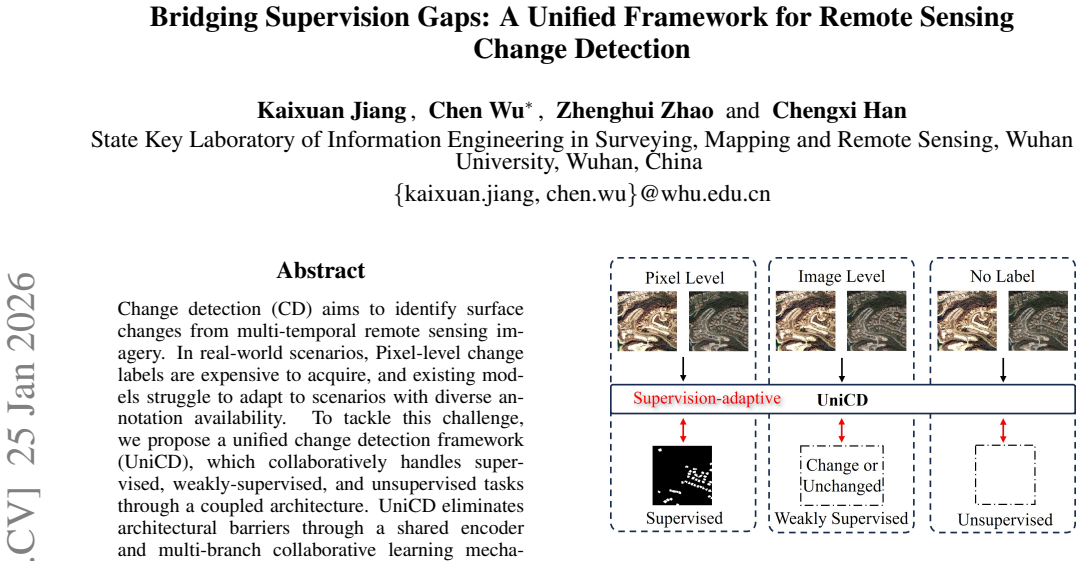
UniCD couples a shared encoder with three supervision-specific branches through collaborative learning. The supervised branch applies a spatial-temporal awareness module to fuse bi-temporal features. The weakly-supervised branch adds change representation regularization that guides coarse activations toward separable change regions. The unsupervised branch introduces semantic prior-driven change inference that converts the task into a controlled weakly-supervised optimization. The architecture achieves state-of-the-art results on three tasks and improves accuracy by 12.72 percent in the weakly-supervised case and 12.37 percent in the unsupervised case on LEVIR-CD.
What carries the argument
The multi-branch collaborative learning mechanism with a shared encoder that couples heterogeneous supervision signals across supervised, weakly-supervised, and unsupervised branches.
If this is right
- A single trained model can be deployed for change detection regardless of the label quality available at inference time.
- Training can mix fully labeled, partially labeled, and unlabeled image pairs without requiring task-specific retraining.
- Performance in low-label regimes approaches supervised levels, reducing reliance on expensive pixel annotations.
- The same encoder weights serve all three regimes, lowering overall model storage and compute costs.
Where Pith is reading between the lines
- The collaborative mechanism may transfer to other dense-prediction tasks such as semantic segmentation where label density also varies.
- If branch interference remains low, the framework could incorporate additional supervision types such as noisy or temporal labels without redesign.
- Practitioners could initialize with unsupervised pre-training on large unlabeled archives and then fine-tune with sparse weak labels.
Load-bearing premise
The shared encoder and branch collaboration can integrate different supervision levels without one degrading the others.
What would settle it
Train UniCD on a mixed-supervision dataset and measure whether fully supervised accuracy falls below that of a dedicated supervised-only model trained on the same labeled data.
Figures


read the original abstract
Change detection (CD) aims to identify surface changes from multi-temporal remote sensing imagery. In real-world scenarios, Pixel-level change labels are expensive to acquire, and existing models struggle to adapt to scenarios with diverse annotation availability. To tackle this challenge, we propose a unified change detection framework (UniCD), which collaboratively handles supervised, weakly-supervised, and unsupervised tasks through a coupled architecture. UniCD eliminates architectural barriers through a shared encoder and multi-branch collaborative learning mechanism, achieving deep coupling of heterogeneous supervision signals. Specifically, UniCD consists of three supervision-specific branches. In the supervision branch, UniCD introduces the spatial-temporal awareness module (STAM), achieving efficient synergistic fusion of bi-temporal features. In the weakly-supervised branch, we construct change representation regularization (CRR), which steers model convergence from coarse-grained activations toward coherent and separable change modeling. In the unsupervised branch, we propose semantic prior-driven change inference (SPCI), which transforms unsupervised tasks into controlled weakly-supervised path optimization. Experiments on mainstream datasets demonstrate that UniCD achieves optimal performance across three tasks. It exhibits significant accuracy improvements in weakly and unsupervised scenarios, surpassing current state-of-the-art by 12.72% and 12.37% on LEVIR-CD, respectively.
Editorial analysis
A structured set of objections, weighed in public.
Referee Report
Summary. The manuscript proposes UniCD, a unified framework for remote sensing change detection that jointly addresses supervised, weakly-supervised, and unsupervised scenarios via a shared encoder and multi-branch collaborative learning. It introduces the spatial-temporal awareness module (STAM) for bi-temporal feature fusion in the supervised branch, change representation regularization (CRR) to guide weakly-supervised convergence, and semantic prior-driven change inference (SPCI) to recast unsupervised tasks as controlled optimization, claiming state-of-the-art performance with gains of 12.72% and 12.37% over prior methods on LEVIR-CD for the weakly-supervised and unsupervised regimes, respectively.
Significance. If the reported gains prove robust under detailed scrutiny, the work would be significant for remote sensing applications by offering a single architecture that adapts to heterogeneous annotation availability, thereby lowering the barrier of expensive pixel-level labeling while maintaining or improving accuracy across supervision regimes.
major comments (2)
- [Abstract / Experiments] Abstract and Experiments section: the claimed improvements of 12.72% and 12.37% on LEVIR-CD are presented without accompanying error bars, number of runs, statistical significance tests, or exhaustive baseline tables, rendering it impossible to assess whether the gains are load-bearing or sensitive to implementation choices.
- [Methods] Methods section on multi-branch collaborative learning: the central claim that heterogeneous supervision signals are deeply coupled through the shared encoder without negative interference lacks explicit mechanisms (e.g., loss weighting schedules, gradient balancing, or task-specific adapters) and supporting ablation results showing single-branch performance, which directly underpins the unified framework's validity.
minor comments (1)
- [Abstract] The abstract refers to 'mainstream datasets' but reports quantitative results only for LEVIR-CD; a concise enumeration of all evaluated datasets and metrics in the abstract would improve immediate readability.
Simulated Author's Rebuttal
We thank the referee for the constructive comments on our manuscript. We address each major point below and will revise the paper accordingly to improve its rigor and clarity.
read point-by-point responses
-
Referee: [Abstract / Experiments] Abstract and Experiments section: the claimed improvements of 12.72% and 12.37% on LEVIR-CD are presented without accompanying error bars, number of runs, statistical significance tests, or exhaustive baseline tables, rendering it impossible to assess whether the gains are load-bearing or sensitive to implementation choices.
Authors: We agree that the absence of error bars, run counts, and statistical tests limits the interpretability of the reported gains. In the revised manuscript we will add results averaged over five independent runs with standard deviations, include paired t-test p-values against the strongest baselines, and expand the experimental tables with additional recent methods for completeness. revision: yes
-
Referee: [Methods] Methods section on multi-branch collaborative learning: the central claim that heterogeneous supervision signals are deeply coupled through the shared encoder without negative interference lacks explicit mechanisms (e.g., loss weighting schedules, gradient balancing, or task-specific adapters) and supporting ablation results showing single-branch performance, which directly underpins the unified framework's validity.
Authors: The coupling occurs via joint optimization of the shared encoder on the summed losses from the three branches, with branch-specific modules (STAM, CRR, SPCI) providing targeted guidance. To make this explicit and to demonstrate absence of negative interference, we will insert a loss-weighting description (currently uniform weights) and new ablation tables comparing full multi-branch performance against single-branch variants on LEVIR-CD and WHU-CD. revision: yes
Circularity Check
No significant circularity in derivation chain
full rationale
The paper introduces UniCD as an architectural framework using a shared encoder plus three supervision-specific branches (STAM for supervised, CRR for weakly-supervised, SPCI for unsupervised). No equations, fitted parameters, or derivation steps appear in the abstract or described text that reduce any claimed performance gain to a self-definition, a renamed input, or a self-citation chain. The reported accuracy improvements (12.72 % and 12.37 % on LEVIR-CD) are presented as outcomes of experiments on external benchmark datasets rather than quantities forced by construction from the model definition itself. The central claim therefore rests on independent empirical validation rather than internal reduction.
Axiom & Free-Parameter Ledger
axioms (1)
- domain assumption Deep neural networks with shared encoders can effectively integrate heterogeneous supervision signals via collaborative branches without destructive interference.
Lean theorems connected to this paper
-
IndisputableMonolith/Foundation/ArithmeticFromLogic.leanreality_from_one_distinction unclear?
unclearRelation between the paper passage and the cited Recognition theorem.
UniCD eliminates architectural barriers through a shared encoder and multi-branch collaborative learning mechanism, achieving deep coupling of heterogeneous supervision signals.
-
IndisputableMonolith/Foundation/AlexanderDuality.leanalexander_duality_circle_linking unclear?
unclearRelation between the paper passage and the cited Recognition theorem.
STAM progressively integrates multi-scale features through hierarchical merging of bi-temporal characteristics
What do these tags mean?
- matches
- The paper's claim is directly supported by a theorem in the formal canon.
- supports
- The theorem supports part of the paper's argument, but the paper may add assumptions or extra steps.
- extends
- The paper goes beyond the formal theorem; the theorem is a base layer rather than the whole result.
- uses
- The paper appears to rely on the theorem as machinery.
- contradicts
- The paper's claim conflicts with a theorem or certificate in the canon.
- unclear
- Pith found a possible connection, but the passage is too broad, indirect, or ambiguous to say the theorem truly supports the claim.
Reference graph
Works this paper leans on
-
[1]
A weakly supervised convolutional network for change segmentation and classification
[Andermatt and Timofte, 2020] Philipp Andermatt and Radu Timofte. A weakly supervised convolutional network for change segmentation and classification. InProceedings of the Asian conference on computer vision,
work page 2020
-
[2]
[Awaiset al., 2025 ] Muhammad Awais, Muzammal Naseer, Salman Khan, Rao Muhammad Anwer, Hisham Cholakkal, Mubarak Shah, Ming-Hsuan Yang, and Fahad Shahbaz Khan. Foundation models defining a new era in vision: a survey and outlook.IEEE Transactions on Pattern Analysis and Machine Intelligence,
work page 2025
-
[3]
A transformer-based siamese network for change detection
[Bandara and Patel, 2022] Wele Gedara Chaminda Bandara and Vishal M Patel. A transformer-based siamese network for change detection. InIGARSS 2022-2022 IEEE Interna- tional Geoscience and Remote Sensing Symposium, pages 207–210. IEEE,
work page 2022
-
[4]
[Chen and Shi, 2020] Hao Chen and Zhenwei Shi. A spatial- temporal attention-based method and a new dataset for re- mote sensing image change detection.Remote sensing, 12(10):1662,
work page 2020
-
[5]
[Chenet al., 2021 ] Hao Chen, Zipeng Qi, and Zhenwei Shi. Remote sensing image change detection with transform- ers.IEEE Transactions on Geoscience and Remote Sens- ing, 60:1–14,
work page 2021
-
[6]
[Chenet al., 2023 ] Hongruixuan Chen, Jian Song, Chen Wu, Bo Du, and Naoto Yokoya. Exchange means change: An unsupervised single-temporal change detection framework based on intra-and inter-image patch exchange.ISPRS journal of photogrammetry and remote sensing, 206:87– 105,
work page 2023
-
[7]
[Chenet al., 2024 ] Hongruixuan Chen, Jian Song, Chengxi Han, Junshi Xia, and Naoto Yokoya. Changemamba: Re- mote sensing change detection with spatiotemporal state space model.IEEE Transactions on Geoscience and Re- mote Sensing, 62:1–20,
work page 2024
-
[8]
[Dinget al., 2024 ] Lei Ding, Kun Zhu, Daifeng Peng, Hao Tang, Kuiwu Yang, and Lorenzo Bruzzone. Adapting seg- ment anything model for change detection in vhr remote sensing images.IEEE Transactions on Geoscience and Remote Sensing, 62:1–11,
work page 2024
-
[9]
[Duet al., 2019 ] Bo Du, Lixiang Ru, Chen Wu, and Liang- pei Zhang. Unsupervised deep slow feature analysis for change detection in multi-temporal remote sensing im- ages.IEEE Transactions on Geoscience and Remote Sens- ing, 57(12):9976–9992,
work page 2019
-
[10]
[Fanget al., 2021 ] Sheng Fang, Kaiyu Li, Jinyuan Shao, and Zhe Li. Snunet-cd: A densely connected siamese network for change detection of vhr images.IEEE Geoscience and Remote Sensing Letters, 19:1–5,
work page 2021
-
[11]
[Fenget al., 2023 ] Yuchao Feng, Jiawei Jiang, Honghui Xu, and Jianwei Zheng. Change detection on remote sens- ing images using dual-branch multilevel intertemporal net- work.IEEE Transactions on Geoscience and Remote Sensing, 61:1–15,
work page 2023
-
[12]
[Gaoet al., 2025 ] Junyu Gao, Da Zhang, Feiyu Wang, Lichen Ning, Zhiyuan Zhao, and Xuelong Li. Combin- ing sam with limited data for change detection in remote sensing.IEEE Transactions on Geoscience and Remote Sensing,
work page 2025
-
[13]
Mamba: Linear- time sequence modeling with selective state spaces
[Gu and Dao, 2024] Albert Gu and Tri Dao. Mamba: Linear- time sequence modeling with selective state spaces. In First conference on language modeling,
work page 2024
-
[14]
[Hanet al., 2022 ] Kai Han, Yunhe Wang, Hanting Chen, Xinghao Chen, Jianyuan Guo, Zhenhua Liu, Yehui Tang, An Xiao, Chunjing Xu, Yixing Xu, et al. A survey on vi- sion transformer.IEEE transactions on pattern analysis and machine intelligence, 45(1):87–110,
work page 2022
-
[15]
Background-mixed augmentation for weakly supervised change detection
[Huanget al., 2023 ] Rui Huang, Ruofei Wang, Qing Guo, Jieda Wei, Yuxiang Zhang, Wei Fan, and Yang Liu. Background-mixed augmentation for weakly supervised change detection. InProceedings of the AAAI Conference on Artificial Intelligence, volume 37, pages 7919–7927,
work page 2023
-
[16]
To- wards omni-supervised referring expression segmentation
[Huanget al., 2024 ] Minglang Huang, Yiyi Zhou, Gen Luo, Guannan Jiang, Weilin Zhuang, and Xiaoshuai Sun. To- wards omni-supervised referring expression segmentation. In2024 IEEE International Conference on Multimedia and Expo (ICME), pages 1–6. IEEE,
work page 2024
-
[17]
[Hussainet al., 2013 ] Masroor Hussain, Dongmei Chen, Angela Cheng, Hui Wei, and David Stanley. Change de- tection from remotely sensed images: From pixel-based to object-based approaches.ISPRS Journal of photogramme- try and remote sensing, 80:91–106,
work page 2013
-
[18]
[Jiet al., 2018 ] Shunping Ji, Shiqing Wei, and Meng Lu. Fully convolutional networks for multisource building ex- traction from an open aerial and satellite imagery data set.IEEE Transactions on geoscience and remote sens- ing, 57(1):574–586,
work page 2018
-
[19]
Land use change detection using deep siamese neural networks and weakly supervised learning
[Kalitaet al., 2021 ] Indrajit Kalita, Savvas Karatsiolis, and Andreas Kamilaris. Land use change detection using deep siamese neural networks and weakly supervised learning. InInternational Conference on Computer Analysis of Im- ages and Patterns, pages 24–35. Springer,
work page 2021
-
[20]
Adam: A Method for Stochastic Optimization
[Kingma, 2014] Diederik P Kingma. Adam: A method for stochastic optimization.arXiv preprint arXiv:1412.6980,
work page internal anchor Pith review Pith/arXiv arXiv 2014
-
[21]
[Kirillovet al., 2023 ] Alexander Kirillov, Eric Mintun, Nikhila Ravi, Hanzi Mao, Chloe Rolland, Laura Gustafson, Tete Xiao, Spencer Whitehead, Alexander C Berg, Wan-Yen Lo, et al. Segment anything. InPro- ceedings of the IEEE/CVF international conference on computer vision, pages 4015–4026,
work page 2023
-
[22]
[Kondmannet al., 2021 ] Lukas Kondmann, Aysim Toker, Sudipan Saha, Bernhard Sch¨olkopf, Laura Leal-Taix´e, and Xiao Xiang Zhu. Spatial context awareness for unsuper- vised change detection in optical satellite images.IEEE Transactions on Geoscience and Remote Sensing, 60:1– 15,
work page 2021
-
[23]
From sam to cams: Exploring segment any- thing model for weakly supervised semantic segmenta- tion
[Kweon and Yoon, 2024] Hyeokjun Kweon and Kuk-Jin Yoon. From sam to cams: Exploring segment any- thing model for weakly supervised semantic segmenta- tion. InProceedings of the IEEE/CVF Conference on Computer Vision and Pattern Recognition, pages 19499– 19509,
work page 2024
-
[24]
[Liet al., 2021 ] Zewen Li, Fan Liu, Wenjie Yang, Shouheng Peng, and Jun Zhou. A survey of convolutional neural networks: analysis, applications, and prospects.IEEE transactions on neural networks and learning systems, 33(12):6999–7019,
work page 2021
-
[25]
[Liu and Shi, 2021] Mengxi Liu and Qian Shi. Dsamnet: A deeply supervised attention metric based network for change detection of high-resolution images. In2021 IEEE International Geoscience and Remote Sensing Symposium IGARSS, pages 6159–6162. IEEE,
work page 2021
-
[26]
[Liuet al., 2022 ] Mengxi Liu, Zhuoqun Chai, Haojun Deng, and Rong Liu. A cnn-transformer network with multiscale context aggregation for fine-grained cropland change de- tection.IEEE Journal of Selected Topics in Applied Earth Observations and Remote Sensing, 15:4297–4306,
work page 2022
-
[27]
[Luoet al., 2025 ] Yunfan Luo, Ronghao Yang, Junxiang Tan, Guyue Hu, Hongyu Yang, Zhiqiu Liang, Yuyun Ding, and Shaojun Liu. Mdenet: Multi-scale difference infor- mation guided dual-temporal enhancement network for re- mote sensing change detection.IEEE Journal of Selected Topics in Applied Earth Observations and Remote Sens- ing,
work page 2025
-
[28]
Rethinking remote sensing change detection with a mask view.arXiv preprint arXiv:2406.15320,
[Maet al., 2024 ] Xiaowen Ma, Zhenkai Wu, Rongrong Lian, Wei Zhang, and Siyang Song. Rethinking remote sensing change detection with a mask view.arXiv preprint arXiv:2406.15320,
-
[29]
[Ninget al., 2025 ] Hailong Ning, Qi He, Tao Lei, Xiaopeng Cao, Wuxia Zhang, Yanping Chen, and Asoke K Nandi. Da 2-net: Integrating sam2 with domain adaption and dif- ference aggregation for remote sensing change detection. IEEE Transactions on Geoscience and Remote Sensing,
work page 2025
-
[30]
Unsupervised change detection based on image reconstruction loss
[Nohet al., 2022 ] Hyeoncheol Noh, Jingi Ju, Minseok Seo, Jongchan Park, and Dong-Geol Choi. Unsupervised change detection based on image reconstruction loss. In proceedings of the IEEE/CVF conference on computer vi- sion and pattern recognition, pages 1352–1361,
work page 2022
-
[31]
[Paszkeet al., 2019 ] Adam Paszke, Sam Gross, Francisco Massa, Adam Lerer, James Bradbury, Gregory Chanan, Trevor Killeen, Zeming Lin, Natalia Gimelshein, Luca Antiga, et al. Pytorch: An imperative style, high- performance deep learning library.Advances in neural in- formation processing systems, 32,
work page 2019
-
[32]
Unsupervised deep change vector analysis for multiple-change detection in vhr images
[Sahaet al., 2019 ] Sudipan Saha, Francesca Bovolo, and Lorenzo Bruzzone. Unsupervised deep change vector analysis for multiple-change detection in vhr images. IEEE transactions on geoscience and remote sensing, 57(6):3677–3693,
work page 2019
-
[33]
Self-supervised equivari- ant attention mechanism for weakly supervised semantic segmentation
[Wanget al., 2020 ] Yude Wang, Jie Zhang, Meina Kan, Shiguang Shan, and Xilin Chen. Self-supervised equivari- ant attention mechanism for weakly supervised semantic segmentation. InProceedings of the IEEE/CVF confer- ence on computer vision and pattern recognition, pages 12275–12284,
work page 2020
-
[34]
Omni-detr: Omni-supervised ob- ject detection with transformers
[Wanget al., 2022 ] Pei Wang, Zhaowei Cai, Hao Yang, Gu- rumurthy Swaminathan, Nuno Vasconcelos, Bernt Schiele, and Stefano Soatto. Omni-detr: Omni-supervised ob- ject detection with transformers. InProceedings of the IEEE/CVF conference on computer vision and pattern recognition, pages 9367–9376,
work page 2022
-
[35]
[Wanget al., 2023 ] Lukang Wang, Min Zhang, and Wen- zhong Shi. Cs-wscdnet: Class activation mapping and seg- ment anything model-based framework for weakly super- vised change detection.IEEE Transactions on Geoscience and Remote Sensing, 61:1–12,
work page 2023
-
[36]
[Wuet al., 2013 ] Chen Wu, Bo Du, and Liangpei Zhang. Slow feature analysis for change detection in multispectral imagery.IEEE Transactions on Geoscience and Remote Sensing, 52(5):2858–2874,
work page 2013
-
[37]
[Wuet al., 2021 ] Chen Wu, Hongruixuan Chen, Bo Du, and Liangpei Zhang. Unsupervised change detection in mul- titemporal vhr images based on deep kernel pca convolu- tional mapping network.IEEE Transactions on Cybernet- ics, 52(11):12084–12098,
work page 2021
-
[38]
[Wuet al., 2023 ] Chen Wu, Bo Du, and Liangpei Zhang. Fully convolutional change detection framework with gen- erative adversarial network for unsupervised, weakly su- pervised and regional supervised change detection.IEEE Transactions on Pattern Analysis and Machine Intelli- gence, 45(8):9774–9788,
work page 2023
-
[39]
Multi-class token transformer for weakly supervised semantic segmentation
[Xuet al., 2022 ] Lian Xu, Wanli Ouyang, Mohammed Ben- namoun, Farid Boussaid, and Dan Xu. Multi-class token transformer for weakly supervised semantic segmentation. InProceedings of the IEEE/CVF conference on computer vision and pattern recognition, pages 4310–4319,
work page 2022
-
[40]
[Zhaoet al., 2023 ] Zhenghui Zhao, Lixiang Ru, and Chen Wu. Exploring effective priors and efficient models for weakly-supervised change detection.arXiv preprint arXiv:2307.10853,
-
[41]
[Zhenget al., 2024 ] Zhuo Zheng, Yanfei Zhong, Liangpei Zhang, and Stefano Ermon. Segment any change. Advances in Neural Information Processing Systems, 37:81204–81224, 2024
work page 2024
discussion (0)
Sign in with ORCID, Apple, or X to comment. Anyone can read and Pith papers without signing in.