The role of the surface energy in nuclear octupole excitations
Pith reviewed 2026-05-16 11:40 UTC · model grok-4.3
The pith
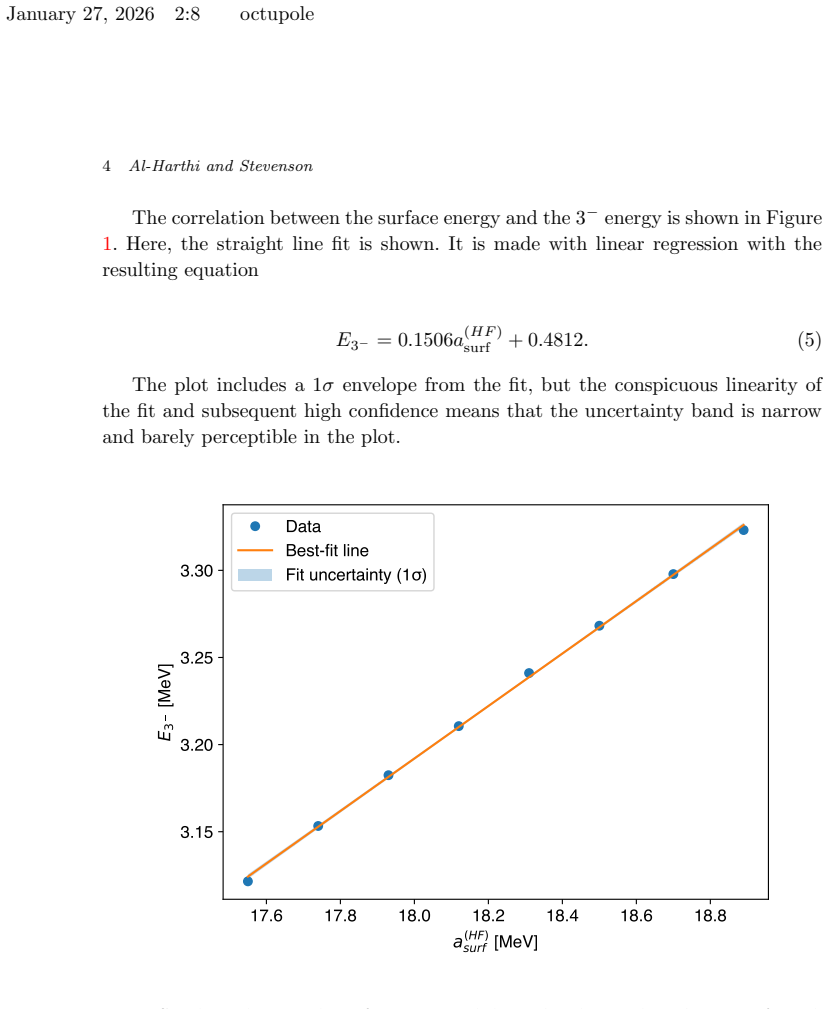
Surface energy of Skyrme forces rises in direct linear proportion to the first 3- octupole energy in 208Pb.
A machine-rendered reading of the paper's core claim, the machinery that carries it, and where it could break.
Core claim
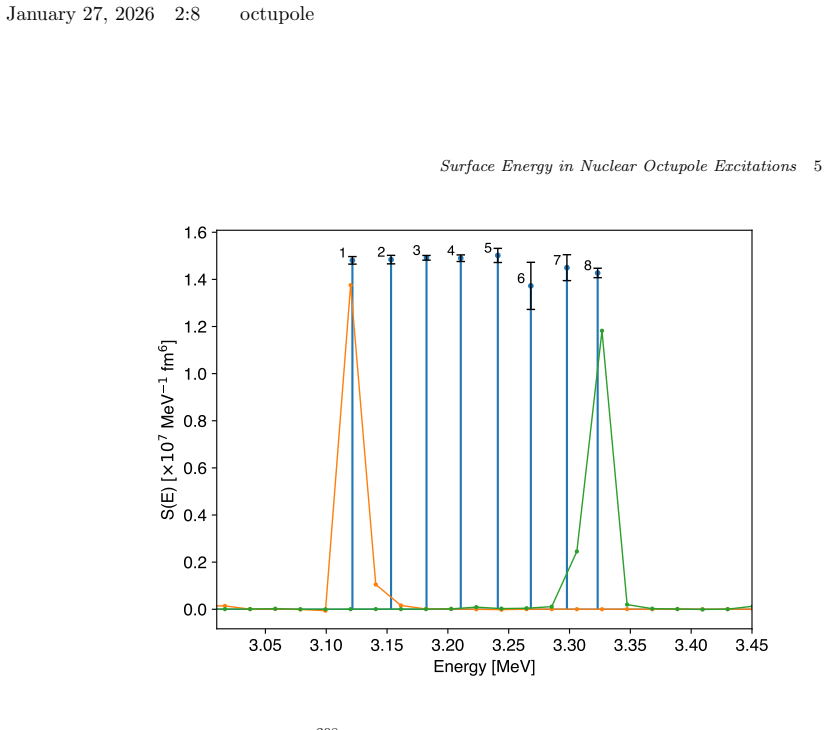
A series of Skyrme interactions is constructed to deliver a systematic range of surface energies. When these interactions are used to compute octupole excitations in 208Pb, the energy of the first 3- state increases linearly with the surface energy of the chosen force.
What carries the argument
Systematic variation of the surface energy parameter across a family of Skyrme interactions, used to compute the 3- octupole excitation energy in 208Pb.
If this is right
- The lowest octupole excitation energy serves as a direct readout of the surface energy term in Skyrme models.
- Different Skyrme forces produce systematically different octupole energies according to their surface energy values.
- Octupole modes can be used to test or constrain the surface properties built into nuclear effective interactions.
- Collective excitation spectra in 208Pb encode information about the surface-to-volume balance in the underlying force.
Where Pith is reading between the lines
- The same surface-energy correlation could be tested in other closed-shell nuclei to check whether it is universal or mass-dependent.
- Experimental octupole energies could supply an independent constraint on Skyrme surface parameters beyond those from ground-state properties.
- Models aiming to describe octupole-soft or octupole-deformed nuclei may need to prioritize accurate surface energy tuning.
Load-bearing premise
Varying surface energy across the selected Skyrme parametrizations isolates its effect on octupole energies without substantial interference from other fitted parameters.
What would settle it
Calculating the 3- energy in 208Pb with a Skyrme force whose surface energy lies outside the studied range and finding that the point deviates from the linear trend would show the correlation is not general.
Figures
read the original abstract
Octupole excitations of atomic nuclei can be viewed as fluctuations around an equilibrium shape. These fluctuations in turn can be seen as probes of nuclear matter properties to the extent that the shape changes explore changes in compression, surface to volume ratio, or isospin overlap. In the present work we use a series of Skyrme interactions, which were fitted to provide a systematic range of surface energies, to explore the surface energy dependence of octupole excitations in $^{208}$Pb. We find a strong positive linear corelation between the surface energy of a Skyrme interaction and its prediction of the first $3^-$ octupole excitation energy.
Editorial analysis
A structured set of objections, weighed in public.
Referee Report
Summary. The manuscript uses a series of Skyrme interactions fitted to span a systematic range of surface energies to compute the first 3^- octupole excitation energy in 208Pb. It reports a strong positive linear correlation between the surface energy coefficient of each interaction and the predicted 3^- energy.
Significance. If the reported correlation can be shown to arise specifically from surface energy rather than from covariation with other Skyrme parameters, the result would provide a useful diagnostic for how surface tension influences the restoring force in low-lying collective modes. This could help constrain effective interactions for octupole studies, but the present evidence does not yet establish that isolation.
major comments (2)
- [Abstract] The abstract asserts a 'strong positive linear correlation' without reporting the number of Skyrme parametrizations employed, the R² or slope of the fit, uncertainties on the calculated 3^- energies, or any goodness-of-fit metric. These details are required to assess whether the trend is statistically meaningful or sensitive to the particular choice of interactions.
- [Results (Skyrme set and correlation analysis)] Skyrme parametrizations that differ in surface energy are globally fitted and therefore typically covary in incompressibility K, effective mass m*, symmetry-energy slope L, and spin-orbit strength. Any of these can shift the single-particle spectrum or the density dependence of the residual interaction that determines the 3^- frequency. No partial-correlation analysis, multiple regression, or control set with fixed K and m* is presented to demonstrate that the trend is driven by surface energy alone rather than by these confounding parameters.
minor comments (1)
- [Abstract] Typo in abstract: 'corelation' should read 'correlation'.
Simulated Author's Rebuttal
We thank the referee for the constructive comments on our manuscript. We address each major point below and have revised the manuscript accordingly where possible to improve clarity and address concerns about statistical details and parameter covariation.
read point-by-point responses
-
Referee: [Abstract] The abstract asserts a 'strong positive linear correlation' without reporting the number of Skyrme parametrizations employed, the R² or slope of the fit, uncertainties on the calculated 3^- energies, or any goodness-of-fit metric. These details are required to assess whether the trend is statistically meaningful or sensitive to the particular choice of interactions.
Authors: We agree that the abstract would be strengthened by these quantitative details. In the revised manuscript we have updated the abstract to report the number of Skyrme parametrizations employed, the R² value and slope of the linear fit, the uncertainties on the calculated 3^- energies, and a statement regarding the goodness of the fit. These additions allow a clearer assessment of the correlation's robustness. revision: yes
-
Referee: [Results (Skyrme set and correlation analysis)] Skyrme parametrizations that differ in surface energy are globally fitted and therefore typically covary in incompressibility K, effective mass m*, symmetry-energy slope L, and spin-orbit strength. Any of these can shift the single-particle spectrum or the density dependence of the residual interaction that determines the 3^- frequency. No partial-correlation analysis, multiple regression, or control set with fixed K and m* is presented to demonstrate that the trend is driven by surface energy alone rather than by these confounding parameters.
Authors: We acknowledge the referee's point on potential covariation among Skyrme parameters. Our interaction set was constructed specifically to vary the surface energy coefficient systematically while attempting to minimize changes in other properties within the constraints of the fitting protocol. In the revised manuscript we have added a dedicated paragraph in the results section that discusses the possible covariations with K, m*, L, and spin-orbit strength and explains why the targeted variation in surface energy is expected to dominate the trend in the 3^- energy. We note that a formal partial-correlation analysis or dedicated control set was not performed, as it would require a substantially larger ensemble of interactions, and we identify this as a limitation of the present study. revision: partial
Circularity Check
No significant circularity; correlation is an independent model output
full rationale
The paper selects Skyrme interactions that provide a systematic range of surface energies and then computes the first 3^- octupole excitation energy in 208Pb using the full nuclear model (mean-field plus RPA or equivalent). Surface energy is a derived bulk property of each parametrization, while the excitation energy is obtained by solving the collective equations of motion; the two quantities are not related by definition or algebraic reduction. No load-bearing self-citations, no fitted parameter renamed as prediction, and no ansatz smuggled via prior work appear in the derivation chain. The observed linear correlation is therefore an empirical result of the calculations rather than a tautology.
Axiom & Free-Parameter Ledger
free parameters (1)
- surface energy coefficient
axioms (1)
- domain assumption Skyrme interactions provide a reliable mean-field description of nuclear ground states and low-lying collective excitations
Reference graph
Works this paper leans on
-
[1]
A. Bohr and B. R. Mottelson,Nuclear Structure(Benjamin, 1969), Vol. 1, p. 141
work page 1969
-
[2]
C. F. von Weizs¨ acker,Z. Phys.96, 431 (1935)
work page 1935
-
[3]
H. A. Bethe and R. F. Bacher,Rev. Mod. Phys.8, 82 (1936)
work page 1936
- [4]
-
[5]
Gianluca Col` o,Eur. Phys. J. Plus133, 553 (2018)
work page 2018
-
[6]
P. D. Stevenson,EPJ Web of Conferences232, 03005 (2020)
work page 2020
-
[7]
Marko Pancic, Yu Qiang, Junchen Pei, and Paul Stevenson,Front. Phys.8, 351 (2020)
work page 2020
- [8]
-
[9]
Md Jafrul Islam, Athul Kunjpurayil, J. Piekarewicz, and A. Volya,arXiv: 2512.22709 (2025)
-
[10]
J. A. Maruhn, P.-G. Reinhard, P. D. Stevenson and A. S. Umar,Comput. Phys. Commun.185, 2195 (2014)
work page 2014
-
[11]
Abhishek, Paul Stevenson, Yue Shi, Esra Y¨ uksel, Sait Umar,Comput. Phys. Commun. 301, 109239 (2024)
work page 2024
-
[12]
C´ edric Simenel,Eur. Phys. J. A61, 181 (2025)
work page 2025
-
[13]
S. Burello, M. Colonna, G. Col` o, D. Lacroix, X. Roca-Maza, G. Scamps, and H. Zheng Phys. Rev. C99, 054314 (2019)
work page 2019
- [14]
- [15]
- [16]
-
[17]
P. D. Stevenson, Poster for the Institute of Physics Publishing Twitter Conference (2020),https://doi.org/10.5281/zenodo.3944774
discussion (0)
Sign in with ORCID, Apple, or X to comment. Anyone can read and Pith papers without signing in.