REVIEW 3 major objections 4 minor 2 cited by
A quasicrystalline system built from momentum-space couplings hosts a topological band with Chern number +1, directly analogous to the Haldane model but without any periodic lattice.
Reviewed by Pith at T0; open to challenge. T0 means a machine referee read the full paper against a public rubric. the ladder, T0–T4 →
A quasicrystalline analogue of the Haldane model is constructed with momentum-space couplings, yielding symmetry-protected Dirac cones gapped into a C=1 Chern band.
T0 review reviewed 2026-08-03 challenge →
load-bearing objection Useful and honest quasicrystalline Haldane analogue with clean analytic and numeric work; the main soft spot is that the Chern number is defined only on approximants, never for the exact quasicrystal. the 3 major comments →
Quasicrystalline Analogue of the Haldane Model
The pith
A machine-rendered reading of the paper's core claim, the machinery that carries it, and where it could break.
The reading
Core claim
The paper establishes that a model Hamiltonian defined by complex couplings between plane-wave momentum states with eightfold rotational symmetry—couplings that break time-reversal symmetry through a phase choice R=5—describes a quasicrystal whose low-lying states form an isolated band with Chern number C=+1. In the weak-potential limit, the spin-flip potential alone produces two symmetry-protected Dirac cones at the corners of the quasi-Brillouin zone; adding a TRS-breaking sigma_z coupling with the appropriate phase opens a gap and gives each Dirac point the same Berry flux +pi, yielding total Chern number +1. Numerical diagonalization of periodic approximants confirms a large C=1 region i
What carries the argument
The central object is the reciprocal-space tight-binding model whose 'sites' are plane-wave states |q,sigma> in momentum space, with complex hopping amplitudes U_l and V_l. The quasi-Brillouin zone (QBZ) is the octagon formed by the perpendicular bisectors of the eight G_l vectors; its corner K hosts a fourfold degeneracy protected by an 8-fold rotation and a mirror symmetry, giving two coincident Dirac cones. The TRS-breaking term H_V with U_l = -U exp(-i pi R l /4) and R=5 opens a gap, and the Chern number is computed from the Berry flux of the gapped Dirac cones. This machinery transfers the Haldane-model mechanism from real-space honeycomb lattices to a momentum-space quasicrystal.
Load-bearing premise
The Chern number is strictly defined only for the finite periodic approximants; the paper assumes that this quantized value continues to describe the true quasicrystal as the approximant size goes to infinity, without a rigorous spectral proof.
What would settle it
For fixed couplings U/ER=0.15 and V/ER=0.075, compute the energy gap and Chern number for approximants with Na=3 up to, say, Na=30; if the gap closes or the Chern number changes from +1 at any step, the claim that the quasicrystal is topological with C=+1 is falsified. Alternatively, in a cold-atom experiment, measure the transverse Hall response of atoms loaded at the QBZ filling density and look for a quantized signal.
If this is right
- The model provides a concrete experimental blueprint for realizing a topological quasicrystal in cold atoms using two-photon Raman couplings.
- The topological phase exists over a wide region of parameter space, not just in the weak-potential limit, so it is robust to moderate lattice depths.
- The density to fill the topological band is set by the QBZ area, approximately 1.6568/lambda^2, and is verified numerically; this gives a direct experimental target for filling.
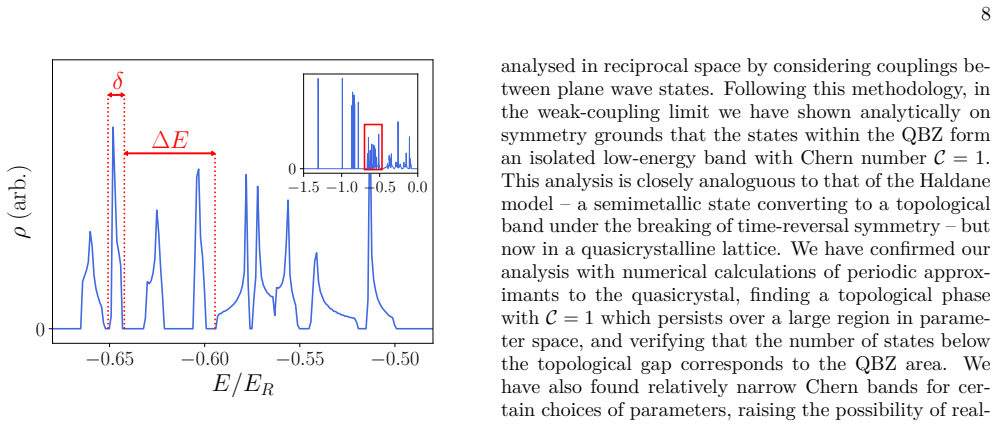
- Narrow Chern bands with bandwidth-to-gap ratio approximately 0.089 appear for certain parameters, potentially enabling strongly correlated phases.
- The quasicrystalline analogue of the Haldane model shows that Dirac-cone physics and Chern number quantization survive without a periodic lattice.
Where Pith is reading between the lines
- The momentum-space construction suggests a general recipe: any incommensurate set of coupling vectors with a common phase around plaquettes could produce topological quasicrystals, extending beyond octagonal symmetry to other rotational symmetries.
- If narrow Chern bands can be further flattened (e.g., by adding scalar potentials), the system could host fractional Chern insulator states with quasicrystalline density modulation, a regime distinct from uniform fractional quantum Hall states.
- The filling-density argument implies a geometric way to count topological band states in a quasicrystal from the QBZ area alone, which could be used to diagnose topological bands in other quasiperiodic models.
- The suggestion that similar models arise in layered 2D materials raises the possibility that quasicrystalline twisted or moire systems might exhibit analogous topological bands without cold-atom machinery.
Editorial analysis
A structured set of objections, weighed in public.
Referee Report
Summary. The paper introduces a two-component cold-atom Hamiltonian defined through complex momentum-space couplings with eightfold rotational symmetry (Eq. 5). In the nearly-free limit, the authors identify an octagonal quasi-Brillouin zone and argue that the low-energy states form an isolated band. A 16-state plane-wave basis at the QBZ corner is used to show the presence of two coincident, symmetry-protected Dirac cones (Appendix C), and the TRS-breaking coupling HV is shown to open a gap, with the claimed Chern number C=+1. The main numerical evidence comes from periodic approximants: the authors compute band structures, Chern numbers, and a phase diagram for Na=3, and study trends with Na up to 10 in Appendix D. They also derive the filling density from the QBZ area, verify it numerically, and propose a two-photon Raman implementation for ultracold atoms, as well as discussing parameter regimes with narrow Chern bands.
Significance. If the central claim is established, the paper provides a clean reciprocal-space construction of a topological quasicrystal with a direct analogy to the Haldane model, together with an experimentally plausible cold-atom implementation. The analytic plane-wave treatment, the group-theoretic proof of the Dirac degeneracy, the exact agreement between the QBZ-area counting and the numerical filling density, and the reproducible code/data availability are all concrete strengths. The main weakness is conceptual: a Chern number is defined for the periodic approximants, but no topological invariant is defined for the exact quasiperiodic Hamiltonian. The paper’s conclusion that Eq. (5) describes a topological quasicrystal is therefore stronger than what is strictly proven. This is a load-bearing gap, but it is a well-posed issue that could be addressed by defining an appropriate bulk invariant for the aperiodic system or by carefully restating the claim in terms of the approximant sequence.
major comments (3)
- [Sec. IV B and Eq. (5); Appendix D] The statement that Eq. (5) 'does indeed describe a topological quasicrystal' with C=1 is not fully established because the Chern number is only defined for the periodic approximants of Sec. V. The exact quasiperiodic Hamiltonian has no Brillouin zone and no Bloch Hamiltonian, and the paper does not define a topological invariant for the aperiodic system itself. Appendix D traces the gap and phase boundaries along a finite approximant sequence, but this only shows that the approximant Chern number does not change along the computed family; it does not prove that a limit index exists or that it equals the approximant value. The footnote to Ref. [117], noting that the net flux per unit cell is undefined for the approximants, further underscores that the conventional topological description is not automatic. Please either define an appropriate bulk invariant for the aperiodic Hamiltonian (e.
- [Sec. IV B, Eq. (15)] The analytic derivation of C=1 is incomplete in the sign assignment. The text asserts that for R=5 and V>0, 'both bands below the gap contribute a Berry flux of +π,' and uses this to conclude C=1. However, the preceding analysis and Fig. 4(b) determine the size of the gap (2V) but not the signs of the Dirac masses. Since the sign of the Berry flux determines whether Eq. (15) gives C=1 or C=0, this is load-bearing. Please provide the explicit low-energy effective Hamiltonian near the Dirac point, including the mass terms, and compute the Berry phase of each band, or state clearly that the sign assignment is obtained only from the numerical 16-state calculation.
- [Appendix D and Fig. 11] The evidence that the topological region persists in the quasicrystalline limit Na→∞ is suggestive but not conclusive. The gap is tracked at a single parameter point (U/ER=0.15, V/ER=0.075), and the phase boundaries are inferred only up to Na=10. The variation of Vmin and Vmax with Na is non-monotonic, and there is no argument that the finite-Na Chern number is independent of the approximant sequence. A definite statement about the limit would require either substantially larger Na, an analytic argument controlling the convergence, or a separately defined aperiodic invariant. As written, the claim of a 'large topological region in the quasicrystalline limit' is an extrapolation rather than a proven result.
minor comments (4)
- [Sec. V B / Fig. 6] The phase diagram is computed on an unspecified grid in (U,V). Please state the grid spacing and the criterion used to decide that the gap vanishes (e.g., tolerance in ΔE), so that the phase boundaries are reproducible.
- [Sec. V D / Fig. 8] The quantities δ and ΔE are introduced informally. Please give precise definitions (e.g., bandwidth and gap measured between which bands) so that the quoted ratio δ/ΔE≈0.089 is unambiguous.
- [Sec. II B, after Eq. (6)] The phrase 'Since these Gl are incommensurate with one another' is imprecise. The relevant property is that the Z-module spanned by the eight Gl has rank greater than two, which is what makes the system quasiperiodic. Consider rephrasing.
- [Fig. 7] The blue data points do not appear to have error bars, or the error bars are not described. Please clarify how the numerical density was obtained and why some points have no uncertainty estimate.
Circularity Check
No significant circularity: C=1 is computed from the explicit Hamiltonian and verified against independent numerics, not fitted or carried by self-citation.
full rationale
All load-bearing steps are carried out in the paper itself. Sec. IV B derives the low-energy band structure from the explicit 16-state plane-wave basis at the QBZ corners; Appendix C proves the four-fold Dirac degeneracy is symmetry-protected; and the gap opening by H_V is obtained by projection, with effective couplings 2V and sqrt(2)W. The Chern number C=1 is not an input parameter: R=5 is chosen, and the resulting phases Phi_up=-pi/4 and Phi_down=-3pi/4 are then analyzed to find C=+1. In Sec. V, the phase diagram is generated by numerically diagonalizing approximants and summing Berry curvature by the standard Fukui-Hatsugai-Suzuki method, so C=1 is computed rather than fitted. The filling-density prediction Eq. (13) is tested against independent band counting via Eq. (16); the agreement with approximant QBZ areas is a consistency check on the identification of the isolated band, not a tautological use of the result. The citations to the authors' prior optical-flux-lattice work ([110]-[112], [119]) provide the general OFL formalism and the 'dual Haldane' starting point, but the quasicrystalline construction, the symmetry proof, and the approximant phase diagram are presented here, and no central claim reduces to an unverified self-citation. The main caveat is a mathematical completeness gap, not circularity: a Chern number is strictly defined for the periodic approximants, and the extrapolation to the exact quasicrystal (Appendix D) is a continuity argument along the Na sequence; footnote [117] even notes that the net flux per unit cell is undefined for the approximants. This is an important limitation on the rigorous definition of the topological invariant in the aperiodic limit, but it does not involve using the claimed prediction as an input.
Axiom & Free-Parameter Ledger
free parameters (2)
- R =
5
- U and V coupling strengths =
scanned in phase diagram
axioms (3)
- domain assumption The quasicrystalline limit is well-approximated by periodic approximants Na=3, 4, ... and topological invariants of approximants converge to the quasicrystal.
- domain assumption The 16-state plane-wave basis near the QBZ corner captures the relevant bandstructure and the Dirac points are indeed symmetry-protected.
- domain assumption Two-photon Raman coupling realizes the Hamiltonian exactly, with no additional significant couplings or losses.
Cite this review
Pith. "Pith review of Quasicrystalline Analogue of the Haldane Model." pith.science (2026). https://pith.science/paper/LLYQ7A6W
@misc{pith2026260117963,
  author       = {Pith},
  title        = {Pith review of: Quasicrystalline Analogue of the Haldane Model},
  year         = {2026},
  howpublished = {\url{https://pith.science/paper/LLYQ7A6W}},
  note         = {Machine review of arXiv:2601.17963}
}
read the original abstract
We present a model for a topological quasicrystalline system which is suitable for realisation in cold-atom experiments. We define the model in terms of complex momentum-space couplings which break time-reversal symmetry (TRS), and detail how it may be experimentally realised using two-photon Raman couplings. In the weak-potential limit, we study the model analytically by calculating the bandstructure over a `quasi-Brillouin zone' (QBZ). We find symmetry-protected Dirac cones, which are gapped by a TRS-breaking term, resulting in a Chern number $\mathcal{C}=1$. This provides a direct analogy to the Haldane model, but now in a quasicrystalline setting. We also infer the number of states below the topological gap from the QBZ area. We verify our analysis with numerical calculations of periodic approximants to our system, constructing a phase diagram in parameter space which shows a topological region extending beyond the weak-potential regime. We also find examples of narrow Chern bands with the potential for hosting strongly-correlated physics. Our work raises questions about the nature of localisation and strongly-correlated states in Chern bands in quasiperiodic systems.
Figures




Forward citations
Cited by 2 Pith papers
-
Programmable Dynamic Phase Control of a Quasiperiodic Optical Lattice
An experimental scheme creates a programmable dynamic 2D quasiperiodic optical lattice with phase noise suppressed by over 70 dB below 60 Hz and 350 kHz modulation bandwidth, enabling translational and phasonic contro...
-
Programmable Dynamic Phase Control of a Quasiperiodic Optical Lattice
First experimental realization of programmable dynamic phase control of a 2D quasiperiodic optical lattice: >70 dB phase-noise suppression (DC–60 Hz) and 350 kHz phase-modulation bandwidth, enabling lattice translatio...
Reference graph
Works this paper leans on
-
[1]
0 5 10 15 20 Na 1.0 1.2 1.4 1.6 1.8 2.0 n/λ□2 Approximant Numerical Approximant QBZ Quasicrystal QBZ FIG
However, at these coupling strengths, the energy gap is generally small in magnitude (∆E/ER ≲0.01), so we cannot be confident that these features will persist from the approximant system to the exact quasicrystal. 0 5 10 15 20 Na 1.0 1.2 1.4 1.6 1.8 2.0 n/λ□2 Approximant Numerical Approximant QBZ Quasicrystal QBZ FIG. 7: Filling density for increasingly a...
-
[2]
We first analyseHU
Symmetries ofH U Analysis using group theory of the symmetry opera- tions which commute with the Hamiltonian enable the degeneracies of eigenvalues at different points in the QBZ to be determined. We first analyseHU. One symmetry ofH U is the unitary operation: ˜C8 =C 8⊗exp(i∆ϕσ z/2)(C1) whereC 8 is an 8-fold spatial rotation in the 2D plane about the ori...
-
[3]
Also, importantly,HW couples between basis states in the two blocks, so we need to treat all 16 basis states together
Symmetries ofH W HW commutes with all the symmetries ofH1, ˜Cn 4 and ˜Cn 4 ˜σd; however, it breaks˜C8 (and its odd powers). Also, importantly,HW couples between basis states in the two blocks, so we need to treat all 16 basis states together. We therefore form a representation ofD 8 in16×16 matrices, which decomposes as4E 1⊕4E 3. These two- dimensional ir...
-
[4]
˜C4 and˜σd obey the relations: ˜σd ˜C4˜σd = (˜C4)−1 (C5a) ˜C8 4 =1(C5b) ˜σ2 d =1(C5c) and are therefore generators ofD8, the group of symme- tries of an octagon
The mirror operations˜σd and ˜Cn 4 ˜σd remain symmetries, as they interchange momentum states but also flip the spin. ˜C4 and˜σd obey the relations: ˜σd ˜C4˜σd = (˜C4)−1 (C5a) ˜C8 4 =1(C5b) ˜σ2 d =1(C5c) and are therefore generators ofD8, the group of symme- tries of an octagon. (Note that sinceRis odd, we have 4∆ϕ=π(mod2π), and therefore ˜C4 4 =−1, not s...
-
[5]
This means that the group of symmetry operations ofH1 is reduced fromD8 down to C8, the cyclic group of order 8
Symmetries ofH V WhenH V is included, we still do not introduce any coupling between the blocksH1 andH 2.H V commutes with all of the rotational˜C8 symmetries, but breaks the mirror˜σd symmetries. This means that the group of symmetry operations ofH1 is reduced fromD8 down to C8, the cyclic group of order 8. Since the cyclic group is abelian, it only has ...
-
[6]
Shechtman, I
D. Shechtman, I. Blech, D. Gratias, and J. W. Cahn, Physical Review Letters53, 1951 (1984)
1951
-
[7]
Lifshitz, Foundations of Physics33, 1703 (2003)
R. Lifshitz, Foundations of Physics33, 1703 (2003)
2003
-
[8]
Anderson, Physical review109, 1492 (1958)
P. Anderson, Physical review109, 1492 (1958)
1958
-
[9]
Abrahams, P
E. Abrahams, P. W. Anderson, D. C. Licciardello, and T. V. Ramakrishnan, Physical Review Letters42, 673 (1979)
1979
-
[10]
Evers and A
F. Evers and A. D. Mirlin, Reviews of Modern Physics 80, 1355 (2008)
2008
-
[11]
Aubry and G
S. Aubry and G. André, Annals of the Israel Physical Society3, 133 (1980)
1980
-
[12]
Roati, C
G. Roati, C. D’Errico, L. Fallani, M. Fattori, C. Fort, M. Zaccanti, G. Modugno, M. Modugno, and M. Ingus- cio, Nature453, 895 (2008)
2008
-
[13]
Lahini, R
Y. Lahini, R. Pugatch, F. Pozzi, M. Sorel, R. Moran- dotti, N. Davidson, and Y. Silberberg, Physical Review Letters103, 013901 (2009)
2009
-
[14]
Biddle and S
J. Biddle and S. Das Sarma, Physical Review Letters 104, 070601 (2010)
2010
-
[15]
Biddle, D
J. Biddle, D. J. Priour, B. Wang, and S. Das Sarma, Physical Review B83, 075105 (2011)
2011
-
[16]
Ganeshan, J
S. Ganeshan, J. Pixley, and S. Das Sarma, Physical Re- view Letters114, 146601 (2015)
2015
-
[17]
Li and S
X. Li and S. Das Sarma, Physical Review B101, 064203 (2020)
2020
-
[18]
F. A. An, K. Padavić, E. J. Meier, S. Hegde, S. Gane- shan, J. Pixley, S. Vishveshwara, and B. Gadway, Phys- ical Review Letters126, 040603 (2021)
2021
-
[19]
Wang, J.-H
Y. Wang, J.-H. Zhang, Y. Li, J. Wu, W. Liu, F. Mei, Y. Hu, L. Xiao, J. Ma, C. Chin, and S. Jia, Physical Review Letters129, 103401 (2022)
2022
-
[20]
Devakul and D
T. Devakul and D. A. Huse, Physical Review B96, 214201 (2017)
2017
-
[21]
Szabó and U
A. Szabó and U. Schneider, Physical Review B101, 014205 (2020)
2020
-
[22]
Gottlob and U
E. Gottlob and U. Schneider, Physical Review B107, 144202 (2023)
2023
-
[23]
Z. Zhu, S. Yu, D. Johnstone, and L. Sanchez-Palencia, Physical Review A109, 013314 (2024)
2024
-
[24]
C. W. Duncan, Physical Review B109, 014210 (2024)
2024
-
[25]
Nandkishore and D
R. Nandkishore and D. A. Huse, Annual Review of Con- densed Matter Physics6, 15 (2015)
2015
-
[26]
Alet and N
F. Alet and N. Laflorencie, Comptes Rendus Physique Quantum simulation / Simulation quantique,19, 498 (2018)
2018
-
[27]
D. A. Abanin, E. Altman, I. Bloch, and M. Serbyn, Reviews of Modern Physics91, 021001 (2019)
2019
-
[28]
I. V. Gornyi, A. D. Mirlin, and D. G. Polyakov, Physical Review Letters95, 206603 (2005)
2005
-
[29]
D. M. Basko, I. L. Aleiner, and B. L. Altshuler, Annals of Physics321, 1126 (2006)
2006
-
[30]
Oganesyan and D
V. Oganesyan and D. A. Huse, Physical Review B75, 155111 (2007)
2007
-
[31]
Pal and D
A. Pal and D. A. Huse, Physical Review B82, 174411 (2010)
2010
-
[32]
M.Serbyn, Z.Papić,andD.A.Abanin,PhysicalReview Letters111, 127201 (2013)
2013
-
[33]
D. A. Huse, R. Nandkishore, and V. Oganesyan, Phys- ical Review B90, 174202 (2014)
2014
-
[34]
V. Ros, M. Müller, and A. Scardicchio, Nuclear Physics B891, 420 (2015)
2015
-
[35]
D. J. Luitz, N. Laflorencie, and F. Alet, Physical Review B91, 081103 (2015)
2015
-
[36]
J. Z. Imbrie, Journal of Statistical Physics163, 998 (2016)
2016
-
[37]
S. Iyer, V. Oganesyan, G. Refael, and D. A. Huse, Phys- ical Review B87, 134202 (2013)
2013
-
[38]
X. Li, S. Ganeshan, J. Pixley, and S. Das Sarma, Phys- ical Review Letters115, 186601 (2015)
2015
-
[39]
X. Li, X. Li, and S. Das Sarma, Physical Review B96, 085119 (2017)
2017
-
[40]
Setiawan, D.-L
F. Setiawan, D.-L. Deng, and J. H. Pixley, Physical Re- view B96, 104205 (2017)
2017
-
[41]
Khemani, D
V. Khemani, D. N. Sheng, and D. A. Huse, Physical Review Letters119, 075702 (2017)
2017
-
[42]
Zhang and H
S.-X. Zhang and H. Yao, Physical Review Letters121, 206601 (2018)
2018
-
[43]
Smith, A
J. Smith, A. Lee, P. Richerme, B. Neyenhuis, P. W. Hess, P. Hauke, M. Heyl, D. A. Huse, and C. Monroe, Nature Physics12, 907 (2016)
2016
-
[44]
K. X. Wei, C. Ramanathan, and P. Cappellaro, Physical Review Letters120, 070501 (2018)
2018
-
[45]
Schreiber, S
M. Schreiber, S. S. Hodgman, P. Bordia, H. P. Lüschen, M. H. Fischer, R. Vosk, E. Altman, U. Schneider, and I. Bloch, Science349, 842 (2015)
2015
-
[46]
Lukin, M
A. Lukin, M. Rispoli, R. Schittko, M. E. Tai, A. M. 12 (a) 0.00 0.05 0.10 0.15 0.20 0.25 0.30 0.35 1/Na 0.000 0.025 0.050 0.075 ∆ E/ER 345678910 Na (b) 0.00 0.05 0.10 0.15 0.20 0.25 0.30 0.35 1/Na 0.00 0.05 0.10 0.15 0.20 V /ER Vmax Vmin 345678910 Na FIG. 11: (a) Energy gap for different approximant systems, for fixedU/ER = 0.15,V/E R = 0.075. The quasicr...
2019
-
[47]
De Roeck and F
W. De Roeck and F. Huveneers, Physical Review B95, 155129 (2017)
2017
-
[48]
D. J. Luitz, F. Huveneers, and W. De Roeck, Physical Review Letters119, 150602 (2017)
2017
-
[49]
Thiery, F
T. Thiery, F. Huveneers, M. Müller, and W. De Roeck, Physical Review Letters121, 140601 (2018)
2018
-
[50]
Potirniche, S
I.-D. Potirniche, S. Banerjee, and E. Altman, Physical Review B99, 205149 (2019)
2019
-
[51]
Morningstar, L
A. Morningstar, L. Colmenarez, V. Khemani, D. J. Luitz, and D. A. Huse, Physical Review B105, 174205 (2022)
2022
-
[52]
Sels, Physical Review B106, L020202 (2022)
D. Sels, Physical Review B106, L020202 (2022)
2022
-
[53]
Léonard, S
J. Léonard, S. Kim, M. Rispoli, A. Lukin, R. Schittko, J. Kwan, E. Demler, D. Sels, and M. Greiner, Nature Physics19, 481 (2023)
2023
-
[54]
Kondov, W
S. Kondov, W. McGehee, W. Xu, and B. DeMarco, Physical Review Letters114, 083002 (2015)
2015
-
[55]
J.-y. Choi, S. Hild, J. Zeiher, P. Schauß, A. Rubio- Abadal, T. Yefsah, V. Khemani, D. A. Huse, I. Bloch, and C. Gross, Science352, 1547 (2016)
2016
-
[56]
Agarwal, E
K. Agarwal, E. Altman, E. Demler, S. Gopalakrishnan, D. A. Huse, and M. Knap, Annalen der Physik529, 1600326 (2017)
2017
-
[57]
T. B. Wahl, A. Pal, and S. H. Simon, Nature Physics 15, 164 (2019)
2019
-
[58]
Gopalakrishnan and D
S. Gopalakrishnan and D. A. Huse, Physical Review B 99, 134305 (2019)
2019
-
[59]
Théveniaut, Z
H. Théveniaut, Z. Lan, G. Meyer, and F. Alet, Physical Review Research2, 033154 (2020)
2020
-
[60]
Kshetrimayum, M
A. Kshetrimayum, M. Goihl, and J. Eisert, Physical Re- view B102, 235132 (2020)
2020
-
[61]
Chertkov, B
E. Chertkov, B. Villalonga, and B. K. Clark, Physical Review Letters126, 180602 (2021)
2021
-
[62]
D. C. W. Foo, N. Swain, P. Sengupta, G. Lemarié, and S. Adam, Physical Review Research5, L032011 (2023)
2023
-
[63]
S. J. Thomson and J. Eisert, Nature Physics20, 1401 (2024)
2024
-
[64]
Sierant, M
P. Sierant, M. Lewenstein, A. Scardicchio, L. Vidmar, and J. Zakrzewski, Reports on Progress in Physics88, 026502 (2025)
2025
-
[65]
A.Štrkalj, E.V.H.Doggen,andC.Castelnovo,Physical Review B106, 184209 (2022)
2022
-
[66]
Bordia, H
P. Bordia, H. Lüschen, S. Scherg, S. Gopalakrishnan, M. Knap, U. Schneider, and I. Bloch, Physical Review X7, 041047 (2017)
2017
-
[67]
Sbroscia, K
M. Sbroscia, K. Viebahn, E. Carter, J.-C. Yu, A. Gaunt, and U. Schneider, Physical Review Letters125, 200604 (2020)
2020
-
[68]
J. Hur, J. Li, B. Lee, K. Kwon, M. Kim, S. Hwang, S. Kim, Y. S. Yu, A. Chan, T. Wahl, and J. yoon Choi, Stability of many-body localization in two dimensions (2025), arXiv:2508.20699 [cond-mat.quant-gas]
Pith/arXiv arXiv 2025
-
[69]
Fan and H
J. Fan and H. Huang, Frontiers of Physics17, 13203 (2021)
2021
-
[70]
Zilberberg, Optical Materials Express11, 1143 (2021)
O. Zilberberg, Optical Materials Express11, 1143 (2021)
2021
-
[71]
C.W.Duncan, S.Manna,andA.E.B.Nielsen,Physical Review B101, 115413 (2020)
2020
-
[72]
Johnstone, M
D. Johnstone, M. J. Colbrook, A. E. B. Nielsen, P. Öh- berg, and C. W. Duncan, Physical Review B106, 045149 (2022)
2022
-
[73]
F. Balling-Ansø, J. L. Krogh, E. E. Lassen, and A. E. B. Nielsen, Identification and Properties of Topo- logical States in the Bulk of Quasicrystals (2025), arXiv:2507.20722 [quant-ph]
arXiv 2025
-
[74]
C.-B. Hua, R. Chen, B. Zhou, and D.-H. Xu, Physical Review B102, 241102 (2020)
2020
-
[75]
Chen, C.-Z
R. Chen, C.-Z. Chen, J.-H. Gao, B. Zhou, and D.-H. Xu, Physical Review Letters124, 036803 (2020)
2020
-
[76]
Peng, C.-B
T. Peng, C.-B. Hua, R. Chen, Z.-R. Liu, D.-H. Xu, and B. Zhou, Physical Review B104, 245302 (2021)
2021
-
[77]
Peng, Y.-C
T. Peng, Y.-C. Xiong, C.-B. Hua, Z.-R. Liu, X. Zhu, W. Cao, F. Lv, Y. Hou, B. Zhou, Z. Wang, and R. Xiong, Physical Review B109, 195301 (2024)
2024
-
[78]
Varjas, A
D. Varjas, A. Lau, K. Pöyhönen, A. R. Akhmerov, D. I. Pikulin, and I. C. Fulga, Physical Review Letters123, 196401 (2019)
2019
-
[79]
C.Wang, F.Liu,andH.Huang,PhysicalReviewLetters 129, 056403 (2022)
2022
-
[80]
M. A. Bandres, M. C. Rechtsman, and M. Segev, Phys- 13 ical Review X6, 011016 (2016)
2016
This paper was first reviewed by deepseek-v4-flash on August 3, 2026.
discussion (0)
Sign in with ORCID, Apple, or X to comment. Anyone can read and Pith papers without signing in.