Intrinsic Width of the Flux Tube as a tool to explore confining mechanisms in Lattice Gauge Theories
Pith reviewed 2026-05-25 07:08 UTC · model grok-4.3
The pith
The intrinsic width of the flux tube distinguishes between different models of confinement in SU(2) lattice gauge theory.
A machine-rendered reading of the paper's core claim, the machinery that carries it, and where it could break.
Core claim
Precise measurements of the intrinsic width demonstrate that high-temperature data just below deconfinement are described by an Ising-like effective model from the Svetitsky-Yaffe mapping, while lower-temperature data are better described by the dual superconductor model than by alternatives; however the Ginzburg-Landau parameter extracted from the latter fits increases with flux tube length, revealing that the model is incomplete for non-abelian gauge theories.
What carries the argument
The intrinsic width of the flux tube, which drives the exponential decay of the flux density at large transverse distances and is directly linked to the underlying confining mechanism.
If this is right
- The Svetitsky-Yaffe mapping accurately describes flux tube profiles near the deconfinement transition.
- The dual superconductor model outperforms other proposals at lower temperatures.
- The Ginzburg-Landau parameter in the dual superconductor fits depends on the length of the flux tube.
- The intrinsic width serves as a benchmark for testing candidate models of confinement.
- More sophisticated models are needed to fully explain confinement in non-abelian theories.
Where Pith is reading between the lines
- The observed length dependence may signal additional dynamical effects such as string fluctuations or higher-order corrections not captured by the basic dual superconductor picture.
- Similar width measurements in 3+1 dimensions or with dynamical quarks could test whether the same model hierarchy persists in more realistic settings.
- Developers of new confinement mechanisms could use these width profiles as quantitative targets for validation.
Load-bearing premise
The intrinsic width drives the exponential decay of the flux density at large transverse distances and this quantity is directly related to the confining mechanism which generates the flux tube.
What would settle it
Observing that the Ginzburg-Landau parameter extracted from dual superconductor fits remains independent of flux tube length would challenge the conclusion that the model requires refinement.
Figures




read the original abstract
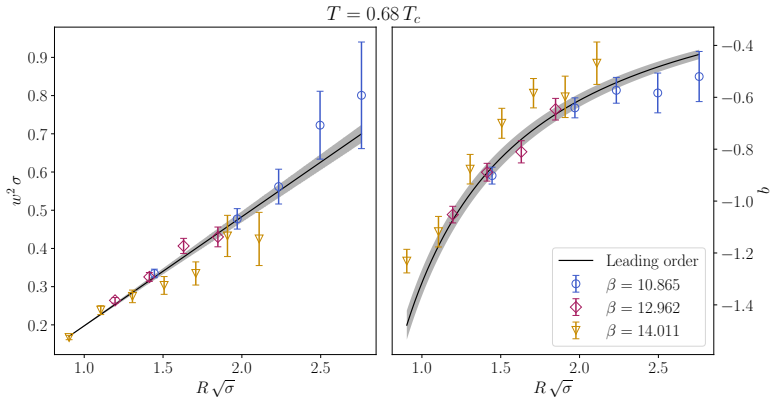
We study the profile of the flux tube in the SU(2) gauge model in 2+1 dimensions, with a particular attention to the so called "intrinsic width" which drives the exponential decay of the flux density at large transverse distances. This quantity is directly related to the confining mechanism which generates the flux tube: to test the properties of the latter we study a wide range of different values of lattice spacing, temperature and flux tube lengths and show that our data are precise enough to distinguish between different confining models. In particular we show that at high temperatures (just below the deconfinement transition) the data are perfectly described by an Ising-like effective model based on the Svetitsky-Yaffe mapping. At lower temperatures this approximation does not hold anymore. In this regime (which is the most interesting one from a physical point of view) we test several alternative proposals and show that the dual superconductor model is the one which better fits the data. However, this proposal is not fully satisfactory, because the values of the Ginzburg-Landau parameter extracted from the fits increase with the length of the flux tube, which is not a feature predicted by the model. This suggests that a more sophisticated model is needed to explain confinement in non-abelian gauge theories and, at the same time, that our data on the intrinsic width may be a powerful tool to benchmark these candidates.
Editorial analysis
A structured set of objections, weighed in public.
Referee Report
Summary. The manuscript studies the profile of the flux tube in SU(2) lattice gauge theory in 2+1 dimensions, focusing on the intrinsic width that governs the exponential decay of the flux density at large transverse distances. It claims that data across a range of lattice spacings, temperatures, and flux-tube lengths are precise enough to distinguish confining models: an Ising-like effective description based on the Svetitsky-Yaffe mapping fits well just below the deconfinement transition, while at lower temperatures the dual-superconductor model provides the best fit among alternatives, although the extracted Ginzburg-Landau parameter increases with flux-tube length, indicating that a more sophisticated effective theory is required.
Significance. If the results hold, the work supplies a quantitative lattice observable—the intrinsic width—for benchmarking candidate models of confinement in non-Abelian gauge theories. The systematic variation over temperature, spacing, and length, together with the explicit identification of the dual-superconductor model's length-dependent inconsistency, strengthens the utility of the observable as a diagnostic tool rather than as support for any single model.
major comments (1)
- [Abstract] Abstract: the central claim that the data 'are precise enough to distinguish between different confining models' rests on the reported superiority of the dual-superconductor fit at low T; however, the same paragraph states that the Ginzburg-Landau parameter grows with flux-tube length, contrary to the model's expectation of length-independent parameters. This tension is load-bearing for the distinction claim and requires explicit quantitative support (e.g., tabulated χ²/dof or AIC values for each model across lengths) to establish that the dual-superconductor description is meaningfully better despite the inconsistency.
Simulated Author's Rebuttal
We thank the referee for the positive evaluation and the constructive comment. We address the single major comment below and will revise the manuscript accordingly.
read point-by-point responses
-
Referee: [Abstract] Abstract: the central claim that the data 'are precise enough to distinguish between different confining models' rests on the reported superiority of the dual-superconductor fit at low T; however, the same paragraph states that the Ginzburg-Landau parameter grows with flux-tube length, contrary to the model's expectation of length-independent parameters. This tension is load-bearing for the distinction claim and requires explicit quantitative support (e.g., tabulated χ²/dof or AIC values for each model across lengths) to establish that the dual-superconductor description is meaningfully better despite the inconsistency.
Authors: We agree that explicit quantitative measures of fit quality are required to substantiate the distinction claim. The manuscript already notes in the abstract and main text that the dual-superconductor model yields the best description among the alternatives tested at low T, while simultaneously flagging its inconsistency with the observed length dependence of the Ginzburg-Landau parameter. To make this comparison transparent, we will add a table in the revised version reporting χ²/dof and AIC values for the Ising-like, dual-superconductor, and other models at each flux-tube length in the low-T regime. This will allow direct assessment of whether the dual-superconductor description remains meaningfully superior despite the parameter variation. revision: yes
Circularity Check
No significant circularity identified
full rationale
The paper measures the intrinsic width from lattice simulations in SU(2) 2+1D and fits the resulting profiles to external literature models (Ising effective theory via Svetitsky-Yaffe at high T; dual superconductor at low T). Extracted parameters such as the Ginzburg-Landau parameter are reported with their observed length dependence, which contradicts model expectations, and the authors conclude a more sophisticated theory is needed. No derivation reduces a claimed prediction to a fitted input by construction, no load-bearing self-citation chain is invoked, and the observable is defined directly from the flux-density decay without circular redefinition. The analysis is therefore data-driven model testing against independent benchmarks.
Axiom & Free-Parameter Ledger
free parameters (1)
- Ginzburg-Landau parameter
axioms (1)
- domain assumption The intrinsic width drives the exponential decay of the flux density at large transverse distances and is directly related to the confining mechanism.
Lean theorems connected to this paper
-
IndisputableMonolith/Cost/FunctionalEquation.leanwashburn_uniqueness_aczel (J-cost uniqueness) unclear?
unclearRelation between the paper passage and the cited Recognition theorem.
the dual superconductor model is the one which better fits the data... values of the Ginzburg-Landau parameter extracted from the fits increase with the length of the flux tube
-
IndisputableMonolith/Foundation/AlexanderDuality.leanalexander_duality_circle_linking unclear?
unclearRelation between the paper passage and the cited Recognition theorem.
Alexander duality... D=3
What do these tags mean?
- matches
- The paper's claim is directly supported by a theorem in the formal canon.
- supports
- The theorem supports part of the paper's argument, but the paper may add assumptions or extra steps.
- extends
- The paper goes beyond the formal theorem; the theorem is a base layer rather than the whole result.
- uses
- The paper appears to rely on the theorem as machinery.
- contradicts
- The paper's claim conflicts with a theorem or certificate in the canon.
- unclear
- Pith found a possible connection, but the passage is too broad, indirect, or ambiguous to say the theorem truly supports the claim.
Forward citations
Cited by 1 Pith paper
-
Effective strings and particles interacting in 3D: the Ising model
In the 3D Ising model, a fluctuating domain wall interacts with bulk particles such that large-distance corrections to free energy and correlation tails are controlled by a single renormalized coupling λ in the nearly...
Reference graph
Works this paper leans on
-
[1]
L¨ uscher,Symmetry Breaking Aspects of the Roughening Transition in Gauge Theories,Nucl
M. L¨ uscher,Symmetry Breaking Aspects of the Roughening Transition in Gauge Theories,Nucl. Phys.B180(1981) 317
work page 1981
-
[2]
M. L¨ uscher, K. Symanzik and P. Weisz,Anomalies of the Free Loop Wave Equation in the WKB Approximation,Nucl. Phys.B173(1980) 365
work page 1980
-
[3]
M. Luscher, G. Munster and P. Weisz,How Thick Are Chromoelectric Flux Tubes?, Nucl. Phys. B180(1981) 1
work page 1981
-
[4]
Nambu,QCD and the String Model,Phys.Lett.B80(1979) 372
Y. Nambu,QCD and the String Model,Phys.Lett.B80(1979) 372
work page 1979
-
[5]
T. Goto,Relativistic quantum mechanics of one-dimensional mechanical continuum and subsidiary condition of dual resonance model,Prog.Theor.Phys.46(1971) 1560
work page 1971
-
[6]
Width of Long Colour Flux Tubes in Lattice Gauge Systems
M. Caselle, F. Gliozzi, U. Magnea and S. Vinti,Width of long color flux tubes in lattice gauge systems,Nucl. Phys. B460(1996) 397 [hep-lat/9510019]
work page internal anchor Pith review Pith/arXiv arXiv 1996
-
[7]
M. Zach, M. Faber and P. Skala,Investigating confinement in dually transformed U(1) lattice gauge theory,Phys. Rev. D57(1998) 123 [hep-lat/9705019]
work page internal anchor Pith review Pith/arXiv arXiv 1998
-
[8]
Y. Koma, M. Koma and P. Majumdar,Static potential, force, and flux tube profile in 4-D compact U(1) lattice gauge theory with the multilevel algorithm,Nucl. Phys. B692(2004) 209 [hep-lat/0311016]
work page internal anchor Pith review Pith/arXiv arXiv 2004
-
[9]
The Width of the Confining String in Yang-Mills Theory
F. Gliozzi, M. Pepe and U.J. Wiese,The Width of the Confining String in Yang-Mills Theory,Phys. Rev. Lett.104(2010) 232001 [1002.4888]
work page internal anchor Pith review Pith/arXiv arXiv 2010
-
[10]
String effects and the distribution of the glue in mesons at finite temperature
A.S. Bakry, D.B. Leinweber, P.J. Moran, A. Sternbeck and A.G. Williams,String effects and the distribution of the glue in mesons at finite temperature,Phys. Rev. D 82(2010) 094503 [1004.0782]
work page internal anchor Pith review Pith/arXiv arXiv 2010
-
[11]
On the linear increase of the flux tube thickness near the deconfinement transition
A. Allais and M. Caselle,On the linear increase of the flux tube thickness near the deconfinement transition,JHEP01(2009) 073 [0812.0284]
work page internal anchor Pith review Pith/arXiv arXiv 2009
-
[12]
Flux tube delocalization at the deconfinement point
M. Caselle,Flux tube delocalization at the deconfinement point,JHEP08(2010) 063 [1004.3875]
work page internal anchor Pith review Pith/arXiv arXiv 2010
-
[13]
Linear broadening of the confining string in Yang-Mills theory at low temperature
F. Gliozzi, M. Pepe and U.J. Wiese,Linear Broadening of the Confining String in Yang-Mills Theory at Low Temperature,JHEP01(2011) 057 [1010.1373]
work page internal anchor Pith review Pith/arXiv arXiv 2011
-
[14]
String excitation energies in SU(N) gauge theories beyond the free-string approximation
M. L¨ uscher and P. Weisz,String excitation energies in SU(N) gauge theories beyond the free-string approximation,JHEP0407(2004) 014 [hep-th/0406205]
work page internal anchor Pith review Pith/arXiv arXiv 2004
-
[15]
Effective String Theory Revisited
S. Dubovsky, R. Flauger and V. Gorbenko,Effective String Theory Revisited,JHEP 09(2012) 044 [1203.1054]
work page internal anchor Pith review Pith/arXiv arXiv 2012
-
[16]
The Effective Theory of Long Strings
O. Aharony and Z. Komargodski,The Effective Theory of Long Strings,JHEP 1305(2013) 118 [1302.6257]
work page internal anchor Pith review Pith/arXiv arXiv 2013
-
[17]
M. Caselle, N. Magnoli, A. Nada, M. Panero, D. Panfalone and L. Verzichelli, Confining strings in three-dimensional gauge theories beyond the Nambu-Got¯ o approximation,JHEP08(2024) 198 [2407.10678]. 33
-
[18]
O. Aharony, N. Barel and T. Sheaffer,Effective strings in QED 3,JHEP03(2025) 143 [2412.01313]
-
[19]
M. Caselle and A. Mariani,The finite temperature ground state energy of the confining string in three-dimensional U(1) gauge theory,JHEP06(2025) 010 [2503.05354]
-
[20]
Polyakov,Quark confinement and topology of gauge theories,Nucl
A. Polyakov,Quark confinement and topology of gauge theories,Nucl. Phys. B120 (1977) 429–458
work page 1977
-
[21]
M. G¨ opfert and G. Mack,Proof of confinement of static quarks in 3-dimensional U(1) lattice gauge theory for all values of the coupling constant,Commun. Math. Phys.82(1982) 545
work page 1982
-
[22]
Width of the flux tube in compact U(1) gauge theory in three dimensions
M. Caselle, M. Panero and D. Vadacchino,Width of the flux tube in compact U(1) gauge theory in three dimensions,JHEP02(2016) 180 [1601.07455]
work page internal anchor Pith review Pith/arXiv arXiv 2016
-
[23]
Detailed study of quark-antiquark flux tubes and flux tube recombination
M. Cardoso, P. Bicudo and N. Cardoso,Detailed study of quark-antiquark flux tubes and flux tube recombination,Acta Phys. Polon. Supp.5(2012) 1149 [1208.2552]
work page internal anchor Pith review Pith/arXiv arXiv 2012
-
[24]
Inside the SU(3) quark-antiquark QCD flux tube: screening versus quantum widening
N. Cardoso, M. Cardoso and P. Bicudo,Inside the SU(3) quark-antiquark QCD flux tube: screening versus quantum widening,Phys. Rev. D88(2013) 054504 [1302.3633]
work page internal anchor Pith review Pith/arXiv arXiv 2013
-
[25]
Isolating the confining color field in the SU(3) flux tube
M. Baker, P. Cea, V. Chelnokov, L. Cosmai, F. Cuteri and A. Papa,Isolating the confining color field in the SU(3) flux tube,Eur. Phys. J. C79(2019) 478 [1810.07133]
work page internal anchor Pith review Pith/arXiv arXiv 2019
- [26]
-
[27]
L. Verzichelli, M. Caselle, E. Cellini, A. Nada and D. Panfalone,Intrinsic width of the flux tube in 2+1 dimensional Yang-Mills theories,PoSLATTICE2024(2025) 403 [2501.01740]
-
[28]
S. Edwards and L. von Smekal,SU(2) lattice gauge theory in 2+1 dimensions: Critical couplings from twisted boundary conditions and universality,Phys. Lett. B 681(2009) 484 [0908.4030]
work page internal anchor Pith review Pith/arXiv arXiv 2009
-
[29]
M. Fukugita and T. Niuya,Distribution of Chromoelectric Flux in SU(2) Lattice Gauge Theory,Phys. Lett. B132(1983) 374
work page 1983
-
[30]
A. Di Giacomo, M. Maggiore and S. Olejnik,Confinement and Chromoelectric Flux Tubes in Lattice QCD,Nucl. Phys. B347(1990) 441
work page 1990
-
[31]
Color flux tubes in $SU(3)$ Yang-Mills theory: an investigation with the connected correlator
N. Battelli and C. Bonati,Color flux tubes inSU(3)Yang-Mills theory: an investigation with the connected correlator,Phys. Rev. D99(2019) 114501 [1903.10463]
work page internal anchor Pith review Pith/arXiv arXiv 2019
-
[32]
C. Bonati and S. Morlacchi,Flux tubes and string breaking in three dimensional SU(2) Yang-Mills theory,Phys. Rev. D101(2020) 094506 [2003.07244]
-
[33]
F. Caristo, M. Caselle, N. Magnoli, A. Nada, M. Panero and A. Smecca,Fine corrections in the effective string describing SU(2) Yang-Mills theory in three dimensions,JHEP03(2022) 115 [2109.06212]. 34
-
[34]
M. Caselle, E. Cellini and A. Nada,Sampling the lattice Nambu-Goto string using Continuous Normalizing Flows,JHEP02(2024) 048 [2307.01107]
-
[35]
M. Caselle, E. Cellini and A. Nada,Numerical determination of the width and shape of the effective string using Stochastic Normalizing Flows,JHEP02(2025) 090 [2409.15937]
-
[36]
Variational Inference with Normalizing Flows
D. Rezende and S. Mohamed,Variational inference with normalizing flows, in International conference on machine learning, pp. 1530–1538, PMLR, 2015 [1505.05770]
work page internal anchor Pith review Pith/arXiv arXiv 2015
-
[37]
M.S. Albergo, G. Kanwar and P.E. Shanahan,Flow-based generative models for Markov chain Monte Carlo in lattice field theory,Phys. Rev. D100(2019) 034515 [1904.12072]
-
[38]
K.A. Nicoli, C.J. Anders, L. Funcke, T. Hartung, K. Jansen, P. Kessel et al., Estimation of Thermodynamic Observables in Lattice Field Theories with Deep Generative Models,Phys. Rev. Lett.126(2021) 032001 [2007.07115]
-
[39]
K. Cranmer, G. Kanwar, S. Racani` ere, D.J. Rezende and P.E. Shanahan,Advances in machine-learning-based sampling motivated by lattice quantum chromodynamics, Nature Rev. Phys.5(2023) 526 [2309.01156]
-
[40]
Polyakov,Compact Gauge Fields and the Infrared Catastrophe,Phys
A.M. Polyakov,Compact Gauge Fields and the Infrared Catastrophe,Phys. Lett. B 59(1975) 82
work page 1975
-
[41]
Mandelstam,Vortices and Quark Confinement in Nonabelian Gauge Theories, Phys
S. Mandelstam,Vortices and Quark Confinement in Nonabelian Gauge Theories, Phys. Rept.23(1976) 245
work page 1976
-
[42]
G. ’t Hooft,Topology of the Gauge Condition and New Confinement Phases in Nonabelian Gauge Theories,Nucl. Phys. B190(1981) 455
work page 1981
-
[43]
P. Cea, L. Cosmai and A. Papa,Chromoelectric flux tubes and coherence length in QCD,Phys. Rev. D86(2012) 054501 [1208.1362]
work page internal anchor Pith review Pith/arXiv arXiv 2012
-
[44]
P. Cea, L. Cosmai, F. Cuteri and A. Papa,Flux tubes in the QCD vacuum,Phys. Rev. D95(2017) 114511 [1702.06437]
work page internal anchor Pith review Pith/arXiv arXiv 2017
-
[45]
Clem,Simple model for the vortex core in a type II superconductor,J
J.R. Clem,Simple model for the vortex core in a type II superconductor,J. Low Temp. Phys.18(1975) 427
work page 1975
-
[46]
N. Cardoso, M. Cardoso and P. Bicudo,SU(3) gauge invariant lattice QCD exploration of the dual superconductor picture in flux tube fusion, in the dual gluon mass, and in the dual Ginzburg-Landau parameters,1004.0166
work page internal anchor Pith review Pith/arXiv arXiv
-
[47]
B. Svetitsky and L.G. Yaffe,Critical Behavior at Finite Temperature Confinement Transitions,Nucl. Phys. B210(1982) 423
work page 1982
-
[48]
Study of the flux tube thickness in 3d LGT's by means of 2d spin models
M. Caselle, P. Grinza and N. Magnoli,Study of the flux tube thickness in 3-D LGT’s by means of 2-D spin models,J. Stat. Mech.0611(2006) P11003 [hep-th/0607014]
work page internal anchor Pith review Pith/arXiv arXiv 2006
-
[49]
On the intrinsic width of the chromoelectric flux tube in finite temperature LGTs
M. Caselle and P. Grinza,On the intrinsic width of the chromoelectric flux tube in finite temperature LGTs,JHEP11(2012) 174 [1207.6523]
work page internal anchor Pith review Pith/arXiv arXiv 2012
-
[50]
Canneti,Flux tube profile from Holography: finite size and strong coupling corrections,2510.02442
T. Canneti,Flux tube profile from Holography: finite size and strong coupling corrections,2510.02442. 35
-
[51]
Vacua, Propagators, and Holographic Probes in AdS/CFT
U.H. Danielsson, E. Keski-Vakkuri and M. Kruczenski,Vacua, propagators, and holographic probes in AdS / CFT,JHEP01(1999) 002 [hep-th/9812007]
work page internal anchor Pith review Pith/arXiv arXiv 1999
-
[52]
SU(N) gauge theories in 2+1 dimensions: glueball spectra and k-string tensions
A. Athenodorou and M. Teper,SU(N) gauge theories in 2+1 dimensions: glueball spectra and k-string tensions,JHEP02(2017) 015 [1609.03873]
work page internal anchor Pith review Pith/arXiv arXiv 2017
-
[53]
Locality and exponential error reduction in numerical lattice gauge theory
M. Luscher and P. Weisz,Locality and exponential error reduction in numerical lattice gauge theory,JHEP09(2001) 010 [hep-lat/0108014]
work page internal anchor Pith review Pith/arXiv arXiv 2001
-
[54]
R. Amorosso, S. Syritsyn and R. Venugopalan,Entanglement entropy of a color flux tube in (1+1)D Yang–Mills theory,Phys. Lett. B868(2025) 139806 [2411.12818]
-
[55]
R. Amorosso, S. Syritsyn and R. Venugopalan,Entanglement entropy of a color flux tube in (2+1)D Yang-Mills theory,JHEP12(2024) 177 [2410.00112]
-
[56]
R. Amorosso, S. Syritsyn and R. Venugopalan,Entanglement Enabled Tomography of Flux Tubes in (2+1)D Yang-Mills Theory,2601.17199
-
[57]
SU(N) gauge theories in 2+1 dimensions
M.J. Teper,SU(N) gauge theories in (2+1)-dimensions,Phys. Rev. D59(1999) 014512 [hep-lat/9804008]
work page internal anchor Pith review Pith/arXiv arXiv 1999
- [58]
-
[59]
M. Nguyen and M. ¨Unsal,Self-dual monopole loops, instantons and confinement, 2509.09625
-
[60]
T. Domurcukg¨ ul, H. Geng, M. Nguyen and M. ¨Unsal,Generalized Yang-Mills theory: Interpolating between SDYM and YM,2512.03217
-
[61]
J. Giansiracusa, D. Lanners and T. Sulejmanpasic,Emergent photons and mechanisms of confinement,2505.00079
-
[62]
$\xi/\xi_{2nd}$ ratio as a tool to refine Effective Polyakov Loop models
M. Caselle and A. Nada,ξ/ξ 2nd ratio as a tool to refine effective Polyakov loop models,Phys. Rev. D96(2017) 074503 [1707.02164]
work page internal anchor Pith review Pith/arXiv arXiv 2017
-
[63]
M. Caselle, N. Magnoli, D. Panfalone and L. Verzichelli,The mass of the baryon junction: a lattice computation in 2 + 1 dimensions,JHEP12(2025) 019 [2508.00608]. [64]ALPHAcollaboration,Monte Carlo errors with less errors,Comput. Phys. Commun.156(2004) 143 [hep-lat/0306017]
- [64]
- [65]
-
[66]
M. Caselle, E. Cellini, A. Nada and M. Panero,Stochastic normalizing flows as non-equilibrium transformations,JHEP07(2022) 015 [2201.08862]
-
[67]
A. Bulgarelli, E. Cellini and A. Nada,Scaling of stochastic normalizing flows in SU(3) lattice gauge theory,Phys. Rev. D111(2025) 074517 [2412.00200]. 36
-
[68]
Scaling flow-based approaches for topology sampling in $\mathrm{SU}(3)$ gauge theory
C. Bonanno, A. Bulgarelli, E. Cellini, A. Nada, D. Panfalone, D. Vadacchino et al., Scaling flow-based approaches for topology sampling inSU(3)gauge theory, 2510.25704. 37
work page internal anchor Pith review Pith/arXiv arXiv
discussion (0)
Sign in with ORCID, Apple, or X to comment. Anyone can read and Pith papers without signing in.