Correlated dynamics of three-particle bound states induced by emergent impurities in Bose-Hubbard model
Pith reviewed 2026-05-25 06:58 UTC · model grok-4.3
The pith
Interaction-induced impurities next to bound pairs and boundaries create dimer-monomer bound states and bound edge states whose quantum walks spread more slowly and whose Bloch oscillations have one-third the single-particle period.
A machine-rendered reading of the paper's core claim, the machinery that carries it, and where it could break.
Core claim
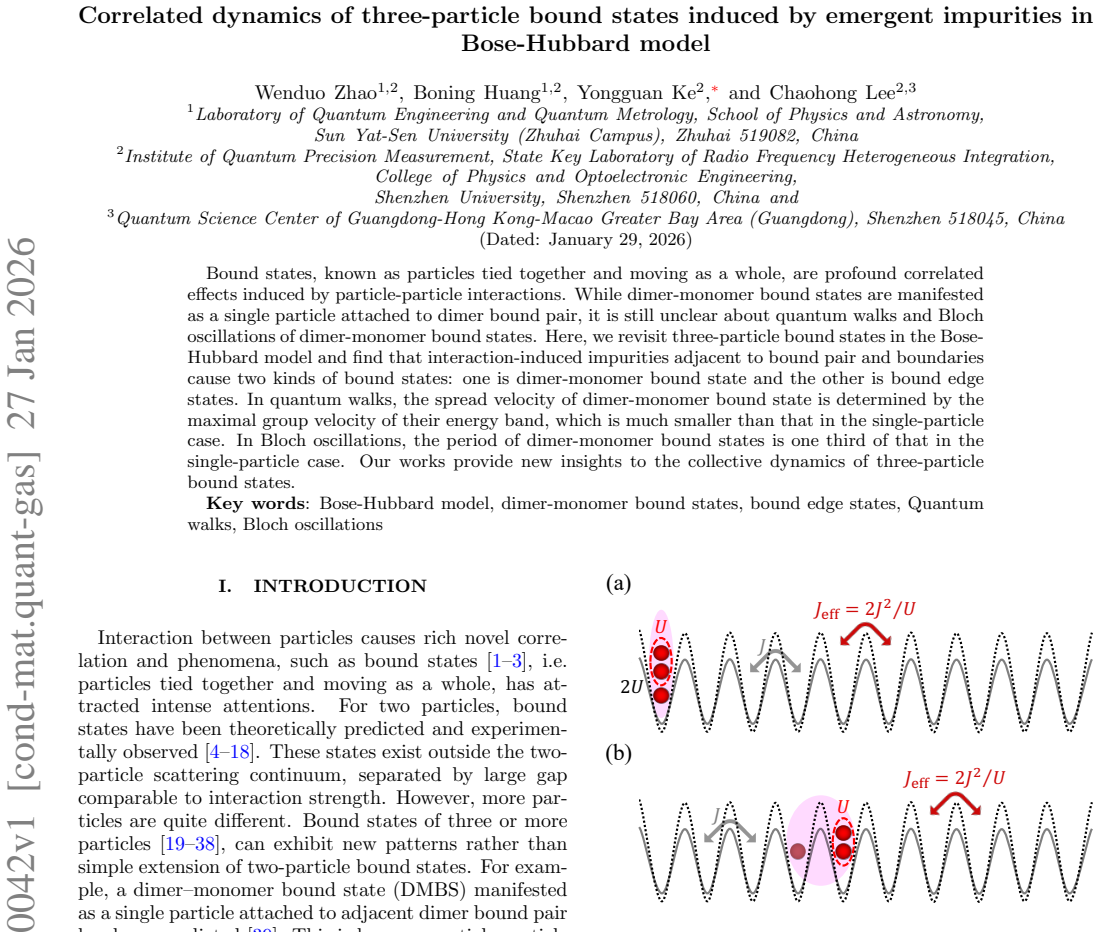
Interaction-induced impurities adjacent to bound pair and boundaries cause two kinds of bound states: one is dimer-monomer bound state and the other is bound edge state. In quantum walks, the spread velocity of dimer-monomer bound state is determined by the maximal group velocity of their energy band, which is much smaller than that in the single-particle case. In Bloch oscillations, the period of dimer-monomer bound states is one third of that in the single-particle case. Emergence of bound edge states also requires that interaction-induced defects are greater than the effective tunneling strength of three-particle bound state.
What carries the argument
Interaction-induced impurities acting as defects adjacent to bound pairs, which enable dimer-monomer bound states whose effective tunneling strength sets their propagation and oscillation scales.
If this is right
- Dimer-monomer bound states spread at a velocity fixed by the maximum group velocity of their energy band.
- Bloch oscillations of dimer-monomer bound states complete one cycle in one-third the time required for single-particle states.
- Bound edge states form only when the strength of interaction-induced defects exceeds the effective tunneling strength of the three-particle bound state.
Where Pith is reading between the lines
- The same impurity mechanism may produce analogous slowed transport for bound states involving four or more particles.
- The reduced spread velocity offers a route to spatially confine correlated particles without external potentials.
- Optical-lattice experiments with tunable interactions could directly map the transition between dimer-monomer and edge-bound regimes.
Load-bearing premise
The three-particle bound states and their effective tunneling strength can be accurately captured by an effective model derived from the Bose-Hubbard Hamiltonian without significant contributions from higher-order scattering or delocalized states.
What would settle it
A numerical diagonalization or cold-atom experiment that measures the Bloch-oscillation period of an isolated dimer-monomer state and finds a value other than one-third the single-particle period.
Figures


read the original abstract
Bound states, known as particles tied together and moving as a whole, are profound correlated effects induced by particle-particle interactions. While dimer-monomer bound states are manifested as a single particle attached to a dimer bound pair, it is still unclear about quantum walks and Bloch oscillations of dimer-monomer bound states. Here, we revisit three-particle bound states in the Bose-Hubbard model and find that interaction-induced impurities adjacent to bound pair and boundaries cause two kinds of bound states: one is dimer-monomer bound state and the other is bound edge state. In quantum walks, the spread velocity of dimer-monomer bound state is determined by the maximal group velocity of their energy band, which is much smaller than that in the single-particle case. In Bloch oscillations, the period of dimer-monomer bound states is one third of that in the single-particle case. Emergence of bound edge states also requires that interaction-induced defects are greater than the effective tunneling strength of three-particle bound state. Our work provides new insights to basic mechanics and collective dynamics of three-particle bound states.
Editorial analysis
A structured set of objections, weighed in public.
Referee Report
Summary. The paper examines three-particle bound states in the Bose-Hubbard model, focusing on interaction-induced impurities that create dimer-monomer bound states and bound edge states. It claims that the spread velocity of dimer-monomer states in quantum walks equals the maximum group velocity of their energy band (much smaller than the single-particle case), that their Bloch oscillation period is exactly one third of the single-particle period, and that bound edge states appear only when interaction-induced defects exceed the effective three-particle tunneling strength. These results are obtained via an effective model derived by projecting the Bose-Hubbard Hamiltonian onto a subspace of bound states plus emergent impurities.
Significance. If the subspace projection is rigorously justified and the dynamical predictions hold, the work would provide concrete, testable predictions for collective few-body dynamics in lattice systems, including a specific factor-of-three reduction in Bloch period. Such results could inform experiments with ultracold atoms and highlight how emergent impurities modify multi-particle transport. The identification of two distinct bound-state species is a useful conceptual contribution, though its impact depends on quantitative validation of the effective model.
major comments (2)
- [effective model derivation (implied in abstract and methods)] The headline claims on spread velocity (set by max group velocity of the bound band) and Bloch period (exactly 1/3 of single-particle) rest on an effective Hamiltonian obtained by projecting onto the dimer-monomer subspace. No bound on residual coupling to the three-particle scattering continuum is supplied, nor is a comparison to the full three-body spectrum shown; any leakage would renormalize the band width and invalidate both the velocity and period predictions.
- [abstract and bound-edge-state discussion] The condition for emergence of bound edge states ('interaction-induced defects greater than the effective tunneling strength of three-particle bound state') is stated without a numerical value for the effective tunneling or an explicit calculation showing how the threshold is obtained from the Bose-Hubbard parameters.
minor comments (1)
- [abstract] Notation for the effective tunneling strength and impurity strength is introduced without a clear equation reference or definition in the abstract.
Simulated Author's Rebuttal
We thank the referee for the careful reading and constructive comments on our manuscript. We address the two major comments point by point below.
read point-by-point responses
-
Referee: The headline claims on spread velocity (set by max group velocity of the bound band) and Bloch period (exactly 1/3 of single-particle) rest on an effective Hamiltonian obtained by projecting onto the dimer-monomer subspace. No bound on residual coupling to the three-particle scattering continuum is supplied, nor is a comparison to the full three-body spectrum shown; any leakage would renormalize the band width and invalidate both the velocity and period predictions.
Authors: We agree that explicit justification of the subspace projection is required to support the quantitative predictions. The effective model assumes energetic separation between bound states and the scattering continuum. In the revised manuscript we will add a perturbative bound on the residual coupling (via second-order virtual processes) together with a direct comparison of the effective dispersion relation against exact diagonalization spectra for small lattices, thereby confirming the regime of validity for the reported velocity and period results. revision: yes
-
Referee: The condition for emergence of bound edge states ('interaction-induced defects greater than the effective tunneling strength of three-particle bound state') is stated without a numerical value for the effective tunneling or an explicit calculation showing how the threshold is obtained from the Bose-Hubbard parameters.
Authors: The threshold follows from comparing the defect potential generated by the interaction-induced impurity to the effective three-particle tunneling amplitude obtained after projection. In the revision we will supply the explicit analytic expression for this effective tunneling strength in terms of the Bose-Hubbard parameters U and J, and state the resulting numerical threshold value. revision: yes
Circularity Check
No circularity: effective three-particle dynamics derived from Bose-Hubbard projection without reduction to inputs
full rationale
The paper constructs an effective model for dimer-monomer bound states and bound edge states by projecting the Bose-Hubbard Hamiltonian onto the three-particle subspace with interaction-induced impurities. The reported spread velocity (max group velocity of the bound-state band) and Bloch period (exactly 1/3 of single-particle) are direct consequences of diagonalizing that effective Hamiltonian; they are not obtained by fitting parameters to the target observables or by renaming known results. No self-citation chain, uniqueness theorem imported from the same authors, or ansatz smuggled via prior work is invoked as load-bearing. The isolation of the bound subspace is presented as an approximation whose validity is assumed rather than proven by construction, but this does not constitute circularity under the defined criteria.
Axiom & Free-Parameter Ledger
Reference graph
Works this paper leans on
-
[1]
K. Winkler, G. Thalhammer, F. Lang, R. Grimm, J. Hecker Denschlag, A. Daley, A. Kantian, H. B¨ uchler, and P. Zoller, Repulsively bound atom pairs in an optical lattice, Nature441, 853–856 (2006)
work page 2006
-
[2]
M. Valiente and D. Petrosyan, Two-particle states in the Hubbard model, J. Phys. B:At., Mol. Opt. Phys.41, 161002 (2008)
work page 2008
-
[3]
T. Fukuhara, P. Schauß, M. Endres, S. Hild, M. Che- neau, I. Bloch, and C. Gross, Microscopic observation of magnon bound states and their dynamics, Nature502, 76–79 (2013)
work page 2013
-
[4]
X. Qin, Y. Ke, X. Guan, Z. Li, N. Andrei, and C. Lee, Statistics-dependent quantum co-walking of two particles in one-dimensional lattices with nearest-neighbor interac- tions, Phys. Rev. A90, 062301 (2014)
work page 2014
-
[5]
M. A. Gorlach and A. N. Poddubny, Topological edge states of bound photon pairs, Phys. Rev. A95, 053866 (2017)
work page 2017
-
[6]
Y. Ke, X. Qin, Y. S. Kivshar, and C. Lee, Multiparti- cleWannier states andThouless pumping of interacting bosons, Phys. Rev. A95, 063630 (2017)
work page 2017
-
[7]
X. Qin, F. Mei, Y. Ke, L. Zhang, and C. Lee, Topo- logical magnon bound states in periodically modulated HeisenbergXXZchains, Phys. Rev. B96, 195134 (2017)
work page 2017
-
[8]
B. Van Voorden and K. Schoutens, Topological quantum pump of strongly interacting fermions in coupled chains, New J. Phys.21, 013026 (2019)
work page 2019
-
[9]
N. A. Olekhno, E. I. Kretov, A. A. Stepanenko, P. A. Ivanova, V. V. Yaroshenko, E. M. Puhtina, D. S. Filonov, B. Cappello, L. Matekovits, and M. A. Gorlach, Topolog- ical edge states of interacting photon pairs emulated in a topolectrical circuit, Nat. Commun.11, 1436 (2020)
work page 2020
-
[10]
L. Lin, Y. Ke, and C. Lee, Interaction-induced topo- logical bound states andThouless pumping in a one- dimensional optical lattice, Phys. Rev. A101, 023620 (2020)
work page 2020
-
[11]
A. A. Stepanenko and M. A. Gorlach, Interaction- induced topological states of photon pairs, Phys. Rev. A102, 013510 (2020)
work page 2020
-
[12]
Y. Ke, J. Zhong, A. V. Poshakinskiy, Y. S. Kivshar, A. N. Poddubny, and C. Lee, Radiative topological bipho- ton states in modulated qubit arrays, Phys. Rev. Res.2, 033190 (2020)
work page 2020
-
[13]
P. M. Azcona and C. Downing, Doublons, topology and interactions in a one-dimensional lattice, Sci. Rep.11, 12540 (2021)
work page 2021
-
[14]
W. Liu, S. Hu, L. Zhang, Y. Ke, and C. Lee, Corre- lated topological pumping of interacting bosons assisted byBloch oscillations, Phys. Rev. Res.5, 013020 (2023)
work page 2023
-
[15]
Y. Zheng and S.-J. Yang, Two-body bound and edge bound states in a ladder lattice with synthetic flux, J. Phys. B:At., Mol. Opt. Phys.56, 125301 (2023)
work page 2023
- [16]
- [17]
- [18]
-
[19]
G. C. Ghirardi and A. Rimini, On the number of bound states of a three-particle system, Il Nuovo Cimento (1955- 1965)37, 450–454 (1965)
work page 1955
-
[20]
A. Ahmadzadeh and J. Tjon, New reduction of the Faddeev equations and its application to the pion as a three-particle bound state, Phys. Rev.139, B1085 (1965)
work page 1965
-
[21]
D. Brayshaw and R. F. Peierls, Connection between bound states or resonances of two-particle and three- particle systems, Phys. Rev.177, 2539 (1969). 8
work page 1969
-
[22]
A. Sitenko and V. Kharchenko, Bound states and scat- tering in a system of three particles, Sov. Phys. Usp.14, 125 (1971)
work page 1971
-
[23]
D. Mattis and S. Rudin, Three-body bound states on a lattice, Phys. Rev. Lett.52, 755 (1984)
work page 1984
-
[24]
Macek, Loosely bound states of three particles, Z
J. Macek, Loosely bound states of three particles, Z. Phys. D:At., Mol. Clusters3, 31–37 (1986)
work page 1986
- [25]
-
[26]
Z. Zhen and J. Macek, Loosely bound states of three particles, Phys. Rev. A38, 1193 (1988)
work page 1988
-
[27]
A. Kievsky, M. Viviani, and S. Rosati, Study of bound and scattering states in three-nucleon systems, Nucl. Phys. A577, 511–527 (1994)
work page 1994
-
[28]
I. V. Brodsky, A. V. Klaptsov, M. Y. Kagan, R. Combescot, and X. Leyronas, Bound states of three and four resonantly interacting particles, J. Exp. Theor. Phys. Lett.82, 273–278 (2005)
work page 2005
-
[29]
D. K. Gridnev, Zero-energy bound states and resonances in three-particle systems, J. Phys. A:Math. Theor.45, 175203 (2012)
work page 2012
-
[30]
U.-G. Meißner, G. R´ ıos, and A. Rusetsky, Spectrum of three-body bound states in a finite volume, Phys. Rev. Lett.114, 091602 (2015)
work page 2015
-
[31]
S. N. Lakaev and S. S. Lakaev, The existence of bound states in a system of three particles in an optical lattice, J. Phys. A:Math. Theor.50, 335202 (2017)
work page 2017
-
[32]
M. T. Hansen and S. R. Sharpe, Applying the relativistic quantization condition to a three-particle bound state in a periodic box, Phys. Rev. D95, 034501 (2017)
work page 2017
-
[33]
Y. Meng, C. Liu, U.-G. Meißner, and A. Rusetsky, Three-particle bound states in a finite volume: unequal masses and higher partial waves, Phys. Rev. D98, 014508 (2018)
work page 2018
- [34]
- [35]
-
[36]
N. Sun, W. Zhang, H. Yuan, and X. Zhang, Boundary- localized many-body bound states in the continuum, Commun. Phys.7, 299 (2024)
work page 2024
-
[37]
S. N. Lakaev, S. I. Khamidov, and S. S. Ulashov, Ex- istence of three-particle bound states in optical lattice, Theor. Math. Phys.225, 2235–2250 (2025)
work page 2025
- [38]
-
[39]
M. Valiente, D. Petrosyan, and A. Saenz, Three-body bound states in a lattice, Phys. Rev. A81, 011601 (2010)
work page 2010
-
[40]
A. M. Childs, Universal computation by quantum walk, Phys. Rev. Lett.102, 180501 (2009)
work page 2009
-
[41]
S. E. Venegas-Andraca, Quantum walks: a comprehen- sive review, Quantum Inf. Process.11, 1015–1106 (2012)
work page 2012
- [42]
-
[43]
Y. Aharonov, L. Davidovich, and N. Zagury, Quantum random walks, Phys. Rev. A48, 1687–1690 (1993)
work page 1993
-
[44]
H. Schmitz, R. Matjeschk, C. Schneider, J. Glueckert, M. Enderlein, T. Huber, and T. Schaetz, Quantum walk of a trapped ion in phase space, Phys. Rev. Lett.103, 090504 (2009)
work page 2009
-
[45]
F. Z¨ ahringer, G. Kirchmair, R. Gerritsma, E. Solano, R. Blatt, and C. F. Roos, Realization of a quantum walk with one and two trapped ions, Phys. Rev. Lett.104, 100503 (2010)
work page 2010
- [46]
-
[47]
H. B. Perets, Y. Lahini, F. Pozzi, M. Sorel, R. Moran- dotti, and Y. Silberberg, Realization of quantum walks with negligible decoherence in waveguide lattices, Phys. Rev. Lett.100, 170506 (2008)
work page 2008
-
[48]
J. Du, H. Li, X. Xu, M. Shi, J. Wu, X. Zhou, and R. Han, Experimental implementation of the quantum random- walk algorithm, Phys. Rev. A67, 042316 (2003)
work page 2003
-
[49]
C. A. Ryan, M. Laforest, J.-C. Boileau, and R. Laflamme, Experimental implementation of a discrete-time quan- tum random walk on anNMRquantum-information pro- cessor, Phys. Rev. A72, 062317 (2005)
work page 2005
-
[50]
P. M. Preiss, R. Ma, M. E. Tai, A. Lukin, M. Rispoli, P. Zupancic, Y. Lahini, R. Islam, and M. Greiner, Strongly correlated quantum walks in optical lattices, Science347, 1229–1233 (2015)
work page 2015
-
[51]
W. Liu, Y. Ke, L. Zhang, and C. Lee, Bloch oscillations of multimagnon excitations in a heisenbergxxzchain, Phys. Rev. A99, 063614 (2019)
work page 2019
-
[52]
Takahashi, Half-filledHubbard model at low temper- ature, J
M. Takahashi, Half-filledHubbard model at low temper- ature, J. Phys. C:Solid State Phys.10, 1289 (1977)
work page 1977
- [53]
-
[54]
N. Marzari and D. Vanderbilt, Maximally localized gen- eralizedWannier functions for composite energy bands, Phys. Rev. B56, 12847–12865 (1997)
work page 1997
- [55]
-
[56]
T. Hartmann, F. Keck, H. J. Korsch, and S. Mossmann, Dynamics ofBloch oscillations, New J. Phys.6, 2 (2004)
work page 2004
discussion (0)
Sign in with ORCID, Apple, or X to comment. Anyone can read and Pith papers without signing in.