Recognition: 2 theorem links
· Lean TheoremAsymmetrical thermonuclear supernovae triggered by the tidal disruption of white dwarfs
Pith reviewed 2026-05-16 10:18 UTC · model grok-4.3
The pith
Tidal disruptions of white dwarfs by intermediate-mass black holes can produce thermonuclear supernovae that appear highly asymmetrical depending on the viewing angle.
A machine-rendered reading of the paper's core claim, the machinery that carries it, and where it could break.
Core claim
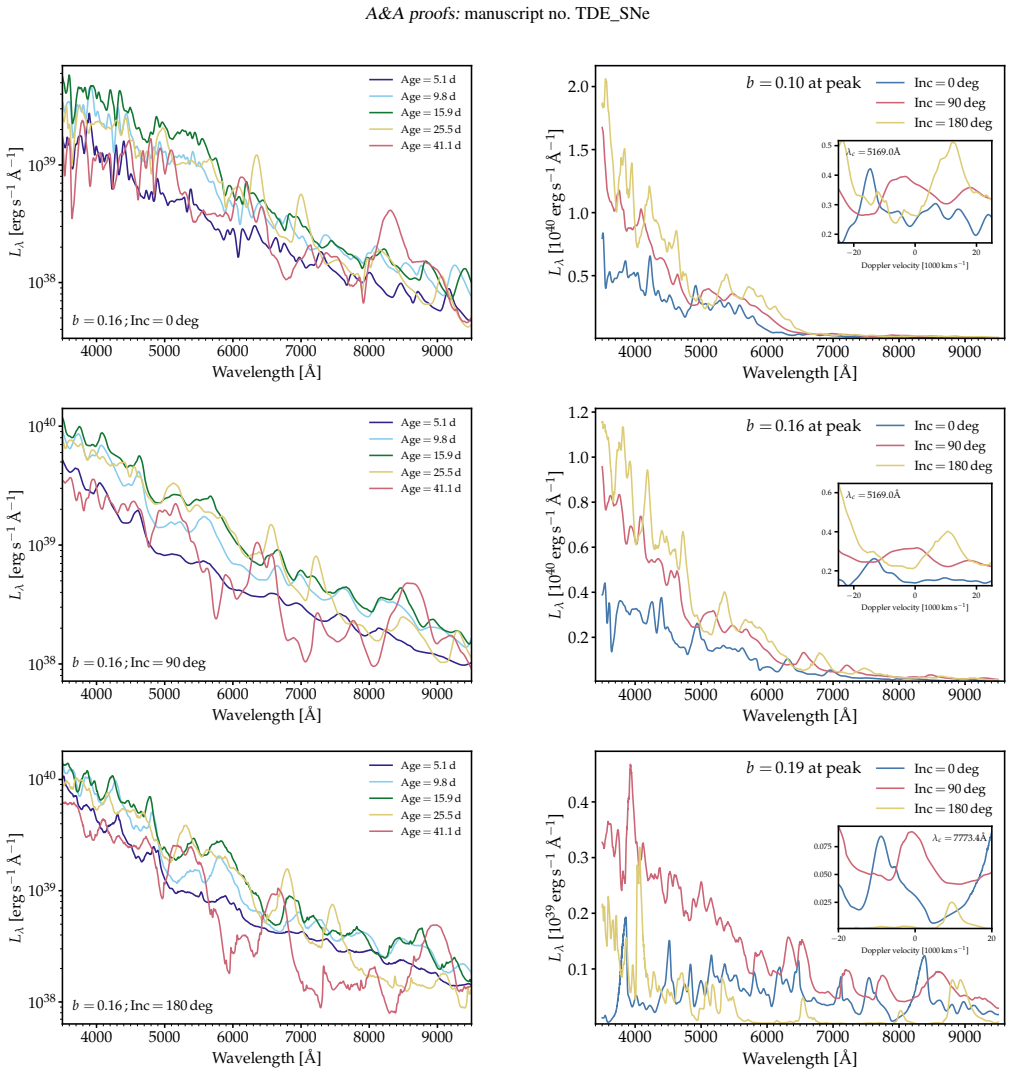
Simulations of white dwarf tidal disruptions by a 500 solar mass black hole show that for impact parameters below about 0.2, the tidal compression induces runaway fusion, converting up to 82% of the material into nickel-56 for the closest encounters, while leaving outer material unburnt. Radiative transfer calculations reveal that the resulting transients have typical Type Ia supernova rise times and luminosities but with strong dependence on viewing angle, and nebular spectra featuring displaced and skewed calcium lines offset by many thousands of km/s.
What carries the argument
High-resolution hydrodynamical simulations with a 55-isotope nuclear network in the AREPO code, combined with 1D and 2D radiative transfer using CMFGEN and LONGPOL, tracking the dependence on the scaled impact parameter b.
Load-bearing premise
The simulations' hydrodynamics and nuclear reaction network fully capture the tidal compression, heating, and burning processes without significant influence from omitted physics such as magnetic fields or general relativity.
What would settle it
A spectroscopic observation at nebular phases showing calcium emission lines displaced and skewed by several thousand km/s in a transient consistent with a white dwarf tidal disruption event, or the absence of such signatures in a large sample of similar events.
Figures



read the original abstract
In a dense star cluster core, a tidal disruption event (TDE) of a white dwarf (WD) can occur if the WD passes within the tidal radius of an intermediate-mass black hole (IMBH). Very close encounters cause extreme tidal compression in the WD, raising temperatures enough to induce runaway fusion and produce a thermonuclear supernova (SN). Using the hydrodynamics code AREPO augmented with a 55-isotope nuclear reaction network, we performed high-resolution simulations of the TDE of a $0.6$ Msun C/O WD by a $500$ Msun IMBH for different values of the scaled impact parameter $b$ (i.e., the ratio of periapsis distance to tidal radius). Closer encounters produce combined TDE+SN events, with a partial burning of $^{12}$C and $^{16}$O into heavier isotopes -- the $^{56}$Ni fractions of the disrupted WD material vary from 1% at $b = 0.19$ to 82% at $b = 0.10$, while wider ones ($b \gtrsim 0.20$) lead to standard TDEs. In all cases, the material away from the denser regions remains unburnt, spanning a wide range of radial velocities. Such WD TDEs also exhibit a central cavity, wherein little material is found below a radial velocity of several $1000 \,\mathrm{km s}^{-1}$. We also performed 1D and 2D radiative-transfer calculations for these WD-TDEs using the codes CMFGEN and LONGPOL, respectively, covering epochs from a few days to one hundred days. We recover the typical rise times and peak luminosities of SNe Ia, but with an extremely strong viewing-angle dependence of both light curves and spectra. At nebular times, isolated strong emission lines like [Ca ii] {\lambda}{\lambda} 7291, 7323 may appear both displaced and skewed by many $1000 \,\mathrm{km s}^{-1}$ -- such extreme offsets are harder to identify at earlier times due to optical depth effects and line overlap. WD TDEs may produce a diverse set of transients with extreme asymmetry and peculiar composition.
Editorial analysis
A structured set of objections, weighed in public.
Referee Report
Summary. The paper presents AREPO hydrodynamical simulations (with a 55-isotope network) of the tidal disruption of a 0.6 Msun C/O white dwarf by a 500 Msun IMBH at varying scaled impact parameters b. Close encounters (b = 0.10–0.19) produce partial thermonuclear burning yielding 56Ni mass fractions from 82% down to 1%, with unburnt material at high velocities and a central low-velocity cavity; wider encounters produce standard TDEs. 1D (CMFGEN) and 2D (LONGPOL) radiative-transfer calculations then predict SN Ia-like rise times and peak luminosities, but with extreme viewing-angle dependence in light curves and spectra, including nebular [Ca II] lines displaced and skewed by thousands of km/s.
Significance. If the numerical results hold, the work identifies a new channel for highly asymmetric thermonuclear transients that could explain certain peculiar SNe Ia or cluster transients. The strong predicted viewing-angle effects and extreme nebular line offsets constitute falsifiable, observationally testable signatures.
major comments (1)
- [§3] §3 (hydrodynamical simulations): No resolution study, convergence tests, or sensitivity analysis to numerical parameters such as cell refinement criteria, artificial viscosity, or mixing is reported. The 56Ni fractions (1% at b=0.19 to 82% at b=0.10) and radial-velocity structure are load-bearing inputs to the CMFGEN/LONGPOL calculations; without demonstrated numerical convergence in the compressive tidal regime, the robustness of the claimed yields, asymmetry, and subsequent light-curve/spectral predictions cannot be verified.
minor comments (2)
- [Abstract and §4] Abstract and §4: The transition from 3D hydro outputs to 1D/2D radiative transfer is described only briefly; explicit statements on how the 3D asymmetry is mapped onto the RT grids and any symmetry assumptions would improve clarity.
- [§5] §5: A short discussion of possible missing physics (magnetic fields, general relativity, neutrino losses) and their potential impact on the 56Ni yields would help contextualize the results.
Simulated Author's Rebuttal
We thank the referee for their careful reading of the manuscript and for highlighting its potential significance as a new channel for asymmetric thermonuclear transients. We address the single major comment below.
read point-by-point responses
-
Referee: [§3] §3 (hydrodynamical simulations): No resolution study, convergence tests, or sensitivity analysis to numerical parameters such as cell refinement criteria, artificial viscosity, or mixing is reported. The 56Ni fractions (1% at b=0.19 to 82% at b=0.10) and radial-velocity structure are load-bearing inputs to the CMFGEN/LONGPOL calculations; without demonstrated numerical convergence in the compressive tidal regime, the robustness of the claimed yields, asymmetry, and subsequent light-curve/spectral predictions cannot be verified.
Authors: We agree that an explicit resolution study and convergence tests are important for establishing the robustness of the 56Ni yields and velocity structure, especially since these quantities feed directly into the radiative-transfer calculations. The current manuscript does not report such tests. In the revised version we will add a dedicated subsection (or appendix) presenting results from additional AREPO runs at doubled and quadrupled resolution (both in terms of cell count and refinement criteria) for the critical impact parameters b=0.10 and b=0.19. We will quantify convergence of the 56Ni mass fraction, the radial-velocity distribution, and the presence of the central low-velocity cavity. Where relevant we will also comment on sensitivity to the artificial viscosity settings used in AREPO. These additions will directly address the referee’s concern and strengthen the reliability of the subsequent light-curve and spectral predictions. revision: yes
Circularity Check
No significant circularity in numerical simulation chain
full rationale
The paper performs direct numerical simulations of WD TDEs using the AREPO hydrodynamics code with a 55-isotope nuclear network for chosen input impact parameters b. Outputs such as 56Ni mass fractions (emergent from 1% to 82% depending on b), velocity structures, and central cavities are computed results rather than inputs. These feed into separate radiative-transfer calculations with CMFGEN and LONGPOL to produce light curves and spectra. No analytical derivations, self-definitional equations, fitted parameters renamed as predictions, or load-bearing self-citations appear in the provided text. The central claims (viewing-angle dependence, nebular line offsets) follow from forward modeling of the simulated profiles without reduction to the inputs by construction. This is a standard self-contained numerical study.
Axiom & Free-Parameter Ledger
free parameters (3)
- scaled impact parameter b
- white dwarf mass 0.6 Msun
- IMBH mass 500 Msun
axioms (2)
- standard math Hydrodynamic equations solved by AREPO code
- domain assumption 55-isotope nuclear reaction network rates
Lean theorems connected to this paper
-
IndisputableMonolith/Cost/FunctionalEquation.leanwashburn_uniqueness_aczel unclear?
unclearRelation between the paper passage and the cited Recognition theorem.
Using the hydrodynamics code AREPO augmented with a 55-isotope nuclear reaction network... 56Ni fractions... from 1% at b=0.19 to 82% at b=0.10
-
IndisputableMonolith/Foundation/RealityFromDistinction.leanreality_from_one_distinction unclear?
unclearRelation between the paper passage and the cited Recognition theorem.
We recover the typical rise times and peak luminosities of SNe Ia, but with an extremely strong viewing-angle dependence
What do these tags mean?
- matches
- The paper's claim is directly supported by a theorem in the formal canon.
- supports
- The theorem supports part of the paper's argument, but the paper may add assumptions or extra steps.
- extends
- The paper goes beyond the formal theorem; the theorem is a base layer rather than the whole result.
- uses
- The paper appears to rely on the theorem as machinery.
- contradicts
- The paper's claim conflicts with a theorem or certificate in the canon.
- unclear
- Pith found a possible connection, but the passage is too broad, indirect, or ambiguous to say the theorem truly supports the claim.
Reference graph
Works this paper leans on
-
[1]
Althaus, L. G., Córsico, A. H., Isern, J., & García-Berro, E. 2010, A&A Rev., 18, 471
work page 2010
-
[2]
Althaus, L. G., Miller Bertolami, M. M., & Córsico, A. H. 2013, A&A, 557, A19
work page 2013
-
[3]
Benetti, S., Meikle, P., Stehle, M., et al. 2004, MNRAS, 348, 261
work page 2004
-
[4]
Blondin, S., Dessart, L., & Hillier, D. J. 2015, MNRAS, 448, 2766
work page 2015
-
[5]
Blondin, S., Dessart, L., Hillier, D. J., & Khokhlov, A. M. 2013, MNRAS, 429, 2127
work page 2013
-
[6]
Blondin, S., Dessart, L., Hillier, D. J., & Khokhlov, A. M. 2017, MNRAS, 470, 157
work page 2017
-
[7]
Blondin, S., Dessart, L., Hillier, D. J., Ramsbottom, C. A., & Storey, P. J. 2023, A&A, 678, A170
work page 2023
-
[8]
Boos, S. J., Dessart, L., Townsley, D. M., & Shen, K. J. 2025, ApJ, 987, 54
work page 2025
- [9]
-
[10]
Chang, J. N. Y ., Dai, L., Pfister, H., Kar Chowdhury, R., & Natarajan, P. 2025, ApJ, 980, L22
work page 2025
- [11]
-
[12]
Cyburt, R. H., Amthor, A. M., Ferguson, R., et al. 2010, ApJS, 189, 240
work page 2010
-
[13]
Dessart, L., Blondin, S., Hillier, D. J., & Khokhlov, A. 2014, MNRAS, 441, 532
work page 2014
- [14]
- [15]
-
[16]
Dessart, L., Leonard, D. C., Hillier, D. J., & Pignata, G. 2021, A&A, 651, A19
work page 2021
-
[17]
Dessart, L., Leonard, D. C., Vasylyev, S. S., & Hillier, D. J. 2025, A&A, 696, L12
work page 2025
- [18]
-
[19]
L., Gil-Pons, P., Siess, L., Lattanzio, J
Doherty, C. L., Gil-Pons, P., Siess, L., Lattanzio, J. C., & Lau, H. H. B. 2015, MNRAS, 446, 2599
work page 2015
- [20]
- [21]
-
[22]
Gomez, S. & Gezari, S. 2023, ApJ, 955, 46 Górski, K. M., Hivon, E., Banday, A. J., et al. 2005, ApJ, 622, 759
work page 2023
-
[23]
Greene, J. E., Strader, J., & Ho, L. C. 2020, ARA&A, 58, 257 Gutiérrez, C. P., Mattila, S., Lundqvist, P., et al. 2024, ApJ, 977, 162 Häberle, M., Neumayer, N., Seth, A., et al. 2024, Nature, 631, 285
work page 2020
-
[24]
Hillier, D. J. 1994, A&A, 289, 492
work page 1994
-
[25]
Hillier, D. J. 1996, A&A, 308, 521
work page 1996
-
[26]
Hillier, D. J. & Dessart, L. 2012, MNRAS, 424, 252
work page 2012
-
[27]
Hillier, D. J. & Miller, D. L. 1998, ApJ, 496, 407
work page 1998
-
[28]
Hills, J. G. 1988, Nature, 331, 687
work page 1988
-
[29]
Hoeflich, P. & Khokhlov, A. 1996, ApJ, 457, 500 Ivezi´c, Ž., Kahn, S. M., Tyson, J. A., et al. 2019, ApJ, 873, 111
work page 1996
-
[30]
G., Glennie, A., Heida, M., et al
Jonker, P. G., Glennie, A., Heida, M., et al. 2013, ApJ, 779, 14
work page 2013
-
[31]
Kasen, D., Thomas, R. C., & Nugent, P. 2006, ApJ, 651, 366 Article number, page 15 A&A proofs:manuscript no. TDE_SNe
work page 2006
-
[32]
Kepler, S. O., Kleinman, S. J., Nitta, A., et al. 2007, MNRAS, 375, 1315
work page 2007
- [33]
-
[34]
Kuin, N. P. M., Wu, K., Oates, S., et al. 2019, MNRAS, 487, 2505
work page 2019
-
[35]
Langanke, K. & Martínez-Pinedo, G. 2001, Atomic Data and Nuclear Data Ta- bles, 79, 1
work page 2001
-
[36]
Law-Smith, J., MacLeod, M., Guillochon, J., Macias, P., & Ramirez-Ruiz, E. 2017, ApJ, 841, 132
work page 2017
-
[37]
Li, D., Zhang, W., Yang, J., et al. 2025, arXiv e-prints, arXiv:2509.25877
-
[38]
MacLeod, M., Guillochon, J., Ramirez-Ruiz, E., Kasen, D., & Rosswog, S. 2016, ApJ, 819, 3
work page 2016
-
[39]
Maguire, K., Eracleous, M., Jonker, P. G., MacLeod, M., & Rosswog, S. 2020, Space Sci. Rev., 216, 39
work page 2020
-
[40]
Tidal disruptions of close white dwarf binaries by intermediate mass black holes
Mahapatra, A., Pandey, A., Banerjee, P., & Sarkar, T. 2025, arXiv e-prints, arXiv:2508.03463
work page internal anchor Pith review Pith/arXiv arXiv 2025
- [41]
- [42]
-
[43]
Ohlmann, S. T., Röpke, F. K., Pakmor, R., & Springel, V . 2017, A&A, 599, A5
work page 2017
-
[44]
Pakmor, R., Edelmann, P., Röpke, F. K., & Hillebrandt, W. 2012, MNRAS, 424, 2222
work page 2012
-
[45]
Pakmor, R., Kromer, M., Taubenberger, S., & Springel, V . 2013, ApJ, 770, L8
work page 2013
-
[46]
Pakmor, R., Springel, V ., Bauer, A., et al. 2016, MNRAS, 455, 1134
work page 2016
-
[47]
Perets, H. B., Li, Z., Lombardi, Jr., J. C., & Milcarek, Jr., S. R. 2016, ApJ, 823, 113
work page 2016
-
[48]
Phillips, M. M., Ashall, C., Brown, P. J., et al. 2024, ApJS, 273, 16
work page 2024
-
[49]
Rees, M. J. 1988, Nature, 333, 523
work page 1988
-
[50]
Rosswog, S., Ramirez-Ruiz, E., & Hix, W. R. 2009, ApJ, 695, 404
work page 2009
-
[51]
Schmidt, B. P., Kirshner, R. P., Leibundgut, B., et al. 1994, ApJ, 434, L19
work page 1994
-
[52]
R., Ciaraldi-Schoolmann, F., Röpke, F
Seitenzahl, I. R., Ciaraldi-Schoolmann, F., Röpke, F. K., et al. 2013, MNRAS, 429, 1156
work page 2013
- [53]
- [54]
- [55]
- [56]
-
[57]
Timmes, F. X. & Swesty, F. D. 2000, ApJS, 126, 501
work page 2000
-
[58]
E., Bergeron, P., & Gianninas, A
Tremblay, P. E., Bergeron, P., & Gianninas, A. 2011, ApJ, 730, 128
work page 2011
-
[59]
Vynatheya, P., Ryu, T., Pakmor, R., de Mink, S. E., & Perets, H. B. 2024, A&A, 685, A45
work page 2024
- [60]
- [61]
- [62]
-
[63]
Ye, C. S., Fragione, G., & Perna, R. 2023, ApJ, 953, 141 Article number, page 16
work page 2023
discussion (0)
Sign in with ORCID, Apple, or X to comment. Anyone can read and Pith papers without signing in.