REVIEW 2 major objections 5 minor
Orbital stability of compact three-planet systems III. The role of three-body resonances
T0 review · 2 major / 5 minor · reviewed 2026-08-15 · deepseek-v4-flash
Pith's one-line read The paper argues that extremely compact three-planet systems can remain stable for 10 billion years when captured into isolated three-body resonances.
desk verdict Solid, large numerical study with a strong case for three-body resonance stabilization; the inner spikes need a timestep convergence test before they are fully convincing. read the letter →
The pith
A machine-rendered reading of the paper's core claim, the machinery that carries it, and where it could break.
The reading
What carries the argument
The central object is the zeroth-order three-body mean-motion resonance (3BR), the commensurability $p n_1 - (p+q) n_2 + q n_3 = 0$ among the three orbital frequencies, labelled by $\alpha = q/p$ and mapped as a line in the period-ratio plane $(P_1/P_2,\,P_2/P_3)$. The load-bearing quantity is the isolation of a given 3BR: resonances with $\alpha = 1, 2, 3/2, 2/3, 1/2$ accumulate the most two-body resonance intersection crossings on top of them, which makes them the most isolated from the rest of the 3BR network and the places where Chirikov diffusion is weakest. Systems that land there librate in the resonant angle $\phi = p\lambda_1 - (p+q)\lambda_2 + q\lambda_3$ and follow the resonance line across the period-ratio plane instead of diffusing perpendicular to it, surviving where neighbouring systems a few Hill radii away are destroyed.
What would settle it
Re-integrate the spike systems (for instance the $10^{10}$-year survivors at $\beta=3.82086$, $5.1547$, and $5.4135$, and the S2 survivor at $\beta=3.4744$) with the same initial conditions but timesteps of 18, 3, and 0.5 days, and with a different high-accuracy integration scheme; if the long-lived survivors disappear or the librating three-body angles begin to circulate at the smaller steps, the resonance-capture claim is refuted.
Extended reading notes
Core claim
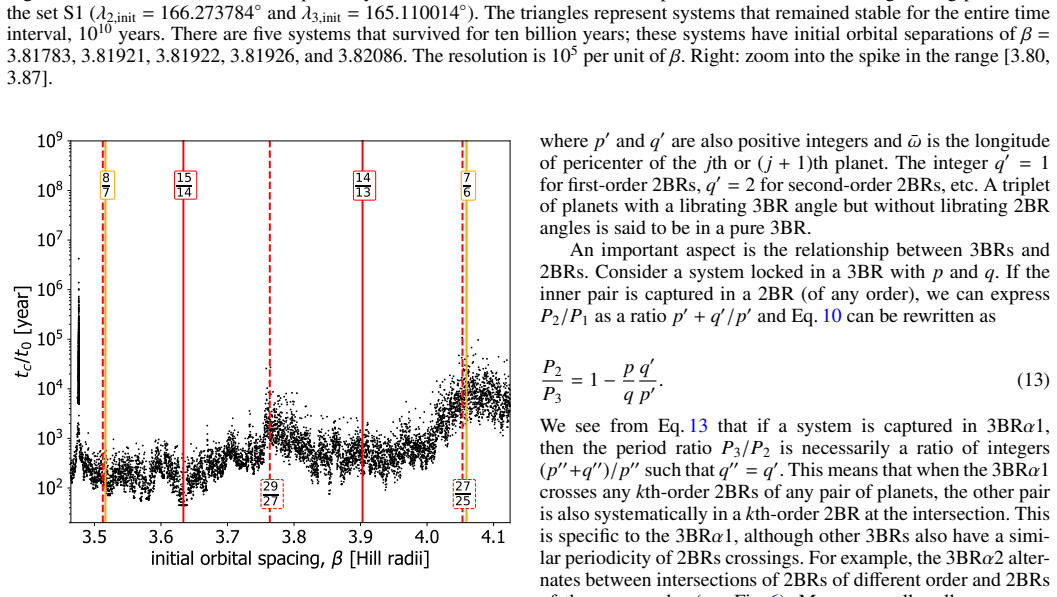
Within the chaotic region inside the three-body resonance overlap limit, the paper claims, the only routes to long-term survival for extremely compact triples lie on the most isolated zeroth-order three-body mean-motion resonances. High-resolution integrations reveal five families of anomalously long-lived systems (spikes SPK1–SPK5); the inner spikes owe their stability to capture into the 3BR with $\alpha=1$, reached when the outer two planets start near conjunction, while the outer spikes correspond to capture into the resonances with $\alpha=10/9$ and $\alpha=11/10$. Survivors of $10^{10}$ years appear at period ratios as small as roughly $0.90$–$0.93$, far inside the overlap limit of PPDJ20. The paper further shows that on the $\alpha=1$ line the stability pattern is sculpted by the two-body resonance network: long-lived islands sit at, or just outside, intersections of first- and second-order two-body resonances, where repeated conjunctions and phase cancellations suppress close approaches.
Load-bearing premise
The entire result rests on the assumption that the 18-day-timestep symplectic integrator faithfully follows the dynamics of these extremely close orbits for up to $10^{10}$ periods; no convergence test with a smaller timestep is reported, so the anomalous spikes and their attribution to three-body resonances could be numerical artifacts.
Editorial extensions
If this is right
- Extremely compact three-planet systems with period ratios above $\sim 0.90$ can remain stable for the full $10^{10}$-year integration, orders of magnitude beyond the exponential lifetime trend, provided they are captured into an isolated zeroth-order 3BR.
- Capture into the $\alpha=1$ 3BR is favoured when the outer pair starts near conjunction, because the asymmetric energy exchange of that half-interaction pushes the system onto the resonance.
- Observed tightly packed resonant chains, including Kepler-60, Kepler-223, Kepler-80, and TRAPPIST-1, lie on or near the same isolated 3BR lines, supporting the idea that these resonances are the stability hubs for ultra-compact architectures.
- In the period-ratio plane, long-lived islands on the $\alpha=1$ line are positioned at or just outside intersections of first-order two-body resonances and directly on top of intersections of second-order ones, so the 2BR network sets the fine structure of stability.
- Stability prediction models for compact planetary systems need to include the three-body resonance network, not just two-body resonances and overall spacing, to reproduce the observed survival of resonant chains.
Reading between the lines
- The isolation geometry is largely mass-independent, so the same 3BR lines should harbour anomalously stable triples for the broader mass distributions found in actual Kepler systems; this can be tested by repeating the spike surveys with non-equal masses.
- The 18-day timestep without a reported convergence study means the $10^{10}$-year survivors could in principle be artefacts of the symplectic integration; a short re-integration of the SPK systems with a much smaller timestep would settle this directly.
- If resonance capture is the only stability route this deep inside the overlap limit, then ultra-compact observed chains were likely stranded on these lines during disk migration, and triplets that missed the resonance lines were rapidly eliminated—predicting a scarcity of old compact non-resonant triples.
Signed reviews
Editorial analysis
A structured set of objections, weighed in public.
Referee Report
Summary. This paper extends earlier numerical studies of compact equal-mass three-planet systems by performing a very high-resolution scan over initial orbital separation (β) for randomly chosen initial longitudes (more than 7.5×10^6 integrations), identifying five 'spikes' of anomalously long-lived systems, and connecting three new inner spikes (SPK1–3) plus the previously known outer spikes (SPK4–5) to zeroth-order three-body mean-motion resonances. The authors use restricted initial-longitude sets (RR, S1, S2), angle grids, resonant-angle libration plots, and an unevenly spaced grid in the period-ratio plane to argue that the most isolated 3BRs (α=1, 10/9, 11/10, 2/3, 3/2, 2) protect systems against Chirikov diffusion and can stabilize systems with period ratios near 0.90 over 10^10 inner periods.
Significance. If the central claim survives numerical scrutiny, it identifies a concrete dynamical mechanism behind the anomalously stable phase-space regions reported in Paper I and connects the numerical stability of ultra-compact systems to the architecture of observed resonant chains (Kepler-60, Kepler-223, TRAPPIST-1, etc.). The paper's strengths include its massive parameter-space coverage, the reproduction of the spike structure in restricted sets and with an independent integrator (WHFast), and the direct demonstration of resonant-angle libration for representative systems. The paper is also commendably explicit about the inner-spike caveat; the remaining question is whether that caveat can be resolved with a control experiment.
major comments (2)
- [Section 2.1 and Section 6.2, Figs. 12–14] The fixed 18-day Wisdom–Holman timestep is never validated for the ultra-compact systems that produce the new inner spikes. The paper's own explanation (Section 6.2, Figs. 12–14) states that the integrator interprets an initial outer-pair conjunction as the second half of a conjunction and applies only half the interaction, pushing the system toward 3BR α=1. That is an artifact hypothesis, not a demonstrated physical capture. I request convergence runs for b382, b415, b451, and the S2 system (β=3.4744) with timesteps 9, 4.5, and 2.25 days (and, if feasible, an adaptive or high-order integrator for the first conjunction), plus epoch-shift tests of half a timestep. If the 10^10-yr survival and the α=1 libration vanish under these tests, SPK1–3 should be reported as numerical artifacts and the abstract's capture claim should be restricted to configurations that are initialized on or very near the resonance. The independent WHFast runs in Sections 6 and 7 use the same 18-day step and therefore do not resolve this concern.
- [Sections 3.2, 4, and 6.2] The inner-spike statistics are conditioned on the very initialization suspected of producing the artifact. The RR, S1, and S2 sets (Table 1, Section 4) deliberately place the outer pair within 2° of conjunction, and Section 3.2 reports that 100%, 91%, and 30% of SPK1, SPK2, and SPK3 systems start in that region. Consequently, the abstract's claim that 'extremely compact systems can remain stable when captured into a small subset of isolated zeroth-order resonances' is not yet supported for random initial longitudes at β<4.55. The cleanest support for the physical role of isolated 3BRs comes from SPK4/5 (Figs. 7–11) and the unevenly spaced grid (Fig. 15), not from the inner spikes.
minor comments (5)
- [Section 6.1] The text contains the typo 'SKP4'; it should read 'SPK4'.
- [Section 3.1 and Fig. 1 caption] The fit subset density is given as 2×10^4 per unit β in the text but 10,000 per unit β in the figure caption; please reconcile these values.
- [Section 6.2 and Fig. 13 caption] The text says the resonant angles are shown 'over the first 1000 years,' while the figure caption says 'first 1000 orbits'; make the wording consistent.
- [Section 3.1] The anomaly criterion ('greater than 5σ above the exponential fit') is stated without reporting the scatter σ; please state how σ was computed from the residuals of the fit.
- [Section 2.2] The mutual Hill radius definition uses Earth mass and solar mass before the symbols M⊕ and M⊙ are explicitly defined; a brief notational clarification would help.
Circularity Check
No load-bearing circularity; the inner-spike caveat is an integrator-artifact risk that the authors explicitly acknowledge, not a circular derivation.
full rationale
The paper's derivation chain is self-contained: blind N-body integrations produce lifetime spikes, and the spikes are then interpreted using the external PPDJ20 three-body-resonance framework. The resonance identifications are not forced by the model: for SPK5 (b541) the stripe pattern in the initial-longitude grid is matched to alpha=10/9 via Eq. 14 and verified by clustering of the resonant angle at phi=0 (Figs. 7-9); for SPK4 (b515) the clustering at phi=180 for alpha=11/10 is shown independently (Fig. 10). The libration plots (Fig. 13) and the two-body-angle checks (Appendix C) provide non-circular diagnostics. Section 7 makes a genuine prediction of stable-island locations from the 2BR/3BR network and confirms it with a new grid (Fig. 15), including very long-lived islands along 3BR alpha=1. The exponential fit is used only as a baseline to define 'anomalous' lifetimes, not as a fitted quantity that is later renamed as a prediction. Self-citations to Paper I and Paper II supply background (SPK4/5 existence, the exponential trend) but are not load-bearing: the present paper independently re-derives the resonance signatures for those spikes. The most serious flagged issue is in Section 6.2, where the authors state that systems starting with the outer pair near conjunction are pushed onto 3BR alpha=1 because 'the integrator interprets the initial conjunction as the second half of an outer pair conjunction' and 'only half of the interaction is considered'; they conclude 'the fact that these systems are stable is thus only due to the fortuitous proximity of this resonance.' This is an acknowledged numerical-artifact risk for the inner spikes SPK1-3 and the S2 system, and it should be tested with smaller timesteps and epoch shifts. However, that is a correctness/robustness concern, not a circularity of the derivation: the paper does not define the resonance in terms of the stability, nor does it fit a parameter and call it a prediction. The independent outer-spike and Fig. 15 evidence supports the central 3BR link. Hence no significant circularity; score 2 reflects minor self-citations that are not load-bearing.
Assumptions & free parameters
free parameters (3)
- b' (exponential slope) =
1.25212
- c' (exponential intercept) =
2.20944
- Anomaly threshold =
5 sigma above the exponential fit
assumptions (4)
- domain assumption The MVS and WHFast integrations with an 18-day timestep accurately evolve these extremely closely spaced systems over 10^10 inner periods.
- domain assumption Instability is defined by orbit crossing (apoapsis of inner exceeding periapsis of outer), the standard criterion in this literature.
- domain assumption PPDJ20's three-body resonance overlap limit and resonance width (their Eq. 55) are correct and applicable to Earth-mass triplets in this regime.
- ad hoc to paper The relative isolation of zeroth-order three-body resonances scales with the density of two-body resonance intersection crossings, making alpha=1/2, 2/3, 1, 3/2, 2 the most protective resonances.
Cite this review
Pith. "Pith review of Orbital stability of compact three-planet systems III. The role of three-body resonances." pith.science (2026). https://pith.science/paper/EHDO5RII
@misc{pith2026260120220,
  author       = {Pith},
  title        = {Pith review of: Orbital stability of compact three-planet systems III. The role of three-body resonances},
  year         = {2026},
  howpublished = {\url{https://pith.science/paper/EHDO5RII}},
  note         = {Machine review of arXiv:2601.20220}
}
read the original abstract
Observational surveys show that at least ~ 30% of short-period multiplanetary systems host tightly packed planets, some of which are locked in stable chains of mean-motion resonances. Despite recent progress, the dynamical stability of these systems remains only partially understood. Numerical simulations have established a general exponential increase in system lifetime with orbital separation, with mean-motion resonances playing a key role in regulating stability. Tightly packed three-planet systems exhibit a distinctive behavior not seen in higher-multiplicity systems: a small yet significant region of phase space is anomalously stable. This study investigates the dynamics of extremely compact three-planet systems, focusing on anomalously long-lived configurations and their connection to resonant chains observed in exoplanetary systems. We perform numerical integrations of coplanar, initially circular, equal-mass three-planet systems over stellar-lifetime timescales and at high resolution in orbital separation, and interpret the results in the context of recent analytical work. We identify regions of phase space hosting anomalously stable orbits, including systems surviving multiple orders of magnitude longer than predicted by the exponential trend. We demonstrate a clear link between stability and isolated three-body mean-motion resonances, showing that extremely compact systems can remain stable when captured into a small subset of isolated zeroth-order resonances. Stability further depends on the initial orbital longitudes and on the interplay between the three-body and two-body resonance networks.
Figures


Figures from the paper (11 more)



Reviewed August 15, 2026 · model on record in the stance chip above.
Discussion (0). Continue with ORCID to comment.