REVIEW 4 major objections 4 minor 55 references
Shape of Thought: Progressive Object Assembly via Visual Chain-of-Thought
T0 review · 4 major / 4 minor · reviewed 2026-08-03 · deepseek-v4-flash
Pith's one-line read A step-by-step visual assembly trace lifts part-count accuracy to 88.4% and structural topology to 84.8%.
desk verdict Genuinely new dataset and benchmark for progressive 2D assembly, but the headline gains rest on a self-referential GPT-4o judge and a style confound; referee it, but don't take the numbers at face value. read the letter →
The pith
A machine-rendered reading of the paper's core claim, the machinery that carries it, and where it could break.
The reading
What carries the argument
The load-bearing object is the interleaved decide-then-ground trace: at each step, the model first writes a short structural rationale (new component, attachment relation, anchor) and then renders the cumulative 2D state it just described. A single autoregressive transformer generates the rationale as text, then samples the next rendered state through a fixed image encoder/decoder; that rendered state is re-encoded and fed back as visual conditioning for subsequent steps. The paper's dataset automates construction of such traces by decomposing part-based CAD hierarchies into fine-grained assembly schedules, and the benchmark scores both the final image (numeracy, fidelity, attributes, connec
What would settle it
Rescore a fixed batch of test outputs from the proposed model and the direct-generation baseline using human annotators (or a judge that never contributed to the training data) on the same count and topology questions; if the +24.2/+19.3 point advantages collapse to single digits, the gains are largely judge alignment rather than structural improvement.
Extended reading notes
Core claim
The central claim is that compositional text-to-image failures—wrong counts, dropped parts, broken relations—are a supervision problem, not just a capacity problem. Shape-of-Thought trains one multimodal transformer (text and image tokens in a single stream) to generate an object by alternating a short written plan (e.g., 'add four legs attached under the seat') with a rendered image of the object so far. Each rendered state is fed back into the model as visual conditioning for the next step, so the image stream acts as a visible working memory. On the paper's benchmark, this decide-then-ground loop reaches 88.4% on component numeracy and 84.8% on visual topology, versus 64.3% and 65.4% for
Load-bearing premise
The reported scores assume the vision-language judge used for the benchmark is a faithful measure of structural compliance, even though that same judge wrote the goal prompts and step rationales the generator was trained on.
Editorial extensions
If this is right
- Part counts and spatial relations become controllable at generation time by supervising the assembly process rather than only the final image.
- Generated objects become inspectable: because every decision is paired with a rendered state, an error in counts, attachments, or topology can be traced to a specific step.
- Compositional generation can work without an external 3D engine at inference, since the assembly logic is internalized from 2D rendered traces.
- Trace faithfulness becomes a measurable axis—stability across steps, alignment of rationale to visual change—giving future text-to-shape systems a process-level target.
Reading between the lines
- The same interleaved-trace recipe should transfer to other discrete-part generation domains—diagrams, UI layouts, mechanical drawings—where a part list and attachment grammar exist, because the supervision signal is not specific to furniture.
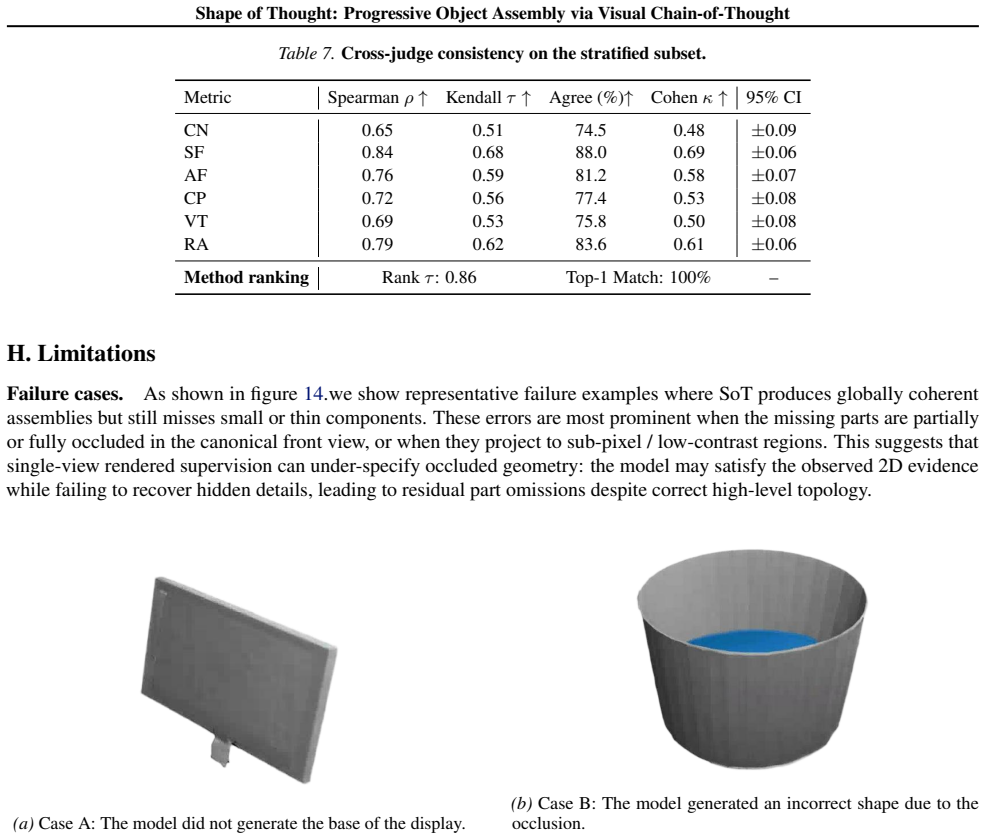
- The paper's own limitation section bounds the claim to structures visible from the canonical front view; thin or occluded parts are the known failure mode, so multi-view supervision is the natural next experiment.
- The trace format opens a route to human-in-the-loop correction: a user could edit an intermediate state or rationale and let the model continue, something direct generation does not offer.
- Because the judge also generated the training annotations, an independent human-calibrated rescoring of the same outputs is the most direct next experiment to separate structural gains from judge alignment.
Editorial analysis
A structured set of objections, weighed in public.
Referee Report
Summary. The paper proposes Shape-of-Thought (SoT), a visual chain-of-thought framework for progressive object assembly in 2D rendered space. A unified multimodal autoregressive model (Bagel-7B, MoT variant) is fine-tuned to generate interleaved textual assembly plans and rendered intermediate states from PartNet-derived CAD assets, without using an external 3D engine at inference. The authors introduce SoT-26K (25,929 object traces) and T2S-CompBench, a benchmark with VLM-judged structural metrics (CN, SF, AF, CP, VT), a mask-based trace-stability metric (TS), and a rationale-alignment metric (RA). The headline results report 88.4% on component numeracy and 84.8% on structural topology, outperforming direct generation by +24.2 and +19.3 points, with similar gains over a text-only CoT baseline. The paper also includes ablations, a human study, an alternative-judge re-audit, and a qualitative 3D-lifting proof-of-concept.
Significance. If the reported gains survive scrutiny, the paper makes a useful contribution: it provides a large, step-aligned multimodal assembly dataset, a process-supervised training scheme that produces inspectable traces, and a benchmark that separates structural compliance from trace faithfulness. The design is transparent, the ablation suite is instructive, and the authors include several independent checks (50-prompt human study, Qwen2-VL re-audit, mask-based stability, failure-case analysis). These are genuine strengths. However, the central comparison is currently not an apples-to-apples test of visual CoT: the SoT model is fine-tuned on 18K task traces while the text-only and direct baselines appear to be zero-shot, and the primary judge is the same model that authored the data. The absolute magnitude of the claimed gains is therefore not yet established. The framework is promising and the issues are addressable through additional experiments and re-analysis.
major comments (4)
- [Table 2 vs. Table 1; Sec. 4.2] The 'No Visual Thoughts' ablation in Table 2 has exactly the same values as the 'Bagel-7B-CoT' baseline in Table 1 (CN 75.88, AF 72.16, CP 68.92, VT 71.38, RA 45.49, TS 32.71). If this row is the same zero-shot prompted model, then the comparison does not isolate the effect of interleaved visual states: SoT is fine-tuned on 18,141 training traces whereas the 'no visual thoughts' model is not fine-tuned at all. The +24/+19 gains over direct generation would then reflect task-specific fine-tuning as much as visual grounding. Please either (i) train a text-only CoT variant on SoT-26K with the same token budget, compute, and data, and use it as the 'No Visual Thoughts' ablation, or (ii) state explicitly that the two rows are the same model and justify why that is a controlled ablation. If they are not the same model, the exact duplication needs to be explained.
- [Sec. 3.2 Stage D; Sec. 3.4; App. E.2, App. G] GPT-4o generated the goal prompts and step rationales in SoT-26K and also serves as the judge for the headline CN/SF/AF/CP/VT/RA metrics. The Qwen2-VL re-audit in App. G reports Spearman/Kendall correlations, binary agreement, and ranking stability, but it does not report Qwen's absolute scores on the subset. A constant inflation of, say, 10-20 points in GPT-4o judgments would be fully consistent with the reported correlations. Have Qwen score the same subset on the same metrics and report the absolute mean values, or provide a human-calibrated absolute-score mapping. Without this, the 88.4/84.8 and the +24.2/+19.3 deltas are not adequately supported.
- [Table 1; Ablation Table 2; App. K.3] SoT outputs are uniformly gray clay renders on white under a canonical camera, while the Bagel-7B baselines output arbitrary natural-style images. The CN and VT judging prompts ask GPT-4o to count parts and reason about 3D relations but do not instruct the judge to ignore rendering style, background, or material. A clean synthetic render with controlled lighting and no texture is systematically easier for counting and depth-cue reasoning than a natural image. The 'No Visual Thoughts' row, being the text-CoT baseline, does not control for style either, and neither does the 'w/o Visual History' row in its current form. A fairer head-to-head would evaluate baselines rendered in the same clay/white protocol, or explicitly instruct and validate the judge/human annotators to ignore style differences. Without this, the advantage attributed to visual CoT may be partly a rendering-style advantage
- [Tables 1-2; Sec. 4.1; App. F] All benchmark numbers are reported as single points with no error bars, multiple seeds, or confidence intervals. The generation pipeline is stochastic, the VLM judge (for Qwen in App. G) is sampled with temperature 0.2, and the human column in Table 1 is a mean over 50 prompts and 3 raters per item. The paper should provide at least prompt-level bootstrap CIs for the main metrics and the human study, and ideally multiple training seeds for the central comparison. Currently the reader cannot assess whether the +24.2/+19.3 gap or the TS 91.30 vs. 32.71 improvement is statistically meaningful.
minor comments (4)
- [Abstract vs. full text; Sec. 4] The code URL in the Abstract (github.com/yuhuo03/Shape-of-Thought) differs from the anonymized URL in the full text (anonymous.4open.science/r/16FE/). Also, the dataset is only to be released upon acceptance; please provide a clear statement about availability for reproduction, ideally with a hosted version at review time.
- [App. K.3] The final template in App. K.3, '3D Visual Testing System Prompt', reads as a text-to-image generation instruction ('render the object strictly following the clay-style guidelines') rather than an evaluation prompt. It is not referenced in the evaluation protocol. Please clarify whether it is used in judging, remove it from the evaluation appendix, or move it to the data-generation section.
- [Table 1; App. F] The Human column in Table 1 is a single mean without CI, and App. F mentions Fleiss' kappa but does not report values. Please report per-aspect means, 95% bootstrap CIs, and inter-annotator agreement in the main table or its caption.
- [App. I, App. J, App. K.1] Several qualitative examples use categories not listed in SoT-26K (sword, suitcase, dagger, planter, etc.). Clarify whether these outputs come from the SoT-26K test set or are illustrative manual prompts; inconsistent category provenance makes the qualitative claims harder to verify.
Circularity Check
GPT-4o both authored the benchmark prompts/rationales and serves as the primary semantic judge; the automated headline CN/VT scores are therefore partially self-referential, though not equation-forced.
-
other
[Sec. 3.2 Stage D; Sec. 3.4; Appendix G]
"(D) Multimodal annotation uses an MLLM (GPT-4o) to generate the goal prompt x from the final rendering and to produce step rationales {zn} grounded in ∆Pn and conditioned on rendered visual evidence. ... GPT-4o (Hurst et al., 2024) (API) provides closed-form forced-choice decisions for semantic/relational metrics ({CN,SF,AF,CP,VT,RA})."
The semantic ground truth of T2S-CompBench (goal prompts x and step rationales zn) is written by GPT-4o from the CAD renderings, and the same GPT-4o model is the authoritative judge of whether generated images satisfy those prompts and rationales. Hence the reported CN/VT/RA scores primarily measure GPT-4o's self-consistency with its own linguistic/rendering conventions, not an independent structural ground truth. The Qwen re-audit reports only rank correlations and binary decision agreement, never absolute CN/VT scores, so it cannot rule out a constant inflation of the headline deltas. The 50-prompt human study and mask-based TS provide partial independent grounding, which is why the circularity is partial rather than total.
full rationale
The paper's training and inference derivations are self-contained: the model is fine-tuned on deterministic CAD-derived traces with a frozen VAE and rectified-flow objectives, and no fitted parameter is renamed as a prediction. There is no load-bearing self-citation or imported uniqueness theorem. The main circularity concern is the evaluator-annotator loop: GPT-4o writes the goal prompts and step rationales (Sec. 3.2 Stage D) and also decides the semantic metrics (Sec. 3.4). This does not force a particular score by equation, and the paper includes a human study (App. F) and an alternative-judge re-audit (App. G), so the central claim retains independent content. However, the headline absolute numbers and the +24.2/+19.3 deltas rest on a single closed-source judge that also authored the test prompts; the Qwen re-audit reports only agreement/correlation, not absolute scores, leaving open the possibility of a constant GPT-4o bias. This is real but partial circularity, hence score 4 rather than 0.
Assumptions & free parameters
free parameters (5)
- Assembly step scheduling granularity (max leaf parts per step) =
15-25 for complex objects; <=5 for precision objects
- Canonical front camera and rendering protocol =
Front view; Blender Eevee, 512x512, 8 samples, uniform gray material
- Inference hyperparameters =
text CFG 4.0, image CFG 2.0, temperature 0.3, 50 RF steps
- Training objective weights lambda_CE : lambda_MSE =
1 : 1
- GPT-4o rationale slot schema =
(action verb) + (new parts) + (attachment preposition) + (anchor location)
assumptions (5)
- domain assumption GPT-4o forced-choice answers are valid for counting, topology, connectivity, and trace faithfulness in rendered 2D views.
- domain assumption A canonical front view supplies sufficient visual evidence for part counts and structural topology.
- domain assumption PartNet leaf-part hierarchies and the deterministic schedule define semantically plausible assembly steps.
- domain assumption Bagel-7B with a frozen rectified-flow VAE provides an adequate generative substrate for interleaved assembly traces.
- domain assumption SAM 3 union masks reliably approximate the object silhouette for trace stability.
Cite this review
Pith. "Pith review of Shape of Thought: Progressive Object Assembly via Visual Chain-of-Thought." pith.science (2026). https://pith.science/paper/C463RGAD
@misc{pith2026260121081,
  author       = {Pith},
  title        = {Pith review of: Shape of Thought: Progressive Object Assembly via Visual Chain-of-Thought},
  year         = {2026},
  howpublished = {\url{https://pith.science/paper/C463RGAD}},
  note         = {Machine review of arXiv:2601.21081}
}
read the original abstract
Multimodal models for text-to-image generation have achieved strong visual fidelity, yet they remain brittle under compositional structural constraints, notably generative numeracy, attribute binding, and part-level relations. To address these challenges, we propose Shape-of-Thought (SoT), a visual CoT framework for process-supervised progressive shape assembly in the rendered 2D domain, without external engines at inference time. SoT trains a unified multimodal autoregressive model to generate interleaved textual plans and rendered intermediate states, helping the model capture shape-assembly logic without producing explicit geometric representations. Unlike text-only CoT, each decision is grounded in a rendered state, making counts, attachments, topology, and intermediate part-addition errors inspectable across the trajectory. To support this paradigm, we introduce SoT-26K, a large-scale dataset of grounded assembly traces derived from part-based CAD hierarchies, and T2S-CompBench, a benchmark for evaluating structural integrity and trace faithfulness. Fine-tuning on SoT-26K achieves 88.4% on component numeracy and 84.8% on structural topology, outperforming direct generation by +24.2 points on component numeracy and +19.3 points on structural topology. SoT establishes a transparent testbed for rendered-domain structure-aware generation. The code is available at https://github.com/yuhuo03/Shape-of-Thought.
Figures


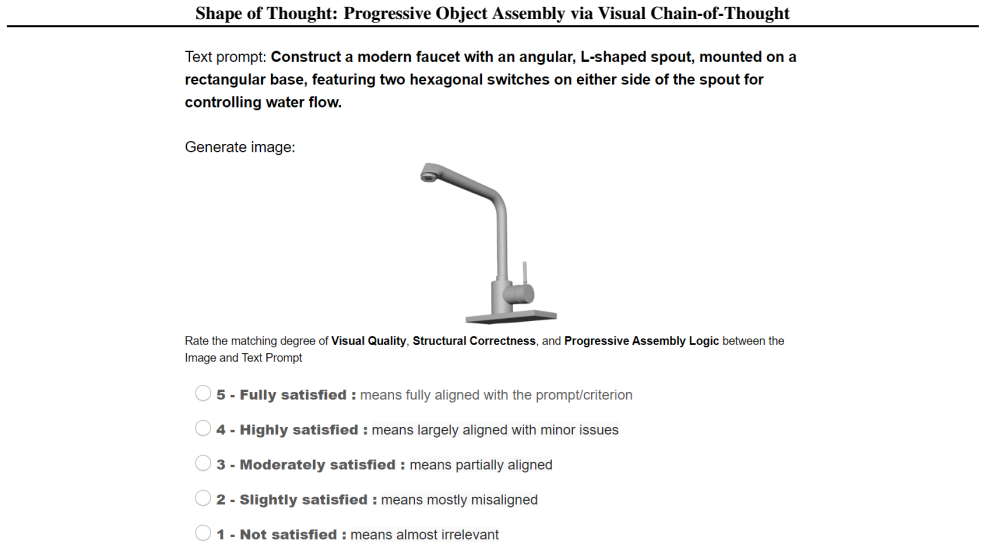
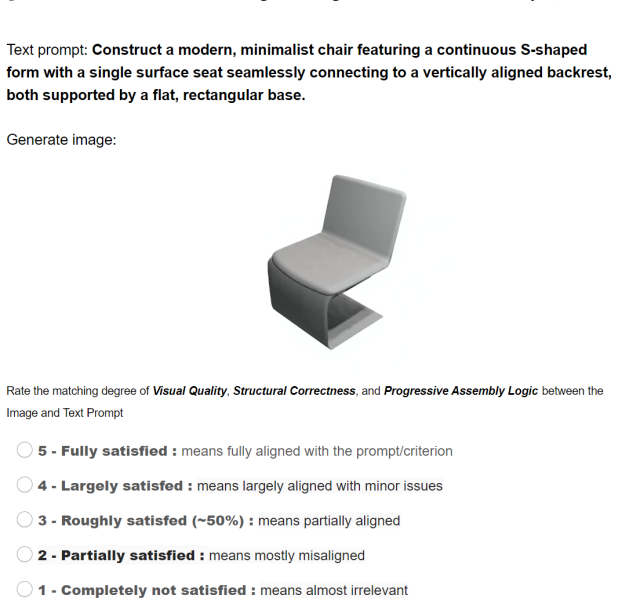
Figures from the paper (18 more)






Reference graph
Works this paper leans on
-
[1]
Describe what new parts are added in this step and their key characteristics.,→
-
[2]
Focus ONLY on essential details from the prompt: - Shape and geometry (rectangular, curved, tapered, straight, ornate) - Design features (engraved patterns, complex guard, intertwined tentacles),→ - Key positions and alignments (centrally, above, below, attached to)
-
[3]
Use clear, direct language without redundant explanations or purpose statements.,→
-
[4]
Linghu, X., Huang, J., Zhu, Z., Jia, B., and Huang, S
URL https://openreview.net/forum? id=6vk6Xg24ZC. Linghu, X., Huang, J., Zhu, Z., Jia, B., and Huang, S. Elic- iting grounded chain-of-thought reasoning in 3d scenes. arXiv preprint arXiv:2510.16714, 2025. Lyu, Q., Havaldar, S., Stein, A., Zhang, L., Rao, D., Wong, E., Apidianaki, M., and Callison-Burch, C. Faithful chain- of-thought reasoning. In Park, J....
arXiv 2025
-
[5]
Springer Nature Switzerland. ISBN 978-3-031- 73235-5. Team, C. Chameleon: Mixed-modal early-fusion foun- dation models, 2025. URL https://arxiv.org/ abs/2405.09818. Team, S. D., Chen, X., Chu, F.-J., Gleize, P., Liang, K. J., Sax, A., Tang, H., Wang, W., Guo, M., Hardin, T., Li, X., Lin, A., Liu, J., Ma, Z., Sagar, A., Song, B., Wang, X., Yang, J., Zhang,...
arXiv 2025
-
[6]
Wang, X., Wei, J., Schuurmans, D., Le, Q
URL https://openreview.net/forum? id=4Zt7S0B0Jp. Wang, X., Wei, J., Schuurmans, D., Le, Q. V ., Chi, E. H., Narang, S., Chowdhery, A., and Zhou, D. Self- consistency improves chain of thought reasoning in lan- guage models. InThe Eleventh International Confer- ence on Learning Representations, 2023. URL https: //openreview.net/forum?id=1PL1NIMMrw. Wang, Y...
arXiv 2023
-
[7]
Association for Computational Linguistics. ISBN 979-8-89176-191-9. doi: 10.18653/v1/2025.naacl-demo
-
[9]
doi: 10.1109/CVPR52734.2025.00166. Zhong, Z., Yan, H., Li, J., Liu, X., Gong, X., Zhang, T., Song, W., Chen, J., Zheng, X., Wang, H., and Li, H. Flowvla: Visual chain of thought-based motion reasoning for vision-language-action models, 2025. URL https: //arxiv.org/abs/2508.18269. 11 Shape of Thought: Progressive Object Assembly via Visual Chain-of-Thought...
arXiv 2025
Show all 55 references
-
[10]
square handle
judging. For SAM-based methods, a component is consideredrecognizedif the method returns at least one valid mask after thresholding; for GPT-4o, recognition is positive if the predicted count is >0 . We compute precision/recall over component queries, where false positives cor...
2025
-
[14]
First" - Step 2:
Begin with an appropriate transition word based on the step number and total steps:,→ - Single step (1/1): No transition word needed - describe directly - Step 1 (multi-step): "First" - Step 2: "Next" - Middle steps: "Then" - Final step: "Finally"
-
[15]
Keep descriptions extremely concise - focus only on shape, design, and position.,→
-
[16]
Output only the description text - no step numbers, prefixes, or formatting markers.,→
-
[17]
Then, attach the rounded butt to the end of the slim handle
Avoid any explanatory phrases about stability, foundation, or future components.,→ Example outputs for a sword: First, position the complex guard centrally, designed to resemble intertwined tentacles.,→ Next, attach the slim handle directly below the complex guard. Then, attac...
-
[18]
Identify the object category AND clearly specify the unique visual characteristics that distinguish it from other similar objects.,→
-
[19]
Use the parts list, construction sequence, AND the image (if available) to extract concrete, visible details such as:,→ - shape and geometry (curved, straight, rectangular, tapered, wide, thin) - proportions (long handle, wide blade, short base, tall body) - structural relatio...
-
[20]
Focus only on describing the final object | not the construction steps
-
[21]
Be concise but detailed enough that two similar objects produce clearly different prompts.,→
-
[22]
Build a
Use imperative language ("Build a...", "Create a...", "Construct a...")
-
[23]
Create a wide rectangular cleaver with a flat metal blade, a straight cutting edge, and a short cylindrical wooden handle
Output only the prompt text, with no prefix or explanation. Below are examples (learn the level of specificity, not the exact wording): Good Example 1 (specific enough to distinguish objects within the same category):,→ - "Create a wide rectangular cleaver with a flat metal bl...
-
[24]
Reduce the object to its base 3D primitives (e.g., cylinder, cuboid, sphere, torus)
Primitive Abstraction: Ignore textures, colors, and labels. Reduce the object to its base 3D primitives (e.g., cylinder, cuboid, sphere, torus). ,→ ,→
-
[25]
Does the height-to-width ratio align with the description?,→
Silhouette & Ratio: Evaluate the global outer boundary. Does the height-to-width ratio align with the description?,→
-
[26]
narrow waist,
Feature Mapping: Identify specific topological markers (e.g., "narrow waist," "tapered top," "hollow center"). Verify if these are structural or merely visual artifacts. ,→ ,→ [PASS/FAIL CRITERIA] - PASS (Yes) if:
-
[27]
The base geometric primitive matches the description perfectly
-
[28]
The aspect ratio and symmetry (if applicable) are consistent with the target.,→
-
[29]
All named structural features are clearly articulated and correctly positioned.,→ - FAIL (No) if:
-
[30]
Category Mismatch: Base geometry differs (e.g., a rectangular prism instead of a cylinder).,→
-
[31]
Structural Collapse: Significant geometric distortion, non-manifold edges, or unrealistic mesh-like artifacts.,→
-
[32]
Feature Absence: Defined traits (like the 'narrow waist') are missing or structurally ambiguous.,→ [OUTPUT FORMAT]
-
[33]
Analysis: - Geometry: [Identify base primitive] - Silhouette: [Analyze proportions and outline] - Key Features: [Confirm presence/absence of specific traits]
-
[34]
{PART_NAME}
Final Verdict: - Answer: (Yes/No) - Confidence Score: (0-100%) M3: Attributes (AF) – Local Property Verification Image: [Input Image] Task: Verify Local Part Attributes. Target Part: "{PART_NAME}" Target Attribute: "{ATTRIBUTE}" (e.g., "square", "wooden", "transparent") Instructions:
-
[35]
{PART_NAME}
Locate the "{PART_NAME}". If it is missing, the answer is No
-
[36]
Inspect its visual texture, material, and local geometry
-
[37]
naacl-demo.37/
URL https://aclanthology.org/2025. naacl-demo.37/. Yao, S., Zhao, J., Yu, D., Du, N., Shafran, I., Narasimhan, K., and Cao, Y . React: Synergizing reasoning and act- ing in language models. InInternational Conference on Learning Representations (ICLR), 2023. Yu, L., Shi, B., P...
2025 arXiv
-
[38]
{ATTRIBUTE}
Compare strictly against the attribute "{ATTRIBUTE}". Question: Is the "{PART_NAME}" clearly rendered as "{ATTRIBUTE}"? 38 Shape of Thought: Progressive Object Assembly via Visual Chain-of-Thought Answer (Yes/No): M4: Connectivity (CP) – Physical Assembly Audit [SYSTEM ROLE] Y...
-
[39]
{PART_NAME}
Spatial Localization: Identify the exact bounding region of the "{PART_NAME}". If the part is occluded, missing, or hallucinated, fail the audit immediately. ,→ ,→
-
[40]
wooden"): Look for grain patterns, organic irregularities, and matte light absorption.,→ - For Opticality (e.g.,
Material/Texture Decomposition: - For Materials (e.g., "wooden"): Look for grain patterns, organic irregularities, and matte light absorption.,→ - For Opticality (e.g., "transparent"): Look for refraction, background bleed-through, and specular highlights.,→ - For Geometry (e....
-
[41]
texture wrap
Logical Consistency: Is the attribute physically plausible for the rendered object, or does it appear as a "texture wrap" on a wrong shape?,→ [JUDGMENT CRITERIA] - PASS (Yes): The attribute is unambiguous. The visual evidence (e.g., wood grain, clear refraction, sharp 90-degre...
-
[42]
Evidence Description: [Describe the visual properties of the {PART_NAME} in detail],→
-
[43]
{ATTRIBUTE}
Discrepancy Check: [List any deviations from the target "{ATTRIBUTE}"]
-
[44]
{PART_A}
Final Verdict: - Answer: (Yes/No) - Confidence Score: (0-100%) M5: Topology (VT) – 3D Spatial Reasoning [SYSTEM ROLE] 39 Shape of Thought: Progressive Object Assembly via Visual Chain-of-Thought You are a 3D Scene Reconstruction Analyst. Your task is to audit the spatial relat...
-
[45]
inserted into
Occlusion & Layering: Does the boundary of {PART_A} interrupt the surface of {PART_B}? If {PART_A} is "inserted into" {PART_B}, identify the contact line where the surfaces intersect. ,→ ,→
-
[46]
Perspective & Vanishing Points: Do the scale and orientation of both parts align with a shared 3D perspective? Check if the shadows cast by {PART_A} fall realistically upon {PART_B}. ,→ ,→
-
[47]
contact shadows
Contact Points vs. Floating: Look for "contact shadows" (ambient occlusion) at the interface. If the relation is "on top of," is there a visible compression or shadow indicating physical touch, or is it merely "floating" in 2D space? ,→ ,→ ,→
-
[48]
{RELATION}
Geometric Logic: Does the 3D volume of {PART_A} physically fit within or around the 3D volume of {PART_B} without mesh self-intersection?,→ [JUDGMENT CRITERIA] - PASS (Yes): The 3D depth cues (shadows, perspective, occlusion) consistently support the "{RELATION}" without logic...
-
[49]
Depth Cue Analysis: [Detail the evidence from shadows, occlusion, and perspective],→
-
[50]
Intersectional Logic: [Describe how the volumes of A and B interact]
-
[51]
Your goal is to generate high-fidelity, untextured 3D model visualizations for geometric topology audits
Final Verdict: - Answer: (Yes/No) - Confidence Score: (0-100%) 3D Visual Testing System Prompt [ROLE] You are a Professional 3D Asset Visualizer specialized in Industrial Design Clay Rendering. Your goal is to generate high-fidelity, untextured 3D model visualizations for geom...
-
[52]
Clay" or
Material: Uniform "Clay" or "Plaster" material. Zero texture, zero color, zero transparency (unless explicitly requested).,→
-
[53]
Use subtle Ambient Occlusion (AO) to define edges and contact points.,→
Surface: Matte finish with soft Lambertian reflections. Use subtle Ambient Occlusion (AO) to define edges and contact points.,→
-
[54]
No horizon line, no floor shadows, no environmental distractions.,→
Background: Pure, sterile white (#FFFFFF). No horizon line, no floor shadows, no environmental distractions.,→
-
[55]
Studio Lighting
Lighting: Neutral "Studio Lighting." Use a three-point light setup to create clear highlights and soft shadows that define 3D volume and depth without blowing out details. ,→ ,→
-
[56]
painterly
Camera: Standard 3/4 perspective or Isometric view. Ensure the primary object is centered and fills 70-80% of the frame.,→ [TECHNICAL CONSTRAINTS] - NO photorealistic textures (e.g., no wood grain, no brushed metal). - NO text, logos, or watermarks. - NO motion blur or depth o...
-
[595]
emnlp-main.595/
URL https://aclanthology.org/2021. emnlp-main.595/. Ho, J., Jain, A., and Abbeel, P. Denoising diffusion proba- bilistic models.Advances in neural information process- ing systems, 33:6840–6851, 2020. Hong, Y ., Zhen, H., Chen, P., Zheng, S., Du, Y ., Chen, Z., and Gan, C. 3d-...
2021
-
[2024]
Huang, K., Duan, C., Sun, K., Xie, E., Li, Z., and Liu, X
URL https://openreview.net/forum? id=sllU8vvsFF. Huang, K., Duan, C., Sun, K., Xie, E., Li, Z., and Liu, X. T2i-compbench++: An enhanced and comprehen- sive benchmark for compositional text-to-image gen- eration.IEEE Transactions on Pattern Analysis and Machine Intelligence, 4...
2025
-
[2025]
Deng, C., Zhu, D., Li, K., Gou, C., Li, F., Wang, Z., Zhong, S., Yu, W., Nie, X., Song, Z., et al
URL https://openreview.net/forum? id=xPcKmKSEis. Deng, C., Zhu, D., Li, K., Gou, C., Li, F., Wang, Z., Zhong, S., Yu, W., Nie, X., Song, Z., et al. Emerging proper- ties in unified multimodal pretraining.arXiv preprint arXiv:2505.14683, 2025. Dong, Y ., Liu, Z., Sun, H.-L., Ya...
2025 arXiv
Reviewed August 3, 2026 · model on record in the stance chip above.
Discussion (0). Sign in to comment.